
AI Dungeons and Dragons: Transforming Game Simulations with Large Language Models
AI Dungeons and Dragons: Revolutionizing LLM-Based Game Simulations Estimated reading time: 15 minutes Table of contents The Evolution of AI in Dungeons & Dragons Understanding the AI Dungeon Master The Role of D&D AI Agents Large Language Models Game Simulation Why Dungeons & Dragons Attracts AI Researchers Benchmarking AI Performance in Dungeons & Dragons Key […]
With Craig Major and Jon Irwin
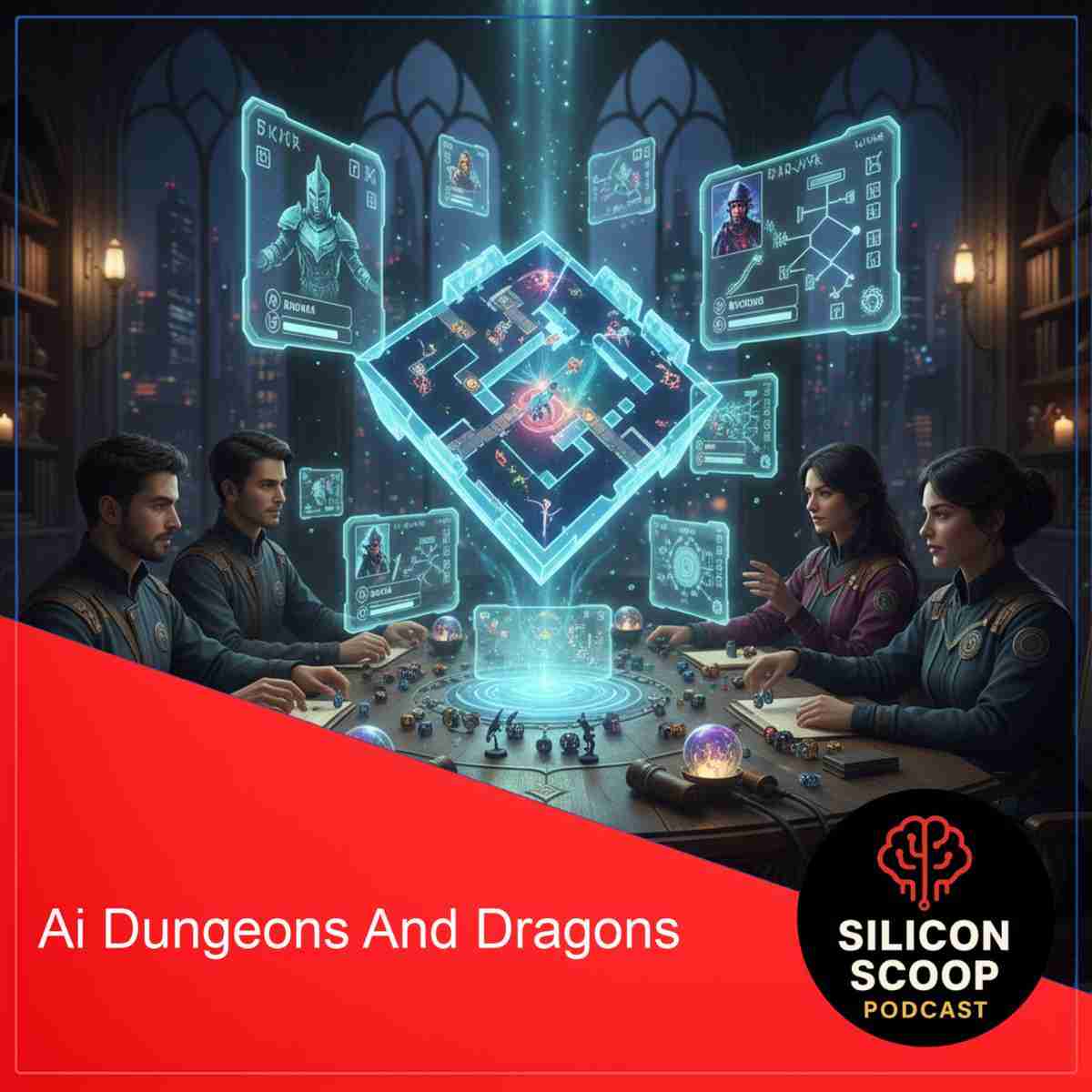
AI Dungeons and Dragons: Revolutionizing LLM-Based Game Simulations
Estimated reading time: 15 minutes
Table of contents
- The Evolution of AI in Dungeons & Dragons
- Understanding the AI Dungeon Master
- The Role of D&D AI Agents
- Large Language Models Game Simulation
- Why Dungeons & Dragons Attracts AI Researchers
- Benchmarking AI Performance in Dungeons & Dragons
- Key Research Findings & Future Directions
- Frequently Asked Questions About AI Dungeons and Dragons
- Conclusion: The Future of AI-Powered Role-Playing and Beyond
The Evolution of AI in Dungeons & Dragons
The world of tabletop gaming is experiencing a dramatic transformation. Large language models (LLMs) are now being integrated with classic role-playing games like Dungeons & Dragons, creating entirely new possibilities for AI Dungeons and Dragons experiences. This convergence of artificial intelligence and traditional gaming opens up exciting opportunities for testing and evaluating long-term AI performance in complex, multi-step scenarios.
In this blog post, we’ll explore how modern AI—including ChatGPT D&D and LLM D&D implementations—is being used to simulate game environments and assess the capabilities of AI systems over extended periods. These innovations are creating structured testbeds that help researchers understand how well AI can handle planning, teamwork, rule-following, and character consistency across many interactions.
We’ll delve into the emerging role of AI Dungeon Masters and D&D AI Agents in recreating immersive Dungeons & Dragons experiences. These systems take on responsibilities once reserved exclusively for humans: orchestrating storylines, enforcing complex rules, controlling multiple characters, and maintaining narrative consistency over long campaigns. The implications extend far beyond entertainment, offering insights that could revolutionize business strategy, team coordination, and automated decision-making systems.
Understanding the AI Dungeon Master
An AI Dungeon Master is an artificial intelligence system that assumes the role traditionally held by a human dungeon master. Instead of a person orchestrating game scenarios, creating storylines, and enforcing rules, an AI-powered system takes charge of these responsibilities. The AI Dungeon Master must:
- Generate compelling narratives that respond to player choices
- Apply complex rule systems consistently across many game sessions
- Control multiple non-player characters with distinct personalities
- Track resources, locations, and story threads over extended periods
- Adapt to unexpected player decisions while maintaining story coherence
This role demands sophisticated language understanding, memory management, and strategic reasoning—capabilities that modern large language models are beginning to demonstrate.
The Role of D&D AI Agents
A D&D AI Agent operates differently from the dungeon master role. These are model-driven character controllers that simulate player or non-player activities during encounters. Think of them as individual party members or monsters controlled by AI rather than human players.
D&D AI Agents must:
- Make tactical decisions during combat encounters
- Coordinate with other party members (whether human or AI)
- Maintain consistent character personalities and motivations
- Follow game rules for movement, attacks, and special abilities
- Track individual resources like health points, spell slots, and equipment
Large Language Models Game Simulation
The concept of Large Language Models Game Simulation brings together narrative generation and rule-based decision-making in a unified framework. Modern LLMs can process natural language descriptions of game states, understand complex rule systems, and generate appropriate responses that advance both combat mechanics and storytelling elements.
This integration has attracted significant research attention. Role-playing games have long served as testbeds for multi-step planning and teamwork evaluation. Text-based adventures and interactive fiction environments—frameworks like TextWorld and Jericho—have been used for years to test AI planning and reasoning capabilities. These environments share structural similarities with Dungeons & Dragons encounters, though D&D adds layers of social interaction, resource management, and rule complexity.
Why Dungeons & Dragons Attracts AI Researchers
Dungeons & Dragons offers several unique advantages as a testing environment for artificial intelligence:
- Complex, Well-Specified Rules: The game system provides detailed, formalized rules for combat, magic, movement, and character abilities. These rules can be encoded into game engines, creating structured environments where AI behavior can be precisely measured.
- Long-Term Campaign Structure: D&D campaigns often span multiple sessions over weeks or months of play. This extended timeline tests whether AI systems can maintain consistency, remember past events, and execute plans that unfold across many game turns.
- Multi-Agent Interactions: Adventuring parties typically include multiple characters who must coordinate strategies, share resources, and communicate effectively. This creates natural scenarios for testing multi-agent AI coordination.
- Rich Natural Language Context: Unlike purely mechanical games, D&D interactions occur through dialogue and descriptive narrative. This aligns perfectly with the strengths of large language models while also testing their ability to ground language in game mechanics.
- Established Player Community: Millions of people worldwide play Dungeons & Dragons and understand its rules, making it easier to recruit human participants for comparative studies and to contextualize AI behavior against human baselines.
The attraction of robotic process automation concepts to game simulation parallels these benefits—both seek to formalize complex, multi-step processes into reliable, repeatable systems that can be evaluated and improved systematically.
Benchmarking AI Performance in Dungeons & Dragons
Moving beyond conceptual discussion, researchers are developing concrete methodologies for using Dungeons & Dragons as a structured benchmark for AI game testing. These experimental frameworks aim to measure how well LLM-based agents perform on long-horizon tasks with clear success criteria.
The Experimental Framework
The envisioned framework positions Dungeons & Dragons as a standardized benchmark environment for evaluating AI agents. Rather than testing AI on isolated questions or short tasks, this approach embeds AI systems in extended game scenarios that require:
- Planning multiple moves ahead
- Tracking numerous game state variables
- Adapting strategies based on changing conditions
- Following complex, interconnected rules
- Coordinating with teammates (human or AI)
- Maintaining character consistency across many interactions
This framework addresses a critical gap in current AI evaluation methods. While most LLM benchmarks focus on short, self-contained tasks—answering a question, writing a code snippet, translating a sentence—these don’t reflect how AI systems are increasingly deployed in the real world. Modern AI agents handle customer service conversations across multiple exchanges, manage business workflows that span days or weeks, and coordinate with other AI systems in complex environments.
The consensus among researchers is clear: we need benchmarks for long-term, agentic AI behavior. Dungeons & Dragons offers a ready-made solution with established rules, engaged human players for comparison, and scenarios that naturally extend across many decision points.
Standardized D&D Battle Scenarios
Research proposals suggest using specific, repeatable combat encounters from published D&D adventures as benchmark scenarios. These include encounters like:
- Goblin Ambush: A classic early-game scenario where players face multiple goblin enemies using terrain advantages. This tests basic tactical reasoning and resource management.
- Kennel in Cragmaw Hideout: A mid-complexity encounter involving multiple enemy types in a structured indoor environment. AI agents must navigate spatial constraints and handle different enemy abilities.
- Klarg’s Cave: A more challenging scenario with a powerful boss enemy and multiple tactical options for success. This evaluates whether AI can identify and exploit strategic advantages.
These scenarios, drawn from the popular “Lost Mine of Phandelver” adventure, provide standardized challenges that can be repeated across different AI systems. By using the same starting conditions, enemy placements, and victory conditions, researchers can directly compare how different LLMs perform.
The methodology pairs these scenarios with a custom D&D rules engine—software that enforces game mechanics, tracks character states, and determines action outcomes. This ensures consistent rule application across all tests, eliminating human judgment variability that might favor certain AI approaches.
Performance Rankings and Model Comparisons
Speculative research claims propose comparing multiple leading LLM systems in these D&D scenarios. While these specific results cannot yet be independently verified and represent forward-looking research directions rather than established findings, they illustrate the type of comparative evaluation this framework enables:
- Claude 3.5 Haiku D&D: Claimed to deliver superior in-character performance with consistent rule-following across extended encounters. The model reportedly maintained character personalities effectively while making tactically sound decisions.
- GPT-4 D&D: Positioned as a close second, with strong tactical reasoning but occasionally less consistent character portrayal compared to Claude 3.5 Haiku.
- DeepSeek-V3: Rated lower in these specific simulations, with suggestions of more frequent rule violations or less optimal strategic choices.
These comparative rankings, if verified through rigorous testing, would provide valuable guidance for selecting LLMs for different applications. A system that excels at maintaining consistency and following complex rules in D&D scenarios might also perform well in business process automation, compliance-heavy workflows, or customer service contexts.
The NeurIPS 2025 D&D AI Study
References to a NeurIPS 2025 D&D AI study represent the anticipated direction of this research area. While specific conference presentations and detailed methodologies remain unverified as forward-looking announcements, the concept aligns with trends in AI research toward more comprehensive, long-horizon evaluation methods.
The envisioned study would potentially include:
- Large-scale human participation (claims suggest over 2,000 experienced D&D players)
- Head-to-head and cooperative scenarios pairing humans with AI agents
- Quantitative metrics for rule adherence, strategic effectiveness, and resource management
- Qualitative evaluations of narrative consistency and character authenticity
- Comparative analysis across multiple LLM systems and configurations
Such a study would represent a significant methodological advance, moving AI evaluation closer to real-world deployment conditions where systems must operate reliably over extended periods while interacting with humans.
Bridging Research and Application
The importance of long-horizon AI game testing extends well beyond entertainment. Businesses increasingly deploy AI agents that must:
- Handle customer interactions across multiple touchpoints
- Manage inventory and supply chain decisions over weeks or months
- Coordinate with other automated systems in complex workflows
- Adapt to changing conditions while maintaining policy compliance
- Track numerous variables and relationships simultaneously
A D&D-based benchmark tests exactly these capabilities. Success in coordinating a party through a multi-room dungeon crawl demonstrates the same underlying abilities needed to manage a multi-step business process with various stakeholders and decision points.
Key Research Findings & Future Directions
Synthesizing the available research insights reveals both the current state of AI Dungeons and Dragons implementations and the exciting possibilities on the horizon. While some specific claims remain speculative and await peer-reviewed publication, the underlying trends and methodological approaches are well-grounded in established research directions.
Research Background and Context
The ongoing trend of using games as innovative testbeds for long-horizon AI tasks has solid foundation in the research community. For years, researchers have recognized that games provide controlled environments where AI capabilities can be systematically evaluated.
Text-based games and interactive fiction have served this purpose since the early days of AI research. Frameworks like TextWorld and Jericho created standardized environments for testing planning algorithms and language understanding. These systems share conceptual DNA with Dungeons & Dragons simulations—both use natural language to describe states and actions, both require multi-step planning, and both demand that AI systems maintain consistency across many interactions.
The shift toward using role-playing games specifically addresses several limitations of earlier benchmarks:
- Richer Social Dynamics: Unlike puzzle-solving in isolation, RPGs involve negotiation, persuasion, and social reasoning alongside tactical decision-making.
- Team Coordination: Multi-agent cooperation and communication become central to success rather than peripheral concerns.
- Personality Consistency: Maintaining character voice and motivation over extended play tests a different dimension of AI capability than pure task completion.
- Rule Complexity: D&D’s detailed rule system provides hundreds of interconnected mechanics that must be correctly applied, testing both knowledge representation and logical reasoning.
Using Dungeons & Dragons as a benchmark aligns perfectly with the broader recognized need for evaluating multi-step planning, rule adherence, and in-character behavior in long-duration tasks. The research community has increasingly acknowledged that short-task benchmarks don’t capture the challenges of deploying AI in real-world scenarios that unfold over time.
Detailed Look at Experimental Claims
The speculative research setup provides a valuable blueprint even if specific results await verification. The proposed experimental design using 27 different D&D battle scenarios offers several methodological advantages:
- Scenario Diversity: Drawing encounters from categories like Goblin Ambush, Kennel in Cragmaw Hideout, and Klarg’s Cave (all from the “Lost Mine of Phandelver” adventure) ensures variety in:
- Enemy types and quantities
- Environmental complexity
- Tactical options available
- Difficulty levels
- Resource pressure
- Repeatability: Using published adventures provides clear starting conditions that other researchers can replicate, enabling independent verification and extension of findings.
- Graduated Difficulty: Ranging from simple ambushes to complex multi-room encounters allows researchers to identify where different AI systems begin to struggle.
- Established Baseline: These scenarios have been played by millions of humans, providing rich context for interpreting AI performance.
Qualitative Behavioral Observations
Beyond quantitative metrics, qualitative aspects of LLM behavior in role-playing contexts reveal important dimensions of AI capability. The reported quirky, in-character behaviors—taunting goblins, dramatic warlocks, heroic paladins—illustrate how modern language models can go beyond mechanical action selection to create engaging narrative experiences.
This “staying in character” represents a meaningful evaluation criterion alongside rule-following and resource tracking. Consider these aspects:
- Narrative Consistency: Does the AI maintain the same personality, speech patterns, and motivations throughout an extended encounter?
- Appropriate Emotional Response: Does the character react to victories, setbacks, and discoveries in ways that fit their established personality?
- Creative Problem-Solving: Does the AI find solutions that align with character capabilities and motivations rather than simply optimizing for mechanical advantage?
- Social Awareness: Does the character’s dialogue and actions acknowledge other party members and build on their contributions?
These qualitative elements matter enormously in real-world AI deployments. A customer service AI that follows script rules but can’t maintain consistent personality across a conversation frustrates users. A business process automation system that optimizes purely for speed without considering stakeholder relationships creates organizational friction.
Frequently Asked Questions About AI Dungeons and Dragons
Q: What is “AI Dungeons and Dragons” and how does it leverage LLM technology?
A: AI Dungeons and Dragons refers to using large language models to simulate, play, or facilitate the classic tabletop role-playing game Dungeons & Dragons. LLM technology enables AI systems to understand game rules, generate narrative descriptions, control characters, and respond to player actions using natural language. The AI processes text descriptions of game states, applies rules encoded in its training or provided through prompts, and generates appropriate responses that advance both combat mechanics and storytelling. This creates experiences where AI can serve as dungeon masters, player characters, or non-player characters in D&D games.
Q: How does an AI Dungeon Master differ from traditional DM roles?
A: An AI Dungeon Master handles many of the same responsibilities as a human DM—creating storylines, controlling monsters and NPCs, enforcing rules, and describing environments—but operates through algorithms rather than human creativity and judgment. The AI DM can generate content instantly, maintain perfect consistency with established rules, and track complex game states without fatigue. However, AI Dungeon Masters currently have limitations in true creative improvisation, understanding subtle player intentions, and adapting to completely unprecedented situations. They excel at structured scenarios with clear rules but may struggle with the nuanced social reading and flexible creativity that experienced human DMs provide.
Q: In what ways can structured game simulations help evaluate long-horizon AI performance?
A: Structured game simulations like D&D scenarios provide controlled environments where AI systems must perform sequences of related actions toward long-term goals. Unlike single-question benchmarks, these simulations test whether AI can maintain consistency across many turns, plan multiple steps ahead, adapt to changing conditions, coordinate with other agents, and track numerous variables simultaneously. The game structure provides clear success criteria (winning battles, completing quests) while the extended duration reveals failure modes like forgetting earlier events, breaking established rules, or making strategically incoherent decisions. This mirrors real-world AI deployments in business, customer service, and automation where systems must operate reliably over extended periods.
Q: What are D&D AI Agents and how do they function in gameplay?
A: D&D AI Agents are artificial intelligence systems that control individual characters in Dungeons & Dragons games, functioning as either player characters or non-player characters. These agents make tactical decisions during encounters, such as which enemies to attack, when to use special abilities, and how to position themselves on the battlefield. They must follow game rules for their character class, manage resources like spell slots and hit points, and ideally maintain consistent personalities and motivations. LLM D&D agents process the current game state described in text, reason about available options within the rules framework, and output actions in natural language that the game engine then resolves mechanically.
Q: How does ChatGPT D&D implementation work in practice?
A: ChatGPT D&D implementations typically use the ChatGPT language model as either a dungeon master or player character. As a DM, ChatGPT receives descriptions of player actions and generates responses describing outcomes, NPC behavior, and environmental details. It can be prompted with specific rule systems and campaign information to maintain consistency. As a player character, ChatGPT receives descriptions of the game state and outputs character actions and dialogue. Implementation usually requires careful prompt engineering to include relevant rules, maintain character knowledge boundaries, and format outputs appropriately. Some implementations connect ChatGPT to dice-rolling systems and character sheet databases to handle mechanical resolution alongside narrative generation.
Q: What are the main challenges in using D&D scenarios as benchmarks for AI?
A: Several challenges complicate using D&D as an AI benchmark. First, rule complexity creates numerous edge cases where even human players disagree on correct application. Second, success in D&D involves subjective elements like narrative quality and character authenticity that resist quantitative measurement. Third, the game’s social dynamics—persuasion, negotiation, group coordination—are difficult to evaluate automatically. Fourth, D&D’s open-ended nature means AI systems can find unexpected but valid solutions that complicate standardized evaluation. Finally, implementing a complete rules engine that handles all possibilities in D&D requires enormous effort. Despite these challenges, the game’s structured framework and established player community provide advantages that outweigh the difficulties for many research purposes.
Q: Can these AI gaming innovations translate to business strategy and automation?
A: Yes, the capabilities tested in AI Dungeons and Dragons directly translate to business applications. Multi-step planning across uncertain conditions mirrors strategic business planning. Resource management in D&D resembles budgeting and allocation decisions. Coordinating party members parallels managing teams with diverse skills. Rule-following in complex game systems relates to compliance and policy adherence. Social encounters test negotiation and relationship-building skills applicable to sales and partnerships. An AI system that successfully manages a D&D campaign demonstrates exactly the long-horizon reasoning, consistency, and adaptive planning needed for sophisticated business automation solutions. Organizations can use game-based evaluation results to identify which LLM systems will perform reliably in their specific business contexts.
Q: What makes Claude 3.5 Haiku D&D performance noteworthy?
A: Claims about Claude 3.5 Haiku D&D performance highlight its reportedly superior ability to maintain character consistency and follow rules accurately across extended encounters. If verified, this would indicate the model excels at exactly the capabilities businesses need in automation contexts: reliable rule application, consistent behavior over time, and appropriate personality expression in customer-facing applications. The model’s claimed performance suggests strong instruction-following and memory management, keeping track of character states, established rules, and narrative threads across many interaction turns. However, these specific comparative results await independent verification and peer review, so they should be viewed as provisional indicators of potential capability rather than established facts.
Q: How do GPT-4 D&D implementations compare to other LLMs in gaming contexts?
A: GPT-4 D&D implementations reportedly demonstrate strong tactical reasoning and rule understanding, making them effective for game simulation. The model can process complex game states, generate contextually appropriate actions, and maintain narrative coherence across multiple turns. Speculative comparisons suggest GPT-4 performs competitively with other leading models in strategic decision-making but may show variation in personality consistency depending on prompt engineering. The model’s broad training enables it to understand D&D rules and conventions without extensive fine-tuning. Real-world performance depends heavily on implementation details like system prompts, memory management approaches, and integration with game mechanics engines.
Q: What future developments can we expect in LLM D&D and game simulations?
A: Future developments will likely expand beyond combat scenarios to full campaign simulation, including exploration, social encounters, resource management, and strategic planning. We can expect more sophisticated benchmarks that standardize evaluation across these diverse scenario types. Integration with visual generation might create illustrated game experiences. Multi-agent systems will enable full parties of AI characters with distinct personalities and coordination strategies. The evaluation methodologies developed for games will increasingly inform AI assessment for business applications. We may see specialized LLMs fine-tuned specifically for game mastering or strategic gameplay. Most importantly, the lessons learned about maintaining consistency, following complex rules, and coordinating multiple agents will drive improvements in AI systems deployed across industries.
Conclusion: The Future of AI-Powered Role-Playing and Beyond
The integration of large language models with Dungeons & Dragons scenarios represents far more than an entertaining technological novelty. As we’ve explored throughout this article, AI Dungeons and Dragons creates robust frameworks for evaluating how well AI systems perform on the long-term, multi-step tasks that increasingly define real-world AI deployment.
While some specific details about model comparisons and large-scale studies remain visionary and await peer-reviewed publication, the underlying trends provide strong evidence for continued development in this direction. The research community has clearly identified the need for long-horizon benchmarks, and structured game environments like D&D offer compelling solutions with established rules, engaged human communities for comparison, and scenarios that naturally extend across many decision points.
The capabilities being tested and refined through these gaming applications—consistent rule-following, multi-agent coordination, resource management, strategic planning, and personality maintenance—directly translate to critical business needs. Organizations implementing automation solutions need AI systems that can:
- Operate reliably across extended workflows without degrading consistency
- Coordinate with other systems and human team members effectively
- Follow complex policies and regulations accurately
- Maintain appropriate communication styles with customers and stakeholders
- Plan strategically while adapting to changing conditions
The innovations emerging from AI Dungeons and Dragons research provide concrete evidence of progress toward these goals. Whether you’re fascinated by the future of gaming or focused on practical business applications, the developments in LLM-based game simulation offer valuable insights into where AI capability is heading.
As these technologies mature from research prototypes to practical tools, the lessons learned in virtual dungeons will help create more reliable, capable, and useful AI systems across industries. The adventure is just beginning.
Future-Proof Your Business Today 🚀
Don’t get left behind! Stay ahead of the curve by leveraging the power of business automation. Free up valuable time, reduce errors, and skyrocket your productivity with custom solutions designed by Flowgrammer.
Schedule a Free Automation Assessment https://flowgrammer.ca/
Additional Links
Flowgrammer.ca – 💡 Unlock AI-Powered Automation! Let flowgrammer.ca handle complex workflows so you can focus on growing your business.
- Silicon Scoop Podcast – Stay Informed, Stay Ahead!
- Startup Talk Podcast
- Flowgrammer Podcast –
- Startup Investor Drinks – Join Toronto’s Startup Community and connect with fellow startup enthusiasts and investors.
- TorontoStarts Startup and Entrepreneur Community – Become a part of Toronto’s thriving startup ecosystem.
- Workhaus – Discover flexible workspace solutions for your business needs.
- Work with The Startup Coach – Get expert guidance and mentorship for your startup journey.
- Reach out to Jon Irwin on LinkedIn – Connect with our co-host and technology expert.
Flowgrammers.ca – 💡 Join Toronto’s Fastest Growing AI and Busiess Automation Community..
Flowgramming.space – 💡 AI Agent and Workflow Marketplace..
More from Silicon Scoop
All episodes
silicon-scoop · October 19, 2026
OpenAI’s Jalapeño Chip Stakes a Claim Against Nvidia Blackwell in Real-World AI Inference
OpenAI Jalapeno chip challenges Nvidia GB300 Blackwell with InferenceX AI benchmark results, reshaping AI inference accelerator efficiency and latency.
View episode

silicon-scoop · October 16, 2026
Meta’s $18 Billion Teen Safety Settlement: Soft Guardrails, Hard Leverage Over TikTok and YouTube
Deep dive on Meta teen safety settlement, social media addiction lawsuit, new Facebook Instagram time limits and pressure on TikTok YouTube age verification.
View episode

silicon-scoop · October 15, 2026
How Claude Mythos Is Reshaping Cryptanalysis: HAWK, AES and the Rise of AI-Driven Crypto Research
Claude Mythos cryptanalysis weakens HAWK post-quantum signature, speeds AES Möbius Bridge attack, and powers CryptanalysisBench benchmark in AI-driven crypto research.
View episode