
Revolutionizing Electronics: Understanding the Impact and Future of the Flexible Chip
Revolutionizing Electronics: The Advent of the Flexible Chip Estimated reading time: 15 minutes Key Takeaways A flexible chip is a breakthrough integrated circuit built on a stretchable polymer substrate that can be rolled into a hair-thin fibre. Researchers at Fudan University in Shanghai have achieved a device that bends, stretches, and twists like a thread—yet […]
With Craig Major and Jon Irwin
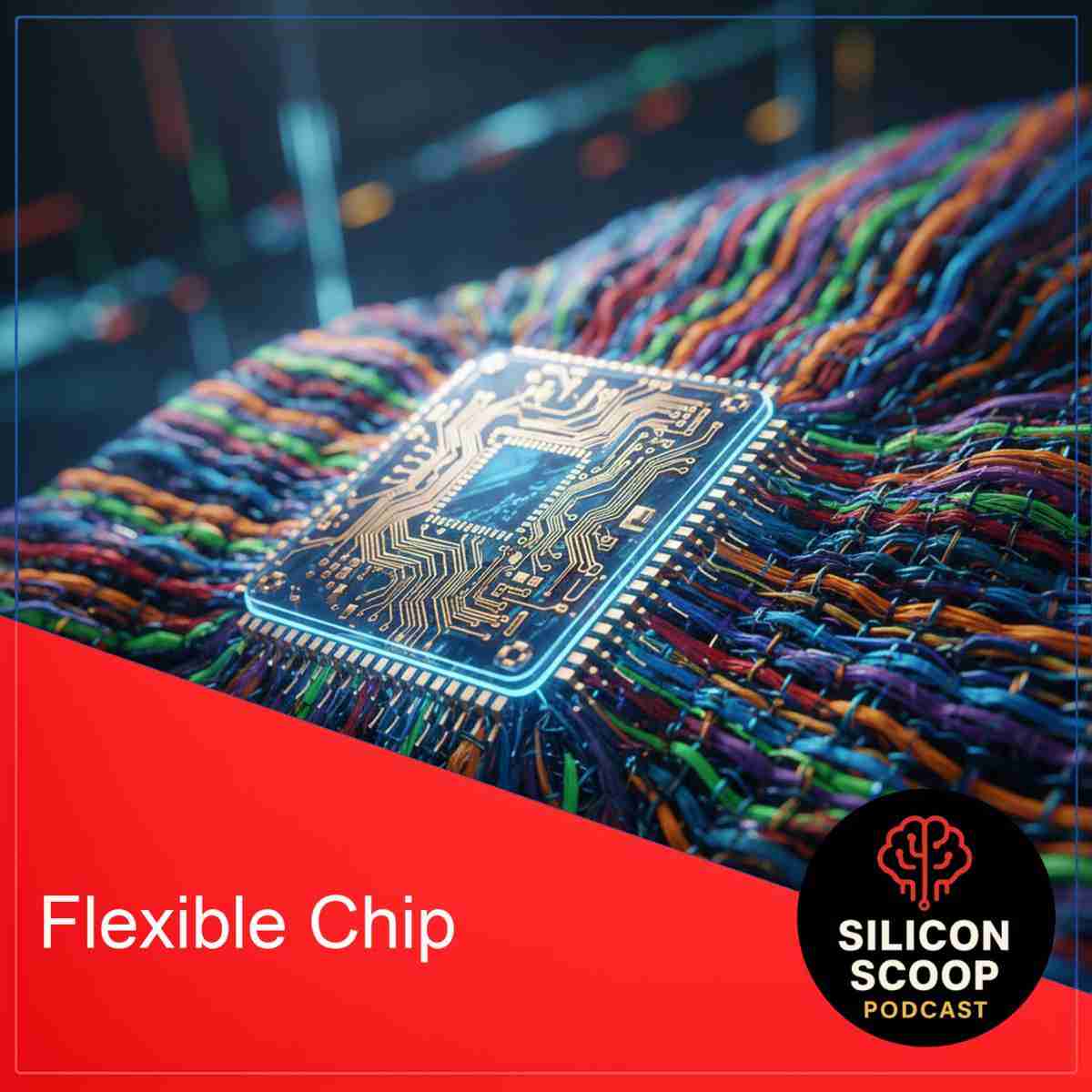
Revolutionizing Electronics: The Advent of the Flexible Chip
Estimated reading time: 15 minutes
Key Takeaways
- A flexible chip is a breakthrough integrated circuit built on a stretchable polymer substrate that can be rolled into a hair-thin fibre.
- Researchers at Fudan University in Shanghai have achieved a device that bends, stretches, and twists like a thread—yet still performs complex computing tasks.
- The secret lies in an ingenious “roll-up” fabrication process inspired by rolling sushi, creating a spiral fibre that protects delicate electronics while allowing flexibility.
- Each centimeter contains approximately 100,000 transistors, withstands over 10,000 bending cycles, and survives stretching beyond 30% of its original length.
- The fibres can perform simple neuromorphic computing tasks, recognizing patterns and processing information similar to neural networks.
- Potential applications include smart clothing, medical implants, fabrics that think and respond, and distributed computing in textiles.
Table of contents
- Revolutionizing Electronics: The Advent of the Flexible Chip
- Key Takeaways
- Introduction: A New Era for Electronics Begins
- Underlying Technology and Chip Fabrication Process
- Applications and Potential Industry Impact
- Manufacturing Challenges, Scalability, and Future Roadmap
- Conclusion and Final Thoughts
- Frequently Asked Questions About Flexible Chips
Introduction: A New Era for Electronics Begins
A flexible chip is a breakthrough integrated circuit built on a stretchable polymer substrate that can be rolled into a hair-thin fibre. This incredible innovation represents one of the most exciting advances in flexible electronics in recent years.
Researchers at Fudan University in Shanghai have achieved something remarkable. They have created a new type of chip that bends, stretches, and twists like a thread—yet still performs complex computing tasks. These revolutionary devices combine both digital and analog signal processing capabilities. They can be woven directly into everyday fabrics, transforming ordinary clothing into smart, responsive technology.
The secret behind this breakthrough lies in an ingenious “roll-up” fabrication process. Inspired by the simple act of rolling sushi, the Fudan team builds a complete circuit on a flat, stretchable surface. Then they carefully roll it into a spiral fibre with a diameter comparable to a human hair. This spiral structure protects the delicate electronics inside while allowing the entire device to flex and stretch with the fabric around it.
The numbers are impressive. Each centimeter of this flexible chip contains approximately 100,000 transistors. These tiny circuits can withstand more than 10,000 bending cycles without breaking. They survive stretching beyond 30% of their original length. They even continue working after being washed in boiling water or run over by a truck weighing 15.6 tonnes.
The research, published in Nature under the title “Scalable and durable integrated circuits in highly stretchable fibre via roll-up strategy,” demonstrates that these fibres can perform simple neuromorphic computing tasks. This means they can recognize patterns and process information similar to how a basic neural network operates. The chip fabrication process opens doors to applications once imagined only in science fiction: clothing that monitors your health, medical implants that adapt to your body, and fabrics that think and respond. https://www.nature.com/
The flexible chip revolution has begun, and it promises to transform how we integrate technology into our daily lives.
Underlying Technology and Chip Fabrication Process
The foundation of this flexible chip technology starts with carefully selected materials and a precise fabrication process.
Building on a Stretchable Foundation
The substrate forms the base of everything. Researchers use a stretchable polymer or elastomer sheet that has been polished to near-perfect flatness. This smooth surface is critical because it allows high-quality lithography—the process of creating extremely tiny patterns needed for modern electronics.
Think of this substrate as the canvas. Unlike the rigid silicon wafers used in traditional chip fabrication, this canvas can bend and stretch. Yet it must be smooth enough to support the same precision manufacturing techniques used in conventional semiconductor factories.
The active layers sit on top of this flexible foundation. These include thin-film semiconductors that form the transistors—the basic building blocks of any computer chip. Metal interconnects create the pathways that allow electrical signals to travel between transistors. Passive components like resistors and capacitors help condition signals, control timing, and enable analog functions.
After all the circuitry is built, an additional protective polymer layer encapsulates everything. This encapsulation shields the delicate electronics from mechanical impact, moisture, and chemical exposure. It acts like a waterproof jacket, keeping the sensitive components safe from the outside world.
The Revolutionary Roll-Up Process
The “sushi-roll” process is where the magic happens. This clever chip fabrication method allows complex integrated circuits to be built using familiar semiconductor techniques, then transformed into flexible fibres.
Here’s how it works step by step:
- First, prepare the substrate. The stretchable polymer sheet is cleaned and prepared for manufacturing. Its surface must be completely flat and free from defects.
- Second, build the circuit. Using standard semiconductor processes—photolithography, deposition, etching, and patterning—the team creates complete integrated circuits on the flat sheet. This includes thousands of transistors, resistors, capacitors, and the metal wiring that connects them all together.
- Third, add protection. Encapsulation and protective layers are carefully applied over the finished circuit. These layers will protect the electronics during the rolling process and throughout the device’s lifetime.
- Fourth, roll it up. The planar circuit is mechanically rolled into a tight spiral. This step requires precise control to ensure the layers wind up correctly. The pitch and alignment must be perfect so that the circuitry ends up protected inside the fibre’s cross-section.
- Finally, seal the package. An additional polymer cladding wraps around the rolled structure, producing a robust, hair-thin chip thread ready for use.
The resulting flexible semiconductors have a diameter measured in tens of micrometers—genuinely comparable to human hair. Yet packed inside that tiny cross-section are complete electronic systems capable of both sensing and computing.
Technical Performance and Protection
The spiral geometry itself provides mechanical protection. When the fibre bends or stretches, the outer layers experience the most stress. The electronic components tucked safely inside the spiral experience much lower mechanical strain. This protective structure explains why these devices can survive such extreme conditions.
The transistor density reaches approximately 100,000 transistors per centimeter along the fibre’s length. This represents a remarkable achievement in stretchable electronics. For comparison, older generation CPUs contained similar numbers of transistors, though they were arranged very differently and operated at much higher speeds.
These flexible chips can process both digital and analog signals. Digital processing handles logic operations and control functions. Analog processing deals with sensor inputs and biological signals—essential for medical applications and wearable technology. This mixed-signal capability makes the fibres far more versatile than simple sensors or conductive threads.
Demonstrations have shown these chips performing simple neuromorphic computing tasks. In one test, a fibre circuit successfully distinguished between different simple images using a small neural-network-like circuit implemented directly in hardware. This proves the device can do real computation, not just sense or transmit data.
The robustness tests are equally impressive. The fibres withstand approximately 10,000 bending cycles without performance degradation. They can be stretched over 30% beyond their original length. They survive twisting up to 180 degrees. They continue working after exposure to temperatures up to 100°C. They even remain functional after being subjected to crushing loads—including being run over by trucks.
These mechanical properties come from the combination of flexible materials, protective encapsulation, and the spiral geometry that distributes stress away from critical components. https://www.nature.com/ https://spectrum.ieee.org/
Applications and Potential Industry Impact
The flexible chip opens possibilities across multiple industries, from everyday clothing to cutting-edge medical devices.
Wearable Technology and Smart Textiles Revolution
Smart textiles represent one of the most immediate applications for flexible chips. Instead of attaching rigid electronic modules to fabric, manufacturers can now weave computation directly into the threads themselves.
Imagine a shirt that monitors your heart rate continuously through the day. The sensors, processing circuits, and communication electronics are all embedded in the fabric fibres. The shirt flexes and moves with your body. You can wash it like normal clothing. The wearable technology becomes invisible yet ever-present.
These smart textiles could track multiple physiological metrics simultaneously:
- Heart rate and rhythm patterns
- Body temperature across different areas
- Movement and posture analysis
- Breathing rate and depth
- Pressure distribution for ergonomic assessment
The flexible chip processes this sensor data locally, right in the fabric. This local processing reduces the amount of data that needs to be transmitted wirelessly to your phone or cloud servers. It extends battery life, protects privacy, and enables faster response times.
For virtual reality and augmented reality applications, motion-capture garments could integrate these fibres throughout. This would provide finer-grained tracking of body movements than external cameras alone. Haptic feedback systems could also use the fibres to create sensations across large areas of the body, making VR experiences more immersive.
Athletes could benefit from smart athletic wear that analyzes biomechanical movements in real time. The clothing would identify improper form, track performance metrics, and even predict injury risk based on movement patterns. All of this happens on the garment itself, with only summary information sent to a phone or tablet.
Medical Implants and Brain-Computer Interfaces
The medical field stands to gain enormously from flexible semiconductors that can adapt to soft tissue.
Traditional medical implants use rigid electronics that don’t move and flex like living tissue. This mismatch creates mechanical stress at the interface between device and body. It can lead to inflammation, scarring, and device failure over time.
Flexible chips solve this problem by matching the mechanical properties of soft tissues. A thread-like device can bend and stretch with surrounding tissue rather than working against it. This biocompatible nature makes the fibres ideal candidates for next-generation medical implants.
Brain-computer interfaces present particularly exciting possibilities. Researchers envision flexible electrode arrays that could be woven through neural tissue, recording and stimulating neurons with minimal damage. The integrated processing on the fibre could filter signals, identify patterns, and reduce the amount of data that needs to exit the body. This would improve battery life for implanted devices and reduce infection risks from power and data connections.
Smart sutures could monitor wound healing from the inside. A surgical thread containing flexible chips could measure tissue temperature, pH, pressure, and other indicators of healing progress or infection. If problems arise, the device could alert medical staff before visible symptoms appear.
Catheters and stents could incorporate sensors and processing to monitor blood flow, pressure, and chemistry continuously. These devices could provide early warning of complications or track recovery after surgery.
The fibres’ ability to process analog signals makes them especially valuable for interfacing with biological systems. Biological signals are inherently analog—varying voltages from neurons, chemical gradients, mechanical forces. Having analog processing integrated into the fibre itself means cleaner signals and more accurate measurements.
Flexible CPUs and Distributed Computing in Fabric
The concept of a “flexible CPU” woven into clothing challenges traditional notions of where computation happens.
Researchers suggest that one meter of fibre contains enough transistors to roughly match an older generation CPU in computational capacity. While this comparison is approximate—modern processors differ greatly in architecture, speed, and efficiency—it illustrates the potential scale of computation that could be embedded in garments.
Think of it as distributed computing woven throughout fabric. Instead of one powerful processor attached to your clothing, you might have many simpler processors scattered across the entire garment. Each fibre handles local tasks—sensor fusion, pattern recognition, data compression—then coordinates with other fibres to create a networked computational system.
This distributed approach offers several advantages:
- Redundancy: If one fibre fails, others continue working
- Lower power consumption: Many simple processors can be more efficient than one powerful chip for certain tasks
- Scalability: Add more functionality by weaving in more computational fibres
- Reduced latency: Processing happens close to sensors, speeding response times
The fibres are particularly well-suited for tasks like sensor data pre-processing, simple pattern recognition, and control of nearby actuators or displays. They won’t replace your smartphone for complex calculations or running applications. But they could handle the routine sensing and processing tasks that smart textiles require, reducing the burden on external devices.
Broader Industrial Implications
Beyond personal wearables and medical devices, flexible electronics could transform industrial monitoring and control systems.
Structural health monitoring could embed these fibres into composite materials used in aircraft, bridges, and buildings. The fibres would continuously monitor stress, strain, vibration, and temperature. Local processing would identify concerning patterns and alert maintenance crews before catastrophic failures occur.
Soft robotics could gain a nervous system. Flexible robots designed to interact safely with humans need distributed sensors and processing throughout their structure. Fibre chips woven into the robot’s soft body could provide proprioception—awareness of its own position and movement—similar to biological organisms.
Remote surgery applications could use garments with integrated fibre chips to capture detailed motion and force feedback from surgeons. This high-fidelity data, processed locally with low latency, could improve control precision in telesurgery scenarios where milliseconds matter.
The mechanical resilience demonstrated in tests—surviving 10,000 bending cycles, washing in hot water, twisting, and even crushing loads—suggests these devices can withstand harsh real-world conditions. This durability is essential for industrial applications where electronics must function reliably despite physical abuse. https://www.scmp.com/ https://www.technologyreview.com/
Conclusion and Final Thoughts
The flexible chip represents a genuine breakthrough in how we think about and manufacture electronics.
By borrowing inspiration from the simple act of rolling sushi, researchers at Fudan University have created integrated circuits that bend, stretch, and twist like threads while maintaining sophisticated computing capabilities. These hair-thin fibres pack approximately 100,000 transistors per centimeter. They process both digital and analog signals. They survive extreme mechanical stress and environmental challenges that would destroy conventional electronics.
The implications extend across multiple fields. Wearable technology could become truly invisible, woven seamlessly into everyday clothing. Smart textiles could monitor health, enhance athletic performance, and enable immersive virtual experiences. Medical implants could adapt to soft tissues, reducing complications and enabling new therapeutic possibilities. Brain-computer interfaces might become more effective with flexible electrodes that conform to neural tissue. Industrial systems could gain distributed sensing and processing embedded in structures and materials.
This breakthrough heralds a new era for electronics. Computing power no longer needs to be confined to rigid rectangles in our pockets or on our desks. It can be distributed throughout the fabric of our lives—literally.
Yet challenges remain. Scaling up manufacturing, ensuring long-term reliability, solving power and communication infrastructure problems, and completing medical safety testing will require continued research and development. The comparison to older CPUs, while illustrative, reminds us these devices complement rather than replace conventional computing.
Understanding both the tremendous potential and the real limitations is essential as this technology matures. The flexible chip is not science fiction—it exists in laboratories today. But transforming laboratory prototypes into mass-market products requires solving practical engineering problems and meeting regulatory requirements.
For businesses watching technological trends, the flexible chip represents an important signal. Flexible electronics are moving from academic curiosity toward commercial viability. Companies in textiles, medical devices, sports equipment, industrial monitoring, and human-machine interfaces should track developments closely. The first applications may arrive sooner than many expect.
The revolution in flexible electronics has begun. The flexible chip stands as proof that breakthrough innovations in chip fabrication continue to emerge, opening possibilities that seemed impossible just years ago.
From Science Fiction to Business Fact
New technologies are emerging daily, but automation is here now. Stop dreaming about the future and start building it. Flowgrammer helps businesses like yours harness no-code and AI to drive efficiency and growth – today.
Discover Automation Solutions → https://flowgrammer.ca/
Frequently Asked Questions About Flexible Chips
Q: What exactly is a flexible chip?
A: A flexible chip is an integrated circuit built on a stretchable polymer substrate rather than rigid silicon. The Fudan University team creates these devices by fabricating complete circuits on flat, flexible sheets, then rolling them into spiral fibres with diameters comparable to human hair. These fibres contain transistors, resistors, capacitors, and interconnects—all the components of conventional chips—but in a form that can bend, stretch, and twist without breaking. The resulting devices can be woven into fabrics or implanted in soft tissues while maintaining their electronic functionality.
Q: How does the roll-up fabrication process work?
A: The roll-up chip fabrication process begins with a flat, stretchable polymer sheet polished to extreme smoothness. Engineers use standard semiconductor manufacturing techniques—photolithography, deposition, and etching—to build complete integrated circuits on this flexible substrate. After adding protective encapsulation layers, they mechanically roll the flat circuit into a tight spiral, like rolling sushi. The spiral structure protects the electronics inside while allowing the entire fibre to flex. A final polymer cladding seals the rolled structure, creating a robust, hair-thin chip thread. This process is notable because it uses familiar semiconductor fabrication tools rather than requiring entirely new manufacturing infrastructure.
Q: How durable are these flexible semiconductors?
A: Testing shows remarkable durability. The flexible chips survive approximately 10,000 bending cycles without performance degradation. They can stretch more than 30% beyond their original length and twist up to 180 degrees. In dramatic demonstrations, researchers ran over the fibres with trucks weighing 15.6 tonnes—the chips continued functioning afterward. The devices also withstand washing in boiling water temperatures (100°C) and repeated handling. The robustness comes from the combination of flexible materials, protective encapsulation, and the spiral geometry that distributes mechanical stress away from critical electronic components inside the fibre. https://www.scmp.com/
Q: What are the main applications for wearable technology and smart textiles?
A: Smart textiles represent a major application area for flexible electronics. These chips can be woven directly into fabric to create clothing that monitors physiological metrics like heart rate, body temperature, breathing patterns, and movement. Unlike rigid sensors attached to garments, flexible chips move naturally with the fabric and wearer. They enable virtual reality motion-capture suits with better tracking, athletic wear that analyzes biomechanics in real time, and health-monitoring garments that process sensor data locally before transmitting summaries to phones or cloud servers. The wearable technology becomes invisible yet provides continuous monitoring and interaction capabilities integrated throughout the fabric itself.
Q: Can flexible chips really be used in medical implants?
A: Flexible chips show promising characteristics for medical applications, though extensive testing remains before clinical use. Their soft, stretchable nature matches the mechanical properties of biological tissues better than rigid electronics. This reduces inflammation and mechanical stress at the implant-tissue interface. Potential uses include brain-computer interfaces with flexible electrode arrays, smart sutures that monitor wound healing, catheters with integrated sensors, and implantable devices that conform to soft tissues. However, long-term biocompatibility testing, regulatory approval, and reliability studies are still needed. Questions about immune response, material degradation inside the body, and failure modes must be thoroughly answered before human implantation. https://www.nature.com/
Q: How much computing power does a flexible CPU actually have?
A: The comparison to an “old CPU” is approximate and context-dependent. One meter of fibre contains roughly 100,000 transistors per centimeter, giving total transistor counts comparable to older generation processors. However, computational performance depends on much more than transistor count—architecture, clock speed, memory, and interconnect design all matter greatly. These flexible chips are best suited for localized tasks like sensor fusion, simple pattern recognition, data filtering, and control functions rather than high-speed general-purpose computing. They complement rather than replace conventional processors. For applications like smart textiles or medical devices, their processing power is more than sufficient for required tasks while offering flexibility that traditional chips cannot provide.
Q: What are the biggest challenges in scaling up production?
A: Manufacturing challenges center on maintaining quality and consistency at scale. The roll-up process requires precise control of winding tension, alignment, and pitch to avoid defects that could interrupt electrical connections. Achieving high manufacturing yield—the percentage of devices that work correctly—requires sophisticated process control and inspection. Integration with textile manufacturing presents additional hurdles since weaving and knitting equipment wasn’t designed for electronic fibres. Minimum bend radius limits, tension control during fabrication, temperature exposure, and chemical compatibility with textile treatments must all be considered. Creating specialized equipment for long-length production with consistent performance will require significant engineering investment. https://spectrum.ieee.org/
Q: How are flexible chip networks powered and connected?
A: Power supply and communication remain partially unsolved challenges. Power options include running thin conductive threads alongside chip fibres to carry electricity from battery packs, harvesting energy from body heat or motion, or using wireless power transfer. Each approach has trade-offs between flexibility, power capacity, and complexity. For data communication, options include wired data buses using conductive threads, optical signalling through fibres, or wireless protocols with tiny radio transmitters in each chip. Different applications will likely use different solutions—a shirt might use a battery pack and wired connections, while an implant might harvest energy and use very short-range wireless communication. Standardization of these technologies is needed before widespread commercial adoption.
Q: What about washing and maintaining garments with embedded electronics?
A: The research demonstrates impressive washing resistance. Flexible chips survived exposure to boiling water temperatures (100°C) and repeated laundering without failure. The protective polymer encapsulation shields electronics from water, detergents, and mechanical abrasion during washing. However, long-term durability under repeated wash cycles over months or years requires further study. Manufacturers will need to establish care instructions and potentially design specialized connectors for power and data that can be disconnected before washing. The fibres’ mechanical robustness—surviving 10,000+ bending cycles and significant stretching—suggests they can withstand normal garment stresses, but integration points and connectors represent potential weak points needing careful engineering. https://www.scmp.com/
Q: When will flexible chip products become commercially available?
A: Commercial availability depends on overcoming manufacturing, reliability, and regulatory challenges at different rates for different applications. Simple smart textile products with basic sensing and processing could appear in premium athletic or medical-monitoring garments within a few years as manufacturing processes mature. More complex applications like implantable medical devices face longer timelines due to extensive biocompatibility testing and regulatory approval processes that typically span many years. Industrial applications for structural monitoring might arrive in specialized contexts before consumer products. While the core technology exists in laboratories today, transforming prototypes into mass-market products requires solving practical engineering problems. Businesses should monitor developments closely, as the first commercial applications may arrive sooner than expected even as more advanced implementations remain years away.
Additional Links
Flowgrammer.ca – 💡 Unlock AI-Powered Automation! Let flowgrammer.ca handle complex workflows so you can focus on growing your business.
Flowgrammers.ca – 💡 Join Toronto’s Fastest Growing AI and Busiess Automation Community..
OpenClaw Toronto – Toronto’s OpenClaw Community
-
-
- Silicon Scoop Podcast – Stay Informed, Stay Ahead!
- Startup Talk Podcast
- Flowgrammer Podcast –
- Startup Investor Drinks – Join Toronto’s Startup Community and connect with fellow startup enthusiasts and investors.
- TorontoStarts Startup and Entrepreneur Community – Become a part of Toronto’s thriving startup ecosystem.
- Workhaus – Discover flexible workspace solutions for your business needs.
- Work with The Startup Coach – Get expert guidance and mentorship for your startup journey.
- Reach out to Jon Irwin on LinkedIn – Connect with our co-host and technology expert.
-
More from Silicon Scoop
All episodes
silicon-scoop · October 16, 2026
Meta’s $18 Billion Teen Safety Settlement: Soft Guardrails, Hard Leverage Over TikTok and YouTube
Deep dive on Meta teen safety settlement, social media addiction lawsuit, new Facebook Instagram time limits and pressure on TikTok YouTube age verification.
View episode

silicon-scoop · October 15, 2026
How Claude Mythos Is Reshaping Cryptanalysis: HAWK, AES and the Rise of AI-Driven Crypto Research
Claude Mythos cryptanalysis weakens HAWK post-quantum signature, speeds AES Möbius Bridge attack, and powers CryptanalysisBench benchmark in AI-driven crypto research.
View episode

silicon-scoop · October 14, 2026
Nvidia’s $12.9 Billion Hugging Face Bet: How Controlling the Open-Source Model Hub Reshapes AI Chips, Cloud, And Competition
Nvidia Hugging Face acquisition could reshape open source AI models, AI chip dominance, and the global developer model hub, raising antitrust and neutrality questions.
View episode