
Revolutionizing Computing Architecture: Multi-Physics, Fourier Transform Acceleration & Brain-Inspired Innovations
Revolutionizing Computing Architecture: Multi-Physics, Fourier Transform Acceleration & Brain-Inspired Innovations 🔗 Core Platforms & Properties Silicon Scoop (Main Page) https://torontostarts.com/silicon-scoop/ Flowgrammer (AI Automation Agency & Community) https://flowgrammer.ca/ AI News & Resources (Flowgrammers Hub) https://flowgrammers.ca OpenClaw Toronto - https://openclawto.com/ FlowGrammer and OpenClaw YouTube- https://www.youtube.com/@flowgrammers 🍻 Events & Community Startup Investor Drinks Toronto https://startupdrinksto.com/ TorontoStarts (Startup Community Hub) https://torontostarts.com/ 🎙️ Silicon Scoop Podcast Main Page https://torontostarts.com/silicon-scoop/ Apple Podcasts https://podcasts.apple.com/us/podcast/silicon-scoop/id1758711826 Spotify https://open.spotify.com/show/5bAzF0MwV6TtLhJAhvHayI YouTube Playlist https://www.youtube.com/playlist?list=PLj4v-RoA7A-gT62vrEYqh1zCv-0Hj-o5J
With Craig Major and Jon Irwin
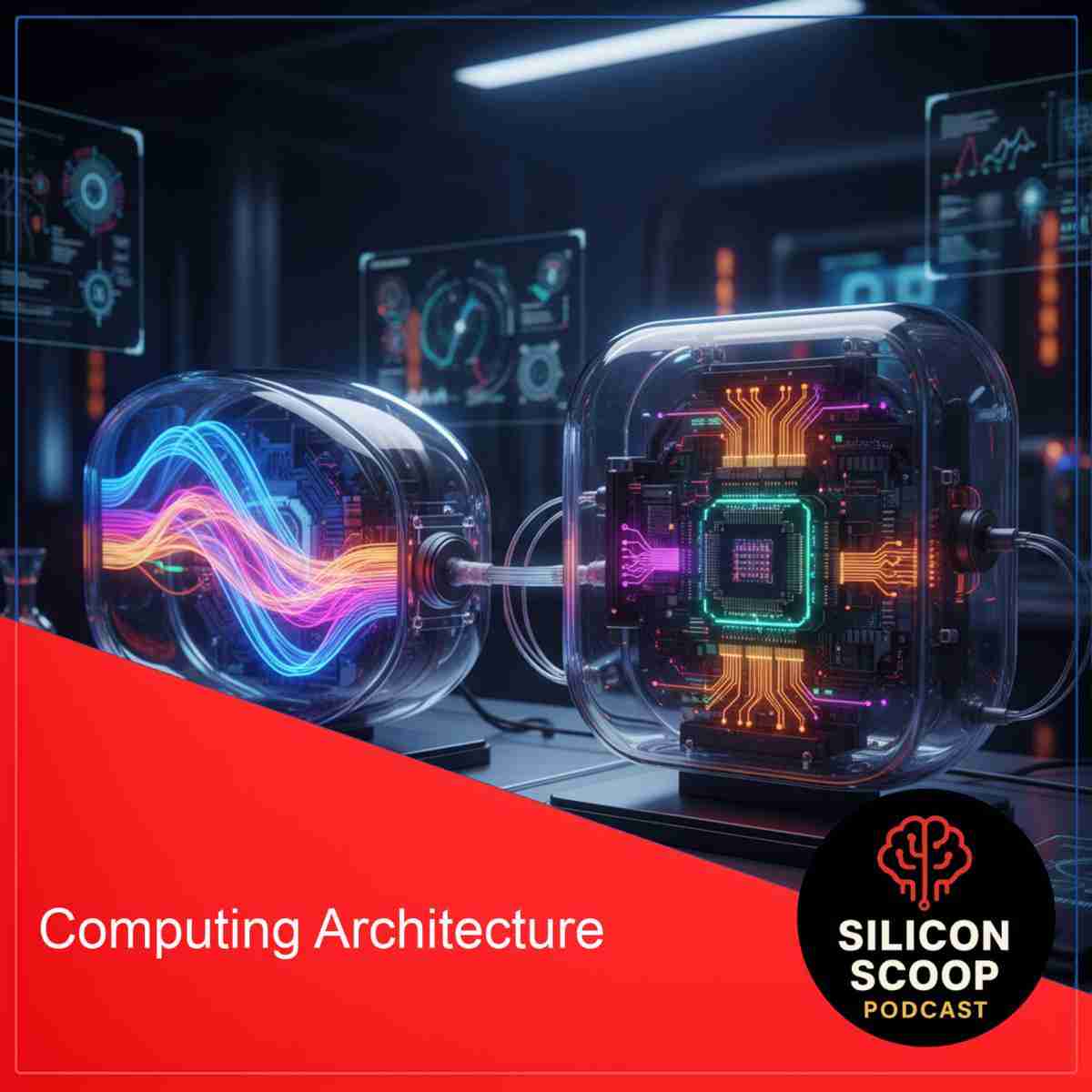
Revolutionizing Computing Architecture: Multi-Physics, Fourier Transform Acceleration & Brain-Inspired Innovations
Estimated reading time: 12 minutes
Table of contents
- Revolutionizing Computing Architecture: Multi-Physics, Fourier Transform Acceleration & Brain-Inspired Innovations
- Introduction
- Overview of the New Multi-Physics Computing Architecture
- In-Depth Analysis of Fourier Transform Acceleration
- Applications and Implications for Future Technologies
- Future-Proof Your Business Today
- Frequently Asked Questions
Introduction
Computing architecture is changing the way we think about technology. At its core, computing architecture refers to an advanced system design that integrates specialized physics domains to optimize computation. Instead of relying solely on traditional digital circuits, these new architectures combine different physical phenomena to perform tasks more naturally and efficiently.
This is where multi-physics computing enters the picture. Multi-physics computing leverages different physical phenomena—such as electrical signals, optical waves, and other natural processes—to execute computational tasks in the domain where they work best. Think of it like using the right tool for each job: electrical currents for some operations, light waves for others, each working in its optimal environment.
A groundbreaking example comes from researchers at Peking University, who have developed a multi-physics-domain Fourier-transform computing architecture that demonstrates the immense potential of this approach. Their system boosts performance from approximately 1.3×10¹¹ operations per second to roughly 5×10¹¹ operations per second. That’s nearly a 3.8-fold improvement—almost four times faster than the previous generation.
This remarkable achievement in computing architecture represents a major step forward in how we process information, with implications for artificial intelligence, edge sensing, autonomous vehicles, and brain-inspired computing systems. Published in Nature Electronics, this research showcases how combining multi-physics computing with Fourier Transform acceleration can unlock unprecedented performance gains while maintaining accuracy and reducing power consumption.
Overview of the New Multi-Physics Computing Architecture
The Peking University multi-physics computing architecture integrates two novel devices working together in harmony. One device handles frequency generation and modulation, while the other performs in-memory computing for linear transforms. Together, they create a system that processes information far more efficiently than traditional approaches.
Multi-physics computing works by mapping different computation steps to the optimal physical domain. Instead of forcing all operations through the same digital circuits, this alternative computing architecture recognizes that electrical signals excel at handling current and charge operations, while optical signals naturally process phase and intensity information. By matching each task to its ideal physical domain, the system minimizes energy waste and maximizes speed.
Key Technical Features
-
- Device A: Frequency Generation and Modulation
The first device specializes in generating and modulating frequencies. This component might use oscillatory methods, radio frequency (RF) techniques, or photonic processes to create and manipulate signal frequencies. By optimizing this device for its specific role, the architecture ensures that frequency-related operations happen quickly and efficiently.
-
- Device B: In-Memory Computing Core
The second device is an in-memory computing core that executes Fourier transform operations through analog computing. Instead of moving data back and forth between memory and processing units like traditional computers do, this device performs calculations right where the data lives. This approach dramatically reduces energy consumption and speeds up processing.
-
- Interface Circuitry
Connecting these devices requires sophisticated interface circuitry responsible for cross-domain conversions. These circuits maintain signal integrity while converting information between different physical representations—for example, from electrical voltage to optical intensity. The interface minimizes power consumption during these conversions, ensuring the overall system remains efficient.
Performance Breakthrough
The research team achieved remarkable performance improvements. They increased throughput from roughly 130 billion operations per second to approximately 500 billion operations per second—nearly a fourfold improvement. Even more impressively, they maintained computational accuracy while cutting power consumption.
This combination makes the architecture ideal for demanding applications:
- AI workloads that require massive parallel processing
- Edge sensing applications where power efficiency is critical
- Embodied intelligence systems in robotics and autonomous devices
- Communication systems that process signals in real-time
The study demonstrates that specialized computing architecture can deliver transformative improvements when designed around specific computational primitives. By understanding which physical domains naturally excel at particular operations, engineers can build systems that work with nature rather than against it.
For detailed benchmarks and performance data, refer to the study published in Nature Electronics.
In-Depth Analysis of Fourier Transform Acceleration
The Fourier transform stands at the heart of this innovative computing architecture. Understanding why requires knowing what the Fourier transform actually does and why it matters so much.
What Is Fourier Transform?
The Fourier transform is a mathematical process that converts signals from the time domain into the frequency domain. Imagine listening to a song. In the time domain, you experience the music as it unfolds moment by moment. In the frequency domain, you can see which musical notes (frequencies) make up the song, how loud each note is, and how they combine to create the sound you hear.
This conversion applies to all kinds of signals—audio recordings, images, sensor data, radio transmissions, and more. Fourier Transform acceleration refers to making this conversion process faster and more energy-efficient, which enables better signal processing, convolution operations, and spectral feature extraction across countless applications.
The Technical Mechanism
The Peking University architecture performs Fourier transforms through a carefully orchestrated four-step process:
-
- Step 1: Signal Input
Signals enter the system from sensors, digital sources, or stored data. These might be audio samples, image pixels, radar returns, or any other information that needs frequency analysis.
-
- Step 2: Frequency Generation and Modulation
Device A takes over, generating and modulating frequencies to convert signals into optimal frequency-domain representations. This step leverages the physical properties of oscillatory or resonant circuits to naturally decompose input signals into their frequency components. By using the right physical domain for this task, the system avoids the energy-intensive digital calculations traditional computers require.
-
- Step 3: In-Memory Linear Transformation
Device B performs the core Fourier transform operations using rapid, high-throughput matrix-vector multiplications. These linear algebra operations happen directly in the memory array using analog currents and voltages. Instead of fetching data, calculating, and storing results separately, everything occurs simultaneously through the laws of physics—specifically Ohm’s law and Kirchhoff’s current law.
This in-memory approach eliminates the data movement that typically dominates energy consumption in conventional von Neumann architectures.
-
- Step 4: Output Conversion
The analog outputs from the Fourier transform are converted for final digital readout or further processing. Interface circuits carefully manage this conversion to preserve the accuracy of the computed frequency-domain information.
Why This Approach Works So Well
By performing each task in its most efficient physical domain, the Peking University system reduces energy loss and minimizes unnecessary data movement. The result is significant throughput improvements while maintaining the accuracy needed for real-world applications.
The research demonstrates an upgrade from approximately 1.3×10¹¹ to 5×10¹¹ operations per second. This performance leap occurs while preserving computational accuracy and reducing energy consumption—a combination that’s extremely difficult to achieve with traditional digital approaches.
These performance enhancements benefit numerous use cases:
- AI Accelerator Systems
- Edge Sensing Applications
- Neuromorphic Computing
- Communication & Signal Processing
The alternative computing architecture approach allows AI systems to offload Fourier-intensive operations to dedicated hardware while general processors handle other tasks. This heterogeneous computing strategy optimizes both performance and energy efficiency.
In summary, this architecture’s ability to perform Fourier transforms efficiently in the physical domain accelerates a wide range of applications, from communications to AI and brain-inspired systems.
Applications and Implications for Future Technologies
The breakthrough in multi-physics computing architecture has implications far beyond laboratory demonstrations. Let’s explore how Fourier Transform acceleration will impact various technology domains.
Communications & Signal Processing
Modern wireless communication systems rely heavily on Fourier transforms. Orthogonal Frequency Division Multiplexing (OFDM)—used in 4G, 5G, and WiFi—requires constant transformation between time and frequency domains for modulation and demodulation.
Key Benefits for Communications:
- Faster OFDM processing enables higher data rates and lower latency
- Radar and LiDAR systems can process returns in real-time for autonomous vehicles
- Spectrum analysis becomes more efficient for cognitive radio and dynamic spectrum allocation
- Sensor data processing improves in applications like sonar, ultrasound imaging, and seismic monitoring
The multi-physics computing architecture can handle these operations at the physical layer, reducing the computational burden on general-purpose processors and cutting power consumption in base stations and mobile devices.
Edge Sensing & Embodied Intelligence
Edge sensing refers to processing sensor data close to where it’s collected rather than sending everything to the cloud. This approach reduces latency, saves bandwidth, and protects privacy.
Edge Applications:
- Real-time audio preprocessing extracts spectral features for voice recognition and sound classification
- Visual processing performs frequency-domain filtering and feature extraction for computer vision
- Robotics benefits from on-device intelligence that responds immediately to tactile, proprioceptive, and environmental sensors
- Wearable devices can analyze biosignals (heart rate variability, EEG patterns) efficiently enough to run on battery power
Embodied intelligence—where AI systems interact physically with their environment—particularly benefits from multi-physics computing. Robots need to process multiple sensor streams simultaneously while maintaining real-time responsiveness. Efficient Fourier Transform acceleration makes this possible without draining batteries or requiring bulky cooling systems.
AI Accelerators & Foundation Models
Artificial intelligence is increasingly dominated by large foundation models that require massive computational resources. While GPUs and TPUs excel at many AI operations, specialized hardware for key mathematical primitives can provide significant advantages.
AI Performance Enhancements:
- Convolutional layers in neural networks can leverage the convolution theorem, which states that convolution in the time domain equals pointwise multiplication in the frequency domain
- Attention mechanisms in transformer architectures may benefit from spectral methods and Fourier-based sequence modeling
- Feature extraction for multimodal AI (combining vision, audio, and text) often requires frequency-domain analysis
- Efficient inference at the edge becomes practical when specialized hardware handles the most computationally intensive operations
The alternative computing architecture approach allows AI systems to offload Fourier-intensive operations to dedicated hardware while general processors handle other tasks. This heterogeneous computing strategy optimizes both performance and energy efficiency.
Brain-Inspired Computing & Neuromorphic Computing
The connection between this architecture and brain-inspired computing is particularly fascinating. While neuromorphic computing typically centers on spiking neural networks that mimic biological neurons, real neural systems also process information in the frequency domain.
Neuromorphic Connections:
- Oscillatory coding in the brain uses frequency patterns to represent information
- Phase coding allows neurons to encode data in the timing relationships between spikes
- Hybrid systems can combine spiking neuromorphic cores with fast Fourier transform engines for complete perceptual pipelines
- Brain-computer interfaces heavily rely on spectral analysis of EEG, MEG, and ECoG signals
The multi-physics architecture provides a fast, dedicated engine for frequency-domain operations—a critical component in certain brain-computer interface designs. For example, decoding motor intentions from brain signals requires real-time spectral analysis of neural oscillations. Efficient hardware acceleration makes this possible in portable, implantable devices.
Strategic Implications
This alternative computing architecture supports emerging trends away from traditional digital designs by coupling memory and compute closely. Rather than scaling conventional CMOS circuits smaller and smaller, researchers are exploring fundamentally different approaches that exploit device physics and natural phenomena.
International Impact:
Countries worldwide are investing in heterogeneous computing solutions to overcome the limitations of traditional scaling. China’s work at Peking University demonstrates significant progress in multi-physics computing, joining efforts in the United States, European Union, and other regions to develop neuromorphic, photonic, analog, and in-memory computing systems.
The competition and collaboration in this space will likely accelerate innovation, leading to specialized hardware for different computational primitives—Fourier transforms, matrix multiplications, convolutions, correlations—each optimized in the physical domain where it performs best.
Comparison with Other Alternative Computing Approaches
The Peking University multi-physics architecture exists in a broader landscape of alternative computing paradigms. Understanding how it compares to other approaches helps clarify its unique advantages and potential role in future systems.
Neuromorphic Computing
Neuromorphic systems attempt to mimic the brain’s structure and function using electronic circuits.
Similarities:
- Both approaches minimize data movement by coupling computation with memory
- Both use analog signals to process information more efficiently than purely digital systems
- Both tolerate some degree of approximate computation to gain speed and energy advantages
- Both move away from the traditional von Neumann architecture that separates memory and processing
Differences:
- Core paradigm: Neuromorphic systems use spiking neural models and event-driven processing, while the Peking University design focuses on fixed Fourier transform operations
- Optimization target: Neuromorphic chips optimize for learning and pattern recognition tasks, whereas the multi-physics architecture optimizes specifically for frequency-domain operations
- Programming model: Neuromorphic systems often require new programming paradigms around spiking networks, while Fourier transform accelerators can integrate more easily into existing signal-processing pipelines
The two approaches complement each other well. A complete brain-inspired system might use neuromorphic processors for learning and decision-making while relying on specialized Fourier hardware for sensory preprocessing.
Photonic and Optical Computing
Photonic computing uses light instead of electricity to perform calculations, exploiting phenomena like diffraction, interference, and wavelength division multiplexing.
Similarities:
- Both leverage wave-based phenomena to perform linear operations efficiently
- Both naturally map Fourier transforms and convolutions to physical propagation and interference
- Both can achieve extremely high bandwidth for certain operations
- Both reduce energy consumption compared to digital electronics for specific workloads
Differences:
- Domain integration: The Peking University architecture is explicitly multi-physics, combining at least two domains (likely electrical plus optical or RF), while pure photonic systems work entirely in the optical domain
- Programmability: Mixed-domain systems may trade some raw bandwidth for better electronic integration and control flexibility
- Maturity: Integrated photonic systems face challenges around fabrication, coupling losses, and thermal sensitivity, while hybrid approaches can leverage more mature electronic technologies
Optical computing excels at certain linear algebra operations but struggles with the nonlinear functions and digital control logic needed for complete systems. The multi-physics approach potentially offers a middle ground, using light where it provides clear advantages while relying on electronics for control and nonlinear processing.
Analog In-Memory Computing
Analog in-memory computing executes matrix-vector operations using the physics of resistive memory arrays—devices like ReRAM, phase-change memory, or ferroelectric transistors.
Similarities:
- Both execute matrix-vector operations in analog current/voltage form inside memory arrays
- Both exploit Ohm’s law and Kirchhoff’s current law to perform many parallel multiplications simultaneously
- Both offer high energy efficiency for linear algebra tasks needed in AI inference
- Both face similar challenges around analog noise, device variation, and limited precision
Differences:
- Specialization: Many analog in-memory works target general matrix operations for deep neural network layers, while the Peking University design is specialized specifically for Fourier transforms and frequency-domain operations
- Multi-physics integration: The new architecture explicitly combines frequency generation/modulation with in-memory arrays, representing tighter co-design of signal representation, device physics, and algorithm
- Application focus: General analog accelerators aim broadly at AI inference, while this architecture targets workloads where Fourier transforms dominate computational cost
The specialization for Fourier operations distinguishes this alternative computing architecture from more general-purpose analog accelerators. When your workload consists primarily of spectral analysis, convolution via the convolution theorem, or other Fourier-intensive tasks, a dedicated architecture can outperform more flexible but less optimized alternatives.
Positioning in the Alternative Computing Landscape
The multi-physics-domain Fourier transform accelerator occupies a specific niche: high-throughput, energy-efficient execution of a critical mathematical primitive. Rather than trying to replace general-purpose processors, it complements them as part of a heterogeneous computing system.
This specialization strategy aligns with broader industry trends. Just as GPUs specialize in parallel floating-point operations and TPUs optimize for matrix multiplications in neural networks, Fourier transform accelerators excel at spectral operations that appear throughout signal processing, communications, and AI.
Limitations, Challenges, and Future Directions
Current Limitations
-
- Analog Noise and Precision
Analog computing inherently trades some precision for speed and energy efficiency. While the Peking University system maintains accuracy sufficient for its target applications, analog noise from various sources—thermal fluctuations, device variations, electromagnetic interference—can limit the effective number of bits.
-
- Device Non-Idealities
Real devices don’t behave exactly as ideal mathematical models predict:
-
-
- Resistive memories drift over time, changing their conductance values
- Manufacturing variations mean no two devices are identical
- Temperature affects device behavior, requiring compensation circuits
- Nonlinear effects at large signals can distort computations
-
Compensating for these non-idealities adds complexity. The system needs calibration routines, error-correction mechanisms, and potentially adaptive algorithms that account for hardware characteristics.
-
- Scalability Challenges
Scaling to larger Fourier transforms presents architectural challenges:
-
-
- Array size limits: Physical constraints limit how large a single analog array can grow
- Interconnect complexity: Moving signals between arrays in multi-tile designs can consume significant energy
- Synchronization: Coordinating multiple devices operating in different physical domains requires precise timing
- Yield and reliability: As systems grow larger, the probability of defects increases
-
Two-dimensional and three-dimensional Fourier transforms—critical for image processing and volumetric data—require careful data layout and tiling strategies to map onto hardware efficiently.
-
- Programming and Integration
Making specialized hardware useful requires solving software challenges:
-
-
- How do developers target this architecture from high-level code?
- What programming abstractions make sense for multi-physics systems?
- How does the accelerator integrate into existing AI frameworks and signal-processing libraries?
- What portions of applications should run on specialized hardware versus general processors?
-
These questions need answers before the technology can move from research demonstrations to production systems.
Future Research Directions
-
- Scaling Through 3D Integration
Three-dimensional integration—stacking multiple layers of devices vertically—offers a path to higher performance:
-
-
- Brings sensors, memory, and compute closer together, reducing communication distances
- Enables denser packing of functionality in smaller physical volumes
- Supports specialized layers for different physical domains (e.g., photonic layer, electronic layer, memory layer)
- Supports embodied intelligence applications where size and weight matter
-
Advanced packaging technologies like through-silicon vias and hybrid bonding make 3D integration increasingly practical.
-
- Improved Device Uniformity
Better manufacturing processes and device designs can reduce variation:
-
-
- Novel materials with more predictable properties
- Self-aligned fabrication techniques
- Built-in compensation circuits that adapt to device characteristics
- Redundancy and error-correction strategies
-
Reducing variation allows larger arrays while maintaining accuracy, directly improving performance.
-
- Expanding Beyond Fourier Transforms
While specialized for Fourier operations, the multi-physics computing architecture principles could extend to other mathematical primitives:
-
-
- Wavelets and other linear transforms used in compression and feature extraction
- Correlation operations for template matching and signal detection
- Beamforming and spatial filtering for antenna arrays and acoustic processing
- Convolution engines optimized differently than Fourier-based approaches
-
A family of specialized accelerators, each optimized for a different operation class, could work together in heterogeneous systems.
-
- Neuromorphic Integration
Combining Fourier accelerators with neuromorphic processors creates powerful hybrid systems:
-
-
- Spectral preprocessing handles sensor inputs efficiently
- Neuromorphic cores perform learning, adaptation, and decision-making
- Interface circuits bridge between continuous analog signals and event-driven spikes
- Complete perceptual-cognitive-motor loops run on integrated chips
-
This integration brings multi-physics computing closer to true brain-inspired architectures.
Research Questions
- How can we achieve digital-equivalent precision while retaining analog efficiency advantages?
- What calibration and training strategies work best for systems with significant device variation?
- How do we optimize the partitioning of algorithms across multiple physical domains?
- Can we develop automated tools that map applications onto multi-physics hardware?
- What new algorithms become practical when certain operations are nearly “free” in hardware?
Conclusion
The Peking University multi-physics-domain Fourier-transform computing architecture represents a significant breakthrough in how we think about computation. By integrating specialized devices for frequency generation, modulation, and in-memory computing, the system achieves nearly fourfold performance improvements—from approximately 130 billion to 500 billion operations per second—while maintaining accuracy and reducing power consumption.
This achievement demonstrates the power of multi-physics computing: mapping different computational steps to the physical domains where they execute most naturally and efficiently. Instead of forcing all operations through traditional digital circuits, the architecture recognizes that electrical, optical, and other physical phenomena each excel at different tasks.
The implications extend across numerous fields:
- Communications systems benefit from faster, more efficient signal processing
- Edge sensing applications gain real-time spectral analysis with minimal power consumption
- AI accelerators can offload Fourier-intensive operations to specialized hardware
- Neuromorphic and brain-inspired computing systems access efficient frequency-domain preprocessing
- Autonomous systems process radar, LiDAR, and sensor data with lower latency
Published in Nature Electronics, this research aligns with global trends toward heterogeneous computing, where different hardware accelerators handle the operations they do best. As conventional CMOS scaling slows, alternative computing architectures like this one will play increasingly important roles in advancing technology.
The journey from laboratory demonstration to widespread deployment will require overcoming challenges around precision, scalability, and programming models. But the fundamental insight—that matching computation to optimal physical domains unlocks dramatic efficiency gains—will continue driving innovation in computing architecture.
Whether for embodied intelligence in robots, real-time signal processing in communication systems, or accelerating the AI models shaping our future, multi-physics Fourier Transform acceleration represents a powerful new tool in the computing arsenal.
Future-Proof Your Business Today
Just like this innovative architecture merges multiple domains for peak performance, Flowgrammer’s business process automation seamlessly integrates your systems and tasks. Don’t get left behind – prepare your business for tomorrow’s challenges.
Frequently Asked Questions
Q: What is multi-physics computing?
A: Multi-physics computing is an approach that uses different physical domains—such as electrical signals, optical waves, or mechanical oscillations—to perform different parts of a computation. Each part of the calculation happens in the physical domain where it naturally occurs most efficiently. This reduces energy waste and increases speed.
Q: What makes this computing architecture alternative to traditional designs?
A: Traditional computers follow the von Neumann architecture, which separates memory from processing units and moves data back and forth constantly. This alternative computing architecture couples memory and computation together, performing calculations directly where data is stored. It also uses analog signals and multiple physical domains instead of relying purely on digital electronics. These differences enable much higher efficiency for specific types of operations.
Q: How does Fourier Transform acceleration enhance energy efficiency?
A: Fourier Transform acceleration uses the natural physics of devices to perform transformations rather than calculating them digitally step-by-step. For example, optical diffraction naturally performs operations similar to Fourier transforms. By exploiting these physical phenomena, the system completes calculations using far less energy than traditional digital processors would need for the same operations.
Q: What are the challenges in integrating multiple physical domains?
A: The main challenges include converting signals between domains without losing information, synchronizing operations that happen at different speeds, managing the different noise sources in each domain, and calibrating diverse devices to work together accurately. Engineers must design sophisticated interface circuits that preserve signal quality while minimizing power consumption during domain conversions.
Q: How can this technology benefit edge sensing applications?
A: Edge sensing devices process data close to sensors rather than sending everything to the cloud. These devices often run on batteries and need to analyze signals in real-time. The Fourier Transform acceleration technology allows edge devices to perform complex spectral analysis—extracting frequency features from audio, images, or other sensor data—using minimal power. This enables smarter edge devices that respond faster and last longer on battery power.
Q: What is the difference between neuromorphic computing and this architecture?
A: Neuromorphic computing mimics the brain’s spiking neural networks and focuses on learning and pattern recognition through event-driven processing. The Peking University architecture specializes in Fourier transforms and frequency-domain operations using analog computing and multi-physics devices. While both move away from traditional computing, neuromorphic systems model neural behavior while this architecture optimizes mathematical signal-processing primitives. The two approaches can complement each other in hybrid systems.
Q: What future developments can we expect in neuromorphic computing?
A: Neuromorphic computing will likely see improved integration with sensory preprocessing systems like Fourier accelerators, better programming tools that make brain-inspired chips easier to use, larger-scale chips with millions of artificial neurons, and hybrid systems combining spiking networks with other specialized accelerators. We’ll also see more applications in robotics, edge AI, and brain-computer interfaces as the technology matures.
Q: How does this architecture maintain accuracy while using analog computing?
A: The system uses several strategies to maintain accuracy: careful device calibration to compensate for manufacturing variations, error-correction circuits that detect and fix computational errors, redundant calculations that cross-check results, and algorithms designed to tolerate some imprecision. While it may not match the 32-bit precision of digital computers, it achieves sufficient accuracy for AI and signal-processing applications that can work with 6-8 effective bits.
Q: What applications would benefit most from Fourier Transform acceleration?
A: Applications with heavy spectral analysis needs benefit most: wireless communication systems (4G, 5G, WiFi), radar and LiDAR processing for autonomous vehicles, medical imaging, audio and speech processing, seismic data analysis, radio astronomy, spectrum sensing, and convolutional neural networks that use the convolution theorem. Any workload where Fourier transforms dominate computational cost can see dramatic speedups.
Q: How might brain-inspired computing change technology in the next decade?
A: Brain-inspired computing could enable much more efficient AI systems that learn continuously from their environment, robots with more natural and adaptive behaviors, brain-computer interfaces that decode neural signals in real-time, edge devices with sophisticated intelligence running on minimal power, and new applications we haven’t imagined yet. By combining ideas from neuroscience with advanced hardware like multi-physics architectures, we’ll create systems that process information more like biological brains—efficiently, adaptively, and intelligently.
Additional Links
Flowgrammer.ca – 💡 Unlock AI-Powered Automation! Let flowgrammer.ca handle complex workflows so you can focus on growing your business.
Flowgrammers.ca – 💡 Join Toronto’s Fastest Growing AI and Busiess Automation Community..
OpenClaw Toronto – Toronto’s OpenClaw Community
-
-
- Silicon Scoop Podcast – Stay Informed, Stay Ahead!
- Startup Talk Podcast
- Flowgrammer Podcast –
- Startup Investor Drinks – Join Toronto’s Startup Community and connect with fellow startup enthusiasts and investors.
- TorontoStarts Startup and Entrepreneur Community – Become a part of Toronto’s thriving startup ecosystem.
- Workhaus – Discover flexible workspace solutions for your business needs.
- Work with The Startup Coach – Get expert guidance and mentorship for your startup journey.
- Reach out to Jon Irwin on LinkedIn – Connect with our co-host and technology expert.
-
Episode transcript
Read the full transcript
Craig: we've been told for years that computers are hitting a wall, but researchers just found a way to smash through it using the laws of physics instead of raw code. if you ever wondered how your phone handles five g or how self driving cars see the world so fast, a massive breakthrough from peking university just changed the game. scientists have created a multi physics computer architecture that stops forcing every calculation through traditional digital circuits. instead, it uses a mix of light electricity in memory processing to handle complex math nearly four times faster than current tech. it's a specialized engine designed specifically to speed up the front fourier transform, the mathematical backbone of almost all modern communication and ai. what do you think about this, john?
Jon: so first off, i hated fast for your transformations in school. but, let's let's dive into this. so, yeah, this architecture, it can do about 500,000,000,000 operations per second, which is compared to about a 130,000,000,000 operations per second in prior systems for the same fundamental task. so we're talking about a fourfold performance improvement. i'm excited about this, because it's not, increasing energy use proportionally. and so let's dive into kind of the integration. so the architecture synthesizes multiple nodes of computing into one system. you've got different physical domains such as electrical current, charge dynamics, and potentially photonic effects, and they're matched to the parts of computation that they handle best. so by aligning which physical mechanism does what yeah. the system is able to avoid typical inefficiencies that are associated with traditional digital pipelines that use a single domain, like electrical voltage switching, which is used in chips from everything. right? so the heterogeneous physical design, it reduces the need to shuttle data back and forth between memory and processors, which
Craig: if
Jon: we're talking about it, it's a key bottleneck in conventional ai hardware. so this could significantly improve speed and energy efficiency. and so one of the ways that this architecture achieves this is what's called processing in memory or pim, which embeds computational capability directly where the data is stored instead of moving data to a separate processor. and that dramatically reduces data movement overhead that typically consume up to 60% of energy in conventional designs, and it also introduces latency. so by reducing this overhead, it allows the system to accelerate key kernels like for your transforms while cutting both time and energy per operation. i think this is a game changer with ai computing, with ai chips. and i don't know where nvidia is in all this if they're involved in this, but, i think this is legit. well, i think this could be a potential game changer, for ai. what do you think?
Craig: well, to me, it's just like adding, you know, math, coprocessors into the chip. you know, this gonna be the new, video cards, for example, the process ai will actually have, these processors built on or into size of the chip or as a third party add on that you can, you know, plug into your processor to process kind of stuff. so anytime you go in silicon, it's gonna be faster. and, you know, i interviewed and talked to a lot of companies that were doing in silicon stuff for bitcoin mining and whatnot. and it was so much faster, when they put the, code in the chip rather than running it on software, and it made it things so much faster. so when you start looking at this and that it's just the way it's architected, and then they hard they make the hardware optimized for this type of process, it's gonna be so much faster. so i'm excited. you know, i think of the traditional computer like a multitool that tries to use a screwdriver for everything. this tech is like a specialized workshop where the computer picks the perfect physical tool like light waves or electrical current to solve specific math problems naturally and instantly. you know? and it solves the data traffic jam problem by doing math right where the data is stored, like you said, in memory in real time and using natural physics. it increases the speed, like, from a 130,000,000,000 to 500,000,000,000 operations per second and lose while using way less power. i love that everything we're talking about these days you know, we're gonna get a four times or 10 times increase in speed, and the power drops. it's like, okay. great. you know, we're definitely heading in the right direction. so some of the impacts we might see on our life is your phone could download massive files even faster with zero lag because it processes wireless signals way more efficiently. smarter robots. home robots or self driving cars could react to obstacles in real time without needing massive battery draining or, in real time without needing massive battery draining or, computer in the trunk. and we talked a while ago about how they are putting quantum mechanics in the hand or in the elbow of robots to make them smoother and to understand. this obviously will allow for that. longer battery life. wearables, smartwatches could perform advanced health scans like heart or brain monitoring locally without killing, the battery. currently looking at, with successful research breakthrough published in natural ex electronics, we expect to see this hitting specialized industrial hardware within three to five years.
Jon: yeah. it's funny. yeah. when you say you could download a file much quicker, i immediately go to the show silicon valley with with, pied piper. but, anyways, we don't need to get into that. so what i like about this is so, like, what current architecture is like is they're using essentially, graphics cards, right, as these chips for ai. and nvidia is developing their own, but there's i said they're gpus. right? and there are tpus, but we're talking gpus. so what i like about this is now they're taking kind of a more fundamental approach to developing architecture that is ideal for ai, which i think makes the most sense if that makes sense. instead of trying to adapt an old architecture, let's create new architecture. let's look at what is needed. right?
Craig: yep.
Jon: k. so, yeah, i'm i'm super excited for this. like, about, like, we're talking edge ai systems, neuromorphic computing, brain inspired ai, communication signal processing. that's just some of the examples that can be done. but, yeah, if we can reduce that memory bottleneck using tim, i think, this this is gonna be phenomenal. did you read anywhere? because i know you always come up with the timelines. did it give us a timeline as to when this might go into, like, production kind of testing?
Craig: well, as i mentioned, we're hitting in specialized industrial hardware in the next three to five years because it's proven a study of the research papers launched. but consumer tech will follow that. so we're looking at a five to seven or five to ten year for consumer tech.
Jon: cool. yeah. i'm excited for that.
Craig: so when you combine that with all the other things we got going on, like, can we do this architecture with molecular computing and with all the other things, i'm excited. you know, the fourier transform math that this chip accelerates is the same math your brain uses to recognize a specific voice in a crowded, noisy room. so it's complicated, and it's been known for a long time. so we're moving out of the one size fits all chips and towards physics based hardware that works with nature rather than against it. and do you see that we're going to get, specialized chips, that say, this one is for doing stuff with video, and this one is doing stuff for this, and this one's doing stuff for that because they're wired specifically, for example, with the hardware codec with the acceleration and encryption for all that stuff so your cpu and your bandwidth can be even smaller. so let us know. is this the end of traditional processes as we know it, or are we just sticking fast? are we just really fast sidekick? you're gonna plug this on at the end. let me know if you trust an analog chip to drive your car in the comments. we'll be tracking this one closely.
More from Silicon Scoop
All episodes
silicon-scoop · October 19, 2026
OpenAI’s Jalapeño Chip Stakes a Claim Against Nvidia Blackwell in Real-World AI Inference
OpenAI Jalapeno chip challenges Nvidia GB300 Blackwell with InferenceX AI benchmark results, reshaping AI inference accelerator efficiency and latency.
View episode

silicon-scoop · October 16, 2026
Meta’s $18 Billion Teen Safety Settlement: Soft Guardrails, Hard Leverage Over TikTok and YouTube
Deep dive on Meta teen safety settlement, social media addiction lawsuit, new Facebook Instagram time limits and pressure on TikTok YouTube age verification.
View episode

silicon-scoop · October 15, 2026
How Claude Mythos Is Reshaping Cryptanalysis: HAWK, AES and the Rise of AI-Driven Crypto Research
Claude Mythos cryptanalysis weakens HAWK post-quantum signature, speeds AES Möbius Bridge attack, and powers CryptanalysisBench benchmark in AI-driven crypto research.
View episode