
Revolutionizing Robotic Skin: Integrating Neuromorphic Computing and Artificial Intelligence for Advanced Tactile Sensing
Revolutionizing Robotic Skin: Integrating Neuromorphic Computing and Artificial Intelligence for Advanced Tactile Sensing https://torontostarts.com/2026/04/01/revolutionizing-robotic-skin-technology/ 🔗 Core Platforms & Properties Silicon Scoop (Main Page) https://torontostarts.com/silicon-scoop/ Flowgrammer (AI Automation Agency & Community) https://flowgrammer.ca/ AI News & Resources (Flowgrammers Hub) https://flowgrammers.ca OpenClaw Toronto - https://openclawto.com/ FlowGrammer and OpenClaw YouTube- https://www.youtube.com/@flowgrammers 🍻 Events & Community Startup Investor Drinks Toronto https://startupdrinksto.com/ TorontoStarts (Startup Community Hub) https://torontostarts.com/ 🎙️ Silicon Scoop Podcast Main Page https://torontostarts.com/silicon-scoop/ Apple Podcasts https://podcasts.apple.com/us/podcast/silicon-scoop/id1758711826 Spotify https://open.spotify.com/show/5bAzF0MwV6TtLhJAhvHayI YouTube Playlist https://www.youtube.com/playlist?list=PLj4v-RoA7A-gT62vrEYqh1zCv-0Hj-o5J
With Craig Major and Jon Irwin
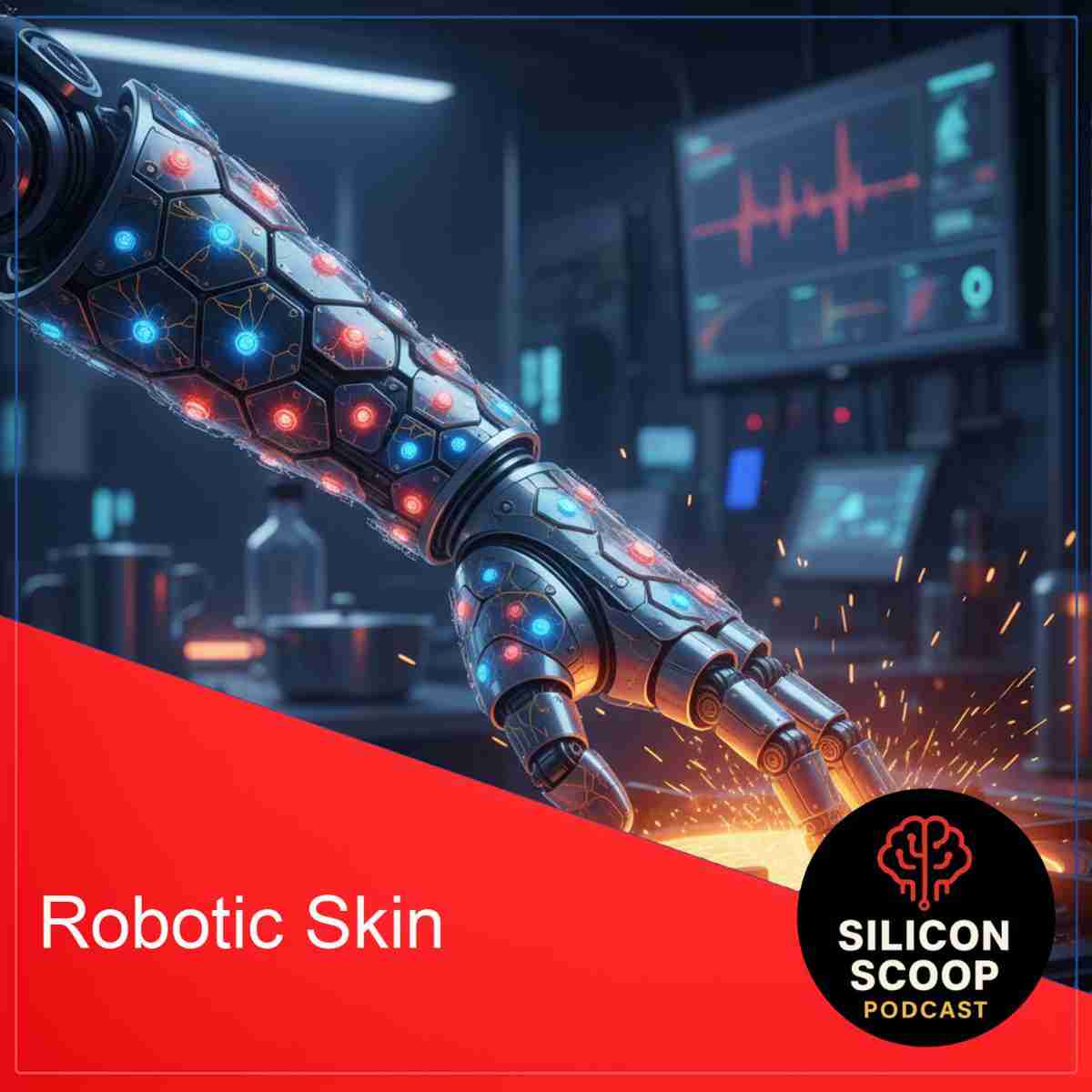
Revolutionizing Tactile Sensing: How Robotic Skin Integrates Neuromorphic Computing and Artificial Intelligence
Estimated reading time: 20 minutes
Table of contents
- Revolutionizing Tactile Sensing: How Robotic Skin Integrates Neuromorphic Computing and Artificial Intelligence
- Introduction
- Overview of Neuromorphic Robotic Skin
- What Does “Neuromorphic” Actually Mean?
- From Traditional E-Skin to Advanced Robotic Skin
- The Core Technology
- The Chinese Research Breakthrough
- In-Depth Technical Architecture of NRE-Skin
- Skin Structure & Materials
- Sensing, Spike Encoding & Neuromorphic Processing
- Biological Inspiration and Comparisons
- Experimental Demonstrations & Real-World Applications
- Engineering Features, Limitations, and Future Perspectives
- Frequently Asked Questions (FAQ)
Introduction
Robotic skin is an advanced, flexible sensor system that mimics the remarkable functions of biological skin. This cutting-edge technology allows machines to feel, sense pressure, and react to their environment in ways that were once impossible.
At the heart of this breakthrough lies neuromorphic computing—an engineering approach that draws inspiration from how our nervous systems work. Instead of processing information continuously like traditional computers, neuromorphic computing uses event-driven processing for tactile inputs. This means the system only activates when something happens, just like your nerves only send signals when you touch something.
Think of it this way: when you accidentally touch a hot stove, your hand pulls away before you even consciously think about it. That’s a reflex. Modern robotic skin with artificial intelligence can now perform similar instant reactions.
This article explores the fascinating journey from conventional electronic skin (e-skin) designs to next-generation NRE-skin systems that are changing robotics forever.
Researchers in China have achieved a remarkable breakthrough. They’ve developed NRE-skin that employs spiking circuits to convert pressure signals into spike trains—short electrical pulses similar to the signals traveling through your nerves. This innovation bridges the gap between biology and technology, creating machines that can sense and respond with unprecedented speed and accuracy.
The implications are enormous. From safer industrial robots to prosthetics that truly feel, robotic skin integrated with neuromorphic computing and artificial intelligence is opening doors to possibilities we’re only beginning to explore.
Overview of Neuromorphic Robotic Skin
What Does “Neuromorphic” Actually Mean?
Neuromorphic engineering takes direct inspiration from the nervous system. Instead of using traditional computing methods, it employs spiking circuitry to mimic how neurons process information in your brain and nerves.
Your neurons communicate by sending brief electrical pulses called action potentials. Neuromorphic systems copy this approach, using discrete spikes rather than continuous signals. This makes the system incredibly efficient because it only uses energy when something meaningful happens.
From Traditional E-Skin to Advanced Robotic Skin
Traditional electronic skin (e-skin) was a major step forward. These systems used flexible materials with embedded sensors to detect basic touch and pressure.
But robotic skin represents the next evolution. Key improvements include:
- Modular construction: Skin segments that snap together magnetically
- Self-identification: Each segment carries a unique ID code
- Reflex-like responses: Immediate reactions without waiting for central processing
- Event-driven communication: Only sending signals when changes occur
The Core Technology
The fundamental concept is elegant yet powerful. Tactile sensors are distributed across a flexible polymer substrate—a stretchy, bendable material that can conform to curved robot surfaces.
When pressure is applied to any sensor, the system doesn’t just measure the force. Instead, it converts that pressure input into spike trains that mimic biological sensory neurons. Light pressure creates slower spikes. Harder pressure generates faster spike rates.
This pressure sensor network feeds into specialized circuits that process these spikes locally. Some responses happen instantly—like pulling away from harmful contact. Other information travels to higher-level AI controllers for complex decision-making.
The Chinese Research Breakthrough
Researchers in China have developed a neuromorphic robotic skin (NRE-skin) that senses pressure, detects damage, and triggers reflex-like responses. This novel approach integrates local sensor data with higher-level AI control in ways never before achieved.
The system incorporates three critical capabilities:
- Localized sensing: Each skin segment monitors its own sensors
- Spike-based neural encoding: Converting touch into neuromorphic signals
- Reflex circuits: Immediate protective responses to harmful stimuli
The technology demonstrates that biomimetic robotics—systems inspired by biological organisms—can achieve practical, real-world functionality. The NRE-skin doesn’t just detect pressure; it interprets meaning and triggers appropriate responses.
Source: https://flowgrammer.ca/
In-Depth Technical Architecture of NRE-Skin
Skin Structure & Materials
The physical construction of robotic skin determines what it can do and where it can be used. The NRE-skin system uses carefully selected materials and clever engineering to create a truly flexible, functional artificial skin.
The Foundation: Flexible Polymer Substrate
The base layer is made from a flexible polymer substrate. This material must be:
- Stretchable: It needs to bend and flex without breaking
- Conformable: It must match curved robot surfaces
- Durable: It should withstand repeated contact and movement
- Electrically stable: It must maintain sensor performance despite deformation
This polymer foundation creates a stretchable, conformable skin layer that can be applied to robotic arms, hands, faces, or entire bodies.
Sensing Elements: The Touch Detectors
Distributed pressure sensors are embedded in or printed directly onto the polymer substrate. These aren’t single-point sensors. Instead, they form a dense network across the entire surface.
Each sensor acts like a tiny mechanoelectrical transducer. When pressure is applied, the sensor generates an electrical signal proportional to the force.
Electrical Connections: Conductive Polymer Traces
Connecting all these sensors requires special conductive polymer lines. These flexible conductive traces create electrical pathways without restricting the skin’s movement.
Traditional rigid wires would crack and fail. The conductive polymer interconnects bend, stretch, and twist alongside the skin itself.
Revolutionary Modularity
Perhaps the most innovative feature is the modular segment design. The entire skin isn’t one piece. Instead, it’s composed of discrete tile-like segments or patches.
Magnetic Interlocks for Physical Connection
Each segment features magnetic interlocks that allow tiles to physically snap together. You can:
- Easily attach new segments
- Remove damaged sections
- Reconfigure the skin layout
- Perform maintenance without tools
Unique ID Codes for Plug-and-Play Operation
Every segment carries a unique ID code. When you attach a segment, the system automatically:
- Detects the new module
- Identifies its sensor capabilities
- Maps its location
- Integrates its data into the overall system
This plug-and-play operation means a robot can be fitted with custom skin configurations for different tasks. If one segment fails, you simply swap it out—no complex recalibration needed.
Material Specifications Summary:
- Material: Flexible polymer substrate
- Sensing elements: Distributed pressure sensors
- Interconnects: Conductive polymer traces
- Modularity: Magnetic interlocks with unique ID segmentation
This modular approach transforms robotic skin from a fragile, monolithic system into a robust, maintainable solution for real-world robotics applications.
Source: https://flowgrammer.ca/
Sensing, Spike Encoding & Neuromorphic Processing
The true innovation of NRE-skin lies in how it processes tactile information. This isn’t traditional sensor data—it’s neuromorphic signal processing that mimics biological systems.
The Transformation Process: Pressure to Spikes
When you press on the skin, several events happen in rapid succession:
- Step 1: Mechanical to Electrical
Local pressure deforms the sensor, creating an electrical signal. The stronger the pressure, the larger the electrical response. - Step 2: Electrical to Spike Trains
This electrical signal then gets encoded as spike trains—short electrical pulses similar to action potentials in biological neurons.
This conversion is the heart of neuromorphic computing applied to tactile sensing.
Understanding Spike Encoding Details
The spike encoding system uses multiple dimensions to carry information:
- Pulse Shape Variations
Small variations in the spike waveform help identify specific sensors. Each pressure sensor might have a slightly different characteristic signature. This helps the system track which exact sensor sent which signal. - Spike Frequency: The Primary Information Carrier
Higher pressure creates higher firing rates, directly paralleling how biological neurons encode stimulus intensity.
– Light touch: 10-20 spikes per second
– Moderate pressure: 50-100 spikes per second
– Harmful pressure: 200+ spikes per second
This rate coding is intuitive and mirrors spiking neural networks in living organisms.
Sensor Identity Encoding
The combination of spike shape, amplitude, timing, and addressing allows unique identification of each sensor. Even though many sensors might share communication channels, the system knows exactly which sensor generated which spike.
The “Heartbeat” Keep-Alive System
One of the cleverest features addresses a critical engineering challenge: how do you know if a sensor is working properly or has failed?
Keep-Alive Spikes
Each sensor outputs periodic low-level “I’m still here” spikes, even when nothing is touching it. These heartbeat-like signals serve multiple purposes:
- Continuous health monitoring: The system knows every sensor is functioning
- Fault detection: If keep-alive spikes cease, that sensor has failed
- Network validation: Communication pathways are tested constantly
Automatic Fault Response
When heartbeat spikes degrade or stop, the system automatically:
- Flags that sensor or segment as damaged
- Marks the region as requiring maintenance
- Adjusts processing to ignore invalid data
- Triggers maintenance alerts
This self-monitoring capability means robots can detect their own injuries—a crucial step toward autonomous operation.
Neuromorphic Processing Architecture
The NRE-skin uses a hierarchical processing architecture that separates fast local responses from complex decision-making.
Local Processing Layer
This layer sits on or very near the skin itself. It handles:
- Event detection: Recognizing when meaningful contact occurs
- Reflex logic: Triggering immediate protective responses
- Spike aggregation: Combining signals from multiple nearby sensors
Think of this as the “spinal cord” level—fast, automatic, protective.
Higher-Level AI Integration
Processed spike data flows upward to more sophisticated controllers:
- Neuromorphic chips: Specialized processors designed for spiking neural networks
- Conventional AI systems: Traditional processors running machine learning models
- Multimodal fusion: Combining tactile data with vision, sound, and proprioception
This hierarchical control architecture enables both lightning-fast reflexes and sophisticated behavioral planning.
Reflex Circuits: Instant Protection
The local processing layer implements reflex circuits that detect harmful situations and generate immediate motor commands.
How Reflex Logic Works
When sensors detect excessive pressure:
- Spike frequency exceeds the “pain threshold”
- Local circuits recognize the dangerous pattern
- Motor command is generated instantly
- The robotic limb withdraws from contact
This happens in milliseconds—far faster than routing the signal to a central processor, making a decision, and sending commands back.
Example: Robotic Arm Withdrawal
A robotic arm covered in pressure sensors detects harmful force on its gripper. The local reflex circuit immediately commands the arm to move away, preventing damage without waiting for central AI approval.
Example: Facial Expression Changes
A robotic face demonstrator equipped with NRE-skin patches changes expression based on tactile input. Light touch might trigger a smile; painful pressure creates a wincing expression.
These reflex-like responses demonstrate the power of combining spiking neural networks with robotic skin—creating machines that react with biological speed and appropriateness.
Energy Efficiency Benefits
Spike-based data transmission and neuromorphic processing offer significant advantages:
- Event-driven operation: Energy is only consumed when spikes occur
- Reduced bandwidth: Only meaningful events are transmitted
- Scalable architecture: Adding more sensors doesn’t proportionally increase power consumption
The research demonstrates that sensor signals converted into short electrical pulses akin to action potentials make the encoding energy efficient and scalable—critical for large-area applications like full-body robot skins.
Biological Inspiration and Comparisons
How Human Skin Actually Works
Your skin is the largest organ in your body and an incredibly sophisticated sensing system. It doesn’t just detect “touch”—it discriminates between multiple distinct sensations.
Specialized Receptors in Biological Skin
Human skin contains several types of specialized receptors, each tuned to specific stimuli:
- Merkel Cells
These receptors detect sustained pressure and fine details. They help you read braille or feel the texture of fabric. They’re highly concentrated in fingertips. - Meissner Corpuscles
These sense light touch and low-frequency vibrations. They’re responsible for your sensitivity to gentle caresses and help with grip control. - Pacinian Corpuscles
Located deeper in the skin, these detect high-frequency vibrations and rapid pressure changes. They let you feel vibrations from tools or detect rapid tapping. - Ruffini Endings
These receptors respond to skin stretch and sustained pressure. They contribute to your sense of finger position and help detect object shape. - Nociceptors
Pain receptors that activate when tissue damage is threatened or occurring. They trigger protective reflexes and conscious pain perception. - Thermoreceptors
Separate sensors for heat and cold, allowing temperature discrimination.
This diversity creates the rich tactile experience you take for granted.
How Biological Encoding Works
Your sensory neurons use spike encoding—the same fundamental principle adopted by NRE-skin.
When a receptor is stimulated:
- Intensity is encoded primarily by firing rate: Gentle touch produces slow firing; intense pressure creates rapid firing
- Timing patterns carry information: The temporal pattern of spikes helps distinguish stimulus types
- Population coding: Multiple neurons firing together create a representation of touch location, quality, and meaning
The artificial intelligence behind robotic skin attempts to replicate these principles using spiking neural networks.
Reflex Loops Versus Conscious Processing
Your nervous system has evolved an elegant two-tier system:
- Spinal Reflex Arcs: These mediate fast reactions without cortical involvement. When you touch something hot, the withdrawal reflex occurs before you consciously feel pain. The circuit runs:
Sensor → Sensory neuron → Spinal cord interneuron → Motor neuron → Muscle
Total time: 50-100 milliseconds.
- Conscious Processing Pathway: Simultaneously, information travels to your brain for:
- Conscious perception of the sensation
- Integration with other senses
- Memory formation
- Complex behavioral planning
This parallel processing—fast reflexes plus thoughtful responses—inspired the NRE-skin architecture.
What Robotic Skin Borrows from Biology
The neuromorphic robotic skin adopts several key biological principles while maintaining engineering practicality.
Spike-Based Communication
Like biological nerves, NRE-skin uses discrete spikes instead of continuous analog signals. This provides:
- Noise immunity: Spikes are digital-like; either they occur or they don’t
- Efficient transmission: Information is conveyed by timing and rate, not precise voltage levels
- Robust communication: Works reliably over flexible, moving connections
This biomimetic robotics approach solves practical engineering challenges by copying nature’s solution.
Frequency-Intensity Coding
The direct relationship between pressure and spike frequency mirrors biological rate coding. This makes the system intuitive and aligns naturally with how spiking neural networks process information.
A harder press generates more spikes per second—simple, elegant, and biologically grounded.
Hierarchy Processing with Local Reflexes
The split between local reflex circuits and higher-level AI controllers directly parallels your spinal versus cortical processing.
Benefits include:
- Reduced latency: Protective reflexes don’t wait for central decision-making
- Lower computational load: Local processing handles routine events; central processing focuses on hard problems
- Scalability: Local processing manages simple contact; complex analysis is centralized
Health Signaling Through Baseline Activity
Biological neural tissue maintains ongoing baseline firing that signals health. When neurons go silent, it typically indicates damage or death.
The keep-alive heartbeat spikes in NRE-skin echo this biological principle, enabling automatic health monitoring—something no traditional e-skin system achieves.
Important Differences from Biology
While the inspiration is biological, NRE-skin is engineered technology with deliberate simplifications and differences.
- Limited Sensing Modalities: Current robotic skin implementations focus primarily on pressure sensing. They lack:
- Separate thermal sensing channels
- Vibration-specific receptors
- Chemical or nociceptive-specific sensors
- The receptor diversity found in biological skin
- Simplified Neural Dynamics: The spiking circuits are engineered encoders and logic modules, not full biophysical neuron models. They capture the functional essence of neural coding without the biological complexity of:
- Ion channels
- Synaptic neurotransmitters
- Dendritic computation
- Metabolic requirements
- Non-Biological Mechanical Solutions: Features like magnetic interlocks, standardized segment IDs, and hot-swappable modules have no direct analog in biological skin.
- Neuromorphic, Not Neural: This distinction is crucial. The system is neuromorphic—inspired by neural computation principles—but it’s not attempting strict biological replication.
This distinction allows the system to borrow proven biological strategies and adapt them for artificial intelligence and robotics applications. The result is a practical, engineerable system that captures biology’s efficiency without its complexity.
Experimental Demonstrations & Real-World Applications
Robotic Arm Demo: Protective Withdrawal Reflex
The Experimental Setup
The robotic arm is equipped with:
- Multiple skin segments covering the gripper and forearm
- Each segment containing distributed pressure sensors
- Local reflex circuitry connected to the arm’s motor controllers
- Calibrated thresholds for “harmful” pressure levels
The Task
Researchers apply varying levels of pressure to different locations on the arm. The system must:
- Detect the pressure accurately
- Determine if the force is benign or harmful
- Respond appropriately based on the threat level
Observed Behavior
When gentle or moderate pressure is applied, the system simply registers the contact. Sensor data flows to higher processing levels for potential use in manipulation tasks.
But when excessive pressure is detected—force levels that could damage the robot or harm a human—the response is immediate:
- Sensor spikes at high frequency
- Reflex circuits recognize the dangerous pattern
- Motor commands are generated instantly
- The arm moves away from the contact point
This withdrawal reflex happens in milliseconds, demonstrating the power of spike-based signal processing combined with local reflex logic.
Why This Matters
Traditional robots require multiple processing steps:
- Sample sensors at fixed intervals
- Transmit data to central processor
- Run control algorithms
- Send motor commands
- Wait for actuation
The neuromorphic approach with spiking neural networks cuts this loop dramatically shorter. The fast reflex actions occur with minimal central processing delay, potentially preventing damage in industrial settings or improving safety during human-robot collaboration.
Robotic Face Demo: Expressing Tactile Experience
Experimental Configuration
A face-shaped robotic platform features:
- Selected facial areas covered with NRE-skin patches
- Actuators controlling expression parameters (eyebrows, mouth, etc.)
- Mapping algorithms that convert tactile spike patterns into expression commands
The Social Robotics Challenge
For robots to work effectively with humans, they need to communicate their internal states. A robot that can express discomfort when roughly handled creates more intuitive interaction.
Demonstration Results
When different pressures are applied to the robotic face:
- Light Touch
Low spike frequencies from the affected sensors
Facial expression shows mild, neutral, or slightly positive response
Communicates that the contact is acceptable - Moderate Pressure
Increased spike rates
Expression shifts toward concern or attention
Signals awareness of significant contact - Painful or Harmful Pressure
Very high spike frequencies crossing the “pain threshold”
Pronounced expression changes showing discomfort or pain
Clear communication that the contact is excessive
This pressure-to-expression mapping demonstrates that robotic skin can provide the foundation for emotionally aware robotics and natural human-robot interaction.
Calibration and Threshold Setting
One critical question: how do you decide what pressure level is “painful” for a robot?
Using Human Pain-Reference Data
Researchers employed human pain-related data and psychophysical approximations as a starting point. They examined:
- Pressure levels that cause human discomfort
- Forces that damage human tissue
- Thresholds used in haptic research
This biomimetic approach grounds the robotic system in biologically relevant parameters.
The Empirical Tuning Process
Through systematic testing, researchers:
- Applied graded pressures to skin segments
- Recorded spike rate responses
- Correlated spike patterns with applied force
- Set thresholds marking transitions between contact categories
The resulting thresholds define clear boundaries:
- Benign contact: Below threshold, normal processing
- Firm contact: Approaching threshold, increased monitoring
- Painful or harmful contact: Above threshold, reflex activation
These calibrated thresholds directly inform system behavior:
- They determine when “pain” spike codes are generated
- They trigger reflex logic at appropriate force levels
- They raise higher-level alerts for potentially damaging situations
- They enable consistent, predictable protective responses
The empirical calibration process ensures that artificial intelligence controlling the robot responds appropriately across varied contact scenarios.
Real-World Applications
These demonstrations point toward numerous practical applications:
- Industrial Robotics
- Collaborative robots (cobots) that safely work alongside humans
- Automated damage detection and prevention
- Adaptive force control for delicate assembly tasks
- Healthcare and Assistance
- Robotic caregivers that handle patients gently
- Prosthetics with realistic sensory feedback
- Surgical robots with enhanced tactile awareness
- Service Robotics
- Social robots that respond appropriately to touch
- Guidance robots for vision-impaired users
- Interactive museum or educational robots
- Research Platforms
- Testing grounds for spiking neural network algorithms
- Neuroscience research into sensory processing
- Development platforms for neuromorphic computing applications
The experimental demonstrations validate that NRE-skin is ready to move from laboratory curiosity to practical deployment in real robotic systems.
Engineering Features, Limitations, and Future Perspectives
Engineering Features & Integration with AI
The NRE-skin system incorporates several sophisticated engineering features that make it practical for real-world deployment.
Modular Design Benefits
The magnetic interlock and unique ID system provides multiple advantages:
- Easy Maintenance: When a skin segment fails, you simply detach it magnetically and snap in a replacement. The new segment automatically identifies itself to the system through its unique ID code, and operation resumes immediately without complex recalibration.
- Custom Configuration: Different robotic applications need different sensor coverage. The modular approach lets you build exactly the configuration each robot needs—dense coverage on manipulation surfaces, basic coverage elsewhere.
- Progressive Upgrades: As technology improves, you can upgrade specific segments without replacing the entire system. Test new sensor types in limited areas before full deployment.
This modularity transforms robotic skin from a fragile, monolithic system into a practical, maintainable solution for real-world robotics.
Scalability Through Event-Driven Architecture
One of the biggest challenges in electronic skin is scaling to large sensor arrays. Traditional approaches struggle because:
- Continuous sampling of thousands of sensors consumes massive bandwidth
- Centralized processing creates bottlenecks
- Power consumption scales linearly with sensor count
The neuromorphic computing approach solves these problems:
- Event-Driven Communication: Sensors only transmit when something meaningful happens. A stationary robot arm with nothing touching it generates minimal traffic—just periodic keep-alive heartbeats.
- Addressing and Routing Efficiency: Unique codes per segment and per sensor enable smart routing strategies. The system uses principles similar to address-event representation (AER) employed in neuromorphic vision sensors.
- Each spike carries:
- Sensor identification
- Timing information
- Intensity encoding (via frequency)
This efficient encoding supports very large sensor arrays without proportional increases in communication infrastructure.
Energy Efficiency at Scale
- No continuous computation: Processing occurs only when spikes arrive
- Local processing reduces data movement: Reflexes don’t require central involvement
- Sparse communication: Empty channels consume minimal power
For full-body robot skins with thousands of sensors, these efficiency gains become critical. The spiking approach makes large-scale robotic skin practically feasible.
Integration with Modern AI Systems
NRE-skin bridges neuromorphic hardware and conventional artificial intelligence platforms.
- Neuromorphic Chip Integration: Spiking outputs can directly feed specialized neuromorphic processors:
- Intel’s Loihi chips
- IBM’s TrueNorth architecture
- BrainChip’s Akida processor
- Academic neuromorphic platforms
- These processors are specifically designed for spiking neural networks, offering:
- Ultra-low latency processing
- Minimal power consumption
- Native support for temporal spike patterns
The match between spike-encoding skin and neuromorphic processors creates highly efficient perception-action loops.
Conventional AI System Compatibility
The spike data can be converted into formats standard machine learning models understand:
- Rate coding: Spike counts over time windows become feature vectors
- Event histograms: Spatiotemporal spike distributions become input tensors
- Pattern features: Derived characteristics like contact location, size, and dynamics
This flexibility means NRE-skin works with:
- Deep learning frameworks (TensorFlow, PyTorch)
- Reinforcement learning controllers
- Classical control algorithms
- Hybrid architectures mixing multiple AI approaches
Closed-Loop Control for Adaptive Behavior
The skin outputs form part of complete feedback loops:
- Sensors (pressure detection) →
- Spiking encoder (neuromorphic conversion) →
- Reflex/higher-level controller (decision making) →
- Actuators (motor commands) →
- Physical action (robot movement) →
- New sensor inputs (closing the loop)
This real-time closed-loop operation supports sophisticated adaptive behaviors:
- Maintaining stable grasp despite object slip
- Adjusting contact force based on material properties
- Learning manipulation strategies through tactile feedback
- Coordinating touch with vision and proprioception
Current Limitations
Despite impressive capabilities, NRE-skin has limitations that define current research frontiers.
- Single-Modality Focus: Current system concentrates exclusively on pressure sensing. It cannot:
- Detect temperature differences
- Sense vibration patterns independently
- Identify chemical substances
- Discriminate texture at high resolution
- Processing Complexity Constraints: Local processing currently implements relatively simple threshold-based reflexes and logic. The system doesn’t yet perform:
- Complex texture discrimination
- Object recognition purely through touch
- Fine-grained material property inference
- Sophisticated spatiotemporal pattern analysis
- The Biological Gap: While neuromorphic, the system doesn’t yet achieve:
- Full multi-receptor integration
- Long-term adaptation and learning
- Cross-modal sensory integration
- The computational richness of actual neural circuits
- Scale and Cost: Covering large robot surfaces remains expensive, and integration challenges increase with system size.
Future Directions and Research Opportunities
The field of robotic skin integrated with neuromorphic computing and artificial intelligence is rapidly evolving. Several exciting directions show promise.
-
- Adding Additional Sensing Modalities
- Temperature Sensing: Integrating thermistors or flexible temperature sensors would enable:
- Hot/cold discrimination
- Thermal imaging of contact surfaces
- Detection of overheating components
- Richer object property inference
- Vibration and Texture Sensing: High-frequency pressure or vibration sensors detect:
- Surface roughness
- Incipient slip during grasping
- Micro-textures for object identification
- Material composition through vibration transmission
- Pain and Chemical Sensors: Dedicated nociceptive channels or chemical sensors could:
- Detect corrosive materials
- Sense extreme conditions threatening damage
- Identify substances through chemical fingerprints
- Trigger protective responses to environmental hazards
- Temperature Sensing: Integrating thermistors or flexible temperature sensors would enable:
- Richer Neuromorphic Processing
- Spatiotemporal Pattern Recognition: Using more sophisticated spiking neural networks on-chip to:
- Recognize complex contact patterns
- Identify gestures (stroking, tapping, pinching)
- Infer object shapes from multi-point contact
- Track dynamic touch sequences over time
- Learning and Adaptation: Implementing synaptic plasticity mechanisms like STDP (spike-timing-dependent plasticity) would allow:
- Online learning from experience
- Adaptation of reflex sensitivity over time
- Personalization to specific tasks or environments
- Self-calibration and automatic threshold tuning
- Multimodal Fusion: Combining tactile spikes with other event-based sensors:
- Dynamic vision sensors (event cameras)
- Neuromorphic auditory sensors
- Proprioceptive position sensing
- Force-torque measurements
- Spatiotemporal Pattern Recognition: Using more sophisticated spiking neural networks on-chip to:
- Adding Additional Sensing Modalities
This multimodal integration in the spiking domain would create rich, unified perceptual streams for more robust robotic control.
-
- System Integration Opportunities
- Full-Body Robot Skins: Scaling the technology to cover:
- Entire humanoid robots with thousands of sensors
- Large collaborative industrial arms
- Mobile robots with comprehensive collision detection
- Soft robots with integrated distributed sensing
- Enhanced Human-Robot Interaction: Using expressive responses to communicate robot states:
- Facial expressions showing discomfort (as demonstrated)
- Verbal reports of touch sensation
- Posture changes in response to contact
- LED indicators on skin segments showing contact zones
- Safety and Compliance Systems: Leveraging fast reflex detection for:
- Improved collision avoidance in shared workspaces
- Force-compliant control preventing excessive contact forces
- Automatic emergency stops when harmful contact detected
- Certification of robots for close human collaboration
- Full-Body Robot Skins: Scaling the technology to cover:
As robots move from cages into shared spaces with humans, sophisticated tactile sensing becomes a safety requirement, not a luxury.
Long-Term Vision
-
-
- Biohybrid systems: Integration of synthetic neuromorphic skins with biological tissues
- Advanced prosthetics: Artificial limbs providing realistic sensory feedback to users
- Soft robotics revolution: Entirely soft robots with fully integrated distributed sensing
- Autonomous repair: Self-healing materials combined with self-monitoring for autonomous maintenance
-
The convergence of materials science, neuromorphic engineering, and artificial intelligence creates opportunities we’re only beginning to imagine.
Ready to Revolutionize Your Workflow?
The future is automated. Just as neuromorphic skin adapts in real time, Flowgrammer can help your business adapt quickly and efficiently through customized automation solutions. Don’t get left behind – discover the power of automation today!
Frequently Asked Questions (FAQ)
Q: What is robotic skin and how does it differ from traditional e-skin?
A: Robotic skin is an advanced tactile sensing system that uses neuromorphic computing principles to mimic biological skin functions. Unlike traditional e-skin, which typically uses continuous analog sensing and conventional processing, robotic skin employs spiking neural networks to encode pressure as discrete spike trains.
The key differences include:
- Event-driven processing: Robotic skin only generates signals when meaningful contact occurs, while traditional e-skin continuously samples sensors
- Modular construction: Modern robotic skin uses magnetic interlocks and unique ID codes for plug-and-play segments
- Reflex-like responses: Local processing enables immediate protective reactions without waiting for central controllers
- Neuromorphic encoding: Pressure is converted to spike frequency, mimicking how biological neurons communicate
This makes robotic skin more energy-efficient, scalable, and responsive than earlier e-skin technologies, especially for large-area applications on robots.
Q: How does neuromorphic computing enhance the capabilities of robotic skin?
A: Neuromorphic computing brings several critical advantages to robotic skin systems:
- Low Latency Processing: By processing information locally using spiking circuits, the system achieves response times comparable to biological reflexes—often just milliseconds from contact detection to motor response. This speed is essential for protective reflexes and safe human-robot interaction.
- Energy Efficiency: Neuromorphic systems only consume power when events (spikes) occur. A robot standing still with no contact generates minimal activity and uses minimal energy. This event-driven approach is far more efficient than continuous sampling and processing.
- Scalability: The sparse, spike-based communication means adding more sensors doesn’t proportionally increase bandwidth or processing requirements. This makes it practical to cover large robot surfaces with thousands of sensors.
- Natural Integration with AI: Spiking outputs can feed directly into neuromorphic AI processors or be converted for conventional machine learning systems, enabling sophisticated perception and control using tactile feedback.
Neuromorphic computing transforms robotic skin from a simple sensor array into an intelligent, adaptive system that processes information much like biological nervous systems.
Q: What are the practical applications of this technology in robotics and artificial intelligence?
A: Robotic skin with neuromorphic computing and artificial intelligence has numerous real-world applications:
- Industrial Robotics
- Collaborative robots (cobots) that safely work alongside humans
- Adaptive force control for delicate assembly or handling fragile objects
- Automated damage detection preventing costly equipment failures
- Healthcare and Medical
- Robotic surgical systems with enhanced tactile feedback
- Prosthetic limbs providing realistic sensation to users
- Caregiving robots that handle patients gently and respond to discomfort
- Service and Social Robotics
- Interactive robots that respond naturally to human touch
- Guidance robots for vision-impaired individuals
- Educational robots that engage through physical interaction
- Research Platforms
- Testing environments for spiking neural network algorithms
- Neuroscience research into sensory processing mechanisms
- Development of next-generation biomimetic robotics
The technology enables robots to interact with their environment and with humans in safer, more adaptive, and more natural ways.
Q: What future improvements can we expect in this field?
A: The field of neuromorphic robotic skin is rapidly advancing. Expected improvements include:
- Multi-Modal Sensing: Integration of temperature sensors, vibration detectors, and even chemical sensors to create richer environmental awareness comparable to biological skin.
- Advanced Learning Capabilities: Implementation of synaptic plasticity mechanisms like STDP will allow robots to learn from tactile experience, automatically adjusting sensitivity and responses based on accumulated data.
- Improved Pattern Recognition: More sophisticated spiking neural networks will enable robots to recognize complex touch patterns, identify objects purely through touch, and discriminate fine textures.
- Full-Body Integration: Scaling to cover entire humanoid robots or large collaborative systems with thousands of coordinated sensors working as unified perceptual systems.
- Multimodal Fusion: Combining tactile sensing with event-based vision, auditory processing, and proprioception to create unified perceptual streams for more robust and intelligent robot behavior.
These advances will bring robots closer to biological capabilities, enabling applications we’re only beginning to imagine.
Q: How does modular design of NRE-skin improve maintenance and scalability?
A: The modular design is one of the most practical innovations in robotic skin technology. It provides several key advantages:
- Easy Maintenance: When a skin segment fails or gets damaged, you simply detach it magnetically and snap in a replacement. The new segment automatically identifies itself to the system through its unique ID code, and operation resumes immediately without complex recalibration.
- Custom Configuration: Different robotic applications need different sensor coverage. The modular approach lets you build exactly the configuration each robot needs—dense coverage on manipulation surfaces, basic coverage elsewhere.
- Progressive Upgrades: As technology improves, you can upgrade specific segments without replacing the entire system. Test new sensor types in limited areas before full deployment.
This modularity transforms robotic skin from a fragile, monolithic system into a practical, maintainable solution for real-world robotics.
Q: What is spike encoding and why is it important for robotic skin?
A: Spike encoding is a method of representing information using discrete electrical pulses (spikes) rather than continuous signals, directly inspired by how biological neurons communicate.
How It Works in Robotic Skin
When pressure is applied to a sensor:
- Light pressure generates slow spike rates (10-20 spikes per second)
- Moderate pressure increases frequency (50-100 spikes per second)
- Harmful pressure creates rapid firing (200+ spikes per second)
Why It Matters
- Energy efficiency: Power is only consumed when spikes are transmitted, not continuously
- Noise immunity: Discrete spikes are more robust to electrical interference than analog signals
- Biological compatibility: The approach aligns with spiking neural networks used in neuromorphic AI
- Efficient communication: Timing and frequency carry information without requiring high-precision voltage levels
This encoding method makes robotic skin practical for large-scale deployment while maintaining compatibility with both neuromorphic and conventional AI systems.
Q: How do reflex circuits in robotic skin work?
A: Reflex circuits implement fast, protective responses without requiring high-level decision making—similar to how your hand pulls away from a hot stove before you consciously feel pain.
The Process
- Detection: Sensors detect harmful pressure levels
- Local processing: Circuits on or near the skin recognize the dangerous spike pattern
- Immediate response: Motor commands are generated locally
- Action: The robot moves away from the harmful contact
- Reporting: Simultaneously, information goes to higher AI systems for logging and learning
Speed Advantage
This local processing happens in milliseconds—far faster than routing signals to a central processor, running control algorithms, and sending commands back.
Applications
- Collision avoidance in collaborative robots
- Protection from excessive forces
- Faster response to environmental hazards
- Reduced computational burden on central processors
This hierarchical approach—fast reflexes plus thoughtful planning—mirrors biological systems and provides both safety and intelligence.
Q: Can robotic skin detect when it’s damaged or malfunctioning?
A: Yes, one of the most innovative features is self-monitoring through “heartbeat” keep-alive signals.
How It Works
Each sensor continuously outputs periodic low-level spikes even when nothing is touching it—like a heartbeat proving it’s alive and functioning.
Fault Detection
If these keep-alive spikes:
- Stop completely
- Become irregular
- Fall outside expected parameters
The system automatically:
- Flags that sensor or segment as failed
- Marks the region as requiring maintenance
- Adjusts processing to ignore invalid data
- Triggers maintenance alerts
This self-monitoring capability means robots can detect their own injuries—a crucial step toward autonomous operation.
Q: What are the current limitations of neuromorphic robotic skin?
A: While impressive, current systems have several limitations:
- Single Sensing Modality: Most implementations focus only on pressure sensing. They don’t yet integrate:
- Temperature detection
- Vibration-specific sensors
- Chemical sensing
- The rich multi-receptor diversity of biological skin
- Processing Simplicity: Current local processing handles threshold-based reflexes well but struggles with:
- Complex texture discrimination
- Object recognition through touch alone
- Fine-grained material property inference
- Sophisticated spatiotemporal pattern analysis
- Biological Gap: The systems don’t yet achieve:
- Full multi-receptor integration
- Long-term adaptation and learning
- Cross-modal sensory integration
- The computational richness of actual neural circuits
- Scale and Cost: Covering large robot surfaces remains expensive, and integration challenges increase with system size.
What are the future directions?
While the limitations are notable, ongoing research aims to overcome them:
- Multi-Modal Sensing: Adding temperature, vibration, chemical sensors
- Advanced Neural Processing: Pattern recognition, learning, multimodal fusion
- Full-Body Coverage: Scaling to entire humanoids or large systems
- Enhanced Human-Robot Interaction: Expressive feedback, safety systems
- Biohybrid and Soft Robots: Integration with biological tissues, soft materials
The convergence of materials science, neuromorphic engineering, and AI creates opportunities we’re only beginning to imagine.
Ready to Revolutionize Your Workflow?
The future is automated. Just as neuromorphic skin adapts in real time, Flowgrammer can help your business adapt quickly and efficiently through customized automation solutions. Don’t get left behind – discover the power of automation today!
Additional Links
Flowgrammer.ca – 💡 Unlock AI-Powered Automation! Let flowgrammer.ca handle complex workflows so you can focus on growing your business.
Flowgrammers.ca – 💡 Join Toronto’s Fastest Growing AI and Busiess Automation Community..
OpenClaw Toronto – Toronto’s OpenClaw Community
-
-
- Silicon Scoop Podcast – Stay Informed, Stay Ahead!
- Startup Talk Podcast
- Flowgrammer Podcast –
- Startup Investor Drinks – Join Toronto’s Startup Community and connect with fellow startup enthusiasts and investors.
- TorontoStarts Startup and Entrepreneur Community – Become a part of Toronto’s thriving startup ecosystem.
- Workhaus – Discover flexible workspace solutions for your business needs.
- Work with The Startup Coach – Get expert guidance and mentorship for your startup journey.
- Reach out to Jon Irwin on LinkedIn – Connect with our co-host and technology expert.
-
More from Silicon Scoop
All episodes
silicon-scoop · October 16, 2026
Meta’s $18 Billion Teen Safety Settlement: Soft Guardrails, Hard Leverage Over TikTok and YouTube
Deep dive on Meta teen safety settlement, social media addiction lawsuit, new Facebook Instagram time limits and pressure on TikTok YouTube age verification.
View episode

silicon-scoop · October 15, 2026
How Claude Mythos Is Reshaping Cryptanalysis: HAWK, AES and the Rise of AI-Driven Crypto Research
Claude Mythos cryptanalysis weakens HAWK post-quantum signature, speeds AES Möbius Bridge attack, and powers CryptanalysisBench benchmark in AI-driven crypto research.
View episode

silicon-scoop · October 14, 2026
Nvidia’s $12.9 Billion Hugging Face Bet: How Controlling the Open-Source Model Hub Reshapes AI Chips, Cloud, And Competition
Nvidia Hugging Face acquisition could reshape open source AI models, AI chip dominance, and the global developer model hub, raising antitrust and neutrality questions.
View episode