
Quantum Technology Future: Its Impact on Healthcare, Secure Communications, Optimization, and AI
Exploring the Quantum Technology Future: How Quantum Technology Works and Its Transformative Impact Estimated reading time: 12 minutes Key Takeaways Quantum technology uses superposition and entanglement to compute, sense, and communicate in ways classical devices cannot. Major advances like IBM’s 133‑qubit “Heron” and 1,121‑qubit “Condor” processors signal rapid progress toward more capable systems. Quantum computing […]
With Craig Major and Jon Irwin
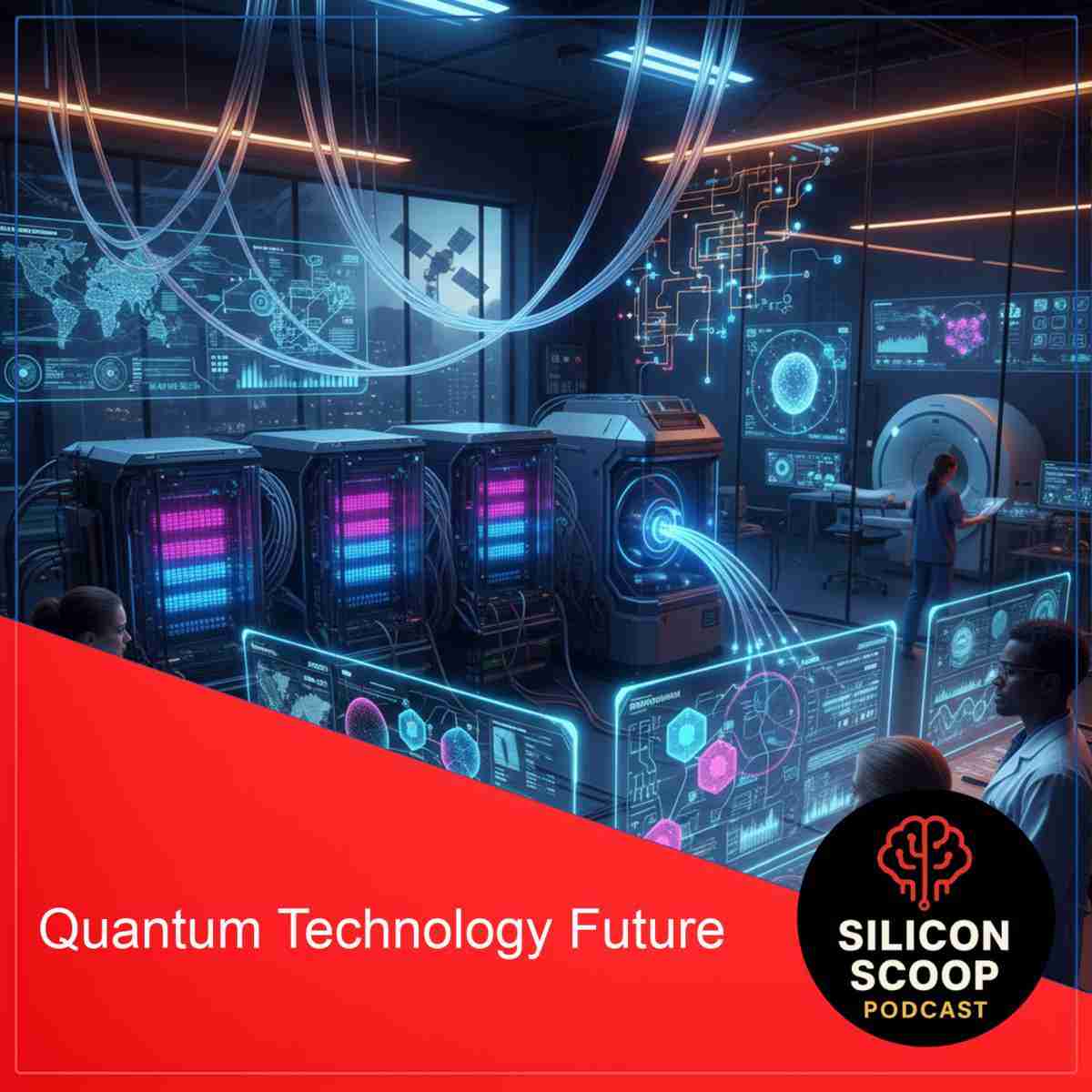
Exploring the Quantum Technology Future: How Quantum Technology Works and Its Transformative Impact
Estimated reading time: 12 minutes
Key Takeaways
- Quantum technology uses superposition and entanglement to compute, sense, and communicate in ways classical devices cannot.
- Major advances like IBM’s 133‑qubit “Heron” and 1,121‑qubit “Condor” processors signal rapid progress toward more capable systems.
- Quantum computing can accelerate drug discovery and materials science using algorithms like VQE, QPE, and QAOA.
- Quantum sensors enable ultra-precise navigation, medical imaging, and environmental monitoring.
- Quantum-safe encryption (QKD and PQC) is critical as quantum computers threaten RSA and ECC via Shor’s algorithm.
- Hybrid quantum‑classical approaches may eventually enhance AI and machine learning through faster linear algebra, quantum kernels, and improved sampling.
Table of contents
- Exploring the Quantum Technology Future: How Quantum Technology Works and Its Transformative Impact
- Key Takeaways
- Introduction
- Section 1 – Fundamentals of Quantum Technology: How Quantum Technology Works
- Section 2 – Practical Applications & Impact on Everyday Life: Quantum Technology Impact on Healthcare
- Section 3 – Optimizing Logistics, Transportation, and Finance: Future of Quantum Computing in Optimization
- Section 4 – Ultra-Secure Communications and Quantum Safe Encryption: Quantum Safe Encryption Benefits
- Section 5 – Supercharging Progress in AI with Quantum Computing: Quantum Technology Applications Illuminate AI
- Conclusion & Future Outlook
- FAQ Section
Introduction
Quantum technology is the next big leap in science and engineering. It uses ideas from quantum mechanics—like superposition and entanglement—to do things that classical devices simply cannot. In other words, quantum technology shows us how quantum technology future might unfold and warms us up to understanding how quantum technology works. Recently, big names have entered the scene. For example, IBM unveiled new quantum systems—the 133‑qubit “Heron” and the 1,121‑qubit “Condor” processors—with roadmaps to even more advanced systems. Denmark has also set ambitious plans to build the “world’s most powerful commercial quantum computer.” These groundbreaking events are changing industries from healthcare to secure communications. In the following sections, we dive into the fundamentals, practical applications, real-world optimizations, ultra‐secure communications, and the exciting overlap with AI.
──────────────────────────────
Section 1 – Fundamentals of Quantum Technology: How Quantum Technology Works
Quantum technology is based on quantum mechanics—the same physics rules that explain the behavior of atoms and particles. By harnessing superposition (where quantum systems exist in multiple states at once) and entanglement (where particles are inter-linked no matter the distance), quantum devices can process information, sense physical changes, and secure communications in ways that classical devices cannot.
Key points include:
- • Definition: Quantum technology exploits the principles of quantum mechanics to compute, sense, and communicate.
- • Main branches:
- – Quantum computing: Uses qubits instead of bits and promises superior computing performance in certain tasks.
- – Quantum sensing & metrology: Provides extreme-precision measurements of physical quantities.
- – Quantum communication & networking: Enables secure transfer of information.
- – Quantum simulation: Models complex systems that are otherwise too difficult for classical computers.
Time Horizons for Quantum Technology:
- • Near Term (0–5 years):
- – Use of NISQ (Noisy Intermediate-Scale Quantum) devices.
- – Early deployment of niche quantum sensors.
- • Medium Term (5–10 years):
- – Introduction of early error‑corrected or strongly error‑mitigated processors.
- – Deployment of practical quantum key distribution links.
- • Long Term (10+ years):
- – Potential full-scale fault‑tolerant quantum computers capable of revolutionizing encryption and simulation.
Recent developments back up these trends. IBM’s new 133‑qubit “Heron” processor and the even larger “Condor” system have set the stage for future quantum breakthroughs. This progress was reported by IBM Research in “IBM introduces IBM Quantum Heron and Osprey processors” (IBM Quantum) and detailed by MIT Technology Review in “IBM’s new quantum chip signals the start of the quantum error-correction era” (MIT Technology Review).
These advances pave the way for exploring quantum computing benefits. As we move from theory to practice, the background of quantum physics begins to merge with tangible real-world applications.
Call to Action 1
──────────────────────────────
Section 2 – Practical Applications & Impact on Everyday Life: Quantum Technology Impact on Healthcare
Transforming Medicine, Drug Discovery, and Materials Science
Classical computers struggle to simulate molecules because the number of possibilities for electrons grows very fast. Quantum computers come to the rescue. Using algorithms like the Variational Quantum Eigensolver (VQE), Quantum Phase Estimation (QPE), and Quantum Approximate Optimization Algorithm (QAOA), they simulate chemical systems with much higher accuracy.
Bullet Points:
- • Classical methods cannot efficiently handle the exponential scaling of complex molecules.
- • With VQE and QPE, quantum devices can calculate things like binding energies, reaction pathways, and properties of new materials.
- • Real‑world initiatives include partnerships by Biogen, Roche, and automotive giants like Mercedes‑Benz, BMW, and Volkswagen who have collaborated with IBM and Google in case studies.
These efforts are already showing promise to reduce drug discovery time and design novel materials more efficiently. For more detailed reference on these breakthroughs, see IBM Research case studies (IBM Research case studies) and MIT Technology Review articles (MIT Technology Review articles).
Everyday Quantum Sensors
Quantum sensors use quantum coherence, superposition, and entanglement to measure physical quantities with amazing precision. They are becoming part of everyday life in several ways:
- • Navigation without GPS: Cold‑atom gravimeters and accelerometers can help submarines, aircraft, and ships navigate when GPS signals fail.
- • Medical imaging: Quantum magnetometers and advanced imaging systems promise higher‑resolution brain scans, improving diagnostics.
- • Environmental monitoring: Quantum clocks and gravimeters can monitor changes in Earth’s gravitational field to detect underground water, ice changes, and even geological shifts.
Everyday applications of these sensors can transform how we travel, diagnose diseases, and monitor our planet, ensuring that quantum sensors in everyday life are a software and hardware revolution in precision measurement. Research on these sensors is backed by projects like those at the University of Nottingham and initiatives by the European Space Agency; see more examples at Nature News and MIT Technology Review.
──────────────────────────────
Section 3 – Optimizing Logistics, Transportation, and Finance: Future of Quantum Computing in Optimization
In the modern world, complex problems in logistics, transportation, and finance challenge classical methods. Quantum computing offers a new way to solve these problems by exploring enormous solution spaces faster than ever.
Challenges of Classical Approaches:
- • Combinatorial explosion in route choices and scheduling.
- • Real-time dynamic constraints in transportation and asset management.
- • Multiple trade-offs in cost, time, and risk management.
Quantum Approaches:
- • Gate‑Based Algorithms:
- – Algorithms like QAOA promise to optimize routing and scheduling problems by using quantum tunneling to escape local minima.
- • Quantum Annealing:
- – Utilized by companies such as Volkswagen and DHL, quantum annealing helps in finding low‑energy solutions in complex optimization landscapes.
- • Quantum‑Inspired Solutions:
- – Even before complete quantum advantage is reached, quantum‑inspired algorithms running on classical hardware lend speedups for specific tasks in energy management and supply chain optimization.
Real-World Examples:
- • Automotive: Volkswagen has experimented on traffic flow optimization using quantum methods.
- • Finance: Institutions like JPMorgan Chase, Goldman Sachs, and HSBC are using quantum algorithms for portfolio optimization and market risk analysis.
Keywords like “future of quantum computing” and “quantum technology applications” underline how upcoming quantum breakthroughs will reshape problem-solving in these industries. For more insights, refer to case studies on IBM and Google collaborations (IBM and Google collaborations) and reports from MIT Technology Review (MIT Technology Review).
──────────────────────────────
Section 4 – Ultra-Secure Communications and Quantum Safe Encryption: Quantum Safe Encryption Benefits
The digital world today relies on encryption methods such as RSA and ECC to protect sensitive information. However, quantum computers running Shor’s algorithm might break these classical systems quickly. This risk spurs the need for quantum-safe encryption.
Current Vulnerabilities:
- • Modern encryption relies on math problems deemed hard for classical computers.
- • A fault‑tolerant quantum computer could compromise RSA and other schemes using Shor’s algorithm.
- • “Harvest now, decrypt later” concerns arise when adversaries store data for future decryption.
Quantum Solutions:
- • Quantum Key Distribution (QKD):
- – Uses quantum states like single photons to exchange cryptographic keys securely.
- – Protocols such as BB84 and E91 make sure any eavesdropping disturbs the quantum state, thereby revealing attacks.
- • Post‑Quantum Cryptography (PQC):
- – Involves classical cryptography methods revamped to resist quantum attacks.
- – Institutions such as NIST are standardizing algorithms like CRYSTALS‑Kyber and CRYSTALS‑Dilithium for future-proof security.
Quantum safe encryption benefits include strengthened digital privacy and intact data integrity even when quantum computers become common. These topics are extensively researched by NIST and explained in various guidance documents available from standardization bodies; see details at NIST and related articles on MIT Technology Review.
──────────────────────────────
Section 5 – Supercharging Progress in AI with Quantum Computing: Quantum Technology Applications Illuminate AI
Quantum computing’s potential is also set to supercharge artificial intelligence. Hybrid quantum‑classical models could bring significant advancements in AI and machine learning, especially for tasks that rely on heavy linear algebra or complex optimizations.
How Quantum Computers Enhance AI:
- • Faster Linear Algebra:
- – Algorithms such as the Harrow–Hassidim–Lloyd (HHL) algorithm offer promising speedups in solving systems of linear equations.
- • Quantum‑Enhanced Feature Spaces:
- – Quantum kernels and variational quantum classifiers can map data to high‑dimensional spaces, enabling more powerful classification.
- • Hybrid Models:
- – Early research shows that small quantum circuits can be integrated into classical neural networks to improve performance on niche tasks.
- • Sampling and Generative Models:
- – Quantum systems naturally perform sampling and can support advanced generative algorithms.
Current Industry Interest:
- • Tech giants like IBM, Google, Microsoft, Amazon, and startups such as Xanadu and QC Ware are exploring the potential intersections of AI and quantum computing.
- • Although practical advantages are still on the horizon, early research demonstrates that such hybrid quantum‑classical approaches may eventually transform fields from natural language processing to image recognition.
In this way, the “future of quantum computing” merges with “quantum technology applications” to offer exciting, though still evolving, benefits for AI systems. For further details, explore industry updates from IBM (IBM) and relevant research reports from MIT Technology Review (MIT Technology Review).
──────────────────────────────
Conclusion & Future Outlook
The quantum technology future promises transformative change across many industries. From understanding how quantum technology works at a fundamental level to its impactful applications in healthcare, sensors, logistics, secure communications, and AI, the possibilities are enormous. In summary:
- • Quantum principles like superposition and entanglement allow quantum devices to handle tasks impossible for classical systems.
- • In medicine and materials science, quantum computing benefits include accelerated drug discovery and advanced material design through algorithms like VQE, QPE, and QAOA.
- • Everyday applications owe much to quantum sensors, which improve navigation, imaging, and environmental monitoring.
- • Optimization in logistics and finance is reimagined with quantum algorithms that tackle combinatorial explosions and dynamic constraints.
- • Ultra‑secure communications rely on quantum safe encryption, with QKD and PQC paving the way for future-proof cybersecurity.
- • The collaboration between quantum computing and AI hints at revolutionizing complex data processing and algorithmic efficiency.
Quantum technology is widely recognized as a key general‑purpose technology for the coming era. Its economic, social, and geopolitical ripple effects are already being debated and will only grow as more robust quantum systems come online. While near‑term advancements with NISQ devices provide a glimpse of a quantum-enhanced future, medium‑term hybrid systems and long‑term fault‑tolerant quantum computers point toward even grander transformations. As research continues and quantum systems mature, industries like healthcare, transportation, security, and AI may experience dramatic improvements.
Call to Action 2
──────────────────────────────
FAQ Section
1. How does quantum technology work?
Quantum technology works by harnessing quantum mechanics. This involves principles like superposition and entanglement, which allow quantum systems to process information beyond what classical systems can do. This is why many are excited about learning how quantum technology works.
2. What are the key benefits of quantum computing?
Quantum computing benefits include solving complex problems faster, potentially revolutionizing drug discovery, materials design, optimization in logistics and finance, secure communications, and AI. It offers pathways to progress where classical computing falls short.
3. How will quantum technology impact healthcare and everyday devices?
Quantum technology impact on healthcare is profound. It helps simulate molecular structures and accelerate drug discovery. In everyday devices, quantum sensors may improve navigation systems, medical diagnostic tools, and environmental monitoring, making these technologies far more precise.
4. What makes quantum sensors different from classical sensors?
Quantum sensors operate on quantum coherence, superposition, and entanglement. This allows them to measure physical quantities with superior precision. Terms like “quantum sensors in everyday life” capture their potential to enhance navigation, imaging, and environmental monitoring.
5. How safe is data in a quantum computing era?
Current classical encryption methods like RSA face risks from quantum computers. Quantum safe encryption benefits come from approaches such as Quantum Key Distribution (QKD) and Post‑Quantum Cryptography (PQC) which protect data even when advanced quantum machines are in play.
6. What industries will benefit most from the future of quantum computing?
Industries from healthcare to logistics, finance, and AI are poised to benefit. For example, drug discovery can become more efficient, transportation networks can be optimized using quantum algorithms, and secure communications can be guaranteed with quantum safe encryption.
7. How soon will quantum technology be part of our daily lives?
In the near term (0–5 years), we will see NISQ devices and early niche implementations, while the most transformative applications might emerge in the 5–10 year medium term or later as error‑correction improves and systems scale up.
8. Can quantum computers solve every problem faster than classical computers?
Not every problem will see a quantum speedup. Quantum computers excel in specific domains like optimization, simulation, and certain algorithms. Classical systems still outperform them on many everyday tasks, making quantum computing a complementary, rather than universal, solution.
9. What are examples of quantum safe encryption in use today?
Examples include projects using QKD in metropolitan networks in China, Switzerland, and parts of Europe. Additionally, governments are adopting post‑quantum cryptography recommendations as detailed by institutions like NIST to secure future communications.
10. Where can I learn more about how quantum technology works and its current progress?
To dive deeper into the subject, follow research updates on IBM Research websites (IBM Research websites), read MIT Technology Review’s articles on quantum developments (MIT Technology Review’s articles), and explore initiatives from national and international scientific organizations such as the Novo Nordisk Foundation and Nature News (Nature News).
With quantum technology advancing rapidly, staying informed can help you navigate a future where quantum mechanics moves from theory to everyday application. Continue to learn and follow the latest updates in this exciting field.
Additional Links
Flowgrammer.ca – 💡 Unlock AI-Powered Automation! Let flowgrammer.ca handle complex workflows so you can focus on growing your business.
- Silicon Scoop Podcast – Stay Informed, Stay Ahead!
- Startup Talk Podcast
- Flowgrammer Podcast –
- Startup Investor Drinks – Join Toronto’s Startup Community and connect with fellow startup enthusiasts and investors.
- TorontoStarts Startup and Entrepreneur Community – Become a part of Toronto’s thriving startup ecosystem.
- Workhaus – Discover flexible workspace solutions for your business needs.
- Work with The Startup Coach – Get expert guidance and mentorship for your startup journey.
- Reach out to Jon Irwin on LinkedIn – Connect with our co-host and technology expert.
Flowgrammers.ca – 💡 Join Toronto’s Fastest Growing AI and Busiess Automation Community..
Flowgramming.space – 💡 AI Agent and Workflow Marketplace..
Episode transcript
Read the full transcript
Craig: we used to think quantum computing was sci fi, but ibm's new 1,121 qubit condor chip just dragged it into reality. if you rely on standard encryption or gps, the foundation of your tech stack is about to crack wide open. so the quantum errors just went hardware native. we've moved beyond theory. ibm's heron and condor processes are live, enabling calculations for drug discovery and logistics that classical computers physically cannot handle. we are transitioning from noisy experimental to actual error corrected processing. this triggers the harvest now decrypt later crisis. your current data is being hoarded by bad actors to be unlocked by these very machines in a few years. what do you think about this, john?
Jon: i think this is great, and this is kind of talking about, like, just kinda letting you know the changes that like, the big five big changes that we've covered individually previously. so, some of these include advances in medicine and material discovery, sensors that dramatically improve navigation and health monitoring, optimization of complex systems like logistics and finance, ultra secure communications that resist hacking, and tools to boost artificial intelligence. so, quantum technology, just to get everyone on the same page, it leverages quantum mechanical principles such as superposition, which is a system existing in multiple states simultaneously, and entanglement, which is correlations that link particles across a distance. so these phenomena enable quantum computers, sensors, and communication systems that work fundamentally different from classical devices. some people like to call it magic, but, instead of bits that are either zero or one, quantum systems use qubits that can be zero and one at the same time, which allows them to process information in ways that classical computers can't. so the core idea itself, it underpins a new class of tools. so quantum computers, they can explore huge combinations of possibilities at once. so they can crack your password in less than, i don't know, a few seconds. quantum sensors, because they're so sensitive, they can detect signals with far greater precision than existing devices. and we've all we covered all this, but quantum communication systems that use quantum states to transmit information securely. and so they could transform all of these fields once it gets to a usable thing. right now and we've talked about this too. right, craig? quantum computing is where computers were in the seventies, i think it was.
Craig: yeah. yeah.
Jon: i go ahead. no. no. you're good.
Craig: think of this update like a mouse in a maze versus water in a maze. a classic computer is the mouse. it runs into a wall, turns around, tries a new path. it's fast, but it does one thing at a time. quantum computer is like pouring water into the maze. the water flows down every path simultaneously, and it instantly finds the exit. so we just upgraded from the mouse to the host. you know? i am excited about this. every time we see these new chips and these new breakthroughs, quantum computing becomes more of a reality to me and gets it seems like ten years closer almost every time. so, you know, we're talking about near term within less than five years for specialized sensors using these chips, and about ten years or so for having them on your desktop.
Jon: yeah. and, like, for those of you that are like, oh, well, we're like, there's no the quantum is so far away or quantum computing or quantum mechanics are it's it's still sci fi. to be honest, there's a lot of technologies that we take for granted. so mri machines, lasers, gps atomic clocks, they all depend on quantum mechanics even if we don't realize it. and these come from sort of the first wave of quantum technology that exploited quantum behavior, but not the full quantum information processing. so we're already we already have implementation in in industry now. we just haven't taken it to the next level.
Craig: and we're starting to see use more and more in everyday things we never would have thought of. like, we talked about a couple of weeks ago. we talked about how quantum computing is going to be used in edge states of, robotics to determine the exact position of the arm and state in real time, in the local in the wrist or in whatever because the computational power is too much. but at a quantum state level, you can now, have that robot react in real time so much faster than it could have before.
Jon: yeah. yeah. like, it's accelerating. i think it's, in my opinion, it's accelerating faster than the development of the computer, but it's much more complex as well. so, like, it could seem like it's a like, the reason why i'm saying that is because quantum is so much more complex than a computer. and so it might seem like it's accelerating slow because of technology, because of where we're at, and because of how many people can be involved in internet and all that sort of stuff. i think it's evolving much quicker than the computer was back in the day.
Craig: as you mentioned, we're in the vacuum tube transit two transistor moment. we're moving from massive noisy experimental rigs to scalable error corrective architecture. to make these chips work, they operate at near absolute zero negative 273 degrees celsius that is colder than deep space. these machines require a dilution refrigerator that sounds like a jet pulse compared to your refrigerator. the banking sector, jpmorgan, goldman sachs isn't just interested. they're actively running portfolio optimization on these machines because even a 1% efficiency gain in a quantum model is worth billions. so keep that in mind. you know, they're not just something that's out there. and if you didn't know, biology did it first. european robins actually use quantum entanglement in their retinas to see earth's magnetic field for migration. we are just trying to reverse engineer a bird's eye. think about that.
Jon: yeah. yeah. this is, so the thing is that quantum technology is not a single thing. it's a it's a suite of emerging technologies. so, it's not just computing. it's a bunch of different things. it's computing. it's sensing. it's communication. so, that's why we have all of that's why we cover so much because there's so many different industries that are gonna be affected by this that, that people are working on technology for using quantum technology as the base.
Craig: yeah. this quantum technology is what changes us from our current state to a star trek style civilization yeah. as we just learn leaps and bounds so much faster. these qubits are incredibly fragile and reach decoherence fast. a slight temperature change or vibration ruins the calculation. we are in a nisq era noisy intermediate scale quantum, meaning the computers still make a lot of mistakes. so quantum isn't replacing your laptop just yet. it's replacing the laboratory, accelerating science from centuries to days. does the era of computer breaking all known encryption terrify you, or are you excited for better battery tech? vote and let us know what you think.
More from Silicon Scoop
All episodes
silicon-scoop · October 16, 2026
Meta’s $18 Billion Teen Safety Settlement: Soft Guardrails, Hard Leverage Over TikTok and YouTube
Deep dive on Meta teen safety settlement, social media addiction lawsuit, new Facebook Instagram time limits and pressure on TikTok YouTube age verification.
View episode
silicon-scoop · October 15, 2026
How Claude Mythos Is Reshaping Cryptanalysis: HAWK, AES and the Rise of AI-Driven Crypto Research
Claude Mythos cryptanalysis weakens HAWK post-quantum signature, speeds AES Möbius Bridge attack, and powers CryptanalysisBench benchmark in AI-driven crypto research.
View episode

silicon-scoop · October 14, 2026
Nvidia’s $12.9 Billion Hugging Face Bet: How Controlling the Open-Source Model Hub Reshapes AI Chips, Cloud, And Competition
Nvidia Hugging Face acquisition could reshape open source AI models, AI chip dominance, and the global developer model hub, raising antitrust and neutrality questions.
View episode