
Blue Energy Breakthroughs
Blue Energy Breakthroughs: Exploring the Future of Renewable Energy from Salt Water Estimated reading time: 10 minutes Key Takeaways Blue energy, or osmotic energy, generates electricity from the free energy released when freshwater mixes with saltwater. New technologies such as nanofluidic and lipid bilayer membrane approaches are improving efficiency and power density. Experimental studies indicate […]
With Craig Major and Jon Irwin
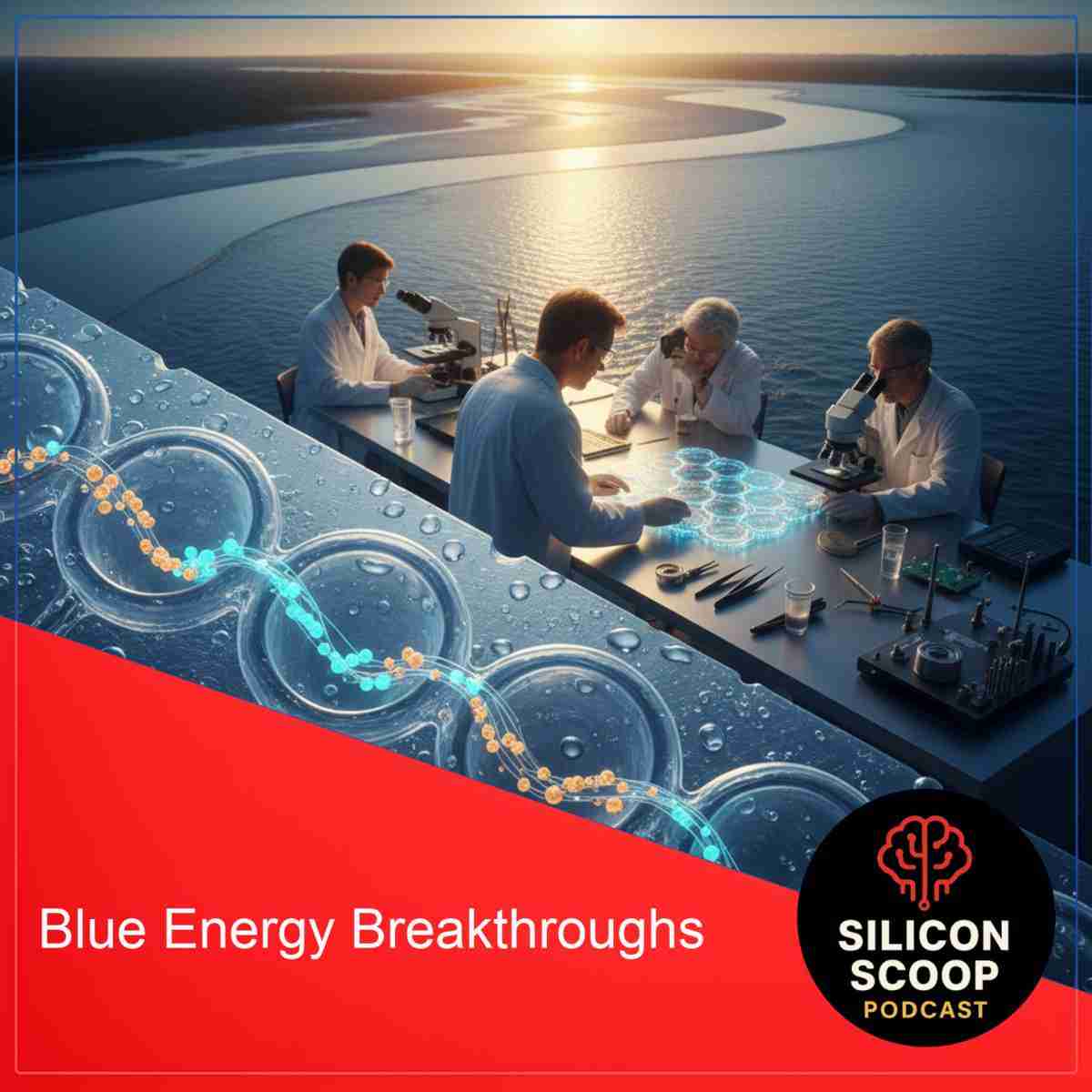
Blue Energy Breakthroughs: Exploring the Future of Renewable Energy from Salt Water
Estimated reading time: 10 minutes
Key Takeaways
- Blue energy, or osmotic energy, generates electricity from the free energy released when freshwater mixes with saltwater.
- New technologies such as nanofluidic and lipid bilayer membrane approaches are improving efficiency and power density.
- Experimental studies indicate power densities around 15 W/m², about 2–3× higher than advanced polymer membranes under similar conditions.
- Key challenges remain in scalability, long-term stability, and fouling resistance for real-world deployment.
- Blue energy breakthroughs have broader applications including estuarine power plants, industrial wastewater treatment, and integration with desalination.
Table of contents
- Blue Energy Breakthroughs: Exploring the Future of Renewable Energy from Salt Water
- Introduction
- Call to Action 1
- Section 1: Fundamentals of Blue Energy and Osmotic Power
- Section 2: Innovative Membrane Design & Nanofluidic Osmotic Energy Conversion
- Call to Action 2 (after Section 2)
- Section 3: Engineering Challenges, Trade-Offs, and Scalability Considerations
- Section 4: Broader Applications, Future Outlook, and Impact
- Call to Action near the End
- FAQ Section
- Conclusion
Introduction
Blue energy breakthroughs are set to transform how we generate clean power. Blue energy, or osmotic energy, is the electricity obtainable from the free energy released when freshwater mixes with saltwater. This process occurs naturally at places like estuaries, where rivers meet the sea. Using an ion‐selective membrane to separate the two water types, we can harvest energy as ions flow from the high‑concentration salt water to the low‑concentration freshwater. This innovative process combines blue energy technology benefits with renewable energy from salt water.
Osmotic energy conversion is emerging as a vital part of our renewable future. New technologies – such as nanofluidic and lipid bilayer membrane approaches – are addressing past efficiency challenges and pushing the boundaries of what is possible. These advances open a window into cleaner, sustainable power generation. For more background information on blue energy research, see Nature Energy: https://www.nature.com/nenergy/.
Section 1: Fundamentals of Blue Energy and Osmotic Power
Blue energy relies on the natural chemical differences between saltwater and freshwater. Here we break down the essential concepts:
- • Definition:
- – Blue energy, also known as osmotic energy, is the power harnessed from the mixing of waters with different salt concentrations.
- – An ion-selective membrane allows this process to occur by permitting only specific ions (often cations) to cross, creating a flow of ions that generates voltage.
- – This process exploits the chemical potential difference developed between two bodies of water.
Reference: Nature Energy: https://www.nature.com/nenergy/
- • Mechanism of Energy Conversion:
- – A salinity gradient is set up between fresh and salt water.
- – The ion-selective membrane, positioned between these water bodies, enables the faster movement of certain charged particles.
- – As ions travel through the membrane, they produce a current and, hence, measurable power output.
- – This mechanism provides a clean alternative to fossil fuels by tapping into a natural process.
Reference: https://www.nature.com/nenergy/
- • Blue Energy Technology Benefits:
- – Clean and renewable power derived from natural water mixing.
- – Sustainable energy production located at estuaries removes dependency on nonrenewable resources.
- – Reduction in greenhouse gas emissions compared to fossil fuel-based generation.
- – The technology represents a new frontier in energy research, seen as a promising addition to existing renewable sources.
Reference: https://www.nature.com/nenergy/
- • Research Insights:
- – An EPFL study confirmed the hydration lubrication principle, which helps reduce friction as ions move through nanopores.
- – The experimental confirmation shows that higher power densities (around 15 W/m²) are achievable compared to conventional polymer membranes.
Reference: https://www.nature.com/nenergy/
Section 2: Innovative Membrane Design & Nanofluidic Osmotic Energy Conversion
Innovation in membrane design is the key to unlocking higher efficiency in blue energy systems. This section details the breakthrough nanofluidic approach and its potential for improving ion transport.
- • Nanofluidic Osmotic Energy Conversion:
- – The new design approach uses solid-state nanopores that are enhanced with lipid coatings.
- – These nanopores – specifically formulated in silicon nitride – are modified to include supported lipid bilayers.
- – The lipid coating forms a hydration layer around each pore. This nanometric water layer acts as a natural lubricant (hydration lubrication) that reduces friction for ion flow while ensuring high selectivity.
- – By controlling these tiny channels at the nanoscale, the system gains both precision and scalability.
Keywords used: nanofluidic osmotic energy conversion, lipid bilayer nanopore membrane
Reference: https://www.nature.com/nenergy/
- • Performance and Efficiency:
- – With a ~1,000‑pore array in the test membranes, the technology achieved power densities of approximately 15 W/m².
- – This output is roughly 2–3× higher than advanced polymer-based ion-exchange membranes under similar conditions.
- – The design balances pore density with fine nanofluidic control which is crucial to boost efficiency.
- – Practical experiments under realistic salinity gradients, such as 0.5 M versus 0.01 M NaCl, confirm the breakthrough results.
Keywords used: osmotic energy harvesting efficiency
Reference: https://www.nature.com/nenergy/
- • Design Details and Research Findings:
- – The membrane is built using stalactite-shaped nanopores. These asymmetrical pores direct ions in a manner that enhances selectivity and transport speed.
- – The lipid bilayer coating not only provides lubrication but also fine-tunes the electrical properties.
- – According to EPFL studies, the combined effects of nanofluidic design and lipid coatings create a synergy that boosts performance compared to traditional systems.
- – Expert quotes note that the new approach advances blue energy research into the realm of rational, nanoscale design.
Keywords integrated: lipid bilayer nanopore membrane
Reference: https://www.nature.com/nenergy/
Section 3: Engineering Challenges, Trade-Offs, and Scalability Considerations
Despite the significant promise of blue energy, challenges remain. This section tackles the technical hurdles and comparisons between emerging and traditional technologies.
- • Core Engineering Challenges:
- – Ion mobility versus selectivity: The heart of the blue energy challenge is balancing fast ion movement with the need for selective ion transport.
- – Traditional polymer ion-exchange membranes boost mobility at the expense of selectivity – leading to energy loss through co‐ion leakage.
- – The current nanofluidic approach shows promise but must still address issues such as long-term membrane stability and production challenges.
Keywords used: salinity gradient energy advantages
Reference: https://www.nature.com/nenergy/
- • Trade-Offs in Membrane Design:
- – Conventional versus nanofluidic techniques:
- • Polymer membranes are proven at a large scale but suffer from lower power densities.
- • Nanofluidic devices can exhibit excellent selectivity and high output on a small scale; however, scaling them up is challenging.
- – The current breakthrough attempts to blend the scalable nature of polymer membranes with the finely controlled ion channels of nanofluidic devices.
- – Factors such as pore density, mechanical durability, and cost-effectiveness need careful trade-off analysis.
- – Trade-offs exist in enhancing ion transport speed while stopping unwanted ions from passing through.
Reference: https://www.nature.com/nenergy/
- • Scalability and Long-Term Reliability:
- – Scalable membrane fabrication is a significant hurdle. Producing large-area membranes with billions of precise nanopores requires advanced, low-cost methods.
- – Stability challenges involve ensuring that lipid bilayers remain robust under variable conditions, including shifts in pH, temperature, and presence of contaminants.
- – Fouling and biofilm formation in real-world water sources add to the complexity of deployment.
- – Ongoing research aims to improve long-term durability without sacrificing performance.
Reference: https://www.nature.com/nenergy/
Section 4: Broader Applications, Future Outlook, and Impact
The innovations discussed in earlier sections pave the way for a range of applications and a bright future for blue energy. This section outlines the impact beyond the laboratory.
- • Applications of Blue Energy Breakthroughs:
- – Estuarine Power Plants:
- • Generate sustainable electricity where freshwater meets the sea.
- • Reduce reliance on fossil fuels and lower greenhouse gas emissions.
- – Industrial Wastewater Treatment:
- • Extract energy from salinity differences in industrial effluents.
- • Enhance energy efficiency in wastewater management.
- – Integration with Desalination:
- • Use the process in tandem with desalination plants to harvest energy from brine discharge.
- • Boost overall system efficiency and lower operating costs.
Keywords: renewable energy from salt water, blue energy breakthroughs
Reference: https://www.nature.com/nenergy/
- • Future Research Directions and Insights:
- – Improving membrane durability and long-term stability:
- • Researchers plan to explore cost-effective scaling methods and more robust lipid formulations.
- • Polymer-supported bilayers or hybrid coatings may enhance longevity in challenging environments.
- – Advancing Interdisciplinary Approaches:
- • Contributions from nanofabrication, materials science, and biomimetic research are crucial for further breakthroughs.
- • Future designs may combine insights from multiple fields to fine-tune ion transport dynamics even further.
- – Expanding the Field:
- • There is potential to adapt the hydration lubrication principle to other sectors such as selective ion separation and biosensing.
- • Future research could open pathways for tailored energy devices in industrial and environmental applications.
Keywords integrated: renewable energy from salt water, blue energy breakthroughs
Reference: https://www.nature.com/nenergy/
- • Comparisons with Existing Technologies:
- – Traditional polymer ion-exchange membranes remain vital for large-scale energy conversion; however, they typically achieve only a few watts per square meter.
- – New nanofluidic membranes show a marked improvement, reaching up to 15 W/m².
- – While the current breakthrough offers higher performance in test conditions, it also presents challenges in manufacturability and long-term stability compared to mass-produced polymer membranes.
- – By integrating design precision from nanofluidics with scalable features of polymer membranes, future systems may combine the best aspects of both worlds.
Reference: https://www.nature.com/nenergy/
––––––– Call to Action near the End –––––––
[Call to Action 2 Text: Don’t let innovation pass you by! Visit Flowgrammer today to unlock more about our breakthrough solutions in renewable energy and be part of the blue energy revolution.]
FAQ Section
Q1: What is blue energy, and how does osmotic energy conversion work?
A1: Blue energy (osmotic energy) uses the mixing of freshwater and saltwater to produce electricity. An ion-selective membrane between the two types of water allows ions to move from high- to low-concentration areas, creating an electrical current. This process is efficient and renewable. Keywords: blue energy breakthroughs, osmotic energy
Q2: How do lipid bilayer nanopore membranes improve efficiency?
A2: The lipid bilayer nanopore membranes are coated with a thin hydration layer that acts as a molecular lubricant. This reduces friction, allowing ions to pass through more quickly while keeping the transport selective. The result is higher power density and efficiency compared to traditional membranes. Keywords: lipid bilayer nanopore membrane
Q3: What advantages do blue energy technology benefits offer?
A3: Blue energy technology benefits include sustainable electricity generation, reduced greenhouse gas emissions, and the ability to produce power at natural estuaries. Additionally, improved efficiency means more energy can be harvested from the same natural process. Keywords: blue energy technology benefits
Q4: Why is balancing ion mobility and selectivity important in blue energy systems?
A4: A key challenge is ensuring that ions move quickly (high mobility) while maintaining control over which ions pass (high selectivity). If the membrane allows too many unwanted ions through, efficiency suffers. The new nanofluidic designs address this by improving both factors simultaneously. Keywords: osmotic energy harvesting efficiency, salinity gradient energy advantages
Q5: What are the main engineering challenges for scaling blue energy systems?
A5: Scaling blue energy systems involves reliably fabricating large-area membranes with billions of nanopores. Other challenges include maintaining the stability of delicate lipid bilayers, managing fouling from environmental contaminants, and ensuring long-term durability under variable conditions. Keywords: salinity gradient energy advantages
Q6: How do experimental studies support these new membrane designs?
A6: Experimental studies at EPFL tested membranes under realistic salinity gradients similar to river–sea conditions (e.g., 0.5 M vs 0.01 M NaCl). The findings indicated a power density of about 15 W/m², which is 2–3× greater than conventional polymer membranes. Keywords: osmotic energy harvesting efficiency
Reference: https://www.nature.com/nenergy/
Q7: Can these new technologies be used with other applications besides power generation?
A7: Yes, the same principles can be applied to selective ion separation, water desalination processes, biosensing, and even lab-on-a-chip technologies. The key is the effective control of ion transport using nanofluidic and biomimetic designs. Keywords: blue energy breakthroughs
Q8: What future improvements are anticipated for these blue energy systems?
A8: Future research aims to enhance membrane durability, reduce production costs, and further optimize ion selectivity and transport. Researchers are exploring hybrid coatings and improved lipid chemistries to extend membrane life and performance. Keywords: renewable energy from salt water
Q9: How does this technology compare with current polymer ion-exchange membranes?
A9: Compared to traditional polymer ion-exchange membranes, the new nanofluidic membranes achieve higher power densities (around 15 W/m² vs. a few W/m²). They offer improved control over ion transport, but challenges such as scalability and long-term stability still need further development. Keywords: blue energy technology benefits
Q10: What is the broader impact of blue energy breakthroughs on the renewable energy landscape?
A10: Blue energy breakthroughs offer a promising avenue for expanding renewable power, especially in locations with natural freshwater-saltwater mixing. With a lower environmental impact and potential integration with existing energy and desalination systems, these technologies could significantly contribute to meeting global energy demands sustainably. Keywords: renewable energy from salt water, blue energy breakthroughs
Conclusion
This breakthrough in blue energy offers a glimpse into a future where renewable power from salt water becomes a major component of our energy mix. The detailed insights into membrane design, engineering challenges, and future directions illustrate the potential to reshape our approach to sustainable energy. With continued research and development, blue energy systems could overcome current limitations and help drive a global movement towards green, clean power.
By embracing innovative nanofluidic designs and overcoming traditional trade-offs, blue energy breakthroughs stand poised to play a critical role in the renewable energy revolution. Stay informed and get involved as these technologies move from the lab bench to real-world applications.
Explore more and join the renewable revolution today with Flowgrammer’s advanced innovations in blue energy.
Additional Links
Flowgrammer.ca – 💡 Unlock AI-Powered Automation! Let flowgrammer.ca handle complex workflows so you can focus on growing your business.
Flowgrammers.ca – 💡 Join Toronto’s Fastest Growing AI and Busiess Automation Community..
Flowgramming.space – 💡 AI Agent and Workflow Marketplace..
-
-
- Silicon Scoop Podcast – Stay Informed, Stay Ahead!
- Startup Talk Podcast
- Flowgrammer Podcast –
- Startup Investor Drinks – Join Toronto’s Startup Community and connect with fellow startup enthusiasts and investors.
- TorontoStarts Startup and Entrepreneur Community – Become a part of Toronto’s thriving startup ecosystem.
- Workhaus – Discover flexible workspace solutions for your business needs.
- Work with The Startup Coach – Get expert guidance and mentorship for your startup journey.
- Reach out to Jon Irwin on LinkedIn – Connect with our co-host and technology expert.
-
More from Silicon Scoop
All episodes
silicon-scoop · October 19, 2026
OpenAI’s Jalapeño Chip Stakes a Claim Against Nvidia Blackwell in Real-World AI Inference
OpenAI Jalapeno chip challenges Nvidia GB300 Blackwell with InferenceX AI benchmark results, reshaping AI inference accelerator efficiency and latency.
View episode

silicon-scoop · October 16, 2026
Meta’s $18 Billion Teen Safety Settlement: Soft Guardrails, Hard Leverage Over TikTok and YouTube
Deep dive on Meta teen safety settlement, social media addiction lawsuit, new Facebook Instagram time limits and pressure on TikTok YouTube age verification.
View episode

silicon-scoop · October 15, 2026
How Claude Mythos Is Reshaping Cryptanalysis: HAWK, AES and the Rise of AI-Driven Crypto Research
Claude Mythos cryptanalysis weakens HAWK post-quantum signature, speeds AES Möbius Bridge attack, and powers CryptanalysisBench benchmark in AI-driven crypto research.
View episode