
Why Does Scotch Tape Screech: How Supersonic Transverse Cracks and Collapsing Voids Create the Loud Peeling Sound
Why Does Scotch Tape Screech? Uncovering the Supersonic Secrets Behind Tape Peeling Sound Physics Estimated reading time: 10 minutes Key Takeaways Peeling Scotch tape involves repeated stick-slip events, where the adhesive builds energy and then rapidly releases it. Transverse fractures travel at supersonic speeds (250–600 m/s), creating low-pressure voids along the adhesive interface. The sudden […]
With Craig Major and Jon Irwin
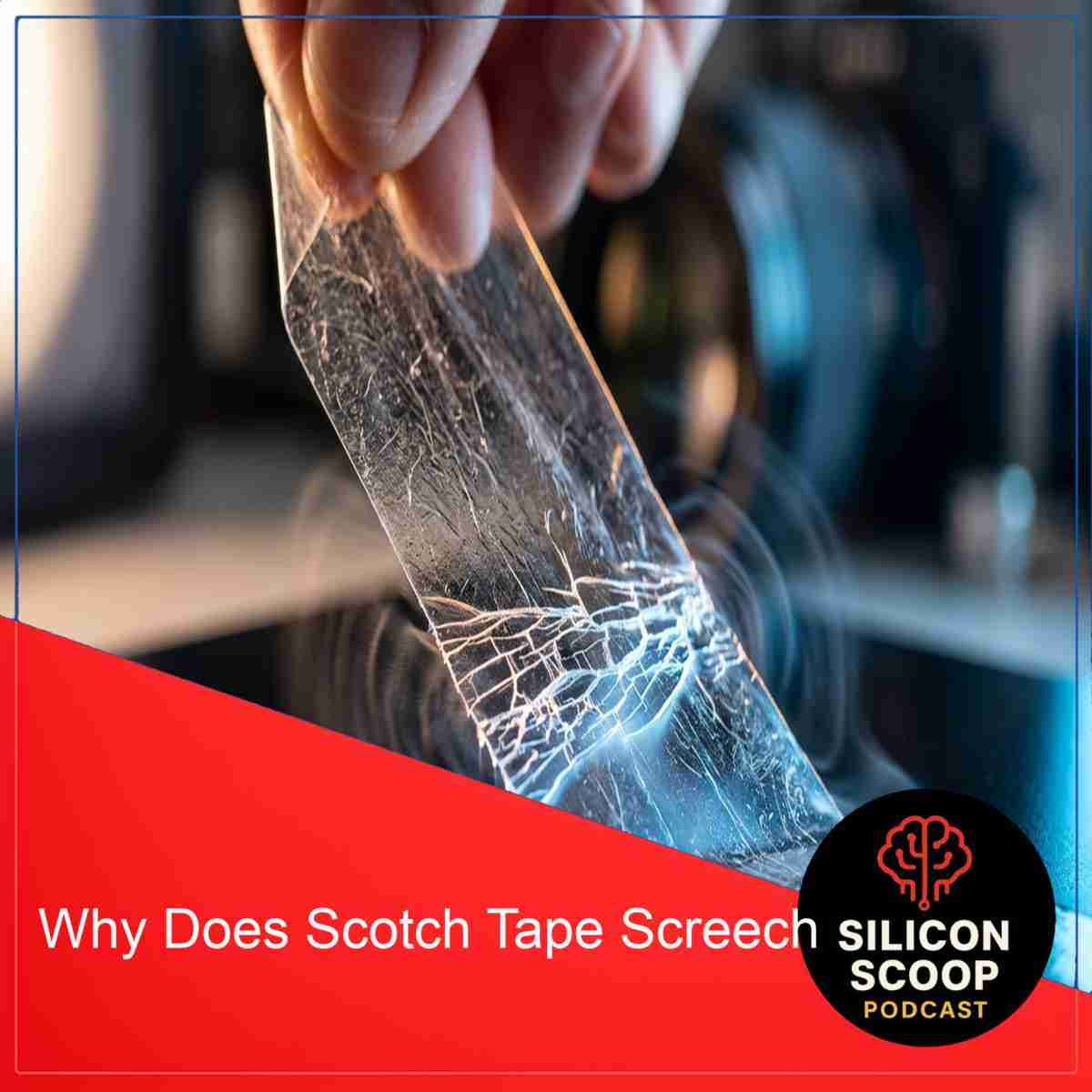
Why Does Scotch Tape Screech? Uncovering the Supersonic Secrets Behind Tape Peeling Sound Physics
Estimated reading time: 10 minutes
Key Takeaways
- Peeling Scotch tape involves repeated stick-slip events, where the adhesive builds energy and then rapidly releases it.
- Transverse fractures travel at supersonic speeds (250–600 m/s), creating low-pressure voids along the adhesive interface.
- The sudden collapse of these voids as ambient air rushes in produces sharp acoustic pulses.
- A rapid sequence of these micro sonic booms is heard as the characteristic screech of tape peeling.
- Historical observations such as the blue glow (triboluminescence) and X‑ray emission further emphasize the rich physics behind this everyday phenomenon.
- These insights show how common materials can reveal complex scientific principles, bridging theoretical physics with practical experiences in everyday life.
Table of contents
- Introduction
- Section 1: The Science Behind the Screeching Sound – Adhesion, Stick-Slip Dynamics, and Fracture Mechanics
- Subsection: Supersonic Crack Propagation
- Subsection: Void Formation and Collapse Mechanics
- Call To Action 1
- Section 2: Historical and Experimental Perspectives on Scotch Tape Phenomena – The History and Early Observations
- Subsection: A Brief History of Scotch Tape
- Subsection: Early Observations and Surprising Phenomena
- Subsection: Modern Experimental Techniques
- Section 3: Detailed Physics & Analysis of Acoustic Generation – Breakdown of Voids and Stick-Slip
- Subsection: Breakdown of the Voids and Acoustic Pulse Formation
- Subsection: Connecting Stick-Slip and Supersonic Dynamics
- Call To Action 2
- FAQ / Common Questions Section
- Conclusion & Key Takeaways
Introduction
Have you ever wondered, “why does scotch tape screech?” This fascinating question invites us to explore the science of everyday things. At first glance, a piece of transparent tape appears simple. Yet when you peel it, a loud, startling noise emerges—a noise that holds secrets of supersonic physics. In this article, we dive into the tape peeling sound physics to explain why is scotch tape so loud. We will uncover how supersonic transverse fractures create tiny sonic booms as they travel through the adhesive.
Scotch tape was invented in 1930 by Richard G. Drew at 3M in Minnesota. Its invention marked the beginning of an everyday product that would later become a model system for studying adhesion, fracture mechanics, and even triboluminescence. This historical background helps us appreciate both the practical and scientific importance of something as common as Scotch tape.
Reference: For more on the invention of Scotch tape, see the historical background details from research findings at the historical background details
Section 1: The Science Behind the Screeching Sound – Adhesion, Stick-Slip Dynamics, and Fracture Mechanics
Pressure‑sensitive adhesives are viscoelastic materials. This means they act partly like a viscous fluid and partly like an elastic solid. When you peel Scotch tape, energy builds up at the adhesive-substrate interface. This accumulation of energy is known as the stick phase. When the energy reaches a threshold, the tape suddenly slips—this rapid release, called the slip phase, causes a fracture in the adhesive. This stick‐slip dynamic is central to understanding tape peeling sound physics.
Key Points:
- • Adhesives stick until energy builds.
- • A rapid slip (with quick fracture) produces a burst of acoustic energy.
- • This process explains why is scotch tape so loud when peeled.
A closer look at transverse fractures in tape reveals that the fracture does not spread uniformly across the tape. Instead, thin cracks travel sideways across the tape’s width.
- • These cracks are narrow bands that move laterally rather than continuously progressing along the tape.
- • Their structure and movement generate specific acoustic pulses perceived as a screech.
The connection between “stick-slip dynamics” and the formation of transverse fractures in tape is key. The build-up of mechanical stress during the stick phase is suddenly released in the slip phase. As the slip occurs, a series of microscopic transverse fractures are created, each of which contributes to the overall acoustic profile.
Source: Detailed explanations on stick-slip dynamics, transverse fractures in tape, and tape peeling sound physics can be found through research details at research details
Subsection: Supersonic Crack Propagation
Experimental observations have shown that microscopic transverse cracks do not move slowly at the adhesive interface—they travel at speeds ranging from 250 to 600 m/s. This velocity range is supersonic considering that the speed of sound in air is around 343 m/s. The high speeds of transverse cracks cause shock waves in the surrounding air. These shock waves are essentially tiny sonic booms, each contributing to the distinct screech resonates when peeling tape.
Highlights of the experimental findings:
- • Ultra‑high‑speed cameras capture the rapid propagation of these cracks.
- • Synchronized high‑sensitivity microphones record the corresponding sound pulses.
- • The high-speed imaging study led by Sigurdur T. Thoroddsen (Physical Review Letters) confirms that these cracks move supersonically.
These supersonic cracks in adhesive are a breakthrough in understanding tape peeling sound physics—they form the basis for the tiny shock waves that generate the audible screech.
Source: For more details on the experimental methods and findings, see the 2010 study reference at the 2010 study reference
Subsection: Void Formation and Collapse Mechanics
When a transverse fracture forms, it leaves behind a tiny void. This void is a low‑pressure region created by the rapid detachment of the adhesive from the substrate. In simple terms:
- • The void forms because the work of adhesion is quickly overcome.
- • The void is a narrow gap where the internal pressure is lower than the ambient air pressure.
As the void travels with the crack, it eventually meets the open edge of the tape. At this edge, the void suddenly collapses because the higher pressure from the surrounding air rushes in. This rapid collapse produces sharp acoustic pulses—each a miniature sonic boom. When many such pulses are generated rapidly, they form the characteristic screech that we hear.
Key Points in Void Dynamics:
- • Rapid, repeated void formation and collapse.
- • Each collapse is linked to a sharp pressure pulse.
- • The series of these events builds the overall screech sound.
These results help answer why is scotch tape so loud: the repetitive nature of these events and the high speeds of the transverse fractures together generate a rapid train of sound pulses.
Source: In-depth details on void formation and collapse mechanics are outlined in the research findings available at the research findings
Call To Action 1
Turn “Busywork Noise” Into Growth
Reading about tiny “sonic booms” in everyday tape is a reminder: the loudest problems in business are usually the small, repetitive ones happening all day long—copy/paste, follow-ups, invoicing, scheduling, reporting. Flowgrammer helps you automate those processes so your team runs smoother, faster, and with fewer mistakes.
👉 Reclaim Your Time — Book a Free Automation Consult > Book a Free Automation Consult
Section 2: Historical and Experimental Perspectives on Scotch Tape Phenomena – The History and Early Observations
Understanding the full picture of Scotch tape’s behavior requires a dive into its historical background and how scientific investigations over the decades have expanded our knowledge.
Subsection: A Brief History of Scotch Tape
Scotch tape is not only renowned for its widespread use but also for its unexpected role in scientific research. The invention of Scotch tape dates back to 1930 by Richard G. Drew at 3M in Minnesota. This breakthrough delivered a transparent, waterproof pressure‑sensitive tape made of a cellophane backing coated with oils, rubber, and resins. Since its debut, Scotch tape has played a dual role as both a convenient adhesive and a model system for studying the physics of adhesion and fracture mechanics.
Key Historical Notes:
- • Invented by Richard G. Drew at 3M in 1930.
- • Simple design led to complex applications in scientific research.
- • Became a model in studying tribology, fracture mechanics, and even charge separation phenomena.
Source: More on the invention and evolution of Scotch tape can be found in historical documents at historical documents
Subsection: Early Observations and Surprising Phenomena
The scientific curiosity around Scotch tape is not new. Even before understanding its acoustic properties, researchers observed other surprising phenomena when peeling tape:
- • Triboluminescence Observation (1939):
– In dark conditions, peeling Scotch tape emits a faint blue glow.
– The blue light is caused by triboluminescence—the emission of light when materials are fractured or rubbed.
– Mechanism: As the adhesive separates, electrons accelerate across small gaps, exciting gas molecules which emit blue light.
- • X‑ray Emission in Vacuum (1953):
– Early experiments by a Russian team revealed that peeling tape in a low‑pressure environment could emit X‑rays.
– The process involved charge separation during the peel, creating electric fields strong enough to accelerate electrons.
– Upon colliding with surfaces, these accelerated electrons produce X‑rays—a phenomenon known as bremsstrahlung radiation.
These early discoveries added layers to our understanding of Scotch tape as more than just an adhesive. It became a gateway into exploring energy contagion in simple mechanical processes.
Source: Detailed accounts of triboluminescence and X‑ray emission from tape peeling are documented in research at research
Subsection: Modern Experimental Techniques
Recent studies have employed advanced techniques to capture and analyze the dynamic process of tape peeling. Modern experimental techniques include:
- • Ultra‑High‑Speed Imaging:
– Cameras with microsecond resolution track the rapid formation of transverse fractures.
– Allows researchers to visualize the instantaneous motion of the peeling front.
- • Synchronized Acoustic Measurements:
– High‑sensitivity microphones record the associated sound pulses with precise time stamping.
– Acoustic data is then correlated with the visual evidence of void formation and transverse fractures.
- • Data Analysis Techniques:
– Synchronization of camera frames with audio signals to pinpoint the exact moment of void collapse.
– Velocity estimations of fracture fronts using distance timing analysis.
These modern methods have decisively linked the tape peeling sound physics to the supersonic crack propagation and void dynamics described earlier.
Source: More on experimental setups and synchronized measurements can be explored at experimental setups and synchronized measurements and modern tape experiments
Section 3: Detailed Physics & Analysis of Acoustic Generation – Breakdown of Voids and Stick-Slip
Delving deeper into the physics, we analyze the underlying mechanisms in two parts: the formation and collapse of voids, and the connection between stick-slip dynamics and supersonic processes.
Subsection: Breakdown of the Voids and Acoustic Pulse Formation
When a transverse crack creates a void, the physical process can be compared to a mini sonic boom. Here’s how it happens:
- • Rapid Void Collapse:
– The void is a region of low pressure created by the quick detachment of the adhesive.
– When this void reaches the tape edge, ambient air at normal pressure rushes in.
– This sudden collapse transforms stored mechanical energy into an acoustic pulse—a sharp “pop.”
- • Energy Conversion:
– The energy stored in the adhesive is quickly converted into kinetic energy as the void collapses.
– This kinetic energy, in turn, translates into sound energy, which we hear as a screech.
- • Sonic Boom Analogy:
– Much like the sonic booms produced by supersonic aircraft, these tiny acoustic pulses are a product of rapid pressure changes.
– Although on a much smaller scale, the underlying mechanics are similar.
Bulleted Summary:
- • Rapid formation of voids behind each transverse fracture.
- • Sudden collapse due to ambient pressure causes a shock wave.
- • A series of these events produces the characteristic screech.
Source: Detailed physics on void collapse and acoustic pulse generation are elucidated in studies at studies and void dynamics
Subsection: Connecting Stick-Slip and Supersonic Dynamics
The interplay of stick‑slip and supersonic crack propagation explains the complete acoustic phenomenon. Let’s break down the connection:
- • Stick-Slip Mechanics:
– As the tape is peeled, the adhesive sticks momentarily, causing energy to build.
– Once the limit is reached, the adhesive gives way—this is the slip phase.
- • Release of Acoustic Energy:
– Each slip event produces a rapid fracture that converts stored energy into sound.
– The rapid transition from stick to slip is responsible for the immediate, sharp acoustic pulse.
- • Supersonic Dynamics:
– During slip, the transverse fractures travel at supersonic speeds.
– These high velocities are key to forming sharp shock fronts that enhance the sound intensity.
– The combined effect of repeated stick-slip events and supersonic movement leads to a complex, discontinuous sound profile that we quickly recognize as a screech.
- • Importance for Material Science:
– Understanding these dynamics is not only academically interesting but also practically useful.
– They provide insights into friction, adhesion, and acoustic emission in everyday materials.
Bulleted Points for Quick Review:
- • Stick phase: Energy builds in the adhesive.
- • Slip phase: Sudden release resulting in rapid, supersonic fractures.
- • Each slip event sends a shock wave into the air, producing a mini sonic boom.
Source: For further reading on the integration of stick-slip dynamics and supersonic fracture events, check research findings at research findings and stick_slip_supersonic
Call To Action 2
Build a Business That Runs Itself (While You Focus on Results)
If your operations feel like constant start-stop “stick-slip” progress, it’s time to streamline. Flowgrammer designs smart automations that cut manual work, speed up turnaround times, and create consistent execution—so you can scale without hiring chaos.
🚀 See What You Can Automate Next — Visit Flowgrammer > Visit Flowgrammer
FAQ / Common Questions Section
1. What causes the screeching sound when peeling Scotch tape?
Answer: The screech is caused by microscopic supersonic transverse fractures in the adhesive that create low-pressure voids which collapse, generating shock waves.
Keywords: tape peeling sound physics, why does scotch tape screech
2. How do experimental setups capture these fast processes?
Answer: Researchers use ultra‑high‑speed cameras combined with synchronized high‑sensitivity microphones to capture the rapid formation of fractures and associated sound pulses.
Keywords: tape peeling sound physics
3. What is triboluminescence and how is it related to tape peeling?
Answer: Triboluminescence is the phenomenon where light is emitted when materials are fractured or separated. In tape peeling, it causes a faint blue glow when the adhesive is detached, highlighting energy release.
Keywords: triboluminescence scotch tape
4. Can peeling speed and angle affect the sound?
Answer: Yes, variations in peeling speed and angle alter the stick-slip dynamics and fracture propagation, affecting the loudness and quality of the screech.
Keywords: tape peeling sound physics
5. Why is Scotch tape used as a model in scientific research?
Answer: Its simple construction and ubiquitous use make Scotch tape an excellent system to study complex phenomena such as adhesion, fracture mechanics, and even acoustic emissions from supersonic cracks.
Keywords: science of everyday things, tape peeling sound physics
6. How fast do the transverse fractures travel in the adhesive layer?
Answer: Transverse fractures have been measured traveling at speeds between 250 and 600 m/s, which is supersonic relative to the speed of sound in air.
Keywords: supersonic cracks in adhesive, tape peeling sound physics
7. Why does the collapse of voids produce sound?
Answer: The void collapse happens when the low-pressure region meets ambient air, causing a rapid influx of air that creates a sharp shock wave or pressure pulse, perceived as sound.
Keywords: transverse fractures in tape, supersonic cracks in adhesive
8. Is the screeching sound continuous or intermittent?
Answer: The sound is intermittent, being produced in a rapid sequence of short, sharp acoustic pulses corresponding to individual fracture events.
Keywords: why does scotch tape screech, tape peeling sound physics
9. How does this phenomenon relate to sonic booms?
Answer: Just like an aircraft that exceeds the speed of sound creates a sonic boom from a shock wave, each supersonic transverse crack in the tape creates a miniature sonic boom through rapid pressure change.
Keywords: supersonic cracks in adhesive
10. Can this research help in designing quieter adhesives?
Answer: Yes, understanding the dynamics of stick-slip and fracture behavior could lead to the development of adhesives with modified formulations or backing geometries that reduce the occurrence of noisy transverse fractures.
Keywords: tape peeling sound physics, triboluminescence scotch tape
Conclusion & Key Takeaways
In summary, the screech produced when peeling Scotch tape is far from a trivial sound. It results from a complex interplay of adhesion, rapid stick-slip dynamics, and the formation of supersonic transverse fractures that generate tiny sonic booms. Here are the key takeaways from our exploration:
- • Peeling Scotch tape involves repeated stick-slip events, where the adhesive builds energy and then rapidly releases it.
- • Transverse fractures travel at supersonic speeds (250–600 m/s), creating low-pressure voids along the adhesive interface.
- • The sudden collapse of these voids as ambient air rushes in produces sharp acoustic pulses.
- • A rapid sequence of these micro sonic booms is heard as the characteristic screech of tape peeling.
- • Historical observations such as the blue glow (triboluminescence) and X‑ray emission further emphasize the rich physics behind this everyday phenomenon.
- • These insights show how common materials can reveal complex scientific principles, bridging theoretical physics with practical experiences in everyday life.
The science of everyday things, like tape peeling sound physics, demonstrates that even the simplest actions are connected to fundamental physical principles. We invite you to reflect on the intricate dynamics behind everyday phenomena and consider how these secrets of supersonic cracks and shock waves mirror challenges in other fields—like business processes that could benefit from automation and smarter workflows.
For additional details on experimental techniques, acoustic measurements, and fracture mechanics, refer back to our source documents and research findings at source documents and research findings, invention of Scotch tape, and modern tape experiments.
Thank you for reading this deep dive into why does scotch tape screech. Let this exploration remind you that science is all around us—in every peel, every crack, and every tiny sonic boom waiting to be discovered.
Additional Links
Flowgrammer.ca – 💡 Unlock AI-Powered Automation! Let flowgrammer.ca handle complex workflows so you can focus on growing your business.
- Silicon Scoop Podcast – Stay Informed, Stay Ahead!
- Startup Talk Podcast
- Flowgrammer Podcast –
- Startup Investor Drinks – Join Toronto’s Startup Community and connect with fellow startup enthusiasts and investors.
- TorontoStarts Startup and Entrepreneur Community – Become a part of Toronto’s thriving startup ecosystem.
- Workhaus – Discover flexible workspace solutions for your business needs.
- Work with The Startup Coach – Get expert guidance and mentorship for your startup journey.
- Reach out to Jon Irwin on LinkedIn – Connect with our co-host and technology expert.
Flowgrammers.ca – 💡 Join Toronto’s Fastest Growing AI and Busiess Automation Community..
Flowgramming.space – 💡 AI Agent and Workflow Marketplace..
More from Silicon Scoop
All episodes
silicon-scoop · October 16, 2026
Meta’s $18 Billion Teen Safety Settlement: Soft Guardrails, Hard Leverage Over TikTok and YouTube
Deep dive on Meta teen safety settlement, social media addiction lawsuit, new Facebook Instagram time limits and pressure on TikTok YouTube age verification.
View episode

silicon-scoop · October 15, 2026
How Claude Mythos Is Reshaping Cryptanalysis: HAWK, AES and the Rise of AI-Driven Crypto Research
Claude Mythos cryptanalysis weakens HAWK post-quantum signature, speeds AES Möbius Bridge attack, and powers CryptanalysisBench benchmark in AI-driven crypto research.
View episode

silicon-scoop · October 14, 2026
Nvidia’s $12.9 Billion Hugging Face Bet: How Controlling the Open-Source Model Hub Reshapes AI Chips, Cloud, And Competition
Nvidia Hugging Face acquisition could reshape open source AI models, AI chip dominance, and the global developer model hub, raising antitrust and neutrality questions.
View episode