
Graphene Quantum Liquid Explained: How Dirac Fluid Graphene Breaks the Wiedemann-Franz Law
Graphene Quantum Liquid Explained: How Dirac Fluid Graphene Breaks the Wiedemann-Franz Law https://torontostarts.com/silicon-scoop/ Flowgrammer.ca -> https://flowgrammer.ca/ AI News and Resources -> https://flowgrammers.ca OpenClaw Toronto -> https://openclawto.com/ Turn “Big Insights” Into Bigger Efficiency If your business is still running on copy-paste, manual follow-ups, and scattered tools—you’re leaking time and money every day. Flowgrammer helps you automate the busywork, streamline operations, and build systems that scale without adding headcount. 👉 Book your free automation consult → https://flowgrammer.ca/ Startup Investor Drinks Toronto - https://startupdrinksto.com/ Toronto’s Startup Community - https://torontostarts.com/ Silicon Scoop Silicon Scoop Podcast - https://torontostarts.com/silicon-scoop/ Apple: https://podcasts.apple.com/us/podcast/silicon-scoop/id1758711826 Spotify: https://open.spotify.com/show/5bAzF0MwV6TtLhJAhvHayI YouTube: https://www.youtube.com/playlist?list=PLj4v-RoA7A-gT62vrEYqh1zCv-0Hj-o5J Startup Talk Startup Talk Podcast -> https://torontostarts.com/startup-talk-toronto-startup-podcast/ Apple -> https://podcasts.apple.com/us/podcast/startup-talk/id1763804003 Spotify -> https://open.spotify.com/show/1siJMILILidHAiAsrX2VBU YouTube: https://youtube.com/playlist?list=PLj4v-RoA7A-jxV5FHs5e61oIsuvUJYmT_&si=LYegRe5GYLKNQ7xL
With Craig Major and Jon Irwin
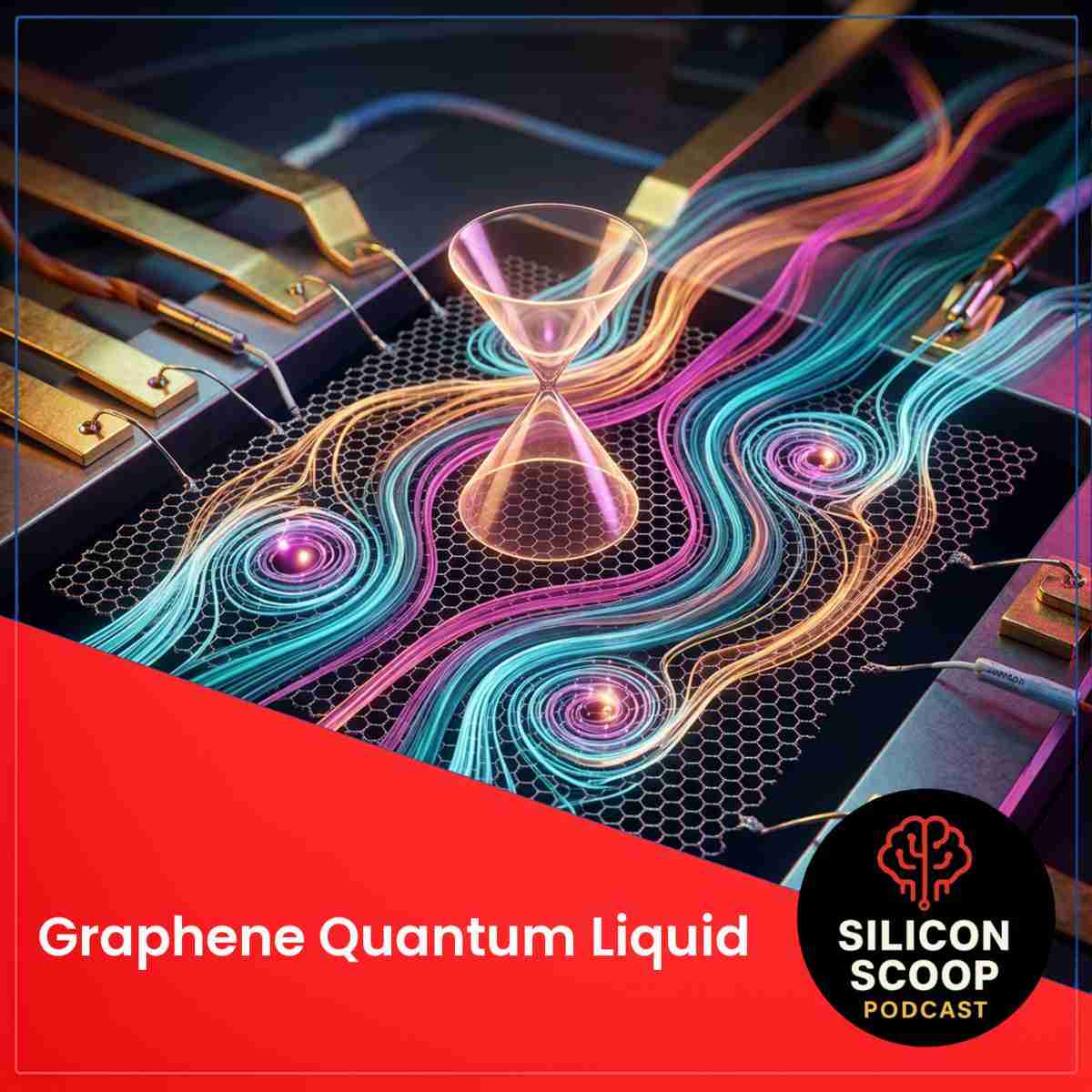
Graphene Quantum Liquid Explained: How Dirac Fluid Graphene Breaks the Wiedemann-Franz Law
Estimated reading time: 14 minutes
Key Takeaways
- Researchers at the Indian Institute of Science (IISc) discovered what is now called the graphene quantum liquid in ultra-clean graphene.
- At the graphene Dirac point, Dirac fluid graphene appears and heat and electrical charge stop traveling together the way they always do in normal metals.
- Researchers measured a dramatic Wiedemann-Franz law violation by a factor of 200 to 300 times.
- Ultra-clean graphene was essential: charge inhomogeneity was reduced to around ~5×10⁹ cm⁻² to reveal collective electron motion.
- This work points toward implications for quantum sensors and future technology, while interpretation details remain under active scientific discussion.
Table of contents
- Graphene Quantum Liquid Explained: How Dirac Fluid Graphene Breaks the Wiedemann-Franz Law
- Key Takeaways
- Introduction: When Electrons Stop Acting Like Electrons
- Section 1: What Is a Graphene Quantum Liquid?
- Section 2: Why the Dirac Point Is the Key to Understanding This Discovery
- Turn “Big Insights” Into Bigger Efficiency
- Section 3: How the Graphene Quantum Liquid Violates the Wiedemann-Franz Law
- Section 4: Electron Viscosity in Graphene and the Idea of a Nearly Perfect Fluid
- Section 5: Why Ultra-Clean Graphene Was Essential to Seeing Collective Electron Motion
- Section 6: How This Differs From Traditional Metals
- Section 7: Real-World Implications for Quantum Technology and Sensors
- Section 8: Scientific Caution and the Credible Debate Around Interpretation
- Section 9: Conclusion — Why the Graphene Quantum Liquid Matters
- Cut the Noise. Automate the Workflow.
- Frequently Asked Questions (FAQ)
Introduction: When Electrons Stop Acting Like Electrons
Imagine a metal where electrons no longer behave like individual particles bouncing around inside a wire. Instead, they flow together like a river current — smooth, coordinated, and collective. That is exactly what researchers at the Indian Institute of Science (IISc) discovered when they studied what is now called the graphene quantum liquid.
This is not a liquid you can pour. It is a quantum state inside ultra-clean graphene — a one-atom-thick sheet of carbon — where electrons and holes move together so strongly that ordinary rules for metals simply break down.
At the heart of this discovery is Dirac fluid graphene, a special regime that appears near a point in graphene’s energy structure called the graphene Dirac point. Near this point, researchers measured something remarkable: heat and electrical charge stopped traveling together the way they always do in normal metals. The result was a dramatic Wiedemann-Franz law violation — a breakdown of one of physics’ most reliable rules — by a factor of 200 to 300 times.
This article explains:
- What the graphene quantum liquid actually is
- Why the Dirac point makes this possible
- How electron transport breaks the Wiedemann-Franz law
- Why ultra-clean graphene was essential to seeing it
- What it could mean for quantum sensors and future technology
Section 1: What Is a Graphene Quantum Liquid?
The term graphene quantum liquid can sound confusing at first. This is not water, and it is not a liquid in the everyday sense of the word.
A graphene quantum liquid is a quantum many-body state. That is a fancy way of saying it is a condition inside graphene where many particles — electrons and holes — interact with each other so strongly and so constantly that they stop acting like separate, independent objects. Instead, they behave more like a single flowing fluid.
What Makes Graphene Special?
Graphene is a single layer of carbon atoms arranged in a flat honeycomb pattern. It is one atom thick. Because of its unusual atomic structure, the electrons inside it behave very differently from electrons in a typical piece of copper or gold.
This makes graphene a natural home for what physicists call a quantum liquid in carbon sheets — a fluid-like quantum state that simply could not form inside a conventional three-dimensional metal.
Collective Flow vs. Individual Scattering
In a typical metal, electrons are often modeled as individual particles. Each one moves through the metal, occasionally bouncing off impurities or vibrating atoms. This is called independent or “ballistic” transport.
In the graphene quantum liquid, something very different happens. Electrons collide with each other — frequently and strongly. These constant electron-to-electron collisions create collective electron motion: the carriers stop acting independently and start moving as a coordinated group, like a fluid.
Here is a simple way to picture it:
- Conventional metal electrons are like commuters all driving their own cars through traffic, each taking slightly different routes and stopping for their own reasons.
- The graphene quantum liquid is more like a river. The water molecules interact constantly, and the whole body of water moves together as one coordinated current.
This fluid-like, hydrodynamic behavior — where internal collisions dominate over scattering from impurities — is what defines the Dirac fluid graphene regime.
How Was This Observed?
IISc researchers engineered exceptionally pure graphene samples to directly observe this viscous electron flow and quantum critical transport. The cleanliness of the samples was critical — without it, the collective fluid behavior would have been hidden by disorder.
Section 2: Why the Dirac Point Is the Key to Understanding This Discovery
To understand why the graphene quantum liquid forms where it does, you need to understand one specific place in graphene’s energy structure: the Dirac point.
What Is the Dirac Point?
Every material has an energy structure that describes how electrons can move through it. In graphene, the conduction band (where electrons carry current) and the valence band (where holes, which are positively charged gaps, live) meet at a single point. That meeting point is called the Dirac point.
At this exact energy level, graphene is electrically neutral overall. There are equal numbers of negatively charged electrons and positively charged holes. The net electrical charge is essentially zero.
This is unusual. In most conductors, there is a clear imbalance — either mostly electrons or mostly holes are carrying charge. At the Dirac point, both are present in equal numbers, and they interact with each other intensely.
What Is “Quantum Critical” Transport?
Near the Dirac point, the system enters what physicists call a quantum critical regime. In plain terms, this means the system sits right at a transition point — between conducting and not conducting, between one phase of matter and another. At this boundary, the physics is governed by universal rules rather than the specific details of the material.
This is the environment that gives rise to Dirac fluid graphene: a strongly interacting quantum fluid where charge and heat move according to those universal rules, not the standard rules used to describe conventional metals.
The Surprising Transport Result
Here is where graphene Dirac point physics produces its most striking result:
- Near the Dirac point, electrical conductivity can decrease.
- At the same time, thermal conductivity — how well the material carries heat — can increase dramatically.
In normal metals, these two properties are tightly linked. Where electricity flows easily, heat flows easily too. At the Dirac point in clean graphene, they decouple. Charge and heat stop traveling together.
At the Dirac point with zero net charge, electrons and holes exist in equal numbers with opposite charges, yet thermal conductivity increases dramatically while electrical conductivity decreases. This demonstrates that the transport decoupling is fundamental — it is not a measurement error or a fluke of fabrication.
The key experimental achievement that made this visible was reducing charge inhomogeneity — uneven patches of charge across the graphene sheet — to around ~5×10⁹ cm⁻². This level of cleanliness enabled direct observation of the collective electron motion and fluid-like regime for the first time.
sciencechronicle.in
ScienceDaily
arXiv 2501.03193
Turn “Big Insights” Into Bigger Efficiency
If your business is still running on copy-paste, manual follow-ups, and scattered tools — you’re leaking time and money every day. Flowgrammer helps you automate the busywork, streamline operations, and build systems that scale without adding headcount.
👉 Book your free automation consult → Flowgrammer
Section 3: How the Graphene Quantum Liquid Violates the Wiedemann-Franz Law
What Is the Wiedemann-Franz Law?
The Wiedemann-Franz law is one of the most reliable rules in materials science. It states that in ordinary metals, the ratio between electrical conductivity and thermal conductivity stays nearly constant. The reason is simple: in a typical metal, the same electrons carry both charge and heat. So if a metal is good at conducting electricity, it is also predictably good at conducting heat.
This law has held up well for over 150 years across many different metals and temperatures. It is a cornerstone of how engineers and physicists think about heat and charge movement in conductors.
The Dramatic Breakdown
In the graphene quantum liquid, researchers found a Wiedemann-Franz law violation of approximately 200 to 300 times at temperatures between roughly 30 and 60 Kelvin (about −243 to −213°C).
This is not a small correction. It is not a minor anomaly. It is a complete breakdown of a fundamental rule — by two to three orders of magnitude.
Why Does This Happen?
In a conventional metal, electrons act as independent quasiparticles. Each one carries its share of charge and heat, and the standard transport picture works well.
Near the graphene Dirac point, the situation is entirely different. The transport of charge and heat is no longer governed by independent quasiparticle motion. Instead, it is governed by universal conductance-scale physics — specifically, quantum of conductance effects tied to the fundamental constant σQ ≈ 4e²/h.
Because charge and heat are now driven by different collective processes, they decouple. Thermal conductivity was enhanced by roughly 200 times over baseline expectation, while electrical conductivity did not scale the same way.
Key Numbers at a Glance
| Measurement | Value |
|—|—|
| Wiedemann-Franz violation factor | 200–300x |
| Temperature range | ~30–60 Kelvin |
| Quantum critical conductivity (σQ) | ≈ 4e²/h |
| Device-to-device variation | ±25% |
The ±25% consistency across different devices is important. It means this is not a one-off result from a single lucky device. It is a repeatable, robust measurement reflecting real physics.
This breakdown of the quasiparticle picture is precisely what makes the Dirac fluid graphene regime so significant. When independent-particle models fail this badly, it tells us that many-body hydrodynamic behavior — the physics of collective flow — is the only accurate description.
arXiv 2501.03193
phys.org news
ScienceDaily
Section 4: Electron Viscosity in Graphene and the Idea of a Nearly Perfect Fluid
What Does Viscosity Mean for Electrons?
When most people hear the word “viscosity,” they think of thick liquids like honey or engine oil. Viscosity describes how much a fluid resists flowing unevenly — its internal resistance to being sheared or disturbed.
Electron viscosity in graphene works the same way, but at the quantum scale. It describes how much the electron fluid resists uneven or disturbed flow. This resistance arises not from the electrons bouncing off atoms or impurities, but from the quantum many-body interactions between the electrons themselves.
Low viscosity in this context does not mean zero interaction. It means the carriers flow collectively with very little dissipative resistance. The electrons are interacting strongly — but in a coordinated, efficient way that minimizes wasted energy. This is exactly what makes the state fluid-like.
How Low Did the Viscosity Get?
The IISc team’s measurements showed that the electron fluid in their ultra-clean graphene reached viscosity ratios within a factor of four of the theoretical minimum expected for a nearly perfect quantum fluid.
This is a remarkable result. The concept of a “nearly perfect fluid” — one with viscosity as close to the quantum minimum as physically allowed — is normally associated with extreme systems.
A Wider Context: Quark-Gluon Plasma and Beyond
Similar hydrodynamic ideas appear in research on:
- Quark-gluon plasma — the state of matter thought to have existed microseconds after the Big Bang, recreated briefly in particle colliders
- Black hole thermodynamics — theoretical frameworks that involve similar transport relationships
Graphene offers a practical, low-cost laboratory platform for exploring some transport principles relevant to those extreme systems. To be clear: graphene is not literally a black hole or a particle collider. But the mathematical frameworks for describing fluid transport overlap, and graphene gives researchers a way to test those ideas in a material that fits on a desk.
This work, led by first author Aniket Majumdar, was published in Nature Physics in 2025 — one of the most prestigious journals in physics. The publication itself is a strong signal of the scientific community’s confidence in these findings.
phys.org news
arXiv 2501.03193
quantumzeitgeist.com
Section 5: Why Ultra-Clean Graphene Was Essential to Seeing Collective Electron Motion
The Problem With Disorder
Observing a graphene quantum liquid is not easy. The fluid-like collective behavior only emerges under very specific conditions. The biggest enemy is disorder.
In this context, disorder means:
- Impurities — foreign atoms or molecules stuck in or on the graphene
- Charge puddles — patches where extra positive or negative charge gets trapped unevenly
- Structural imperfections — wrinkles, cracks, or defects in the carbon lattice
When disorder is too high, electrons scatter off these imperfections before they can interact strongly with each other. The collective electron motion needed for hydrodynamic transport never gets a chance to develop. The material just looks like a slightly unusual conventional conductor.
What the IISc Team Achieved
The IISc researchers engineered exceptionally clean monolayer graphene devices — single-atom-thick graphene sheets with extreme purity.
Their key technical achievement:
- Charge inhomogeneity was reduced to ~5×10⁹ cm⁻² — an extremely low level that allowed the electron-electron interactions to dominate over impurity scattering.
At this level of cleanliness, the Dirac fluid graphene state could finally emerge and be measured directly.
Consistency Across Devices
One of the most reassuring aspects of this study is the device-to-device variation of only ±25%. This means the results were not the product of one unusually lucky fabrication run. Multiple devices showed the same behavior, which strongly supports the conclusion that the measurements reflect intrinsic quantum physics rather than accidental artifacts.
International Collaboration
Japanese collaborators also played an important role in this research. They helped refine thermal measurement techniques and validate the fluid behavior signatures across multiple experimental conditions. This cross-institutional validation adds further credibility to the findings.
Section 6: How This Differs From Traditional Metals
One of the best ways to understand the graphene quantum liquid is to place it directly beside conventional metal behavior.
In Traditional Metals
- Electrons are modeled as quasiparticles — individual charge carriers that move through the material relatively independently.
- Each electron carries both charge and heat in a predictable, linked way.
- The Wiedemann-Franz law holds reliably. Good electrical conductors are also good thermal conductors, in a fixed ratio.
- Scattering off impurities and lattice vibrations dominates transport.
- The standard independent-particle model works well.
In the Graphene Quantum Liquid
- Near the Dirac point, electrons and holes coexist in equal numbers.
- Electron-electron and electron-hole interactions dominate.
- Transport enters a quantum critical hydrodynamic regime.
- Heat and charge decouple sharply — they no longer move together in the expected ratio.
- The Wiedemann-Franz law violation is 200–300 times the expected value.
- The quasiparticle picture breaks down. Many-body physics takes over.
Why This Matters Beyond the Lab
The discovery does not mean graphene breaks every rule of physics. What it shows is that there is a regime — near the Dirac point, in ultra-clean quantum liquid in carbon sheets — where the rules derived from studying conventional metals no longer apply.
That is scientifically valuable because it expands the experimental toolkit. Graphene gives researchers a solid-state platform — something you can make in a lab without a particle collider — for studying quantum critical transport and collective electron motion that previously could only be theorized or studied in extreme conditions.
For students and engineers working in quantum materials and graphene Dirac point physics, this is a significant shift: the theory now has a controllable experimental platform to test against.
phys.org news
sciencechronicle.in
Section 7: Real-World Implications for Quantum Technology and Sensors
From Physics Lab to Technology Platform
The graphene quantum liquid is not just an interesting physics result. It points toward a set of real-world applications where ultra-sensitive control of heat, charge, and magnetic response is essential.
Key Application Areas
The fluid-like, low-viscosity electron transport observed in Dirac fluid graphene makes it highly relevant to:
- Magnetic field sensing — detecting extremely weak magnetic fields with high precision
- Ultra-low-noise signal detection — amplifying tiny signals without adding unwanted interference
- Precision navigation — enabling accurate positioning in environments where GPS is unavailable
- Compact quantum sensing hardware — building smaller, lighter sensors for portable or embedded use
The EU GaToR Project
The European Commission is already taking graphene quantum sensing seriously. The EU-funded GaToR project (grant 101205617) is explicitly investigating graphene as a robust magnetic field quantum sensor. This is not a distant ambition — it is an active, funded research program.
cordis.europa.eu project 101205617
Market Trajectory
The commercial landscape for quantum sensing is accelerating:
- Quantum sensor miniaturization is projected to reach credit-card-sized packages by 2030.
- Fully integrated chip-scale quantum sensor solutions below 1 cm are expected by the mid-2030s.
Key sectors driving adoption include:
- 5G and 6G network synchronization — precise timing and signal integrity
- Autonomous vehicles — navigation sensors that work independently of GPS
- Defense and aerospace — GPS-denied navigation and precision positioning
- Scientific instrumentation — ultra-sensitive measurement tools
The graphene quantum dots market alone is projected to expand at an 18.6% CAGR through 2030, reflecting strong commercial momentum in graphene-based technologies.
grandviewresearch.com graphene quantum dots market report
A Realistic Outlook
This discovery does not mean commercial graphene quantum sensors will appear on shelves next year. The path from fundamental physics result to mass-market product takes time and significant engineering work.
What this result does do is strengthen the case that graphene is transitioning from a purely academic material into a practical platform for specialized quantum technologies. The collective electron motion and near-perfect fluid behavior observed here give engineers new properties to design with.
Section 8: Scientific Caution and the Credible Debate Around Interpretation
Important Nuance
Strong results in physics always attract scrutiny. The graphene quantum liquid discovery is no exception, and it is important to represent the debate honestly.
The Skeptical Argument
Some critics — including analysis published by Power Electronics News in October 2025 — argue that graphene’s fundamental structure as a semimetal may naturally lead to a Wiedemann-Franz law violation. The argument goes like this:
- Graphene is not a conventional metal. Its band structure near the Dirac point is inherently different.
- Because of this, the Wiedemann-Franz law — which was derived from conventional metal physics — may simply not apply to graphene by default.
- If that is true, the measured violation may not by itself prove full hydrodynamic collective electron flow. It might instead reflect graphene’s structural character rather than a fluid-like quantum state.
What This Does Not Change
This critique does not invalidate the experiment. The measurements are real. The Wiedemann-Franz law violation of 200–300x was measured accurately. The quantum critical conductivity σQ ≈ 4e²/h was observed and is consistent with theoretical predictions.
The publication in Nature Physics — a peer-reviewed journal with rigorous standards — and the independent corroboration via arXiv preprints both stand as major experimental achievements.
The Strongest Defensible Claim
The most accurate way to frame this discovery is:
- Ultra-clean graphene near the Dirac point shows striking quantum critical transport and strong evidence of fluid-like collective electron behavior.
- Some details of interpretation — specifically, whether this constitutes full hydrodynamic flow in the strictest theoretical sense — remain under active discussion in the physics community.
- The experimental results are solid. The broader interpretation continues to be refined.
This is how science works. The discovery is significant. The conversation continues.
powerelectronicsnews.com
arXiv 2501.03193
Section 9: Conclusion — Why the Graphene Quantum Liquid Matters
This discovery can be summarized across three clear layers:
Scientific Takeaway
The graphene quantum liquid is a strongly interacting Dirac fluid regime where charge and heat transport no longer behave the way they do in normal metals. Near the Dirac point in ultra-clean graphene, electrons and holes form a collectively flowing quantum fluid governed by universal physics.
Experimental Takeaway
The IISc team’s precision engineering made it possible to directly measure electron viscosity in graphene, observe quantum critical conductivity, and confirm a dramatic Wiedemann-Franz law violation of 200–300 times at temperatures between 30 and 60 Kelvin. The results were reproducible across devices with only ±25% variation, establishing them as reliable and significant.
Strategic Takeaway
This makes graphene a promising platform for both fundamental physics research and emerging quantum sensing technologies. The quantum liquid in carbon sheets is no longer just a theoretical curiosity. It is a measurable, reproducible, engineerable state with real implications for sensors, navigation, and signal detection.
The biggest reason this discovery matters is this: it turns graphene from a material with unusual theory into a controllable platform where collective quantum transport can actually be measured and potentially engineered. That transition — from theory to experiment to engineering — is where transformative technology begins.
Cut the Noise. Automate the Workflow.
The fastest-growing companies aren’t doing more work — they’re removing friction. Flowgrammer designs custom automations that reduce errors, speed up delivery, and keep your team focused on high-value tasks that actually move revenue.
⚡ See what you can automate today → Flowgrammer
Frequently Asked Questions (FAQ)
FAQ 1: What is a graphene quantum liquid?
A graphene quantum liquid is a fluid-like quantum state that forms inside ultra-clean graphene. In this state, electrons and holes do not act like separate, independent particles. Instead, they exhibit collective electron motion — moving together as a coordinated group, much like water molecules flowing in a river current. This state only emerges in very clean graphene near specific energy conditions, and it causes the material to behave in ways that standard metal physics cannot explain.
FAQ 2: What is Dirac fluid graphene?
Dirac fluid graphene refers to the specific regime that forms near the Dirac point in graphene — the energy level where the electron and hole bands meet. Near this point, electrons and holes coexist in equal numbers and interact very strongly with each other. This creates a strongly interacting, hydrodynamic transport state that is the foundation of graphene Dirac point physics. In this regime, heat and charge decouple, and the material’s behavior is governed by universal quantum rules rather than ordinary metal physics.
FAQ 3: Why is the Wiedemann-Franz law violation important?
The Wiedemann-Franz law is a long-standing rule in materials science that says electrical conductivity and thermal conductivity are proportionally linked in normal metals. The Wiedemann-Franz law violation in the graphene quantum liquid — measuring 200 to 300 times the expected value — shows that graphene near the Dirac point can completely decouple heat and charge transport. This is not a minor deviation. It reveals an entirely new quantum transport regime that ordinary metal physics cannot describe, opening new doors for both fundamental research and technology development.
FAQ 4: What does electron viscosity in graphene mean?
Electron viscosity in graphene refers to the internal resistance of the electron fluid to shear — to being pushed unevenly. In a normal metal, electrons scatter off impurities and lattice vibrations. In the graphene quantum liquid, electrons interact strongly with each other and flow collectively. Viscosity here arises from those quantum many-body interactions. Unusually low viscosity means the carriers flow with very little dissipative resistance — nearly perfect fluid behavior. The IISc measurements showed viscosity ratios within a factor of four of the theoretical quantum minimum, confirming strong collective electron motion.
FAQ 5: Could this lead to real technology?
Yes — though not immediately. The properties of the graphene quantum liquid make it relevant to several practical areas:
- Magnetic field sensing using Dirac fluid graphene transport properties
- Ultra-low-noise signal amplification for precision instruments
- GPS-denied navigation using compact quantum sensors
- 5G/6G network timing and synchronization hardware
The EU’s GaToR project is already funding graphene-based magnetic field sensors. Market projections suggest quantum sensors could reach credit-card size by 2030. Commercialization is still developing, but the scientific foundation — the graphene quantum liquid — is now experimentally established and reproducible.
FAQ 6: How is the graphene quantum liquid different from a regular conductor?
In a regular conductor, electrons act as independent particles. They scatter off impurities and lattice vibrations, and heat and charge travel in a predictable, linked ratio described by the Wiedemann-Franz law. In the graphene quantum liquid, electrons and holes interact so strongly that they form a collective fluid. Heat and charge decouple sharply. The standard quasiparticle model breaks down, and many-body hydrodynamic physics takes over.
FAQ 7: What temperature does this happen at?
The strongest effects — including the 200–300 times Wiedemann-Franz law violation — were observed at approximately 30 to 60 Kelvin, which is roughly −243 to −213 degrees Celsius. These are very cold temperatures, achieved in laboratory conditions using cryogenic equipment. This is one of the practical challenges for real-world applications: maintaining these temperatures outside a lab requires engineering solutions.
FAQ 8: What is quantum critical transport?
Quantum critical transport refers to how charge and heat move through a material that sits near a quantum phase transition — a boundary between two different quantum states. Near this boundary, transport is governed by universal physics rather than material-specific details. In the graphene Dirac point, this means electrical and thermal conductivity are set by universal quantum constants like σQ ≈ 4e²/h, rather than by the specific details of how the material was made or what impurities it contains.
FAQ 9: Who conducted this research?
The research was conducted by a team at the Indian Institute of Science (IISc) in India, with important contributions from Japanese collaborators who helped validate thermal measurement techniques. The lead author was Aniket Majumdar. The results were published in Nature Physics in 2025, one of the most respected journals in physics, and are supported by an arXiv preprint (2501.03193) available for open review.
FAQ 10: Is there any debate about these results?
Yes, and it is worth knowing about. Some scientists argue that graphene’s nature as a semimetal — rather than a true conventional metal — may naturally lead to a Wiedemann-Franz law violation, independent of whether collective hydrodynamic flow is truly occurring. This means the violation alone may not conclusively prove full fluid-like transport in every theoretical sense.
However, this debate does not erase the experimental achievement. The measurements are real, consistent, and published in a peer-reviewed journal. The strongest supported conclusion is that ultra-clean graphene near the Dirac point shows striking quantum critical transport and strong evidence of fluid-like behavior. Some interpretation details remain under active scientific discussion — which is normal for frontier research.
Additional Links
Flowgrammer.ca – 💡 Unlock AI-Powered Automation! Let flowgrammer.ca handle complex workflows so you can focus on growing your business.
- Silicon Scoop Podcast – Stay Informed, Stay Ahead!
- Startup Talk Podcast
- Flowgrammer Youtube
- Startup Investor Drinks – Join Toronto’s Startup Community and connect with fellow startup enthusiasts and investors.
- TorontoStarts Startup and Entrepreneur Community – Become a part of Toronto’s thriving startup ecosystem.
- Workhaus – Discover flexible workspace solutions for your business needs.
- Work with The Startup Coach – Get expert guidance and mentorship for your startup journey.
- Reach out to Jon Irwin on LinkedIn – Connect with our co-host and technology expert.
Flowgrammers.ca – 💡 Join Toronto’s Fastest Growing AI and Busiess Automation Community..
Episode transcript
Read the full transcript
Craig: researchers at iisc discovered that in ultra clean graphene, electrons stop acting like individual particles and start flowing collectively like a coordinated liquid. this direct fluid allows heat to travel 300 times faster than electricity, completely shattering the standard rules of metallurgy. physics just hit a massive glitch. researchers found a state of matter where heat and electricity finally filed for divorce. we're talking about quantum liquid and graphene that breaks a 150 old law of nature and its secret key to the next generation of super sensors. this isn't just lab trivia. it paves the way for our perfect thermal conductors and quantum sensors that could make gps obsolete by sensing magnetic fields with terrifying precision. what do you think about this, john?
Jon: i i'm excited for this. i've always loved graphene. i think graphene is awesome and there we've talked about graphene batteries. we've talked about graphene in a lot of things. but this is really cool because they're essentially breaking, a physics law, which is the wiedemann franz law. and that states that the ratio of thermal conductivity, which is heat, to electro conductivity charge is constant in metals. and this works because electrons normally carry both heat and electric current. so if electricity flows well, heat should too. so what did graphene do instead? so in ultra clean graphene, scientists observe a massive deviation up to 200 x from this law. so heat and charge are decoupled. they no longer move together, which was what was even more surprising was sometimes heat increased while electro electrical conductivity decreased, which is the opposite of what physics predicts. so the physics behind it is this dirac fluid. so at a special condition called the dirac point, graphene becomes neither metal nor an insulator, and electrons behave like massless relativistic
Craig: particles.
Jon: and so in this regime, electrons kind of interact strongly with each other and they form this, like you said, this collective quantum fluid, which is called the direct fluid. so instead of moving independently, they move like a coordinated liquid with ultra low viscosity, which is really cool. so, the electrons in the law assumes that electrons behave like independent particles. but in graphene, they behave like a strong interacting system. and so the result is the foundational assumptions of the law essentially collapse and heat and charge become independent transport channels, which i think is, is really cool. so it's not breaking physics. it just breaks assumptions if that makes sense.
Craig: makes total sense. i like to think of this as an update like the difference between a crowded sidewalk and a synchronized swim team. in normal metals, electrons are like, commuters bumping into each other, struggling to move forward. in graphene quantum liquid, the electrons link arms and flow like a high speed river because they move as one. they carry a massive wave of heat through the material without the electrical baggage that usually slows them down. so this is currently, in the high end lab phase. commercial credit size, card size quantum sensors are not projected, till about 2030 or are projected for about 2030. so we're talking about only four years away.
Jon: yeah. and so if actually heat electricity decouple, we could design systems where electricity flows without overheating and energy losses dramatically reduced. so ultra efficient chips, like you said, quantum computing sensors, quantum computing platforms, and new sensor technologies. so i like to think about graphene as becoming sort of like this physics playground because it's not just a material. it's a test bed for rewriting physics models, and this is really cool.
Craig: yeah. absolutely. so this violation is 200 to 300 times, factor. right?
Jon: yeah. 200 times. yeah.
Craig: and the temp at temperature is roughly between thirty and sixty kelvin, which is about negative 243 to negative two hundred and thirteen thirteen degrees celsius.
Jon: negative two fifty three. is that is that negative is that kelvin?
Craig: so the kelvin is thirty and sixty. so, anyway, the the utilize the direct point that we talked about, the neutral energy junction where the induction, and valence bands meet. in ultra clean samples, the electron to electron collisions dominate over impurity scattering, creating a hydrodynamic transport. so this is the most significant challenge to the wide wide mainframes law since its inception in 1853. it represents a shift in the quasi particle model to many body physics, similar to leap from classical mechanics to general relativity. i'm kind of excited that almost every time we talk about something new in the physics world, we're getting closer and closer to the overlap of quantum physics and our understanding of normal physics. even though i call quantum magic and, when we talk about quantum physics and whatnot, we're starting to get a better picture. every time we see the early inceptions of the universe and every time we see what's escaping a black hole and every time like, it all changes our big picture and starting to make, you know, now the universal quantum theory of gravity and our normal theory of gravity are starting to, make sense together. i like it when these start, joining together. and the electron fluid in this graphene had the viscosity ratio within four times the theoretical minimum, making it a nearly perfect fluid similar to the quark gluon plasma found milliseconds after the big bang. yeah. so the eu is already pouring millions into this via the gator project specifically to weaponize this fluid state for magnetic field sensing. despite being one atom thick, this liquid state is effectively a two dimensional river where electrons and holes, the absence of electrons, flow together in a perfect dance. critics still argue that this isn't a new state of matter, but rather a natural byproduct of graphene being a semi metal. they claim the law isn't broken. it just never applied to graphene's unique geometry in the first place.
Jon: yeah. i think so. yep.
Craig: if you are in the defense, aerospace, or autonomous, vehicle sector, start tracking solid state quantum sensors today because there's probably some good investments coming, but don't take our investment advice. but, you know, we're always have my startup advice and where things are going. and, as a startup, i'd be looking at this kind of space if you're into it. what do you think? anything else here, john?
Jon: no. i i'm just excited. i love graphene. i think integrating it into everything, is like, even solar cells and everything like that, it's gonna be a game changer for tons of devices and tons of, instruments.
Craig: yeah. we've officially moved past the era of treating electrons like billiard balls into the era of treating them like a high speed quantum tide. if you could have a sensor that knows exactly where you are without a single satellite or gps, would you trade your privacy for that kind of unhackable navigation? let us know in the chat.
More from Silicon Scoop
All episodes
silicon-scoop · October 16, 2026
Meta’s $18 Billion Teen Safety Settlement: Soft Guardrails, Hard Leverage Over TikTok and YouTube
Deep dive on Meta teen safety settlement, social media addiction lawsuit, new Facebook Instagram time limits and pressure on TikTok YouTube age verification.
View episode

silicon-scoop · October 15, 2026
How Claude Mythos Is Reshaping Cryptanalysis: HAWK, AES and the Rise of AI-Driven Crypto Research
Claude Mythos cryptanalysis weakens HAWK post-quantum signature, speeds AES Möbius Bridge attack, and powers CryptanalysisBench benchmark in AI-driven crypto research.
View episode

silicon-scoop · October 14, 2026
Nvidia’s $12.9 Billion Hugging Face Bet: How Controlling the Open-Source Model Hub Reshapes AI Chips, Cloud, And Competition
Nvidia Hugging Face acquisition could reshape open source AI models, AI chip dominance, and the global developer model hub, raising antitrust and neutrality questions.
View episode