
How a Modern Volcano Eruption Warning System Uses Jerk Signals to Predict Eruptions Earlier
How a Modern Volcano Eruption Warning System Uses Jerk Signals to Predict Eruptions Earlier https://torontostarts.com/silicon-scoop/ Flowgrammer.ca -> https://flowgrammer.ca/ AI News and Resources -> https://flowgrammers.ca OpenClaw Toronto -> https://openclawto.com/ Turn “Hours of Work” Into Automatic Workflows If a single smart system can deliver faster, more reliable results, imagine what automation can do for your business. Flowgrammer helps you eliminate repetitive tasks, reduce errors, and scale operations without hiring more staff. Book a Free Automation Consult https://flowgrammer.ca/ Startup Investor Drinks Toronto - https://startupdrinksto.com/ Toronto’s Startup Community - https://torontostarts.com/ Silicon Scoop Silicon Scoop Podcast - https://torontostarts.com/silicon-scoop/ Apple: https://podcasts.apple.com/us/podcast/silicon-scoop/id1758711826 Spotify: https://open.spotify.com/show/5bAzF0MwV6TtLhJAhvHayI YouTube: https://www.youtube.com/playlist?list=PLj4v-RoA7A-gT62vrEYqh1zCv-0Hj-o5J Startup Talk Startup Talk Podcast -> https://torontostarts.com/startup-talk-toronto-startup-podcast/ Apple -> https://podcasts.apple.com/us/podcast/startup-talk/id1763804003 Spotify -> https://open.spotify.com/show/1siJMILILidHAiAsrX2VBU YouTube: https://youtube.com/playlist?list=PLj4v-RoA7A-jxV5FHs5e61oIsuvUJYmT_&si=LYegRe5GYLKNQ7xL
With Craig Major and Jon Irwin
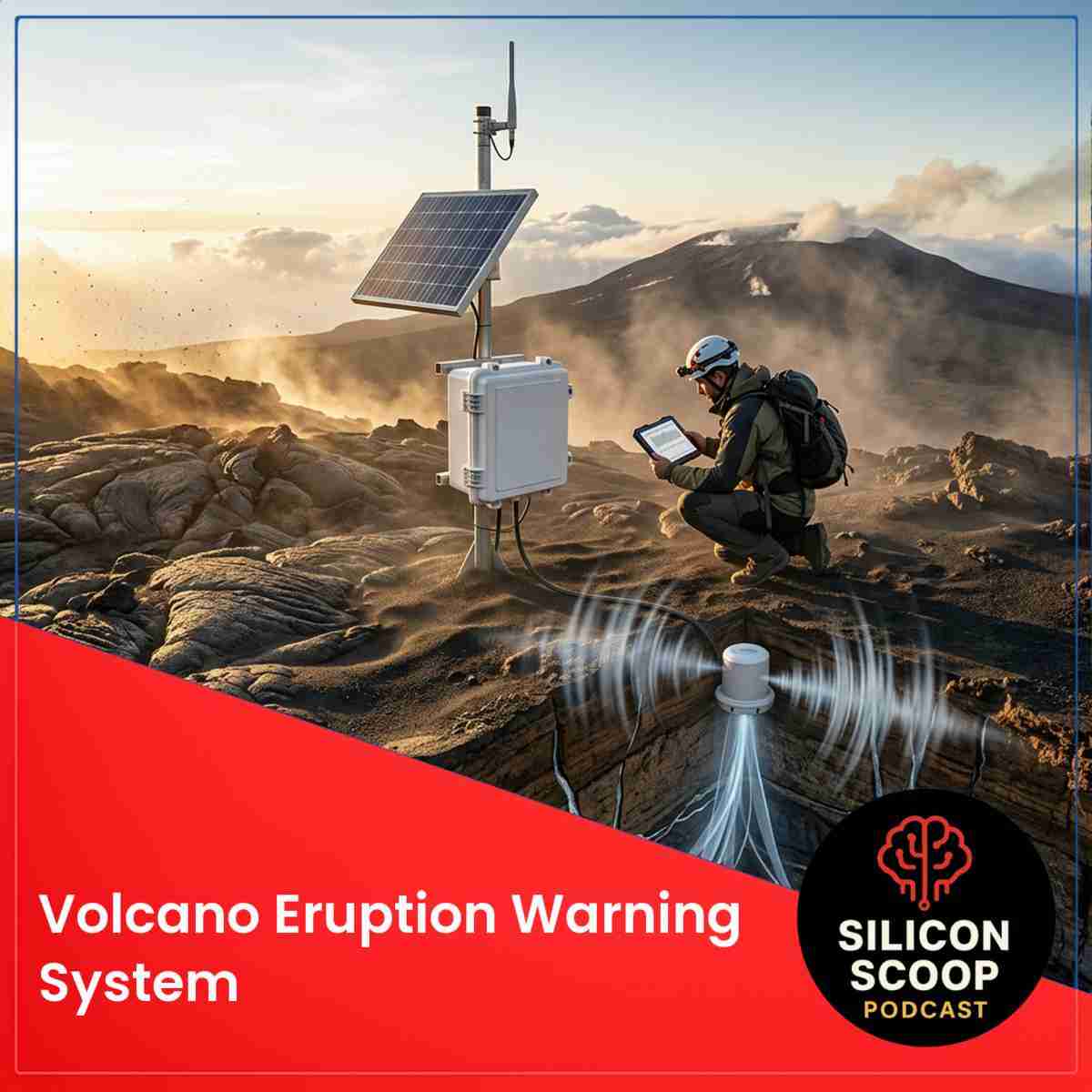
How a Modern Volcano Eruption Warning System Uses Jerk Signals to Predict Eruptions Earlier
Estimated reading time: 12 minutes
Key Takeaways
- A new volcano eruption warning system approach has shown a remarkable 92% detection accuracy across 24 eruptions at one of the world’s most active volcanoes — and it uses just one instrument.
- The system can deliver warnings anywhere from a few minutes to 8.5 hours before an eruption begins.
- The system is built around something called a Jerk signal detector — a method that picks up tiny, rapid changes in ground motion caused by magma fracturing rock underground.
- Researchers from the Institut de Physique du Globe de Paris (IPGP) and the German Research Centre for Geosciences (GFZ) tested this approach at Piton de la Fournaise.
- The 2026 expansion to Mount Etna could mean for real-time eruption alerts worldwide.
Table of contents
- How a Modern Volcano Eruption Warning System Uses Jerk Signals to Predict Eruptions Earlier
- Introduction: A Single Instrument That Can See Eruptions Coming
- Section 1: What Is the Jerk Method, and Why Is It a Breakthrough in Volcano Monitoring?
- Section 2: How the System Worked at Piton de la Fournaise in Real-World Conditions
- 🚀 Turn “Hours of Work” Into Automatic Workflows
- Section 3: How Magma Intrusion Detection Works Before an Eruption
- Section 4: Why One Seismometer Is Such a Big Deal for Global Volcano Forecasting Technology
- Section 5: The December 5, 2025 Crisis and What It Revealed About Aborted Eruptions
- Section 6: What Happens Next — Mount Etna, POS4dyke, and Geophysics Innovation in 2026
- Section 7: Why This Matters for Public Safety and Disaster Prevention
- ⚙️ Predictable Operations. Faster Decisions. More Growth.
- Frequently Asked Questions
- Conclusion: A New Standard for Volcano Eruption Warning Systems
Introduction: A Single Instrument That Can See Eruptions Coming
Most people assume predicting a volcanic eruption requires a small army of sensors, gas detectors, satellite feeds, and expert scientists working around the clock. That assumption is being challenged right now.
A new volcano eruption warning system approach has shown a remarkable 92% detection accuracy across 24 eruptions at one of the world’s most active volcanoes — and it uses just one instrument. Even more striking, the system can deliver warnings anywhere from a few minutes to 8.5 hours before an eruption begins.
This is not a lab experiment. It is a real-time, field-tested volcanic eruption early warning system that has been running automatically for over a decade.
The system is built around something called a Jerk signal detector — a method that picks up tiny, rapid changes in ground motion caused by magma fracturing rock underground. Where most monitoring tools look for what is already happening, the Jerk method catches the physical preparation stage before lava ever reaches the surface.
Researchers from the Institut de Physique du Globe de Paris (IPGP) and the German Research Centre for Geosciences (GFZ) tested this approach at Piton de la Fournaise, a highly active shield volcano on Réunion Island in the Indian Ocean. The study ran for more than 10 years, making it one of the most rigorously validated advances in volcano forecasting technology in recent memory.
This article breaks down exactly how the Jerk method works, what the results at Piton de la Fournaise actually mean, why even the “false positives” matter, and what the 2026 expansion to Mount Etna could mean for real-time eruption alerts worldwide.
Sources: Nature Communications article | Phys.org report
Section 1: What Is the Jerk Method, and Why Is It a Breakthrough in Volcano Monitoring?
The Jerk Signal Detector Explained in Plain Language
The word “Jerk” here is a physics term. It refers to the rate of change of acceleration — meaning it measures how quickly ground movement is speeding up or slowing down, not just whether the ground is moving at all.
Think of it this way:
- Velocity tells you how fast something is moving.
- Acceleration tells you how quickly the speed is changing.
- Jerk tells you how quickly that change in speed is itself changing.
This extra layer of sensitivity is what makes the Jerk signal detector powerful. It can catch sudden, tiny ground-motion spikes that standard velocity or acceleration measurements would miss entirely.
When magma forces its way through cracks and channels underground, it fractures the surrounding rock. Those fractures send out seismic pulses — not the big shaking you’d feel during an earthquake, but extremely subtle transient signals. The Jerk method is specifically tuned to detect these.
The Numbers Behind the Signal
The signals involved are almost unimaginably small. The measured amplitudes range from 0.1 to a few nanometres per second cubed (nm/s³). A nanometre is one billionth of a metre. These are not vibrations you would ever feel standing on the ground.
To make sure the measurements were clean, researchers corrected the data for Earth tides — the very slight flexing of the ground caused by the gravitational pull of the Moon and Sun. Without this correction, those natural tidal effects could mask or distort the volcanic signal entirely.
Why Traditional Volcano Forecasting Technology Falls Short in Many Places
Standard volcano forecasting technology typically relies on combining multiple data streams:
- Seismic networks (multiple stations)
- Ground deformation sensors (GPS, tiltmeters)
- Gas emission monitors (SO₂, CO₂)
- Thermal cameras
- Expert human interpretation
This multi-instrument approach works well at well-funded, well-staffed observatories. But it is expensive, complex, and completely out of reach for many active volcanoes in developing regions, remote islands, or politically inaccessible areas.
The Jerk method is notable precisely because it can generate useful magma intrusion detection information from a single broadband seismometer — one instrument, one location, automated operation.
Tested in Real Time, Not Just in Hindsight
This is not a case of researchers looking back at old data and saying “see, the signal was there all along.” The system has been operating in automatic, real-time mode for over 10 years.
Dr. Philippe Jousset of GFZ described it as a method tested automatically in real time for over a decade, calling it a “perfect detector of magmatic intrusions.” That phrase matters: the system detects the intrusion of magma itself, which is the direct physical process that usually precedes eruption.
This makes it a genuinely different kind of tool in the volcanic eruption early warning system toolkit — one that doesn’t just correlate with eruptions after the fact, but responds to the underlying mechanical process as it unfolds.
Sources: Nature Communications article | Phys.org report | GFZ publication record
Section 2: How the System Worked at Piton de la Fournaise in Real-World Conditions
Why Piton de la Fournaise Was the Right Test Site
Piton de la Fournaise is one of the most active volcanoes on Earth. It erupts frequently — sometimes multiple times per year — which means researchers have plenty of events to validate against. It is also well-observed, with a dedicated observatory (OVPF-IPGP) that has accumulated decades of high-quality data.
This combination of high activity and strong baseline monitoring made it an ideal, but genuinely challenging, proving ground for Piton de la Fournaise eruption prediction research. The volcano doesn’t give you the luxury of rare events — it demands that your system performs consistently.
The Monitoring Setup
The broadband seismometer volcano monitoring station used in this study was the Geoscope station, located 8 kilometres from the summit of Piton de la Fournaise. The system was installed and activated in April 2014 at the OVPF-IPGP observatory.
That 8 km distance is significant. The instrument was not mounted on the crater rim or inside the active zone. It operated from a practical, safe standoff distance — which strengthens the argument that this kind of volcano eruption warning system can be deployed realistically, not just in ideal theoretical conditions.
The First Live Alert
On June 20, 2014, the system issued its first real-time alert. The eruption began 1 hour and 2 minutes later.
That single event proved the concept was not just retrospective pattern-matching. It was working live, automatically, without human interpretation in the loop, and it delivered genuine advance notice. For volcanic monitoring, that is a meaningful result right out of the gate.
Ten Years of Validation
Before and alongside the real-time phase, researchers also validated the method against historical data from 24 eruptions between 1998 and 2010. This historical testing helped confirm that the signal pattern was consistent across different eruptions and different conditions at the same volcano.
Then the real-time data from 2014 to 2023 added a live validation layer. Together, these two phases produced strong evidence for the method’s reliability.
What the 92% Detection Rate Actually Means
The 92% detection rate means that out of all tested eruptions from 2014 to 2023, the system correctly identified eruption-related precursory Jerk signals in nearly every case.
Warning times ranged from just a few minutes to 8.5 hours. Even a few minutes of advance notice is operationally valuable. It can allow observatories to:
- Activate emergency protocols
- Alert field teams working near the summit
- Issue preliminary public advisories
- Trigger aviation notifications for airspace management
Eight and a half hours of warning is extraordinary by volcanic monitoring standards. That window is large enough to support meaningful evacuations, trail closures, and broader emergency coordination — the kind of time that can directly save lives.
This is what makes real-time eruption alerts from this system so practically significant. It’s not just a scientific achievement; it’s a public safety tool.
Sources: Nature Communications article | ScienceDaily release | Phys.org report
🚀 Turn “Hours of Work” Into Automatic Workflows
If a single smart system can deliver faster, more reliable results, imagine what automation can do for your business. Flowgrammer helps you eliminate repetitive tasks, reduce errors, and scale operations without hiring more staff.
Book a Free Automation Consult → flowgrammer.ca
Section 3: How Magma Intrusion Detection Works Before an Eruption
What “Magma Intrusion” Actually Means
Magma intrusion detection means identifying the movement of molten rock into fractures, channels, dikes, or shallow storage areas beneath a volcano — before that magma ever reaches the surface and erupts.
Here is the basic process:
- Magma forms deep underground and begins moving upward due to pressure differences.
- As it pushes through existing cracks or forces open new ones, it physically fractures surrounding rock.
- Those fractures change the stress state underground and produce tiny seismic signatures.
- The Jerk signal detector is sensitive enough to identify those signatures in real time.
Why the Signal Arrives Before the Eruption
Eruptions don’t happen in an instant. Magma must first negotiate a path to the surface — opening, widening, and extending fractures as it goes. This mechanical preparation phase takes time, and it leaves a seismic fingerprint.
The Jerk method captures this preparation stage. That is precisely why it can issue a warning before any lava appears. It is not detecting the eruption itself; it is detecting the underground work that makes the eruption possible.
Intrusion Doesn’t Always Mean Eruption — And That’s Still Valuable
This is an important distinction in volcano forecasting technology: sometimes magma begins intruding but stalls before reaching the surface. The eruption is “aborted.”
From a hazard perspective, this is still a significant event. The underground fracturing is real. The pressure changes are real. The volcanic system is in a state of elevated unrest even if the lava doesn’t break through.
The Jerk signal detector identifies these episodes too — and that’s a feature, not a limitation.
The “False Positives” That Weren’t Actually False
Roughly 14% of the detections at Piton de la Fournaise were initially categorised as false positives because no surface eruption followed. But when researchers examined these events using other monitoring data — seismicity, ground deformation, and gas emissions — they confirmed that real magma intrusions had occurred every single time.
These were not errors. They were genuine unrest events that simply did not culminate in a visible eruption.
A useful way to think about it: the system detected “the knock on the door” even when the door didn’t open. From a safety standpoint, knowing the knock happened is still critical information.
This reframing matters enormously for emergency planners. It means the system reliably detects meaningful volcanic unrest — not just the subset of events that produce lava flows.
Sources: Nature Communications article | GFZ publication record
Section 4: Why One Seismometer Is Such a Big Deal for Global Volcano Forecasting Technology
The Problem: Most Active Volcanoes Are Under-Monitored
There are hundreds of active volcanoes on Earth. Many of them sit in regions where full observatory-grade monitoring is simply not feasible:
- Remote islands with no permanent infrastructure
- Low-income countries with limited scientific budgets
- Politically complex regions where international scientific access is restricted
- Underwater or coastal volcanoes where installation is physically difficult
Building and maintaining a dense network of seismometers, gas sensors, GPS stations, and deformation monitors is expensive. Powering those instruments, transmitting the data, and paying trained scientists to interpret it in real time adds significant ongoing cost.
For these volcanoes, the current situation is simple: they have little or no early warning capability at all.
The Breakthrough: One Broadband Seismometer Can Do More Than Expected
Single broadband seismometer volcano monitoring dramatically lowers the barrier to early-warning deployment. Instead of requiring a full multi-instrument network, the Jerk method can generate actionable real-time eruption alerts from one carefully placed, well-calibrated station.
This does not mean the science becomes simple. The signal processing, Earth-tide correction, calibration, and validation behind this approach are sophisticated. But the hardware cost and logistical complexity are radically reduced.
This is a textbook example of geophysics innovation 2026: achieving more with less by improving interpretation rather than endlessly adding more instruments.
What This Means for Under-Monitored Volcanoes
Even a basic volcano eruption warning system based on one seismometer could provide:
- Triage alerts that flag when deeper human review or emergency response is needed
- Automated SMS or radio warnings triggered by detection events
- Field team protection by alerting workers when unrest begins
- Aviation advisories with enough lead time to reroute flights
In regions with no current monitoring, even a few minutes of warning is the difference between zero and something. That “something” can save lives.
Institutional Credibility Behind the Method
This is not a fringe concept or a startup’s marketing claim. The Jerk detection method is backed by a peer-reviewed publication in Nature Communications (DOI: 10.1038/s41467-025-66256-z) and represents a collaboration between two of the world’s leading geophysical research institutions: IPGP and GFZ.
That combination of rigorous publication and institutional credibility is important when advocating for adoption by national disaster management agencies and international observatories.
Sources: Nature Communications article | Phys.org report | GFZ publication record
Section 5: The December 5, 2025 Crisis and What It Revealed About Aborted Eruptions
A Critical Stress Test
On December 5, 2025, the monitoring system at Piton de la Fournaise recorded an event that tested the boundaries of what the Jerk method can detect.
The signal amplitude was just 0.1 nm/s³ — at the very lower edge of detection sensitivity. No surface eruption followed. But subsequent analysis using seismicity, ground deformation data, and gas measurements confirmed that a real magma intrusion had occurred underground.
This was an aborted intrusion: magma moved, fractured rock, and then stalled before breaking through to the surface.
Why This Event Matters
The December 2025 event is important for several reasons:
- It proves the system can detect the very weakest intrusion signals, not just the large precursory events before major eruptions.
- It confirms that the detector is responding to the physical process of magma movement itself, not just to a proxy signal that happens to correlate with eruptions.
- It shows the method has value across the full spectrum of volcanic unrest — from low-level intrusions to full eruptions.
Why Emergency Planners Should Care About Aborted Intrusions
When a magma intrusion occurs but doesn’t erupt, it still carries real hazard implications:
- Pressure has built up in the volcanic system.
- Rock has fractured, which may make future intrusions easier to propagate.
- Hydrothermal systems may have been disturbed, increasing gas and steam hazards.
- The volcano has moved into a heightened state of unrest, even if no lava appeared.
For real-time eruption alerts systems to be genuinely useful for public safety, they need to detect this kind of unrest — not just the dramatic visible eruptions. The December 2025 event demonstrates that the Jerk method meets that standard.
This is especially relevant for tourist volcanoes and populated volcanic regions, where precautionary closures and updated hazard bulletins can make a significant difference in risk management, even when no eruption ultimately occurs.
Sources: Nature Communications article | ScienceDaily release
Section 6: What Happens Next — Mount Etna, POS4dyke, and Geophysics Innovation in 2026
The Big Question: Does It Work Everywhere?
Piton de la Fournaise is a specific type of volcano — a high-effusion basaltic shield volcano with relatively well-understood plumbing. The biggest outstanding question for the scientific community is whether the Jerk method will work at different types of volcanoes, in different geological settings, with different eruption styles.
That question is about to get its most important real-world test.
The POS4dyke Project at Mount Etna
The POS4dyke project will deploy GIPP seismometers at Mount Etna in 2026, in collaboration with INGV (Italy’s National Institute of Geophysics and Volcanology). This represents the next major validation phase for the volcanic eruption early warning system built on Jerk detection.
Mount Etna is a dramatically different challenge:
- It is one of the largest and most active volcanoes in Europe.
- It sits adjacent to densely populated areas in Sicily, Italy.
- It has a more complex eruption history involving multiple summit craters and flank activity.
- It receives enormous public and media attention, meaning errors carry significant real-world consequences.
Success at Etna would be a powerful signal that the Jerk method generalises beyond its original test site.
The Role of SAFAtor and Fibre-Based Sensing
The Etna deployment is also linked to SAFAtor optic fiber early warning efforts — a complementary approach that uses distributed acoustic sensing (DAS) along fiber optic cables to detect ground motion across large areas.
In simple terms, this means combining the Jerk seismometer data with a network of fiber-based ground motion sensors, creating a multi-layer early warning architecture. This kind of integration represents the frontier of geophysics innovation 2026: blending different sensing technologies to build more robust, redundant, and cost-effective monitoring systems.
Why This Is a 2026 Trend Worth Watching
The shift happening right now in volcano monitoring can be summarised in three points:
- Smarter algorithms are extracting more information from fewer sensors.
- Lower-cost hardware options are making deployment more accessible globally.
- International collaboration (IPGP, GFZ, INGV) is accelerating the testing and rollout of proven methods.
If the Jerk method performs well at Etna, the case for broader adoption becomes very strong — particularly for national disaster management agencies in countries with active volcanoes but limited scientific infrastructure.
Sources: Nature Communications article | Phys.org report
Section 7: Why This Matters for Public Safety and Disaster Prevention
Bringing the Science Back to People
All of the technical detail above ultimately serves one purpose: protecting human life near active volcanoes.
Approximately 800 million people live within 100 kilometres of an active volcano. Many of these populations rely on observatories and government agencies to tell them when a volcano is becoming dangerous. Those agencies can only act as fast as their detection systems allow.
A volcano eruption warning system that delivers reliable real-time eruption alerts hours before an eruption begins changes what is possible for emergency response teams.
Concrete Safety Benefits
Here is what better warning times actually enable:
- Trail and summit closures before hazardous conditions develop
- Tourist and worker evacuation from danger zones with enough time to move safely
- Aviation advisories issued early enough to reroute flights before ash clouds form
- Emergency team pre-positioning rather than reactive scrambling
- Public communication — text alerts, sirens, social media — issued with enough lead time to be useful
- Hazard bulletin updates that keep civil authorities continuously informed of changing risk levels
Even when the Jerk detector flags a magma intrusion that does not produce a surface eruption, these precautionary actions can still be triggered. The cost of a precautionary closure is far lower than the cost of an eruption that catches people unprepared.
Honest Limitations
No prediction system is perfect, and this one is no exception:
- Warning windows vary enormously — from minutes to hours — and cannot be predicted in advance.
- The method has only been rigorously validated at one volcano so far.
- Performance may differ at volcanoes with different geological structures, eruption styles, or background noise conditions.
- A single seismometer provides limited spatial information compared to a full monitoring network.
These are real constraints, and they matter for how the system should be used in practice: as a front-line detector that triggers further expert review, not as a standalone replacement for comprehensive monitoring.
The Practical Bottom Line
A low-cost, automated volcano eruption warning system with a proven 92% detection rate and warning times up to 8.5 hours is a genuinely significant advance in volcano forecasting technology. It may not replace every other monitoring tool. But it could become one of the most efficient and accessible first-line detectors for magma intrusion detection ever deployed at scale.
For the hundreds of under-monitored volcanoes around the world, that is not a small thing. It is a potentially life-saving step forward.
Sources: Nature Communications article | ScienceDaily release
⚙️ Predictable Operations. Faster Decisions. More Growth.
Stop running your business on manual follow-ups and scattered tools. Flowgrammer builds streamlined automations that keep your leads, tasks, and customer journeys moving — so you get consistent outcomes and more time back every week.
See How Business Automation Can Help → flowgrammer.ca
Frequently Asked Questions
FAQ 1: What is a Jerk signal in volcano monitoring?
A Jerk signal is a tiny, rapid change in ground motion caused by rock fracturing as magma pushes through underground pathways. It is measured in nanometres per second cubed (nm/s³) — an extremely small unit that reflects just how subtle these signals are.
A Jerk signal detector is designed specifically to identify these brief, faint pulses before they escalate into a full eruption. By targeting the rate of change of ground acceleration (rather than just velocity or acceleration itself), the detector can catch the mechanical preparation stage of an eruption as it is happening underground. This makes it a powerful tool for magma intrusion detection at the earliest possible stage.
Source: Nature Communications article
FAQ 2: How accurate is this volcano eruption warning system?
Researchers reported a 92% detection rate across 24 eruptions at Piton de la Fournaise from 2014 to 2023. That means the system successfully identified eruption-related precursor signals in nearly every event tested over a decade of real-time operation.
Warning times ranged from a few minutes to 8.5 hours before eruption onset. The variation depends on how much advance underground preparation each specific eruption involves.
It’s important to note that this is Piton de la Fournaise eruption prediction performance, validated at one specific volcano. Results may vary at other sites, and the method is now being tested at Mount Etna to assess broader applicability. This volcano eruption warning system should be understood as a validated front-line tool, not a guarantee of perfect prediction everywhere. The real-time eruption alerts it generates still require expert review and integration with other hazard management processes.
Source: Nature Communications article
FAQ 3: Does one seismometer really work for eruption forecasting?
Yes — at least in the Piton de la Fournaise case, one broadband seismometer volcano monitoring station operating 8 km from the summit was sufficient to detect eruption precursors with high reliability over a 10-year period.
This is significant because it challenges the assumption that effective volcano forecasting technology always requires dense, expensive multi-instrument networks. The Jerk method shows that sophisticated signal processing can extract more information from a single well-placed instrument than was previously thought possible.
That said, broader deployment is now being tested, including at Mount Etna in 2026 via the POS4dyke project. Whether one seismometer performs equally well across different volcano types is the key open question that field testing will answer.
Source: Phys.org report
FAQ 4: What were the false positives, and were they actually mistakes?
Approximately 14% of the system’s detections at Piton de la Fournaise were classified as “false positives” because no surface eruption followed. However, when researchers analysed these events using independent datasets — including seismicity, ground deformation measurements, and gas emission data — they confirmed that real magma intrusions had occurred in every case.
These were not errors. They were genuine episodes of volcanic unrest in which magma moved underground but stalled before breaking through to the surface.
This distinction is important. In the context of a volcanic eruption early warning system, detecting a magma intrusion that doesn’t erupt is still valuable. It indicates elevated volcanic unrest, increased system pressure, and a meaningful change in hazard level. Treating these as “false alarms” would lead to dangerous underestimation of the system’s value for magma intrusion detection.
Source: Nature Communications article
FAQ 5: Why is Mount Etna important for the next phase of this technology?
Mount Etna is one of the most active and socially significant volcanoes in Europe. Unlike Piton de la Fournaise — which is located on a remote island — Etna sits near densely populated communities in Sicily, Italy. It has a more complex eruption history, multiple active craters, and enormous public visibility.
The POS4dyke project is deploying GIPP seismometers at Etna in 2026 in collaboration with INGV. If the Jerk detection method performs well there, it will provide strong evidence that this volcanic eruption early warning system approach can generalise to different volcanic environments.
This makes the Etna deployment a pivotal moment in geophysics innovation 2026. A positive result would significantly strengthen the case for adopting the Jerk method as a standard monitoring tool at active volcanoes globally, especially those currently lacking effective volcano forecasting technology.
Source: Phys.org report
FAQ 6: How does the Jerk method compare to traditional volcano monitoring?
Traditional monitoring combines multiple instruments — seismometers, GPS, gas sensors, tiltmeters, and thermal cameras — interpreted by trained scientists. This approach provides rich, multi-dimensional data but is expensive and requires significant infrastructure.
The Jerk method uses one broadband seismometer and automated signal processing. It does not replace comprehensive monitoring at well-resourced observatories, but it offers a viable first-line early warning option for volcanoes where full networks are not feasible. The key advantage is accessibility: the Jerk approach can provide baseline eruption precursor detection at a fraction of the cost.
FAQ 7: What happens after the system issues an alert?
When the Jerk detector identifies a precursory signal, the alert is passed to the monitoring observatory (in this case, OVPF-IPGP). Scientists then review the signal alongside other available data — seismicity, deformation, gas levels — and decide on the appropriate response.
Depending on lead time and signal strength, responses can range from increased surveillance to active hazard bulletins, field team withdrawal, public advisories, trail closures, and aviation notifications. The system is a decision-support tool, not an automatic action trigger.
FAQ 8: Could this technology be used for other types of natural hazards?
The Jerk method is specifically designed around the seismic signature of magma-induced rock fracturing. It has been developed and validated for volcanic contexts. However, the underlying principle — detecting rapid changes in ground acceleration to identify subsurface mechanical events — has potential relevance in other geophysical monitoring contexts, including fault-zone research and landslide precursor detection.
No formal extensions to other hazard types have been published as part of this research programme, but the methodology represents a broader advance in precision seismic signal interpretation.
FAQ 9: What does “broadband seismometer” mean and why does it matter?
A broadband seismometer is an instrument capable of detecting a wide range of ground motion frequencies — from very slow, long-period movements (like those caused by Earth tides or distant earthquakes) to faster, short-period signals (like those from local rock fracturing).
The broadband capability is essential for the Jerk method because the signals associated with magma intrusion are subtle and may occur across a range of frequencies. A narrowband instrument might miss them entirely. The use of a broadband station also allows researchers to correct for Earth tides and other background signals, isolating the volcanic precursor with greater confidence.
FAQ 10: When could this system be deployed at other volcanoes globally?
The immediate next step is the 2026 deployment at Mount Etna via the POS4dyke project. If results there are positive, the pathway to broader international adoption becomes clearer.
The relatively low cost and simple hardware requirements (one broadband seismometer) mean that deployment at additional volcanoes is technically achievable without massive infrastructure investment. What is needed is scientific validation across diverse volcanic settings, which the Etna deployment will begin to provide.
For volcanoes in developing countries or remote regions, international scientific partnerships — similar to the IPGP-GFZ collaboration that produced this research — would be the most likely mechanism for broader rollout in the near term.
Conclusion: A New Standard for Volcano Eruption Warning Systems
The Jerk method represents a genuine step forward in volcano forecasting technology — not because it is flashy or complex, but because it is simple, rigorous, and proven in the field.
Here is what the evidence shows:
- The Jerk method detects tiny ground-motion changes (as small as 0.1 nm/s³) caused by magma fracturing rock underground — catching the eruption preparation phase before lava ever reaches the surface.
- At Piton de la Fournaise, it achieved 92% eruption detection accuracy across 24 eruptions from 2014 to 2023, with warning times ranging from a few minutes to 8.5 hours — using a single broadband seismometer station 8 km from the summit.
- Expansion to Mount Etna in 2026 via the POS4dyke project will test whether this becomes a globally scalable volcano eruption warning system model, applicable beyond one well-studied test site.
The combination of real-time performance, low-cost single-sensor deployment, and meaningful magma intrusion detection — even for aborted events — makes this one of the most practical and scalable advances in real-time eruption alerts infrastructure in recent years.
If future deployments confirm similar results across different volcanic settings, the Jerk method could become one of the most important contributions to volcano forecasting technology and public safety in a generation.
The science is solid. The results are real. And for the millions of people living near active volcanoes around the world, that matters more than any technical detail.
Sources used in this article:
Additional Links
Flowgrammer.ca – 💡 Unlock AI-Powered Automation! Let flowgrammer.ca handle complex workflows so you can focus on growing your business.
Flowgrammers.ca – 💡 Join Toronto’s Fastest Growing AI and Busiess Automation Community..
-
-
- Silicon Scoop Podcast – Stay Informed, Stay Ahead!
- Startup Talk Podcast
- Flowgrammer Youtube
- Startup Investor Drinks – Join Toronto’s Startup Community and connect with fellow startup enthusiasts and investors.
- TorontoStarts Startup and Entrepreneur Community – Become a part of Toronto’s thriving startup ecosystem.
- Workhaus – Discover flexible workspace solutions for your business needs.
- Work with The Startup Coach – Get expert guidance and mentorship for your startup journey.
- Reach out to Jon Irwin on LinkedIn – Connect with our co-host and technology expert.
-
Episode transcript
Read the full transcript
Craig: nature usually gives us a heads up, but we finally found a way to listen to the earth shutter before it blows. forget massive sensor arrays, a single instrument can now predict volcanic eruptions within 92% accuracy, giving us a life saving eight hour head start. this is called the jerk signal, and it predicts interrupt eruptions. sorry. not interruptions. researchers have spent ten years perfecting a system that detects jerk signals, a rapid rate of change in ground acceleration causing a magma fracturing rock. it's a specialized early warning system that catches the mechanical preparation of a volcano before the lava ever breaks the surface. this turns volcanic volcano monitoring from an expensive multi sensor luxury into an accessible single instrument reality for under monitored regions worldwide. what do you think about this, john?
Jon: i think this is cool. and just so you guys know, this has been validated. they validated this at, volcano, and it was tested over ten years at piton de la fommez, which is one of the most active volcanoes. and the result is ninety two percent of eruptions were successfully forecast. warning times range from minutes up to eight hours, and they only had about fourteen percent false positives where there was magma movement without eruption. and so this is a major improvement because volcano prediction, as we know, it's been highly uncertain. even detecting if interruption will happen has been difficult. and so this moves forecasting closer to operational reliability. and my question is, is this gonna work with, what's the largest volcano in the it's it's in the us, and it hasn't erupted in years.
Craig: well, and they're just really cold. reliable, what they call it.
Jon: yeah. something. i wonder if this will work with that. hopefully, they can find a way for that because if that one erupts, we're we're screwed. but, i think this is cool because, the way that it works is it uses essentially a single brand a single broadband seismometer. right? so traditional volcano monitoring requires networks of sensors, gas measurements, satellite deformation tracking. but the jerk method, it extracts far more information from existing seismic data. so it detects signals that were previously hidden in noise. and it's so the cool thing about this is it's less about new hardware and more about new signal processing and interpretation, which i think is cool. and i didn't read anything about using ai to predict, but i'm curious to i'm guessing if they to integrate ai into this, they might even get more accuracy. what are your thoughts?
Craig: well, there's just to go back, the biggest volcano in the us is mauna loa lau, located, on the big island in hawaii. it's the largest active volcano in the us. so that was the active one. so
Jon: sorry. the supervolcano in yellowstone is called the yellowstone caldera. that's the one i'm thinking of.
Craig: that's yeah. that's the next one on my list still. yep. or, we're screwed if those happen. i like to think of this update like a high-tech home security system. most sensors only go off, when the front door is kicked open when that's the eruption. but the jerk method is like a vibration sensor on the frame that hears the intruder's drill bits grinding into the lock. it catches the work being done to get inside long before the door actually swings wide open. i think this is really, great and could save a lot of lives. so i'm really excited, you know. and this is low cost compared to traditional rays, requires only one broadband, seismometer. it's currently active at the piton de la fournes expanding to mount aetna, this year.
Jon: yeah. oh, i remember mount aetna. i studied mount aetna in school. i totally forgot about mount aetna.
Craig: i'm not sorry. you'll your dollars in mount aetna is probably superior to mine at this point.
Jon: i just know it's in italy, and that's all i remember. but, anyways, it's a straddle volcano.
Craig: yeah. right now, it's primarily for government observations and disaster management agencies. you know, this is great immediate impact for those living near, active peaks. this means receiving evacuations, text hours earlier than previously possible. yeah. with 92% across 24 historical and live eruptions, with lead time two minutes to eight point five hours, events warning. this is amazing. i'm excited about this. you were gonna say, john? sorry.
Jon: yeah. i'm excited. so the big challenge here is that the signals are still extremely weak, and they're easily buried in environmental noise. so wind, ocean waves, human activity, things like that. so with this innovation, hopefully, they're gonna be able to identify more consistent patterns in these tiny fluctuations and distinguish real magma movement from random noise. and, hopefully, that the more data that they gather, the more accurate they're gonna be and if they introduce ai. so this is really cool. i'm excited for this.
Craig: yeah. the difference is standard seismology looks at velocity or acceleration. this system isolates the rate of change of acceleration, allowing it to filter out a lot of the noise and identify specific transient pulses created by magma intrusions fracturing the lithosphere. so this moves us away from the multiparameter era of the late twentieth century toward a smarter algorithmic monitoring where signal processing does the heavy lifting previously required by, dozens of gps and gas sensors. so the system has to account for things like earth tides, gravitational pull of the moon, and sun actually flexes the solid ground enough to mask these tiny jerk signals. so researchers use complex algorithms to subtract the moon's influence. we talked about the twenty twenty six mount expansion, project pos four dyke, for pos four d i d y k e is integrating this with fiber optic sensing, effectively turning miles of internet cables into one giant continuing, ear to the ground. and the system is so sensitive, it can detect aborted eruptions. on december 5, 2025, the system screamed incoming, but no lava appeared. skeptics called it a fail, but lava data proved magma did move and stall just beneath the surface, and the system literally heard the volcano clear its throat and decided not to cough.
Jon: crazy.
Craig: yeah. so a single sensors setup lacks spatial data. it can tell you an eruption is coming, but it struggles to pinpoint exactly where the volcano on the volcano. the flank might unzip compared to, full sensory, grid. so you know what's happening, but you don't quite know where it's gonna break through. so if you're living in a volcanic hazard zone, look for this kinda stuff and advocate for them to be putting this in your area. yeah. so we're moving from a reacting to eruptions to hearing them think, providing a critical window for human survival. if you lived at the base of volcano, would you trust your life to a single sensor, or do you think we still need old school multimillion dollar sensor grids to feel safe? let us know in the chat.
More from Silicon Scoop
All episodes
silicon-scoop · October 16, 2026
Meta’s $18 Billion Teen Safety Settlement: Soft Guardrails, Hard Leverage Over TikTok and YouTube
Deep dive on Meta teen safety settlement, social media addiction lawsuit, new Facebook Instagram time limits and pressure on TikTok YouTube age verification.
View episode

silicon-scoop · October 15, 2026
How Claude Mythos Is Reshaping Cryptanalysis: HAWK, AES and the Rise of AI-Driven Crypto Research
Claude Mythos cryptanalysis weakens HAWK post-quantum signature, speeds AES Möbius Bridge attack, and powers CryptanalysisBench benchmark in AI-driven crypto research.
View episode

silicon-scoop · October 14, 2026
Nvidia’s $12.9 Billion Hugging Face Bet: How Controlling the Open-Source Model Hub Reshapes AI Chips, Cloud, And Competition
Nvidia Hugging Face acquisition could reshape open source AI models, AI chip dominance, and the global developer model hub, raising antitrust and neutrality questions.
View episode