
Pulsar Fusion Ignites World’s First Fusion Rocket: Sunbird Breakthrough
Pulsar Fusion Ignites World's First Fusion Rocket: Sunbird Breakthrough https://torontostarts.com/silicon-scoop/ Flowgrammer.ca -> https://flowgrammer.ca/ AI News and Resources -> https://flowgrammers.ca OpenClaw Toronto -> https://openclawto.com/ Turn Big Ideas Into Repeatable Results If a fusion rocket can prove “first plasma,” you can prove “first automated workflow.” Stop letting manual tasks drain your team—automate your operations, reduce errors, and scale without hiring more hands. Book a Free Automation Consult → https://flowgrammer.ca/ Startup Investor Drinks Toronto - https://startupdrinksto.com/ Toronto’s Startup Community - https://torontostarts.com/ Silicon Scoop Silicon Scoop Podcast - https://torontostarts.com/silicon-scoop/ Apple: https://podcasts.apple.com/us/podcast/silicon-scoop/id1758711826 Spotify: https://open.spotify.com/show/5bAzF0MwV6TtLhJAhvHayI YouTube: https://www.youtube.com/playlist?list=PLj4v-RoA7A-gT62vrEYqh1zCv-0Hj-o5J Startup Talk Startup Talk Podcast -> https://torontostarts.com/startup-talk-toronto-startup-podcast/ Apple -> https://podcasts.apple.com/us/podcast/startup-talk/id1763804003 Spotify -> https://open.spotify.com/show/1siJMILILidHAiAsrX2VBU YouTube: https://youtube.com/playlist?list=PLj4v-RoA7A-jxV5FHs5e61oIsuvUJYmT_&si=LYegRe5GYLKNQ7xL
With Craig Major and Jon Irwin
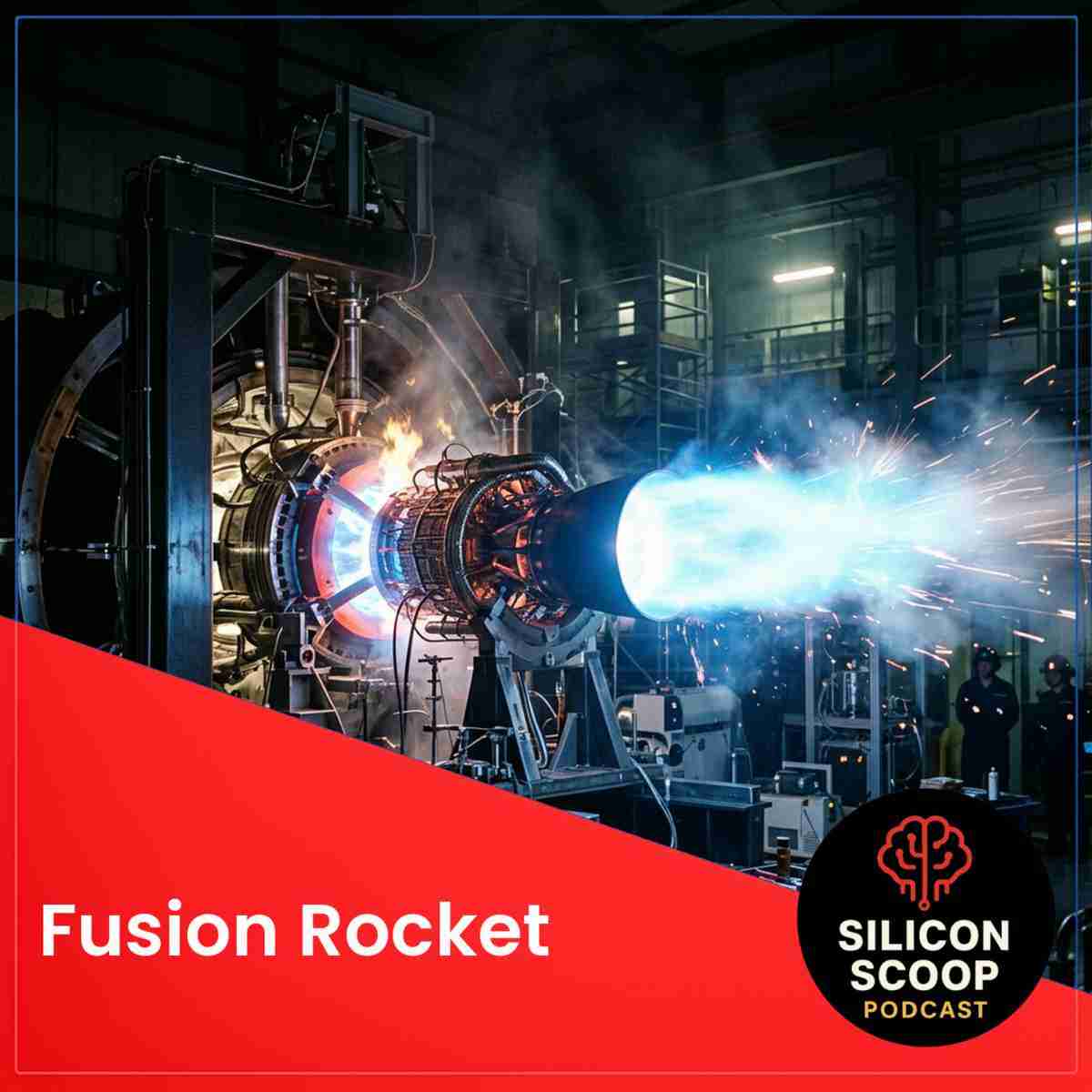
Fusion Rocket Sunbird Achieves Historic First Plasma — And It Could Change Space Travel Forever
Estimated reading time: 10 minutes
Key Takeaways
- Pulsar Fusion achieved “first plasma” in its Sunbird exhaust test system on March 25, 2026.
- This is the first time a nuclear fusion rocket has successfully generated and confined plasma in a system designed for deep-space propulsion.
- The milestone validates the core technology behind the Dual Direct Fusion Drive (DDFD) engine.
- Sunbird is designed as a reusable space-tug that docks with spacecraft in orbit and provides continuous high-thrust propulsion.
- The DDFD targets 10,000 to 15,000 seconds specific impulse, 98 to 147 km/s exhaust velocity, and 2 megawatts of electrical power output.
- Pulsar Fusion plans a 2027 in-orbit demonstration of Sunbird’s core components.
Table of contents
- Fusion Rocket Sunbird Achieves Historic First Plasma — And It Could Change Space Travel Forever
- Introduction: A Fusion Rocket That Could Rewrite the Rules of Space Travel
- Section 1: What Is First Plasma — and Why Does It Matter for Sunbird Propulsion?
- Section 2: Pulsar Fusion’s DDFD Engine — The Technical Specs Behind the Breakthrough
- 🚀 Turn Big Ideas Into Repeatable Results
- Section 3: How the Sunbird Space-Tug Works — First Plasma in Action
- Section 4: The Road to Launch — What Comes Next After First Plasma
- FAQ: 10 Questions and Answers About the Fusion Rocket Sunbird
- Conclusion: The Fusion Rocket Era Has Officially Begun
Introduction: A Fusion Rocket That Could Rewrite the Rules of Space Travel
The fusion rocket has long been the stuff of science fiction. Now, it is becoming science fact.
On March 25, 2026, UK-based space propulsion company Pulsar Fusion announced it had achieved “first plasma” in its Sunbird exhaust test system. The live demonstration was streamed from Bletchley, England, directly to the stage at Amazon’s MARS Conference in Ojai, California.
This is not a small step. This is the first time a nuclear fusion rocket has successfully generated and confined plasma in a system designed for deep-space propulsion. It validates the core technology behind the Dual Direct Fusion Drive (DDFD) engine — and it puts humanity on a path to reaching Mars in under six months.
Here is everything you need to know about what happened, how the technology works, and why it matters.
Section 1: What Is First Plasma — and Why Does It Matter for Sunbird Propulsion?
Sunbird propulsion is built around a simple but powerful idea: use the same process that powers stars to push rockets through space.
What Is Plasma?
Plasma is the fourth state of matter. When gas is heated to extreme temperatures, its atoms strip apart into a cloud of charged particles. That cloud is plasma. Stars are made of it. Nuclear fusion happens inside it.
Achieving “first plasma” means Pulsar Fusion successfully:
- Generated a plasma state inside the Sunbird exhaust test system
- Confined that plasma — meaning they controlled it and stopped it from dissipating
- Validated the core physical process needed for the DDFD engine to work
Without plasma confinement, there is no fusion. Without fusion, there is no Sunbird.
Why Plasma Confinement Is So Hard
Plasma reaches temperatures hotter than the surface of the sun. No physical material can contain it directly. Engineers must use powerful magnetic fields to keep it suspended — like holding a burning ball of fire in an invisible cage.
The Sunbird system uses high-temperature superconducting magnets to create those magnetic fields. Upcoming tests in June 2026 will push this further by introducing:
- Langmuir probes — tools that measure plasma density and temperature
- Retarding Potential Analysers — instruments that analyse the energy of ions leaving the plasma
- Advanced superconducting magnets — for stronger, more precise field control
These upgrades will give Pulsar Fusion detailed data on how the plasma behaves, which is critical for scaling toward a full flight engine.
Sources:
– Sunbird fusion propulsion
– In a World’s First, Pulsar Fusion Demonstrates Its Sunbird Nuclear Fusion Rocket’s First Plasma at MARS Conference Hosted by Jeff Bezos
Section 2: Pulsar Fusion’s DDFD Engine — The Technical Specs Behind the Breakthrough
Pulsar Fusion has built something unlike any rocket engine in history. The Dual Direct Fusion Drive is not just a propulsion system. It is also a power generator.
Key Technical Specifications
| Metric | Value |
|—|—|
| Specific Impulse | 10,000 – 15,000 seconds |
| Thrust | 10 – 100 Newtons |
| Exhaust Velocity | 98 – 147 km/s |
| Electrical Power Output | 2 megawatts |
| Engine Dimensions | 9.8m x 3.5m x 3.5m |
| Vehicle Length (full) | ~30 metres (100 feet) |
| Fusion Fuel | Deuterium + Helium-3 (D-3He) |
Why These Numbers Are Revolutionary
Chemical rockets — the kind we use today — have a specific impulse of roughly 450 seconds. The DDFD would deliver 10,000 to 15,000 seconds. That is more than 20 times the fuel efficiency of the best chemical engines alive today.
Exhaust velocity tells you how fast propellant exits the engine. Chemical rockets top out around 4.5 km/s. The DDFD targets 98 to 147 km/s — meaning the exhaust moves up to 33 times faster.
The 2 megawatt power output is equally important. Chemical rocket engines produce zero electricity. The DDFD generates enough power to run all onboard spacecraft systems — sensors, life support, communication, and more. This matters enormously for deep-space missions where solar panels become less effective the farther you travel from the sun.
The Propellant: Why Krypton?
Current Sunbird tests use krypton as the propellant. Krypton was chosen for:
- High ionization efficiency — it converts to plasma easily
- Inert chemical properties — it is safe and stable at low mass flow rates
- Diagnostic clarity — it makes it easier to study plasma behaviour during early testing
The operational version of Sunbird will use Deuterium-Helium-3 (D-3He) fusion — an aneutronic reaction, meaning it produces far fewer harmful neutrons than traditional nuclear reactions. This reduces radiation shielding requirements and makes the system safer for long-duration missions.
Pulsar Fusion is working with the UK Atomic Energy Authority to study neutron radiation effects on reactor materials — ensuring the structure can handle whatever neutrons are produced during real operational runs.
Funding and Institutional Backing
Pulsar Fusion has received:
- A UK Space Agency grant (December 2022)
- A contract under the ESA General Support Technology Programme (GSTP) for Hall-Effect Thruster development
This institutional support signals that both national and international space agencies see genuine potential in fusion propulsion technology.
Sources:
– Sunbird fusion propulsion
– Fusion Propulsion (PDF)
– YouTube video
🚀 Turn Big Ideas Into Repeatable Results
If a fusion rocket can prove “first plasma,” you can prove “first automated workflow.”
Stop letting manual tasks drain your team — automate your operations, reduce errors, and scale without hiring more hands.
Book a Free Automation Consult → flowgrammer.ca
Section 3: How the Sunbird Space-Tug Works — First Plasma in Action
Sunbird is not a traditional rocket. It will not launch from a launchpad on Earth. It is a space-tug — a propulsion vehicle that lives and operates entirely in space.
The Orbital Docking System
Here is how the operational Sunbird system would work:
1. Sunbird units are stored on large orbital docking stations in low-Earth orbit (LEO)
2. A spacecraft launches from Earth using conventional chemical rockets and reaches LEO
3. A Sunbird detaches from its docking station and manoeuvres toward the spacecraft
4. Using its eight thrusters, Sunbird attaches to the spacecraft like a jet pack
5. Sunbird then fires its DDFD engine, providing continuous high-thrust propulsion to push the spacecraft toward its destination
6. Upon arrival, Sunbird detaches and docks with a waiting orbital station at the destination
7. The cycle repeats — the same Sunbird unit can be used over and over
Think of it as a reusable deep-space ferry engine. The spacecraft carries the cargo or crew. The Sunbird carries the firepower.
What Sunbird Can Carry and How Fast
Once fully operational, Sunbird is designed to:
- Transport 1,000 to 2,000 kilograms (2,200 to 4,400 pounds) of cargo
- Deliver payloads to Mars orbit in under 6 months
- Support missions to the asteroid belt and outer planets
Compare that to today’s chemical propulsion technology, which takes up to 10 months just to reach Mars.
Analysts also estimate that Sunbird-class propulsion could deliver 20 to 50% delta-V reductions — meaning spacecraft need far less total velocity change to reach their destinations. That translates directly into smaller fuel loads, lower costs, and more mission flexibility.
Beyond Mars: Asteroid Mining and Outer Planet Exploration
The DDFD’s combination of high thrust and 2 MW power output opens up entirely new mission profiles:
- Asteroid mining operations that need sustained power far from the sun
- Fast-turnaround cargo runs between Earth, the Moon, and Mars
- Outer planet probes to Jupiter, Saturn, and beyond — missions that would take decades with chemical rockets
Sources:
– Sunbird fusion propulsion
– YouTube video
Section 4: The Road to Launch — What Comes Next After First Plasma
Achieving first plasma is a milestone. But Pulsar Fusion still has a clear and demanding roadmap ahead before Sunbird becomes fully operational.
The 2027 In-Orbit Demonstration
The most critical near-term target is a 2027 in-orbit demonstration of Sunbird’s core components. This will be the first time any element of the fusion propulsion system operates in the vacuum of real space.
Static ground tests began in 2025. The first plasma demonstration in March 2026 validated plasma confinement. June 2026 tests will add Langmuir probes, Retarding Potential Analysers, and advanced superconducting magnets to gather deep plasma diagnostic data.
Each step builds on the last — methodically proving the technology before it ever reaches orbit.
Key Remaining Challenges
Even with this historic breakthrough, serious engineering hurdles remain:
- Neutron shielding — D-3He fusion is low-neutron but not zero-neutron. Protecting sensitive spacecraft systems from even trace radiation requires careful material engineering
- Building orbital docking infrastructure — The LEO and deep-space stations needed to house and refuel Sunbird units represent a massive construction challenge
- Scaling the engine — Moving from a test exhaust system to a full 30-metre flight vehicle is an enormous engineering leap
- Long-duration plasma stability — Maintaining plasma confinement for mission-length burns (days, not seconds) has never been demonstrated
Despite these challenges, the expert consensus is clear: Sunbird represents the most credible near-term path to practical nuclear fusion propulsion. The UK Atomic Energy Authority collaboration, ESA backing, and staged testing approach all suggest a serious, disciplined programme — not a flashy concept with no follow-through.
Why This Matters for the Entire Space Industry
Nuclear fusion propulsion has been studied for decades. What Pulsar Fusion has done is move it from theoretical papers to a live plasma demonstration. This changes the conversation across the entire space sector.
If Sunbird succeeds:
- NASA Mars missions could be redesigned around faster transit times
- Private space companies gain access to reusable deep-space propulsion
- Satellite operators could deploy and reposition assets far more efficiently
- Planetary defence missions could reach threatening asteroids faster
The ripple effects of this technology extend well beyond Pulsar Fusion itself.
Sources:
– Sunbird fusion propulsion
– Fusion Propulsion (PDF)
FAQ: 10 Questions and Answers About the Fusion Rocket Sunbird
Q1: What is a fusion rocket?
A fusion rocket uses nuclear fusion — the same process that powers the sun — to create thrust. Instead of burning chemical fuel, it superheats a plasma of fusion fuel to extreme temperatures and ejects it at enormous velocity to push the spacecraft forward.
Q2: What did Pulsar Fusion actually achieve on March 25, 2026?
Pulsar Fusion successfully generated and confined plasma inside the Sunbird exhaust test system. This “first plasma” milestone validates the core physics behind the DDFD engine and proves the system can create the conditions needed for nuclear fusion propulsion.
Q3: What is the Sunbird Migratory Transfer Vehicle?
Sunbird is a space-tug — a fusion-powered propulsion vehicle that docks with spacecraft already in orbit and boosts them to their destinations. It does not carry people or cargo itself. It is the engine that pushes other vehicles through deep space.
Q4: How fast could Sunbird get a spacecraft to Mars?
Sunbird is designed to transport a spacecraft carrying up to 2,000 kilograms of cargo to Mars orbit in under 6 months. Today’s chemical rockets take up to 10 months.
Q5: What fuel does Sunbird use?
Sunbird’s operational design uses Deuterium and Helium-3 (D-3He) — an aneutronic fusion reaction that produces fewer harmful neutrons than other fusion approaches. Current tests use krypton as a stand-in propellant for diagnostic efficiency.
Q6: What is specific impulse and why does it matter?
Specific impulse measures how efficiently a rocket uses its fuel. Higher specific impulse means you get more thrust from the same amount of fuel. Chemical rockets achieve around 450 seconds. Sunbird’s DDFD engine targets 10,000 to 15,000 seconds — over 20 times better.
Q7: Can Sunbird power spacecraft systems as well as move them?
Yes. The DDFD engine is designed to generate 2 megawatts of electrical power in addition to providing thrust. This allows it to run all spacecraft systems — communication, sensors, life support — without needing separate power sources like solar panels.
Q8: When will Sunbird be ready for real space missions?
Pulsar Fusion plans an in-orbit demonstration of core components in 2027. A fully operational Sunbird system, including orbital docking stations, will take additional years beyond that to develop and deploy.
Q9: What are the biggest remaining challenges?
The main hurdles are neutron radiation shielding, building orbital docking infrastructure, scaling from a test system to a full flight vehicle, and sustaining plasma confinement for mission-length periods rather than brief test pulses.
Q10: Why does this matter if Sunbird is still years away from full operation?
First plasma proves the underlying technology works. Every major engineering programme requires this kind of staged validation. The fact that Pulsar Fusion has achieved plasma confinement means the science is sound — now it is an engineering execution problem, which is a far more tractable challenge than an unsolved physics problem.
Conclusion: The Fusion Rocket Era Has Officially Begun
Pulsar Fusion has done something no one has done before. They ignited plasma inside a working fusion rocket exhaust system and proved that the Sunbird propulsion concept is physically real.
This is not a simulation. It is not a concept video. It is a validated demonstration of the core technology that could cut Mars transit time in half, enable asteroid mining, power outer planet missions, and redefine what deep-space travel means for humanity.
The road from first plasma to a fully operational fusion-powered space-tug is still long. But for the first time, that road has a clear first step — and Pulsar Fusion has taken it.
Watch the 2027 in-orbit demonstration closely. If it succeeds, the age of the fusion rocket will have truly arrived.
Sources:
– Sunbird fusion propulsion
– Fusion Propulsion (PDF)
– YouTube video
– In a World’s First, Pulsar Fusion Demonstrates Its Sunbird Nuclear Fusion Rocket’s First Plasma at MARS Conference Hosted by Jeff Bezos
Additional Links
Flowgrammer.ca – 💡 Unlock AI-Powered Automation! Let flowgrammer.ca handle complex workflows so you can focus on growing your business.
- Silicon Scoop Podcast – Stay Informed, Stay Ahead!
- Startup Talk Podcast
- Flowgrammer Youtube
- Startup Investor Drinks – Join Toronto’s Startup Community and connect with fellow startup enthusiasts and investors.
- TorontoStarts Startup and Entrepreneur Community – Become a part of Toronto’s thriving startup ecosystem.
- Workhaus – Discover flexible workspace solutions for your business needs.
- Work with The Startup Coach – Get expert guidance and mentorship for your startup journey.
- Reach out to Jon Irwin on LinkedIn – Connect with our co-host and technology expert.
Flowgrammers.ca – 💡 Join Toronto’s Fastest Growing AI and Busiess Automation Community..
Episode transcript
Read the full transcript
Craig: for decades, nuclear fusion rockets were confined to the pages of science fiction and whiteboard theories. yesterday, pulsar fusion ignited a miniature sun in a lab and effectively rewrote the physics of deep space travel. fusion rocket achieves the first plasma. uk pulsar fusion successfully generated a confined plasma in their sunbird exhaust system, validating physics of their dual direct fusion drive. this reusable space tug system uses magnetic fields to contain stellar level heat generating both immense thrust and electrical power. this technology mathematically cuts time travel to mars in half and provides enough onboard electricity to make deep space, habitation, and asteroid mining a physical reality. what do you think about this, john?
Jon: i think this is cool, but hold on. this isn't the same. it's similar to nuclear fusion, but they're they're not creating a sun. they're creating a fuel, in they're they're heating fuel, like, which is hydrogen isotopes into plasma, forcing the atomic nuclear to fuse, and then releasing that energy. they're not capturing the enter like, they're not trying to contain it. right? they're expelling it, which is different.
Craig: correct.
Jon: yeah. so yeah. so we're not shooting out these miniature suns. we're just we're using fusion technology to, to propel ourselves, which is super, super cool. i absolutely love this. so the engine called sunbird is designed as part of this future spacecraft concept known as migratory transfer vehicle. so chemical rockets, what artemis two uses and all this sort of stuff, they burn fuel explosively for short bursts. whereas fusion rockets, they can, they're aiming for continuous sustained thrust, which in which will enable faster acceleration over long durations and much higher efficiency. so in theory, it could allow spacecraft achieve, to reach higher speeds and travel deeper in space with less fuel. but, again, we gotta think about what's gonna be the impact on on humans and all that sort of stuff. but as we know, because we've covered nuclear fusion, fusion produces far more energy per unit mass than chemical reactions in potentially orders of magnitude higher efficiency. so the biggest technological hurdle that they have right now is keeping the plasma stable and contained because plasma is extremely hot and unstable you know, and it must be confined using magnetic fields. so the fact that pulsar fusion achieved a controlled plasma generation and confinement within the engine, that means they've crossed a major engineering threshold, which is super, super cool, super interesting. what do you think about this? do you think they're on the right path? do you think that this is, this is a viable potential technology for space travel?
Craig: well, we're gonna know soon. diagnostic tests scale up in june 2026 where they're gonna be testing the langmuir probes, retarding potential analyzers, advanced superconducting magnets, for this upcoming test and with anticipated in orbit demonstrations in 2027. so we're a year away potentially of them testing this in orbit. think of this update like a high speed locomotive for the solar system. you don't use a massive freight train to back out of your driveway. you use a standard car to get to the station and then hit your car go to the train and let its incredible efficient high powered engine blast you across the continent. so sunbird stays in orbit, grabs traditional chemically launched spacecraft, and hauls them across the solar system at speeds we've never seen. so it sounds great, but the cost is a trillion dollar infrastructure. you know, seems, to promise low emission cost by driving a 20 to 50% reduction in delta b requirements for payloads. but i guess you have to think that we're gonna be doing a lot of work to get this investment on your dollar back, john.
Jon: absolutely. yeah. but here's the thing is i think the real breakthrough, it's not fusion. it's that they're controlling plasma in a propulsion system. so, this is essentially the same bottleneck that slowed fusion energy for decades, but, this validates decades of theory where fusion rockets have been theoretical for decades and considered impractical, to be honest. so this experiment is showing that we're transitioning from theory to engineering, which, like we said like you said, it's gonna cost trillions of dollars in infrastructure and all that sort of stuff. but think about it like this. i think we're we're at plasma or fusion engines where we were with early jet engine prototypes in the nineteen thirties. do you think that's about accurate?
Craig: yeah. i think so. like, there's a lot of experimentation going on now around what's gonna take us to the stars. we've seen, i can't remember at the time, the blast, blast, blast, blast, blast, blast explosion we talked about a few weeks ago, that they're trying to con the constant acceleration to achieve higher speeds. if you can use that technology and this together, obviously, you know, we're heading towards the stars faster than we think. elon has already redirected his efforts to the moon having, basically the same thought saying it's so much easier to launch from the moon than from the earth. so we might as well build the station there, get all the resources there where we can build everything, and then everything going to mars passes, you know, stops at the moon, and then so the concept is there. it sounds like a lot of people are on board with space travel, and money is going like crazy. we are running out. i say running out. we have limited resources on the planet earth, and so much of these resources are out there saying that this is well worth, the trillion dollar investment just to start getting out there to being able to bring resources back and stuff. so i think, yes, this is, you know, the electrical power is two megawatts continuous output. 10,000 to 15,000, seconds is the specific impulse, and the exhaust velocity is 98 to a 147 kilometers per second up to 33 times faster than chemical rockets. yeah. the dual direct fusion drive utilizes an anneutronic fusion reaction combining deutronic and helium three. speaking of the moon, helium three is abundant there. systems rely on high temperature superconducting magnets to create a magnetic bottle confining the ultra hot plasma while selectively allowing it to escape through a magnetic nozzle to generate the thrust. so, you know, helium three, the ideal fuel for the, how do you say that? the nautical reaction?
Jon: yeah. i think so.
Craig: because it's because it produces fewer, degrading neurons. it's incredibly rare on earth but abundant on the moon. this makes sunbird the ultimate catalyst for lunar mining. we gotta get up there to do it. pulse surf fusion chose to livestream this historic first plasma milestone directly to jeff bezos, highly exclusive invitation only mars conference heavily heavily hitting a back channel synergies with origins, orbital in, infrastructure plan. so maybe there's some back end deals there. and it has direct funding from the uk space agency and the european space agency agency, signaling a major international effort to break the us monopoly on next gen propulsion in space. i love it. yeah. so sunberg just proved that fusion propulsion is no longer a theoretical physics problem. it is now strictly an engineering execute execution challenge. are we actually ready for nuclear fusion engines in earth's orbit, or does the radiation and complexity risk make you nervous? let us know in the chat.
More from Silicon Scoop
All episodes
silicon-scoop · October 16, 2026
Meta’s $18 Billion Teen Safety Settlement: Soft Guardrails, Hard Leverage Over TikTok and YouTube
Deep dive on Meta teen safety settlement, social media addiction lawsuit, new Facebook Instagram time limits and pressure on TikTok YouTube age verification.
View episode

silicon-scoop · October 15, 2026
How Claude Mythos Is Reshaping Cryptanalysis: HAWK, AES and the Rise of AI-Driven Crypto Research
Claude Mythos cryptanalysis weakens HAWK post-quantum signature, speeds AES Möbius Bridge attack, and powers CryptanalysisBench benchmark in AI-driven crypto research.
View episode

silicon-scoop · October 14, 2026
Nvidia’s $12.9 Billion Hugging Face Bet: How Controlling the Open-Source Model Hub Reshapes AI Chips, Cloud, And Competition
Nvidia Hugging Face acquisition could reshape open source AI models, AI chip dominance, and the global developer model hub, raising antitrust and neutrality questions.
View episode