
Tofu Brine Batteries Make 120,000 Cycles Look Normal
Tofu brine batteries make 120,000 cycles look normal https://torontostarts.com/silicon-scoop/ Flowgrammer.ca -> https://flowgrammer.ca/ AI News and Resources -> https://flowgrammers.ca OpenClaw Toronto -> https://openclawto.com/ Startup Investor Drinks Toronto - https://startupdrinksto.com/ Toronto’s Startup Community - https://torontostarts.com/ Silicon Scoop Silicon Scoop Podcast - https://torontostarts.com/silicon-scoop/ Apple: https://podcasts.apple.com/us/podcast/silicon-scoop/id1758711826 Spotify: https://open.spotify.com/show/5bAzF0MwV6TtLhJAhvHayI YouTube: https://www.youtube.com/playlist?list=PLj4v-RoA7A-gT62vrEYqh1zCv-0Hj-o5J Startup Talk Startup Talk Podcast -> https://torontostarts.com/startup-talk-toronto-startup-podcast/ Apple -> https://podcasts.apple.com/us/podcast/startup-talk/id1763804003 Spotify -> https://open.spotify.com/show/1siJMILILidHAiAsrX2VBU YouTube: https://youtube.com/playlist?list=PLj4v-RoA7A-jxV5FHs5e61oIsuvUJYmT_&si=LYegRe5GYLKNQ7xL
With Craig Major and Jon Irwin
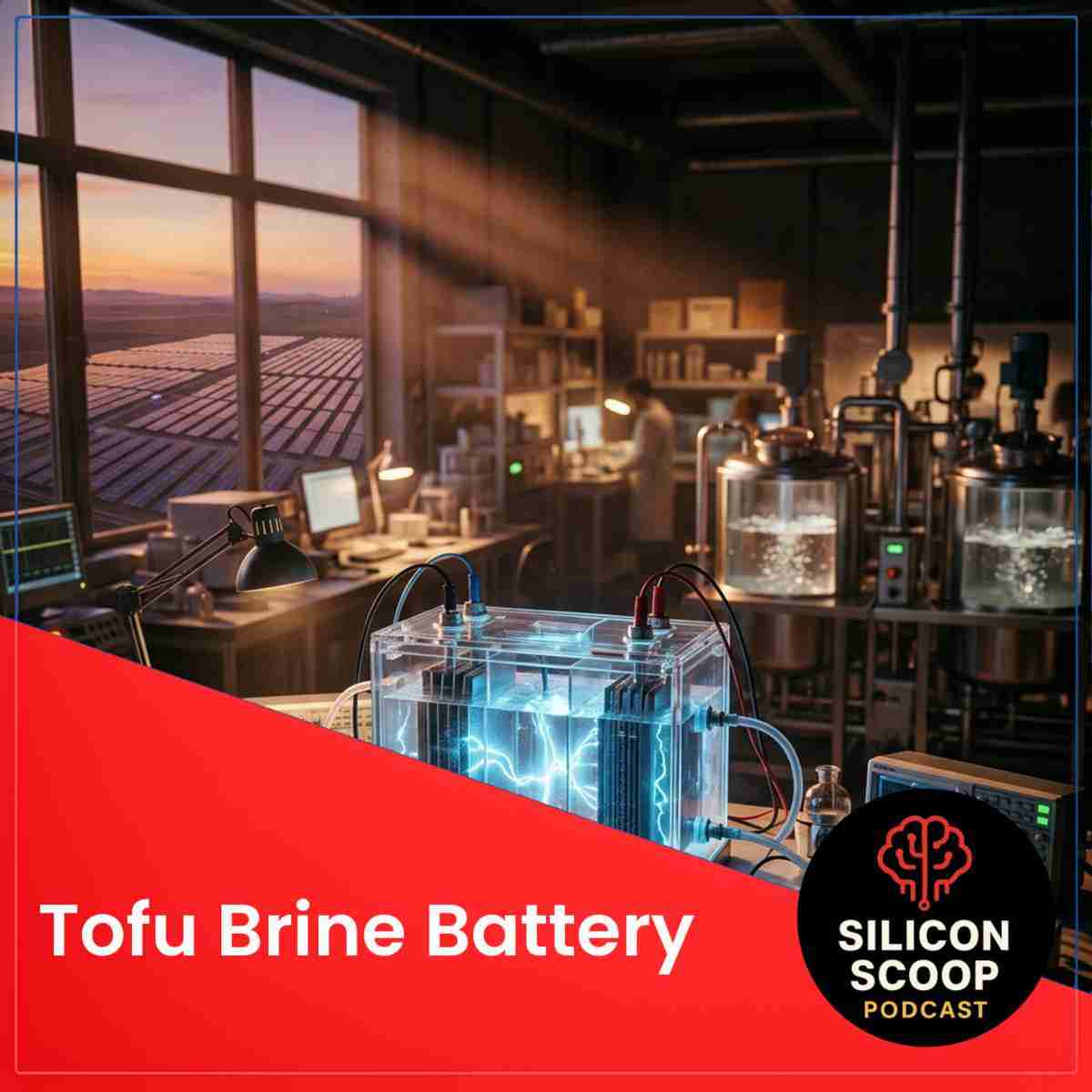
China’s Tofu Brine Battery: 120,000+ Cycles That Could Outlast Lithium-Ion Forever
Reading Time: ~10 minutes
Key Takeaways
- The tofu brine battery is a water-based battery inspired by the salty liquid left over from making tofu.
- This aqueous battery has achieved more than 120,000 charge and discharge cycles in lab tests.
- It uses a neutral pH of 7 electrolyte to reduce corrosion and improve long-term stability.
- It is designed for stationary grid storage, not electric vehicles, prioritizing longevity and safety over energy density.
- China’s planned $574 billion grid investment (2026–2030) makes the timing of this breakthrough especially significant.
Table of contents
- China’s Tofu Brine Battery: 120,000+ Cycles That Could Outlast Lithium-Ion Forever
- Introduction: A Battery Born From Bean Curd
- Section 1: What Is a Tofu Brine Battery and How Does It Work?
- Section 2: Water Battery Cycles vs. Lithium-Ion — How Does It Compare?
- ⚡ Stay Ahead of the Energy Revolution
- Section 3: China Grid Storage — Why This Breakthrough Matters Right Now
- Section 4: Safety and Environmental Impact of the Eco-Friendly Water Battery
- Section 5: Challenges — What Needs to Happen Before This Battery Reaches the Grid
- FAQ: 10 Common Questions About the Tofu Brine Battery
- Conclusion: A Quiet Revolution in How We Store Energy
Introduction: A Battery Born From Bean Curd
The tofu brine battery sounds like something out of a science fiction story. But it is very real — and it could change the way the world stores energy.
Researchers from the City University of Hong Kong and the Southern University of Science and Technology have built a water-based battery using an electrolyte inspired by the salty liquid left over from making tofu. This aqueous battery has achieved more than 120,000 charge and discharge cycles in lab tests — a number that leaves traditional lithium-ion batteries far behind.
This is not just a cool science experiment. With China pouring $574 billion into power grid upgrades between 2026 and 2030, the timing of this breakthrough could not be better. Safe, long-lasting, low-cost grid storage is exactly what the renewable energy revolution needs.
Let’s break down what this battery is, how it works, and why it matters.
Section 1: What Is a Tofu Brine Battery and How Does It Work?
The Science Behind the Aqueous Battery Stability
Traditional lithium-ion batteries use a flammable liquid electrolyte — the substance that carries electrical charge between the two ends of the battery. This makes them powerful but also dangerous. They can catch fire, they degrade over time, and they are full of toxic materials.
The tofu brine battery takes a very different approach. Instead of a flammable electrolyte, it uses a water-based solution of magnesium chloride (MgCl₂) or calcium chloride (CaCl₂) salts at a neutral pH of 7 — essentially a saltwater-level safe liquid that closely mimics the brine used in tofu production.
Here is why that neutral pH is such a big deal:
- Most aqueous batteries use strongly acidic or alkaline electrolytes. These corrode the battery’s inner parts over time, limiting how many cycles the battery can handle before it dies.
- At pH 7, the electrolyte is neither acidic nor alkaline. This dramatically reduces corrosion and keeps the battery stable for far longer.
- Divalent ions (magnesium and calcium carry two charges instead of one) allow the battery to store and release energy efficiently without breaking down the internal structure.
The negative electrode of this battery is made from a special class of materials called covalent organic polymers (COPs). Specifically, the researchers used a compound called Hexaketone-tetraaminodibenzo-p-dioxin (HK-TADBD), which gives the electrode a specific capacity of 112.8 mAh/g.
The full cell operates at:
- 2.2 V voltage window — competitive for an aqueous system
- 20 A/g high-rate capability — meaning it can charge and discharge quickly
- 48.3 Wh/kg energy density — lower than lithium-ion but more than enough for stationary storage applications
The study was published in Nature Communications on February 18, 2026, led by researchers Hui Chen and Chunyi Zhi.
“An aqueous battery using an electrolyte with a pH of 7 and suitable for direct environmental discard” — Nature Communications
This water battery is not trying to power your electric car. It is built for something different — and arguably more important.
Sources:
- china-water-battery-120k-cycles-breakthrough-or-sustech-research-6303
- chinese-scientists-create-new-battery-electrolyte-safe-tofu-brine
- Nature Communications paper
Section 2: Water Battery Cycles vs. Lithium-Ion — How Does It Compare?
120,000 Water Battery Cycles: What Does That Actually Mean?
To understand why 120,000+ charge cycles is such a massive achievement, you need to know what typical batteries look like.
- A standard lithium-ion battery (like the kind in your phone or an electric vehicle) lasts roughly 500 to 2,000 cycles before it loses too much capacity to be useful.
- High-end lithium-iron-phosphate (LFP) batteries used in some grid storage systems can reach 3,000 to 6,000 cycles under ideal conditions.
- The tofu brine battery hits 120,000 cycles — that is 20 to 240 times longer than conventional lithium-ion systems.
Put that into real-world terms:
- If a grid storage battery charges and discharges once per day, a lithium-ion battery lasts roughly 5 to 16 years.
- The tofu brine aqueous battery, at one cycle per day, could theoretically last over 328 years.
Even accounting for other forms of wear and degradation, this battery could operate for decades without needing replacement. That fundamentally changes the economics of energy storage.
Why Longevity Beats Energy Density for Grid Storage
Lithium-ion batteries are prized for their high energy density — they pack a lot of power into a small space. That is critical for electric vehicles and smartphones. But grid storage is a completely different use case.
When you are storing power from a solar farm or wind turbine, the battery does not need to be small or light. It just needs to:
- Last a very long time without degrading
- Charge and discharge reliably thousands of times
- Be safe — because grid-scale installations are massive
- Be affordable to maintain over decades
On every single one of these points, the tofu brine battery wins against lithium-ion for stationary storage applications.
Analysts who have reviewed the research agree: this battery is ideally suited for stationary, long-duration energy storage where longevity matters far more than compactness. The aqueous battery’s stability across 120,000 cycles is a defining feature that no current commercial battery system can match.
Sources:
- fluorine-tofu-brine-lead-to-battery-breakthroughs-in-china
- chinese-scientists-create-new-battery-electrolyte-safe-tofu-brine
⚡ Stay Ahead of the Energy Revolution
The tofu brine battery is just one example of how fast the clean energy world is moving. If you want to stay informed on breakthroughs like this — from aqueous battery research to grid-scale storage investments — make sure you never miss an update.
Subscribe to our newsletter and get cutting-edge energy technology news delivered straight to your inbox every week.
Section 3: China Grid Storage — Why This Breakthrough Matters Right Now
China’s $574 Billion Power Grid Investment Creates the Perfect Market
The tofu brine battery does not exist in a vacuum. It is arriving at exactly the right moment for China — and for the world.
China’s State Grid Corporation has announced a $574 billion (4 trillion yuan) investment in power grid infrastructure between 2026 and 2030. A huge portion of this spending is aimed at integrating more renewable energy — solar and wind — into the national grid.
Here is the problem that money is trying to solve:
- Solar panels only generate power when the sun shines. Wind turbines only spin when the wind blows.
- To use renewable energy around the clock, you need to store it when it is being produced and release it when it is not.
- That means massive amounts of battery storage — more than the world currently has.
Lithium-ion batteries are the current default for grid storage. But they come with serious drawbacks at scale:
- Fire risk — large lithium-ion installations have caused destructive fires at energy storage sites worldwide
- Toxic materials — cobalt, nickel, and other materials are difficult and expensive to mine and recycle
- Limited lifespan — even the best grid-scale lithium-ion systems need replacing every 10 to 15 years
- Supply chain vulnerability — lithium, cobalt, and nickel are geopolitically sensitive materials
The tofu brine battery addresses every single one of these problems:
- ✅ Non-flammable — the water-based electrolyte cannot catch fire
- ✅ Non-toxic — uses common salts (magnesium chloride, calcium chloride) instead of rare and hazardous materials
- ✅ Extremely long lifespan — 120,000 cycles compared to lithium-ion’s 500-6,000
- ✅ Simpler supply chain — magnesium and calcium are among the most abundant elements on Earth
Compliance With Environmental Standards
One of the most striking claims made in the Nature Communications study is that this battery complies with GB 18599-2020 and ISO 14001 environmental standards, which means it can be discarded directly without special hazardous waste disposal.
That is a completely different world from lithium-ion batteries, which require carefully controlled recycling processes to prevent toxic contamination of soil and water. For large-scale grid storage installations, the ability to safely and cheaply dispose of old batteries could represent enormous cost savings over time.
Sources:
- china-to-spend-574-billion-on-power-grids-amid-renewables-push
- fluorine-tofu-brine-lead-to-battery-breakthroughs-in-china
- china-water-battery-120k-cycles-breakthrough-or-sustech-research-6303
Section 4: Safety and Environmental Impact of the Eco-Friendly Water Battery
Why “Safe to Throw Away” Is a Revolutionary Claim
When was the last time you heard someone say a battery was safe to throw in the trash?
With lithium-ion batteries, improper disposal is a serious environmental hazard. Lithium, cobalt, and other materials can leach into groundwater. Damaged lithium-ion batteries can spontaneously combust in landfills and recycling facilities.
The tofu brine battery flips this entirely:
- The electrolyte is essentially saltwater — the same type of mildly salty solution used in tofu production. It poses no meaningful toxicity risk.
- Covalent organic polymer electrodes are far more benign than the cobalt-oxide or nickel-manganese-cobalt cathodes used in lithium-ion cells.
- The materials are abundant — magnesium and calcium are not rare earth elements. They are not geopolitically sensitive. They do not require destructive mining practices.
Fire Safety: A Critical Advantage for Large Installations
The fire risk of lithium-ion batteries is not a minor footnote. It is a major obstacle to the rapid deployment of grid-scale storage.
Large battery energy storage systems (BESS) have caused serious fires in multiple countries. Lithium-ion fires are extremely difficult to extinguish and can burn for hours or even days. This has led to strict — and expensive — fire suppression requirements for large installations.
A water-based battery system simply cannot catch fire in the same way. The liquid electrolyte itself acts as a fire suppressant. This could:
- Dramatically reduce the cost of building grid storage facilities by eliminating complex fire suppression systems
- Open up installation locations that are currently too risky for lithium-ion (e.g., near populated areas, inside buildings)
- Reduce insurance costs for battery storage operators
For military installations and data centers — two specific applications highlighted by the research team — the ability to store large amounts of energy safely and reliably without fire risk is particularly valuable.
Sources:
- chinese-scientists-create-new-battery-electrolyte-safe-tofu-brine
- fluorine-tofu-brine-lead-to-battery-breakthroughs-in-china
Section 5: Challenges — What Needs to Happen Before This Battery Reaches the Grid
Scalability and Real-World Reliability of Aqueous Battery Technology
No breakthrough is complete without honest discussion of what still needs to be solved. The tofu brine battery is genuinely exciting, but it is still a laboratory result. Turning it into a commercial product is a different challenge entirely.
Here are the key hurdles:
1. Energy Density Needs to Improve
- At 48.3 Wh/kg, the tofu brine battery holds significantly less energy per kilogram than lithium-ion batteries, which typically achieve 150-250 Wh/kg.
- For grid storage, this is not necessarily a dealbreaker — you can just use more batteries. But it does mean you need more physical space and potentially more material cost per unit of energy stored.
- Researchers will need to find ways to increase energy density without sacrificing the battery’s safety and longevity advantages.
2. Industrial-Scale Manufacturing
- The covalent organic polymer (COP) electrodes used in this battery — specifically HK-TADBD — are currently synthesized in small quantities in research labs.
- Scaling up the production of these novel materials to industrial volumes while keeping costs competitive will take significant engineering effort.
- The manufacturing process must also be consistent enough to produce millions of battery cells with reliable performance.
3. Real-World Performance Validation
- Lab conditions are controlled and ideal. Real-world grid storage must handle:
- Extreme temperatures (both hot and cold)
- Humidity and weathering
- Variable charge/discharge patterns
- Years of continuous operation without maintenance
- The battery must prove it can perform at 120,000 cycles outside of the laboratory before manufacturers will commit to large-scale production.
4. Commercialization Timeline
- Analysts who follow China’s battery sector estimate that pilot projects could emerge within 5 to 7 years, assuming continued research progress and government support.
- Given China’s aggressive investment in battery R&D and its stated grid storage goals, this timeline could accelerate — but it is not guaranteed.
Despite these challenges, the fundamental science is solid. The neutral pH electrolyte approach to aqueous battery stability is a genuine breakthrough, and the research team has clearly done rigorous work to validate their results.
Sources:
- china-water-battery-120k-cycles-breakthrough-or-sustech-research-6303
- fluorine-tofu-brine-lead-to-battery-breakthroughs-in-china
FAQ: 10 Common Questions About the Tofu Brine Battery
Q1: What is a tofu brine battery?
A tofu brine battery is a water-based (aqueous) rechargeable battery that uses a saltwater electrolyte similar to the liquid used in making tofu. It was developed by researchers in China and can last for over 120,000 charge cycles without catching fire or releasing toxic materials.
Q2: Who invented the tofu brine battery?
The battery was developed by researchers from the City University of Hong Kong and the Southern University of Science and Technology. The study was led by Hui Chen and Chunyi Zhi and published in Nature Communications on February 18, 2026.
Q3: How many cycles can the tofu brine battery last?
The battery has demonstrated over 120,000 charge and discharge cycles in laboratory tests. This is dramatically more than standard lithium-ion batteries, which typically last 500 to 6,000 cycles.
Q4: Is the tofu brine battery safe?
Yes. The electrolyte is water-based and non-flammable, making it far safer than lithium-ion batteries. It also complies with international environmental standards (GB 18599-2020 and ISO 14001) and can be safely discarded without special hazardous waste treatment.
Q5: Can this battery power electric vehicles?
Not in its current form. With an energy density of 48.3 Wh/kg, it stores much less energy per kilogram than lithium-ion batteries (150–250 Wh/kg). It is best suited for stationary grid storage, not portable applications like electric vehicles or smartphones.
Q6: What materials are used in the tofu brine battery?
The electrolyte uses magnesium chloride (MgCl₂) or calcium chloride (CaCl₂) salts dissolved in water at neutral pH 7. The negative electrode is made from a covalent organic polymer called HK-TADBD. These are far more abundant and less toxic than the lithium, cobalt, and nickel used in conventional batteries.
Q7: When will the tofu brine battery be available commercially?
Analysts estimate 5 to 7 years before pilot projects could begin. Full commercial deployment depends on solving challenges related to manufacturing scale, energy density improvement, and real-world performance validation.
Q8: Why is China investing so heavily in grid storage?
China is rapidly expanding its renewable energy capacity (solar and wind). To make this energy usable around the clock, massive amounts of storage are needed. China’s State Grid Corporation is investing $574 billion in power grid upgrades from 2026 to 2030, making advanced battery storage a national priority.
Q9: How does the tofu brine battery compare to lithium-ion for grid storage?
For grid storage, the tofu brine battery has major advantages: it lasts 20 to 240 times longer, cannot catch fire, uses non-toxic materials, and is cheaper to dispose of. Its lower energy density is not a significant problem for stationary storage where space is not a constraint.
Q10: Is the research peer-reviewed?
Yes. The study was published in Nature Communications, one of the world’s most respected peer-reviewed scientific journals. The full paper is titled “An aqueous battery using an electrolyte with a pH of 7 and suitable for direct environmental discard.”
Conclusion: A Quiet Revolution in How We Store Energy
The tofu brine battery will not make headlines the way a new smartphone does. It will not go into your next electric car. It will not sit in your pocket.
But it could quietly become one of the most important energy technologies of the next decade.
The combination of 120,000+ cycles, zero fire risk, non-toxic materials, and environmentally safe disposal makes it a near-perfect solution for the one problem that matters most for the clean energy transition: storing renewable energy at scale, safely, and for a very long time.
With China’s $574 billion grid investment creating immediate demand for exactly this kind of technology, and with a strong peer-reviewed research foundation already in place, the path from lab to grid — while not short — is clearer than it has ever been for a battery of this type.
The world’s energy storage future might just be made of saltwater.
Published: April 2026 | Category: Energy Technology | Reading Time: ~10 minutes
Additional Links
Flowgrammer.ca – 💡 Unlock AI-Powered Automation! Let flowgrammer.ca handle complex workflows so you can focus on growing your business.
Flowgrammers.ca – 💡 Join Toronto’s Fastest Growing AI and Business Automation Community.
- SRED Funding Solutions – Maximize your R&D tax credits and secure funding for your innovation.
- Silicon Scoop Podcast – Stay Informed, Stay Ahead!
- Startup Talk Podcast
- Flowgrammer Youtube
- Startup Investor Drinks – Join Toronto’s Startup Community and connect with fellow startup enthusiasts and investors.
- TorontoStarts Startup and Entrepreneur Community – Become a part of Toronto’s thriving startup ecosystem.
- Workhaus – Discover flexible workspace solutions for your business needs.
- Work with The Startup Coach – Get expert guidance and mentorship for your startup journey.
- Reach out to Jon Irwin on LinkedIn – Connect with our co-host and technology expert.
Episode transcript
Read the full transcript
Craig: lithium ion batteries are a fire hazard that dies in a decade, but researchers just built a forever battery out of tofu brine that lasts three centuries. this isn't a kitchen experiment. it's a $574,000,000,000 backbone of the future power grid. tofu brine, power an external grid. using natural ph saltwater electrolyte inspired by tofu production, scientists have created a battery hitting a 120,000 plus charge cycles. it swaps flammable chemicals for a safer water based solution that refuses to degrade. this effectively solves, the biggest roadblock to a twenty four seven renewable energy, storing solar and wind power for decades without the risk of a massive chemical fire. what do you think about this, john?
Jon: i'm excited for this. i think this is cool, if they can actually get this to production and commercialize it. so, the battery itself, it belongs to a class called aqueous batteries, meaning it uses a water based electrolyte rather than organic solvents. so in this case, the electrolytes, like you said, it's similar to tofu brine, which is a saltwater level chemistry. so it operates at a neutral ph, so that avoids corrosion, corrosive conditions. it uses organic electrodes instead of heavy metals. and this matters because traditional lithium ion batteries degrade due to chemical instability inside reactions. so water based systems avoid many of these degradation pathways. and so that 120,000 is key plus. that 120,000 key, plus discharge charge cycles is key, with minimal performance degradation. because if you compare that to typical lithium ion, you're getting 500 to 3,000 cycles. and so like you said, this translates to a potential lifespan of, like, thirty plus years. so, yeah. daily charging could last centuries under lab conditions. so, as one researcher kind of he he analogized this was traditional batteries equals running in acid rain, whereas this system equals running in perfect weather. i don't know. that? do you disagree? what are your thoughts on this? is this a potential, solution for batteries or for energy storage, craig?
Craig: well, i'm thinking like this as this update from switching from a high performance racing engine to a stone reliable water wheel. a racing engine, the lithium ion is fast and powerful but burns out and needs, rebuild every few years. this tofu brine battery is like the water wheel. it's not going to win a drag race, but it'll keep turning maintenance free for your grandkids' entire lives. so, i'd like all the energy alternative we're seeing. and we'll have to see, how big per watt these things become and how more efficient they get. like, the cycle life right now is a 120,000 plus. so versus the 2,000, approximate cycle for the standard lithium. energy density is 400 and sorry. four 48.3, watts per kilogram. yeah. water. with a volt. yeah. yeah. water. and, 2.2 volts with a rate capacity of 20 a to g. i don't know what that is, a to g there. but it doesn't give us the power we currently want to power, like, our phones and whatnot. no. however, it is a stable storage supply that we could definitely use, and i'm curious to see how quickly they can bring down the size and the weight to power ratio.
Jon: yeah. so, like, yeah, this is great for grid storage, renewable energy buffering, or industrial systems. so, yeah, we're not talking you're not gonna see a tofu battery in your smartphone, at least no time soon. so, what's also arguably just as important as lifespan is that it's nonflammable, so there's no thermal run runway risk. it's nontoxic, so it's safely disposable. it uses an abundance of materials compared to lithium ion, which can catch fire, require hazardous waste. now that being said, we've covered other batteries that, that don't, like more solid state batteries that don't catch fire. but they still require hazardous waste handling because they use, rare earth minerals or heavy minerals or things like that. so, i think this is cool. this is more comparable to, like, we've covered the sand storage and the air storage and things like that. i think this is more comparable to that. right?
Craig: yeah. it's definitely more comparable to that. and one of the most striking claims is that this battery complies with the gb eighteen five nine nine dash twenty twenty and iso 14,001 environmental standards, meaning it can be directly discarded without hazardous waste materials. you can just toss it, which is interesting. and most water based batteries suffer from water splitting where they accidentally turn their own liquid into explosive hydrogen gas. oh. the ph seven neutral approach creates a stability window that prevents the battery from literally gassing itself to death. so the timing of surgical china is currently in the middle of a 574,000,000,000 grid overhaul specifically designed to integrate the massive amount of solar power this battery is built to store. and despite the tofu branding, researchers didn't just dump food waste into a jar. they synthesized a high purity magnesium calcium chloride mix that mimics the brine chemical profile, meaning the battery won't smell like fermented bean curd in a factory. it's a forever battery that is safe enough to throw, in a standard landfill even if it's too heavy to ever fit into your pocket. would you live next to a massive battery farm if it was guaranteed nonflammable, or does grid scale storage still sketch you out? let us know in the chat. we'd love to hear back from you.
More from Silicon Scoop
All episodes
silicon-scoop · October 16, 2026
Meta’s $18 Billion Teen Safety Settlement: Soft Guardrails, Hard Leverage Over TikTok and YouTube
Deep dive on Meta teen safety settlement, social media addiction lawsuit, new Facebook Instagram time limits and pressure on TikTok YouTube age verification.
View episode

silicon-scoop · October 15, 2026
How Claude Mythos Is Reshaping Cryptanalysis: HAWK, AES and the Rise of AI-Driven Crypto Research
Claude Mythos cryptanalysis weakens HAWK post-quantum signature, speeds AES Möbius Bridge attack, and powers CryptanalysisBench benchmark in AI-driven crypto research.
View episode

silicon-scoop · October 14, 2026
Nvidia’s $12.9 Billion Hugging Face Bet: How Controlling the Open-Source Model Hub Reshapes AI Chips, Cloud, And Competition
Nvidia Hugging Face acquisition could reshape open source AI models, AI chip dominance, and the global developer model hub, raising antitrust and neutrality questions.
View episode