
WOTA: Homes Make Safe Water From Shower Waste
Finally: Homes Make Safe Water From Shower Waste https://torontostarts.com/silicon-scoop/ Flowgrammer.ca -> https://flowgrammer.ca/ AI News and Resources -> https://flowgrammers.ca OpenClaw Toronto -> https://openclawto.com/ Cut Costs. Boost Speed. Stay Resilient. ⚡ If rising costs are squeezing your business, automation is your unfair advantage. Flowgrammer streamlines operations with no-code + AI workflows so you save hours, reduce errors, and scale without hiring. Book a free consult https://flowgrammer.ca/ Startup Investor Drinks Toronto - https://startupdrinksto.com/ Toronto’s Startup Community - https://torontostarts.com/ Silicon Scoop Silicon Scoop Podcast - https://torontostarts.com/silicon-scoop/ Apple: https://podcasts.apple.com/us/podcast/silicon-scoop/id1758711826 Spotify: https://open.spotify.com/show/5bAzF0MwV6TtLhJAhvHayI YouTube: https://www.youtube.com/playlist?list=PLj4v-RoA7A-gT62vrEYqh1zCv-0Hj-o5J Startup Talk Startup Talk Podcast -> https://torontostarts.com/startup-talk-toronto-startup-podcast/ Apple -> https://podcasts.apple.com/us/podcast/startup-talk/id1763804003 Spotify -> https://open.spotify.com/show/1siJMILILidHAiAsrX2VBU YouTube: https://youtube.com/playlist?list=PLj4v-RoA7A-jxV5FHs5e61oIsuvUJYmT_&si=LYegRe5GYLKNQ7xL
With Craig Major and Jon Irwin
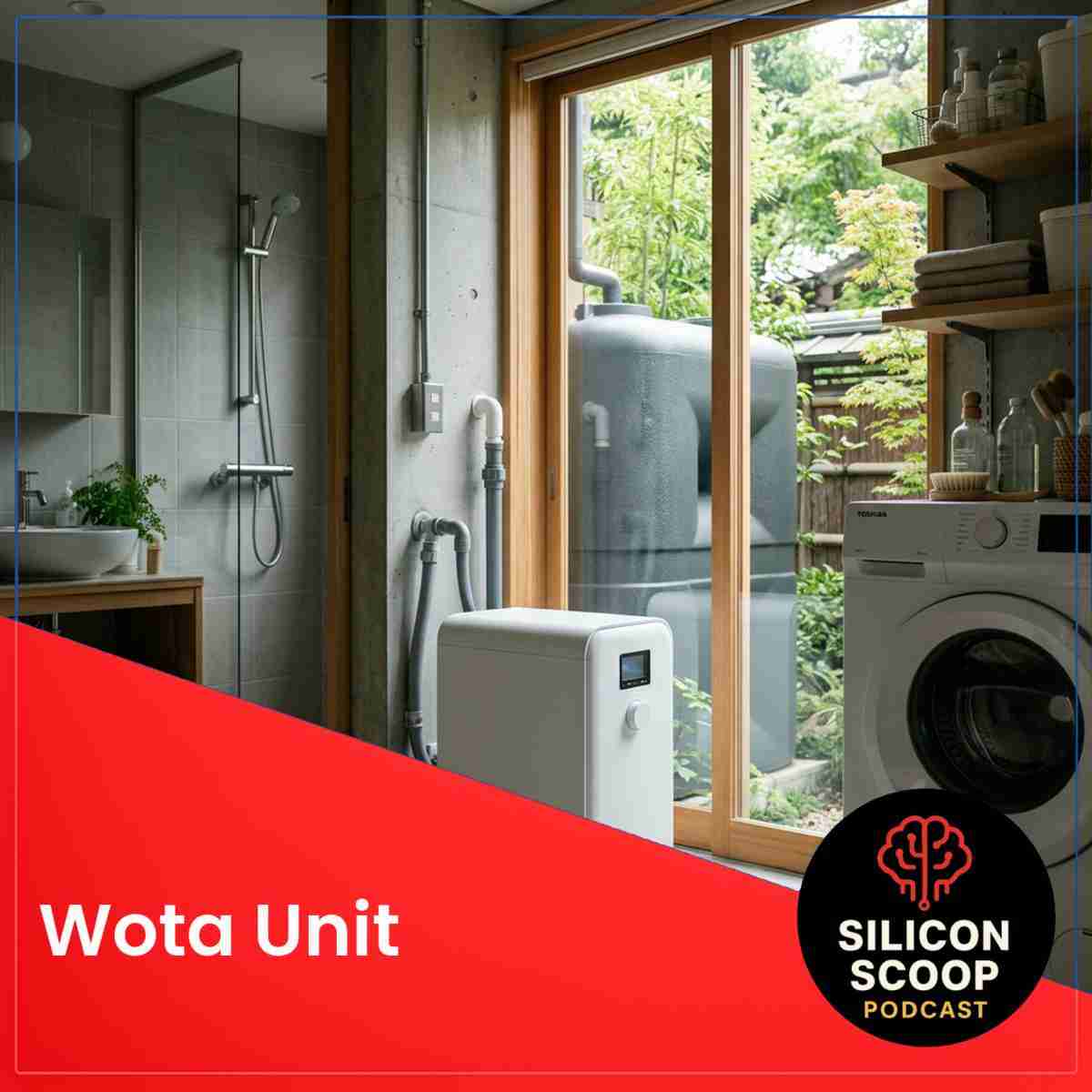
Japan’s WOTA Unit Ushers in Pipe-Free Homes with 97% Wastewater Recycling in 2026 Trials
By [Your Name] | April 13, 2026 | Reading Time: ~9 minutes
Key Takeaways
- The WOTA Unit is a home water recycling machine that could make municipal water pipes obsolete.
- It purifies up to 97% of household wastewater and meets all 51 Japanese tap water quality standards plus World Health Organization benchmarks.
- In January 2026, households in Japan began testing a self-contained water system that connects to no public pipe.
- Japan’s policy and funding are shifting toward decentralized water systems, including the Water 2040 Fund.
- Current limitations include not yet producing drinking water from greywater alone and routing toilet wastewater to a septic tank.
Table of contents
- Japan’s WOTA Unit Ushers in Pipe-Free Homes with 97% Wastewater Recycling in 2026 Trials
- Introduction: The WOTA Unit Is Quietly Rewriting How Homes Handle Water
- Section 1: What Is the WOTA Unit and How Does Home Water Recycling Work?
- Section 2: Japan’s Water Infrastructure Crisis — Why Decentralized Water Systems Are Necessary Now
- ⚡ Cut Costs. Boost Speed. Stay Resilient.
- Section 3: The Water 2040 Fund — Financing Japan’s Decentralized Water Future
- Section 4: The Science and Standards Behind WOTA’s Japan Water Tech
- Section 5: The Bigger Picture — Global Water Reuse Market and What It Means for Japan Water Tech
- Section 6: Current Limitations — What the WOTA Unit Cannot Do Yet
- Frequently Asked Questions: WOTA Unit and Home Water Recycling
- Final Thoughts: A Pipe-Free Future Is Already Being Built
Introduction: The WOTA Unit Is Quietly Rewriting How Homes Handle Water
The WOTA Unit is a home water recycling machine that could make municipal water pipes obsolete.
In January 2026, households in Japan began testing a self-contained water system that connects to no public pipe. The compact unit — installed beside a washing machine — filters and recirculates greywater from showers, sinks, and laundry. It purifies up to 97% of household wastewater and meets all 51 Japanese tap water quality standards plus World Health Organization benchmarks.
This is not a concept. It is already in homes.
With Japan facing crumbling water infrastructure, rapidly declining rural populations, and disaster-driven service failures, decentralized water systems like the WOTA Unit are shifting from experimental to essential. The question is no longer if this technology works — it is how fast it can be deployed.
Here is everything you need to know.
Section 1: What Is the WOTA Unit and How Does Home Water Recycling Work?
The WOTA Unit — Japan’s Most Advanced Home Water Recycling Machine
The WOTA Unit is manufactured by WOTA Corp., a Tokyo-based startup. It is a standalone water recycling system designed for residential use without any connection to centralized municipal water networks.
Physical specs you need to know:
- Dimensions: 1,680mm W × 780mm D × 1,400mm H
- Weight: 166kg (dry)
- Daily processing capacity: 438 to 720 litres per day
- Power consumption: 105 watts
- Operating range: 0°C to 40°C environments
- Wind resistance: Tested to Category 3 hurricane conditions
This unit is built tough and built for real-world use.
How the Water Recycling Process Works
The WOTA Unit uses a multi-stage treatment process that mirrors industrial-grade water purification, scaled down for a single household:
- Biological treatment — breaks down organic waste matter
- Membrane filtration — removes particles, bacteria, and contaminants
- UV disinfection — destroys remaining pathogens
- Chlorine disinfection — ensures ongoing microbial safety
Water from showers, bathroom sinks, and laundry — known as greywater — feeds into the unit. The system processes this wastewater and returns it for domestic reuse. Any water lost through the cycle is replenished using filtered rainwater.
Toilet wastewater is handled separately and routed to a standard septic tank.
Smart Monitoring Built In
A companion app monitors water levels in real time and tracks maintenance needs. Homeowners get alerts before problems occur. The system is designed for minimal user intervention — it does the work automatically.
The WOTA Unit is not just a water filter. It is a closed-loop water management system that keeps a home running independently of the public grid.
> Sources:
> – WOTA Unit
> – WOTA
Section 2: Japan’s Water Infrastructure Crisis — Why Decentralized Water Systems Are Necessary Now
Aging Pipes and a Shrinking Population — A Funding Disaster
Japan’s centralized water infrastructure was designed for a growing population. That population is now shrinking.
Rural communities are emptying out. Local tax bases are collapsing. And the pipes built decades ago are crumbling.
The financial reality is brutal:
- Replacing one kilometre of water pipe costs between 100 million and 200 million yen
- Between fiscal 2020 and 2024, the national average replacement cost rose by 20%
- In Osaka, actual project costs in some cases reached twice the initial budget
- A 2024 survey by the Ministry of Internal Affairs and Communications found that 60% of municipalities had postponed earthquake-resilience upgrades due to lack of funding
In depopulated regions like Akita and Ishikawa Prefectures — where the 2026 WOTA field trials are currently running — maintaining centralized service has become financially unsustainable. Some local authorities have already begun quietly scaling back services.
Government Policy Is Catching Up
Japan’s Cabinet did not ignore this problem. In June 2025, the Basic Policy on Economic and Fiscal Management and Reform 2025 was adopted. It explicitly calls for:
> “Early practical implementation of decentralized water and sewerage systems.”
The Ministry of Land, Infrastructure, Transport and Tourism has been building toward this policy for years, documenting rising maintenance costs and the limits of centralized network management.
Their Basic Policy Review Committee on Water and Sewerage Systems is now developing a “best-mix” approach — combining centralized and decentralized water systems based on population density and local geography. This framework is expected to be included in the First Mid-term Plan for National Resilience Implementation.
Earthquakes Exposed the Fragility of Centralized Networks
The 2024 Noto Peninsula earthquake damaged water systems across affected communities and left residents without access to safe water for extended periods.
WOTA Corp. deployed its systems in Suzu City immediately after the disaster. The units provided emergency access to clean water when the centralized network was destroyed.
Municipal leaders in Suzu City have since made local water autonomy a formal priority in their disaster response planning.
A decentralized water system does not fail city-wide when a single pipe bursts or an earthquake strikes. That resilience is not a bonus feature — it is now considered a public safety requirement.
> Sources:
> – DailyGalaxy
> – WOTA
⚡ Cut Costs. Boost Speed. Stay Resilient.
If rising costs are squeezing your business, automation is your unfair advantage. Flowgrammer streamlines operations with no-code + AI workflows so you save hours, reduce errors, and scale without hiring.
👉 Book a Free Consult — Flowgrammer.ca
Section 3: The Water 2040 Fund — Financing Japan’s Decentralized Water Future
A 10 Billion Yen Commitment to Getting Off the Grid
Knowing the technology works is one thing. Paying to deploy it across hundreds of municipalities is another.
In July 2025, WOTA Corp. launched the Water 2040 Fund — a 10 billion yen program designed specifically to help municipalities make the transition to decentralized water systems.
What the fund provides:
- Direct financing for system adoption
- Planning tools and feasibility simulations
- Operational frameworks and implementation guides
- Digital tools that simulate deployment impact across a 500-metre mesh of any municipal area
- Infrastructure planning tailored to local geography and population conditions
Applications opened nationally in mid-2025 and are accepted on a first-come, first-served basis.
Shared Risk, Shared Infrastructure
The Water 2040 Fund also enables municipalities to partner with financial institutions and local businesses to distribute deployment risk. No single government entity has to shoulder the full cost.
This model is significant. It means that even small, cash-strapped rural municipalities — exactly the communities most desperate for an alternative to crumbling pipe networks — can access the support they need to trial and adopt the WOTA system.
Three Modules, Configurable for Local Needs
The WOTA decentralized water system is broken into three separate modules:
- Drinking water — currently requires external supply or a rainwater purification module
- Domestic water — covered by the core WOTA Unit greywater recycling function
- Toilet water — routed to septic tank in current configuration
Municipalities and households can configure these modules based on local water availability, infrastructure conditions, and budget. This modularity is a critical advantage over one-size-fits-all centralized systems.
It is worth noting: the full drinking water module is still in development. The company states that a fully integrated drinking water solution — drawing entirely from recycled greywater and rainwater — is in progress, but no firm completion timeline has been published.
> Sources:
> – WOTA
> – DailyGalaxy
Section 4: The Science and Standards Behind WOTA’s Japan Water Tech
Meeting the Toughest Quality Benchmarks
Skeptics of home water recycling often ask the same question: Is it actually safe?
The WOTA Unit has cleared all 51 Japanese tap water quality standards. It also meets World Health Organization benchmarks for safe water reuse. This is not a grey area — the water it produces is verified against some of the most rigorous standards on the planet.
The treatment sequence of biological processing, membrane filtration, UV irradiation, and chlorine disinfection is the same multi-barrier approach used in large-scale municipal water recycling plants. WOTA has miniaturized and automated this process for a single residential unit.
Technology Readiness Level — Where WOTA Stands in 2026
The WOTA system is advancing through internationally recognized Technology Readiness Levels (TRL):
- In 2025, the system passed TRL 6 — technology demonstrated in relevant environment
- It is now advancing to TRL 7 — demonstration under actual environmental conditions (real-world field trials)
The 2026 field trials in Akita and Ishikawa Prefectures are part of this TRL 7 demonstration phase. Results from these trials are expected over the following 12 to 24 months.
Government-Backed R&D Support
WOTA’s development has not been done in isolation. It has received substantial backing from Japan’s national research and innovation infrastructure:
- New Energy and Industrial Technology Development Organization (NEDO) — Deep Tech Startup Support Fund
- Cabinet Office — Strategic Innovation Program support
- Ministry of Economy, Trade and Industry — Small Business Innovation Research (SBIR) program
This level of institutional support signals strong government confidence that decentralized water treatment is not a niche experiment — it is a national infrastructure strategy.
The JWAD Platform — Disaster Water Aid Goes Digital
WOTA also launched the JWAD (Japan Water Aid and Dispatch) platform — a digital system for coordinating inter-municipal disaster water aid. When a disaster strikes and one municipality’s water supply is compromised, the JWAD platform can rapidly coordinate the deployment of WOTA units from nearby areas.
This moves disaster water response from reactive and slow to proactive and coordinated.
> Sources:
> – WOTA Unit
> – WOTA
Section 5: The Bigger Picture — Global Water Reuse Market and What It Means for Japan Water Tech
Water Scarcity Is a Global Crisis — And the Market Knows It
Japan’s WOTA Unit is not developing in a vacuum. The global water reuse market is experiencing rapid growth driven by population pressure, climate change, and aging infrastructure across dozens of countries.
Key market projections:
- The global water reuse market is projected to reach $30 billion or more by 2030
- Analysts project a compound annual growth rate (CAGR) of 9.7% to 10.6%
Japan’s approach — moving toward decentralized, household-level water recycling systems — positions it ahead of most nations in developing a scalable model for this challenge.
Why Japan’s Model Is Globally Relevant
Most countries with water stress are looking for solutions that:
- Work without large-scale infrastructure investment
- Can be deployed quickly in disaster or emergency settings
- Scale down to serve shrinking or remote communities
- Meet international water safety standards
The WOTA Unit checks every one of these boxes.
More than 98% of Japan’s residents currently have access to safe drinking water through conventional networks. But conventional networks are exactly what Japan can no longer afford to maintain everywhere. The WOTA model offers a path to maintaining that access rate — or improving it — even as centralized infrastructure contracts.
> Sources:
> – WOTA
> – DailyGalaxy
Section 6: Current Limitations — What the WOTA Unit Cannot Do Yet
Honest Assessment of Where the Technology Stands
No technology this new comes without limits. Here is what the WOTA Unit does not yet do:
1. Produce drinking water from greywater alone
The current system does not generate potable drinking water from recycled greywater. Households must obtain drinking water from an external source or wait for the rainwater purification module — which is still under development with no confirmed release date.
2. Provide long-term residential performance data
The 2026 field trials are the first extended real-world deployments. Long-term performance data under permanent household use does not yet exist. Researchers and municipalities will have 12 to 24 months of results before drawing firm conclusions.
3. Replace septic systems for toilet waste
Toilet wastewater is still routed to a conventional septic tank. This is a separate stream from the greywater the WOTA Unit handles. Full integration of toilet waste processing remains outside the current product scope.
What This Means for Early Adopters
Municipalities and households entering the 2026 trials are doing exactly that — trialling a technology at TRL 7. They are getting strong water quality guarantees backed by regulatory compliance. But they are also participating in the data-generation phase that will determine how the system performs over years of continuous use.
Early adoption has risk. It also has the full backing of national policy, a 10 billion yen fund, and a company with deep institutional support.
> Sources:
> – WOTA Unit
> – DailyGalaxy
Frequently Asked Questions: WOTA Unit and Home Water Recycling
1. What is the WOTA Unit?
The WOTA Unit is a home water recycling machine made by WOTA Corp. in Tokyo, Japan. It collects greywater from showers, sinks, and laundry, purifies it through a four-stage treatment process, and returns it for household reuse — all without connecting to public water pipes.
2. How much water does the WOTA Unit recycle?
The WOTA Unit recovers up to 97% of household greywater. It processes between 438 and 720 litres per day, depending on usage patterns and environmental conditions.
3. Is the water safe to use?
Yes. The treated water meets all 51 Japanese tap water quality standards and World Health Organization benchmarks for safe water reuse. The system uses biological treatment, membrane filtration, UV disinfection, and chlorine disinfection.
4. Where is the WOTA Unit being tested in 2026?
Field trials launched in January 2026 in Akita and Ishikawa Prefectures in Japan — two regions where population decline has made maintaining conventional water infrastructure financially unsustainable.
5. Can the WOTA Unit produce drinking water?
Not yet in its current configuration. Households must obtain drinking water from external sources. WOTA Corp. is developing a rainwater purification module that would eventually enable drinking water production from within the system, but no release date has been confirmed.
6. How big is the WOTA Unit?
The unit measures 1,680mm wide × 780mm deep × 1,400mm tall and weighs 166kg when dry. It is designed to be installed beside a washing machine in a residential setting.
7. How much power does it use?
The WOTA Unit runs on 105 watts — roughly equivalent to a large light bulb or a small laptop charger. It is designed for energy-efficient continuous operation.
8. What is the Water 2040 Fund?
The Water 2040 Fund is a 10 billion yen program launched by WOTA Corp. in July 2025. It provides financing, planning tools, feasibility simulations, and operational support to help municipalities adopt decentralized water systems. Applications are accepted nationally on a first-come basis.
9. How did the 2024 Noto Peninsula earthquake influence WOTA’s development?
After the 2024 Noto earthquake destroyed water infrastructure in affected areas, WOTA deployed units in Suzu City to restore emergency water access. This real-world disaster response demonstrated the resilience advantage of decentralized systems and accelerated government support for their national adoption.
10. What is the global market outlook for water recycling technology?
The global water reuse market is projected to grow at a CAGR of 9.7% to 10.6%, reaching $30 billion or more by 2030. Analysts highlight technologies like the WOTA Unit as critical solutions for addressing water scarcity, aging infrastructure, and climate-driven water stress worldwide.
Final Thoughts: A Pipe-Free Future Is Already Being Built
The WOTA Unit represents one of the most significant shifts in residential water management in modern history. It is compact, powerful, independently verified, and backed by national policy and a 10 billion yen deployment fund.
Japan is not waiting for a perfect solution. It is building a practical one — right now — in real homes, in real communities, in the middle of a real infrastructure crisis.
The 2026 field trials in Akita and Ishikawa will produce the long-term performance data that could accelerate global adoption. Over the next 12 to 24 months, the world will learn whether decentralized home water recycling is ready to scale.
Given what we already know — 97% greywater recovery, WHO-compliant water quality, disaster-resilient design, and government mandate — the answer looks increasingly like yes.
> Full Source References:
> – WOTA Unit
> – WOTA
> – DailyGalaxy
Additional Links
Flowgrammer.ca – 💡 Unlock AI-Powered Automation! Let flowgrammer.ca handle complex workflows so you can focus on growing your business.
Flowgrammers.ca – 💡 Join Toronto’s Fastest Growing AI and Business Automation Community.
- SRED Funding Solutions – Maximize your R&D tax credits and secure funding for your innovation.
- Silicon Scoop Podcast – Stay Informed, Stay Ahead!
- Startup Talk Podcast
- Flowgrammer Youtube
- Startup Investor Drinks – Join Toronto’s Startup Community and connect with fellow startup enthusiasts and investors.
- TorontoStarts Startup and Entrepreneur Community – Become a part of Toronto’s thriving startup ecosystem.
- Workhaus – Discover flexible workspace solutions for your business needs.
- Work with The Startup Coach – Get expert guidance and mentorship for your startup journey.
- Reach out to Jon Irwin on LinkedIn – Connect with our co-host and technology expert.
Episode transcript
Read the full transcript
Craig: japan is officially cutting the cord on municipal water pipes, and it's starting in the laundry room. imagine recycling 97% of your shower water with a device that uses less power than a high end gaming laptop. is this the death of the water main? the wota or wota unit is a stand alone residential water refinery that recycles gray water, showers, and sinks into high quality tap water. it's currently in the twenty twenty six field trials in japan to solve the crisis of crumbling multibillion dollar pipe infrastructure. this effectively makes the unplugged home a reality, allowing high density living or remote off the grid cabins without the needing for massive government utility projects. what do you think about this, john?
Jon: i think this is cool. and before i dive in, do you not remember this, like, twenty years ago? there was a concept that that there was floating around. do you remember that?
Craig: i remember, they're talking about these for things like, i guess, the trailers, that they use where they have a lot of this recycling stuff, but i never heard where it went.
Jon: the system, like you said, is wota. so it collects gray water from sinks, showers, laundry, not toilets, obviously. it filters it through a membrane filtration system. it applies a chemical disinfection, and it recirculates the clean water back into the home. so that creates a closed loop water system, which dramatically reduces the need for external supply. so the system can recycle up to 97% of household water, like you said. and this is obviously in japan. so it can meet all 51 japanese tap water quality standard, which i think is really cool. i'm curious what their water standards are compared to ours. but it aligns with the who's safety benchmarks. so water loss, the remaining 3% is replenished using filtered rainwater. so this means the system essentially, it's not just experimental. it meets the regulated drinking water qualities, which is critical, and it can be implemented. so what it does is it breaks the water into different streams. domestic water, washing and cleaning, drinking water, which is still partially external for now, obviously, and then waste systems. and so the modular design allows the gradual transition from a centralized system to a fully autonomous water system, which i think this is phenomenal. and japan is actively supporting this transit because, b, their 2025 national policy called for decentralized water systems. so they're way ahead of us. think? do you think you'd you'd build a house with this system, craig?
Craig: i think it's inevitable, whether it's this system or something similar, just from, whether you're on municipal water or not. why aren't we, recirculating, reusing the water at the household level rather than it going back to some major station? and i think there's a lot to be done here from a reusing water in the household. we're in canada. we have lots of fresh water. we have an abundance of fresh water here. however, many countries don't. and this is gonna really help them versus, say, us. but if you can reduce the water uses by 97%, that's way less water pollution. that's way less stuff going on, going out of your house. that's way less of those gallons and gallons and gallons of those, cleaning stations pumping crap into the ocean or the yeah. lakes and whatnot. so anything that makes our life more efficient for using this kind of stuff, i think, is great. now time will tell whether the quality of the water, like, whether you'd wanna be drinking it or just using it for, laundry and household tasks
Jon: and stuff. even if you're not using it for drinking, even if you're just reusing it for everything else but drinking, that you could receive a high percentage of, waste use.
Craig: yeah. and you can now build or live in regions with failing infrastructure without losing the luxury of a twenty minute hot shower. and we understand that, you know, the pipes, crumbling pipes, replacing one kilometer of water pipes cost between a 100,000,000 and 200,000,000 yen in japan. so it's just so expensive, and their infrastructure is crumbling in certain areas. i'm just sure we are too, but because this is a japan invention, and they're pushing it forward in their 2040, what did they call it? their water '24 already fund. they're subsidizing by 10,000,000,000 yen water 2040 fund for municipal adoption, and residential unit pricing is scaling up as production ramps up. so they're starting to sell these now. yeah. and the specs are 97% recovery rate of gray water, a 105 watts power consumption, incredibly low for flotation stages involved, 720 liters per day peak, processing capacity, and category three hurricane wind resistance for external, housing. so i guess you put this thing outside the home.
Jon: yeah. oh, yeah. makes sense. but yeah.
Craig: use a
Jon: go ahead.
Craig: use a multi barrier purification sequence that starts with biological treatment to break down organics, moves to membrane filtration for particulates, and finish off with a dual stage uv and chlorine disinfection to meet all 51 japanese tap water standards. so, yeah. interesting. what were you gonna say, john?
Jon: i just say gonna say because, it, the cost to replace pipelines can cost, like, up to 200,000,000 yen per kilometer. so, having this, having this new infrastructure because, obviously, they have aging infrastructure with many pipes over 40 years old. so, having this new infrastructure helps with so many things. and in the long run, like, i get why they're subsidizing because in the long run, it's gonna save the government money.
Craig: yeah. and it 2024 survey by the ministry of internal affairs and communication found that 60% of municipalities had postponed resilient upgrades due to lack of funding. so
Jon: yeah.
Craig: apparently, they're behind. yeah. and while, the system's trial by fire was the twenty twenty four nado peninsula earthquake, while the city pipeline shattered wota units were air dropped into suzu city to provide the only functional clean water for weeks. so it's already been deployed in emergency situations. they're ramping these up fast and pulling these. it's not total recall yet. you still need a septic tank for black water or toilet waste, and it doesn't officially produce drinking water from gray water alone without optional rainwater module. so if you're, i'm looking forward to this. i think this is great. anytime we can, you know, reduce our waste by this much, i'm in.
Jon: yeah.
Craig: so the water unit is the first legitimate step towards the unplugged home turning water from a public utility into a private asset. does the idea of showering in 97% recycled water sound like peak sustainability, or does it make you a little squeamish? let us know in the chat. would you cut the pipe, or would you put barrels out back to collect rainwater, funnel through the system, and use it so that you could have a more, closed system? let us know.
More from Silicon Scoop
All episodes
silicon-scoop · October 19, 2026
OpenAI’s Jalapeño Chip Stakes a Claim Against Nvidia Blackwell in Real-World AI Inference
OpenAI Jalapeno chip challenges Nvidia GB300 Blackwell with InferenceX AI benchmark results, reshaping AI inference accelerator efficiency and latency.
View episode

silicon-scoop · October 16, 2026
Meta’s $18 Billion Teen Safety Settlement: Soft Guardrails, Hard Leverage Over TikTok and YouTube
Deep dive on Meta teen safety settlement, social media addiction lawsuit, new Facebook Instagram time limits and pressure on TikTok YouTube age verification.
View episode

silicon-scoop · October 15, 2026
How Claude Mythos Is Reshaping Cryptanalysis: HAWK, AES and the Rise of AI-Driven Crypto Research
Claude Mythos cryptanalysis weakens HAWK post-quantum signature, speeds AES Möbius Bridge attack, and powers CryptanalysisBench benchmark in AI-driven crypto research.
View episode