
This Retinal Implant Lets Humans See Near-infrared
This Retinal Implant Lets Humans See Near-infrared https://torontostarts.com/silicon-scoop/ Flowgrammer.ca -> https://flowgrammer.ca/ AI News and Resources -> https://flowgrammers.ca OpenClaw Toronto -> https://openclawto.com/ Stop Doing Work Your Software Can Do If your team is stuck copying data, chasing approvals, or updating spreadsheets, automation can give you hours back every week—without hiring. Book an automation consult https://flowgrammer.ca Startup Investor Drinks Toronto - https://startupdrinksto.com/ Toronto’s Startup Community - https://torontostarts.com/ Silicon Scoop Silicon Scoop Podcast - https://torontostarts.com/silicon-scoop/ Apple: https://podcasts.apple.com/us/podcast/silicon-scoop/id1758711826 Spotify: https://open.spotify.com/show/5bAzF0MwV6TtLhJAhvHayI YouTube: https://www.youtube.com/playlist?list=PLj4v-RoA7A-gT62vrEYqh1zCv-0Hj-o5J Startup Talk Startup Talk Podcast -> https://torontostarts.com/startup-talk-toronto-startup-podcast/ Apple -> https://podcasts.apple.com/us/podcast/startup-talk/id1763804003 Spotify -> https://open.spotify.com/show/1siJMILILidHAiAsrX2VBU YouTube: https://youtube.com/playlist?list=PLj4v-RoA7A-jxV5FHs5e61oIsuvUJYmT_&si=LYegRe5GYLKNQ7xL
With Craig Major and Jon Irwin
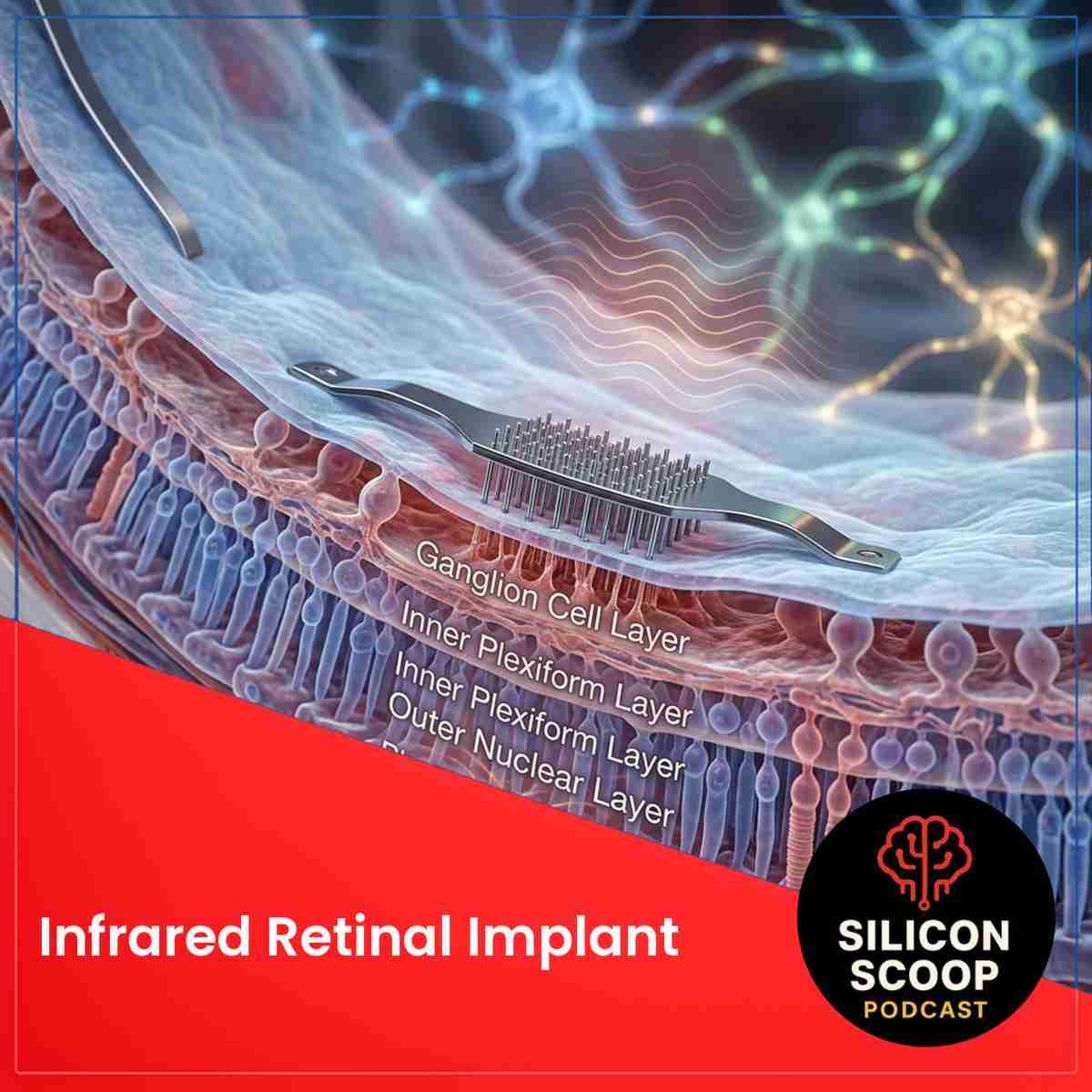
Beyond Natural Vision: Yonsei University’s Liquid-Metal Artificial Retina Pioneers Infrared Perception in Blind Patients
Estimated reading time: 10 minutes
Key Takeaways
- The infrared retinal implant developed by researchers at Yonsei University and South Korea’s Institute for Basic Science (IBS) can detect near-infrared (NIR) light and convert it into electrical signals that stimulate surviving retinal cells.
- It uses 3D liquid metal micropillar electrodes designed to reduce mechanical tissue damage while improving contact with retinal ganglion cells.
- Early testing in retinal tissue and blind mice showed neural responses in the visual cortex and behavioral responses to light stimuli.
- The device may open a new sensory channel for humans: the ability to perceive infrared light.
- Further safety, durability, signal refinement, and regulatory work is needed before human trials and patient availability.
Table of contents
- Beyond Natural Vision: Yonsei University’s Liquid-Metal Artificial Retina Pioneers Infrared Perception in Blind Patients
- Introduction: A New Era for the Infrared Retinal Implant
- Section 1: What Is Near-Infrared Vision Restoration and Why Does It Matter?
- Section 2: How Liquid Metal Electrode Implants Work in the Artificial Retina
- ⚡ Stop Doing Work Your Software Can Do
- Section 3: Bioelectronic Retinal Prosthetics — Early Results and What They Showed
- Section 4: Expanding Human Senses — The NIR Visual Channel and Beyond
- Section 5: What Comes Next for the Infrared Retinal Implant
- FAQ: 10 Questions About the Infrared Retinal Implant
- Conclusion
Introduction: A New Era for the Infrared Retinal Implant
The infrared retinal implant developed by researchers at Yonsei University and South Korea’s Institute for Basic Science (IBS) is not just a step forward in restoring sight — it is a leap into entirely new territory for human perception.
Published in Nature Electronics on April 12, 2026, this breakthrough device can detect near-infrared (NIR) light and convert it into electrical signals that stimulate surviving retinal cells. For millions of people living with blindness caused by photoreceptor degeneration, this could mean regaining the ability to sense light — and possibly much more.
What makes this device truly extraordinary is that it does not just attempt to rebuild what was lost. It may open a new sensory channel that humans have never had before — the ability to perceive infrared light, a capability found naturally in snakes and some other animals, but never in people.
This article breaks down how the device works, what the early results mean, and why this matters for the future of bioelectronic vision restoration.
Section 1: What Is Near-Infrared Vision Restoration and Why Does It Matter?
The Problem: Retinal Degeneration Destroys Photoreceptor Cells
The retina is a thin layer of tissue at the back of the eye. It is packed with photoreceptor cells — rods and cones — that catch light and turn it into electrical signals the brain can read.
Diseases like retinitis pigmentosa and age-related macular degeneration (AMD) destroy these photoreceptor cells over time. Once they are gone, the person becomes blind.
But here is something important: in most cases of retinal degeneration, retinal ganglion cells (RGCs) — the cells that carry visual signals from the eye to the brain — often survive. They are still functional. They just have nothing to work with because the photoreceptors are gone.
This is exactly the gap that near-infrared vision restoration technology aims to fill.
Why Near-Infrared Light?
Near-infrared light sits just beyond what the human eye can naturally see. It is invisible to us but is all around us — emitted by warm bodies, electronics, and the sun.
By designing an implant that detects NIR light and converts it into electrical signals for surviving ganglion cells, the Yonsei team found a way to:
- Bypass the damaged photoreceptors entirely
- Stimulate the healthy ganglion cells directly
- Avoid interfering with any remaining natural vision
This approach is a major advance over earlier retinal prosthetics, which often competed with or disrupted whatever residual vision a patient had left.
A Growing Global Need
The scale of this problem is enormous:
- Retinitis pigmentosa alone affects approximately 1 in 4,000 people worldwide
- The global retinal prosthetics market was valued at USD 271.31 million in 2024
- That market is projected to reach USD 644.39 million by 2032, growing at an 11.40% CAGR
- The broader artificial retina market is expected to grow from USD 238.5 million (2024) to USD 1,586.6 million by 2035 — an 18.8% CAGR
These numbers reflect a world urgently searching for solutions to vision loss caused by photoreceptor degeneration.
global retinal prosthetics market
artificial retina market
Section 2: How Liquid Metal Electrode Implants Work in the Artificial Retina
The Device: Three Core Components
The Yonsei artificial retina is thin, flexible, and designed to sit directly on the epiretinal surface — the inner surface of the retina. It is made up of three integrated components:
- NIR-sensitive phototransistor array — A grid of tiny, light-sensitive devices that detect near-infrared light and convert it into electrical signals.
- Ultrathin NIR-transmission filter — This filters out visible light interference so the device responds specifically to NIR signals without disrupting the patient’s remaining natural vision.
- 3D liquid metal micropillar electrodes — Soft, pillar-shaped structures made from a conductive liquid metal alloy that physically reach toward and stimulate the retinal ganglion cells.
Why Liquid Metal Electrodes Are a Game Changer
Previous retinal implants used rigid electrodes — hard, stiff structures that pressed against delicate retinal tissue. The problem? Rigid materials cause mechanical damage over time. The tissue gets irritated, inflamed, or scarred.
The liquid metal micropillar electrodes in this new device solve that problem through material science:
- They have a low Young’s modulus — meaning they are soft and elastic, not stiff
- This allows the electrodes to conform to the natural curves and contours of the living retinal tissue
- They make closer, more intimate contact with the ganglion cells, improving signal delivery
- They cause significantly less mechanical tissue damage than conventional rigid prosthetics
The result is a bioelectronic retinal prosthetic that is both more effective and safer for the biological tissue it is embedded in.
Targeting Ganglion Cells — Not Photoreceptors
A key strategic decision in this design is the target cell type. Rather than trying to replace or regenerate photoreceptor cells — which is enormously complex — the device skips straight to the retinal ganglion cells.
RGCs are the final output layer of the retina. They collect processed visual information and send it via the optic nerve to the brain’s visual cortex. By targeting RGCs directly, the implant:
- Avoids the complexity of replicating all the intermediate retinal processing layers
- Works with the natural neural architecture that is still intact
- Delivers electrical stimulation that the brain can interpret as visual input
“The liquid metal electrodes enhance proximity to retinal ganglion cells, providing effective charge injection while minimizing tissue damage, owing to their low Young’s modulus.” — Won Gi Chung, Inhea Jeong et al., Nature Electronics, 2026
⚡ Stop Doing Work Your Software Can Do
If your team is stuck copying data, chasing approvals, or updating spreadsheets, automation can give you hours back every week — without hiring.
Section 3: Bioelectronic Retinal Prosthetics — Early Results and What They Showed
Testing the Device: From Lab Tissue to Living Animals
The research team ran two types of tests to validate their bioelectronic retinal prosthetic:
Ex vivo testing (outside a living body):
- The device was attached to extracted retinal tissue
- Results confirmed biocompatibility — the device did not cause toxic reactions, cell death, or inflammation in the tissue
- This is a critical safety milestone for any implanted medical device
In vivo testing (inside living animals):
- The device was tested in both healthy mice and blind mice with photoreceptor degeneration
- Researchers monitored cortical recordings (brain activity in the visual cortex) and observed behavioral responses to light
- In blind mice fitted with the implant, both visible and NIR light triggered neural responses in the visual cortex
- Behavioral tests showed the blind mice responding to light stimuli — evidence that light perception had been meaningfully restored
End-to-End Neural Pathway Confirmed
One of the most significant findings was the confirmation of an end-to-end neural pathway:
- When NIR light hit the implant, the phototransistor array generated electrical signals
- Those signals traveled through the liquid metal electrodes to the ganglion cells
- The ganglion cells fired and sent signals up the optic nerve
- The visual cortex of the brain activated in synchrony with the retinal stimulation
This simultaneous activation between the implanted retina and the visual cortex is powerful evidence that the device is not just stimulating random electrical noise — it is creating a functional visual signal chain from implant to brain.
Safety Profile: A Key Differentiator
Industry analysts point to safety profile as one of the most important factors in patient adoption of retinal implants. This device stands out because:
- Its soft, flexible construction avoids the mechanical irritation common with rigid prosthetics
- It does not interfere with residual natural vision, preserving whatever sight the patient retains
- Early biocompatibility data suggests a low risk of tissue rejection or damage
These properties distinguish it from competing technologies like the IRIS II system from Pixium Vision (which uses 150 electrodes) and Stanford-led subretinal arrays, which are advancing in parallel but often face greater biocompatibility challenges.
Nature Electronics article
nanotech visual implant
ScienceDaily release
Section 4: Expanding Human Senses — The NIR Visual Channel and Beyond
Not Just Restoration — Expansion of Human Perception
Here is where this technology becomes genuinely extraordinary.
The human eye has never been able to see infrared light. But with this implant, people with photoreceptor degeneration could potentially gain a brand new sensory channel — the ability to perceive NIR light.
What would that feel like? Researchers are honest: they do not yet know exactly what the brain would experience when ganglion cells are stimulated by NIR-derived signals. The visual perceptions arising from this kind of artificial stimulation are still being studied.
But the potential applications are already clear:
- Thermal signature perception — Warm bodies and objects emit infrared radiation. A person with NIR vision could potentially sense people or animals in complete darkness.
- Night-vision capabilities — Near-infrared is used extensively in night-vision technology. An implant that perceives NIR could function as a biological night-vision system.
- Military and industrial applications — Surveillance, navigation in low-light environments, and detection of heat signatures are all areas where NIR perception would be valuable.
- Everyday safety — Detecting the heat of a fire or a hot surface before making physical contact.
A Sensory Frontier That Has Only Existed in Animals
Until now, perceiving infrared light has been a capability reserved for certain animals:
- Pit vipers and pythons have specialized heat-sensing pit organs
- Some insects can perceive near-infrared wavelengths
- Vampire bats have warm-receptor neurons tuned to infrared
The Yonsei implant could potentially give humans a version of this capability for the first time — not through genetic modification or surgery to the brain, but through a thin, flexible device attached to surviving retinal tissue.
The Market and Strategic Landscape
The commercial landscape for this technology is heating up rapidly:
- The smart retinal implants market is projected to reach USD 79.11 billion by 2032 from USD 48.22 billion in 2025 (an 8.11% CAGR)
- Competitors including Pixium Vision, Stanford research teams, and others are racing to bring retinal prosthetics to market
- The PRIMA subretinal system reported over 80% meaningful central vision recovery in a 2026 clinical trial
- South Korea’s collaborative research ecosystem — spanning Yonsei University, IBS, and multiple partner institutes — is positioning the country as a global leader in bioelectronic vision restoration
Three enabling trends are converging to accelerate this field:
- Miniaturization and AI integration — smaller, smarter devices improving patient outcomes
- Biocompatible material science — reducing rejection and mechanical damage
- Expanding clinical trial pipelines — more devices moving toward human testing and approval
smart retinal implants market
retinal implants market
artificial retina market
Section 5: What Comes Next for the Infrared Retinal Implant
The Road to Human Trials
The current findings are promising but still preliminary. The researchers are clear about what still needs to happen before this device can be used in humans:
- Extended in vivo safety studies — longer-term animal testing to confirm the device remains safe and effective over months and years
- Durability testing — confirming the liquid metal electrodes and phototransistor arrays maintain function inside a biological environment
- Signal quality refinement — improving the resolution and clarity of the visual information the device can deliver
- Regulatory approval pathways — navigating medical device approval processes in South Korea, the US FDA, and the EU
Challenges Ahead
The team and broader industry face several honest challenges:
- Cost reduction — current retinal implant technology is expensive, limiting access to wealthy markets and well-funded healthcare systems
- Broader accessibility — ensuring this technology reaches patients in low- and middle-income countries where retinal disease burden is also high
- Understanding NIR perception — researchers need to better understand what humans actually experience when ganglion cells are stimulated by NIR-derived signals before designing effective user interfaces or training protocols
- Long-term biocompatibility — even with the soft liquid metal design, multi-year implantation studies are needed
Why This Research Represents a Major Shift
What sets the Yonsei infrared retinal implant apart from earlier prosthetics is its dual capability: it does not force a patient to choose between restoring lost vision and gaining new sensory capability.
Because the device targets ganglion cells using NIR light — rather than attempting to reconstruct the full photoreceptor cascade — it operates alongside remaining natural vision, not in competition with it.
This design philosophy reflects a broader shift in bioelectronic medicine: instead of trying to perfectly replicate biological systems, the best devices are learning to work with the surviving biology in smarter, more targeted ways.
Nature Electronics article
global retinal prosthetics market
FAQ: 10 Questions About the Infrared Retinal Implant
Q1: What is an infrared retinal implant?
An infrared retinal implant is a thin, flexible device attached to the inner surface of the eye’s retina. It detects near-infrared light and converts it into electrical signals that stimulate surviving retinal cells, helping blind people perceive light.
Q2: Who developed this artificial retina?
The device was developed by researchers at Yonsei University and the Institute for Basic Science (IBS) in South Korea, led by Won Gi Chung, Inhea Jeong, and their team. Their findings were published in Nature Electronics in April 2026.
Q3: How does near-infrared vision restoration work?
The implant uses a phototransistor array to detect NIR light. It converts that light into electrical signals, which are then delivered to retinal ganglion cells — cells that carry visual information to the brain — using liquid metal micropillar electrodes.
Q4: What are liquid metal micropillar electrodes?
These are tiny, pillar-shaped structures made from a soft, electrically conductive liquid metal. They are flexible enough to conform to the curved surface of retinal tissue, allowing close contact with ganglion cells without causing mechanical damage.
Q5: Can this device restore full normal vision?
Not exactly. The device partially restores the ability to perceive light by stimulating ganglion cells with NIR-derived signals. It does not fully replicate the complex visual processing of a healthy retina. What the brain actually experiences is still being studied.
Q6: Does the implant interfere with any remaining natural vision?
No. One of its key advantages is that it operates via NIR light and targets ganglion cells without disrupting whatever natural vision the patient still has. It adds a new signal channel rather than replacing the existing one.
Q7: What is a retinal ganglion cell and why does it matter?
Retinal ganglion cells (RGCs) are the output neurons of the retina. They collect processed visual information and send it via the optic nerve to the brain. In most cases of photoreceptor degeneration, RGCs survive, making them ideal targets for artificial stimulation.
Q8: Has this been tested in humans yet?
Not yet. Testing has been conducted on retinal tissue samples and on blind mice. Results were promising, but further safety and effectiveness studies are needed before human clinical trials can begin.
Q9: Could this give people the ability to see in the dark?
Potentially, yes. Near-infrared light is used in night-vision technology and is emitted by warm bodies and objects. If humans can perceive NIR signals through this implant, it could enable a form of biological night vision or thermal perception.
Q10: When will this technology be available to patients?
There is no confirmed timeline yet. The research is at an early stage. Human trials, regulatory approval, and manufacturing scale-up will all take time. Industry trends suggest this field is moving toward rapid commercialization, but patient access is likely still several years away.
Conclusion
The infrared retinal implant from Yonsei University and IBS is one of the most exciting developments in bioelectronic medicine in years.
It does not just offer a path to near-infrared vision restoration for people blinded by photoreceptor degeneration. It hints at something bigger: a future where medical implants do not just fix what is broken, but expand the boundaries of human sensory experience.
The convergence of soft liquid metal electrode implants, precision targeting of retinal ganglion cells, and a design that preserves remaining natural vision makes this device stand out in a rapidly advancing field.
As the retinal prosthetics market races toward billions in value and clinical pipelines fill with promising candidates, the Yonsei team’s work represents a clear marker of where this technology is heading — not just toward seeing again, but toward seeing more.
Published in Nature Electronics, April 12, 2026. DOI: 10.1038/s41928-026-01601-8
Additional Links
Flowgrammer.ca – 💡 Unlock AI-Powered Automation! Let flowgrammer.ca handle complex workflows so you can focus on growing your business.
Flowgrammers.ca – 💡 Join Toronto’s Fastest Growing AI and Business Automation Community.
- SRED Funding Solutions – Maximize your R&D tax credits and secure funding for your innovation.
- Silicon Scoop Podcast – Stay Informed, Stay Ahead!
- Startup Talk Podcast
- Flowgrammer Youtube
- Startup Investor Drinks – Join Toronto’s Startup Community and connect with fellow startup enthusiasts and investors.
- TorontoStarts Startup and Entrepreneur Community – Become a part of Toronto’s thriving startup ecosystem.
- Workhaus – Discover flexible workspace solutions for your business needs.
- Work with The Startup Coach – Get expert guidance and mentorship for your startup journey.
- Reach out to Jon Irwin on LinkedIn – Connect with our co-host and technology expert.
Episode transcript
Read the full transcript
Craig: we're moving past just fixing broken eyes and entering the era of human dlc. scientists have just built a retinal implant that lets the blind see in infrared. this isn't just about restoring vision. it's about giving humans a sensory superpower that normally belongs to snakes. liquid metal, provider liquid metal now provides infrared sight. researchers at yonsei university have created flexible liquid metal retinal implant that detects near infrared light and beams it directly into surviving brain linked cells. it bypasses dead photoreceptors to restore light perception in patients with conditions like retinitis, pigmentosa. this effectively turns a medical prosthetic into a biological night vision goggles, opening new sensory channels humans have never naturally possessed. what do you think about this, john?
Jon: i think this is cool. i want one of these. and it's, it's awesome because what it does is it enhances vision. it doesn't just restore vision, it enhances it. so like you said, it's built using two critical components, an nir phototransistor right near infrared and a liquid metal, micro pillar electrodes. and so the phototransistor ray acts like an artificial photoreceptor layer. so what it does is it detects near infrared light, which is just beyond visible wavelengths, and it converts it into electrical signals. so then these signals are then delivered directly to the retina's ganglion cells, using liquid metal electrodes, which is super cool. and every time i hear liquid metal, i always think of is it the t 1,000? the, well, the the the metal one in turn here too?
Craig: anyways yes.
Jon: so this is significant because in many forms of blindness, so, like, think of retinal degeneration, the photoreceptors are damaged. but the ganglion cells often remain functional, meaning the brain's visual pathway is still intact. so they're i love the way that they're approaching this. and so the new system, is fundamentally different because it bypasses the damaged photoreceptors entirely and introduces a new sensory input, which is infrared. so it doesn't interfere with any remaining natural vision. so it's not just restoring, it's augmenting like we said, which i think this is cool. this is getting us one step closer to super human. when are they going to, at one point, maybe they'll create, an artificial retina that can zoom 2,000 times or something. right? i don't know. what do you think about this? do you think this is cool, or do you think this is useful? or, like, what are your thoughts on this?
Craig: i think it's interesting. i won't know if it's useful till, you know, it successfully passes the human trials because it's currently in post animal testing. so, you know, we'll see how the human trials go. did, they're supposed to be into them. have you seen the results of the human trials yet? no. i think it's cool that we're getting to the point of this kind of thing where from a medical point of view, we're able to bypass, burn out photocells in the eyes or the and bypass them with stuff like this so that we can now, you know, make life change for these people. like, it's it affects approximately one in four thousand people worldwide. the global retinal prosthesis market was valued at $271,310,000 in 2024. the us market is expected to be 644,390,000 in 2032, which is a growth of, 11.4%. so it looks like this is a growing market, and it'll probably grow faster as more advanced tools become available. yeah. but go ahead.
Jon: one question that remains kind of an open question is, what does infrared look like to the brain? right? like yes. the brain could interpret it as brightness. it could map it to colors, or it could develop entirely new perceptual experiences. like, that's the thing. it scares me, but if if the brain can handle it properly, it's it it'll be cool.
Craig: yes. the liquid metal used isn't just a gimmick. it addresses the impedance mismatch between hard electronics and soft biological tissue, which is the number one reason most neural implants fail after two years. yeah. the global market for the smart retinas is exploding. it's projected at 79,000,000,000 by 2032. i think my other number was bigger. ages, while we call this restoring site, the brain might initially interpret
Jon: sorry. i didn't silence
Craig: my phone there. the brain might initially interpret infrared signals as, phosph fiends, flashes of light, or even colors we don't have names for requiring the user to relearn how to see. so we don't know the refresh rate or resolution, seeing a blob if he is a life changing for a blind patient, but is it a long way from reading a book or recognizing a face yeah. or, you know, being able to watch tv. so, i'm curious as go ahead.
Jon: humans, they've always been blind to like, well, yeah, we've been blind to most of the electromagnetic spectrum, and so this changes that. and we're talking about adding a completely new sensory channel to the human experience. and so the real question is, isn't whether that i can detect infrared? it's how the brain is going to interpret it because the brain may literally invent a new kind of perception. right? and that's what's really cool about this.
Craig: yeah. we are officially bridging the gap between medical recovery and human augmentation. you know? and, if you had a choice, would you take a medical implant that gave you twenty twenty vision or one that gave you twenty forty vision but included built in night vision? let us know what you think in the chat.
More from Silicon Scoop
All episodes
silicon-scoop · October 19, 2026
OpenAI’s Jalapeño Chip Stakes a Claim Against Nvidia Blackwell in Real-World AI Inference
OpenAI Jalapeno chip challenges Nvidia GB300 Blackwell with InferenceX AI benchmark results, reshaping AI inference accelerator efficiency and latency.
View episode

silicon-scoop · October 16, 2026
Meta’s $18 Billion Teen Safety Settlement: Soft Guardrails, Hard Leverage Over TikTok and YouTube
Deep dive on Meta teen safety settlement, social media addiction lawsuit, new Facebook Instagram time limits and pressure on TikTok YouTube age verification.
View episode

silicon-scoop · October 15, 2026
How Claude Mythos Is Reshaping Cryptanalysis: HAWK, AES and the Rise of AI-Driven Crypto Research
Claude Mythos cryptanalysis weakens HAWK post-quantum signature, speeds AES Möbius Bridge attack, and powers CryptanalysisBench benchmark in AI-driven crypto research.
View episode