
China Just Made $2B AI Deals Harder to Close
China Just Made $2B AI Deals Harder to Close https://torontostarts.com/2026/07/03/china-blocks-meta-manus-deal/ Flowgrammer.ca -> https://flowgrammer.ca/ AI News and Resources -> https://flowgrammers.ca OpenClaw Toronto -> https://openclawto.com/ Stop Hiring for Busywork Automate the repeatable tasks that drain your week—lead routing, follow-ups, reporting, invoicing—so your team ships more with the same headcount. Book an automation consult https://flowgrammer.ca Startup Investor Drinks Toronto - https://startupdrinksto.com/ Toronto’s Startup Community - https://torontostarts.com/ Silicon Scoop Silicon Scoop Podcast - https://torontostarts.com/silicon-scoop/ Apple: https://podcasts.apple.com/us/podcast/silicon-scoop/id1758711826 Spotify: https://open.spotify.com/show/5bAzF0MwV6TtLhJAhvHayI YouTube: https://www.youtube.com/playlist?list=PLj4v-RoA7A-gT62vrEYqh1zCv-0Hj-o5J Startup Talk Startup Talk Podcast -> https://torontostarts.com/startup-talk-toronto-startup-podcast/ Apple -> https://podcasts.apple.com/us/podcast/startup-talk/id1763804003 Spotify -> https://open.spotify.com/show/1siJMILILidHAiAsrX2VBU YouTube: https://youtube.com/playlist?list=PLj4v-RoA7A-jxV5FHs5e61oIsuvUJYmT_&si=LYegRe5GYLKNQ7xL
With Craig Major and Jon Irwin
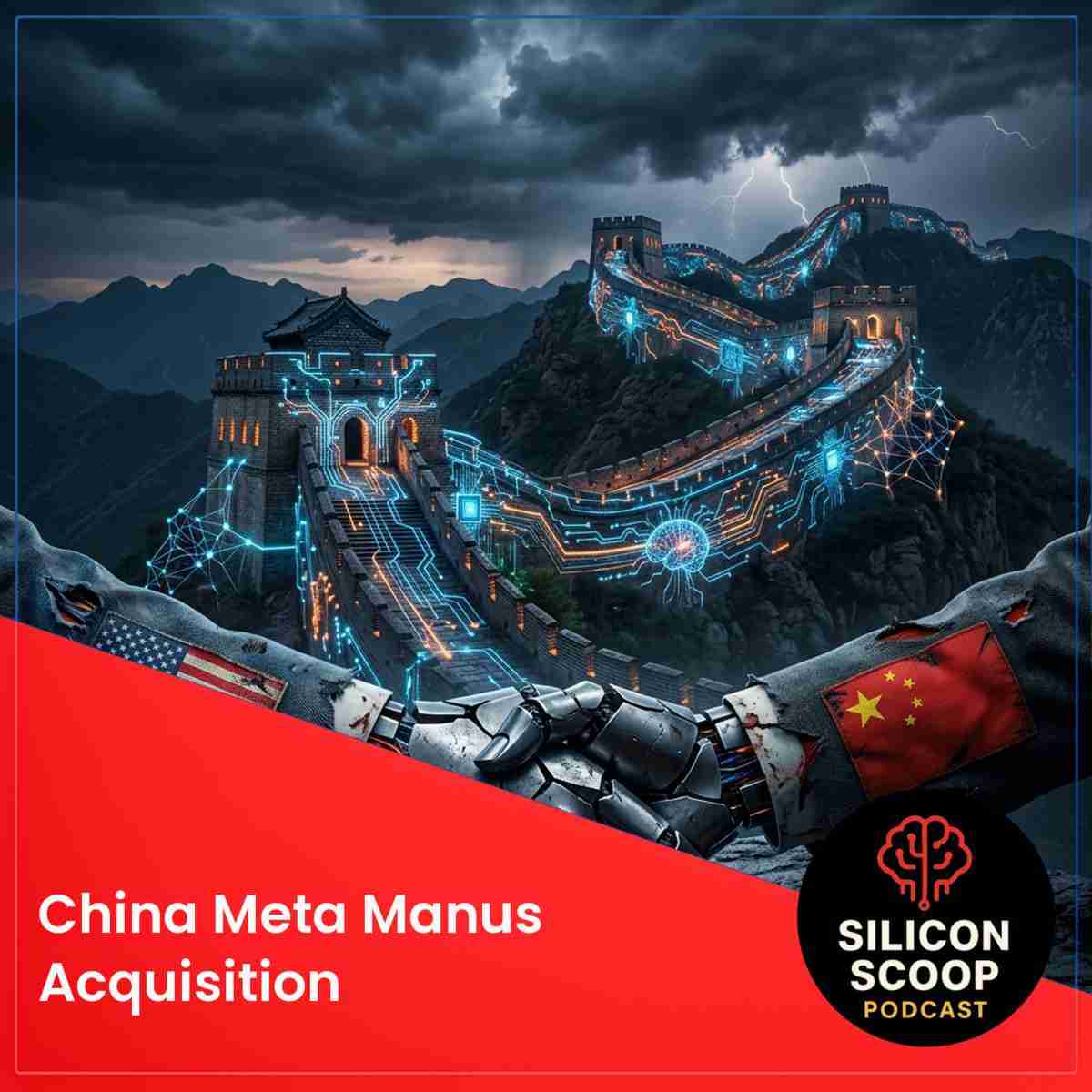
China Blocks Meta’s $2 Billion Manus AI Acquisition: What the NDRC’s Full Unwind Order Means for Global Tech Deals
Estimated reading time: 10 minutes
Key Takeaways
- China’s NDRC has formally ordered Meta Platforms to fully unwind its $2 billion deal to acquire AI startup Manus.
- The ruling asserts jurisdiction over technology developed in mainland China regardless of offshore incorporation.
- The decision signals that an AI team itself can be treated as a technology export under China’s export control framework.
- NDRC foreign investment security review is likely to become a standard closing condition for cross-border AI deals involving Chinese-founded teams.
Table of contents
- China Blocks Meta’s $2 Billion Manus AI Acquisition: What the NDRC’s Full Unwind Order Means for Global Tech Deals
- Key Takeaways
- Introduction: The China Meta Manus Acquisition That Just Shook the AI World
- What Is Manus? The AI Agent That Caught Meta’s Eye
- How China Blocked the Deal: The NDRC Foreign Investment Review
- The “Singapore-Washing” Problem: Why Offshore Incorporation Did Not Save the Deal
- Stop Hiring for Busywork
- Strategic Context: Why Beijing Views AI as a National Asset
- What Happens Now: The Unwind Problem
- What This Means for the Future of Cross-Border AI Deals
- FAQ: 10 Questions Answered About the China Meta Manus Deal Block
Introduction: The China Meta Manus Acquisition That Just Shook the AI World
The China Meta Manus acquisition is over — and Beijing made sure of it.
China’s top economic planning body, the National Development and Reform Commission (NDRC), has formally ordered Meta Platforms to fully unwind its $2 billion deal to acquire AI startup Manus. The order is sweeping, the precedent is enormous, and the message from Beijing is crystal clear: Chinese-founded AI companies are national assets, no matter where they are incorporated.
This is not a minor regulatory hiccup. This is a watershed moment for every tech company eyeing cross-border AI deals involving Chinese talent or technology.
Here is everything you need to know.
What Is Manus? The AI Agent That Caught Meta’s Eye
Before diving into the regulatory fallout, it helps to understand why Meta wanted Manus badly enough to pay $2 billion for it.
Manus launched in March 2025 as a general-purpose AI agent — a system capable of autonomously carrying out complex, multi-step tasks without human hand-holding. Think web browsing, writing and running code, managing files, and executing entire workflows from a single instruction.
What Made Manus So Valuable
- Multi-agent architecture: Manus dynamically invokes multiple AI models — including Claude 3.5 Sonnet and fine-tuned versions of Qwen — to handle reasoning, coding, and knowledge tasks. This is not a single-model chatbot. It is a coordinated fleet of specialized AI workers.
- Scale: Within eight months of launch, Manus reported over 80 million virtual computers supported and 147 trillion tokens processed.
- Revenue: The company crossed $100 million in annualized revenue — a remarkable pace for a startup less than a year old.
- Funding: Manus raised a $75 million Series A at a $500 million valuation in April 2025, just weeks after launch.
Manus was founded in China. Its parent company, Butterfly Effect, later relocated to Singapore in the summer of 2025 — a move that would eventually become legally significant.
Meta announced the acquisition in December 2025, valuing the deal at $2 to $2.5 billion. By then, approximately 100 Manus employees had already integrated into Meta’s Singapore offices. Teams were deeply intertwined. The deal looked done.
It was not done.
china probe metas purchase manus regarding export control and tech exports
How China Blocked the Deal: The NDRC Foreign Investment Review
The Probe Begins
In January 2026, China’s Ministry of Commerce opened a formal investigation into the Meta-Manus deal. Investigators examined three areas:
- Technology export rules — whether Manus’s AI technology counted as a controlled export
- Foreign investment compliance — whether the acquisition satisfied China’s Foreign Investment Law
- National security — whether handing this technology to a US company threatened China’s strategic interests
Founders Summoned and Grounded
By March 2026, the NDRC escalated. Investigators summoned Manus co-founders Xiao Hong and Ji Yichao to Beijing for questioning. Both were barred from leaving China. The message was unmistakable: Beijing considered this deal unfinished business, regardless of where Butterfly Effect was legally registered.
The Final Order
The NDRC’s Office of the Working Mechanism for Foreign Investment Security Review issued a cancellation notice. In characteristically terse bureaucratic language, the order was made “in accordance with laws and regulations” — with no further explanation given.
The notice prohibits foreign investment in the “Manus project” without naming Meta directly. This framing is deliberate. It sets a precedent that applies to any future buyer, not just this one transaction.
Key legal frameworks cited or implicated:
- Catalogue of Technologies Prohibited and Restricted for Export
- Foreign Trade Law (revised)
- Foreign Investment Law
- NDRC’s Foreign Investment Security Review mechanism (China’s equivalent of CFIUS)
globaltimes ndrc blocks foreign acquisition
ndrcs manus decision and chinas cfius
china blocks foreign acquisition of ai startup manus
The “Singapore-Washing” Problem: Why Offshore Incorporation Did Not Save the Deal
Butterfly Effect relocated to Singapore months before the acquisition closed. On paper, Manus was a Singaporean company being acquired by a US company. Straightforward, right?
Beijing disagreed.
The NDRC’s ruling establishes a clear doctrine: if the technology was developed in mainland China, China asserts jurisdiction over its transfer — regardless of where the corporate entity is registered.
This kills what some in the industry had quietly called “Singapore-washing” — the practice of relocating a Chinese-founded startup offshore to sidestep Chinese regulatory scrutiny before pursuing a foreign acquisition.
What This Means in Practice
- Incorporation in Singapore, the Cayman Islands, or anywhere else does not insulate a Chinese-founded AI company from NDRC oversight.
- The key question regulators will ask is: where was the core technology developed, and by whom?
- Any startup with roots in China, Chinese co-founders, or technology developed on the mainland is now squarely within NDRC reach.
Industry analyst Ma Jihua notes that while the rules feel restrictive, they actually create a more predictable environment — companies now know exactly what the risk is and can plan around it. Attorney Weiheng Chen of Wilson Sonsini predicts that NDRC clearance will become a standard closing condition in any cross-border tech deal involving Chinese-founded teams, similar to how Hart-Scott-Rodino antitrust clearance works in US deals.
ndrcs manus decision and chinas cfius
china blocks foreign acquisition of ai startup manus
Stop Hiring for Busywork
Your team is spending hours every week on tasks a system could handle automatically — lead routing, follow-ups, reporting, invoicing.
Automate the repeatable tasks that drain your week so your team ships more with the same headcount.
👉 Book an automation consult with Flowgrammer
Strategic Context: Why Beijing Views AI as a National Asset
This decision does not exist in a vacuum. It is part of a much larger Chinese strategic posture around advanced technology.
China’s R&D Surge
A March 2026 OECD report confirmed that China had crossed the $1 trillion threshold in R&D spending, reaching effective parity with the United States on a purchasing power basis. This is not a country that views its AI capabilities as freely tradeable commodities.
AI Talent as Technology Export
One of the most significant rulings embedded in the NDRC decision is this: an AI team itself constitutes a technology export.
This is a profound legal and strategic statement. It means:
- Moving Chinese AI engineers to a foreign company’s offices — even in Singapore — can be treated as exporting controlled technology
- Human capital, institutional knowledge, and proprietary training methodologies are now explicitly within the scope of China’s export control framework
- The approximately 100 Manus employees who had already relocated to Meta’s Singapore operations are now central to the unwind problem
Beijing has effectively declared that its most advanced AI researchers are national resources — not free agents in a global talent market.
The NDRC as China’s CFIUS
Analysts at Geopolitechs compare the NDRC’s foreign investment security review mechanism directly to the Committee on Foreign Investment in the United States (CFIUS). Both bodies review deals for national security implications. Both can block or unwind transactions. The Manus ruling signals that China’s version is now just as active — and perhaps more sweeping in its interpretation of what counts as a security risk.
ndrcs manus decision and chinas cfius
globaltimes ndrc blocks foreign acquisition
What Happens Now: The Unwind Problem
Unwinding a $2 billion acquisition that was already 100 employees deep into integration is enormously complicated. Meta faces several immediate challenges.
Recovering Acquisition Costs
Meta paid somewhere between $2 and $2.5 billion for Manus. Unwinding does not mean a refund arrives in the mail. Contract terms, escrow arrangements, and legal disputes over deal proceeds will likely take years to resolve fully.
Retaining the Team
The Manus team scattered across Meta’s Singapore office represents some of the world’s most capable agentic AI engineers. Once the corporate acquisition is unwound:
- Team members are no longer Meta employees through the Manus vehicle
- Individual engineers may or may not have separate employment contracts with Meta
- Co-founders Xiao Hong and Ji Yichao remain in China under travel restrictions
Meta could attempt to hire individual Manus engineers directly, but this raises fresh questions about whether such hiring itself triggers further NDRC scrutiny.
The Singapore Incorporation Question
The NDRC’s ruling does not resolve every jurisdictional question neatly. Butterfly Effect is still a Singaporean entity. Legal battles over what the NDRC’s authority actually covers in a Singaporean corporate structure will almost certainly follow.
china blocks foreign acquisition of ai startup manus
china probe metas purchase manus regarding export control and tech exports
What This Means for the Future of Cross-Border AI Deals
The NDRC’s ruling on the China Meta Manus acquisition reshapes the landscape for every future cross-border technology transaction involving Chinese-founded companies.
New Due Diligence Requirements
Any acquirer looking at a Chinese-founded AI startup — regardless of where it is currently incorporated — must now:
- File for NDRC foreign investment security review as a standard deal condition
- Map the technology’s development history to determine whether mainland China is the origin point
- Identify all co-founders and key engineers with Chinese citizenship or mainland ties
- Build deal timelines that account for a Beijing review process that has no published deadline
The Chilling Effect on Chinese AI Startups
For Chinese-founded AI companies seeking foreign investment or acquisition:
- Offshore incorporation is no longer a clean exit from Chinese jurisdiction
- Raising foreign venture capital may itself attract scrutiny if the investors seek meaningful control or IP transfer
- The Singapore relocation playbook is now significantly less reliable as a regulatory strategy
A More Predictable — But More Restricted — Environment
Paradoxically, the ruling creates more clarity even as it creates more friction. Deal-makers now know the rules. NDRC clearance is the new closing condition. Deals that go through that process cleanly will be on firmer ground than the informal workarounds that characterized the previous era.
ndrcs manus decision and chinas cfius
china blocks foreign acquisition of ai startup manus
globaltimes ndrc blocks foreign acquisition
FAQ: 10 Questions Answered About the China Meta Manus Deal Block
1. What is the China Meta Manus acquisition, and why was it blocked?
Meta agreed to buy AI startup Manus for $2 billion in December 2025. China’s NDRC blocked and ordered the deal unwound because it determined the transaction violated foreign investment security review laws and technology export controls.
2. Who is Manus, and what does its AI actually do?
Manus is a general-purpose AI agent that can autonomously carry out complex multi-step tasks — browsing the web, writing and running code, managing files — using a multi-agent architecture that dynamically uses models like Claude 3.5 Sonnet and fine-tuned Qwen.
3. What is the NDRC, and what authority does it have?
The National Development and Reform Commission is China’s top economic planning body. Its Office of the Working Mechanism for Foreign Investment Security Review can investigate, block, and order the unwinding of foreign acquisitions that it deems a national security risk — functioning similarly to CFIUS in the United States.
4. Why didn’t Butterfly Effect’s Singapore incorporation protect the deal?
The NDRC ruled that technology developed in mainland China remains subject to Chinese jurisdiction regardless of where the parent company is incorporated. This directly challenges the “Singapore-washing” strategy some Chinese startups had used to appear as offshore entities before pursuing foreign deals.
5. What happened to Manus’s co-founders?
Co-founders Xiao Hong and Ji Yichao were summoned to Beijing by NDRC investigators in March 2026 and barred from leaving China. They remain in China as the unwind process unfolds.
6. How much was Manus worth before the acquisition?
Manus raised a $75 million Series A at a $500 million valuation in April 2025, just one month after launching. By the time of the acquisition announcement in December 2025, Meta valued the company at $2 to $2.5 billion.
7. Does this ruling affect other Chinese AI startups incorporated abroad?
Yes. The ruling establishes that any Chinese-founded AI company whose core technology was developed in mainland China must factor NDRC foreign investment security review into any future foreign acquisition or significant investment deal.
8. What does “AI team as technology export” mean legally?
The NDRC’s ruling implies that moving Chinese AI engineers and their expertise to a foreign company’s control can itself be classified as a technology export under China’s Foreign Trade Law and export control frameworks — even if no code or data is formally transferred.
9. What are the practical challenges Meta faces in unwinding the deal?
Meta must untangle the approximately 100 Manus employees already integrated into its Singapore offices, resolve financial claims over the $2 billion paid, and navigate what happens to co-founders who cannot currently leave China. Individual employment arrangements may need to be renegotiated separately.
10. Will NDRC review become standard practice for future AI deals?
Analysts and legal experts, including attorney Weiheng Chen of Wilson Sonsini, predict that NDRC foreign investment security clearance will become a standard closing condition in any cross-border deal involving Chinese-founded AI companies — similar to antitrust clearance requirements in Western jurisdictions.
Sources: Global Times, WTAQ, Geopolitechs, SCMP, GitHub/Renschni
globaltimes ndrc blocks foreign acquisition
china blocks foreign acquisition of ai startup manus
ndrcs manus decision and chinas cfius
china probe metas purchase manus regarding export control and tech exports
Additional Links
Flowgrammer.ca – 💡 Unlock AI-Powered Automation! Let flowgrammer.ca handle complex workflows so you can focus on growing your business.
Flowgrammers.ca – 💡 Join Toronto’s Fastest Growing AI and Business Automation Community.
- SRED Funding Solutions – Maximize your R&D tax credits and secure funding for your innovation.
- Silicon Scoop Podcast – Stay Informed, Stay Ahead!
- Startup Talk Podcast
- Flowgrammer Youtube
- Startup Investor Drinks – Join Toronto’s Startup Community and connect with fellow startup enthusiasts and investors.
- TorontoStarts Startup and Entrepreneur Community – Become a part of Toronto’s thriving startup ecosystem.
- Workhaus – Discover flexible workspace solutions for your business needs.
- Work with The Startup Coach – Get expert guidance and mentorship for your startup journey.
- Reach out to Jon Irwin on LinkedIn – Connect with our co-host and technology expert.
Episode transcript
Read the full transcript
Jon: we thought it was a done deal, but beijing just issued a 2,000,000,000 return to sender notice on meta's biggest ai play of the year. if you thought a singapore office was enough to escape china's regulatory, uh, reach, the manus block just rewrote the rules for the entire globe tech industry. so
Craig: we
Jon: all heard about the $2,000,000,000 deal where meta bought their chinese, uh, company manus. yeah. china's ndrc has ordered meta to fully unwind its $2,000,000,000 purchase of ai startup manus despite the company being incorporated in singapore. regulators ruled that because the tech was born in china, it remains a national asset under strict export controls. so this effectively kills singapore washing, which is a strategy of moving chinese startups offshore to facilitate us sale and declares that ai talents talent itself is now restricted government export. and this is kind of a big deal because a lot of people have been paid. you know, people have moved. they, uh, some people have been laid off. um, people have moved into the other offices. investors in manus have, uh, got their money and cashed out. and all of a sudden, everyone's saying, okay. no. no. no. everybody's gotta put everything back. all those deals gotta go back, and everything's gotta be unwound. and so it's not simple because, you know, the deal was done back in january and sorry, december. and then the, uh, and the china's ndrc started investigation in january. so now that they've come up with this deal, uh, meta said they were gonna try and fight it, but it looks less and less likely that that's gonna happen. what do you think about this, john?
Craig: yeah. um, uh, this is this is so it's funny that and i'll probably get hacked by china for this, but, like, it's funny that that, um, china can pick and choose whether when it decides whether or not a company is is linked to china. think about the tiktok deals and all that sort of stuff where, uh, bytedance was based in singapore, but china said, oh, no. no ties to china, and they all said no ties to china. but yet, this is the same kind of thing where there is a company in singapore and there's ties to china, and now they decide, oh, yeah. these are ties to china. so, um, this is a complex, unprecedented kind of move from from from what i understand. um, so the deal has already progressed. like you said, uh, code bases and models were partially integrated already. employees had transition roles. intellectually intellectual property had been shared. and so reversing it is gonna require re separating ai models and training data, reassigning or relocating engineering teams, untangling licensing and ownership rights. like, it's this is gonna be technically legal, uh, technically and legally messy. and, um, it's it's it's absolutely nuts. the other thing too is that, like, this is gonna set a precedent. right? because this isn't a one off. so future deals involving chinese origin ai companies are going to face mandatory security reviews. even minority investments could be blocked. and so there's gonna be slower cross border m and a, which is merger and acquisitions. there's gonna be more joint ventures instead of acquisitions. there's potentially increased geopolitical friction in ai. um, like, there's a lot that, um, that there's a lot that that could, uh, that could be affected by this. and, uh, china didn't just block the deal. it actually reportedly restricted founders' travel and investigated personnel movements. so, um, i guess, china's saying that in ai, the engineers are the asset, not just the product. so, um, this i can't say i'm surprised that china did this, but, yeah, what are your what are your thoughts on this? i know you kind of introduced this. what do you think about this?
Jon: um, i guess it's just kinda getting to the point of we're trying to the world is changing, and what is a strategic company asset has changed or country asset. so whereas i think a few years ago, people wouldn't have batted an eye at this, the world has changed, and we realize that ai, whoever loses the ai battle loses the world as it were, um, on the military, uh, front. and they don't want, um, any of these ai stars or companies or assets to leave. you know, i don't know if, for example, if openai was bought for china, would the us allow it to go through?
Craig: probably not.
Jon: yeah. well, look what we did
Craig: with tiktok, and that's not that's just, like, videos and stuff. right? but that's the thing. so there's deeper things to that tiktok thing than than just what's on the checklist.
Jon: it's more user data and stuff, but that's a whole other, uh, question. so
Craig: deeper reasoning behind it besides the user data is what i'm saying, but we don't have to get into it.
Jon: so think of this update like trying to sell a custom built supercar. you might have moved the car to a garage in singapore, changed the license plate, but the country where the engine was designed and master mechanics live, it just stepped in and said, it's our proprietary engineering. you can't sell it to a rival team no matter where the garage is located. so the unwind order was, uh, issued april 27 just a few days ago. ameda has preliminary deadline of several weeks to comply. the cost, like, uh, i think we mentioned was 2,000,000,000 to $2,500,000,000 deal. is currently in legal in inbox because meta faces a a massive write down if they can't recover the costs, um, if people don't cooperate on the other end. so, um, manus ai agents, uh, which were being integrated in meta's ecosystem are now legally frozen for us global users, so, uh, they can't use them. uh, i don't know. i i think of this as two ways. you know, people starting to draw countries starting to draw a line, and second, meta can't get a break.
Craig: yeah. i know.
Jon: they did yeah. you know, whatever they tried to do never quite works out. you know? they just gave up on the metaverse after $80,000,000,000 worth of investment.
Craig: they haven't given up on the metaverse, by the way. yeah. yeah. there's more money being spent on it than i just read about. so we can cover that another day. but yeah.
Jon: agreed. but it's a lot less than it used to be. i think what happens is some companies jump the gun on how ahead this technology is gonna be. and the virtual three d world has been promised to us for, you know, twenty five years.
Craig: yeah.
Jon: and we're we're just not there yet. but, you know, maybe in the next twenty. anyway, that's a separate story. my point being is they can't catch a break because this was, uh, manus is a great product, and it would compete with, like, opencloud, cloudcowork, and a lot of these other tools. at one point, it was the leader. now cloudcowork came out after this and all that, and i haven't gone back to look at manus and compare the two. but manus was definitely a leader in the industry for a while, um, and this gave meta a leg up as they started integrating this technology ahead of many of the others into their platform as everyone's trying to be the developer platform of choice as well as the ai builder platform of choice to get dominate that market. and meta just, you know, loses this deal. they're everyone's using their, uh, llama models for their own stuff, um, which is all open source models. i it'll be interesting to see where they pivot to because their ai, except for the base models, which everyone uses, no i don't see too many people using their flagship models. so we don't know what's i don't know what's happening there. um, and they're not they're never in the conversation.
Craig: no. no. they're not. and here's the other thing too. it's so this is like, the way that china's approaching this, it's essentially setting ai as officially a sovereign asset class because it's confirming that ai is now treated like semiconductors, energy infrastructure, and defense systems, which isn't which isn't surprising. right? um, and both the us and china are restricting cross border investments. they're blocking acquisitions. they're controlling talent movement. so it's a shift from because we were going we were this, uh, at one point, uh, we were becoming more globalization, and it's becoming more tech is becoming more of a nationalism type type of thing now. would you agree?
Jon: well, i think absolutely. i think covid proved one thing to come trees that they need to be able to produce their own medicine in a crisis, that they need to produce some of these things that they currently, at a globalization, outsourced to other countries because it's cheaper, faster, more efficient at a global scale. all the things when global's in harmony, but then you have a crisis and every country is vying for the same stuff, and you got we got to see that where everyone's, uh, vying for the, uh, vaccines. now we live in a fragmented world of hostility. we don't know who's gonna be on whose side in a iran confrontation, in a ukraine confrontation, in a otherworldly converse other other areas of the world going on. and as the cold war or whatever actual war heats up, these businesses are starting to, uh, break themselves apart because they can be shut down overnight. this is the most aggressive use of the china's foreign investment security review. it's for its, um, version of cifas since the 2020 inception, marking it the first time, uh, completed ai deal has been forced to full unwind.
Craig: yes. yeah.
Jon: so the rule yeah. go ahead. the ruling hinges on legal doctrine, ai talent as a technology export. it means moving a team of engineers to a foreign office can now be legally classified as smuggling intellectual property. manus' parent company, butterfly effect, attempted to desyanize by wiping the chinese social media and blocking chinese ip address months before the meta deal was announced, but, you know, that didn't help. the two founders are currently under exit bans in china. they were summoned for questioning in march 2026 and haven't been allowed to leave since. so we'll keep an eye on this, but it looks like that deal's done, and we're not gonna see too much technology from china, i don't think, coming to the west from a investment or ownership point of view anytime soon.
Craig: yeah.
Jon: let us know what you think. trying to just prove that in the ai arms race, the engineers are just as regulated as the engines. does china have the right to claim ownership over talent just because they were trained there, or is it a massive overreach that will stifle global innovation? let us know what you think in the chat.
More from Silicon Scoop
All episodes
silicon-scoop · October 19, 2026
OpenAI’s Jalapeño Chip Stakes a Claim Against Nvidia Blackwell in Real-World AI Inference
OpenAI Jalapeno chip challenges Nvidia GB300 Blackwell with InferenceX AI benchmark results, reshaping AI inference accelerator efficiency and latency.
View episode

silicon-scoop · October 16, 2026
Meta’s $18 Billion Teen Safety Settlement: Soft Guardrails, Hard Leverage Over TikTok and YouTube
Deep dive on Meta teen safety settlement, social media addiction lawsuit, new Facebook Instagram time limits and pressure on TikTok YouTube age verification.
View episode

silicon-scoop · October 15, 2026
How Claude Mythos Is Reshaping Cryptanalysis: HAWK, AES and the Rise of AI-Driven Crypto Research
Claude Mythos cryptanalysis weakens HAWK post-quantum signature, speeds AES Möbius Bridge attack, and powers CryptanalysisBench benchmark in AI-driven crypto research.
View episode