
Eduqit Lets You Build a Real Quantum Computer at School
Eduqit Lets You Build a Real Quantum Computer at School https://torontostarts.com/silicon-scoop/ Flowgrammer.ca -> https://flowgrammer.ca/ AI News and Resources -> https://flowgrammers.ca OpenClaw Toronto -> https://openclawto.com/ Stop Losing Hours to Repeatable Work If your team keeps copying, pasting, chasing approvals, or updating spreadsheets, automation can take it off your plate—so you scale without hiring. Book an automation consult https://flowgrammer.ca Startup Investor Drinks Toronto - https://startupdrinksto.com/ Toronto’s Startup Community - https://torontostarts.com/ Silicon Scoop Silicon Scoop Podcast - https://torontostarts.com/silicon-scoop/ Apple: https://podcasts.apple.com/us/podcast/silicon-scoop/id1758711826 Spotify: https://open.spotify.com/show/5bAzF0MwV6TtLhJAhvHayI YouTube: https://www.youtube.com/playlist?list=PLj4v-RoA7A-gT62vrEYqh1zCv-0Hj-o5J Startup Talk Startup Talk Podcast -> https://torontostarts.com/startup-talk-toronto-startup-podcast/ Apple -> https://podcasts.apple.com/us/podcast/startup-talk/id1763804003 Spotify -> https://open.spotify.com/show/1siJMILILidHAiAsrX2VBU YouTube: https://youtube.com/playlist?list=PLj4v-RoA7A-jxV5FHs5e61oIsuvUJYmT_&si=LYegRe5GYLKNQ7xL
With Craig Major and Jon Irwin
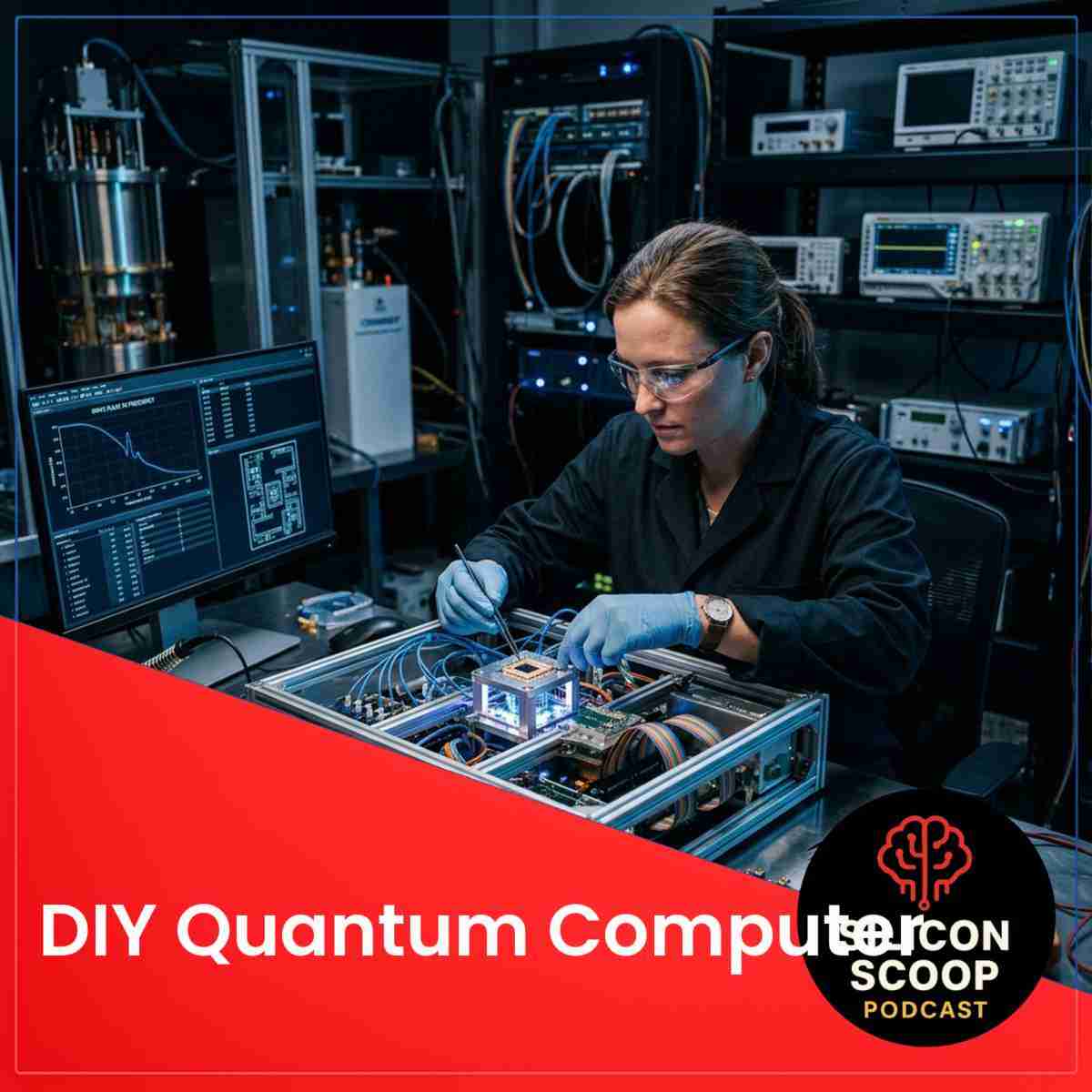
DIY Quantum Computer Kit: Build Your Own 5-Qubit Superconducting Quantum Machine with Qilimanjaro’s EduQit
Estimated reading time: 10 minutes
Key Takeaways
- A DIY quantum computer is now commercially available in 2026 through Qilimanjaro’s EduQit.
- EduQit is a modular kit that includes a superconducting chip, cryogenic refrigerator, control electronics, and supporting hardware.
- The system runs 5 qubits, enabling real learning, calibration practice, and early-stage experimentation.
- EduQit provides hands-on experience that quantum simulators cannot, including cryogenics, wiring, calibration, and troubleshooting.
- It supports universities, research groups, industry training, and broader quantum workforce development and technological sovereignty goals.
Table of contents
- DIY Quantum Computer Kit: Build Your Own 5-Qubit Superconducting Quantum Machine with Qilimanjaro’s EduQit
- Key Takeaways
- Introduction: A DIY Quantum Computer Is Now Real
- What Is the Qilimanjaro EduQit Quantum Computing Kit?
- How the EduQit Superconducting Quantum Kit Works
- Why EduQit Beats Quantum Simulators for Hands-On Learning
- 🚨 Stop Losing Hours to Repeatable Work
- Who Is EduQit For? Quantum Workforce Development in 2026
- EduQit’s Role in Quantum Workforce Development
- What Makes EduQit Modular and Customizable?
- EduQit Technical Specs at a Glance
- FAQ: 10 Common Questions About the DIY Quantum Computer Kit
- Final Thoughts: The Future of Quantum Education Is Hands-On
Introduction: A DIY Quantum Computer Is Now Real
A DIY quantum computer is no longer science fiction. In 2026, you can actually buy a kit, follow the instructions, and assemble a working quantum machine yourself.
Barcelona-based company Qilimanjaro Quantum Tech launched EduQit — a build-your-own quantum computing kit designed for universities, researchers, and anyone serious about getting hands-on with real quantum hardware.
This is a big deal. Until now, most people learning about quantum computing were stuck using cloud simulators or reading textbooks. EduQit changes that by putting physical quantum hardware directly in your hands.
In this post, we break down exactly what EduQit is, how it works, who it’s for, and why it matters for the future of quantum education and research.
—
What Is the Qilimanjaro EduQit Quantum Computing Kit?
The Qilimanjaro EduQit is a modular, flatpack-style quantum computing kit. Think of it like IKEA furniture — but instead of building a bookshelf, you’re assembling a real superconducting quantum computer.
Announced on January 28, 2026, EduQit is targeted at universities and research institutions. It bundles everything you need into one package:
- A superconducting chip — the core of the quantum computer, made from tiny superconducting circuits
- A cryogenic refrigerator — the chip must be kept at temperatures colder than outer space to function
- Control electronics — devices that use radio waves and microwaves to operate the chip and read computation results
- Racks, power cables, and supporting hardware — everything needed to complete the full system
- Software, manuals, and technical support — so users can calibrate and run their quantum machine
The system runs 5 qubits — less than a tenth of what cutting-edge commercial quantum computers use today, but powerful enough for real learning and early-stage experimentation.
The pricing has been described as “relatively cheap” compared to full-scale quantum systems, though specific figures have not been publicly disclosed.
—
How the EduQit Superconducting Quantum Kit Works
To understand why this kit matters, it helps to know how a superconducting quantum computer works.
Qubits: The Building Blocks
Regular computers use bits — either a 0 or a 1. Quantum computers use qubits, which can be 0, 1, or both at the same time (called superposition). This is what gives quantum computers their unique power.
EduQit’s qubits are built from superconducting circuits — tiny loops of metal that, when cooled to near absolute zero, carry electricity with zero resistance. This allows them to behave quantum mechanically.
Cryogenic Cooling Is Essential
The superconducting chip in EduQit must be kept at temperatures around 15 millikelvin — colder than the vacuum of outer space. The kit includes a dedicated cryogenic refrigerator (also called a dilution refrigerator) to achieve this.
Setting up and managing cryogenics is one of the most technically demanding parts of quantum computing. EduQit gives students and researchers direct experience with this process.
Control and Readout Electronics
Once cooled, the qubits are controlled using microwave pulses sent through carefully engineered electronics. The results of quantum operations are then read back out through the same system.
EduQit includes all the control hardware needed, along with software for:
- Qubit calibration — tuning the system so qubits behave predictably
- Running quantum circuits — executing digital, analog, and hybrid quantum operations
- Multi-modal quantum paradigms — users can explore different approaches to quantum computing on the same hardware
Optional Cloud Access
Users also get optional access to SpeQtrum, Qilimanjaro’s cloud platform, which connects the local hardware to broader quantum computing resources and tools.
—
Why EduQit Beats Quantum Simulators for Hands-On Learning
Most quantum education today relies on quantum simulators — software tools that mimic what a quantum computer would do. These are useful, but they have serious limits.
Here’s what simulators cannot teach you:
- How to set up and maintain a cryogenic cooling system
- How to physically wire and connect quantum hardware components
- How to calibrate qubits in a real-world environment where noise is a factor
- How control electronics interact with the chip at a system level
- How to troubleshoot hardware failures and unexpected behavior
EduQit provides all of this.
Professor Bruno Julià Díaz from the University of Barcelona has highlighted how EduQit bridges the gap between academic theory and real quantum operations. He points to the close expert interaction built into the kit experience as a key advantage — students aren’t just running simulations, they’re getting system-level exposure that you simply can’t replicate on a laptop.
For master’s students, PhD researchers, and academic labs, this is the difference between knowing about quantum computing and actually knowing how to do it.
The modular quantum computing system also allows for customization. Research teams can adapt the hardware configuration to suit specific experiments and goals — something no simulator can offer.
EduQit for education and research
—
🚨 Stop Losing Hours to Repeatable Work
If your team keeps copying, pasting, chasing approvals, or updating spreadsheets — automation can take it off your plate so you scale without hiring.
Whether you’re in research, education, or business operations, manual processes eat up time that should go toward high-value work.
Book an automation consult → flowgrammer.ca
—
Who Is EduQit For? Quantum Workforce Development in 2026
The quantum computing kit is designed with a clear audience in mind:
Universities and Academic Labs
EduQit gives teaching institutions a real quantum system to use in coursework. Students in physics, engineering, and computer science programs can learn hands-on — moving beyond blackboard diagrams into actual hardware operation.
Quantum Research Groups
For research teams exploring early-stage quantum algorithms or qubit modalities, EduQit offers a customizable quantum platform at a fraction of the cost of building a system from scratch. The open design allows modification of hardware for specific research goals.
Industry Training Programs
Companies investing in quantum capabilities can use EduQit to build internal expertise. Training engineers on real cryogenic and control systems creates workforce readiness that simulators and cloud platforms don’t develop.
Quantum Ecosystem Builders
EduQit also plays a role in technological sovereignty — a growing priority for nations and institutions that want to develop local quantum expertise rather than depending entirely on foreign quantum cloud services.
The kit fosters ecosystem collaboration, connecting universities, companies, and research institutions around shared hardware experiences and open design principles.
—
EduQit’s Role in Quantum Workforce Development
The global push toward fault-tolerant quantum systems is accelerating. But the workforce needed to build, operate, and innovate with these systems is lagging behind.
EduQit directly addresses this skills gap.
Here’s how it builds quantum capability:
- Cryogenics training — rare, practical skills that are in high demand across quantum hardware companies
- Control electronics experience — understanding microwave engineering at the quantum level
- Qubit calibration expertise — one of the most critical and underrepresented skill sets in the quantum field
- Multi-modal quantum paradigms — exposure to digital, analog, and hybrid quantum approaches on a single platform
- System-level thinking — understanding how all parts of a quantum computer work together
Experts broadly agree that EduQit accelerates quantum workforce development by giving the next generation of quantum scientists and engineers real tools to learn with. It bridges the gap between academia and industry in a concrete, practical way.
This aligns with 2026’s global push toward building local quantum capability — institutions and governments alike are recognizing that training people on real hardware is essential to staying competitive.
—
What Makes EduQit Modular and Customizable?
One of EduQit’s most powerful features is its open, modular design.
Unlike a sealed commercial quantum computer, EduQit is designed to be taken apart, reconfigured, and modified. This matters for several reasons:
- Research flexibility — teams can swap components or adjust configurations for specific experiments
- Qubit modality comparison — researchers can test different types of qubit approaches on the same physical framework
- Iterative upgrades — as quantum hardware technology improves, individual components can be updated without replacing the whole system
- Collaborative development — the open architecture invites contribution from the wider quantum research community
This design philosophy reflects Qilimanjaro’s vision for ecosystem collaboration — rather than locking users into one proprietary system, EduQit is built to grow with the field.
For institutions investing in quantum education for the long term, this modularity means EduQit stays relevant as the technology evolves.
—
EduQit Technical Specs at a Glance
Here’s a quick summary of what the EduQit quantum computing kit includes and delivers:
| Feature | Detail |
| Qubit count | 5 qubits |
| Qubit type | Superconducting circuits |
| Cooling system | Cryogenic dilution refrigerator |
| Control method | Microwave and radio wave electronics |
| Software included | Calibration and circuit execution tools |
| Cloud access | Optional SpeQtrum platform |
| Design | Modular, open, customizable |
| Target users | Universities, research labs, industry training |
| Pricing | Relatively cheap vs. full-scale quantum systems |
| Announced | January 28, 2026 |
—
FAQ: 10 Common Questions About the DIY Quantum Computer Kit
1. What is a DIY quantum computer?
A DIY quantum computer is a kit that comes with all the parts and instructions needed to assemble a working quantum computer yourself. Qilimanjaro’s EduQit is the first commercially available example, designed for universities and research labs.
2. How many qubits does EduQit have?
EduQit operates with 5 qubits. That’s less than a tenth of cutting-edge quantum computers, but it’s enough for real learning, calibration practice, and early-stage quantum experiments.
3. Is EduQit a real quantum computer or just a simulator?
It is a real quantum computer. It uses an actual superconducting chip, a real cryogenic refrigerator, and physical control electronics. It is not a simulation.
4. Who makes the EduQit quantum computing kit?
EduQit is made by Qilimanjaro Quantum Tech, a quantum computing company based in Barcelona, Spain. They announced the kit on January 28, 2026.
5. How cold does the EduQit quantum chip need to be?
The superconducting chip must be cooled to around 15 millikelvin — colder than outer space. The kit includes a cryogenic refrigerator to achieve this.
6. Can students use EduQit without expert help?
EduQit comes with software, manuals, and technical support from Qilimanjaro. It’s designed to be accessible to university students and researchers, especially with guidance from instructors who have expert support from the company.
7. How is EduQit different from cloud-based quantum computing?
Cloud quantum computing lets you run algorithms on a remote quantum machine. EduQit lets you build, calibrate, and operate a quantum machine yourself. You learn cryogenics, hardware assembly, and control electronics — skills cloud access cannot provide.
8. How much does EduQit cost?
Qilimanjaro describes EduQit as “relatively cheap” compared to full-scale quantum systems. However, specific pricing has not been publicly disclosed. Contact Qilimanjaro directly for pricing information.
9. What is SpeQtrum?
SpeQtrum is Qilimanjaro’s cloud quantum computing platform. EduQit users can optionally connect their kit to SpeQtrum to access additional resources and extend their quantum computing capabilities beyond the local hardware.
10. Why does EduQit matter for quantum workforce development?
EduQit gives the next generation of quantum scientists and engineers real hands-on experience with cryogenics, qubit calibration, and control systems. This is critical for building the skilled workforce that quantum computing companies and research institutions need as the field moves toward fault-tolerant quantum systems.
—
Final Thoughts: The Future of Quantum Education Is Hands-On
The launch of EduQit is a landmark moment. For the first time, a DIY quantum computer is available outside of a handful of elite research facilities.
It won’t replace industrial-scale quantum machines. But that’s not the point.
EduQit’s value lies in what it teaches — not just quantum theory, but the real engineering and physical intuition needed to work with quantum hardware. Cryogenics. Calibration. Control electronics. System-level thinking.
These are the skills the quantum industry desperately needs. And now, there’s a kit that can help develop them.
Whether you’re a university building a quantum curriculum, a research lab exploring new qubit approaches, or an institution investing in technological sovereignty, EduQit represents a concrete step toward a more capable and widespread quantum ecosystem.
The quantum future isn’t just being built in corporate labs. It’s being assembled — one kit at a time.
—
Sources:
Additional Links
Flowgrammer.ca – 💡 Unlock AI-Powered Automation! Let flowgrammer.ca handle complex workflows so you can focus on growing your business.
Flowgrammers.ca – 💡 Join Toronto’s Fastest Growing AI and Business Automation Community.
- SRED Funding Solutions – Maximize your R&D tax credits and secure funding for your innovation.
- Silicon Scoop Podcast – Stay Informed, Stay Ahead!
- Startup Talk Podcast
- Flowgrammer Youtube
- Startup Investor Drinks – Join Toronto’s Startup Community and connect with fellow startup enthusiasts and investors.
- TorontoStarts Startup and Entrepreneur Community – Become a part of Toronto’s thriving startup ecosystem.
- Workhaus – Discover flexible workspace solutions for your business needs.
- Work with The Startup Coach – Get expert guidance and mentorship for your startup journey.
- Reach out to Jon Irwin on LinkedIn – Connect with our co-host and technology expert.
Episode transcript
Read the full transcript
Craig: forget everything you know about ikea. barcelona's kilimanjaro just released a flat pack kit for a five qubit supercomputing quantum computer. we aren't just teaching quantum theory anymore. we're letting students build the coldest machines in the universe in their own classrooms. is this quantum ikea, build your own? edukit is a modular, commercially available kit that lets your universities assemble a five qubit quantum machine from the ground up. it includes the chip, the microwave electronics, and the massive cooling system needed to reach near absolute zero. this shifts quantum education from cloud only simulator to hands on hardware mastery, solving a massive talent shortage in quantum engineering. what do you think about this, john?
Jon: i absolutely love this. i'm geeking out over this. do you have a picture of it? it looks like a suitcase kind of thing. it looks like a very primitive suitcase. it reminds me of the first, laptop computers back in the day. right? so, let's let's kind of what is a do it yourself quantum computer. right? so unlike the superconducting quantum computer used by ibm, google, we're getting computing or trapped ion systems from ion q. spin q systems rely on nuclear magnetic resonance, which is the same underlying physics used in, you know, like mri machines or nmr spectroscopy. in these systems, the qubits are represented by nuclear spins. magnetic fields are manipulated by those spins. and so radio frequency pulses, they perform the gate operations and measurements determine the quantum state outcomes. so these machines, they use permanent maintenance generating approximately one tesla magnetic field to control the quantum states. now the key engineering breakthrough here is accessibility. room temperature operation, no dilution refrigerators, integrated touch screen interface, compact design, and low power requirements. and how low power requirements you say and what are those specs? well, the gemini mini, it reportedly weighs only 14 kilograms and consumes roughly 60 watts of power, which is radically different from industrial quantum computers. so, i'm excited for this. i would love to experiment with it. i know you can experiment in the cloud with ibms and stuff like that, but this is kinda cool. what are your thoughts on this, craig? like, what do you think about this? would you get one?
Craig: well, we'll get into that in a second. i put a picture up here on the board, on the board, on the screen for those who want students playing with it. described as relatively cheap compared to multimillion dollar industrial rigs. i'm gonna skip down here. i went to the cost. so, while the kilimanjaro doesn't buy it now button on their site, the current market reports the academic listing place, the full educate bundle is approximately €1,000,000. to the average consumer, a million dollars sounds like a heist. to a university department head, it's a bargain. the fridge is what cost the most money. the fridge cost between 500 to 800,000,000. yeah. and so the electronics, you're not just getting a pc. you're getting a specialized radio frequency microwave control stacks and translate code into precise pulses needed to, nudge the atom. so enterprise systems can cost 10,000,000 to 50,000,000 and require a dedicated team of phes just to keep the lights on. and there's an entry level spin queue, which is a desktop, but that are mini two cubit desktop units for around 15,000 to 30,000. but those are nuclear magnetic resonance machines. basically, they call them high-tech toys that can't be modified or used for serious supercomputing. so i think i'd have, better money for me personally, for that million dollars. i wouldn't mind playing with one, but i'm not, shopping.
Jon: no. i was talking more about the gemini mini, the one that's 15,000. so that one, it supports two qubits and coherent times around a 150 to 200 milliseconds. so, obviously, nowhere near the scale of anything else, but the cool thing about this is that, owning a physical quantum device, it kind of changes the educational experience. so students can directly manipulate hardware, they can observe decoherence, they can experiment with pulse sequences, and they can physically interact with quantum systems, which is cool, which could accelerate, obviously, quantum literacy, some workforce training, and even, broader public understanding of quantum technologies. right? so i think this is cool. so the one that you're picturing there, i don't know i don't think that's their mini their spin cube gemini mini lab. i don't know what
Craig: oh, this is the edukit, the million dollar one.
Jon: oh, okay. that's the million dollar one. yeah. so the one that i was referring to, it looks like an old, and that's that's not spinq's one, is it? that's kilimanjaro's. yeah. yeah. yeah. the one i was talking about was spinq. but it it's still an nmr, but that it's much smaller. so, that's probably the one that you're talking about for 15,000 or 10,000. right?
Craig: yep. yeah. alright. let me jump back here. i just jumped over to spin queue so you could see what's happening.
Jon: so if you go to, products and services and nmr quantum product and services, the experimental platform spin queue jump that one. yeah. doesn't that look cool?
Craig: sure. it looks cool, and you can have a lot of fun with that.
Jon: yeah.
Craig: think of this update like a transition from flight simulators to flying in a real cessna. simulators are great for learning the dashboard, but they don't teach you how to fix a fuel leak or handle real world turbulence. the educate moves students out of the video game version of quantum computing and into the actual hangar where they have to turn the wrenches themselves. so this was announced in january, 2026. they're described as relatively cheap, and they're available for people to, universities and whatnot to buy now. their operating temperature is at 15 millikelvin, which is, you know, the is roughly 200 times colder than the cosmic microwave background radiation. anyway, it's cold, and that's why the fridge is, like, $800,000. the price at five cubics, this machine cannot perform quantum supremacy or break encryption. it is sophisticated educational tool, not a shortcut to solving the world's hardest problems. it's really cool. i like that we're getting this in the hands of students, and i look forward to hearing more about, more quantum people. and if we want to really raise our education, we'll have more quantum scientists, we need this at the university level.
Jon: absolutely.
Craig: so the era of the black box quantum computer is over. the era of the do it yourself quantum engineer has begun. if you had a five bit qubit machine in your basement, what's the first thing you try to optimize? your stock portfolio or the perfect cup of coffee? let us know in the chat.
More from Silicon Scoop
All episodes
silicon-scoop · October 19, 2026
OpenAI’s Jalapeño Chip Stakes a Claim Against Nvidia Blackwell in Real-World AI Inference
OpenAI Jalapeno chip challenges Nvidia GB300 Blackwell with InferenceX AI benchmark results, reshaping AI inference accelerator efficiency and latency.
View episode

silicon-scoop · October 16, 2026
Meta’s $18 Billion Teen Safety Settlement: Soft Guardrails, Hard Leverage Over TikTok and YouTube
Deep dive on Meta teen safety settlement, social media addiction lawsuit, new Facebook Instagram time limits and pressure on TikTok YouTube age verification.
View episode

silicon-scoop · October 15, 2026
How Claude Mythos Is Reshaping Cryptanalysis: HAWK, AES and the Rise of AI-Driven Crypto Research
Claude Mythos cryptanalysis weakens HAWK post-quantum signature, speeds AES Möbius Bridge attack, and powers CryptanalysisBench benchmark in AI-driven crypto research.
View episode