
Quantum Batteries Could Make Charging Feel Instant
Quantum Batteries Could Make Charging Feel Instant https://torontostarts.com/silicon-scoop/ Flowgrammer.ca -> https://flowgrammer.ca/ AI News and Resources -> https://flowgrammers.ca OpenClaw Toronto -> https://openclawto.com/ Cut Busywork, Not Corners If your team is copy-pasting, chasing approvals, or reconciling spreadsheets, you’re burning hours you’ll never get back. Flowgrammer automates the workflows so work moves on its own—faster, cleaner, and scalable. Book an automation consult https://flowgrammer.ca Startup Investor Drinks Toronto - https://startupdrinksto.com/ Toronto’s Startup Community - https://torontostarts.com/ Silicon Scoop Silicon Scoop Podcast - https://torontostarts.com/silicon-scoop/ Apple: https://podcasts.apple.com/us/podcast/silicon-scoop/id1758711826 Spotify: https://open.spotify.com/show/5bAzF0MwV6TtLhJAhvHayI YouTube: https://www.youtube.com/playlist?list=PLj4v-RoA7A-gT62vrEYqh1zCv-0Hj-o5J Startup Talk Startup Talk Podcast -> https://torontostarts.com/startup-talk-toronto-startup-podcast/ Apple -> https://podcasts.apple.com/us/podcast/startup-talk/id1763804003 Spotify -> https://open.spotify.com/show/1siJMILILidHAiAsrX2VBU YouTube: https://youtube.com/playlist?list=PLj4v-RoA7A-jxV5FHs5e61oIsuvUJYmT_&si=LYegRe5GYLKNQ7xL
With Craig Major and Jon Irwin
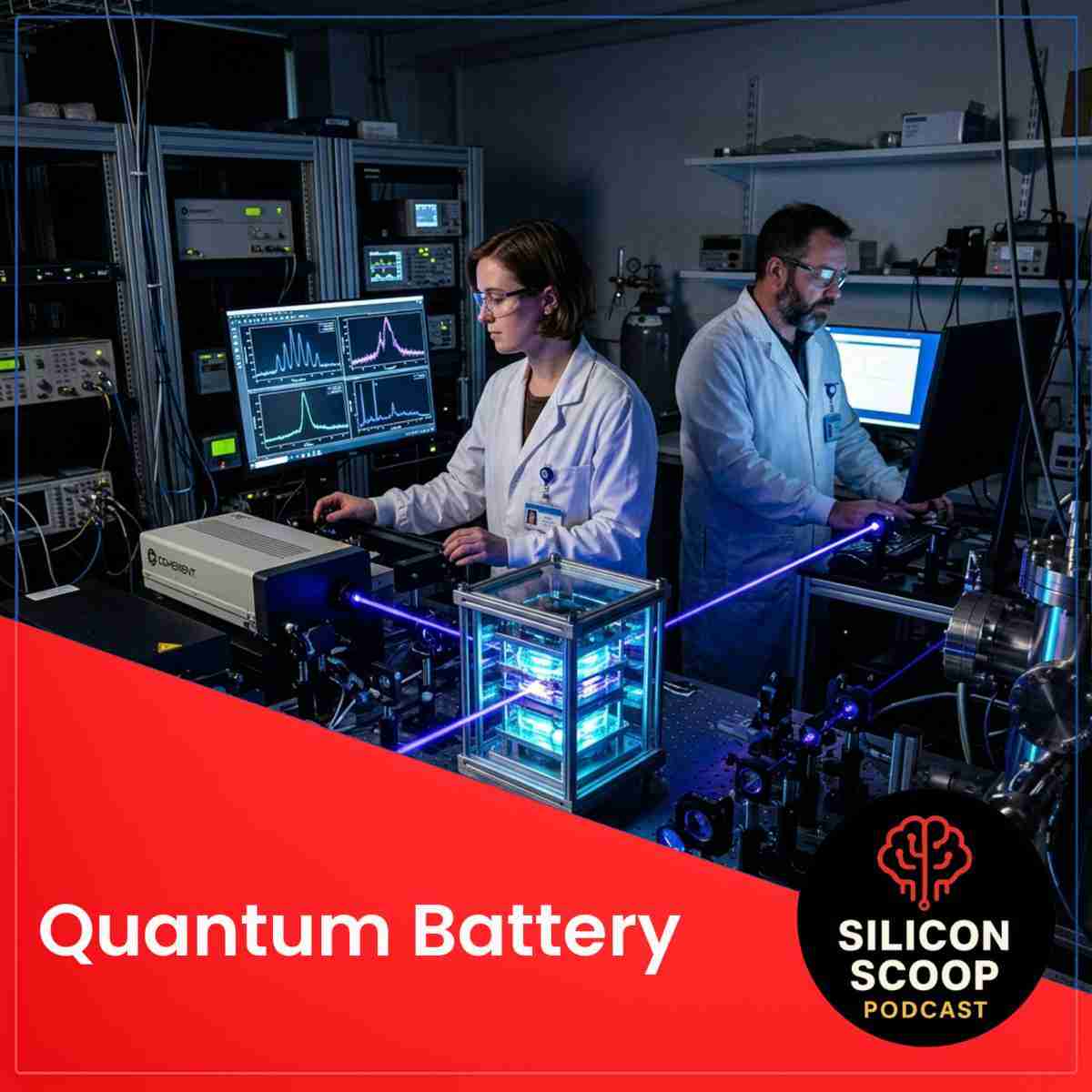
Australian Scientists Unveil the World’s First Full-Cycle Quantum Battery with Superextensive Charging
Estimated reading time: 10 minutes
Key Takeaways
- Australian researchers have built and tested the world’s first proof-of-concept quantum battery — a device that doesn’t just store energy, it charges almost instantly using the strange rules of quantum physics.
- It was published in a peer-reviewed journal in March 2026.
- The team behind it includes scientists from CSIRO, the University of Melbourne, and RMIT University.
- The device is charged wirelessly via laser and it works at room temperature.
- The results confirmed steady-state superextensive light-to-charge conversion and that the prototype retains stored energy for six orders of magnitude longer than the time it takes to charge.
Table of contents
- Australian Scientists Unveil the World’s First Full-Cycle Quantum Battery with Superextensive Charging
- Key Takeaways
- The Quantum Battery Breakthrough That Could Change How We Power Everything
- What Is a Quantum Battery and How Does It Work?
- How the CSIRO Prototype Was Built and Tested
- ⚡ Cut Busywork, Not Corners
- Quantum Energy Storage: Market Size, Applications, and What Comes Next
- Why “Superextensive Charging” Changes the Rules of Energy Science
- Challenges Ahead Before Quantum Batteries Go Mainstream
- FAQ: 10 Common Questions About Quantum Batteries
- Final Thoughts
The Quantum Battery Breakthrough That Could Change How We Power Everything
The word quantum battery just got a lot more real.
Australian researchers have built and tested the world’s first proof-of-concept quantum battery — a device that doesn’t just store energy, it charges almost instantly using the strange rules of quantum physics.
This isn’t a theory on a whiteboard. It’s a working prototype, and it was published in a peer-reviewed journal in March 2026.
The team behind it includes scientists from CSIRO, the University of Melbourne, and RMIT University. Their findings appeared in Light: Science & Applications on March 13, 2026.
What they built could one day change how electric vehicles charge, how consumer electronics are powered, and how quantum computers manage energy.
Here’s everything you need to know.
—
What Is a Quantum Battery and How Does It Work?
A regular battery stores energy through chemical reactions. You plug it in, chemicals inside shift around, and energy gets stored. When you use the device, those chemicals shift back and release energy.
A quantum battery works completely differently.
Instead of chemistry, it uses the rules of quantum mechanics — the science of how particles behave at the tiniest scales.
The Key Difference: Super Absorption
Associate Professor James Hutchison from the University of Melbourne explained it clearly:
“The advantage of quantum is that the system absorbs light in a single, giant ‘super absorption’ event and this charges the battery faster.”
This process is called superextensive charging — and it’s one of the most counterintuitive discoveries in recent energy science.
In normal charging, the more cells you add to a battery, the longer it takes to charge them all. With this quantum battery, the opposite is true. The bigger the battery gets, the faster it charges.
That’s not a typo. It scales in reverse.
The Architecture Behind It
The CSIRO prototype uses a multi-layered organic microcavity design. This structure creates what scientists call strong light-matter coupling — a condition where light and matter interact so tightly that energy transfer happens almost all at once.
The device is charged wirelessly via laser — specifically a femtosecond laser, which fires pulses measured in quadrillionths of a second.
And it works at room temperature. That’s a big deal. Many quantum technologies need extreme cold to function. This one doesn’t.
Sources:
– Light: Science & Applications article
– CSIRO quantum battery full-cycle news
—
How the CSIRO Prototype Was Built and Tested
The CSIRO prototype is more than a concept. It went through a full charge-store-discharge cycle, making it the first quantum battery to demonstrate all three phases in a working device.
Built in a Clean Lab
CSIRO engineered the prototype in a controlled clean lab environment. The device uses a multi-layered organic microcavity structure, carefully designed to support quantum superposition and quantum entanglement — two properties that allow particles to exist in multiple states at once and to influence each other instantly across space.
These quantum properties are what allow the battery to absorb energy in that single “super absorption” event rather than in a slow, sequential process.
Tested With Ultrafast Lasers
To confirm the charging speed, the team ran experiments at the Ultrafast Laser Laboratory in the School of Chemistry at the University of Melbourne.
Professor Trevor Smith described the equipment used:
“The unique capabilities of our Ultrafast Laser Lab, including dual femtosecond laser amplifiers and tunable optical parametric amplifiers, were critical in enabling us to record ultrafast signals over orders of magnitude in time.”
Using advanced spectroscopy techniques, the researchers were able to watch the charging happen in real time — measuring signals across timescales from femtoseconds to much longer durations.
What the Data Showed
The results confirmed something remarkable:
- The device demonstrated steady-state superextensive light-to-charge conversion
- The prototype retains stored energy for six orders of magnitude longer than the time it takes to charge
- This makes it viable for real-world energy harvesting, even under low-intensity illumination
That last point matters. A battery that only works under a powerful lab laser isn’t useful. One that works in low light has real-world potential.
Sources:
– Light: Science & Applications article
– RMIT quantum battery prototype news
—
⚡ Cut Busywork, Not Corners
If your team is copy-pasting, chasing approvals, or reconciling spreadsheets, you’re burning hours you’ll never get back. Flowgrammer automates the workflows so work moves on its own — faster, cleaner, and scalable.
—
Quantum Energy Storage: Market Size, Applications, and What Comes Next
This breakthrough doesn’t exist in a vacuum. The quantum energy storage market is already growing fast — and this prototype just gave it a massive shot of credibility.
The Market Numbers
According to market research from Coherent Market Insights:
- The quantum batteries market is valued at USD 17.21 billion in 2026
- It is projected to reach USD 52.68 billion by 2033
- That’s a compound annual growth rate (CAGR) of 20.5%
- The consumer electronics segment holds the largest share at 60.2%
These numbers signal that investors, manufacturers, and governments are paying close attention to quantum-based energy solutions.
Where Could Quantum Batteries Be Used?
Electric Vehicles (EVs)
One of the biggest pain points with EVs right now is charging time. Even fast chargers take 20–45 minutes for a meaningful charge. A quantum battery that scales charging speed with size could, in theory, charge a large EV battery faster than a small one — the complete opposite of current technology.
Analysts note that quantum batteries hold real promise for revolutionizing energy density in EVs, though they also highlight that scaling hurdles and high costs remain significant challenges before mass adoption.
Consumer Electronics
Smartphones, laptops, and wearables drain batteries constantly. The idea of a phone that charges in seconds — not minutes — is exactly the kind of application the consumer electronics market is watching closely.
Quantum Computing
Quantum computers are powerful but energy-hungry and heat-sensitive. A quantum battery integrated into quantum computing systems could recycle energy more efficiently and generate less heat, extending the operational windows of these machines.
Energy Harvesting in Low-Light Conditions
Because the prototype demonstrated superextensive charging even under low-intensity illumination, there’s real potential for solar energy harvesting in conditions where traditional panels struggle — cloudy days, indoor environments, and shaded areas.
What the Lead Researcher Says About Next Steps
Dr. James Quach, quantum science and technologies science leader at CSIRO, was direct about where things stand:
“While there’s still much work to be done in quantum battery research, we’ve made an important move towards realizing the possibilities. The next step right now for quantum batteries is extending their energy storage time.”
The device already stores energy for six orders of magnitude longer than its charge time. But for commercial use, that storage window needs to grow significantly. That’s the team’s current focus.
Sources:
– Coherent Market Insights quantum batteries market report
– Energy-Storage.news coverage
– CSIRO quantum battery full-cycle news
—
Why “Superextensive Charging” Changes the Rules of Energy Science
Most technology gets slower and harder to manage as it gets bigger. Think about how long it takes to download a massive file versus a small one. Think about charging a large battery pack versus a tiny one.
Superextensive charging breaks this rule entirely.
In the quantum battery framework, the charging power doesn’t just scale linearly with size — it grows faster than the size of the battery. This is called superextensive scaling, and it’s a direct result of quantum coherence.
What Is Quantum Coherence?
Quantum coherence is when particles in a system act together in sync — like a perfectly coordinated team rather than a crowd of individuals all doing their own thing.
In a conventional battery, each molecule stores energy on its own. They don’t cooperate. In the quantum battery, all molecules absorb energy together in one synchronized event — the “super absorption” moment. The more molecules there are, the more powerful that coordinated event becomes.
This is why the battery charges faster as it grows larger.
Why This Is Counterintuitive
Every engineering principle we use today is built on the assumption that bigger means slower to charge, harder to manage, and more likely to fail.
Quantum batteries flip that assumption. Engineers designing future systems around this technology would need to completely rethink how they approach battery architecture, thermal management, and power delivery systems.
The First Experimental Proof
Before this prototype, superextensive charging was a theoretical prediction. Researchers had modeled it mathematically, but no one had confirmed it in a real working device.
This is the first experimental demonstration of steady-state superextensive light-to-charge conversion. That distinction matters enormously in science. It moves the concept from “possible” to “proven.”
Sources:
– Light: Science & Applications article
– RMIT quantum battery prototype news
—
Challenges Ahead Before Quantum Batteries Go Mainstream
This breakthrough is exciting. But it’s important to be clear-eyed about what still needs to happen before quantum batteries show up in your phone or car.
Energy Storage Time Needs to Grow
The prototype stores energy for a long time relative to its charge duration. But in absolute terms, the current storage window is not yet practical for commercial applications. Dr. Quach identified this as the immediate next challenge for the research team.
Scaling From Lab to Real World
The CSIRO prototype is a proof-of-concept device, built under controlled lab conditions with precision laser equipment. Moving from that environment to mass production involves enormous engineering challenges:
- Manufacturing the multi-layered organic microcavity structure at scale
- Replacing the femtosecond laser charging mechanism with something practical and affordable
- Ensuring consistency across millions of units
Cost
Quantum technologies are expensive to produce right now. The materials, equipment, and expertise required are not yet accessible at consumer-market prices. Analysts consistently highlight high production costs as one of the key barriers to commercialization.
Heat and Environmental Stability
While the prototype works at room temperature — already a major advantage — real-world devices face temperature swings, humidity, physical impact, and other environmental stresses that lab conditions don’t replicate. Stability under those conditions hasn’t been fully tested.
Sources:
– Energy-Storage.news coverage
– Coherent Market Insights quantum batteries market report
—
FAQ: 10 Common Questions About Quantum Batteries
1. What is a quantum battery?
A quantum battery is a type of energy storage device that uses the rules of quantum mechanics — like quantum superposition and entanglement — instead of chemical reactions to store and release energy. It charges by absorbing light in a single coordinated event rather than slowly building up charge.
2. How is a quantum battery different from a regular battery?
A regular battery uses chemistry to store energy. Electrons move through chemical reactions to charge and discharge. A quantum battery skips the chemistry entirely and uses quantum effects, which allows it to absorb energy much faster — especially as the device gets larger.
3. What is superextensive charging?
Superextensive charging means the battery charges faster as it gets bigger. In normal batteries, larger size means longer charge times. In a quantum battery, the quantum coherence of the system means all molecules absorb energy together, so adding more molecules makes the whole process more powerful and faster.
4. Who built the first quantum battery prototype?
The prototype was built by a team from CSIRO, the University of Melbourne, and RMIT University in Australia. The research was led by Dr. James Quach at CSIRO, with key contributions from Associate Professor James Hutchison and Professor Trevor Smith.
5. When was this quantum battery breakthrough announced?
The research was published on March 13, 2026, in the journal Light: Science & Applications. It was announced publicly in early May 2026.
6. Does the quantum battery work at room temperature?
Yes. One of the most important features of this prototype is that it operates at room temperature. Most quantum technologies require extreme cooling, which makes them expensive and impractical. Room-temperature operation brings this technology much closer to real-world use.
7. How long does the quantum battery hold its charge?
The prototype retains stored energy for six orders of magnitude longer than it takes to charge. In practical terms, this means it holds charge for a vastly longer time than the near-instant charging process takes — though the absolute storage duration still needs to be extended for commercial applications.
8. Could quantum batteries be used in electric vehicles?
Potentially yes. One of the most exciting potential applications is ultrafast EV charging. Because quantum batteries charge faster as they scale up, a large EV battery pack could theoretically charge much faster than a smaller one — the reverse of how current EV batteries work.
9. How big is the quantum battery market?
The global quantum batteries market is valued at USD 17.21 billion in 2026 and is projected to reach USD 52.68 billion by 2033, growing at a CAGR of 20.5%. Consumer electronics currently represent the largest market segment at 60.2%.
10. When will quantum batteries be available to consumers?
There is no confirmed timeline yet. The current prototype is a proof-of-concept device. Significant challenges remain around extending storage time, reducing costs, and scaling manufacturing. Researchers describe the current stage as foundational — proving the science works before moving toward commercial development.
—
Final Thoughts
The CSIRO quantum battery prototype is one of the most significant energy science announcements of 2026.
It proves that superextensive charging is real — not just a theory. It works at room temperature. It completes a full charge-store-discharge cycle. And it hints at a future where the size of a battery is an advantage, not a limitation.
There’s still work to do. Storage times need to grow. Costs need to come down. Manufacturing at scale remains unsolved.
But the foundation has been built. And based on what Australian researchers just demonstrated, the future of energy storage may look nothing like what we have today.
Reference: “Superextensive electrical power from a quantum battery” — Light: Science & Applications, DOI: 10.1038/s41377-026-02240-6
Additional Links
Flowgrammer.ca – 💡 Unlock AI-Powered Automation! Let flowgrammer.ca handle complex workflows so you can focus on growing your business.
Flowgrammers.ca – 💡 Join Toronto’s Fastest Growing AI and Business Automation Community.
- SRED Funding Solutions – Maximize your R&D tax credits and secure funding for your innovation.
- Silicon Scoop Podcast – Stay Informed, Stay Ahead!
- Startup Talk Podcast
- Flowgrammer Youtube
- Startup Investor Drinks – Join Toronto’s Startup Community and connect with fellow startup enthusiasts and investors.
- TorontoStarts Startup and Entrepreneur Community – Become a part of Toronto’s thriving startup ecosystem.
- Workhaus – Discover flexible workspace solutions for your business needs.
- Work with The Startup Coach – Get expert guidance and mentorship for your startup journey.
- Reach out to Jon Irwin on LinkedIn – Connect with our co-host and technology expert.
Episode transcript
Read the full transcript
Craig: everything you know about batteries is officially backwards. australian scientists just built a device that actually charges faster the bigger it gets. we aren't talking about a better iphone battery. we're talking about the end of overnight charge forever. so these quantum batteries defy physics logics. research from csiro rmit, the university of melbourne, have successfully tested the full cycle quantum battery. unlike lithium ion, it uses light and quantum entanglement to hit super absorption states for near instant power. this effectively flips the scaling laws of energy. imagine a semi truck charging faster than your smartwatch. what do you think about this, john?
Jon: i love this. i've we've covered tons of different batteries. we've even we've even covered quantum batteries, but not where they've actually built,
Craig: a a a a
Jon: device, like an actual prototype. so let's just so we're all on the same, on the same field here. so a classical battery, it stores energy chemically. so lithium ion batteries, for example, they move lithium ions between electrodes during charging and discharging. now, quantum batteries work differently. they use quantum mechanical states, especially, collective quantum effects like coherence, super radiance, and super absorption to store and transfer energy. okay? so you've gotta eliminate whole classical physics when it comes to this, but this is really cool. the key principle here that they're that that that they're touting is something called collective charging. so in a normal battery, each unit charges independently. okay? in a quantum battery, many quantum systems behave collectively as one coherent object and this creates a phenomenon where energy absorption scales non linearly. so instead of charging speed increasing linearly with battery size, this is crazy, it can increase super linearly, meaning larger systems may charge disproportionately faster. so this is one of the most radical claims in the field because it appears to partially bypass traditional scaling limitations in battery physics. so what the researchers did was they built the device using organic semiconductor layers sandwiched between reflective silver mirrors forming what's called a microcavity. okay? so this microcavity, it traps light in a tiny space and forces strong interaction between photons and molecular excitations. and this setup is based on the dicke model, which is a famous quantum optics framework describing collective light matter interactions. so this just blows my mind. what are your thoughts on this, craig? i'm excited for this. do you think they've got something here, or what are your thoughts?
Craig: i think this is really cool, and i like this analogy to kind of explain why it's faster the larger, the more capacity. think of a standard battery like a stadium where every fan has to enter through a single turnstile one by one. that's your phone charging at night. the quantum battery is like a stadium where every seat is a door that opens at the exact same microsecond. the more seats you add, the more doors you have and the faster the stadium fills up. so it's kinda like, the more parking spaces you have in a large parking lot, the easier it is to find, and fill up a parking spot. right? the more crowded it gets, the harder it is to find a spot similar with cell charging. so interesting. is proof of concept was confirmed, this month, sorry, march, and we are expecting to see commercial prototypes in the next three years. so i'm really excited about this. they were targeting evs and high end laptops and energy dense quantum computers for this. so in the near future, you could pull your ev into a station and be back at a 100% in the time it takes to click your seat belt. i'm excited about this charging because you know, it's one of the reluctant things from an ev perspective. your white nickel syndrome, it takes up to an hour or maybe longer to charge depending on a trickle charger. you got a fast charger that's compatible with your unit. and, it's a little bit of a nightmare sometimes yeah. if you're in a places where you can't, it's hard to find these things. so all of a sudden, you can pull in and pull out within less than five minutes and be full ready to go just like, you know, faster than a gas station. that changes things quite a bit.
Jon: yeah. that that totally does. that changes that that would make adoption, like, it would, go like a hockey stick. so, right now, like, even though they sit they did build a prototype, it's still experimental. it only stores a tiny amount of energy and holds that charge for nanoseconds. but the thing about this is the physics behind it validates decades of theoretical work in quantum mechanics and energy storage. so they believe that this could lead to wireless charging systems and, like you said, ultra fast e b. the other thing is we did cover previous quantum battery experiments, but those mostly demonstrated charging effects theoretically or partially experimental. and so what this new work has demonstrated is they've demonstrated charging, they've demonstrated storing, and extracting electrical energy. and that last step is critical because without any energy extraction, it's not functioning as a battery. so this moves a field from abstract physics into early engineering, and that's what gets me excited.
Craig: so while most quantum tech requires dilution refrigerators to stay near absolute zero, this battery operates at room temperature thanks to its organic dye filled microcavity. you mentioned the microcavity. the global quantum battery market was nonexistent five years ago, but it's already valued at 17,210,000,000, you know, this year, 2026. and the laser used to charge this, the femtosecond laser, pulses so fast that if one second was the age of the entire universe, a femtosecond would be just a fraction of a day. yeah. so, you know, these things are crazy. we just moved the instant charge from science fiction to lab proven reality. if you're you could charge your car in ten seconds, would you finally ditch your gas guzzler, or did you still have range anxiety even with quantumtech? let us know what you think in the chat. we'd love to hear from you.
More from Silicon Scoop
All episodes
silicon-scoop · October 16, 2026
Meta’s $18 Billion Teen Safety Settlement: Soft Guardrails, Hard Leverage Over TikTok and YouTube
Deep dive on Meta teen safety settlement, social media addiction lawsuit, new Facebook Instagram time limits and pressure on TikTok YouTube age verification.
View episode

silicon-scoop · October 15, 2026
How Claude Mythos Is Reshaping Cryptanalysis: HAWK, AES and the Rise of AI-Driven Crypto Research
Claude Mythos cryptanalysis weakens HAWK post-quantum signature, speeds AES Möbius Bridge attack, and powers CryptanalysisBench benchmark in AI-driven crypto research.
View episode

silicon-scoop · October 14, 2026
Nvidia’s $12.9 Billion Hugging Face Bet: How Controlling the Open-Source Model Hub Reshapes AI Chips, Cloud, And Competition
Nvidia Hugging Face acquisition could reshape open source AI models, AI chip dominance, and the global developer model hub, raising antitrust and neutrality questions.
View episode