
Meta’s AI Push Just Made Work Feel Like Surveillance
Meta’s AI Push Just Made Work Feel Like Surveillance https://torontostarts.com/silicon-scoop/ Flowgrammer.ca -> https://flowgrammer.ca/ AI News and Resources -> https://flowgrammers.ca OpenClaw Toronto -> https://openclawto.com/ Automate the Busywork, Not Your People Cut manual steps, reduce errors, and free your team to do the work that actually drives revenue. Flowgrammer builds automations that scale with you. Book an automation consult https://flowgrammer.ca Startup Investor Drinks Toronto - https://startupdrinksto.com/ Toronto’s Startup Community - https://torontostarts.com/ Silicon Scoop Silicon Scoop Podcast - https://torontostarts.com/silicon-scoop/ Apple: https://podcasts.apple.com/us/podcast/silicon-scoop/id1758711826 Spotify: https://open.spotify.com/show/5bAzF0MwV6TtLhJAhvHayI YouTube: https://www.youtube.com/playlist?list=PLj4v-RoA7A-gT62vrEYqh1zCv-0Hj-o5J Startup Talk Startup Talk Podcast -> https://torontostarts.com/startup-talk-toronto-startup-podcast/ Apple -> https://podcasts.apple.com/us/podcast/startup-talk/id1763804003 Spotify -> https://open.spotify.com/show/1siJMILILidHAiAsrX2VBU YouTube: https://youtube.com/playlist?list=PLj4v-RoA7A-jxV5FHs5e61oIsuvUJYmT_&si=LYegRe5GYLKNQ7xL
With Craig Major and Jon Irwin
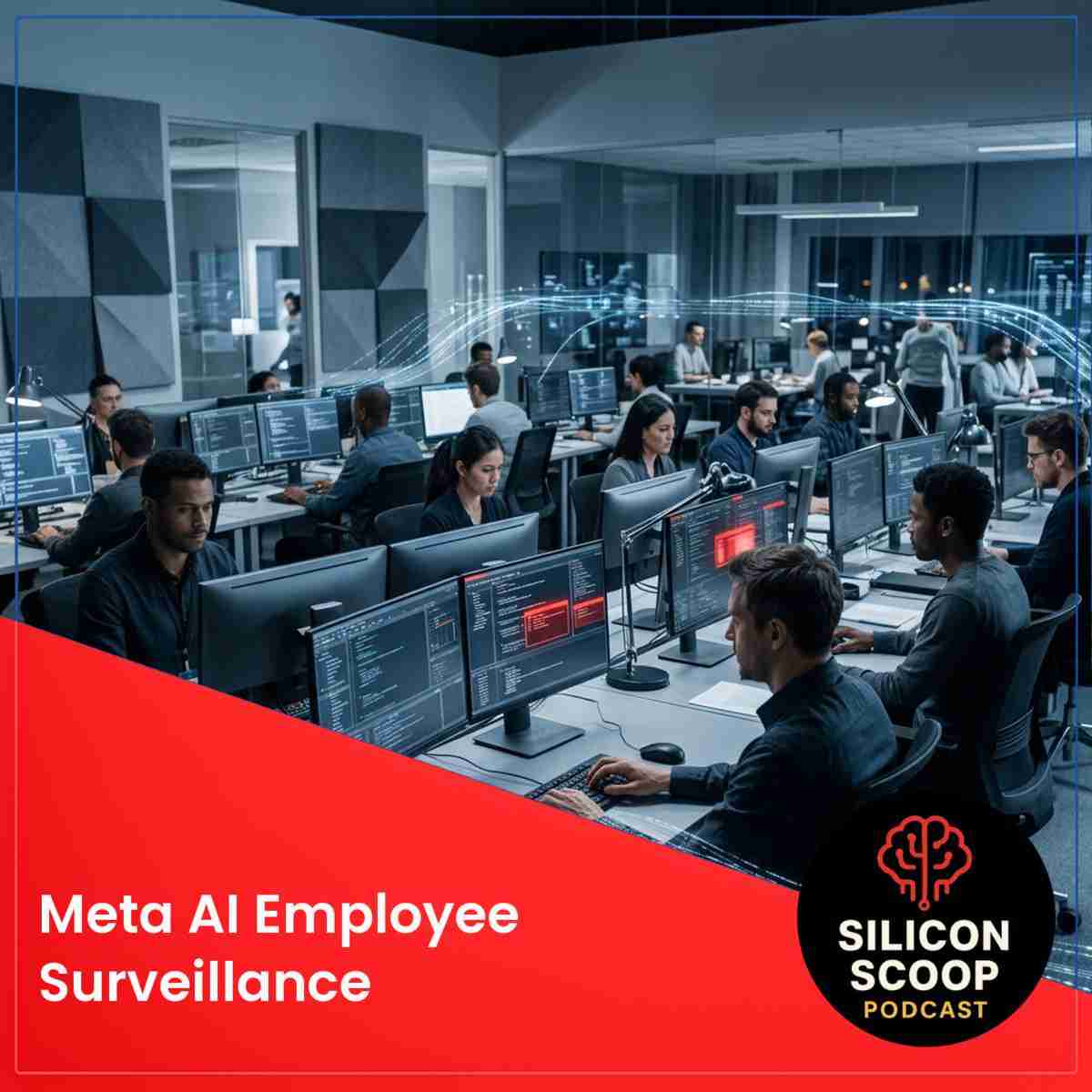
Meta AI Employee Surveillance: How a $145 Billion Bet Is Breaking the People Behind It
Estimated reading time: 10 minutes
Key Takeaways
- Meta’s AI employee surveillance program is active now, capturing real-time behavioral data from corporate laptops.
- Meta’s 2026 capex guidance has been revised upward to $125–145 billion, nearly double 2025 spending.
- Meta layoffs May 2026 include 8,000 employees on May 20, 2026, plus 6,000 internal role eliminations through restructuring.
- Employee morale is described as at its “most negative level on record,” with concerns about deskilling and fear-driven culture.
- Analysts are divided on whether the spending and workforce transformation will produce returns, citing limited visibility on AI products and legal overhang.
Table of contents
- Meta AI Employee Surveillance: How a $145 Billion Bet Is Breaking the People Behind It
- What Is Meta’s AI Employee Surveillance Program?
- The $145 Billion Bet: Meta’s AI Investment and What It Is Really Buying
- Meta Layoffs May 2026: 8,000 Jobs, One Date, One Message
- 🔧 Automate the Busywork, Not Your People
- Inside the Morale Crisis: What Meta Employees Are Actually Saying
- What Analysts Are Saying: Divided on the Outcome
- What This Means for the Future of Work
- FAQ: Meta AI Employee Surveillance and the 2026 Workforce Crisis
Meta’s AI employee surveillance program is not a rumor. It is happening right now — and the full picture is more alarming than most headlines let on.
In 2026, Meta is executing one of the most aggressive artificial intelligence transformations in corporate history. The price tag is staggering: up to $145 billion in capital expenditure for the year alone. But the real cost is being paid by the 78,000 people who work there.
Keystroke tracking. Mass layoffs. Record-low morale. A performance review system that punishes workers who don’t adopt AI fast enough.
This post breaks down exactly what is happening inside Meta, what the numbers reveal, and what it means for the future of work.
—
What Is Meta’s AI Employee Surveillance Program?
Meta has deployed internal software called the Model Capability Initiative (MCI). It runs on corporate laptops issued to U.S. employees.
Here is what MCI captures in real time:
- Keystroke patterns — every key a worker presses
- Mouse movements — where your cursor goes and when
- Click behavior — what you open, close, and interact with
- Periodic screenshots — snapshots of your screen taken automatically
The stated purpose? To train AI agents that can replicate human computer interactions. In plain language, Meta is using its own employees as a live dataset to teach machines how people do their jobs.
There is no optional opt-out for workers using company-issued laptops.
This is not background monitoring for security purposes. This is systematic behavioral data collection designed to build AI systems that can replace the very tasks being recorded.
The employee activity monitoring program represents one of the most invasive forms of workplace surveillance ever deployed at scale by a major tech company. It is workplace tracking, digital monitoring, and AI training rolled into one.
Sources:
- PCMag report on Meta tracking employee activity to train AI models
- TechCrunch report on Meta employee tracking surveillance
—
The $145 Billion Bet: Meta’s AI Investment and What It Is Really Buying
Mark Zuckerberg is not hedging. He is going all in.
Meta’s 2026 capital expenditure guidance has been revised upward to $125–145 billion. That is nearly double what the company spent in 2025 ($72.2 billion).
Here is how the money is moving:
Key Financial Metrics
- Q1 2026 Revenue: $56.3 billion (33% year-over-year growth)
- Operating Margin: 41%
- 2025 Capex: $72.2 billion
- 2026 Capex Guidance: $125–145 billion (+$10 billion revision mid-cycle)
- Reality Labs Losses: $4.03 billion in Q1 2026 alone; $19.2 billion in all of 2025
- Multi-year infrastructure commitments: jumped $107 billion in a single quarter (Q1 2026)
A significant chunk of this spending is tied to NVIDIA Blackwell Ultra chip orders ($13 billion+) and long-term data center agreements — some locked in through 2033 with operators like Blue Owl, with potential exit penalties.
Zuckerberg’s AI Investment ROI Problem
The market position tells a harder story.
According to Menlo Ventures research, Meta’s enterprise AI footprint remains minimal. The current market share breakdown for enterprise large language models (LLMs):
| Company | Enterprise AI Market Share |
|—|—|
| Anthropic | 40% |
| OpenAI | 27% |
| Google Gemini | 21% |
| All others (including Meta) | Under 12% combined |
Meta is spending more than any competitor but holds less than a fraction of the enterprise AI market. Analysts at JPMorgan and Erste Group have flagged “limited visibility on AI products” and raised serious questions about return on investment timing.
Piper Sandler, Cantor Fitzgerald, and KeyBanc have already reduced their Meta price targets by $50–100+ citing expense concerns and uncertainty around AI monetization.
The Zuckerberg AI investment ROI question is not theoretical. It is the central tension driving every decision the company is making right now — including the layoffs.
Sources:
- Fortune report on Meta Zuckerberg $145 billion AI spending ROI
- Yahoo Finance report on Meta bumping 2026 capex
- Yahoo Finance report on Meta Platforms story shifting
—
Meta Layoffs May 2026: 8,000 Jobs, One Date, One Message
On May 20, 2026, Meta began its first wave of layoffs. The number: 8,000 employees, representing 10% of its 78,000-person global workforce. An additional 6,000 internal roles have been eliminated through restructuring.
This was not a surprise inside the company. An internal memo from Chief People Officer Janelle Gale made the direction clear: starting in 2026, demonstrating “AI-driven impact” is a core expectation for every employee.
Workers who fail to show AI adoption in their day-to-day work face performance penalties.
The Timeline Is Not Accidental
The May 20 layoff date strategically precedes a critical milestone:
- December 8, 2026 — Meta’s AI performance review rollout
Workers laid off in May will never reach that review. For those who remain, the message is unmistakable: adopt AI tools or face consequences at year-end.
This creates a workplace dynamic where employees are simultaneously:
- Being monitored to train the AI systems being built
- Being evaluated on how well they use those same AI systems
- Watching colleagues lose jobs to headcount reductions justified by AI efficiency gains
The Reuters internal memo analysis from April 2026 confirmed the layoff targeting and timing. Business Insider reporting aligned, citing the 10% total workforce reduction plan.
Sources:
- Reuters report on Meta targeting May 20 first wave layoffs
- Business Insider report on Meta plans to lay off 10% of staff
- Wall Street Journal analysis on Meta layoffs and AI shift
—
—
🔧 Automate the Busywork, Not Your People
Cut manual steps, reduce errors, and free your team to do the work that actually drives revenue. Flowgrammer builds automations that scale with you.
—
—
Inside the Morale Crisis: What Meta Employees Are Actually Saying
The Wall Street Journal analysis published April 23, 2026, described Meta employee morale as being at its “most negative level on record.”
Workers on the anonymous professional platform Blind described their workplace as:
- “Dead and depressing”
- A place where AI tools create “deskilling” — the gradual erosion of human expertise as AI takes over cognitive tasks
- An environment of fear, not innovation
The Management Structure Is Making It Worse
Meta’s Applied AI Engineering division operates at a 50-to-1 employee-to-manager ratio. The industry standard is roughly 25 to 1.
What that means in practice:
- Managers are stretched impossibly thin
- Workers have fewer touchpoints for guidance, feedback, or support
- The flattened hierarchy, while efficient on paper, isolates individual contributors during a period of massive uncertainty
The result is a workforce going through surveillance, job cuts, and forced technology adoption — largely without meaningful human leadership support.
The Pay Disparity Is Fueling Resentment
Meta has spent $250–300 million in recruitment packages to attract elite AI researchers over four years. Some individual contracts reportedly exceed $100 million in year one.
For the roughly 78,000 existing employees watching this happen, the message is hard to miss: the people whose jobs are being automated away are funding the salaries of the people building the automation.
Internal resentment over wage disparity is documented and growing. The insider analysis suggests this pay gap is already creating attrition pressure even among Meta’s newly assembled AI “dream team.”
Sources:
- Wall Street Journal analysis on Meta layoffs and AI shift
- New York Post report on Meta AI dream team pay wars
- Fortune report on Meta AI team flat management structure
- New York Times report on Meta AI employees miserable
- GV Wire report on Meta’s embrace of AI and employee misery
—
What Analysts Are Saying: Divided on the Outcome
Expert opinion on Meta’s strategy falls into clear camps.
The Bulls
- Jefferies and Bank of America argue that AI productivity tools could justify up to a 20% headcount reduction, making current layoffs financially sound
- UBS and Morgan Stanley maintain bullish stances on Meta overall, citing the revenue growth and operating margin strength
The Bears and Skeptics
- JPMorgan and Erste Group flag “limited visibility on AI products” and question whether the $145 billion capex will generate returns within a reasonable window
- Piper Sandler, Cantor Fitzgerald, and KeyBanc have cut price targets by $50–100+ each
- Menlo Ventures research indicates Meta’s enterprise AI footprint is too small to track as a standalone metric — the company is spending top-tier capital for sub-tier market presence
The Legal Overhang
Analysts consistently flag Meta’s growing legal exposure as a material risk that offsets any AI upside:
- Los Angeles social media addiction verdict: $3 million+
- New Mexico child safety verdict: $375 million
- Ongoing EU regulatory exposure from data privacy frameworks
The robotic process automation and AI agent rollout may create additional regulatory scrutiny as more jurisdictions examine employee monitoring and data collection practices.
Sources:
- AI Business Review report on Meta workforce transformation
- New York Times report on AI risks and debt
- Japan Times commentary on Meta workers and AI replacements
—
What This Means for the Future of Work
Meta is not an outlier. It is a preview.
The combination of employee monitoring software, AI-driven performance reviews, and mass headcount reductions justified by automation is a template other large technology companies are watching closely.
The Meta model raises serious questions for every company considering AI adoption:
- Who owns the behavioral data collected from employees?
- What happens when AI training datasets are built from workers who were later laid off?
- Can companies mandate AI adoption without triggering labor violations?
- What is the human cost of “efficiency” at this scale?
The Verge, Fortune, and the New York Times have all noted that the worker experience at Meta in 2026 represents a stress test for how far a corporation can push artificial intelligence integration before it produces catastrophic talent loss.
The answer, based on current Blind sentiment data, is that Meta may already be past that point.
Sources:
- The Verge report on Meta employees reportedly miserable
- Fortune report on Meta Zuckerberg $145 billion AI spending ROI
—
FAQ: Meta AI Employee Surveillance and the 2026 Workforce Crisis
1. What is Meta’s Model Capability Initiative (MCI)?
MCI is internal software Meta has deployed on corporate laptops for U.S. employees. It captures keystroke patterns, mouse movements, click behavior, and periodic screenshots. The data is used to train AI agents to replicate how humans complete computer-based tasks.
2. Can Meta employees opt out of the keystroke tracking?
No. There is no optional opt-out for employees using company-issued corporate laptops. The monitoring is mandatory for those on Meta hardware.
3. How many employees is Meta laying off in May 2026?
Meta announced 8,000 layoffs targeted for May 20, 2026. Combined with 6,000 internal role eliminations, this represents approximately 10% of Meta’s total 78,000-person global workforce.
4. Why is Meta spending $145 billion on AI in 2026?
Meta is attempting to capture AI market share from competitors like OpenAI (27% enterprise share) and Anthropic (40% enterprise share). The company views AI infrastructure — data centers, chips, and AI agents — as the core of its long-term competitive strategy. CEO Mark Zuckerberg has staked the company’s direction on winning the AI race.
5. What is the “AI-driven impact” performance review requirement?
Starting with the December 8, 2026 review cycle, Meta has formalized “AI-driven impact” as a core expectation for all employees. Workers who do not demonstrate adoption of AI tools in their daily work face performance penalties, up to and including termination.
6. What is employee sentiment like at Meta right now?
According to Wall Street Journal analysis of data from the anonymous professional platform Blind, Meta employee morale is at its most negative level on record. Workers have described the environment as “dead and depressing” and have raised concerns about “deskilling” — the erosion of human expertise as AI takes over knowledge work.
7. How much is Meta paying its top AI researchers?
Meta has deployed $250–300 million in recruitment packages over four years to attract elite AI researchers. Some individual contracts reportedly exceed $100 million in year one. This has created significant wage disparity resentment among existing employees.
8. What do financial analysts think about Meta’s $145 billion AI spending?
Opinion is divided. Jefferies and Bank of America support the strategy, arguing AI tools justify headcount reductions and improve productivity. JPMorgan, Erste Group, Piper Sandler, Cantor Fitzgerald, and KeyBanc are skeptical, citing limited visibility on AI product monetization and cutting their price targets by $50–100+.
9. Is Meta’s AI strategy working in the enterprise market?
Not yet in any dominant way. Menlo Ventures research shows Meta holds less than 12% combined enterprise AI share alongside all non-top-3 competitors. Anthropic leads at 40%, OpenAI holds 27%, and Google Gemini has 21%. Meta is spending more than any competitor but holds a fraction of the market.
10. What legal risks is Meta facing alongside its AI transformation?
Meta is navigating several active legal exposures: a $3 million+ Los Angeles verdict related to social media addiction, a $375 million New Mexico child safety verdict, and ongoing EU regulatory scrutiny around data privacy. Analysts flag these as material headwinds that offset some of the upside from AI investment.
Last updated: May 2026. All data sourced from Meta Q1 2026 earnings, Reuters, the New York Times, Wall Street Journal, Fortune, The Verge, TechCrunch, PCMag, Business Insider, and industry analyst reports cited throughout this article.
Additional Links
Flowgrammer.ca – 💡 Unlock AI-Powered Automation! Let flowgrammer.ca handle complex workflows so you can focus on growing your business.
Flowgrammers.ca – 💡 Join Toronto’s Fastest Growing AI and Business Automation Community.
- SRED Funding Solutions – Maximize your R&D tax credits and secure funding for your innovation.
- Silicon Scoop Podcast – Stay Informed, Stay Ahead!
- Startup Talk Podcast
- Flowgrammer Youtube
- Startup Investor Drinks – Join Toronto’s Startup Community and connect with fellow startup enthusiasts and investors.
- TorontoStarts Startup and Entrepreneur Community – Become a part of Toronto’s thriving startup ecosystem.
- Workhaus – Discover flexible workspace solutions for your business needs.
- Work with The Startup Coach – Get expert guidance and mentorship for your startup journey.
- Reach out to Jon Irwin on LinkedIn – Connect with our co-host and technology expert.
Episode transcript
Read the full transcript
Craig: meta is spending a 145,000,000,000 this year to turn their office into an ai laboratory, and the test subjects are their own employees. if you thought your boss was hovering before, wait until you hear about the software recording every single one of your keystrokes to build your digital replacement. meta's high stakes ai surveillance. um, they've pivoted, you know, from, uh, the metaverse and whatnot. they're kinda moving away from it, but not moving away from it depending on, uh, who you talk to. but they're definitely reducing their spending in that area. but meta has deployed the model capability initiative, mci, a mandatory software suite that tracks every mouse movement and keystroke of its us staff. the data is being used to train ai agents to replicate human work coinciding with 14,000 role eliminations. this is the ultimate quiet part out loud moment for big tech proving that the path to ai roi in this involves literal human de stealing and surveillance backed automation. what do you think about this, john?
Jon: yeah. this is not so before we dive into it, i think it was, um, jensen wong, the ceo of nvidia. he was saying, um, he expects his employees to be i can't remember how much, uh, spend on ai that he expects them to be. so, like, although this isn't surprising, this is scary that, like, obviously, this is the first one that's kind of come to the forefront and being covered. i think this was a new york times article. say i'm surprised, but this is, uh, it's controversial, i would say. so let's let's kinda get into the the nitty gritty. so according to the reporting, what is doing is they're they're requiring workers to adopt ai tools across coding, writing, product planning, communication, and internal operations. so one kind of revealing moment involved employee backlash against mandatory ai integrations on company laptops. so when workers asked whether they could opt out, meta ceo andrew bosworth, uh, he reportedly responded saying there's no option to opt out on your corporate laptop. and so ai adoption is essentially no longer voluntary. so what employees are worried about? they're worried about surveillance. they're worried about loss of autonomy. they're worried about declining craftsmanship, productivity tracking, and ai replacing parts of their own jobs. so what meta is saying is that the reason why they're doing this is to help train models, their own models, which to me on a high level makes sense. um, but i think this is coming from more of a place of fear, um, where meta, obviously, they believe the future of social media search, advertising, entertainment, and computing, it's gonna be fundamentally shaped by ai agents and generative systems, which is what was that one purchase they made? uh, i think we covered manus. what's that? manus. oh, yeah. yeah. but it's now getting reversed. um, so, essentially and feel free to to to push back on this. but if meta loses the ai race, its entire business model could weaken. um, but that's where we're at. what are your thoughts on this?
Craig: well, i think we're at a stage where every big move that a company does that seems to lead to reduction of headcount is always blamed on ai. yeah. doesn't matter. we're blaming it on ai. whether it's true or not, i think we are in a situation where the costs are up, uh, profits are down, so people are reducing, um, the cost internally and looking at who's actually productive and things are shrinking. and they're using ai as an excuse for that because they're making these massive dumps in ai, and then we hear the regrets, and then we see the articles that ai is not really replacing. it's 95% failure. so it's hard to see who's doing what. but let's take a step back and think about the reality that meta is in right now and, um, see if there's some truth behind this that we can kinda maybe shed some light on. so, uh, metal meta's capital expenditure has been revised upward for a hundred and twenty five to a 145,000,000,000. this is nearly double what the company spent in 2025. a significant chunk is for their nvidia blackwell ultra, uh, chip orders, which is 13,000,000,000. so they've got a huge capex related to ai, and they've got a positioning problem. this chart didn't turn out too good, but anthropics got 40% of enterprise ai market share. openai has got 27. google's got 21%. all others, that's everyone else, including meta, is combined, is under 12%. so they have very limited visibility, uh, by, uh, the customer focus. and so as a result, if people aren't using your ai, you're not training your ai, your ai isn't getting better faster. people realized recently that anthropic got it right by saying, let's focus on development because with development, we can do everything else. we can trade our models to train themselves and develop better. everyone else is just starting to catch up to that meme. the more people you have using your ai, the better your ai becomes, the better you can train your stuff. so what do you do? then you turn around and say, well, people aren't using our ai products. even internally in our company, we have all these things. we need to start forcing adoption. and not only that, it's the whole it's the start up mindset of eating your own dog food. right? so you gotta use your own ai. we wanna track how you're using your own ai. we wanna track all the re stuff around using ai because we need to train our ai to do better, to be able to do for everyone. and we just got, you know, 50,000, a 100,000. like, i don't know the number. we'll get to it in a bit. probably, uh, the employees are now being able to use, uh, forced to use this product every day, eight hours a day. that's a lot of data. is it really being trained to completely replace these employees, or is it being trained to make their ai better? what's the outcome here? i don't know. but everybody's trying to get as many users of their own ai to increase their training, um, and visibility and whatnot. and if you don't force people, like, to use your ai or your company's ai or your enterprise private ai, they'll use whatever. they'll use chatdtp. they'll use anthropic. they'll use that. and those things aren't private, so your information gets out there. so corporations have to do things. so that's kind of my mindset around this at least, um, the situation meta finds itself in. now i think of this update like a master chef being forced to wear a body cam and a heart rate monitor while they cook. management isn't just watching to see if the chef is working. they're using the footage to program a robot that can flip the same pans and then season the same sauces. once the robot gets this right, the chef is handed a pink slip. so i think that might be an overreaction because everyone using ai, uh, every time they type in the ai is training the ai no matter what ai you're using. but is it training you to replace your job, or is it training the ai to understand you better, to be able to respond better, to give you better results, not specifically to replace you. and i think there's a lot of fear around ai, um, that people think of ai as the terminator and a lot of business thing, whether it's coming from my job and it's gonna take my income and whatnot. and people aren't really fostering a, uh, more of an ironman situation. what are the tools we can give you that will enable you to do your job at the next level? and how do we make that happen and enable you? so we sit back and say in a situation of fear, the employees are saying they're gonna replace us. we have a huge morale issue. nobody wants to do this, um, and what meta is doing is wrong. so i'm kinda i don't know the motivation. i don't know, um, what happens in the management boardrooms, but i can see the business state, and i can see a business reason behind it that isn't we need to spy on our employees.
Jon: yeah. well, it's not just meta, though. silicon valley, they're they're kind of quietly transitioning from what we would call a perks culture to more of a performance culture, in my opinion. so, um, for years, most of these major tech firms, they emphasize flexibility, campus culture, experimentation, employee comfort, all that sort of stuff. but i feel that now the industry is shifting more towards leaner organizations, stack ranking, performance pressure, and ai enabled productivity expectations. and i think meta right now may be one of the clearest examples of this transition. so, like, the old move fast and break things culture is involving into move fast with ai or become obsolete. do you think what are your thoughts on that?
Craig: i absolutely think that's the case. um, we need to move fast with all this. but i also as we started talking briefly offline before we got started, some of this is also like you said, everyone's doing it. microsoft recall. yeah. um, they're tracking every key keystroke, taking a screenshot every eight seconds or whatever it is. it might be three seconds, and there are you know, you can go back in time and that stuff is being hacked all the time we see. so they're all doing it. yeah. um, so that aside, are they using this to figure out which employees are actually productive, which ones are actually doing work, which ones are, you know, working from home are, you know, only on their computer an hour a day. um, some of that is bound to be happening as well because, you know, with the work from home culture that we have now, like we're i was saying, we used to do management by walking around and then meetings and productivity reports and stuff. but a lot of times, you just can't tell until you see stuff. and when the age of ai, you're not sure how much is a person, how much is ai. and so you want peep cost companies wanna have a better control of their, uh, information, their data. they don't want public ai using it, and they also want their employees, you know, working a regular work hour. so we're in a situation here where people are training ai to replace their jobs all across the world. it wouldn't be any different in meta. um, i'm just not sure that what percentage of this is driven by let's replace jobs. 10%, 20%, and how much is driven by we are way behind in ai and need to train our models in order to get, uh, uh, the meta, um, the lama models, uh, being used by more companies. so the mci captures periodic screenshots, which are likely being processed, uh, by multimodal lms to bridge the gap between text code and visual ui execution. meta is paying a player ai research packages exceeding a 100,000,000 in one year, creating a massive internal wealth gap where the builders earn 500 times more than the users being monitored. um, despite the massive spend, meta's reality labs, uh, metaverse division is still hemorrhaging cash, losing over 4,000,000,000 in, uh, q one twenty twenty six alone. and i just wanted to, uh, mention ucedd, jensen huang. if an engineer's particular, those earning around 500,000 in base salary do not consume at least $250,000 worth of ai tokens per year, he would be deeply alarmed.
Jon: yeah.
Craig: so what do you think about this? um, is meta is cannibalizing its own culture to build an ai workforce or making its ai superior, uh, to compete? or is it all in the same thing betting that silicon efficiency will eventually outrun human resentment? would you stay at a job that recorded every keystroke to train your replacement, or is the meta paycheck no longer worth the privacy price tag? let us know what you think in the chat. we'd love to hear from you.
More from Silicon Scoop
All episodes
silicon-scoop · October 19, 2026
OpenAI’s Jalapeño Chip Stakes a Claim Against Nvidia Blackwell in Real-World AI Inference
OpenAI Jalapeno chip challenges Nvidia GB300 Blackwell with InferenceX AI benchmark results, reshaping AI inference accelerator efficiency and latency.
View episode

silicon-scoop · October 16, 2026
Meta’s $18 Billion Teen Safety Settlement: Soft Guardrails, Hard Leverage Over TikTok and YouTube
Deep dive on Meta teen safety settlement, social media addiction lawsuit, new Facebook Instagram time limits and pressure on TikTok YouTube age verification.
View episode

silicon-scoop · October 15, 2026
How Claude Mythos Is Reshaping Cryptanalysis: HAWK, AES and the Rise of AI-Driven Crypto Research
Claude Mythos cryptanalysis weakens HAWK post-quantum signature, speeds AES Möbius Bridge attack, and powers CryptanalysisBench benchmark in AI-driven crypto research.
View episode