
Openai’s IPO Move Could Reshape AI Rules and Costs
Openai’s IPO Move Could Reshape AI Rules and Costs https://torontostarts.com/2026/08/03/openai-ipo-confidential-filing/ Flowgrammer.ca -> https://flowgrammer.ca/ AI News and Resources -> https://flowgrammers.ca OpenClaw Toronto -> https://openclawto.com/ Cut the Busywork, Keep the Growth If your team is drowning in manual follow-ups, spreadsheets, and copy-paste ops, automation turns that chaos into clean, repeatable systems—without adding headcount. Book an automation consult https://flowgrammer.ca Startup Investor Drinks Toronto - https://startupdrinksto.com/ Toronto’s Startup Community - https://torontostarts.com/ Silicon Scoop Silicon Scoop Podcast - https://torontostarts.com/silicon-scoop/ Apple: https://podcasts.apple.com/us/podcast/silicon-scoop/id1758711826 Spotify: https://open.spotify.com/show/5bAzF0MwV6TtLhJAhvHayI YouTube: https://www.youtube.com/playlist?list=PLj4v-RoA7A-gT62vrEYqh1zCv-0Hj-o5J Startup Talk Startup Talk Podcast -> https://torontostarts.com/startup-talk-toronto-startup-podcast/ Apple -> https://podcasts.apple.com/us/podcast/startup-talk/id1763804003 Spotify -> https://open.spotify.com/show/1siJMILILidHAiAsrX2VBU YouTube: https://youtube.com/playlist?list=PLj4v-RoA7A-jxV5FHs5e61oIsuvUJYmT_&si=LYegRe5GYLKNQ7xL
With Craig Major and Jon Irwin
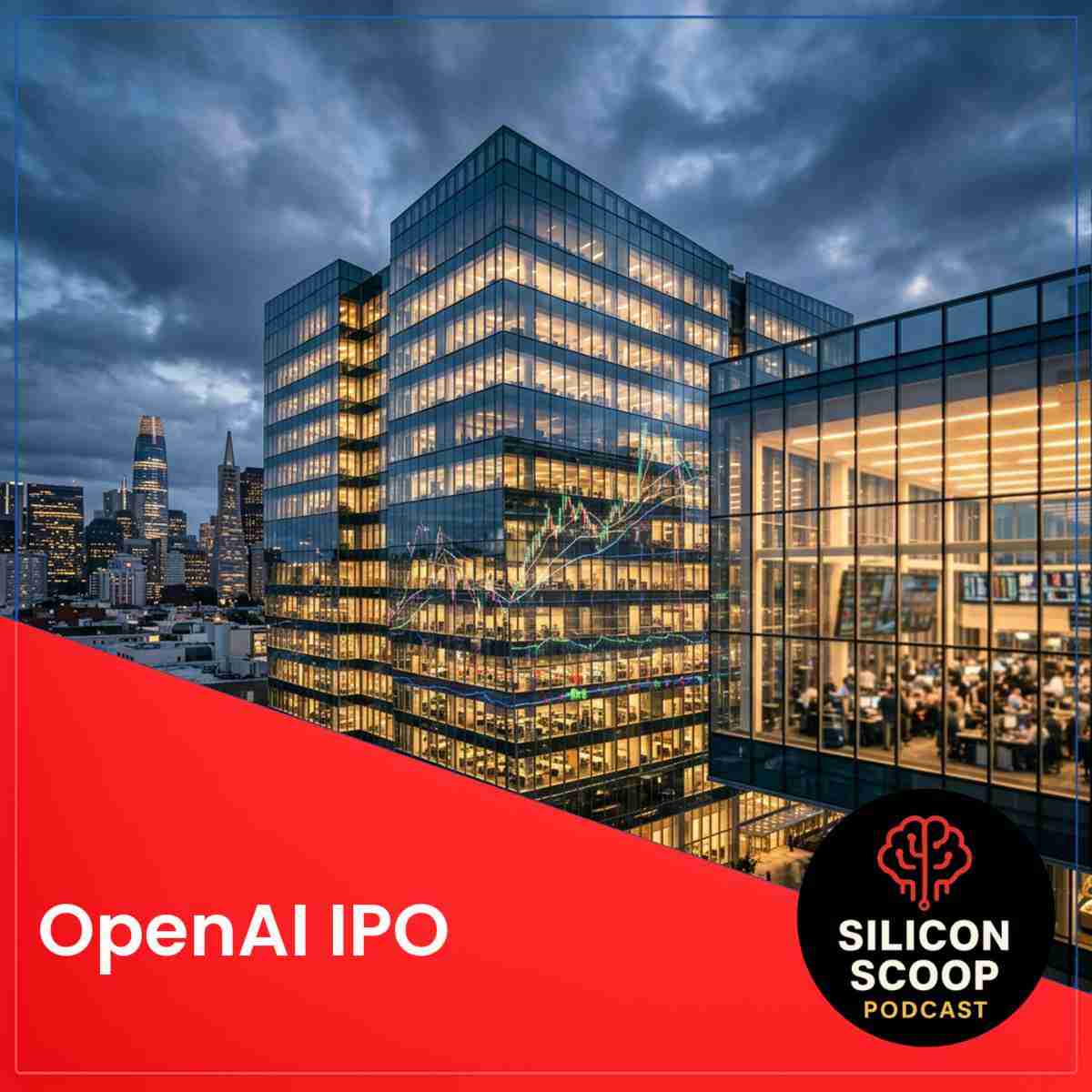
Inside OpenAI’s Confidential IPO Filing: Valuation Math, Legal Landmines, and the Regulatory Maze Facing the ChatGPT Maker
Estimated reading time: 10 minutes
Key Takeaways
- The OpenAI IPO is no longer a rumour, with OpenAI confirming a confidential S-1 filing with the SEC on June 9, 2026.
- IPO scenarios now model a valuation range between $730 billion and $1 trillion, with bullish cases going even higher.
- Investors may face major risks tied to compute costs, competition, revenue concentration, governance complexity, and regulatory friction (including the EU AI Act).
- OpenAI is not alone: 2026 could see simultaneous megascale listings from SpaceX, Anthropic, and OpenAI.
- OpenAI has published its “Frontier Governance Framework” to signal alignment with emerging AI safety and transparency regimes.
Table of contents
- Inside OpenAI’s Confidential IPO Filing: Valuation Math, Legal Landmines, and the Regulatory Maze Facing the ChatGPT Maker
- The OpenAI IPO Is Here — And It’s Already Making Waves
- The OpenAI Valuation: What Is the ChatGPT Maker Actually Worth?
- Three $1 Trillion IPOs at Once: Can the Market Handle It?
- ✂️ Cut the Busywork, Keep the Growth
- The Legal Team Behind the Deal: Who Is Running the OpenAI IPO?
- EU AI Act and AI Regulation: The Regulatory Maze Facing OpenAI
- What Could Go Wrong? Key Risks for IPO Investors
- What Could Go Right? The Bull Case for OpenAI Stock
- FAQ: 10 Common Questions About the OpenAI IPO
The OpenAI IPO Is Here — And It’s Already Making Waves
The OpenAI IPO is no longer a rumour. On June 9, 2026, OpenAI confirmed it had quietly filed a confidential S-1 with the SEC — and the way it made the announcement tells you everything about how the company operates.
Instead of a polished press release, OpenAI dropped a blunt, three-sentence statement. The key line: “We expect it to leak so we’re just announcing it.”
That kind of raw, front-footed honesty is rare in corporate finance. It also signals something important: OpenAI knows it is under a microscope, and it is choosing to control the narrative on its own terms.
This filing sets the stage for what could be one of the largest IPOs in stock market history — with a valuation expected to top $1 trillion.
Here is what you need to know about the filing, the numbers behind it, the risks investors face, and why the regulatory landscape could reshape the entire deal.
—
The OpenAI Valuation: What Is the ChatGPT Maker Actually Worth?
From $500 Billion to $1 Trillion in Under a Year
The OpenAI valuation has climbed at a pace that makes even seasoned investors blink.
- In late 2025, secondary market sales put OpenAI’s value at around $500 billion.
- By March 2026, a private funding round pushed that figure to approximately $852 billion.
- IPO scenarios now model a range between $730 billion and $1 trillion, with bullish cases going even higher.
That is a near-doubling in less than 12 months. For context, most Fortune 500 companies take decades to build that kind of market cap.
What Is Driving the Price Tag?
- Enterprise revenue is growing fast. Enterprise customers already make up roughly 40% of OpenAI’s revenue, and that share is expected to reach parity with consumer lines by end of 2026.
- Revenue is heading into the tens of billions. Investor briefings suggest OpenAI is on track to generate tens of billions of dollars in annual revenue, though exact figures will only be confirmed in the public S-1.
- The IPO could raise $60 billion or more. That would place it just behind the largest IPOs ever recorded.
- Retail investors get a slice. OpenAI has indicated it will reserve a portion of shares for everyday investors, not just institutions.
The ChatGPT maker is also expected to set aside IPO proceeds to fund the enormous compute costs required to train and run frontier AI models — a cost that keeps rising with each new generation.
aiweekly.co
fortune.com
theinformation.com
—
Three $1 Trillion IPOs at Once: Can the Market Handle It?
The AI IPO Flood of 2026
OpenAI is not the only AI giant heading for public markets this year. Investors are being asked to absorb three monster listings at the same time:
- SpaceX — valued at approximately $1.78 trillion
- Anthropic — last valued at $965 billion
- OpenAI — targeting $1 trillion+
The combined float could represent the largest simultaneous wave of tech listings in market history.
What Wall Street Is Saying
Not everyone is rushing to buy in. Here is how analysts and investors are reacting:
- One asset manager with $1 billion+ under management told Fortune he would not touch any of the three IPOs for at least six months. His reason: he wants to watch what happens when insider lockup periods end and executives are free to sell their shares.
- IG analyst Chris Beauchamp drew a direct parallel to the early 2010s wave of loss-making tech IPOs. He said the stakes are “much higher and the risks much greater” this time around.
- AllianceBernstein’s Inigo Fraser Jenkins warned clients about what he called “the increased circularity of the whole thing.” His point: roughly one-third of tech sector earnings come from cross-holdings in companies like Anthropic and OpenAI. For example, Alphabet holds a stake in Anthropic. If those valuations correct, the ripple effects hit the broader tech sector.
A Key Reassurance From AllianceBernstein
Fraser Jenkins did offer one calming note. Only a fraction of SpaceX’s stock — around $75 billion worth — is being offered to the public. That is actually less than the rate at which corporate America buys back its own stock each year.
So the raw supply of new shares may not be enough to flood the market by itself. The bigger risk is whether the underlying business models can justify the price tags once investors see the actual numbers.
—
—
✂️ Cut the Busywork, Keep the Growth
If your team is drowning in manual follow-ups, spreadsheets, and copy-paste ops, automation turns that chaos into clean, repeatable systems — without adding headcount.
—
—
The Legal Team Behind the Deal: Who Is Running the OpenAI IPO?
Heavy Hitters on the Advisory Side
This deal is being handled by some of the biggest names in finance and law.
- Banks: Goldman Sachs and Morgan Stanley are reportedly underwriting the offering — the same pair that handles most of the largest tech listings in history.
- Law firms: Cooley LLP and Wachtell Lipton Rosen & Katz are acting as lead legal advisers.
These choices position the OpenAI IPO structurally alongside other megacap tech listings. It signals OpenAI is preparing for an offering that will face extreme scrutiny from regulators, institutional investors, and the media.
The Governance Question: From Nonprofit to Public Company
One of the most complicated parts of this deal is OpenAI’s unusual corporate structure.
OpenAI was originally set up as a nonprofit organisation. Over time, it created a “capped-profit” subsidiary to attract investment. Now it is transitioning toward a public benefit corporation structure as it moves toward a full IPO.
That transformation raises difficult questions:
- How do you balance shareholder returns with a stated mission to benefit all of humanity?
- Who controls OpenAI’s safety decisions after it goes public?
- What happens to the nonprofit’s oversight role once Wall Street has a stake?
These governance questions are expected to feature prominently in the S-1’s risk factors section — and they are likely to draw heavy scrutiny from both investors and regulators.
news.bloomberglaw.com
cnbc.com
—
EU AI Act and AI Regulation: The Regulatory Maze Facing OpenAI
Why the EU AI Act Is a Major IPO Risk Factor
Of all the risks in OpenAI’s prospective S-1, the regulatory picture may be the most complex — and the least understood by everyday investors.
The EU AI Act is the world’s first comprehensive legal framework for artificial intelligence. Here is what matters for the OpenAI IPO:
- August 2026: Broad transparency obligations for many AI systems begin enforcement — right around the time OpenAI may be looking to list.
- 2027–2028: Full high-risk regime and sector-specific provisions phase in.
- Fines: Up to €35 million or a percentage of global annual turnover for serious violations.
OpenAI’s systems — including ChatGPT and its underlying large language models — are likely to be classified as general-purpose AI (GPAI) under the Act. That classification carries its own set of transparency and documentation requirements.
OpenAI’s Response: The Frontier Governance Framework
OpenAI has not been sitting still on regulation. It has published its own “Frontier Governance Framework” — an internal policy document that explicitly references:
- Alignment with the EU AI Act’s rules for general-purpose AI
- Compliance with California’s Transparency in Frontier AI Act
- Ongoing safety monitoring and evaluation processes
This is a smart move. By building a regulatory narrative before the IPO, OpenAI is signalling to institutional investors that it takes compliance seriously. It also helps the company frame safety costs as a feature, not a drag.
U.S. AI Regulation Is Also Shifting
It is not just Europe. In the United States, AI regulation at both the federal and state level is evolving rapidly.
- State-level lawsuits over AI safety are ongoing.
- OpenAI also recently resolved litigation brought by co-founder Elon Musk, though the details of that settlement remain limited.
- California’s AI transparency rules add another layer of disclosure obligations for companies operating at OpenAI’s scale.
Legal and policy experts note that OpenAI will be among the first general-purpose AI providers to reconcile public-company financial disclosure with new AI-specific safety and transparency regimes. That is genuinely uncharted territory.
hklaw.com
complianceandrisks.com
openai.com
—
What Could Go Wrong? Key Risks for IPO Investors
The Business Model Is Still Unproven at Scale
OpenAI is one of the most talked-about companies in the world, but it has never had to answer to public shareholders before. Once the S-1 is public, investors will see — for the first time — the actual revenue figures, cost structure, and margin profile.
Some of the biggest risks include:
Compute costs are enormous and rising.
Training and running frontier AI models requires massive, expensive computing infrastructure. As models grow more powerful, those costs do not shrink — they grow. This is a structural headwind on margins.
Competition is intensifying.
OpenAI faces pressure from Google (Gemini), Anthropic (Claude), Meta (Llama), and a growing number of open-source alternatives. Any of these rivals could erode OpenAI’s market share or force costly product upgrades.
Revenue concentration risk.
A significant portion of OpenAI’s revenue still flows through Microsoft, which holds a large strategic investment. If that relationship changes, it could materially impact the business.
Regulatory friction could reshape the product.
EU AI Act compliance, transparency requirements, and safety audits could force changes to how OpenAI builds and deploys its models — and those changes cost money.
The circularity problem.
As AllianceBernstein flagged, much of the enthusiasm for OpenAI’s valuation is baked into the stock prices of companies like Microsoft, Alphabet, and Nvidia, which are themselves investors in or customers of OpenAI. A correction in one can trigger a correction in all.
The Bear Case
Bank of America’s Savita Subramanian recently flagged that seven out of ten signals that historically precede bear markets have now been triggered. Her S&P 500 year-end target implies 6% downside from current levels.
If broader markets turn south just as OpenAI tries to price its IPO, the timing could not be worse.
—
What Could Go Right? The Bull Case for OpenAI Stock
Despite the risks, there are strong reasons why investors are excited.
Brand strength is unmatched in AI.
ChatGPT remains one of the fastest-adopted technologies in history. OpenAI’s name recognition gives it a distribution advantage that rivals cannot easily replicate.
Enterprise revenue is growing and sticky.
Business customers signing multi-year contracts represent durable, predictable revenue — exactly what public market investors prize.
Microsoft backing provides a safety net.
Microsoft’s deep integration of OpenAI’s models across its product suite — Azure, Office, Copilot — creates a massive, built-in revenue channel.
Regulatory compliance as a moat.
Smaller AI companies may struggle to absorb the cost of EU AI Act compliance, safety audits, and transparency requirements. OpenAI’s scale and resources allow it to build compliance into its product roadmap in a way that actually reinforces its competitive position.
The developer ecosystem is enormous.
Thousands of businesses have built products on top of OpenAI’s API. Switching costs are real and growing.
—
FAQ: 10 Common Questions About the OpenAI IPO
1. What is a confidential S-1 filing?
A confidential S-1 is a document a company submits to the U.S. Securities and Exchange Commission (SEC) to prepare for an IPO. By filing confidentially, the company keeps its financial details private until it is ready to go fully public. OpenAI used this path so it can choose whether and when to proceed.
2. When will the OpenAI IPO actually happen?
OpenAI said in its announcement that it has “not decided on timing yet” and that “it may be a while.” The filing gives the company the option to go public when it decides the time is right — not an obligation to do so on a fixed date.
3. What is OpenAI currently valued at?
As of its most recent private funding round in March 2026, OpenAI was valued at approximately $852 billion. Some analysts project the IPO valuation could reach $1 trillion or more depending on market conditions.
4. Can regular investors buy OpenAI shares at the IPO?
OpenAI has indicated it plans to reserve a portion of IPO shares for retail investors — meaning everyday people, not just large institutions. The exact details will be disclosed in the public S-1.
5. What is the EU AI Act and why does it matter for the IPO?
The EU AI Act is a European law that sets rules for how AI systems can be built and used. It starts enforcing broad transparency obligations in August 2026. Because OpenAI sells its products in Europe, it must comply — and compliance costs and product changes will likely be disclosed as risk factors in the IPO documents.
6. Who are the banks and lawyers handling the OpenAI IPO?
Goldman Sachs and Morgan Stanley are reportedly the lead underwriting banks. Cooley LLP and Wachtell Lipton Rosen & Katz are the primary law firms advising on the deal.
7. Why did OpenAI announce the filing in such an unusual way?
OpenAI said it expected the confidential filing to leak — so it announced it first. This is unusual for an IPO process, which is typically kept very quiet until a company is ready to formally market shares to investors.
8. How does the OpenAI IPO compare to SpaceX and Anthropic?
All three are expected to go public in 2026 with valuations above $750 billion. SpaceX is the largest at around $1.78 trillion, Anthropic was last valued at $965 billion, and OpenAI is targeting $1 trillion+. Together, they represent an unprecedented wave of AI-related public listings.
9. What are the biggest risks for investors in the OpenAI IPO?
The main risks include: high and rising compute costs, intense competition from Google and others, regulatory changes under the EU AI Act and U.S. laws, complex governance during the transition from nonprofit to public company, and revenue concentration through Microsoft.
10. What is OpenAI’s Frontier Governance Framework?
It is OpenAI’s internal policy document on AI safety and compliance. It aligns OpenAI’s internal practices with the EU AI Act and California’s AI transparency laws. The company is using it to show investors and regulators that it takes responsible AI seriously as it moves toward public markets.
openai.com
hklaw.com
fortune.com
—
Sources used in this article include reporting from Fortune, Bloomberg Law, The Information, Forbes, CNBC, CMC Markets, AI Weekly, Holland & Knight, Compliance and Risks, and OpenAI’s official communications.
Additional Links
Flowgrammer.ca – 💡 Unlock AI-Powered Automation! Let flowgrammer.ca handle complex workflows so you can focus on growing your business.
Flowgrammers.ca – 💡 Join Toronto’s Fastest Growing AI and Business Automation Community.
- SRED Funding Solutions – Maximize your R&D tax credits and secure funding for your innovation.
- Silicon Scoop Podcast – Stay Informed, Stay Ahead!
- Startup Talk Podcast
- Flowgrammer Youtube
- Startup Investor Drinks – Join Toronto’s Startup Community and connect with fellow startup enthusiasts and investors.
- TorontoStarts Startup and Entrepreneur Community – Become a part of Toronto’s thriving startup ecosystem.
- Workhaus – Discover flexible workspace solutions for your business needs.
- Work with The Startup Coach – Get expert guidance and mentorship for your startup journey.
- Reach out to Jon Irwin on LinkedIn – Connect with our co-host and technology expert.
Episode transcript
Read the full transcript
Craig: openai just quietly triggered the biggest financial earthquake in tech history by filing a confidential s one for a trillion dollar ipo. if you thought ai was just an expensive hype cycle, wall street is about to find out exactly what chachipt's internal recipes actually look like. so openai on monday, june 8 in the evening filed for, a trillion dollar ipo. openai has officially confirmed a confidential s one filing with the s c sec targeting a staggering valuation between 730,000,000,000 and 1,000,000,000,000. this transitions the chatgtp creator from a private capped profit entity into a public market, juggernaut alongside a massive wave of other twenty twenty six filings including, the spacex ipo and the anthropic ipo. so this forces the world's most secretive ai giant to finally open its books testing whether generative ai business models can actually survive public market scrutiny and astronomical compute cost. now i don't really know if we're gonna be opening up the books all that much, but and how much will trickle down to us. but, you know, we've been saying this since the start. they're losing billions of dollars every month, and they're slowly starting to, make that bleed less and less and less. but when you open up your books, are the consumers and other people filing for the ipo gonna be looking at that, or are they gonna be looking at a long term value? so what do you think about this, john, and the string of ipos we've had recently?
Jon: yeah. so i was gonna open up with the, oh, openai filing confidentially, look at what they're doing, but then i would research that anthropic did the same thing. so, i can't really fault them for that. so, i'm not surprised that, openai has done this. they're obviously filing shortly after anthropic. so anthropic, like i said, confidentially filed for its own ipo. but the recent valuation has gotten closer to open apis. now i get why these companies are filing for ipo because they require massive data centers. they require lots of hardware, tens of thousands of gpus. they require specialized networking infrastructure, proprietary, development, especially ai chip development, potential power generation agreements, global cloud infrastructure. so, like, from some of my research, it looked like openai's long term spending projections exceeded a $100,000,000,000 just through the remaining of the decade. and much of that was directed towards training increasingly capable api models. so, historically, software companies scaled with relatively modest infrastructure costs, but ai companies are becoming essentially utility providers and also semiconductor manufacturers. okay? if we're talking about capital requirements. so i get it. now we didn't cover this in anthropic, but we should talk about this a little bit. wi fi confidentially. so it allows them to resolve sec questions privately. it also tests investor interest, which i don't know why they need to do that because, obviously, there's a lot of investor interest. also, refining financial disclosures and offering structure. so i guess it's a way for them to file an ipo quicker and get to an ipo quicker so that they can resolve all this while they've already committed to filing an ipo, if that makes sense. right? what are your thoughts, craig? i i'm curious to see who does better between anthropic and openai. this is gonna be cool.
Craig: yeah. and you know, they're burning cash. so think of this update like a local charity drag racing team that suddenly is entering a formula one. they built a mind blowing rocket ship of a car using the donations and private grants and vc money. but to keep buying the incredible expensive fuel it needs to run every single lap, they now need to sell team ownership to wall street, all while promising the fans they won't lose the original nonprofit soul. so, the last one filed was 06/09/2026. the exact public debut date is still undecided, but it's moving rapidly to align with major regulatory shifts this summer. the share price is to be, announced, but openai has explicitly stated plan to, reserve a dedicated portion of the ipo to retail everyday investors, not just mass institution investors. shares will be publicly traded on major us stock exchange open to anyone with a standard brokerage account. and we can expect an aggressive push for paid gpt plus features and tighter limits on free tiers over the coming months as openai scrambles to optimize its profit margins before investors audit their ledger. so they'll wanna tighten all that up before people start looking at it. we got, you know, the trillion dollar evaluation. spacex is what? going for 1.5. anthropic's going for about a trillion. so we'll have to see what the market seems to think. i think the market's ai crazy. i think these are all gonna do really well during the day as far as selling, but i don't know what the final price will be. ipos, you know, let's face it, our crapshoot day of because, they set a price at, hey, $50, and then everybody buys in, and then it goes up to, like, $90, and then it comes down and ends the day at $35. or something like that. and it's all it not always, but a lot of times, it ends way lower than you thought, and then it eventually makes it back up. so ipos are very interesting. and when you will see what kind of regulation is for non institutional investors because they usually hold that pretty tight.
Jon: yeah.
Craig: because just because of the rich, i think, for most of anything. plus, you know, obviously, people say the rich get richer and all that. but go ahead.
Jon: yeah. also sorry. just, one thing that the ontario public teachers union, i was it openai that they invested in, or was it spacex? i can't remember. but they invested, 200,000,000, and now it's looking to be valued at a $111,000,000,000. so, sorry if it's not openai. i thought it was, but now that i see it, i think it's maybe spacex. but just speaking about, investments. right? so, it's, i'd like to get in on anthropics for sure. i feel like what baffles me is that elon, out of all people, has released these financials compared to openai and anthropic filing confidentially. so that's kind of back ass words to me. i would think elon would file secret secretively or confidentially at first. right? or no?
Craig: yeah. i think. well well so i well, time is gonna tell. right? and i just did a quick search on the ontario, teachers pension plan, and their, teachers venture growth, which is, i guess, investment arm. they hold major investments in anthropic, quantexa, deepl, spacex, and wave.
Jon: so not openai?
Craig: not openai, but anthropic and spacex right now.
Jon: yeah. that's that's actually kind of interesting.
Craig: alright. so, back to this.
Jon: yeah. so my question was, like like, you think, like, why are these companies filing confidentially and elon isn't?
Craig: i think elon's had way more scrutiny than most of these other companies just because of all the crap he's been through for the last few years and because investors have gone through this how many times they had to do evaluations, go through court, and say, was that valuation worth it? should i get paid? do like, i think he's just been so more used to the public scrutiny that it's already out there, so it doesn't matter to him. i think these other companies are still learning those lessons, so they're just gonna take a little while to and it's not farther ahead or whatnot, but that's why i think he's doing public ipo.
Jon: okay. yeah. that makes sense.
Craig: expect capital raise for this 60,000,000,000 or more, placing it among one of the largest ipos in global history. we're back to openai. enterprise clients currently make up 40% of the revenue projected to reach fifty fifty parity with consumer lines by the end of twenty twenty six. and part of the simultaneous triad including spacex, 1,780,000,000,000 and it anthropics $9.06 5,000,000,000. so i guess my big problem is, is there almost $4,000,000,000,000, in these three companies of value, and will investors just jump all over any one of them or all of them? or is it too much? is it meaning that they're gonna bank on one or two of them?
Jon: yeah. well, the the there's two that obviously are the similar, which is anthropic and openai. but then spacex is different because spacex doesn't have just ai. it has hardware. it's got spacex. it's got it's got servers. it's got, data centers. it's got xai. it's got, what else is under there? is tesla under there? no.
Craig: if it's not, it will be.
Jon: spacex, xai, there was something else under there. yeah.
Craig: and, the new robots, i think the boring company maybe. i'm not there's other stuff there. but, definitely, spacex is a stronger, offering, but that's why it's at 1.78. like, there's hardware. there's other stuff involved.
Jon: oh, starlink. that's why i said, yes.
Craig: they've got the satellite. starlink. yeah. they've also getting paid billions of dollars, from, anthropic and other ai companies for their hardware. so anthropic's playing them 2 plus billion dollars a month, and one of the other ones are as well to host their hardware. so that's a interesting take on things. so the core engineering challenge driving the ipo, as you mentioned before, is the compute scaling law. training and running frontier language models requires exponentially expensive infrastructure. openai is attempting to fund these hardware scaling requirements while reconciling its new frontier governance framework with the eu's ai act, strict general purpose ai classification rule. so this is the most significant corporate structure transformation since the early two thousand tens, the wave of high growth, loss making tech debuts, but an unprecedented twist navigation that transitioned from a five zero one c three nonprofit foundation ancestry ancestry into a public benefit corporation. so we'll have to see how all this goes. there's a lot of money, happening in the markets right now. i'm not sure if openai is gonna be able to make that jump to enterprise or whether anthropic's gonna, completely take on that market. so it it's an interesting time.
Jon: yeah.
Craig: and, yeah, they continue to raise this money because they continue to have all the stuff going on. i've talked about this, the openai. we've talked about this phone that's supposed to be coming out, and that's gonna be hugely expensive. i expect it's not gonna do well, but that's, just me. and mark carney last week, i think it was last week, announced, its new canadian sovereign ai program. so what so as we start to see these, how does that affect these ipos when canada's planning to have its own government, ai that everybody can use? yeah. so we got a lot to think about here. we might as well, wrap this up. this ipo is the ultimate macroeconomic reality check that will definitely prove whether generative ai is self sustaining economic powerhouse or history's most expensive tech bubble. are you risking your own cash on openai, anthropic, or spacex stock on day one? or are you sitting on the sidelines until we see actual profit margins? let us know in the chat. we'd love to hear from you.
More from Silicon Scoop
All episodes
silicon-scoop · October 19, 2026
OpenAI’s Jalapeño Chip Stakes a Claim Against Nvidia Blackwell in Real-World AI Inference
OpenAI Jalapeno chip challenges Nvidia GB300 Blackwell with InferenceX AI benchmark results, reshaping AI inference accelerator efficiency and latency.
View episode

silicon-scoop · October 16, 2026
Meta’s $18 Billion Teen Safety Settlement: Soft Guardrails, Hard Leverage Over TikTok and YouTube
Deep dive on Meta teen safety settlement, social media addiction lawsuit, new Facebook Instagram time limits and pressure on TikTok YouTube age verification.
View episode

silicon-scoop · October 15, 2026
How Claude Mythos Is Reshaping Cryptanalysis: HAWK, AES and the Rise of AI-Driven Crypto Research
Claude Mythos cryptanalysis weakens HAWK post-quantum signature, speeds AES Möbius Bridge attack, and powers CryptanalysisBench benchmark in AI-driven crypto research.
View episode