
Hand Photos Just Made Acromegaly Screening Private
Hand Photos Just Made Acromegaly Screening Private https://torontostarts.com/2026/08/04/ai-acromegaly-detection-hands/ Flowgrammer.ca -> https://flowgrammer.ca/ AI News and Resources -> https://flowgrammers.ca OpenClaw Toronto -> https://openclawto.com/ Stop Losing Hours to Repeatable Work We map your busiest workflows and automate the handoffs, follow-ups, and admin so your team can focus on revenue-driving work—not copy-paste. Book an automation consult https://flowgrammer.ca Startup Investor Drinks Toronto - https://startupdrinksto.com/ Toronto’s Startup Community - https://torontostarts.com/ Silicon Scoop Silicon Scoop Podcast - https://torontostarts.com/silicon-scoop/ Apple: https://podcasts.apple.com/us/podcast/silicon-scoop/id1758711826 Spotify: https://open.spotify.com/show/5bAzF0MwV6TtLhJAhvHayI YouTube: https://www.youtube.com/playlist?list=PLj4v-RoA7A-gT62vrEYqh1zCv-0Hj-o5J Startup Talk Startup Talk Podcast -> https://torontostarts.com/startup-talk-toronto-startup-podcast/ Apple -> https://podcasts.apple.com/us/podcast/startup-talk/id1763804003 Spotify -> https://open.spotify.com/show/1siJMILILidHAiAsrX2VBU YouTube: https://youtube.com/playlist?list=PLj4v-RoA7A-jxV5FHs5e61oIsuvUJYmT_&si=LYegRe5GYLKNQ7xL
With Craig Major and Jon Irwin
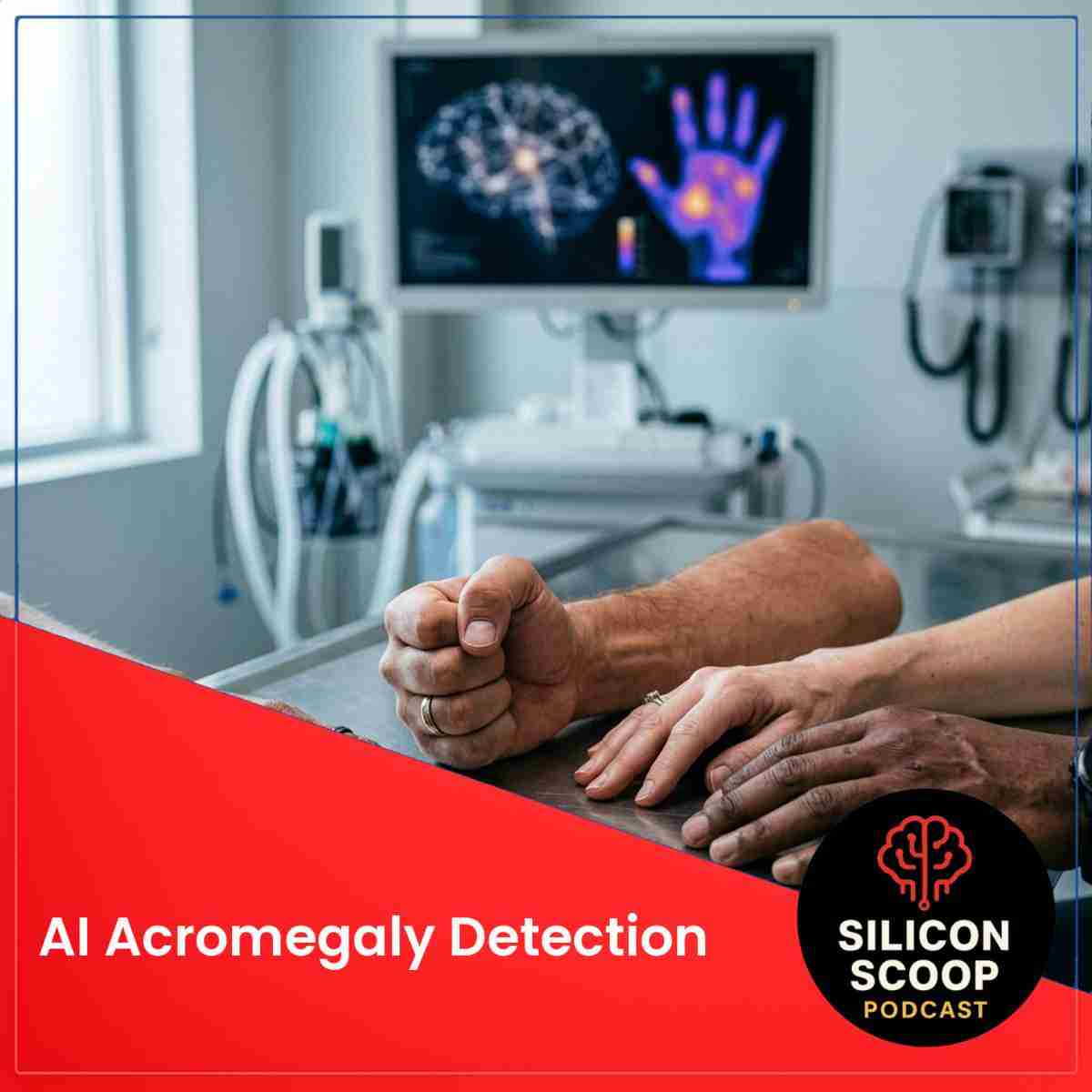
AI Acromegaly Detection: How Hand Photos Are Outsmarting Specialist Doctors
Estimated reading time: 8 minutes
Key Takeaways
- A rare hormone disorder that silently steals a decade of your life can now be spotted from a simple photo of your hand.
- Researchers at Kobe University have built an AI acromegaly detection system that analyses photos of the back of the hand and a clenched fist.
- The results were published on February 27, 2026, in The Journal of Clinical Endocrinology & Metabolism.
- The AI model outperformed ten experienced specialist doctors.
- This is a screening and triage tool, not a replacement for a full clinical diagnosis.
Table of contents
- AI Acromegaly Detection: How Hand Photos Are Outsmarting Specialist Doctors
- Key Takeaways
- Privacy-Preserving AI Uses Hand Photos to Outperform Endocrinologists in Detecting Life-Shortening Acromegaly—and Raises New Questions for 2026 Medical AI Governance
- What Is Acromegaly and Why Does Diagnosis Take So Long?
- How Hand Image Deep Learning Works Without Using Your Face
- The Results: AI vs. Specialist Doctors
- ⚡ Stop Losing Hours to Repeatable Work
- Where This AI Screening Tool Fits Into Healthcare
- What Comes Next: Expanding to Other Conditions
- Medical AI Regulation 2026: What This Means for Governance
- FAQ: AI Acromegaly Detection and Hand Image Deep Learning
Privacy-Preserving AI Uses Hand Photos to Outperform Endocrinologists in Detecting Life-Shortening Acromegaly—and Raises New Questions for 2026 Medical AI Governance
A rare hormone disorder that silently steals a decade of your life can now be spotted from a simple photo of your hand.
Researchers at Kobe University have built an AI acromegaly detection system that analyses photos of the back of the hand and a clenched fist. No face required. No invasive testing to get started. Just two hand photos fed into a deep learning model that outperformed ten experienced specialist doctors.
This is not science fiction. The results were published on February 27, 2026, in The Journal of Clinical Endocrinology & Metabolism, and the numbers are striking.
What Is Acromegaly and Why Does Diagnosis Take So Long?
Acromegaly is a rare endocrine disorder caused by the body producing too much growth hormone. This excess hormone causes:
- Enlarged hands and feet
- Noticeable facial changes
- Abnormal growth of bones and internal organs
- Serious complications affecting the heart, joints, and metabolism
The disease moves slowly. It creeps forward over many years. Most people do not notice the changes because they happen so gradually. By the time a diagnosis is made, significant damage may already be done.
Without treatment, acromegaly can shorten life expectancy by roughly ten years.
The biggest problem? It takes an average of up to a decade to get diagnosed. This is partly because acromegaly is rare, and partly because its symptoms overlap with other conditions. Primary care doctors may not think to check for it. Patients may not get referred to an endocrinologist—a hormone specialist—for years.
Endocrinologist Hidenori Fukuoka from Kobe University explains:
> “Because the condition progresses so slowly, and because it is a rare disease, it is not uncommon to take up to a decade for it to be diagnosed. With the progress of AI tools, there have been attempts to use photographs for early detection, but they have not been adopted in clinical practice.”
Previous attempts at AI-powered detection have used facial photographs. But facial images raise real privacy concerns. People are understandably cautious about sharing their face with a medical AI system, especially during mass health screenings.
deep learning analysis hand images improve acromegaly diagnosis
Kobe University news article
How Hand Image Deep Learning Works Without Using Your Face
The Kobe University team took a deliberate approach to build a privacy-preserving medical AI system.
They asked a simple question: what if we use the hands instead of the face?
Acromegaly causes visible changes in the hands. The bones around the knuckles and thumb base shift. The overall shape of the hand changes in ways that are subtle to the human eye but detectable to a well-trained model.
The Dataset Behind the Model
The team collected data from 15 medical centres across Japan. In total:
- 716 patients participated (317 with acromegaly, 399 healthy controls)
- 11,480 hand images were gathered
- 12 centres were used for training and validation
- 3 independent centres were used for final testing
This multicenter design is important. It means the AI was not just trained and tested on the same pool of patients. It had to prove itself on entirely new data from hospitals it had never seen before.
Why Palm Photos Were Left Out
Here is a clever privacy detail: the researchers deliberately excluded palm photos from the dataset.
Palm lines are highly individual. They are as identifying as a fingerprint. By only using the back of the hand and the clenched fist, the team ensured that no identifiable biometric data was captured. Patients felt more comfortable sharing images. Participation was broad and consistent across all 15 sites.
Graduate student Yuka Ohmachi explains:
> “Trying to address this concern, we decided to focus on the hands, a body part we routinely examine alongside the face in clinical practice for diagnostic purposes, particularly because acromegaly often manifests changes in the hands.”
The AI Model Itself
Under the hood, the system is built on a ResNet-50 convolutional neural network, implemented in PyTorch. The model was trained with data augmentation and 5-fold cross-validation to prevent overfitting and improve reliability. To make predictions more robust, the model aggregates results across four images per patient before reaching a conclusion.
Explainability visualisations—known as heatmaps—show exactly where the model is looking. It focuses on:
- The area around the metacarpophalangeal joints (knuckles)
- The base of the thumb
This matches what experienced endocrinologists already know to look for in acromegaly patients, which adds a layer of clinical credibility to the results.
PubMed
The Journal of Clinical Endocrinology & Metabolism
News-Medical
The Results: AI vs. Specialist Doctors
The performance numbers from the independent test set are the headline story.
| Metric | AI Model | Endocrinologists |
|—|—|—|
| Sensitivity | 0.89 | — |
| Specificity | 0.91 | — |
| Positive Predictive Value | 0.88 | — |
| Negative Predictive Value | 0.93 | — |
| F1-Score | 0.89 | 0.43–0.63 |
| AUC | 0.96 | — |
The ten board-certified endocrinologists who reviewed the same hand photos scored F1 scores ranging from 0.43 to 0.63. The AI hit 0.89. That is not a marginal improvement. It is a substantial gap.
An AUC of 0.96 is considered excellent. It means the model is highly capable of distinguishing between patients who have acromegaly and those who do not—based only on hand photos.
Ohmachi says:
> “Frankly, I was surprised that the diagnostic accuracy reached such a high level using only photographs of the back of the hand and the clenched fist. What struck me as particularly significant was achieving this level of performance without facial features, which makes this approach a great deal more practical for disease screening.”
Rare disease specialists have noted that this level of performance could allow AI to reliably flag subtle skeletal changes that busy primary care doctors or occupational health workers might easily miss.
hand photos may flag rare hormone disorder
ScienceDaily
⚡ Stop Losing Hours to Repeatable Work
We map your busiest workflows and automate the handoffs, follow-ups, and admin so your team can focus on revenue-driving work—not copy-paste.
Where This AI Screening Tool Fits Into Healthcare
It is important to be clear about what this tool is and what it is not.
This is a screening and triage tool, not a replacement for a full clinical diagnosis. Doctors still rely on:
- Medical history and patient interviews
- Laboratory tests measuring growth hormone and IGF-1 levels
- MRI scans to check for pituitary tumours
- Physical examination
The Kobe University team is explicit about this in their paper. The AI is designed to complement clinical expertise, reduce the chance that a case is overlooked, and enable earlier referrals to specialists.
Lead researcher Fukuoka says:
> “We believe that, by further developing this technology, it could lead to creating a medical infrastructure during comprehensive health check-ups to connect suspected cases of hand-related disorders to specialists. Furthermore, it could support non-specialist physicians in regional healthcare settings, thus contributing to a reduction of healthcare disparities there.”
Closing Healthcare Gaps in Regional Areas
This is one of the most important practical uses of the technology. In many countries, specialist endocrinologists are concentrated in major cities. Patients in rural or regional areas may wait years for a referral simply because their local doctor does not have the experience to suspect a rare hormonal condition.
A hand-photo screening tool integrated into routine health checkups could:
- Flag suspected acromegaly cases automatically
- Generate a referral recommendation for a specialist
- Reduce the 10-year diagnostic delay
- Help patients in under-served areas get care faster
This is where privacy-preserving medical AI has real-world, life-changing impact.
Kobe University news article
deep learning analysis hand images improve acromegaly diagnosis
What Comes Next: Expanding to Other Conditions
The Kobe University team has no plans to stop with acromegaly. They are already looking at applying the same hand-image deep learning approach to other conditions that cause visible changes in the hands:
- Rheumatoid arthritis — causes joint deformity and swelling
- Anaemia — can cause pallor and changes in nail and skin appearance
- Finger clubbing — associated with lung disease, heart conditions, and other serious illnesses
Ohmachi says: “This result could be the entry point for expanding the potential of medical AI.”
This positions hand-image analysis as a broader platform for non-invasive, low-cost, scalable medical screening. The approach requires nothing more than a smartphone camera and an internet connection, in theory, making it accessible in low-resource clinical settings worldwide.
hand photos may flag rare hormone disorder
Medical AI Regulation 2026: What This Means for Governance
The success of this study lands in the middle of a fast-moving debate about medical AI regulation in 2026.
The Regulatory Landscape Right Now
Legal and policy analysts have noted that tools like the Kobe acromegaly AI will push regulators to address several difficult questions:
- Informed consent: Do patients undergoing routine health checkups need to explicitly consent to AI analysis of their photos?
- Bias auditing: The study used Japanese patients from 15 centres. Will the model work equally well on patients of other ethnicities and body types?
- Algorithmic transparency: Heatmap visualisations help explain the model’s focus areas, but regulators and hospital review boards will demand more formal interpretability documentation.
- Liability: If an AI screening tool misses a case or flags a false positive that leads to unnecessary testing, who is responsible?
In the United States, 2026 has seen a wave of state-level healthcare AI legislation, with ongoing debate about whether federal frameworks should preempt state laws and whether dedicated rules for healthcare AI are needed. Regulatory scholars such as W. Nicholson Price II have argued for evaluation regimes that test AI tools specifically in low-expertise settings—exactly the regional clinic deployment scenario the Kobe team envisions.
The privacy-first design of this system—avoiding facial biometrics, excluding palm lines, using only non-identifiable morphological features—is already a step ahead of many existing AI medical tools when it comes to anticipating regulatory requirements.
Why the Multicenter Design Matters for Regulators
The fact that this model was validated across 15 independent centres, with a held-out test set from three sites the model had never seen, is significant not just scientifically but from a regulatory standpoint. Regulators increasingly demand evidence of generalisability—proof that an AI tool works outside the lab it was built in.
This study provides that evidence for the Japanese population. The next challenge is cross-population validation.
Improving Regulatory Oversight of Medical AI
digital health
States Rush to Regulate AI in Healthcare
FAQ: AI Acromegaly Detection and Hand Image Deep Learning
1. What is acromegaly?
Acromegaly is a rare hormonal disorder caused by the body producing too much growth hormone. It leads to enlarged hands, feet, and facial features, along with abnormal growth of bones and internal organs. Without treatment, it can reduce life expectancy by about ten years.
2. How does the AI detect acromegaly from hand photos?
The AI uses a deep learning model called ResNet-50. It analyses photos of the back of the hand and a clenched fist. It has learned to spot subtle changes in hand shape—especially around the knuckles and thumb base—that are signs of acromegaly.
3. Why are hand photos used instead of face photos?
Face photos raise privacy concerns. The Kobe University team deliberately chose hand photos to protect patient identity. They also excluded palm photos because palm lines can identify a person. This privacy-first design encouraged more patients to participate.
4. How accurate is the AI compared to human doctors?
On an independent test set, the AI achieved an AUC of 0.96 and an F1-score of 0.89. Ten board-certified endocrinologists reviewing the same images scored F1-scores between 0.43 and 0.63. The AI significantly outperformed the specialists.
5. Does this AI replace doctors?
No. The tool is designed to support, not replace, medical professionals. Doctors still use medical history, blood tests, and imaging scans to make a final diagnosis. The AI helps flag suspected cases so patients can be referred to specialists sooner.
6. How many patients were included in the study?
The study included 716 patients—317 with acromegaly and 399 healthy controls—across 15 medical centres in Japan. Over 11,480 hand images were collected.
7. Can this technology be used for other diseases?
Yes. The Kobe University team is already exploring using the same approach to detect rheumatoid arthritis, anaemia, and finger clubbing—all conditions that produce visible changes in the hands.
8. Where would this AI tool be used in practice?
The team envisions it being used at routine health checkups and in regional clinics where specialist endocrinologists are not available. It could automatically flag suspected cases and generate referrals to specialists, reducing delays in diagnosis.
9. What are the concerns around AI medical tools like this?
Key concerns include the need for bias auditing across different ethnic groups, informed consent during health screenings, algorithmic transparency for regulators and hospital boards, and questions around liability if the AI makes an error.
10. Where can I read the original research?
The full study is published in The Journal of Clinical Endocrinology & Metabolism. The DOI is: 10.1210/clinem/dgag027
Research cited in this article:
- https://pubmed.ncbi.nlm.nih.gov/41757900/
- https://academic.oup.com/jcem/advance-article-abstract/doi/10.1210/clinem/dgag027/8494383
- https://www.thepathologist.com/issues/2026/articles/march/hand-photos-may-flag-rare-hormone-disorder/
- https://www.rarediseaseadvisor.com/news/deep-learning-analysis-hand-images-improve-acromegaly-diagnosis/
- https://www.kobe-u.ac.jp/en/news/article/20260227-67610/
- https://www.news-medical.net/news/20260227/AI-Accurately-Spots-Medical-Disorder-From-Privacy-Conscious-Hand-Images.aspx
- https://www.sciencedaily.com/releases/2026/03/260303201807.htm
- https://www.theregreview.org/2026/01/15/smith-improving-regulatory-oversight-of-medical-ai/
- https://www.jdsupra.com/topics/health-technology/regulatory-reform/digital-health/
- https://www.hklaw.com/en/news/intheheadlines/2026/04/states-rush-to-regulate-ai-in-healthcare
Additional Links
Flowgrammer.ca – 💡 Unlock AI-Powered Automation! Let flowgrammer.ca handle complex workflows so you can focus on growing your business.
Flowgrammers.ca – 💡 Join Toronto’s Fastest Growing AI and Business Automation Community.
- SRED Funding Solutions – Maximize your R&D tax credits and secure funding for your innovation.
- Silicon Scoop Podcast – Stay Informed, Stay Ahead!
- Startup Talk Podcast
- Flowgrammer Youtube
- Startup Investor Drinks – Join Toronto’s Startup Community and connect with fellow startup enthusiasts and investors.
- TorontoStarts Startup and Entrepreneur Community – Become a part of Toronto’s thriving startup ecosystem.
- Workhaus – Discover flexible workspace solutions for your business needs.
- Work with The Startup Coach – Get expert guidance and mentorship for your startup journey.
- Reach out to Jon Irwin on LinkedIn – Connect with our co-host and technology expert.
Episode transcript
Read the full transcript
Craig: imagine a rare disease that silently steals a decade of your life, but human doctors routinely miss it for ten whole years. researcher just built a privacy first ai that completely outsmarts medical specialists using nothing but two quick smartphone photos of your hands. so hand photos can outsmart specialist doctors now. cobalt university researchers trained a deep learning model to detect acromegaly, a life shortening hormone disorder by analyzing photos of the back of the hand and clenched fist. the system bypasses facial and palm recognition entirely, delivering an elite diagnostic triage tool without compromising user anonymity. this proves medical ai can perform world class screening using completely non identifiable, low cost, morphological data from a standard smartphone drastically reducing the typical ten year diagnostic delay. what do you think about this, john?
Jon: i love this. i always love new unique use cases for ai especially for disease detection. and so for those of you that don't know, acromegaly, occurs when the body produces excessive amounts of growth hormone, which in turn increases levels of insulin like igf one. and so unlike gigantism, which, be before growth plates close during childhood, acromegaly develops in adulthood. so since bones can no longer lengthen, the disease causes thickening and enlarging of existing structures. so common manifestations include enlarged hands, feet, jaw, nose, tongue, and internal organs. and so one of the biggest clinical challenges is that symptoms emerge very gradually. so patients may simply notice they need larger rings, gloves, or shoes over many years. we're not talking months or weeks. right? so because these changes occur slowly, both patients and physicians often fail to recognize the disease until significant damage has already occurred. and so we're talking about, diagnostic delays exceeding 10. that's not uncommon. and so, if you're wondering why researchers focused on hands, it's because most previous ai systems for acromegaly detection relied on facial photographs, like looking at the face. so while effective facial recognition, it creates significant privacy concerns, it also limits patient participation. so they train their model using only photographs of the back of the hand and a clenched fist. so they deliberately excluded palm images because palm prints contain highly identical biometric information. so the privacy conscious design made it easier to collect large scale patient data while maintaining confidentiality, which was cool. so the one reason this study stands out is the quality of the training dataset. and i love this because nowadays, the training datasets are getting less and less quality when it comes to training, and that's why we're having issues with a lot of these things. so the researchers themselves collected more than 11,000 hand images, seven from 725 participants in 15 different medical centers across japan, which is a great, great dataset to use, which it's which is part of kind of a larger trend, which i love. so this is great. this is exciting. what do you think about this, craig? do you think this is, there are other potentials for this?
Craig: well, there's definitely other potentials for this type of technology. and i think now that we have, tools like ai, where every day we're seeing new uses where it's finding, it's mapping our genomes faster than ever before. we're finding defects and way to prove stuff. it's finding new proteins, new treatments, potential treatments for things. doing things that, we couldn't do by ourselves, and it's amazing. and i love where we're going with this. and the fact that, you know, it could take up to ten years to determine this before, and now we can do it so quickly, at you know, with four images apparently. it's a the thought is amazing. like, if you can determine that quickly, send it in, and be done with it, the idea is astounding. think of this update like a master mechanic who can tell your engine's internal timing belt is about to snap just by looking at the subtle uneven wear on the outside of your tires. you don't need to tear down the entire engine to run a full expensive computer diagnostic yet. the ai flags hidden structural damages from just two quick external snapshots. so this is a freshly published clinical study currently moving towards, regional clinical pilot deployments and integration into routine public health checkup. so this, is designed to be a low cost software implementation integrated in public screening infrastructure requiring no special medical hardware. so it'll be easy to implement into, standard checkups and that kind of stuff. any standard digital or smartphone camera paired with an internet connection for cloud based, deep learning inference and zero privacy anxiety. you're not giving away any of your information, facial, face, or fingerprint data. so, this technology is really cool. it, works faster than we've ever thought. the resnet 50 architecture driving this model utilizes a skip connections or residual learning. this mathematical workaround solve the infamous vanishing gradient problem in deep neural networks, which is the exact reason it can map hyper subtle bone density and tissue shifts without getting lost in the data noise.
Jon: yeah. and the thing is, again, we talked about this. it's not about acromegaly. it's about the growing ability of ai systems to identify diseases from unexpected sources of information. we haven't covered most of these, but we should. so there's the there's some ones i've got listed here. so they were able to use ai to detect heart disease from retinal scans, parkinson's from voice patterns. that kinda makes sense. covid nineteen from ct images, diabetes from eye photographs, and, acromegaly from facial images, which we just talked about. so i love that they're taking a, an outside the box kind of approach to detecting diseases, which is kinda cool.
Craig: yeah. there's a full article over here on that covers all of this and what other things we it could find. early screening tools in industry are an industry gold mine for health care systems. the primary treatment endoscopic transfenodial surgery to remove, pitular tumors boasts an immensely higher success rate at a fraction of the long term cost it performed before permanent bone and organ enlargement sets in. so while the ai focus on hands, historical clinic history shows that acromegaly, is hoft and retroactively spotted by looking at teeth. the excess growth, hormone widens the jaw creating sudden distinct spacing between lower teeth, a symptom that went unflagged for decades before modern imaging. mhmm. so this is the monumental win for noninvasive privacy first diagnostic tech that could completely eliminate a decade worth of medical waiting times. would you trust an ai smartphone scan to audit your body for hidden diseases, or does medical ai still make you nervous? let us know in the chat.
More from Silicon Scoop
All episodes
silicon-scoop · October 19, 2026
OpenAI’s Jalapeño Chip Stakes a Claim Against Nvidia Blackwell in Real-World AI Inference
OpenAI Jalapeno chip challenges Nvidia GB300 Blackwell with InferenceX AI benchmark results, reshaping AI inference accelerator efficiency and latency.
View episode

silicon-scoop · October 16, 2026
Meta’s $18 Billion Teen Safety Settlement: Soft Guardrails, Hard Leverage Over TikTok and YouTube
Deep dive on Meta teen safety settlement, social media addiction lawsuit, new Facebook Instagram time limits and pressure on TikTok YouTube age verification.
View episode

silicon-scoop · October 15, 2026
How Claude Mythos Is Reshaping Cryptanalysis: HAWK, AES and the Rise of AI-Driven Crypto Research
Claude Mythos cryptanalysis weakens HAWK post-quantum signature, speeds AES Möbius Bridge attack, and powers CryptanalysisBench benchmark in AI-driven crypto research.
View episode