
Europe’s Next-Gen Electromagnetic Railgun: Inside ISL’s First Open-Range Hypersonic Trial
Europe’s Next-Gen Electromagnetic Railgun: Inside ISL’s First Open-Range Hypersonic Trial https://torontostarts.com/2026/08/24/electromagnetic-railgun-isl-open-test/ Flowgrammer.ca -> https://flowgrammer.ca/ AI News and Resources -> https://flowgrammers.ca OpenClaw Toronto -> https://openclawto.com/ Europe’s Next-Gen Electromagnetic Railgun: Inside ISL’s First Open-Range Hypersonic Trial Europe’s ISL electromagnetic railgun completes first open-range free-flight test, advancing ISL railgun tech for hypersonic missile defense and future artillery. FLogrammer is your Business Automation Experts - https://Flowgrammer.ca Startup Investor Drinks Toronto - https://startupdrinksto.com/ Toronto’s Startup Community - https://torontostarts.com/ Silicon Scoop Silicon Scoop Podcast - https://torontostarts.com/silicon-scoop/ Apple: https://podcasts.apple.com/us/podcast/silicon-scoop/id1758711826 Spotify: https://open.spotify.com/show/5bAzF0MwV6TtLhJAhvHayI YouTube: https://www.youtube.com/playlist?list=PLj4v-RoA7A-gT62vrEYqh1zCv-0Hj-o5J Startup Talk Startup Talk Podcast -> https://torontostarts.com/startup-talk-toronto-startup-podcast/ Apple -> https://podcasts.apple.com/us/podcast/startup-talk/id1763804003 Spotify -> https://open.spotify.com/show/1siJMILILidHAiAsrX2VBU YouTube: https://youtube.com/playlist?list=PLj4v-RoA7A-jxV5FHs5e61oIsuvUJYmT_&si=LYegRe5GYLKNQ7xL
With Craig Major and Jon Irwin
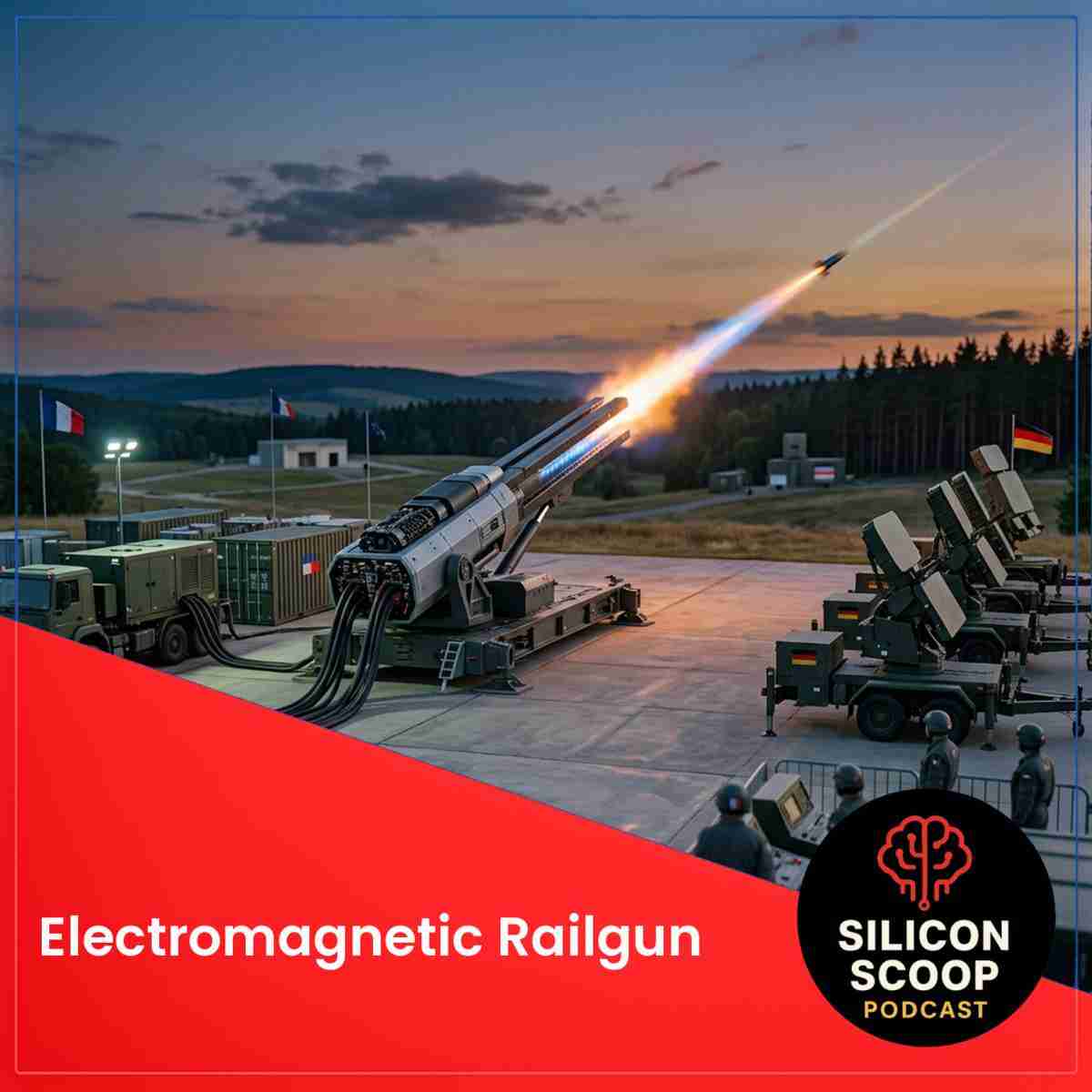
Europe’s Electromagnetic Railgun Just Cleared Its Biggest Test
Estimated reading time: 10 minutes
Key Takeaways
- On June 29, 2026, the French-German Research Institute of Saint-Louis (ISL) fired its electromagnetic railgun in open air for the very first time.
- The test took place at ISL’s Baldersheim proving ground in Alsace, France, using tracking cameras, radar, and telemetry.
- The launcher fired 25 mm projectiles at speeds above 2,000 m/s — beyond Mach 5, approximately 7,000 km/h — under accelerations over 100,000 g.
- EU-linked programs PILUM and THEMA are directly connected to ISL’s railgun work through PADR and EDF funding structures.
- Defense analysts view the test as a significant step, while cautioning that an operational weapon is still years away.
Table of contents
- Europe’s Electromagnetic Railgun Just Cleared Its Biggest Test
- What Is an Electromagnetic Railgun and Why Does It Matter for Hypersonic Missile Defense
- The June 29 ISL Railgun Test — Inside the Numbers
- PILUM, THEMA, and the EU Funding Structure Behind European Railgun Research
- What Defense Analysts Are Actually Saying
- ISL’s Integrated Research Model — Why a Single Institution Matters
- Where European Railgun Technology Stands Today vs. Global Competitors
- FAQ
Europe just crossed a line it has been working toward for decades.
On June 29, 2026, the French-German Research Institute of Saint-Louis (ISL) fired its electromagnetic railgun in open air for the very first time. Not in a lab. Not behind a controlled enclosure. Outside, on a real proving ground in Baldersheim, Alsace, with tracking cameras, radar, and telemetry watching every millisecond of flight.
That single shot changed what European defense technology can claim to have done.
This post breaks down exactly what happened, what the numbers mean, which EU programs are bankrolling the work, and why defense analysts from Paris to Brussels are paying close attention — even as they caution that an operational weapon is still years away.
What Is an Electromagnetic Railgun and Why Does It Matter for Hypersonic Missile Defense
Before we get into the test data, let’s make sure the foundation is solid.
A conventional artillery round or missile works by burning a chemical propellant — gunpowder, solid rocket fuel, or a similar explosive compound. That chemical reaction produces expanding gas, which pushes the projectile out of the barrel or nozzle.
A railgun does something fundamentally different. It uses electrical energy to generate a powerful electromagnetic force. That force accelerates a conductive projectile along two parallel metal rails at speeds that chemical propellants simply cannot match.
Here is why that matters for hypersonic missile defense:
- Modern hypersonic missiles travel at speeds above Mach 5 — roughly five times the speed of sound.
- They can maneuver mid-flight, making them very hard to intercept with traditional systems.
- Current interceptor missiles are expensive. Each shot can cost millions of dollars.
- A railgun round, by contrast, is a relatively low-cost metal projectile. ISL’s design targets a per-shot cost far lower than conventional artillery or guided missiles, while still reaching ranges beyond 200 km.
- Railgun projectiles can reach speeds above 2,000 m/s at the muzzle — fast enough to physically destroy incoming threats through kinetic impact alone, with no explosive warhead needed.
The logic is simple: if you can put a cheap, fast, accurate round in the path of an expensive hypersonic missile, you shift the cost equation dramatically in favor of the defender.
That is the strategic promise ISL is working to deliver.
Source: Naval News
The June 29 ISL Railgun Test — Inside the Numbers
The headline from ISL’s official release was deliberately brief. But reporting from European defense media and near-primary technical sources fills in the picture with hard figures.
The Shot Itself
- Date: June 29, 2026
- Location: ISL’s Baldersheim proving ground, Alsace, France
- Projectile caliber: 25 mm
- Muzzle velocity: Above 2,000 m/s — which translates to speeds beyond Mach 5, approximately 7,000 km/h
- Acceleration experienced by the projectile: Over 100,000 g
Let’s put 100,000 g in perspective. A human fighter pilot starts to black out at around 9 g. The projectile ISL fired experienced more than 11,000 times that force during its acceleration down the barrel. The structural engineering required to build a round that survives that intact — and still flies accurately — is one of the hardest problems in the field.
The Facility
The test was conducted at ISL’s newly built Railgun Free Flight Facility. Construction on this dedicated range took approximately two years. It was purpose-built for one specific job: measuring what happens to a railgun projectile the moment it leaves the barrel.
That moment — called the muzzle exit transition — is where many railgun programs have struggled. Plasma from the electrical discharge, vibration from the rails, and aerodynamic forces all hit the projectile simultaneously. Understanding that behavior in real open air is qualitatively different from any lab measurement.
The facility is equipped with:
- Optical tracking systems to capture projectile flight in real time
- Radar instrumentation for velocity and trajectory measurement
- Telemetry sensors validated on this first shot
- High-end metrology equipment to analyze external ballistics
Future tests at this facility will progressively increase the electrical energy fed into each shot and extend free-flight distances up to approximately 1 km.
ISL’s Internal Programs: PEGASUS and RAFIRA
ISL did not build this demonstrator from scratch in isolation. The current launcher draws directly on two internal development programs:
- PEGASUS — an earlier electromagnetic launcher program that established ISL’s core design knowledge
- RAFIRA — a 25 mm electromagnetic cannon capable of firing salvos at accelerations over 100,000 g
The open-range test launcher is understood to use parameters closely aligned with RAFIRA, which is significant because RAFIRA’s specifications were already tied to potential future applications in naval artillery and long-range land-based fires.
Sources:
PILUM, THEMA, and the EU Funding Structure Behind European Railgun Research
ISL does not operate in a vacuum. Its open-range test is one visible node in a larger European defense investment strategy.
Two EU-level programs are directly connected to ISL’s railgun work.
PILUM — The Pathfinder Project
PILUM (Projectile with Increased Lethality, Updated Materials) ran under the Preparatory Action on Defence Research (PADR), which was the EU’s first dedicated defense research funding mechanism before the full European Defence Fund was established.
The PILUM consortium was selected by the European Defence Agency (EDA) in 2020. Its two-year mandate was to prove that railgun concepts could launch precision hypervelocity projectiles over ranges of several hundreds of kilometers.
That is a remarkable range target. For context, most conventional artillery systems operate effectively at 20 to 50 km. The idea of a railgun round reaching 200+ km with precision changes the strategic geography of a conflict entirely.
PILUM’s work established the conceptual and technical foundation that programs like ISL’s current demonstrator are now building on.
THEMA — The Maturation Project
The THEMA project was funded under the European Defence Fund (EDF) 2022 call. Where PILUM proved the concept, THEMA is designed to mature it.
The European Commission specifically cites THEMA as a program to advance critical components and technology for electromagnetic launch and hypervelocity munitions. That includes:
- Power generation and storage systems
- Rail and barrel materials under repeated high-energy cycles
- Guidance systems for projectiles traveling at hypervelocity
- Thermal management for sustained firing
These are the hard engineering problems that stand between a successful demonstration shot and a weapon system a ship or vehicle can use in combat.
What the EU Funding Structure Signals
The fact that Brussels has been funding railgun research through PADR and EDF — both formal EU-level mechanisms — tells you something important. European defense planners are not treating electromagnetic launch as a curiosity. They are treating it as a disruptive technology for extended-range fires and hypersonic defense, worthy of sustained, multi-program investment.
The EDF’s 2025–2027 Indicative Multiannual Perspective specifically identifies the PILUM project as the pathfinder for electromagnetic railgun and hypervelocity projectile concepts in European defense planning.
Sources:
EDF-Indicative-Multiannual-Perspective-2025-2027.pdf
Stop Doing Things Manually When Automation Can Handle It
Your business runs on repeatable processes — scheduling, follow-ups, data entry, reporting. Every hour spent on those tasks is an hour not spent growing. Flowgrammer builds custom automation systems that remove the manual work and let your team focus on what actually moves the needle.
👉 See How Flowgrammer Automates Your Business
What Defense Analysts Are Actually Saying
The reaction across European defense media has been carefully measured. Nobody is calling this a finished weapon. But the consensus is clear that ISL’s test is a materially significant step — not just a publicity event.
The Strategic Framing
Analysts writing for outlets like Naval News and Army Recognition frame the open-range test as a strategic demonstration. The key word is strategic. A demonstration that validates external ballistics in real conditions, confirms that 25 mm projectiles survive 100,000 g and fly stably, and proves that a purpose-built metrology facility can track the shot — that is not a footnote. It is infrastructure for everything that comes next.
Naval-focused analysts specifically point out that validating external ballistics, structural integrity under extreme acceleration, and reliable telemetry in open air is a direct prerequisite for naval integration. A shipboard railgun that cannot be trusted to fire reliably and be accurately tracked is not a weapon system — it is a science experiment.
The Threat Context
The threat environment ISL is designing against is not hypothetical. China has conducted extensive railgun research and testing on naval vessels. Russia fields hypersonic missiles including the Kinzhal and Zircon. The US Navy ran its own railgun program for years before pausing it due to power and durability challenges.
Europe’s strategic question is not whether hypersonic and maneuvering threats are real. They are real today. The question is whether European nations want an independent capability to counter them, or whether they will depend entirely on US-developed interceptor technology.
ISL’s test is a data point in that strategic conversation.
The Honest Cautions
Technical commentators are equally clear about what remains unsolved:
- Power generation: A railgun needs enormous amounts of electrical energy delivered in milliseconds. Generating and storing that power on a mobile platform — a ship, a vehicle — is a major unresolved engineering challenge.
- Barrel life: The electromagnetic forces and heat generated during firing wear down the rails rapidly. Achieving enough shots per barrel to make a system operationally viable is still an open problem.
- Thermal management: Repeated firing generates extreme heat. Managing that heat to maintain a useful rate of fire has defeated several earlier programs.
- Hypervelocity guidance: Guiding a projectile traveling at 2,000+ m/s over 200+ km with the precision needed to intercept a maneuvering target requires guidance systems that do not yet exist at production scale.
Operationalizing electromagnetic launch technology is, by the candid assessment of the experts involved, a multi-decade effort. ISL’s June 29 test is not the end of that road. It is a confirmed step along it.
Sources:
ISL’s Integrated Research Model — Why a Single Institution Matters
One detail that often gets lost in the excitement over the test results is how ISL is structured to do this work.
The Institute is a joint French-German research body. That binational structure means it operates with funding, scientific staff, and institutional legitimacy from both France and Germany — the two largest defense industrial nations in the EU. That is not a trivial advantage when you need sustained, long-term investment in a technology that will not be combat-ready for decades.
But the structural advantage goes deeper than funding.
ISL brings together expertise across a remarkably wide range of disciplines under one roof:
- Energetic materials — the chemistry of propellants and high-energy compounds
- Guidance systems — the electronics and software that steer projectiles
- Sensors — the hardware that measures what is happening in real time
- Drones and robotics — autonomous systems that increasingly intersect with munitions delivery
- Acoustics — critical for understanding the sound signature and detection of high-velocity projectiles
- Navigation — the systems that keep a projectile on course at extreme speeds
This integration is not accidental. When researchers working on electromagnetic acceleration need better guidance electronics, the guidance team is down the hallway. When the sensors team needs to understand the electromagnetic environment around a railgun firing, the electromagnetics team is in the same institution.
That cross-pollination of expertise is what allows advances in one area to speed up work in another. It is why ISL was able to move from internal lab work to a purpose-built open-range facility with validated instrumentation in a relatively compressed timeline.
For the next phase of work, ISL has identified four priorities:
- Higher energy levels — increasing the electrical energy per shot to push projectile velocities even further
- Longer free-flight distances — extending the range tracked in open air from the initial tests toward the planned ~1 km maximum
- Deeper system integration studies — examining how the launcher integrates with power systems, platform structures, and fire control
- Development of dedicated electromagnetic-launch munitions — designing projectiles specifically optimized for railgun acceleration, rather than adapting existing rounds
Each of these is a significant research program in itself.
Source: Army Recognition
Where European Railgun Technology Stands Today vs. Global Competitors
To understand what ISL’s test means, you need to know where it sits relative to the global state of railgun research.
United States
The US Navy ran the most publicized railgun program in the world for over a decade. The BAE Systems and General Atomics demonstrators reached muzzle energies of 32 megajoules in testing. However, the Navy paused active railgun development around 2021, citing challenges with barrel life, power system integration on ships, and the competing priority of hypersonic missile development. The underlying research remains classified and available to US defense planners, but an operational US Navy railgun is not currently on a near-term delivery schedule.
China
China’s People’s Liberation Army Navy (PLAN) has been more aggressive in public demonstration. Imagery and reporting from 2018 onward showed what appeared to be a railgun launcher installed on a Type 072III landing ship used as a test platform. Chinese state media has made strong claims about progress, though independent technical verification is limited. The strategic intent — a long-range, low-cost weapon for anti-ship and anti-aircraft roles in the Western Pacific — is clear.
Europe / ISL
Europe’s position is more measured in its claims but arguably more transparent in its published testing data. ISL’s June 2026 test marks the first confirmed open-range free-flight test by a European institution with published metrology validation. The connection to PILUM and THEMA shows a programmatic structure that China and the US lack — a formal, multi-nation funding and research pathway embedded in EU defense planning.
The honest summary: Europe is behind the US in total investment and behind China in public boldness of claims. But Europe is building a credible, independently verifiable, institutionally supported capability that does not depend on US technology transfer or Chinese strategic ambiguity.
Sources:
FAQ
1. What exactly is an electromagnetic railgun?
An electromagnetic railgun is a weapon that uses electrical energy rather than chemical explosives to fire a projectile. Two parallel rails carry a massive electrical current, which generates a magnetic force that accelerates the projectile to extremely high speeds — often above Mach 5. There is no gunpowder or rocket fuel involved.
2. Who is ISL and why are they doing this research?
ISL stands for the Institut franco-allemand de recherches de Saint-Louis — the French-German Research Institute of Saint-Louis. It is a joint binational defense research organization funded and operated by France and Germany. ISL has been conducting research into electromagnetic acceleration and energetic materials for decades and is now one of Europe’s leading institutions in railgun technology.
3. What happened on June 29, 2026?
ISL fired its electromagnetic railgun demonstrator in open air for the first time. The test took place at the institute’s Baldersheim proving ground in Alsace, France. The launcher fired 25 mm projectiles at speeds exceeding Mach 5, roughly 7,000 km/h, under accelerations above 100,000 g. Telemetry, optical tracking, and radar systems validated the shot data.
4. What is Mach 5 and why does it matter for defense?
Mach 5 means five times the speed of sound, approximately 6,125 km/h at sea level. ISL’s projectile exceeded this at approximately 7,000 km/h. This speed matters because hypersonic missiles — a major emerging threat from China and Russia — also travel at Mach 5 and above. A weapon that can match or exceed those speeds as an interceptor represents a fundamentally different defensive capability compared to current subsonic or supersonic systems.
5. What is the PILUM project?
PILUM was a two-year research project funded by the European Defence Agency under the EU’s Preparatory Action on Defence Research. Selected in 2020, the PILUM consortium set out to demonstrate that railgun technology could launch precision hypervelocity projectiles over several hundreds of kilometers. It served as the pathfinder project for European electromagnetic railgun development and informed the current generation of EU defense funding for this technology.
6. What is the THEMA project?
THEMA is a follow-on program funded under the European Defence Fund’s 2022 call. Where PILUM proved the concept, THEMA is focused on maturing the critical components and technology needed for operational electromagnetic launch systems. This includes work on power generation, rail materials, thermal management, and guidance systems for hypervelocity munitions.
7. Why is validating external ballistics in open air so important?
Laboratory tests measure what happens inside the launcher. Open-range free-flight tests measure what happens after the projectile leaves the barrel — the aerodynamics, structural behavior under real flight conditions, and trajectory accuracy. These are the variables that determine whether a projectile can hit a target at range. No amount of lab data fully replaces this, which is why building the Railgun Free Flight Facility was a critical prerequisite for the next phase of development.
8. What are the biggest remaining technical challenges?
The main unsolved problems are: generating and storing the enormous electrical energy needed for each shot on a mobile platform; extending barrel life so the rails survive many shots before needing replacement; managing the extreme heat generated by repeated firing; and developing guidance systems precise enough to intercept maneuvering targets at ranges of 200+ km. Each of these is a significant engineering program on its own.
9. How does this compare to US and Chinese railgun programs?
The US ran the most publicly documented railgun program through the Navy but paused active development around 2021 due to technical and funding challenges. China has demonstrated what appears to be a shipboard railgun but provides limited verifiable technical data. Europe’s ISL program is smaller in total investment but offers greater institutional transparency, formal EU-level programmatic support through PILUM and THEMA, and a clear binational governance structure that gives it long-term stability.
10. When could a railgun like this actually be deployed operationally?
There is no firm deployment timeline. ISL researchers and independent analysts consistently describe the path to an operational system as a multi-decade effort. The June 2026 test is a genuine milestone — the first validated open-range free-flight test in Europe — but it is one step in a much longer journey. Future work will push to higher energy levels, longer ranges, integrated power systems, and purpose-built hypervelocity munitions before any deployment decision could be made. The technology is advancing, but anyone claiming a near-term operational railgun is not reading the data carefully.
Additional Links
Flowgrammer.ca – 💡 Unlock AI-Powered Automation! Let flowgrammer.ca handle complex workflows so you can focus on growing your business.
Flowgrammers.ca – 💡 Join Toronto’s Fastest Growing AI and Business Automation Community.
- SRED Funding Solutions – Maximize your R&D tax credits and secure funding for your innovation.
- Silicon Scoop Podcast – Stay Informed, Stay Ahead!
- Startup Talk Podcast
- Flowgrammer Youtube
- Startup Investor Drinks – Join Toronto’s Startup Community and connect with fellow startup enthusiasts and investors.
- TorontoStarts Startup and Entrepreneur Community – Become a part of Toronto’s thriving startup ecosystem.
- Workhaus – Discover flexible workspace solutions for your business needs.
- Work with The Startup Coach – Get expert guidance and mentorship for your startup journey.
- Reach out to Jon Irwin on LinkedIn – Connect with our co-host and technology expert.
Episode transcript
Read the full transcript
Craig: europe just fired a projectile beyond mach five without gunpowder or rocket fuel, but launching one hypersonic round is far easier than turning a railgun into a weapon capable of stopping a maneuvering missile. so europe takes rail guns into the open air. on june 29, the french german research institute of saint louis fired its domestically developed electromagnetic rail gun outdoors at its baldersheim proving ground. the test moved the launcher from controlled laboratory experiment into a measurable free flight. the isl's official announcement, you know, mentioned that the railguns could eventually fire extremely fast, comparatively inexpensive projectiles for long range artillery and missile defense without carrying explosive propellant inside every round. what do you think about this, john?
Jon: i love this. it it's been such a long i don't even know if we've covered rail guns on this, on this podcast before, but i love rail guns. ever since was it doom that had the rail gun? i think
Craig: they had it in, transformers. loom.
Jon: no. no. but in the video game. anyways alright. one of the video games, duke nukem or doom hide the railgun, and i always thought it was cool. but, anyways, this is cool. now this trial doesn't mean that europe has a combat ready railgun. okay? what this means is they're building a testing platform that allows them to gradually increase the weapon's energy, examine longer flight distances, measure accuracy, aerodynamic stability, and eventually experiment with specialized or guided projectiles. now for those of you that don't know, a real gun, it consists of two parallel conductive rails connected to a pulse electrical power source. so the conductive component is called an armature and bridges the rails and completes the electrical circuit. so when an extremely large current passes along one rail through the armature and back along the second rail, creates a magnetic field. and so the interaction between the electrical current and magnetic field produces what's called the lorentz force, which pushes the armature and the projectile attached to it or carried by it down the barrel. and so the underlying physics is conceptually straightforward, but the engineering of it is extremely difficult because the system may have to conduct currents approaching millions of amperes over only a few milliseconds. so essentially, you're using a magnet. yeah. you're there you go. to shoot a projectile. and this is really cool. like, there's a lot of engineering that goes into this. and so yeah. go ahead.
Craig: i was just gonna say we are showing the video for those people watching of some of this, the railgun in test trials.
Jon: yeah. and so, what's cool about what they're doing here like, there's open ranges, i think, in the us, for testing, but, this is gonna allow them to measure factors such as muzzle velocity and velocity loss down rate downrange, pitch, yaw, roll, and aerodynamic stability, projectile dispersion and accuracy, armature, structural integrity after launch. there's a whole bunch that they're gonna be able to, to test. and so the railgun itself, it uses a six meter launcher and a roughly 40 by 40 millimeter bore, which is kinda cool. so, yeah, this is obviously, like, if you if you're watching the videos, real guns, they obviously, they can't shoot right now as fast as, say, a machine gun or something like that. like, you know, one projectile. i don't even know what the reset time is because of all of the, currents and everything, that that, that are included here. but what are your thoughts on this? and what do you think about real ones?
Craig: well, i think the idea is cool. and, i'm not as big a fan as the doom games as you are. so i know they exist, and i liked them back in the day, but i haven't followed any of the more modern ones. however, they did show this in transformers where they were taking out that little big transform on top of the pyramid.
Jon: oh, yeah. i remember that.
Craig: yep. that whether, you know, the again, that is probably the future thing that we want, which is launching a nonexplosive device. right? so this, think of this update like replacing a cannon's explosion with a magnetic launch system on a roller coaster, except the track accelerates a metal projectile to more than two kilometers per second in just a few milliseconds. so, the test happened, but there's no deployable weapon has been announced. europe's team development program is targeting further firing ranges, testing in 2028, with research mapped to twenty thirties. little bit of search and found similar testing going on in the united states where they were reaching over mach seven. so the reported projectile diameter was 25 millimeters. the reported muzzle velocity were 2,000 mile, meters per second, equivalent speed 7,200 kilometers per hour, reported acceleration over a 100,000 g's. so it's a planned facility free flight distance of approximately one kilometer. isl confirms the outdoor shot, but does not publish the velocity, caliber, or acceleration in the announcement, so we had to kinda go through it. the us navy previously tested rail guns at muzzle energies reaching 32 megajoules. but the durability, power integration, and, competing weapon priorities kept the technology from becoming operational. so yeah. a projectile experiencing a 100,000 g's cannot, use ordinary artillery electronics, batteries, circuit board sensors, and guidance components, must all survive forces that can tear conventional hardware apart. so, basically, they're just sending a piece of metal down the pipe. pillow began with relatively modest budget of $1,500,000 euro dollar euro. sorry. and united, seven partners across four countries. its results became the foundation for the largest cema program, which is, part of the european defense agency. and the railgun may not use gunpowder, but it neither silent nor flashless. the projectile creates a sonic boom while electrical arcing and superheated plasma can produce an extremely bright muzzle flash. so it's interesting. the concept is cool. i'm just not sure how fast we're gonna get there and how excited we should be about this because we've been kind of here before, and people just change their mind about how much money it was gonna take to get them to a practical weapon.
Jon: yeah. sorry. it was quake two that had the railgun. sorry.
Craig: there you go.
Jon: that wasn't due. it was quake two. but yeah. so, there hasn't been much advancement in railgun technology, which is probably why we haven't covered it. but i think we did cover now that i'm looking back, we did cover, railgun being tested onboard a ship, maybe? because that sounds familiar to me or at least i've ran an article on it. so, there's a bunch of different experiments and testing going on and things like that. so, i'm, i'm excited for this. and the thing is the breakthrough here, it's not that europe has suddenly produced a deployable electromagnetic super weapon. it's that they can observe the entire transition from electrical acceleration to atmospheric free flight. so, as you said, mach five, railguns have proven they can generate extraordinary speed. the question that still remains unanswered is that whether engineers can turn that speed into an accurate, durable durable and rapidly, that's key, firing, power efficient and affordable military system. i guess my question here too is, are there other technologies that are that are up and coming? because back back in 2010 and when rail guns were first or back when i don't wanna say 2010. back when rail guns were first, started to be experimented and tested, we didn't have technologies that like, the laser technology that we have now. so i don't know if railgun technology is still viable. may i think it is. but we also have laser technology, which is a lot more predominant and could potentially, be cheaper.
Craig: yeah. i think the difference is right now, the test is demonstrated projectile can leave the launcher and fly outdoors. it did not demonstrate repeated firing or operational accuracy, 200 kilometer shot or the interception of a maneuvering hypersonic missile. but if they can get a accurate 200 kilometer shot, that's something that is completely different than what lasers can do. and the damage something like this can do is extremely devastating if they can do it. so the promise is there. it's also if we are going to space, this kind of thing feels like a, a great thing for space.
Jon: oh, yeah. good point. yeah.
Craig: but, the power storage, rail erosion, heat removal, projectile guidance, and targeting, tracking all remain major obstacles. so, watch the shot count, not just the speed. the real breakthrough will be accurate and pre repeated firings without destroying the rails, not one spectacular launch. so europe has moved its railgun research from laboratory hardware to real world ballistics, but the operational weapon is still on the other side of several brutal engineering problems. would you rather fund railguns that might deliver cheaper defensive shots or spend that money improving interceptive missiles or john's thoughts of lasers? or even now, we're coming into the world of, quantum entanglement. i can see a feature of quantum weapons. how exactly that would be deployed, i don't know. but, you start thinking outside the box when you can have, these things that are quite, that are entangled quite a distance apart and replicate each other. all of a sudden, if you can have quantum batteries, why can't you have quantum bumps? so, let us know what your thoughts are in the comments below. we'd love to hear, what you think.
More from Silicon Scoop
All episodes
silicon-scoop · October 16, 2026
Meta’s $18 Billion Teen Safety Settlement: Soft Guardrails, Hard Leverage Over TikTok and YouTube
Deep dive on Meta teen safety settlement, social media addiction lawsuit, new Facebook Instagram time limits and pressure on TikTok YouTube age verification.
View episode

silicon-scoop · October 15, 2026
How Claude Mythos Is Reshaping Cryptanalysis: HAWK, AES and the Rise of AI-Driven Crypto Research
Claude Mythos cryptanalysis weakens HAWK post-quantum signature, speeds AES Möbius Bridge attack, and powers CryptanalysisBench benchmark in AI-driven crypto research.
View episode

silicon-scoop · October 14, 2026
Nvidia’s $12.9 Billion Hugging Face Bet: How Controlling the Open-Source Model Hub Reshapes AI Chips, Cloud, And Competition
Nvidia Hugging Face acquisition could reshape open source AI models, AI chip dominance, and the global developer model hub, raising antitrust and neutrality questions.
View episode