
How Crystal Symmetry in Vanadium Could Rewire the Economics of Clean Hydrogen Storage
How Crystal Symmetry in Vanadium Could Rewire the Economics of Clean Hydrogen Storage https://torontostarts.com/2026/08/25/vanadium-hydrogen-storage-quantum/ Flowgrammer.ca -> https://flowgrammer.ca/ AI News and Resources -> https://flowgrammers.ca OpenClaw Toronto -> https://openclawto.com/ How Crystal Symmetry in Vanadium Could Rewire the Economics of Clean Hydrogen Storage How vanadium hydrogen storage and crystal symmetry enable quantum tunneling hydrogen, reshaping clean hydrogen tax credits and next-gen energy materials. FLogrammer is your Business Automation Experts - https://Flowgrammer.ca Startup Investor Drinks Toronto - https://startupdrinksto.com/ Toronto’s Startup Community - https://torontostarts.com/ Silicon Scoop Silicon Scoop Podcast - https://torontostarts.com/silicon-scoop/ Apple: https://podcasts.apple.com/us/podcast/silicon-scoop/id1758711826 Spotify: https://open.spotify.com/show/5bAzF0MwV6TtLhJAhvHayI YouTube: https://www.youtube.com/playlist?list=PLj4v-RoA7A-gT62vrEYqh1zCv-0Hj-o5J Startup Talk Startup Talk Podcast -> https://torontostarts.com/startup-talk-toronto-startup-podcast/ Apple -> https://podcasts.apple.com/us/podcast/startup-talk/id1763804003 Spotify -> https://open.spotify.com/show/1siJMILILidHAiAsrX2VBU YouTube: https://youtube.com/playlist?list=PLj4v-RoA7A-jxV5FHs5e61oIsuvUJYmT_&si=LYegRe5GYLKNQ7xL
With Craig Major and Jon Irwin
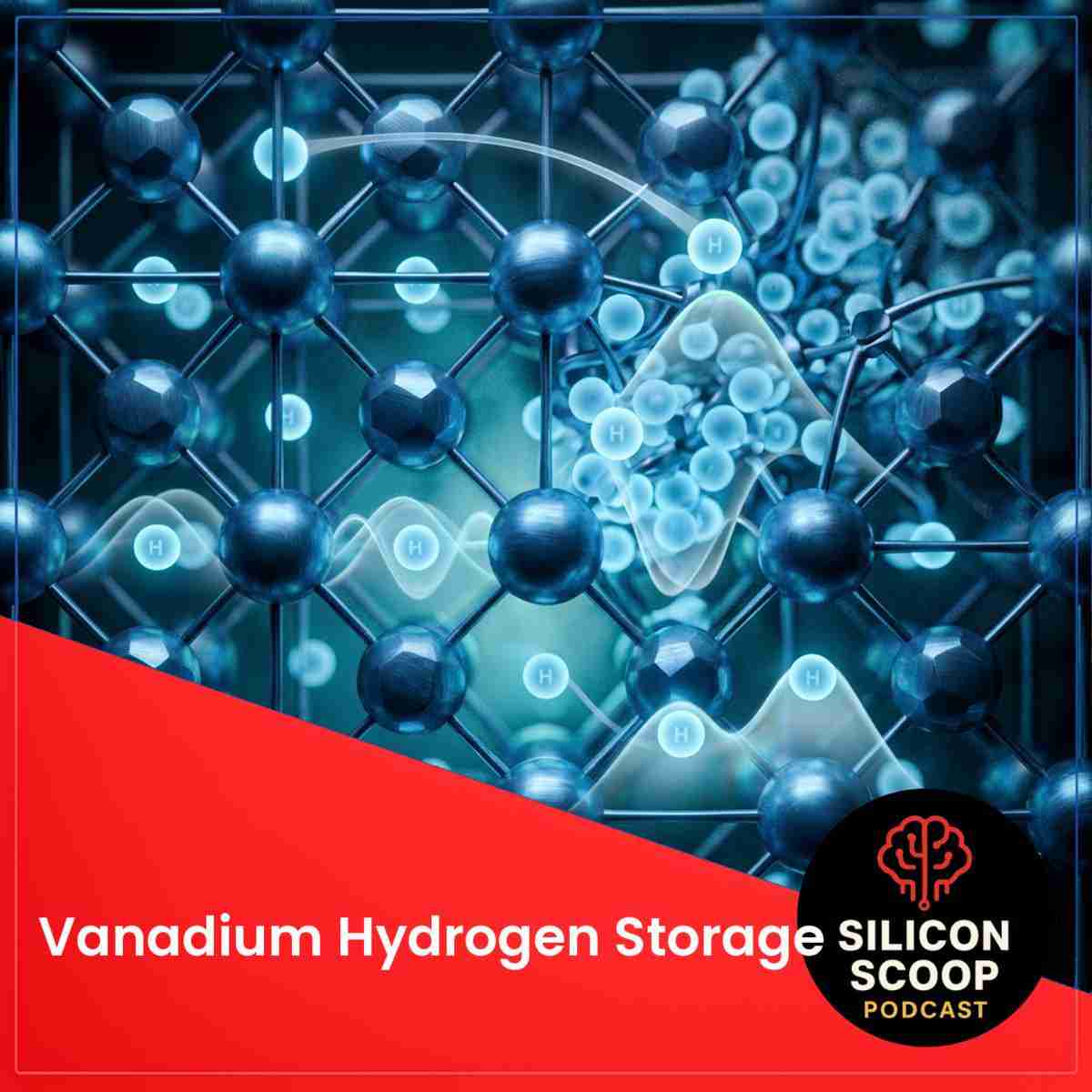
Vanadium Hydrogen Storage Just Got a Quantum Upgrade
Estimated reading time: 12 minutes
Key Takeaways
- Researchers at the University of Tokyo discovered that vanadium has a hidden switch — one controlled by the geometry of its crystal structure — that can turn hydrogen’s quantum behavior on or off.
- This is a fundamental insight into vanadium hydrogen storage that rewrites how scientists and engineers can approach next-generation clean energy materials.
- It is crystal symmetry.
- When hydrogen concentration inside the vanadium is low, the crystal lattice stays symmetrical and hydrogen can tunnel; as hydrogen concentration increases, the lattice becomes distorted and tunneling is suppressed.
- The timing matters, with billions of dollars in government hydrogen tax credits now tied to storage efficiency and lifecycle emissions.
Table of contents
- Vanadium Hydrogen Storage Just Got a Quantum Upgrade
- What Is Vanadium and Why Does It Matter for Hydrogen Storage?
- The Quantum Tunneling Hydrogen Discovery That Changes Everything
- Crystal Symmetry Materials and the New Design Blueprint for Clean Energy
- Clean Hydrogen Tax Credits and the Economic Case for Solid-State Storage
- What Comes Next for Vanadium Alloy Research
- Frequently Asked Questions
Hydrogen has long been called the fuel of the future. But that future keeps getting pushed back — not because hydrogen lacks potential, but because storing it safely and efficiently remains one of the hardest problems in clean energy.
Now, researchers at the University of Tokyo have found something that could change how we design the materials at the heart of hydrogen storage. They discovered that a metal called vanadium has a hidden switch — one controlled by the geometry of its crystal structure — that can turn hydrogen’s quantum behavior on or off.
This is not a small tweak. It is a fundamental insight into vanadium hydrogen storage that rewrites how scientists and engineers can approach next-generation clean energy materials. And it could not have come at a better time, with billions of dollars in government hydrogen tax credits now tied to storage efficiency and lifecycle emissions.
What Is Vanadium and Why Does It Matter for Hydrogen Storage?
To understand why this discovery is significant, you first need to understand why vanadium became interesting to clean energy researchers in the first place.
Hydrogen is the most abundant element in the universe. When burned or used in a fuel cell, it produces zero carbon emissions. Its only byproduct is water. On paper, it is the perfect clean fuel.
The problem is physics.
Hydrogen is extremely light, and in its gas form, it takes up a lot of space. To store meaningful amounts, you either need to compress it to very high pressures (around 700 bar in most commercial tanks) or cool it to cryogenic temperatures below -253°C to make it liquid. Both approaches are energy-intensive and carry real safety risks, especially for passenger vehicles and distributed industrial use.
Solid-state storage using metal hydrides offers a third path. Certain metals and alloys can absorb hydrogen directly into their crystal structure — holding it as a solid and releasing it on demand through heat. No extreme pressures. No cryogenic systems. Much safer by design.
Vanadium is one of the most promising candidates for this role. It can absorb and release hydrogen reversibly, and researchers have measured that it can hold up to 3.8 percent of its own weight in hydrogen — a figure that puts it in a competitive range for practical use cases. At low hydrogen concentrations (around 0.01 H/V, roughly equivalent to three effective monolayers), transport inside vanadium occurs through interstitial tetrahedral pathways within the crystal lattice.
In practice, engineers often mix vanadium with other metals like iron, titanium, and chromium to tune how tightly hydrogen is held, making it easier to extract when needed. But despite decades of research, one stubborn mystery remained: why does hydrogen behave so differently inside vanadium depending on conditions?
Sometimes it moves like a classical particle, jumping between sites by overcoming energy barriers when enough heat is available. Other times, it seems to take a shortcut — moving in ways that classical physics simply cannot explain.
Source: phys.org news on hydrogen quantum behavior and symmetry
Source: Nature article ncomms1897
The Quantum Tunneling Hydrogen Discovery That Changes Everything
The team at the Institute of Industrial Science (IIS) at the University of Tokyo set out to resolve this mystery. Their approach combined real-world measurements of hydrogen’s structure and movement inside vanadium with quantum mechanical calculations tied directly to the crystal’s geometry.
What they found was elegant and clear.
Hydrogen Takes a Quantum Shortcut — When the Crystal Lets It
Inside vanadium’s crystal lattice, there are small gaps called interstitial sites. Hydrogen atoms sit in these gaps. When conditions are right, they hop between neighboring sites.
The researchers found that this hopping does not always happen the same way:
- Classical hopping: The hydrogen atom behaves like a ball rolling over a hill. It needs enough thermal energy to overcome the energy barrier between two sites. This is normal, predictable physics.
- Quantum tunneling: The hydrogen atom behaves like a wave. Instead of going over the energy barrier, it passes directly through it — taking what the researchers called a “quantum shortcut.” This tunneling behavior is a direct consequence of hydrogen’s extremely low mass and the quantum mechanical nature of protons.
The critical insight is what controls which mode dominates.
It is crystal symmetry.
When hydrogen concentration inside the vanadium is low, the crystal lattice stays symmetrical. In that symmetric arrangement, the potential energy surface between neighboring interstitial sites forms what physicists call a double-well profile. The two wells are equivalent, which means hydrogen can occupy a delocalized quantum state that spans both sites simultaneously. That is tunneling. The proton is not bouncing back and forth — it is genuinely present in both locations at once, in the quantum mechanical sense.
As hydrogen concentration increases, the lattice becomes distorted. The symmetry breaks down. The two neighboring sites are no longer equivalent. The double-well becomes asymmetric, and the delocalized quantum state collapses. Hydrogen is forced to behave like a classical particle, relying on thermal energy to hop between sites.
> “Crystal symmetry is the underlying switch that turns quantum behavior on or off,” said Professor Katsuyuki Fukutani of IIS. “In a symmetric structure, hydrogen finds equivalent pathways that allow it to tunnel between sites. Distort that symmetry — as happens at higher hydrogen concentrations — and tunneling is suppressed, forcing hydrogen to rely on thermal energy to hop between sites instead.”
Research associate Takahiro Ozawa added: “Our results show that crystal symmetry is key to controlling hydrogen’s quantum behavior. Highly symmetric structures allow hydrogen to tunnel, while distorted structures suppress this effect.”
Why This Resolves a Long-Standing Puzzle
For years, experimental data on hydrogen diffusion in vanadium showed anomalies that did not fit cleanly into either a purely classical or a purely quantum model. Resistance relaxation curves showed unexpected crossover behavior between thermal and quantum regimes. Metastable hydride states appeared in near-surface regions of vanadium films that were hard to explain using classical diffusion alone.
Earlier work from Fukutani’s group, presented at the IAEA’s MoD-PMI 2025 conference, showed that low-energy hydrogen ions could create these metastable hydride states in vanadium films, with the relaxation curves hinting at exactly this kind of quantum-to-classical crossover. The 2026 Nature Communications paper formally models the mechanism: symmetry-lowering phase transitions in vanadium hydrides reshape the proton potential energy surface from a tunneling-supporting double-well to a localized, classical-hopping configuration.
In short, the quantum anomalies were not noise. They were the signal. And now researchers have the framework to interpret them.
Source: phys.org news on hydrogen quantum behavior and symmetry
Source: IAEA MoD-PMI 2025 contribution PDF
Published in Nature Communications, DOI: 10.1038/s41467-026-75020-w
Stop Letting Manual Work Slow Down Your Business
While scientists are automating the behavior of atoms, most businesses are still doing things the hard way — manually handling repetitive tasks that drain hours every week. Flowgrammer helps businesses like yours automate the workflows, approvals, and data tasks that eat your team’s time alive.
If you are spending more than 30 minutes a day on a task that happens the same way every time, that task should be automated.
👉 See How Flowgrammer Automates Your Business
Crystal Symmetry Materials and the New Design Blueprint for Clean Energy
The most immediate practical implication of this research is that it gives materials engineers a design principle — not just a description of what vanadium does, but a rule for how to build better hydrogen storage materials from the ground up.
Engineering the Switch Deliberately
Before this study, designing a hydrogen storage alloy was partly a trial-and-error process. You would mix metals, test absorption and release rates, and tune compositions empirically. The quantum behavior of hydrogen inside the lattice was treated as a background effect that was poorly understood.
Now, engineers have a clearer target. If you want hydrogen to tunnel efficiently at a given concentration, design the lattice to maintain high symmetry at that loading level. If you want to suppress tunneling and favor classical, thermally controlled release, introduce deliberate distortions.
This opens new directions for alloy design:
- Symmetry-preserving alloys: By carefully selecting which secondary metals are added to vanadium, engineers may be able to maintain lattice symmetry even at higher hydrogen loadings — potentially expanding the concentration range over which fast, quantum-assisted diffusion operates.
- Tunable release rates: The symmetry switch could be engineered as a functional feature, allowing storage materials to shift between rapid quantum-mode filling and controlled classical-mode release based on temperature or composition.
- Metastable hydride phases: The near-surface metastable states observed in earlier vanadium film studies could be deliberately stabilized for specialized applications where intermediate hydrogen states are useful.
Materials scientists at Phys.org note that the University of Tokyo result offers “a practical strategy for developing materials designed to control hydrogen’s quantum behavior” — meaning the symmetry principle is not just theoretically interesting, it is an actionable engineering tool.
Connecting Quantum Behavior to Real-World Storage Performance
One detail worth understanding is why quantum tunneling actually matters for storage performance, not just scientific curiosity.
In a hydrogen storage system, the speed at which hydrogen moves through the material affects both the charging rate (how fast you can fill the tank) and the discharge rate (how fast you can draw fuel out). Materials where hydrogen diffuses quickly can charge and discharge faster — a critical spec for vehicles and for grid-scale energy buffering.
Quantum tunneling, when active, allows hydrogen to move through the lattice without needing as much thermal energy. That means faster diffusion at lower temperatures — a significant advantage for systems that need to operate in cold environments or with minimal heating energy.
By understanding exactly when and why tunneling is active in vanadium alloys, engineers can now design systems that deliberately exploit this quantum speed advantage under the right conditions.
Source: phys.org news on hydrogen quantum behavior and symmetry
Source: Nature article ncomms1897
Clean Hydrogen Tax Credits and the Economic Case for Solid-State Storage
The scientific advance matters on its own terms. But it lands at a moment when the economics of clean hydrogen are being reshaped by major government policy initiatives. And that intersection makes the timing of this research particularly important.
The United States: Inflation Reduction Act and the Clean Hydrogen Credit
The U.S. government’s Inflation Reduction Act (IRA) includes one of the most significant clean hydrogen incentives ever enacted. The clean hydrogen production tax credit — administered through IRS Form 7210 for production and Form 3468 for investment — provides tiered credits based on the lifecycle emissions intensity of the hydrogen produced.
The key threshold: to qualify for the credit at any tier, hydrogen must be produced at or below 4 kg of CO2-equivalent per kg of hydrogen. The best credits go to hydrogen produced at or below 0.45 kg CO2e/kg — close to net zero.
Under final Treasury regulations, even modified existing (legacy) facilities can qualify, provided the modification costs are capitalized and the facility meets the emissions threshold. This creates real demand for storage systems that can be integrated into brownfield retrofits — older industrial sites being upgraded for clean hydrogen production.
Symmetry-engineered vanadium hydrides fit this need well. They are compact, they operate at moderate pressures and temperatures, and they produce no additional emissions during storage. For a retrofit facility trying to hit strict lifecycle-emissions targets, a solid-state storage system with a small physical footprint and predictable hydrogen flux is a strategic asset.
Resources for the Future has noted that the IRA incentives and associated 45Q carbon capture credits were deliberately set high to drive commercial adoption of low-carbon hydrogen at scale — meaning the financial stakes for getting storage right are significant.
Australia: The Hydrogen Production Tax Offset
Australia is pursuing a parallel strategy through the Future Made in Australia (Production Tax Credits and Other Measures) Bill, which establishes a Hydrogen Production Tax Offset (HPTO) with a base credit of AUD $2 per kilogram of eligible clean hydrogen under proposed section 421-10.
This is a substantial incentive for Australian clean hydrogen producers, particularly those targeting export markets in Asia. For projects in remote areas where pipeline infrastructure is limited, solid-state storage technologies that reduce the need for compressed or cryogenic hydrogen transport could be a key enabler for qualifying under this offset.
Why Solid-State Storage Is Strategically Aligned With These Incentives
Both the U.S. and Australian incentive regimes reward hydrogen production systems that are low-emissions, safe, and scalable. Solid-state vanadium-based storage contributes to all three dimensions:
- Lower emissions footprint: No energy-intensive compression or cryogenic cooling needed during storage
- Safety: Hydrogen is held in solid form, dramatically reducing explosion and leak risks compared to high-pressure tanks
- Integration flexibility: Compact solid-state systems can be installed in constrained spaces, including brownfield retrofits
As clean hydrogen tax credits tighten their lifecycle-emissions rules and reward projects that demonstrate integrated, low-carbon supply chains, the ability to choose and engineer your storage medium based on precise quantum-level science rather than empirical guesswork becomes a genuine competitive advantage.
Source: Treasury press release jy2768
Source: WSGR insights on final hydrogen production tax credit regulations
Source: APH bill digest 25bd046
What Comes Next for Vanadium Alloy Research
The Nature Communications publication is a foundation, not a finish line. Several clear directions follow from this work.
Alloy library expansion: Now that crystal symmetry is identified as a controlling variable, researchers can systematically test how different metal combinations — iron, titanium, chromium, and others mixed with vanadium — affect symmetry maintenance under varying hydrogen loads. This transforms alloy design from empirical testing into guided engineering.
Near-surface effects: Fukutani’s earlier IAEA work showed that near-surface regions of vanadium films behave differently from the bulk material when exposed to low-energy hydrogen ions. Understanding how surface and interface effects interact with the bulk symmetry-tunneling mechanism will be important for thin-film and nanostructured storage applications.
Computational screening: With a validated quantum mechanical model of the symmetry-tunneling relationship, computational researchers can now screen thousands of hypothetical alloy compositions in simulation before committing to laboratory synthesis — dramatically accelerating the materials discovery timeline.
Broader materials family: The symmetry principle identified in vanadium may extend to other metal hydride systems. Palladium, for example, has been studied in the same IAEA-linked research context. If crystal symmetry controls tunneling in a broad class of hydride-forming metals, the design principle from this paper could become a unifying framework across the entire metal hydride field.
The research team’s finding that vanadium can hold up to 3.8 wt% hydrogen reversibly, combined with the new understanding of how symmetry controls diffusion rates, positions this material as a serious candidate for the next generation of hydrogen storage systems — ones designed with quantum behavior built in from the start, not discovered by accident.
Source: phys.org news on hydrogen quantum behavior and symmetry
Published in Nature Communications, DOI: 10.1038/s41467-026-75020-w
Frequently Asked Questions
1. What is vanadium hydrogen storage and why is it better than tank-based storage?
Vanadium hydrogen storage is a method where hydrogen atoms are absorbed directly into the crystal lattice of vanadium metal or vanadium alloys, held in solid form. Unlike compressed gas tanks (which require pressures up to 700 bar) or cryogenic liquid tanks (which require temperatures below -253°C), solid-state vanadium storage works at moderate temperatures and pressures. This makes it significantly safer, more energy-efficient during the storage phase, and easier to integrate into compact systems. Vanadium alloys can store up to 3.8 percent of their weight in hydrogen, which is competitive for practical applications.
2. What is quantum tunneling hydrogen and how does it apply to this research?
Quantum tunneling is a phenomenon where a particle passes through an energy barrier rather than over it — something that is impossible in classical physics but allowed by quantum mechanics due to the wave-like nature of matter at very small scales. Hydrogen atoms (or more precisely, protons) are light enough that this tunneling effect is significant. In the Tokyo study, researchers found that hydrogen inside vanadium can tunnel between interstitial lattice sites when the crystal structure is symmetric, moving faster and without needing as much thermal energy as classical hopping requires.
3. What exactly did the University of Tokyo researchers discover?
The research team at the Institute of Industrial Science found that the crystal symmetry of vanadium’s lattice structure acts as a switch controlling hydrogen’s quantum behavior. When hydrogen concentration is low, the lattice stays symmetric and hydrogen can quantum-tunnel between sites. When concentration increases, the lattice distorts, symmetry breaks, and hydrogen is forced to behave like a classical particle, relying on heat to move. This mechanism explains anomalies in hydrogen diffusion data that had puzzled scientists for years.
4. What is the significance of the Nature Communications publication?
The paper, titled “Impact of Crystal Symmetry Lowering on Proton Tunneling” (DOI: 10.1038/s41467-026-75020-w), is significant because it provides the first formal quantum mechanical model linking symmetry-lowering phase transitions in vanadium hydrides to changes in the proton potential energy surface. It moves the field from empirical observation (“hydrogen behaves oddly under these conditions”) to mechanistic understanding (“here is exactly why, and here is how to engineer it”).
5. How does crystal symmetry control whether tunneling happens or not?
In a symmetric crystal lattice, neighboring interstitial sites where hydrogen can sit are energetically equivalent. This creates a double-well potential energy surface where the proton can occupy a quantum state delocalized across both sites — that is tunneling. When the lattice distorts (due to higher hydrogen loading causing asymmetric strain), the two sites become inequivalent, the double-well becomes asymmetric, and the delocalized quantum state collapses. The proton is effectively localized, and classical thermal hopping takes over.
6. Can this research help design better hydrogen storage materials?
Yes, and that is one of the most direct practical implications. The symmetry principle gives engineers a concrete design target. By selecting alloy compositions that maintain high crystal symmetry even at higher hydrogen loadings, it may be possible to preserve quantum tunneling behavior across a wider range of operating conditions. Conversely, engineers who want controlled, thermally triggered hydrogen release can introduce deliberate lattice distortions. Either way, the design process shifts from trial-and-error to guided engineering.
7. How does this connect to clean hydrogen tax credits in the United States?
The U.S. Inflation Reduction Act’s clean hydrogen production tax credit (administered via IRS Forms 7210 and 3468) rewards hydrogen production at or below 4 kg CO2e per kg of hydrogen, with higher credits for lower emission intensity. Modified existing facilities can qualify if they meet these thresholds. Solid-state vanadium storage systems, which require no energy-intensive compression or cryogenic cooling, can lower the overall lifecycle emissions of a hydrogen production and delivery system, helping projects qualify for higher credit tiers. This makes materials like symmetry-engineered vanadium alloys financially strategic, not just technically interesting.
8. What is Australia’s Hydrogen Production Tax Offset and who does it apply to?
Australia’s proposed Hydrogen Production Tax Offset (HPTO), established under the Future Made in Australia (Production Tax Credits and Other Measures) Bill, offers a base credit of AUD $2 per kilogram of eligible clean hydrogen under proposed section 421-10. It is designed to support Australian clean hydrogen producers, particularly those targeting export markets. Projects that can demonstrate compact, safe, low-emissions storage — characteristics of solid-state hydride systems — are well-positioned to benefit from this offset as part of an integrated clean hydrogen supply chain.
9. Are there other metals besides vanadium where this symmetry-tunneling principle might apply?
Potentially yes. Fukutani’s IAEA research group has also studied palladium in the context of hydrogen diffusion and near-surface quantum states. The broader principle — that crystal symmetry governs whether hydrogen’s proton potential energy surface supports delocalized tunneling states — may apply across a wider family of hydride-forming transition metals. This is an active area of investigation, and the validated model from the vanadium study gives researchers a framework to test in other systems computationally before committing to laboratory experiments.
10. What are the next research steps following this discovery?
Several directions are likely. First, experimental and computational work to test how different vanadium alloy compositions (with iron, titanium, chromium, and other metals) affect lattice symmetry at varying hydrogen concentrations. Second, deeper investigation of near-surface effects in vanadium films, where metastable hydride states can form — these may have applications in thin-film and nanostructured storage. Third, computational screening of hypothetical alloy compositions using the validated quantum mechanical model, which can dramatically speed up materials discovery. And fourth, testing whether the symmetry-tunneling framework extends to other metal hydride systems beyond vanadium.
Additional Links
Flowgrammer.ca – 💡 Unlock AI-Powered Automation! Let flowgrammer.ca handle complex workflows so you can focus on growing your business.
Flowgrammers.ca – 💡 Join Toronto’s Fastest Growing AI and Business Automation Community.
- SRED Funding Solutions – Maximize your R&D tax credits and secure funding for your innovation.
- Silicon Scoop Podcast – Stay Informed, Stay Ahead!
- Startup Talk Podcast
- Flowgrammer Youtube
- Startup Investor Drinks – Join Toronto’s Startup Community and connect with fellow startup enthusiasts and investors.
- TorontoStarts Startup and Entrepreneur Community – Become a part of Toronto’s thriving startup ecosystem.
- Workhaus – Discover flexible workspace solutions for your business needs.
- Work with The Startup Coach – Get expert guidance and mentorship for your startup journey.
- Reach out to Jon Irwin on LinkedIn – Connect with our co-host and technology expert.
Episode transcript
Read the full transcript
Craig: hydrogen may be the fuel of the future, but storing it remains an expensive engineering headache. researchers have now discovered changing the symmetry of vanadium's crystal lattice can switch hydrogen between quantum tunneling and ordinary heat driven movement. so the crystal symmetry switches hydrogen's behavior. university of tokyo researchers have found hydrogen moves unusually quickly through symmetrical low hydrogen vanadium because its quantum state can spread across multiple lattice sites. at higher concentration, this crystal stretches into less symmetrical phase, localizing the hydrogen and forcing it to move slower through thermally activated hopping. what do you think about this, john?
Jon: my favorite chemical element. love hydrogen. but let's let's kind of just break this down. so if you can imagine trying to walk through a neighborhood filled with fences, normally, you'd have to climb over those fences before moving to the next yard. but quantum mechanics, or some people like to call it magic, sometimes allows something remarkable. what it does is it lets hydrogen effectively pass through the fence instead of having to climb over it. and now scientists have discovered what determines whether hydrogen can perform this quantum shortcut. so what they found is that when hydrogen moves inside the metal vanadium, everything depends on how neatly the metals atoms are arranged. so if the crystal structure remains highly symmetrical, hydrogen behaves like a quantum wave and can tunnel through energy barriers with surprising efficiency. but when more hydrogen enters the metal, the crystal becomes distorted, switching hydrogen back to behaving like an ordinary particle that must over come each barrier conventionally. and so this discovery is helping engineers design much better materials for storing and transporting hydrogen, which is one of the leading candidates for clean energy, which is what i love so much, and i need to put my money where my mouth is at some point. but, so why vanadium matters is because it has long attracted attention because it readily absorbs hydrogen into its crystal lattice. so unlike a gas tank that physically contains hydrogen, vanadium stores hydrogen inside the atomic structure of itself. and so hydrogen atoms occupy tiny spaces between the vanadium atoms called interstitial sites. and so the challenge is that hydrogen doesn't simply sit still. it continuously diffuses through the crystal. and so understanding how hydrogen moves, it's going to determine storage efficiency, charging speed, discharge rate, material lifetime, and mechanical stability. and until now, scientists knew hydrogen sometimes exhibited quantum behavior and sometimes classical behavior, but they didn't understand why. so this is super cool. what do you think about this? does this give us another, another step into hydrogen becoming the clean energy of choice?
Craig: maybe. anytime where we can start restoring it, storing it at room temperature is helpful. and if we can extol, store it in, crystal forms, etcetera, which is interesting, we have to see if that becomes usable. meaning, can you do that, say, in a hydrogen energy cell, store this in something like this, and then slow release by just changing the electricity through it or changing the structure, that would allow it to flow or make it slow. and being able to do the distortion, would allow a lot of either storage or flowing of the hydrogen. this is very interesting, especially when you can really control it at the physical state rather than at a liquid or gaseous state because, you have less likelihood of explosions and whatnot. so all of that, makes me very excited. so replace ordinary hydrogen with heavier deuterium and tunneling becomes less likely because tunneling probability is extremely sensitive to particle mass. so isotope testing can help distinguish genuine quantum transport from classical diffusion. vanadium is already economically important for strengthening steel and was included in the united states 2025, critical minerals list. a successful, storage technology would therefore compete for supply with an established industrial market. vanadium was named after vanatus, another name for north goddess, freya, because vanadium compounds produce an unusually colorful range of oxidation states. so this was a 40 nanometre laboratory field study largely at cryogenic temperatures. so the researchers did not demonstrate a full size tank storage, room temperature performance, rapid refueling, long term cycling, manufacturing cost or commercially useful system level capacity. so claims that this discovery will directly unlock hydrogen tax credits or eliminate high pressure storage are therefore pretty speculative. so i like where this is going, but we've got a long way to prove that this is, effective.
Jon: yeah. and this is one step closer to solving one of hydrogen's biggest problems is storing it. so yes. because hydrogen will escape through tiny defects. it weakens metal. it requires high pressure, sometimes low temperature, which they've somewhat overcome, and it's difficult to transport economically. so, every step is one step closer. right? so, this is the breakthrough here is discovering the switch that turns that quantum behavior on and off here. it's not that it hydrogen behaves like, behaves quantum mechanically because we've known that for decades. so, it's that switch that they found. so this will be interesting to see, how this will affect other hydrogen research going forward, especially when it comes to storage.
Craig: this is not a quantum hydrogen tank. it is a newly identified atomic control knob that could help engineers design one. would you trust hydrogen stored inside a metal lattice, or would you prefer, batteries for vehicle and grid storage? let us know in the comments below. we'd love to hear your thoughts.
More from Silicon Scoop
All episodes
silicon-scoop · October 16, 2026
Meta’s $18 Billion Teen Safety Settlement: Soft Guardrails, Hard Leverage Over TikTok and YouTube
Deep dive on Meta teen safety settlement, social media addiction lawsuit, new Facebook Instagram time limits and pressure on TikTok YouTube age verification.
View episode

silicon-scoop · October 15, 2026
How Claude Mythos Is Reshaping Cryptanalysis: HAWK, AES and the Rise of AI-Driven Crypto Research
Claude Mythos cryptanalysis weakens HAWK post-quantum signature, speeds AES Möbius Bridge attack, and powers CryptanalysisBench benchmark in AI-driven crypto research.
View episode

silicon-scoop · October 14, 2026
Nvidia’s $12.9 Billion Hugging Face Bet: How Controlling the Open-Source Model Hub Reshapes AI Chips, Cloud, And Competition
Nvidia Hugging Face acquisition could reshape open source AI models, AI chip dominance, and the global developer model hub, raising antitrust and neutrality questions.
View episode