
OpenAI’s Screenless AI Speaker: Hardware Strategy, Legal Risks, and Market Impact
OpenAI’s Screenless AI Speaker: Hardware Strategy, Legal Risks, and Market Impact https://torontostarts.com/2026/08/26/openai-ai-speaker-companion/ Flowgrammer.ca -> https://flowgrammer.ca/ AI News and Resources -> https://flowgrammers.ca OpenClaw Toronto -> https://openclawto.com/ OpenAI’s Screenless AI Speaker: Hardware Strategy, Legal Risks, and Market Impact OpenAI AI speaker: a screenless GPT-Live companion, shaped by Jony Ive’s io Products amid Apple OpenAI trade secret lawsuit and new hardware ambitions. FLogrammer is your Business Automation Experts - https://Flowgrammer.ca Startup Investor Drinks Toronto - https://startupdrinksto.com/ Toronto’s Startup Community - https://torontostarts.com/ Silicon Scoop Silicon Scoop Podcast - https://torontostarts.com/silicon-scoop/ Apple: https://podcasts.apple.com/us/podcast/silicon-scoop/id1758711826 Spotify: https://open.spotify.com/show/5bAzF0MwV6TtLhJAhvHayI YouTube: https://www.youtube.com/playlist?list=PLj4v-RoA7A-gT62vrEYqh1zCv-0Hj-o5J Startup Talk Startup Talk Podcast -> https://torontostarts.com/startup-talk-toronto-startup-podcast/ Apple -> https://podcasts.apple.com/us/podcast/startup-talk/id1763804003 Spotify -> https://open.spotify.com/show/1siJMILILidHAiAsrX2VBU YouTube: https://youtube.com/playlist?list=PLj4v-RoA7A-jxV5FHs5e61oIsuvUJYmT_&si=LYegRe5GYLKNQ7xL
With Craig Major and Jon Irwin
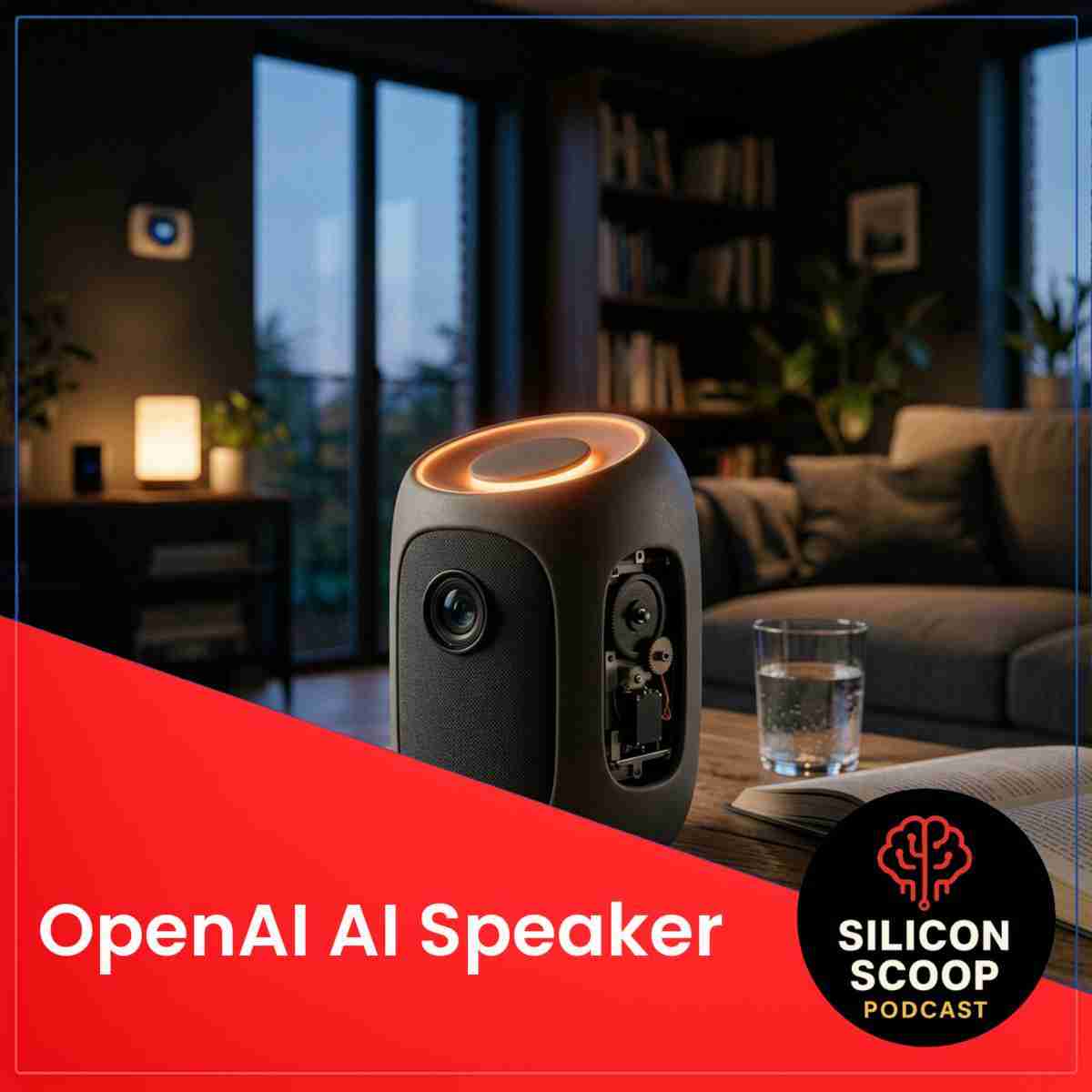
OpenAI AI Speaker Changes What a Home Computer Can Be
Estimated reading time: 8 minutes
Key Takeaways
- OpenAI is not building another smart speaker, but something closer to a new kind of home computer — one with no screen, a built-in camera, and a voice engine powerful enough to hold a real conversation rather than just answer a command.
- The device is described as a portable, screenless speaker using GPT-Live as a full-duplex voice engine, with heavier reasoning tasks reportedly offloaded to a cloud model called GPT-5.5.
- OpenAI acquired io Products in an all-stock transaction valued at approximately $6.5 billion, bringing Jony Ive’s hardware team into the core of its new hardware division.
- Apple filed a lawsuit — Apple Inc. v. Liu — and OpenAI has committed not to ship any consumer devices before at least April 2027.
- OpenAI’s broader hardware roadmap reportedly includes roughly five devices, including a smartphone-replacement AI device and Codex Micro built with Work Louder.
Table of contents
- OpenAI AI Speaker Changes What a Home Computer Can Be
- What Exactly Is the OpenAI AI Speaker?
- The Jony Ive Connection and the io Products Acquisition
- How It Stacks Up Against Existing Smart Speakers
- Apple’s Trade Secret Lawsuit and the Legal Risk OpenAI Faces
- OpenAI’s Broader Hardware Roadmap
- The Race With Apple and What It Means for Consumers
- What This Actually Means in Practice
- FAQ: OpenAI AI Speaker
OpenAI is not building another smart speaker. What the company is quietly assembling is something closer to a new kind of home computer — one with no screen, a built-in camera, and a voice engine powerful enough to hold a real conversation rather than just answer a command. This is the OpenAI AI speaker, and it may be the most consequential consumer device launch since the original iPhone.
The story behind it involves a $6.5 billion acquisition, the legendary designer who gave Apple its look, a lawsuit from Apple itself, and a race to own the living room before anyone else gets there. Whether you follow AI, tech hardware, or just want to know what will sit on your kitchen counter in 2027, this one matters.
What Exactly Is the OpenAI AI Speaker?
Let’s start with what we actually know, based on reporting from Bloomberg, Reuters, and several secondary sources.
The device is a portable, screenless speaker. It has no display. Instead, it is designed to interact with you entirely through voice — but not in the way your Amazon Echo or Google Nest does today. Those devices wait for you to say a wake word, then they look up an answer. The OpenAI speaker is built to do something fundamentally different.
According to technical write-ups reviewed by multiple outlets, the device uses GPT-Live as a full-duplex voice engine. Full-duplex means it listens and speaks at the same time, the way a real person does in a conversation. It does not stop and wait. It can interrupt, follow up, and pick up on context from earlier in the conversation. Heavier reasoning tasks are reportedly offloaded to a cloud model called GPT-5.5, giving the device access to far more intelligence than it could handle on its own hardware.
The device is also described as moveable, meaning it is not designed to sit in one spot like a stationary smart home hub. It is meant to travel with you from room to room. Some reports reference a small camera built into the unit and mechanical elements that suggest motion — possibly the ability to track a speaker as they move.
This is not a product designed to play music and set timers. OpenAI is explicitly framing it as a “computer built for AI” — a device where the intelligence is the whole product, not a feature added onto something else.
Sources:
- Bloomberg reporting on OpenAI’s first device
- Reuters reporting on OpenAI’s first hardware device
- TechCrunch reporting on the screenless speaker
The Jony Ive Connection and the io Products Acquisition
The design side of this story is just as interesting as the technology.
In May 2025, OpenAI completed the acquisition of io Products, a hardware startup co-founded by Jony Ive — the designer who spent decades at Apple and was responsible for the look of the iMac, iPod, iPhone, and Apple Watch. Ive left Apple in 2019 and set up his own design firm, LoveFrom, and later co-founded io Products to explore what hardware could look like if it was built from the ground up with AI in mind.
The deal was an all-stock transaction valued at approximately $6.5 billion. OpenAI already held a 23% stake in io Products, and it paid roughly $5 billion in additional shares to acquire the remaining 77%. At the time, this implied OpenAI’s overall valuation was sitting around $300 billion. The io team brought about 55 employees into OpenAI, and they now form the core of the company’s new hardware division.
Ive’s firm, LoveFrom, retained its independence as a creative partner rather than becoming a fully absorbed internal team. A joint letter from Sam Altman and Jony Ive published on OpenAI’s website confirmed this structure and described the ambition: to build devices that feel natural, human, and worthy of being in your home.
What does Ive actually bring here? Beyond aesthetics, he brings a philosophy. His approach to product design has always prioritized removing things rather than adding them — stripping a product down to what it needs to be and nothing more. A screenless AI speaker fits that philosophy perfectly. There is no screen because you do not need one if the AI is good enough.
Sources:
How It Stacks Up Against Existing Smart Speakers
To understand why the OpenAI AI speaker is getting serious attention from analysts, you need to understand how limited today’s smart speakers actually are.
Amazon Alexa, Google Assistant, and Apple’s Siri (in its current form on HomePod) all operate on a command-and-response model. You say something specific, the device parses it, runs a lookup or a script, and gives you an answer. The interaction ends. There is no memory of what you said five minutes ago. There is no ability to anticipate what you might need next. There is certainly no back-and-forth that resembles a real conversation.
The GPT-Live voice assistant powering the OpenAI speaker works differently in several key ways:
- Full-duplex audio: It does not require you to pause and wait. The conversation flows naturally.
- Contextual memory: It can hold information across a conversation and, depending on how OpenAI configures it, potentially across sessions.
- Proactive behavior: With a camera and environmental sensors, the device is described as capable of observing its surroundings and responding to context — not just commands.
- Deep reasoning via cloud: By routing complex tasks to GPT-5.5 in the cloud, the device can answer follow-up questions, help with planning, and handle nuanced requests far beyond what Alexa or Google Home can do today.
Industry analysts and hardware observers widely agree that this functional gap — between today’s command-driven assistants and a true conversational AI companion — is real and significant. If OpenAI can deliver on what has been described, it would represent a meaningful jump beyond anything currently on the market.
Pricing is a key variable. Early secondary reporting from The Information, relayed by 9to5Mac, pegs the expected US price at roughly $200 to $300. That puts it above mass-market smart speakers like the $50 Amazon Echo Dot but well below premium audiophile systems. It is a deliberate positioning — premium enough to signal quality, accessible enough to reach mainstream buyers.
Sources:
Stop Managing Manual Work. Start Running a Smarter Business.
Every hour your team spends on repetitive tasks is an hour not spent on growth. At Flowgrammer, we design custom automation systems that eliminate manual workflows, save time at scale, and let your business run without you babysitting every process.
👉 See How Automation Works for Your Business
Apple’s Trade Secret Lawsuit and the Legal Risk OpenAI Faces
Here is where the story gets complicated.
As OpenAI was building momentum toward a hardware launch, Apple filed a lawsuit — Apple Inc. v. Liu — that targets former Apple employees who joined io Products and, by extension, OpenAI. The case is being argued under the California Uniform Trade Secrets Act (CUTSA) along with breach-of-contract theories.
The core allegation is serious. Apple claims that OpenAI’s chief hardware officer, Tang Tan, ran a recruiting program designed to extract confidential Apple hardware information from employees who were leaving. According to legal commentary and case filings reviewed by The Innovation Attorney, the alleged information includes project codenames and physical component details — the kind of specifics that could give a hardware startup a meaningful head start in development.
For OpenAI, the legal consequences are already showing up in ways that affect the product timeline:
- OpenAI has reportedly abandoned the “io” branding for its hardware line in response to the lawsuit.
- In court filings, OpenAI has committed not to ship any consumer devices before at least April 2027.
- Apple is seeking an injunction that could block OpenAI from selling hardware devices altogether, based on the argument that those products benefited from stolen trade secrets. No final order has been issued yet.
Legal analysts who follow innovation and trade secret law note that even if OpenAI ultimately wins the case, the discovery process alone creates a significant burden. Apple’s legal team would gain access to internal hardware documents, communications, and development timelines. That exposure has real strategic cost, separate from any final ruling.
The April 2027 self-imposed shipping constraint is particularly important. OpenAI’s hardware team has been working toward a 2026 launch for certain products. That window now appears effectively closed for consumer-facing devices. The AI speaker, already targeted for 2027, may slip further depending on how the legal proceedings develop.
Sources:
OpenAI’s Broader Hardware Roadmap
The AI speaker is not a one-off product. It is the first visible piece of a larger hardware strategy.
Reports indicate that OpenAI’s hardware roadmap now includes roughly five devices at various stages of development. Two other products have been described with some specificity:
1. A Smartphone-Replacement AI Device
One of the five devices is described as a potential replacement for the smartphone — not an Android phone or an iPhone clone, but something designed from the ground up to interact with AI as its primary function. Details on this product are limited, but the framing suggests OpenAI is thinking about what you carry in your pocket, not just what sits on your shelf.
2. Codex Micro
This is a separate, developer-focused gadget built in collaboration with Work Louder, a mechanical keyboard and input device company. Codex Micro is aimed at coders and technical users and was reportedly scheduled for a mid-2026 launch — though the legal constraints described above may affect its timeline as well.
The strategic logic here is straightforward: OpenAI wants to own the interface layer. Right now, people access GPT through their phones, laptops, and browsers — devices made by Apple, Google, Samsung, or Microsoft. Each of those companies has an interest in keeping their own AI front and center. If OpenAI can build the hardware that people reach for first, it removes that dependency entirely.
This is a familiar playbook. Amazon built Alexa-powered devices to create a direct relationship with consumers and reduce dependence on other platforms. Apple built the iPhone to move computing off the desktop and into a device it fully controlled. OpenAI is attempting something similar, but with a model-first philosophy: the AI comes first, and the hardware is built around it.
Sources:
The Race With Apple and What It Means for Consumers
Apple is not standing still.
Reports indicate that Apple is developing its own AI-focused home device, internally referred to as J490, described as a smart-home hub. Apple is also reportedly working on related concepts that include a robotic-arm display. Meanwhile, iOS 27 is expected to ship with a significantly improved version of Siri — what some are calling a “new Siri” — that would close some of the capability gap between Apple’s assistant and GPT-powered alternatives.
So you have two of the world’s most prominent tech companies converging on the same category at roughly the same time, from opposite directions.
Apple is coming from a position of enormous hardware strength — supply chain mastery, retail presence, a loyal installed base of iPhone users, and deep operating system integration. Its weakness, as many observers note, is that Siri has fallen years behind ChatGPT and Google Gemini on raw AI capability.
OpenAI is coming from a position of AI-model strength — GPT-Live is widely regarded as the most capable conversational AI available to consumers today. Its weakness is that it has never built and shipped mass-market consumer hardware, has no retail footprint, no established supply chain, and now faces a significant legal constraint from the very company it is trying to compete with.
The consumer question is equally interesting: Will people accept an always-on AI device with a camera in their home?
This is not a trivial concern. Smart speakers already raised privacy questions when they were “just” listening for wake words. A device that watches, listens, tracks context over time, and uses that information to improve its responses is a fundamentally different privacy proposition. OpenAI will need to address this clearly — both in product design and in public communication — if it wants mainstream adoption.
Sources:
What This Actually Means in Practice
Pull back from the legal filings and acquisition numbers for a moment, and think about what this device would look like in a real home.
You are cooking dinner. You ask a question without stopping what you are doing. The device not only answers but follows up with a related suggestion based on what you were talking about earlier in the day. It is not waiting for a wake word — it is tracking the conversation. You move to the living room; the device is portable enough to follow or already has a companion unit there.
That is the use case OpenAI is building toward. Not a speaker that plays music and tells you the weather. A genuine AI companion that understands context, remembers things, and participates in your day.
Whether that sounds exciting or unsettling probably depends on your relationship with technology and privacy. But from a product design perspective, it is a coherent and well-reasoned vision. It addresses a real gap in the market. And it has one of the world’s best designers and one of the world’s most capable AI models behind it.
The question is not whether this category will exist. It is who will own it.
FAQ: OpenAI AI Speaker
1. What is the OpenAI AI speaker?
It is OpenAI’s first planned consumer hardware product — a portable, screenless device that uses the GPT-Live voice engine to hold real conversations. Unlike traditional smart speakers, it does not just respond to commands. It is designed to listen and speak simultaneously, remember context, and interact in a way that resembles a real conversation.
2. Who designed the OpenAI AI speaker?
The design was led by the team at io Products, co-founded by Jony Ive, the legendary designer behind Apple’s iPhone, iPod, and iMac. OpenAI acquired io Products in a deal worth approximately $6.5 billion in May 2025. Ive’s creative firm, LoveFrom, continues to work with OpenAI independently.
3. How much will the OpenAI AI speaker cost?
Early reporting from The Information and relayed by 9to5Mac suggests the device will be priced at roughly $200 to $300 in the US market. This positions it above entry-level smart speakers like the Amazon Echo but significantly below high-end audio equipment.
4. What makes GPT-Live different from Alexa or Google Assistant?
GPT-Live operates as a full-duplex voice engine, meaning it can listen and speak at the same time — like a real person in a conversation. It carries context across an entire exchange, not just a single command. It also routes complex reasoning to a cloud model called GPT-5.5, giving it access to much deeper intelligence than traditional command-driven voice assistants.
5. What is the Apple trade secret lawsuit about?
Apple filed a lawsuit — Apple Inc. v. Liu — alleging that OpenAI’s chief hardware officer, Tang Tan, ran a recruiting program that extracted confidential hardware information from departing Apple employees. Apple is pursuing claims under the California Uniform Trade Secrets Act and breach-of-contract theories. The company is seeking an injunction that could block OpenAI from selling hardware products.
6. Has the lawsuit already affected OpenAI’s hardware plans?
Yes. OpenAI has dropped the “io” branding for its hardware line in response to the lawsuit. In court filings, the company has committed not to ship consumer devices before at least April 2027. This constrains the launch window for the AI speaker and potentially other products in the roadmap.
7. Does the OpenAI AI speaker have a camera?
Based on available reports, yes. The device is described as including a camera and environmental sensors that allow it to observe its surroundings and respond to context, not just voice commands. This is one of the features that distinguishes it from existing smart speakers.
8. What other hardware is OpenAI working on?
OpenAI’s hardware roadmap reportedly includes around five devices in total. Beyond the AI speaker, reports describe a smartphone-replacement AI device and a developer-focused gadget called Codex Micro, built in collaboration with the keyboard company Work Louder. Codex Micro was originally targeted for a mid-2026 release.
9. How does this compete with Apple’s own home AI device?
Apple is reportedly developing a smart-home hub codenamed J490 and working on a significantly upgraded version of Siri for iOS 27. Apple holds major advantages in hardware experience, supply chain, retail presence, and ecosystem integration. OpenAI’s advantage is its AI model — GPT-Live is widely regarded as more capable than current Siri for conversational tasks. The two companies are converging on the same product category from opposite strengths.
10. When will the OpenAI AI speaker actually be available?
The current target is sometime in 2027, though the legal constraint tied to the Apple lawsuit sets a floor of April 2027 at the earliest. Depending on how the legal proceedings develop, the timeline could shift further. No firm release date has been announced by OpenAI.
Additional Links
Flowgrammer.ca – 💡 Unlock AI-Powered Automation! Let flowgrammer.ca handle complex workflows so you can focus on growing your business.
Flowgrammers.ca – 💡 Join Toronto’s Fastest Growing AI and Business Automation Community.
- SRED Funding Solutions – Maximize your R&D tax credits and secure funding for your innovation.
- Silicon Scoop Podcast – Stay Informed, Stay Ahead!
- Startup Talk Podcast
- Flowgrammer Youtube
- Startup Investor Drinks – Join Toronto’s Startup Community and connect with fellow startup enthusiasts and investors.
- TorontoStarts Startup and Entrepreneur Community – Become a part of Toronto’s thriving startup ecosystem.
- Workhaus – Discover flexible workspace solutions for your business needs.
- Work with The Startup Coach – Get expert guidance and mentorship for your startup journey.
- Reach out to Jon Irwin on LinkedIn – Connect with our co-host and technology expert.
Episode transcript
Read the full transcript
Craig: openai wants to replace the screen with a device that watches, listens, remembers, and talks like another person in the room. the breakthrough is natural conversation, but the battle will be whether consumers trust an always aware ai companion in their homes. so openai is reportedly developing a portable screenless home device containing cameras, environmental sensors, and movable mechanical opponents. instead of waiting for isolated commands like conversational smart speaker, it would use gpt live to carry on continuous conversations and delegate difficult work to more powerful cloud models. what do you think of this, john?
Jon: this sounds like the amazon alexa, all over again, but a little bit smarter this time. i can't say i'm surprised. it does make sense. again, the always on is the thing that really concerns me. now what would be cool is if you could run a local llm and have this listening all the time and learning and, you know, all that sort of stuff, taking in all this information so that it doesn't get out to the interweb. but, i think this is a good idea because having a smarter alexa, is helpful. like, i was using alexa for a while when it first came out, but there was a lot of limitations. but now that i'm a little bit more aware of data and, and data usage and and and all that sort of stuff and privacy, i'm less apt to get, a speaker like this. but this is still great. like, this makes sense to me. what about you? what do you think?
Craig: well, i think we are leaps and bounds away from alexa and siri. i think the world is not prepared for what is happening. i have several agents. i don't know. right now, i'm gonna say six on the go that i can talk to, and get them to actively do stuff. i usually type to them, but there's a lot of times where just talking to them is easier. and the more you look around, products like whisperflow and a few others, i've even got a, open source one installed on one of my machines. i hit a special key, the thing, and i dictate to it, and it does what i want it to. these things are like what we wanted the rabbit r one to be because the back ends are now connected to what they call large action models where you're connected to your cowork claude or your opencloud agent or your hermes or your, chatttp work, engine. these things can or open whatever and actively do stuff. so now you hook up a speaker to them. this thing knows who you are, knows your business, knows where all your files are, knows what's going on, and can actively do stuff on your behalf rather than, hey. play a song. you know, it can actively do work, develop, do, create apps, email people, do work, create documents, proposals, whatever you want. so the world changes. and i think what we got before from a voice interface was interesting. it just never, really became what people wanted.
Jon: no. and, again, i i like this. i like can, that, yeah, it can act on your behalf. it can access different things. but, again, worried about hacking. but, hey. if i can you know what? i thought we could easily create a device and build it ourselves and just link it to a local llm if this track dbt speaker doesn't allow that. i don't think it'd be too difficult. right? you just get a raspberry pi. you get a couple sensors. it wouldn't look too pretty, but, it would be local and be more safe. right?
Craig: yeah. absolutely. you could do all of that. i just don't know how much consumers are really concerned about privacy on most of this stuff.
Jon: yeah. compared to you and i don't, i agree. they're not too concerned. but what's interesting is that there's no screen on this. right? but we've talked about this. we talked about a device. we've talked about devices eliminating screens, but, openai is believing that ai should disappear into the background kind of thing. so instead of interacting with it through a screen, you just talk naturally, which i still i still don't interact with any of my llms using voice. i know a lot of people do, but i don't. i just type to it. i don't know why i don't. i've never i've never been one to dictate. maybe because i have adhd, and if i were to actually dictate, yeah, it wouldn't be the same coming out as if i was typing, if that makes sense.
Craig: it does. but the more i use them, the more i'm like you where i'm a little dyslexic and i need the time for me to sit down and type it, stops my flying brain from sending 10,000 things at a time and makes it focus on this one thing i have to communicate. because otherwise, when you're talking, it's like, okay. i got this to do, this to do, this to do, and they all come rushing out. right? but, you eventually get to the point where it's faster. it's just faster to say, okay. do this. you know, commit that to github, then do the update, then phase one, then send the email and get back to me when you're done. okay. and it goes and does it. you know? you don't anyway, back to this. our revealed, reported target is for 2026 with sales expected in 2027. openai previously stated in a separate trademark case that its jony ive device would not ship before february 2027, but no official launch date. so we're not a 100% sure if this is a johnny eyes device and whether this will be slowed down by the apple openai lawsuit, that we talked about last week. the reported cost is 2 to $300 us, and it requires a chatgdp subscription, optional premium tier for cloud service fees not disclosed. yeah. so it's interesting.
Jon: yeah. the let's just talk about because we kinda skipped over the camera and sensors because for those of you that are wondering, well, what can it possibly do? right? so this ambient ai device, it could continuously understand which room you're in, who's present, what objects are nearby, the lighting conditions, time of date, ongoing conversations, user routines, household patterns. there's so much. like, it could anticipate needs. like, oh, i'm noticing you're heading into work. traffic is unusually heavy today, which kinda freaks you out, but whatever. that's where we're going. or you usually take your medication around now. have you taken it? this would be great for older people, for sure. better than the alexa. but, i think this is, this is interesting. the flip side of this, which i don't know if we're covering today, is the, so this device that they're building and the fact that apple is suing, openai too. so, there's a bunch of things going on.
Craig: so, yeah, we can talk about whether we wanna talk about the trade secret lawsuit because we're not a 100% about which projects, are affected by this lawsuit. openai has, reportedly abandoned the io branding. in core follow-up filings. openai has committed not to ship any consumer devices before at least april 2027. i guess that might have to do with some of these, trade agreements. when people like johnny ives leaves, they have to have so many years before they can, do what have you. legal analysts that follow the trade secret, law note that even if openai ultimately wins the case discovery process alone creates a significant burden. so we're gonna see a bunch of stuff coming out about openai, which is probably been why they're delaying the ipo in you know, we talk about all sorts of stuff, but discovery means they get to look at all these emails and all this information and all this crap gets out. and if they don't have all their ducks in order, it might have a real impact on their ipo. so i think they'd like to see that behind them before that happens. right. it's not their first piece of hardware because they do have, this codecs micro for developers. i don't know if you've seen it before. it looks like this. i'm sharing it on the screen. yeah.
Jon: that's device. yeah. the codecs. yeah. for yeah.
Craig: so i'm trying to get it to show you. there you go. it shows it for a second then back to this guy. but it's mostly aimed at developers. yeah. and that was launched already. you can buy it off, work louder. it's interesting. so we'll have to see if we can get to a point where consumers are ready for this because the google home speaker, the alexa, and siri all did not
Jon: do well. alexa home speaker did well.
Craig: well, i don't think it well, i you say do well. i don't think it's a profitable device for them.
Jon: i think so.
Craig: i'm gonna be wrong. i'll look it up later. and, yeah. i guess my point is i don't think the intelligent speaker market up to this point as a whole has been successful, because it doesn't have enough functionality on the back end. we got people who wanna play music. we got people who wanna do some amazon stuff. i use siri to set alarms, but i don't do that. when i'm talking to apple people, they use siri a little bit, but not a lot, because, you know, it doesn't work consistently enough, and there are a bunch of other things. like, these are the reasons why they really haven't taken off in the consumer market. they have, i think, in the geek market where i have a google home and an alexa somewhere. i use the google home just for playing music, and i have the microphone off on it. so the point being is they weren't able to do much before. you could tie in a few things. you could get it to play the radio, tell the news, maybe play a podcast, any, like, audio type stuff. great. now we're gonna you're gonna have functionality. the question is, is that enough? and will consumers have enough functionality versus, say, geeks who have all these things installed with agents and things that can get things handled? are we moving to every person's gonna have multiple agents whether they know how to use them or not, and they're just gonna work for them. and now we're gonna be able to talk to them through devices like this or whatever they have handy. yeah. so,
Jon: so you were right. amazon historically sells echo speakers at or near cost. and so internal documents had revealed that the division lost over $25,000,000,000 between 2017 and 2021. so
Craig: okay. yeah. i, thought i read that somewhere or not even out those numbers, but it was and i couldn't confirm it. thank you. well, i guess but i mean
Jon: if you're not speaking to account the value of the data, right, which is why
Craig: the value of the data, being able to purchase stuff, like, if you can have hook it up your amazon account, account and automatically order stuff, we have that, you know, reorder this, reorder that, add this to my thing. yeah. the value inside that ecosystem might pay off, but the smart speaker as a whole has been a failure as a product. the market hasn't taken off. they haven't been profitable. again, because i believe the back end hasn't been able to do enough stuff. so now that we're moving to that, like, let's go. everybody wanted to rabbit our run for the large action model when it came out, like, it doesn't do any of the stuff and everyone's disappointed. but now we're getting to the point where the back ends are catching up to that promise. so yeah. you know, at this point, i don't have a computer that doesn't have an active agent on it that i can talk to to get stuff done, whether type two or whatever, because it's just so much more productive for me. me, and i'm not sure everyone else is like that. so is everyone else willing to do this and pay 2 to 300 plus have a subscription to chatttp? at what level, in this economy is the average consumer willing to take this and use it? so we'll have to see. i'm skeptical that the average consumer will do this. we'll see what about workplaces because then you have the data issue because it could help productivity. but i think more of the other product, we were just talking about the codecs micro would be better for that. so we'll see. i just think that i'm curious to see where this is going. it might just be the first proof of concept to a portable thing you carry with you all the time that knows your context, like, the pendant stuff that, you know, comes out and will record everything and then put everything in context out of the real time or later. and maybe match in an ecosystem with a visual glasses and what have you at some point. maybe. but i'm still i don't think this is gonna be successful because i don't think there's the mass market is ready for it. yep. so let us know what you think. openai is not simply building a smarter speaker. it's betting the cat conversation, vision, and contextual memory can become the next computing interface. would you put a camera equipped chatgtp companion in your kitchen if it genuinely made life easier, or is it continuous awareness a privacy line you will not cross? and then it's supposed to have a battery, and you can take it with you. i'm not quite sure how that works, taking it from room to room. because if it just sat in one place, then you'd how many do you need if you wanna continuously use it throughout the day? so let us know what you think. would you jump at this, or is this not something you would be looking for?
More from Silicon Scoop
All episodes
silicon-scoop · October 19, 2026
OpenAI’s Jalapeño Chip Stakes a Claim Against Nvidia Blackwell in Real-World AI Inference
OpenAI Jalapeno chip challenges Nvidia GB300 Blackwell with InferenceX AI benchmark results, reshaping AI inference accelerator efficiency and latency.
View episode

silicon-scoop · October 16, 2026
Meta’s $18 Billion Teen Safety Settlement: Soft Guardrails, Hard Leverage Over TikTok and YouTube
Deep dive on Meta teen safety settlement, social media addiction lawsuit, new Facebook Instagram time limits and pressure on TikTok YouTube age verification.
View episode

silicon-scoop · October 15, 2026
How Claude Mythos Is Reshaping Cryptanalysis: HAWK, AES and the Rise of AI-Driven Crypto Research
Claude Mythos cryptanalysis weakens HAWK post-quantum signature, speeds AES Möbius Bridge attack, and powers CryptanalysisBench benchmark in AI-driven crypto research.
View episode