
Inside Stathera’s $75M Bet on Silicon Timing and Canada’s AI Chip Future
Inside Stathera’s $75M Bet on Silicon Timing and Canada’s AI Chip Future https://torontostarts.com/2026/08/27/stathera-silicon-timing-canada/ Flowgrammer.ca -> https://flowgrammer.ca/ AI News and Resources -> https://flowgrammers.ca OpenClaw Toronto -> https://openclawto.com/ Inside Stathera’s $75M Bet on Silicon Timing and Canada’s AI Chip Future Stathera silicon timing startup raises $75M to power AI data center chips with MEMS timing solutions, reshaping Canadian semiconductor innovation. FLogrammer is your Business Automation Experts - https://Flowgrammer.ca Startup Investor Drinks Toronto - https://startupdrinksto.com/ Toronto’s Startup Community - https://torontostarts.com/ Silicon Scoop Silicon Scoop Podcast - https://torontostarts.com/silicon-scoop/ Apple: https://podcasts.apple.com/us/podcast/silicon-scoop/id1758711826 Spotify: https://open.spotify.com/show/5bAzF0MwV6TtLhJAhvHayI YouTube: https://www.youtube.com/playlist?list=PLj4v-RoA7A-gT62vrEYqh1zCv-0Hj-o5J Startup Talk Startup Talk Podcast -> https://torontostarts.com/startup-talk-toronto-startup-podcast/ Apple -> https://podcasts.apple.com/us/podcast/startup-talk/id1763804003 Spotify -> https://open.spotify.com/show/1siJMILILidHAiAsrX2VBU YouTube: https://youtube.com/playlist?list=PLj4v-RoA7A-jxV5FHs5e61oIsuvUJYmT_&si=LYegRe5GYLKNQ7xL
With Craig Major and Jon Irwin
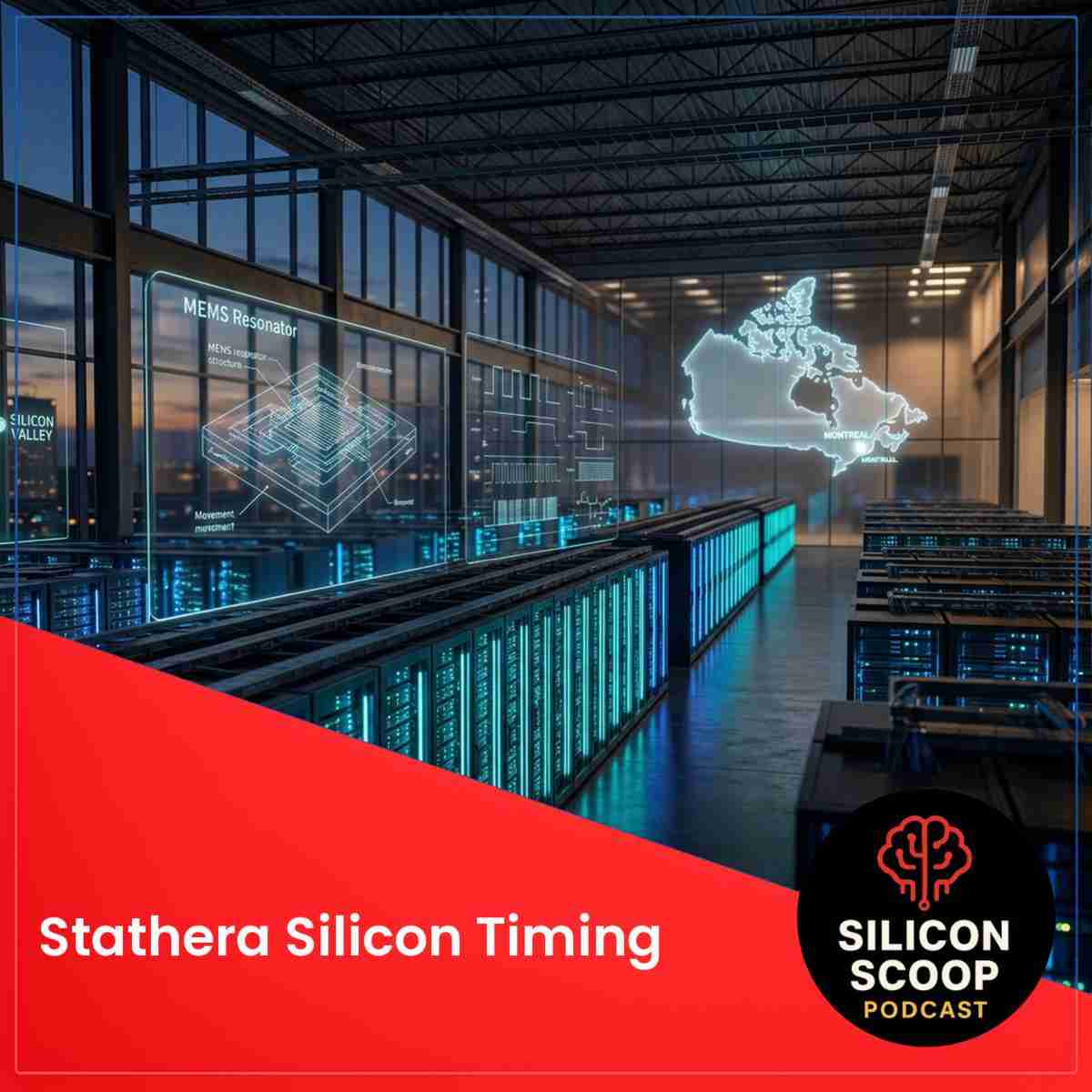
Stathera Silicon Timing Just Changed How AI Data Centers Sync
Estimated reading time: 10 minutes
Key Takeaways
- On June 30, 2026, Stathera Inc. closed an oversubscribed US$55 million Series B, bringing its total funding to US$75 million.
- The problem is called timing drift.
- Stathera’s technology is built around what the company calls a DualMode® MEMS resonator.
- It outputs both a 32.768 kHz and MHz-class frequency from a single device.
- The GEN3 platform is being architected from the ground up for AI workloads, enterprise communications, and hyperscale data center (CED) applications, with initial customer sampling targeted for around 2028.
Table of contents
- Stathera Silicon Timing Just Changed How AI Data Centers Sync
- Key Takeaways
- The AI Data Center Problem Nobody Talks About Enough
- What Makes Stathera’s MEMS Timing Technology Different
- Who Backed This Round and What That Signals
- George Xereas and the Decision to Stay in Canada
- The SiTime Challenge and What Analysts Are Saying
- What This Means for Canada’s Semiconductor Ambitions
- The Road Ahead: GEN3, 2028, and the AI Timing Market
- Frequently Asked Questions
Montreal is not supposed to be where chip companies are born and stay. That is the conventional wisdom. You build something promising in Canada, and then you either sell to an American firm or you pack up and head to Silicon Valley. It is a pattern so common it barely makes the news anymore.
Stathera Inc. is trying to break that pattern in a very loud way.
On June 30, 2026, the Montreal-based semiconductor startup closed an oversubscribed US$55 million Series B, bringing its total funding to US$75 million. The money is earmarked for one specific mission: scaling a silicon timing technology that the company believes will solve one of the most overlooked bottlenecks in modern AI infrastructure. And they plan to do it from Canada.
This is the story of Stathera silicon timing, what it does, why it matters, and what it means for the future of Canadian semiconductors.
The AI Data Center Problem Nobody Talks About Enough
When most people think about what makes an AI data center powerful, they think about GPUs. More GPUs, more power, better AI. That logic makes sense on the surface.
But there is a hidden problem that sits quietly underneath all those rows of expensive chips, and it is costing companies billions of dollars in wasted computing potential.
The problem is called timing drift.
Here is how it works in plain language. In an AI data center, thousands of GPUs have to work together in perfect coordination. They pass data back and forth at extreme speeds. For that to work properly, every chip needs to be synchronized to the same clock signal. When those clocks drift even slightly out of alignment, the whole system slows down. Jobs have to wait. Data has to be resent. The system stalls.
Industry analysts have reported that AI cluster timing drift can cap GPU utilization at just 20 to 40 percent of capacity. Think about that for a moment. A company might spend hundreds of millions of dollars on GPU hardware and only get a fraction of the performance they paid for, because the timing signals keeping those chips in sync are not precise enough.
Stathera’s research and investor communications peg the addressable market for AI data center synchronization solutions at roughly US$1.5 billion by 2030, which tells you just how serious this problem has become for the industry. (Industry analysts have reported)
The current standard solution? Quartz oscillators. These are the same basic timing components that have been used in electronics for decades. They work. But they were not designed with AI-scale synchronization in mind, and they are showing their age when pushed to the demands of hyperscale GPU clusters.
This is the gap that Stathera is building into.
What Makes Stathera’s MEMS Timing Technology Different
To understand why investors are excited about this Montreal startup, you need to understand what makes its core technology stand apart from the quartz-based competition.
Stathera’s technology is built around what the company calls a DualMode® MEMS resonator. MEMS stands for Micro-Electro-Mechanical Systems. It is a type of tiny mechanical structure etched onto a silicon chip. Instead of using a piece of quartz crystal to generate a timing signal, Stathera uses a precisely engineered silicon structure that vibrates at controlled frequencies.
That by itself is not entirely new. Silicon MEMS timing chips have existed for years. But Stathera’s patented DualMode architecture does something that no single quartz oscillator can do on its own.
It outputs both a 32.768 kHz and MHz-class frequency from a single device.
Why does that matter? Because most electronics, and data centers in particular, need multiple different clock frequencies running simultaneously. Traditionally, you would need separate quartz oscillators for each frequency range. Stathera’s single silicon component can handle both, consolidating what used to require multiple discrete components into one.
For AI data centers, this has real consequences:
- Fewer components means fewer points of failure
- Silicon manufacturing allows for tighter tolerances than quartz cutting
- Temperature stability in silicon MEMS can be engineered to a degree quartz cannot match
- Single-chip consolidation reduces board space and system complexity
The company’s current GEN2 portfolio is already in motion for mobile, IoT, and connected device applications. These are the products moving toward mass production today.
The GEN3 platform is where the AI data center story really begins. This next generation is being architected from the ground up for AI workloads, enterprise communications, and hyperscale data center (CED) applications. Initial customer sampling for this platform is targeted for around 2028.
This is not a product being retrofitted from consumer applications into enterprise use. Stathera is designing GEN3 specifically for the synchronization demands of large GPU clusters. That distinction matters enormously.
(Stathera announces US$55 million Series B)
Who Backed This Round and What That Signals
The investors behind the Series B are not accidental. Each one tells you something about where Stathera sits in the global semiconductor ecosystem.
The round was oversubscribed, which means demand from investors exceeded what Stathera was even asking for. That is a meaningful signal in any market. In the current climate for semiconductor investment, it is especially telling.
Lead investor: Maverick Silicon — a firm with deep roots in chip industry strategy.
Other participants include:
- Celesta Capital — a prominent deep tech and semiconductor-focused venture firm
- BDC Capital — the Business Development Bank of Canada, the only Canadian institutional investor in the round
- MediaTek Innovation Fund — the venture arm of MediaTek Inc., one of the world’s largest chip designers based in Taiwan
- TXC Corporation — a major Taiwanese quartz and timing component manufacturer (their participation as a strategic backer in a competitor-adjacent company is particularly notable)
- Ultratech Capital Partners
- Seiko Epson — in some reports identified as a strategic backer, another established timing industry player
The presence of TXC Corporation and Seiko Epson is worth pausing on. These are companies that manufacture traditional quartz timing components. When established players in an incumbent technology back a startup that is challenging that same technology, it suggests they see the writing on the wall and want a stake in what comes next.
The participation of MediaTek also signals something important. MediaTek makes chips for billions of devices around the world. Their investment suggests they see Stathera’s timing technology as relevant to their own product roadmap in the future.
The fact that BDC Capital is the sole Canadian investor in the round is a complicated data point. It reflects the ongoing challenge Canadian founders face when trying to raise later-stage capital domestically. The money came largely from the U.S. and Taiwan, even as the product is built in Canada.
Are You Still Spending Hours on Work That Should Run Itself?
Most growing businesses are bleeding time on repetitive tasks that could be automated today. Scheduling, reporting, data entry, follow-ups — these are not strategy. They are friction. At Flowgrammer, we build custom automation systems that remove the manual work from your operations so your team can focus on what actually moves the needle.
👉 See How Business Automation Works for You
George Xereas and the Decision to Stay in Canada
The business case for Stathera’s technology is compelling on its own. But the company’s story is also about something more than product specs and market size.
Founder and CEO George Xereas has received direct offers to relocate the company to the United States. He has turned them down.
That is not a trivial thing. Canada has a well-documented pattern of what commentators sometimes call the “branch plant” problem in tech — promising startups get acquired by American firms or the founders themselves move to the U.S. because that is where the capital, the customers, and the talent concentration exist. It is not a moral failure. It is a rational economic response to the incentives in the market.
Xereas describes building a chip company in Canada as “more painful” than doing so in the U.S. He has been direct about the structural challenges: securing later-stage funding is harder, recruiting executive talent with semiconductor experience is harder, and the proximity to major customers requires deliberate effort rather than being a natural side effect of geography.
His approach to these challenges is practical. Stathera is building out a presence in Silicon Valley specifically to engage with potential customers and maintain an engineering team in the U.S. He is not pretending geography does not matter for certain functions. He is being strategic about which parts of the company need to be where.
But the core of the operation — and critically, the manufacturing of the MEMS components — stays in Canada. The supply chain spans Canada and Asia, with the most technically sensitive component, the MEMS resonator, produced domestically.
Xereas is also thinking ahead about supply chain resilience. The company is actively considering alternative vendors to prepare for potential tariff-related disruptions, a prudent posture given the volatility in global trade policy that has characterized recent years.
This dual posture — Canadian roots, global reach — is the model Xereas is testing. Whether it can work at the scale needed to compete with incumbents like SiTime, the dominant California-based precision timing company that Stathera is positioned against, remains the central question.
(Stathera announces US$55 million Series B)
The SiTime Challenge and What Analysts Are Saying
No analysis of Stathera is complete without talking about SiTime Corporation.
SiTime is the current market leader in silicon MEMS timing. It is publicly traded, California-based, and has spent over a decade establishing itself as the go-to alternative to quartz oscillators for precision timing applications. Its products are used in data centers, telecom infrastructure, and enterprise networking equipment today.
Stathera is positioning itself as a direct independent challenger to SiTime. That is a bold claim for a startup, and analysts are watching carefully.
What gives Stathera credibility in this comparison:
- Purpose-built AI architecture. SiTime’s data center products were largely developed from existing product lines adapted for enterprise use. Stathera’s GEN3 is being designed from scratch for AI data center synchronization. That ground-up approach can produce better results for a specific use case, even if it takes longer to deliver.
- Oversubscribed funding. An oversubscribed round suggests investor conviction that is harder to dismiss. When the people putting up real money believe a challenger can compete, that carries weight.
- Strategic investor mix. Having quartz industry insiders like TXC and potentially Seiko Epson on the cap table suggests the incumbent ecosystem itself sees disruption coming.
Analyst commentary across technology and semiconductor coverage converges on the same three themes:
- Stathera’s DualMode MEMS platform is a credible technical alternative to SiTime for AI-specific workloads.
- The GPU utilization problem caused by timing drift is real and getting more expensive as AI cluster sizes grow.
- This round is a test case for whether Canada can support a semiconductor company through to commercial scale, rather than losing it to acquisition or relocation.
What This Means for Canada’s Semiconductor Ambitions
Canada has world-class universities producing semiconductor engineers. It has strong research institutions. It has a history of producing technically excellent startups.
What it has historically struggled to do is keep them.
Stathera’s trajectory is being watched closely as a data point in a larger policy and economic conversation. Analysts situate its strategy within Canada’s evolving semiconductor and AI industrial policies, even as specific legislative frameworks for chip manufacturing support are still less developed than what the U.S. CHIPS and Science Act provides.
The implications are significant for a few reasons:
Capital structure. The fact that the only Canadian institutional investor in a Canadian chip company’s $55M round is BDC Capital should prompt questions about whether Canadian pension funds and institutional investors are doing enough to back domestic deep tech.
Talent pipeline. Xereas has been direct about the difficulty of finding executive talent with semiconductor backgrounds in Canada. This is a structural gap that does not fix itself without deliberate investment in training, immigration policy, and retention incentives.
Manufacturing. Stathera keeping MEMS production in Canada is meaningful, but it is also currently possible partly because the component is highly specialized and not dependent on the mass-scale fabrication infrastructure that doesn’t exist in Canada. Scaling that will require more.
Policy signal. Every time a Canadian semiconductor company scales successfully from Canada, it weakens the argument that it cannot be done. Every acquisition or relocation strengthens that same argument. The stakes for Stathera’s success extend well beyond one company’s balance sheet.
The Canadian AI and semiconductor ecosystem needs proof-of-concept success stories. Stathera, if it executes on its GEN3 roadmap and reaches commercial scale in the AI data center market, could be one of the most important ones yet.
The Road Ahead: GEN3, 2028, and the AI Timing Market
Stathera’s immediate priorities with the new capital are clear:
- Scale the GEN2 portfolio into mass production for mobile, IoT, and connected devices
- Accelerate GEN3 development for AI, communications, enterprise, and data center markets
- Expand manufacturing capacity in Canada
- Grow the Silicon Valley presence to engage directly with hyperscaler and enterprise customers
- Begin initial customer sampling for the GEN3 AI data center platform around 2028
The 2028 timeline for AI data center sampling gives Stathera roughly two years to execute on the technical development funded by this round. That is a tight window in semiconductor development terms, but not unrealistic for a company that already has a validated architecture in production for other markets.
The broader AI infrastructure buildout that Stathera is targeting is projected to reach US$1 trillion in cumulative investment. Even a small slice of the synchronization component of that buildout represents an enormous commercial opportunity for a company with the right technology at the right time.
If AI clusters continue to scale in size — and every signal from major hyperscalers suggests they will — the timing drift problem gets harder, not easier, to manage with legacy quartz-based solutions. The window for a purpose-built silicon timing challenger is opening.
Stathera is trying to be the company that walks through it.
(Stathera annonce une serie B)
Frequently Asked Questions
1. What is Stathera Inc. and where is it based?
Stathera Inc. is a semiconductor startup headquartered in Montreal, Canada. It designs silicon MEMS timing components that are used in consumer electronics, IoT devices, and — in development — AI data center infrastructure. The company was founded with the explicit goal of building a chip company that stays in Canada rather than relocating to the U.S.
2. What is silicon MEMS timing and how does it differ from quartz timing?
Traditional timing components use pieces of quartz crystal that vibrate at a specific frequency to generate a clock signal. Silicon MEMS timing uses a tiny mechanical structure etched into a silicon chip to do the same thing. The silicon approach allows for tighter engineering tolerances, better temperature stability, and the ability to integrate multiple functions into a single chip — advantages that become more significant as the precision demands of AI infrastructure grow.
3. What is Stathera’s DualMode® architecture?
The DualMode® MEMS resonator is Stathera’s patented core technology. It can output both a 32.768 kHz frequency (typically used for real-time clocks in low-power applications) and a MHz-class frequency (used for higher-speed processing functions) from a single silicon device. This allows a single Stathera component to replace multiple quartz oscillators in a system.
4. What is AI cluster timing drift and why does it matter?
When thousands of GPUs in an AI data center work together, they need to be synchronized to the same clock signal. When those clock signals drift out of alignment — even slightly — the entire cluster loses efficiency because processors end up waiting for each other. Industry analysis has reported that timing drift can cap actual GPU utilization at just 20 to 40 percent of rated capacity, which represents enormous wasted investment for companies spending heavily on AI hardware.
5. How much has Stathera raised in total?
As of June 30, 2026, Stathera has raised a total of US$75 million. This includes an oversubscribed Series B of US$55 million closed on that date, led by Maverick Silicon, with participation from Celesta Capital, BDC Capital, MediaTek Innovation Fund, TXC Corporation, Ultratech Capital Partners, and in some reports, Seiko Epson.
6. Who are the main investors in Stathera’s Series B?
The lead investor is Maverick Silicon. Other investors include Celesta Capital, BDC Capital (the only Canadian institutional investor), MediaTek Innovation Fund (the venture arm of Taiwanese chip giant MediaTek), TXC Corporation (a Taiwanese quartz and timing component manufacturer), Ultratech Capital Partners, and reportedly Seiko Epson as a strategic backer. The round being oversubscribed indicates that investor demand exceeded what Stathera was seeking.
7. What is Stathera’s GEN3 platform and when will it be available?
The GEN3 platform is Stathera’s next-generation silicon timing architecture being designed specifically for AI data centers, enterprise communications, and hyperscale infrastructure. Unlike the GEN2 portfolio which targets mobile and IoT applications, GEN3 is being built from the ground up for the synchronization demands of large GPU clusters. Initial customer sampling for the GEN3 platform is targeted for around 2028.
8. How does Stathera compare to SiTime?
SiTime is the current market leader in silicon MEMS timing and is Stathera’s primary point of competitive reference. SiTime is a publicly traded California company with an established product portfolio for data centers and telecom. Stathera differentiates itself by developing a purpose-built architecture for AI data center synchronization rather than adapting existing products, and by maintaining its core engineering and manufacturing operations in Canada. Analysts consider Stathera a credible independent challenger to SiTime, particularly for AI-specific workloads.
9. Why is the company committed to staying in Canada?
CEO George Xereas has been transparent about this being a deliberate choice. He has received offers to relocate the company to the U.S. and has declined. His reasoning centers on a long-term vision to prove that Canadian founders can build globally competitive chip companies without leaving the country. He acknowledges that it is harder — his word was “more painful” — to do it in Canada due to challenges in late-stage funding and talent recruitment, but he views that as a challenge to work through rather than a reason to leave.
10. What does this mean for Canada’s broader semiconductor industry?
Stathera’s trajectory is being closely watched as a test case. Canada has a strong engineering talent base but has historically struggled to keep successful deep tech companies from being acquired or relocated to the U.S. Stathera keeping its MEMS manufacturing in Canada, raising at scale, and targeting a large global market from a Canadian base could serve as a proof-of-concept for other founders and investors. It also raises pointed questions about why domestic Canadian institutional capital (beyond BDC) has largely been absent from backing a homegrown semiconductor startup of this significance.
Additional Links
Flowgrammer.ca – 💡 Unlock AI-Powered Automation! Let flowgrammer.ca handle complex workflows so you can focus on growing your business.
Flowgrammers.ca – 💡 Join Toronto’s Fastest Growing AI and Business Automation Community.
- SRED Funding Solutions – Maximize your R&D tax credits and secure funding for your innovation.
- Silicon Scoop Podcast – Stay Informed, Stay Ahead!
- Startup Talk Podcast
- Flowgrammer Youtube
- Startup Investor Drinks – Join Toronto’s Startup Community and connect with fellow startup enthusiasts and investors.
- TorontoStarts Startup and Entrepreneur Community – Become a part of Toronto’s thriving startup ecosystem.
- Workhaus – Discover flexible workspace solutions for your business needs.
- Work with The Startup Coach – Get expert guidance and mentorship for your startup journey.
- Reach out to Jon Irwin on LinkedIn – Connect with our co-host and technology expert.
Episode transcript
Read the full transcript
Craig: ai data centers are buying gpus by the warehouse, but all the silicon is useless if the machines cannot agree on what time it is. a montreal startup just raised $55,000,000 to replace centro's quartz timing with microscopic silicon clocks built for the ai era. so strathtera closed and oversubscribed 55,000,000,000 series b, bringing its total funding to us $75,000,000. the company will mass produce its gen two silicon timing products and develop gen three components for ai dentists data centers with initial customer samples targeted for 2028. so canada's building the new ai clock, and the ai infrastructure is becoming a coordination problem, not merely a gpu counting contest. the better timing could make networking, optical links, and distributed computing more stable as clusters grow to tens of thousands of processors. what do you think about this, john?
Jon: yeah. i love this. i love that this is a canadian company taking a different approach than trying to compete with nvidia because they're not competing with nvidia. they're enabling nvidia. and so, many people assume that every semiconductor startup wants to build gpus. and so stathera, i think, is pursuing a different part of the semiconductor stack, like you said. so its products are mems timing devices, which i think we've covered in the past. we've covered so much. it provides an ultra precise clock signal that synchronize digital electronics. so think of it like an orchestra. without a conductor, every musician would slowly drift apart. and computers have the same problem. every computer has, whether they have a crystal in it before, i don't know if they still do, but, a clock. so every processor, operates according to a clock. so if the clock drifts even by incredibly small amounts, then you get performance degradation. your errors increase, and communication between trips become unreliable. and so modern ai clusters, they contain gpus, cpus, modern asics, memory controllers, optical interconnects, and every one of these components depends on precise timing. so as ai clusters scale to tens of thousands of accelerators, maintaining that synchronization is gonna become increasingly difficult and increasingly valuable. so i guess people are asking if you don't follow us, what is mems timing? so, it's microelectrical mechanical systems. and so mems combines microscopic mechanical structures with semiconductor electronics. so traditional timing devices, they often rely on cool. it was quartz crystal. that's right. yeah. so quartz oscillators are extremely accurate, but they have limitations. they're larger in size. they have a greater sensitivity to shock, actogen complexities, and manufacturing constraints. whereas mems resonators are fabricated using semiconductor manufacturing techniques. and so they have a smaller footprint. they have a better integration. they have higher robustness. they have lower power consumption, and they're easier for mass manufacturing. so i think this is a smart move. what are your thoughts on this? do you, on this company and on the investment and on the technology?
Craig: i think it's really interesting. you know, there's always a race for better timers as we know. we've talked about the different types of atomic clocks and whatnot. and as we get into these clusters and ai and global networks, it's more and more important. and the gen three platform is where the ai data center story really begins. the next generation is being architected from the ground up for ai workloads, enterprise communications, and hyperscale data center applications. initial customer sampling for this platform is targeted around 2028. so, basically, when you build something like colossus with a 100,000 gpus, you need systems like this that could control who can talk when and, like, in what order things are happening. otherwise, things are gonna get messed up. and, as we build more and more of these data centers, we really need i think this is great. i think, we've got a lot of very interesting lead investors here. bdc capital, celestia capital, mediatek innovation fund, txc corporation, ultratech capital partners, seiko, epsilon. the question is, i didn't see what the competition is like. i like that this is canada. i like what we're doing, but what competition is out there? and are we poised to take this market, or are we, just another player?
Jon: yeah. what i liked i don't know if you caught this in the article when you're reading it, but, oh, you have it there. his his decision to stay in canada. i love that.
Craig: yeah. the founder, george zeres, has received direct offers to relocate his company in united states and he's turned them down. this is not a trivial thing. canada's a well documented pattern of commenters a commentator sometimes calling, branch plant problem in tech. promising startups get acquired by american firms or the founders themselves move to the us because that is where the capital is. the customers and the talent concentration exists. so it's not a moral failure. it's a rational economic decision. he describes building a chip company in canada as more painful than doing in the us. he has been direct about the structural challenges securing later stage funding is harder, recruiting executive talent and semiconductor experience is harder, and the proximity to major customers requires deliberate effort rather than being a natural side effect of geography. so, yeah, it's great to see, canadians staying in canada and keeping the tech and whatnot here.
Jon: and so it just because he's in canada, doesn't mean everything's happening in canada. right? so, they're taking an interesting manufacturing approach. so the mems component is manufactured in canada. there's other electronic components that are sourced internationally. assembly and packaging is performed primarily in asia, and sales are focused on silicon valley, obviously. so i think his approach is a smart approach. if he wants to stay in canada, that's probably one of the best ways to do it, is not have everything happening in canada. do it where it makes the most sense.
Craig: and i mentioned we didn't have much on the competitors, but we do have one on systime, which is, the current market leader in silicon mems timing. it's a publicly traded california based company. has been over a decade establishing itself as a go to alternative for quantum, oscillators at precision timing. so they're taking them on, head on saying they're better. so we'll have to watch this carefully and see what's happening.
Jon: yeah. and the other thing that i learned while doing some research is that canada is quietly becoming an ai superconductor hub. so we've got, photonic, which does quantum computing. we've got thales, which does ai processors. we've got tenstorrent, which does ai chips. and we have spark microsystems, which does a ultra low power wireless chips. so i didn't know that, even though we're in tech. jesus. i can't believe i missed all that. that is awesome.
Craig: there's a lot more chip manufacturers or, maybe not manufacturers because they all use the same foundations that build the chips. but the, the peep like groc, g r o g r o k. k. yeah.
Jon: q. q, i mean. no. q.
Craig: yeah. the canadian, ai chip manufacturer. you know? that there's a bunch out there. and when we, were doing blockchain stuff a few years back, there was a bunch of different chip manufacturers that were building asics with the blockchain algorithm and the different algorithms right on the chip to do. so there's a lot of interesting chip stuff happening in canada when you start looking into it. yeah. so we'll have to see where this goes. so spracera has not fixed ai data centers yet, but has raised the serious money to rebuild one of the smallest and most fundamental components. if canada develops the technology, but most of the investment and customers remain elsewhere, is the canadian semiconductor sovereignty or just canadian r and d feeding a global supply chain? let us know what your thoughts are below and whether you're gonna check them out. we'd love to hear from you.
More from Silicon Scoop
All episodes
silicon-scoop · October 16, 2026
Meta’s $18 Billion Teen Safety Settlement: Soft Guardrails, Hard Leverage Over TikTok and YouTube
Deep dive on Meta teen safety settlement, social media addiction lawsuit, new Facebook Instagram time limits and pressure on TikTok YouTube age verification.
View episode

silicon-scoop · October 15, 2026
How Claude Mythos Is Reshaping Cryptanalysis: HAWK, AES and the Rise of AI-Driven Crypto Research
Claude Mythos cryptanalysis weakens HAWK post-quantum signature, speeds AES Möbius Bridge attack, and powers CryptanalysisBench benchmark in AI-driven crypto research.
View episode

silicon-scoop · October 14, 2026
Nvidia’s $12.9 Billion Hugging Face Bet: How Controlling the Open-Source Model Hub Reshapes AI Chips, Cloud, And Competition
Nvidia Hugging Face acquisition could reshape open source AI models, AI chip dominance, and the global developer model hub, raising antitrust and neutrality questions.
View episode