
Silicon Scoop · Technology
Atomic Machines Matter Compiler and PrimeSwitch Debut
Craig Major·October 18, 2026
The Atomic Machines Matter Compiler targets micromachine manufacturing, and PrimeSwitch is its first product. Learn what is claimed versus proven.
Estimated reading time: 10 minutes
Key Takeaways
- PrimeSwitch PS-150 is specified to open in 50 microseconds, carry 150 amps of continuous AC or DC current, and offer 1,500 volts of galvanic isolation with zero holding power. These are Atomic Machines' own figures, not independently verified results.
- The Matter Compiler was announced on October 7, 2026. Atomic Machines describes it as an AI-native system that designs, simulates and writes its own manufacturing process, and its stated target is to cut development cycles from years to weeks or days. That target has not been demonstrated.
- The $250 million figure is aggregate funding, not a verified single round. The company did not disclose a round stage, lead investor, valuation or financing split.
- Only PrimeSwitch has been disclosed so far. It is listed as sampling and was described as shipping to unnamed early-access customers, with no disclosed pricing, volumes or named customer validation.
- No independent technical expert commentary was retrieved, so the open questions are yield, repeatability, throughput, unit economics, qualification and whether a second device family can show platform reuse.
Table of contents
- What the Atomic Machines Matter Compiler Claims to Do
- Why Micromachine Manufacturing Has Been Stuck at "One Product, One Process"
- Atomic Machines PrimeSwitch: The Specs, Line by Line
- Why AI Manufacturing Hardware Starts With a Data Center Relay
- What the $250 Million Does and Does Not Tell Us
- What Is Verified, What Is Claimed, and What Is Still Open
- What This Means for Startups and Small Businesses
- Frequently Asked Questions
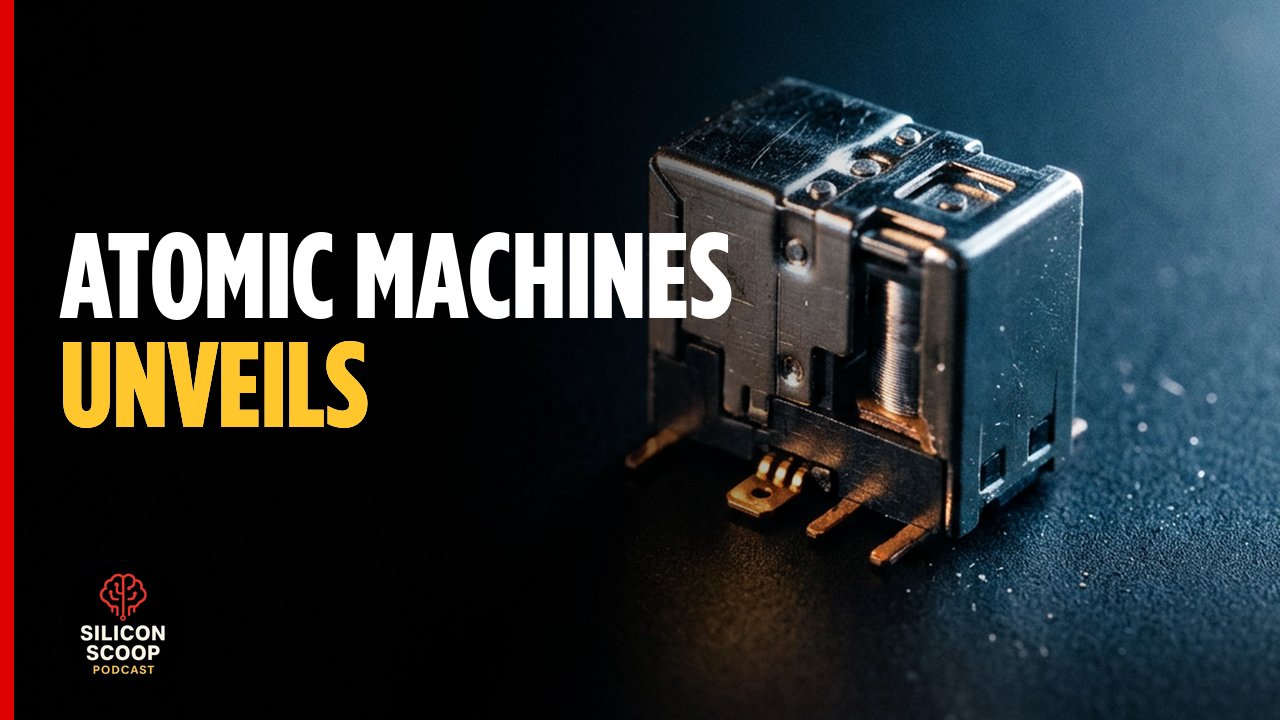
PrimeSwitch is specified to combine 50-microsecond opening, 200-microohm on-resistance, 1,500-volt galvanic isolation and zero holding power in a surface-mount package about 9.5 millimeters across and 3 millimeters thick, according to Atomic Machines' PrimeSwitch specification page. "Galvanic isolation" means a physical separation that stops current from flowing between two parts of a circuit.
The part is the first product from the Atomic Machines Matter Compiler. This is the manufacturing system the company introduced on October 7, 2026, according to the company's Matter Compiler page. The company says it spent six years building the system, per its micro-machine blog post.
For hardware founders and operators, the potential value is replacing product-specific tooling and process development with reusable manufacturing infrastructure. Commercial yield, qualification and unit economics remain unproven. This post separates what the company claims from what outsiders have checked.
What the Atomic Machines Matter Compiler Claims to Do
Atomic Machines describes the Matter Compiler as an AI-native fab, meaning a factory built around artificial intelligence. It says the system turns digital designs into working micro-machines and learns with each build. These descriptions come from the company's Matter Compiler page, dated October 7, 2026.
The proposed workflow
The company says the system can:
- Design a device
- Simulate it
- Write its own manufacturing process
- Measure each build
- Carry what it learned into later designs
The stated target is to shrink cycles that took years to weeks or days. That is a company target, not an operating result.
The platform claims
According to the technical summary, the Matter Compiler is described as supporting:
- Single-digit-micron features
- Multiple materials
- Three-dimensional structures
- Moving parts
All of these remain company-reported platform claims.
The name and the pitch
A Cade Metz article published October 7, 2026, which is the source article for this post, reports more detail. It says the name comes from a machine in Neal Stephenson's novel The Diamond Age. In the novel, such machines build objects atom by atom from digital specifications.
It also quotes founder and CEO Jeff Holden: "3D printing made shapes programmable: any geometry, straight from a file. We're making machines programmable."
The article says Holden was Amazon's tenth engineer, helped build Amazon Prime, and later became Uber's first chief product officer.
Source: Atomic Machines Matter Compiler page (October 7, 2026); Atomic Machines micro-machine blog post (October 7, 2026); Cade Metz's October 7, 2026 report (the source article for this post).
Why Micromachine Manufacturing Has Been Stuck at "One Product, One Process"
Metz's article describes a gap in how tiny machines get made. Casting, molding and machining reach their practical limits at roughly the low tens of microns. A micron is one-millionth of a meter.
Below that scale, the main tool is semiconductor fabrication. Those factories are tuned to pattern flat electronic circuits in silicon. They are not built to make arbitrary mechanical machines.
What the MEMS industry has built
MEMS stands for microelectromechanical systems. The industry has used semiconductor tools to make a limited set of products, including:
- Accelerometers
- Gyroscopes
- Micro-mirrors
- Inkjet nozzles
- Microphone diaphragms
- Thermal cameras
- Blood-chemistry cartridges
The article cites the industry's maxim: "one product, one process." Each new category of device generally needs years of custom process development.
The company's argument
Atomic Machines says many possible micro-machines remain unbuilt. In its view the cause is not physics. It says no manufacturing system has existed to produce them.
The Matter Compiler is meant to skip dedicated tooling and a new process for every product. The company says that changing the code can change the machine. It also says the system avoids molds, masks and other fixed tooling.
This is the core idea behind micromachine manufacturing in this story. The company says one flexible factory can replace many single-purpose process lines. Whether that holds up in production is not yet shown.
Source: Atomic Machines Matter Compiler page; Atomic Machines micro-machine blog post; Cade Metz's October 7, 2026 report.
Stop Rebuilding the Same Process by Hand
Hardware teams are not the only ones who lose months rebuilding a process for every new product. Most small businesses do the same with invoices, lead follow-ups and reports. Flowgrammer builds business automation that handles that repeat work, so you can scale without adding headcount.
Atomic Machines PrimeSwitch: The Specs, Line by Line
The first product is the PrimeSwitch PS-150, a miniature electromechanical relay, which is a switch that opens and closes a circuit. Here is what Atomic Machines' PrimeSwitch page lists:
- Current: 150 amps continuous, AC or DC
- Opening time: 50 microseconds, to 1,500 volts
- On-resistance: 200 microohms
- Isolation: 1,500 volts of true galvanic isolation
- Size: 9.5 millimeters in diameter, 3 millimeters thick
- Holding power: zero
- Configuration: SPST (single pole, single throw), surface-mount
- Availability: listed as "sampling now"
Metz's article adds that the package is hermetically sealed. It also says PrimeSwitch is bistable, so it stays in either state without drawing power.
Why it is said to be fast
Atomic Machines attributes the speed to a low-mass contact that travels only microns. It contrasts this with conventional electromechanical relays, which open in milliseconds. It also contrasts it with solid-state switches, which switch quickly but conduct through lossy semiconductors.
In its blog post, the company says PrimeSwitch is the first micro-machine produced by the Matter Compiler. It says the relay opens about 1,000 times faster than a conventional contactor.
Treat every number here as a company claim. The briefing contains no independent test data.
Source: Atomic Machines PrimeSwitch specification page; Atomic Machines micro-machine blog post (October 7, 2026).
Why AI Manufacturing Hardware Starts With a Data Center Relay
The Metz article explains why the company built this part first. AI data centers are moving toward 800-volt direct-current power distribution to feed racks that use more and more power.
At those voltages, a fault can release destructive energy within microseconds. Mechanical protection devices generally open in milliseconds, which is too slow. Opening a mechanical contact also creates an electrical arc. A direct-current arc does not die out as easily as an alternating-current arc.
The trade-off PrimeSwitch targets
Solid-state protection devices switch fast and avoid arcing, but they cannot provide galvanic isolation. A mechanical contactor is still needed beside them. They also lose energy as heat when they carry current continuously.
PrimeSwitch is designed to combine the best of both. In a hybrid breaker, a small solid-state bypass carries current while the relay opens. The relay then offers low-loss conduction and isolation like a mechanical contact, with opening speed closer to solid-state devices.
The company also says PrimeSwitch exists because standard chip fabs cannot process its materials or assemble its moving parts. It says conventional manufacturing tools cannot reach its feature sizes. That is the company's reasoning, and the briefing offers no outside confirmation of it.
For AI manufacturing hardware, the lesson is practical. A narrow, high-value part is a sensible first test for a general-purpose factory. A second product would show whether the factory is truly general.
Source: Atomic Machines PrimeSwitch specification page; Atomic Machines micro-machine blog post; Cade Metz's October 7, 2026 report.
What the $250 Million Does and Does Not Tell Us
Atomic Machines disclosed $250 million of aggregate funding. The citybiz report, dated October 7, 2026, says the company emerged from six years of stealth with that amount raised to date.
Independent coverage adds a caution. In an analysis published October 8, 2026, Venture Capital Tracker found no evidence of a single new $250 million round.
What is missing
The company did not identify:
- A round stage
- A lead investor
- A valuation
- How the money was split across financings
- Whether the amount included secondary transactions (sales of existing shares)
So "$250 million" should be read as cumulative funding, not as a fresh round announced on October 7.
Who is named
Metz's article lists investors including OneIM, Gigafund, XTX Ventures, KAS Venture Partners, Valor Equity Partners, Tru Arrow Partners, Construct Capital, Sozo Ventures and the Regents of the University of California. The article does not say how much each put in or which round it joined. It notes the company did not disclose its valuation or how the $250 million was divided.
Founders should read the number as proof of patient funding, not proof of market demand. Money pays for equipment and engineers. It does not show that customers have qualified the product.
Source: citybiz report (October 7, 2026); Venture Capital Tracker analysis (October 8, 2026); Cade Metz's October 7, 2026 report.
What Is Verified, What Is Claimed, and What Is Still Open
Be clear about the evidence level here. No independent technical expert, analyst, competitor or academic commentary was retrieved that validates Atomic Machines' performance figures. There is also no outside consensus about the Matter Compiler.
What independent analysis flags
The available independent financial analysis, from Venture Capital Tracker, names the unresolved issues:
- Manufacturing yield
- Repeatability
- Throughput
- Unit economics
- Customer qualification
- Whether a second device family can show platform reuse
That is one financial analysis, not a broad expert consensus.
Early access and the trade show
PrimeSwitch was described as shipping to early-access customers for evaluation, per citybiz. Customers, pricing and production volumes were not disclosed. The company's own page lists the part as sampling now.
The product was scheduled for its first public appearance at the Open Compute Project Global Summit in San Jose, October 12–15, 2026. That is an event appearance, not evidence of completed commercial deployment. The briefing includes no report of how the showing went.
Applications are targets
Metz's article lists devices the company is targeting. They include sand-grain-sized motors and gears, robots small enough to work inside the body, surgical micro-robots, and cooling built into AI chips. These are goals, not products.
The company's wider aim is "prompt-to-product manufacturing." Metz reports that this is not yet realized. The Matter Compiler is used for Atomic Machines' own products, and human technicians still move components between machines and help assemble finished devices.
Company materials present a longer-term platform spanning mechanical, fluidic, thermal, optical, chemical and electrical devices. Those are strategic claims, not demonstrated results.
Source: Venture Capital Tracker analysis (October 8, 2026); citybiz report (October 7, 2026); Atomic Machines Matter Compiler page; Cade Metz's October 7, 2026 report.
What This Means for Startups and Small Businesses
Most readers will never buy a micro-relay. The story still offers practical lessons.
If you build hardware
- Treat PrimeSwitch as a sample, not a supply plan. The company lists it as sampling, and no pricing or volumes are public.
- Ask for qualification data. Request yield, repeatability and lifetime test results before designing it into a product.
- Ask about the second product. One device does not prove a platform. A second device family would.
- Watch tooling costs in your own plans. The company argues that no product-specific tooling means a production run of one needs no separate engineering charge. That is its claim, and it is untested at scale.
If you invest or advise
- Do not read $250 million as a round. Ask for stage, lead investor, valuation and secondary share.
- Keep investor language in context. Gigafund's Luke Nosek told Metz, "If vibe coding is how software gets made now, this is the start of vibe manufacturing." That is an investor's view of the company's approach, not independent validation.
If you run any small business
The deeper idea is reusable infrastructure. The company argues that one factory, changed through code, can serve many products. Small teams can apply the same logic to their own work by building one reliable process and reusing it, instead of redoing it by hand each time.
Source: Atomic Machines PrimeSwitch specification page; Venture Capital Tracker analysis (October 8, 2026); Cade Metz's October 7, 2026 report.
Frequently Asked Questions
Q: What is the Atomic Machines Matter Compiler?
A: It is a manufacturing system that Atomic Machines describes as AI-native. The company says it turns digital designs into working micro-machines and learns from each build. It was announced on October 7, 2026.
Q: What does the atomic machines Matter Compiler actually build?
A: So far, the only disclosed product is the PrimeSwitch PS-150 relay. The company says the system is meant to make devices with moving parts, multiple materials and single-digit-micron features. Those platform capabilities are company-reported.
Q: What is Atomic Machines PrimeSwitch?
A: PrimeSwitch PS-150 is a miniature, surface-mount electromechanical relay. Atomic Machines specifies 150 amps of continuous AC or DC current, 50-microsecond opening, 200 microohms of on-resistance and 1,500 volts of galvanic isolation. The company's page lists it as sampling now.
Q: How fast is the Atomic Machines PrimeSwitch?
A: The company says it opens in 50 microseconds. It also says that is about 1,000 times faster than a conventional contactor. No independent test of these figures was retrieved.
Q: How big is PrimeSwitch?
A: The company lists it as 9.5 millimeters in diameter and 3 millimeters thick. It is a surface-mount package that holds its state with zero power.
Q: Is PrimeSwitch available to buy?
A: The company's specification page lists it as sampling now. Independent reporting says it was shipping to unnamed early-access customers for evaluation. Pricing and production volumes have not been disclosed.
Q: Did Atomic Machines raise a $250 million round?
A: Not as far as the retrieved sources show. The company disclosed $250 million of aggregate funding. Venture Capital Tracker found no evidence of a single new round and noted that no stage, lead investor, valuation or financing split was identified.
Q: What is micromachine manufacturing?
A: It means making very small machines, often with parts measured in microns. According to Metz's reporting, the MEMS industry has done this with semiconductor tools, but usually needs years of custom process work for each product type.
Q: What does AI manufacturing hardware mean in this story?
A: It describes a factory where AI helps design, simulate and refine the process and the manufacturing equipment sits inside its feedback loop. Atomic Machines also targets parts for AI data centers, starting with the PrimeSwitch relay. Outside experts have not yet confirmed how well this works.
Q: Where was PrimeSwitch shown publicly?
A: It was scheduled for its first public appearance at the Open Compute Project Global Summit in San Jose, October 12–15, 2026. That was an event appearance, not proof of commercial deployment.
Additional Links
Flowgrammer.ca – 💡 Unlock AI-Powered Automation! Let flowgrammer.ca handle complex workflows so you can focus on growing your business.
Flowgrammers.ca – 💡 Join Toronto's Fastest Growing AI and Business Automation Community.
- SRED Funding Solutions – Maximize your R&D tax credits and secure funding for your innovation.
- Silicon Scoop Podcast – Stay Informed, Stay Ahead!
- Startup Talk Podcast
- Flowgrammer Youtube
- Startup Investor Drinks – Join Toronto’s Startup Community and connect with fellow startup enthusiasts and investors.
- TorontoStarts Startup and Entrepreneur Community – Become a part of Toronto’s thriving startup ecosystem.
- Workhaus – Discover flexible workspace solutions for your business needs.
- Work with The Startup Coach – Get expert guidance and mentorship for your startup journey.
- Reach out to Jon Irwin on LinkedIn – Connect with our co-host and technology expert.