
HL-LHC Upgrade: New Detector Specs, 2030 Timeline, and the Physics Stakes
HL-LHC Upgrade: New Detector Specs, 2030 Timeline, and the Physics Stakes https://torontostarts.com/silicon-scoop/ Flowgrammer.ca -> https://flowgrammer.ca/ AI News and Resources -> https://flowgrammers.ca OpenClaw Toronto -> https://openclawto.com/ HL-LHC Upgrade: New Detector Specs, 2030 Timeline, and the Physics Stakes HL-LHC upgrade details, High-Luminosity LHC timing detectors, ATLAS timing detector, and CMS MIP timing detector with 2030 launch outlook. FLogrammer is your Business Automation Experts - https://Flowgrammer.ca Startup Investor Drinks Toronto - https://startupdrinksto.com/ Toronto’s Startup Community - https://torontostarts.com/ Silicon Scoop Silicon Scoop Podcast - https://torontostarts.com/silicon-scoop/ Apple: https://podcasts.apple.com/us/podcast/silicon-scoop/id1758711826 Spotify: https://open.spotify.com/show/5bAzF0MwV6TtLhJAhvHayI YouTube: https://www.youtube.com/playlist?list=PLj4v-RoA7A-gT62vrEYqh1zCv-0Hj-o5J Startup Talk Startup Talk Podcast -> https://torontostarts.com/startup-talk-toronto-startup-podcast/ Apple -> https://podcasts.apple.com/us/podcast/startup-talk/id1763804003 Spotify -> https://open.spotify.com/show/1siJMILILidHAiAsrX2VBU YouTube: https://youtube.com/playlist?list=PLj4v-RoA7A-jxV5FHs5e61oIsuvUJYmT_&si=LYegRe5GYLKNQ7xL
With Craig Major and Jon Irwin
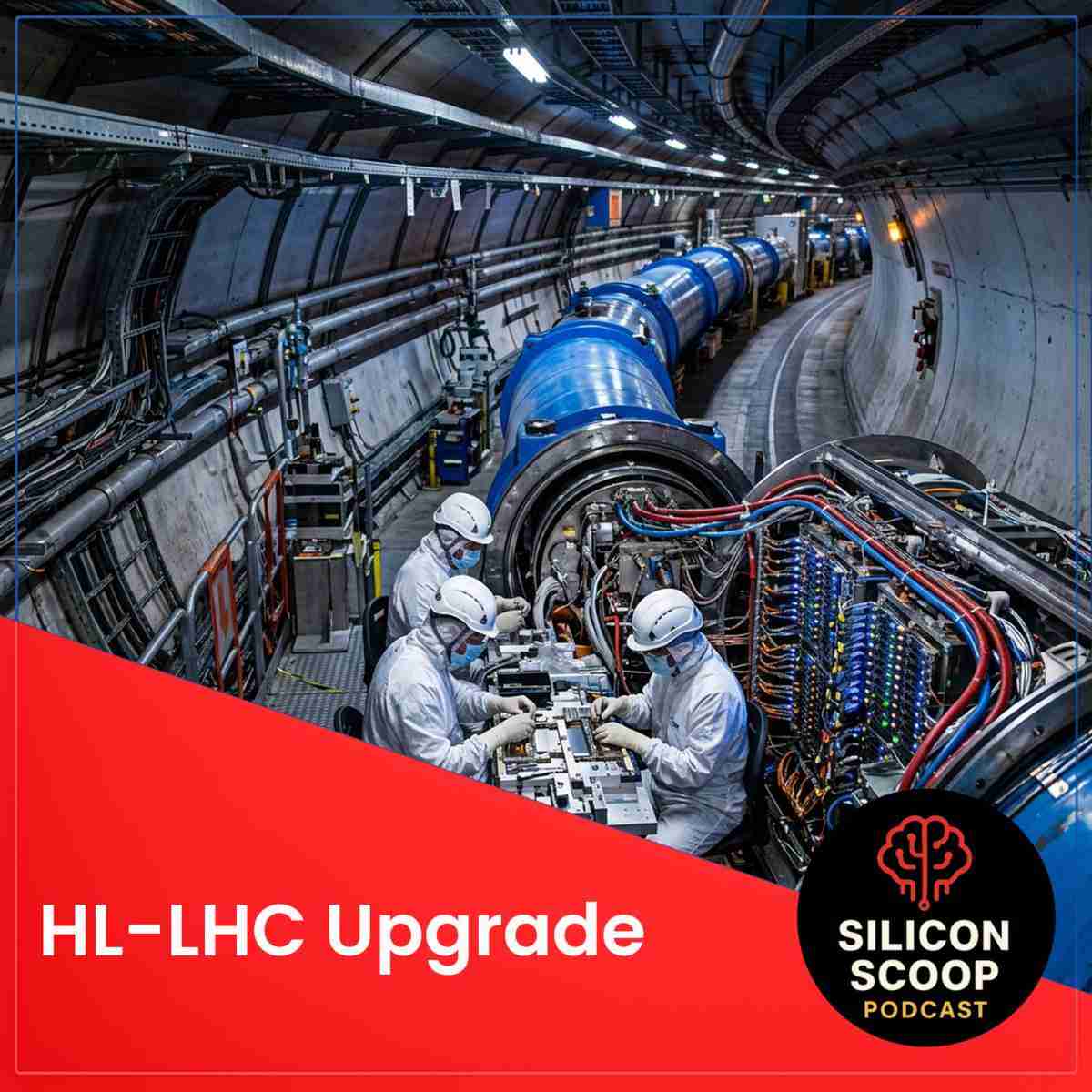
The HL-LHC Upgrade Will Collect 7x More Data by 2030
Estimated reading time: 10 minutes
Key Takeaways
- The HL-LHC upgrade is not about smashing particles harder. It is about doing it smarter, longer, and with far more precision than any particle collider has ever managed before.
- When they are done, the High-Luminosity LHC will be able to collect roughly seven times more collision data per year than the current machine.
- More data means rarer events become visible. Rarer events mean deeper tests of the Standard Model of particle physics.
- This article walks through every major part of the upgrade: the timeline, the new detectors, the engineering challenges, and what the physics community actually expects to learn.
Table of contents
- The HL-LHC Upgrade Will Collect 7x More Data by 2030
- Key Takeaways
- What the High-Luminosity LHC Actually Changes
- Long Shutdown 3 — What Is Happening Right Now
- The ATLAS Timing Detector — Reading Collisions in Picoseconds
- The CMS MIP Timing Detector — A Hermetic Timing Shell
- Radiation-Hard Electronics — The Invisible Engineering Problem
- The Physics Targets — Why This Level of Precision Matters
- The Economic and Industrial Case for the Upgrade
- What Comes After HL-LHC
- FAQ — HL-LHC Upgrade Explained
The HL-LHC upgrade is not about smashing particles harder. It is about doing it smarter, longer, and with far more precision than any particle collider has ever managed before.
Right now, the Large Hadron Collider at CERN sits in a carefully planned pause. Engineers, physicists, and technologists from dozens of countries are tearing apart two of the world's most complex scientific instruments — the ATLAS and CMS detectors — and rebuilding them from scratch. When they are done, the High-Luminosity LHC will be able to collect roughly seven times more collision data per year than the current machine.
That matters enormously. More data means rarer events become visible. Rarer events mean deeper tests of the Standard Model of particle physics. And deeper tests mean we get closer to answering questions like: why does the Higgs boson behave the way it does, and is there physics hiding beyond what we currently understand?
This article walks through every major part of the upgrade: the timeline, the new detectors, the engineering challenges, and what the physics community actually expects to learn.
What the High-Luminosity LHC Actually Changes
The word "luminosity" is the key here. In particle physics, luminosity measures how many collisions a collider can produce per second per unit area. Higher luminosity means more collisions, more data, and more chances to spot rare processes.
The current LHC already delivered about 300 fb⁻¹ (femtobarns inverse — a unit of integrated collision data) across its first three runs. The High-Luminosity LHC is targeting a total of 3,000 fb⁻¹, with the hardware built to handle up to 4,000 fb⁻¹ if needed. That is a tenfold increase in total physics data over the life of the program.
To get there, CERN is upgrading the accelerator magnets, installing new superconducting crab cavities to squeeze the beams tighter at the collision points, and completely rebuilding the inner tracking and timing systems of both major detectors.
The result is a machine that does not collide beams at higher energy — the beam energy stays at 13.6 TeV — but collides them far more frequently and far more densely.
Key numbers to keep in mind:
- Up to 200 proton-proton interactions per beam crossing (called "pileup")
- Peak luminosity about 5–7.5 × 10³⁴ cm⁻² s⁻¹, leveled during operations
- Long Shutdown 3 (LS3) runs from 2026 to 2028
- First HL-LHC physics collisions expected around 2030
- Physics operations continue through the early 2040s
Source: report reveals full reach LHC programme
Long Shutdown 3 — What Is Happening Right Now
Long Shutdown 3, which started in 2026, is the single largest coordinated upgrade in CERN's history. It is not a simple maintenance stop. It is a full infrastructure overhaul running in parallel across the accelerator tunnel, both experimental caverns, and multiple surface facilities.
On the accelerator side
The LHC tunnel is receiving new niobium-tin (Nb₃Sn) superconducting magnets in the insertion regions near the ATLAS and CMS collision points. These magnets operate at higher field strengths than the current niobium-titanium magnets, which allows the beams to be focused more tightly and increases the collision rate.
Crab cavities — radio-frequency devices that tilt the beam bunches so they collide more head-on — are being installed. This alone can boost the effective luminosity significantly without changing anything else.
On the detector side
Both ATLAS and CMS are undergoing complete inner detector replacements. Their current silicon tracking systems cannot survive the radiation levels that 200 pileup interactions per crossing would produce. New all-silicon trackers are being installed that are both more radiation-hard and more granular.
A June 2026 LHCC machine report confirmed the LS3 schedule is progressing, with commissioning expected to begin after installation wraps in 2028 and peak pileup during early commissioning projected near 101 interactions per crossing, rising toward a leveled value of about 132 as operations mature.
Source: LHCC machine report
The ATLAS Timing Detector — Reading Collisions in Picoseconds
One of the biggest engineering challenges at 200 pileup is simple to describe but extraordinarily hard to solve: how do you tell which particles came from which collision?
When 200 interactions happen in the same beam crossing, they all occur at nearly the same point in space. Standard tracking — which measures where particles go — cannot separate them cleanly. The positions overlap too much.
The solution is time. If you can measure when each track was produced with enough precision, you can sort the 200 collisions in time even if they are piled up in space.
ATLAS is solving this with the High-Granularity Timing Detector (HGTD).
What the ATLAS HGTD does
The HGTD is installed in the forward region of the ATLAS detector (covering pseudorapidity 2.4 to 4.0 — the more angled tracks away from the beam axis). It uses Low-Gain Avalanche Detector (LGAD) silicon sensors, a technology specifically developed for this kind of ultra-fast timing work.
Key HGTD specifications:
- Per-track timing resolution: approximately 30–50 picoseconds
- Sensor technology: LGADs in the forward region
- Covers the high-pileup forward acceptance gap left by the inner tracker
- Designed to survive integrated radiation doses expected across the full HL-LHC run
To put 30–50 picoseconds in perspective: a picosecond is one trillionth of a second. Light travels about 9–15 millimeters in that time. The HGTD is measuring the arrival time of particles with enough precision to separate collision vertices that occurred fractions of a millimeter apart in time.
Source: ATLAS Prepares HLLHC
The CMS MIP Timing Detector — A Hermetic Timing Shell
CMS is taking a different but equally ambitious approach. Instead of focusing only on the forward region, CMS is building a hermetic timing layer that wraps around its entire Outer Tracker — both the barrel (central cylinder) and the endcaps (the disc-shaped end sections).
This system is called the MIP Timing Detector (MTD).
What the CMS MTD does
MIP stands for Minimum Ionizing Particle — a term for the low-energy charged particles that are most common in LHC collisions. The MTD is designed to time-stamp essentially every charged track that passes through the CMS detector.
Key MTD specifications:
- Timing resolution: approximately 35 picoseconds
- Barrel: Uses LYSO scintillating crystals read out by Silicon Photomultipliers (SiPMs) — an approach borrowed and scaled from medical imaging technology
- Endcaps (ETL): Uses LGAD silicon sensors, the same core technology as the ATLAS HGTD
- Hermetic coverage means almost no track escapes without a timestamp
The barrel and endcap split is a practical engineering choice. In the barrel, the radiation levels are lower and LYSO+SiPM provides excellent timing with a well-understood manufacturing path. In the endcaps, radiation levels are far higher, so the more radiation-hard LGAD sensors are used.
Together, the barrel and endcap layers give CMS the ability to perform 4D tracking — three spatial coordinates plus time — for the first time in a collider experiment operating at this scale.
Source: new precision timing detector
Your Business Runs on Time Too
Stop Losing Hours to Tasks a Machine Can Handle
Every hour your team spends on repetitive, manual work is an hour not spent on strategy, customers, or growth. Business automation removes the bottleneck — whether it is data entry, scheduling, reporting, or client follow-ups — so your team can focus on work that actually moves the needle. The businesses scaling fastest right now are not hiring more people to do more manual tasks. They are automating the routine so their people can do more of the valuable.
👉 See What Flowgrammer Can Automate for Your Business (Flowgrammer Can Automate for Your Business)
Radiation-Hard Electronics — The Invisible Engineering Problem
Timing detectors get the headlines, but there is a quieter challenge underneath all of it: the electronics have to survive.
At 200 pileup interactions per crossing over a decade of running, the radiation doses inside ATLAS and CMS will be extreme. Silicon sensors in the innermost tracking layers will absorb radiation doses measured in hundreds of megarads. Standard commercial chips would fail within weeks.
CERN and its collaborators have developed a new generation of radiation-hard ASICs (Application-Specific Integrated Circuits) specifically for the HL-LHC. These chips are designed in specialized CMOS processes that remain functional after the projected lifetime dose.
For the LGAD sensors themselves, radiation hardness is a core design criterion. As LGADs absorb radiation, their internal gain — the property that makes them fast — gradually degrades. The sensors are designed with this degradation factored in, so even at end-of-life radiation doses, they still meet the timing resolution requirements.
The all-silicon inner trackers replacing the current mixed silicon/straw-tube systems at both ATLAS and CMS are similarly optimized: smaller pixels, more granular, and built from materials that degrade more predictably under radiation.
Source: arXiv analysis
The Physics Targets — Why This Level of Precision Matters
The HL-LHC is not being built to discover a specific new particle. That is an honest and important distinction. It is being built to measure things we already know exist with far higher precision, and to search for rare processes that the current LHC simply cannot accumulate enough data to see.
Higgs boson precision measurements
The Higgs boson was discovered in 2012. More than a decade later, we still do not know its properties well enough to fully test the Standard Model predictions. Several Higgs coupling measurements currently have uncertainties of 10–20%. The HL-LHC is designed to bring those uncertainties down to the few-percent level.
Specific targets include:
- Higgs self-coupling — does the Higgs interact with itself the way the Standard Model predicts? This requires observing di-Higgs production, an extremely rare process
- Higgs couplings to second-generation fermions — particularly the coupling to muons, which is tiny and has never been cleanly measured
- Rare Higgs decay modes that are invisible to the current dataset
Rare processes and searches beyond the Standard Model
With 3,000 fb⁻¹ of data, processes that occurred only a handful of times in Run 1, 2, and 3 combined will be produced thousands of times. This includes:
- Rare B-meson decays sensitive to new physics
- Direct production of new particles, if they exist near the TeV scale
- Precision electroweak measurements that test quantum corrections
A 2025 arXiv analysis of the full HL-LHC physics program confirmed that the combination of higher luminosity and improved detector resolution — particularly the 4D tracking capability from the new timing layers — significantly extends sensitivity to many of these processes compared to a simple extrapolation from current data.
Source: arXiv analysis and report reveals full reach LHC programme
The Economic and Industrial Case for the Upgrade
Large-scale science projects always face the question: is the cost justified?
CERN commissioned a formal social cost-benefit analysis of the HL-LHC program. The results are concrete:
- Benefit-cost ratio: approximately 1.7
- Probability of positive net present value: 94%
- Significant spillover effects in industrial training, advanced manufacturing, and high-technology procurement
The analysis counts not just the direct scientific output but the broader economic activity generated: contracts with European and international industry for superconducting magnets, cryogenics, precision mechanics, electronics, and software. Universities and research institutes gain trained engineers and physicists who carry those skills into commercial sectors.
This is consistent with the historical record of large physics infrastructure. Technologies originating from CERN particle detector work have found applications in medical imaging, radiation therapy, and semiconductor manufacturing.
Source: record 2319300
What Comes After HL-LHC
The HL-LHC program is formally planned to run through the early 2040s, accumulating up to 3,000 fb⁻¹ with hardware headroom to reach 4,000 fb⁻¹.
What comes after is still being debated. The European Strategy for Particle Physics — the field's long-range planning document — is currently under review. Leading candidates for a post-HL-LHC machine include a Future Circular Collider (FCC) at CERN, which would reach much higher energies in a new 91-kilometer tunnel, and a muon collider, which would offer a different physics approach at a smaller physical scale.
None of those decisions are finalized. What is certain is that the HL-LHC represents the definitive end of the current LHC era and the last major use of the existing accelerator infrastructure before something fundamentally new is required.
The data collected through the 2040s will define the questions that the next machine must answer.
Source: report reveals full reach LHC programme
FAQ — HL-LHC Upgrade Explained
1. What is the HL-LHC upgrade and why is it happening?
The HL-LHC (High-Luminosity Large Hadron Collider) upgrade is a major reconstruction of CERN's primary particle collider and its two main detectors, ATLAS and CMS. It is happening because the current machine has collected most of the physics data it can produce at its existing performance level. Increasing luminosity — the collision rate — by roughly seven times allows physicists to study rare processes and measure known particles with far greater precision.
2. When will the HL-LHC start taking physics data?
Long Shutdown 3 (LS3) runs from 2026 to 2028. After installation and commissioning, the HL-LHC is expected to begin physics operations around 2030, with the full program running through the early 2040s.
3. What is pileup and why does it matter?
Pileup refers to the number of separate proton-proton interactions that happen in a single beam crossing. At the HL-LHC, this will reach up to 200 interactions per crossing. More pileup means more data but also more confusion — it becomes harder to figure out which particles came from which collision. The new timing detectors are specifically designed to solve this problem.
4. What is the ATLAS High-Granularity Timing Detector (HGTD)?
The HGTD is a new detector layer being installed in the forward region of ATLAS. It uses Low-Gain Avalanche Detector (LGAD) silicon sensors to time-stamp individual particle tracks with a resolution of 30–50 picoseconds. This allows ATLAS to separate collision vertices that are very close together in space by their differences in time.
5. What is the CMS MIP Timing Detector (MTD)?
The MTD is a hermetic timing layer added around the full CMS Outer Tracker. It achieves about 35 picoseconds of timing resolution. The barrel section uses LYSO crystals with Silicon Photomultipliers (SiPMs), while the endcap section uses LGAD silicon sensors. Together they give CMS full-coverage 4D tracking capability.
6. Does the HL-LHC run at higher beam energy than the current LHC?
No. The beam energy remains at 13.6 TeV (center-of-mass energy). The upgrade is entirely focused on luminosity — more collisions per second — not on pushing particles to higher energies. The physics gains come from volume of data and detector precision, not from higher energy collisions.
7. How much data will the HL-LHC collect in total?
The target integrated luminosity is 3,000 fb⁻¹ (femtobarns inverse), roughly ten times the total data collected in all LHC runs before the upgrade. The hardware is designed to be compatible with up to 4,000 fb⁻¹ if the program is extended.
8. What are the most important physics goals of the HL-LHC?
The top priorities include:
- Measuring Higgs boson couplings with few-percent precision
- Observing Higgs self-coupling through di-Higgs production
- Measuring the Higgs-muon coupling for the first time
- Extending sensitivity to rare B-meson decays
- Searching for new particles at the TeV scale with much more data than currently available
9. What is the economic justification for spending this much on a particle collider?
A CERN-commissioned social cost-benefit analysis found a benefit-cost ratio of about 1.7 and a 94% probability that the project has a positive net present value. Beyond direct scientific output, the project generates substantial industrial spillovers in advanced manufacturing, cryogenics, precision electronics, and trains a large number of engineers and physicists who contribute to commercial sectors.
10. What happens after the HL-LHC program ends in the 2040s?
The future is still being planned. The leading proposals include the Future Circular Collider (FCC) — a potential 91-kilometer ring at CERN that would reach much higher energies — and a muon collider concept being studied internationally. The HL-LHC data will directly inform which of these directions makes the most scientific sense, as it will clarify which questions remain unanswered and which energy scales are most worth exploring next.
Sources:
Additional Links
Flowgrammer.ca – 💡 Unlock AI-Powered Automation! Let flowgrammer.ca handle complex workflows so you can focus on growing your business.
Flowgrammers.ca – 💡 Join Toronto's Fastest Growing AI and Business Automation Community.
- SRED Funding Solutions – Maximize your R&D tax credits and secure funding for your innovation.
- Silicon Scoop Podcast – Stay Informed, Stay Ahead!
- Startup Talk Podcast
- Flowgrammer Youtube
- Startup Investor Drinks – Join Toronto’s Startup Community and connect with fellow startup enthusiasts and investors.
- TorontoStarts Startup and Entrepreneur Community – Become a part of Toronto’s thriving startup ecosystem.
- Workhaus – Discover flexible workspace solutions for your business needs.
- Work with The Startup Coach – Get expert guidance and mentorship for your startup journey.
- Reach out to Jon Irwin on LinkedIn – Connect with our co-host and technology expert.
Episode transcript
Read the full transcript
Craig: cern has switched off the world's most powerful particle collider, and it will stay largely silent for about four years. they're not rebuilding it to smash particles much harder, but to produce so many more collision that events currently buried in statistical noise may finally become visible. the large hadron collider has gone dark, and engineers are now dismantling parts of a machine buried beneath two countries. when it returns around 2030, it will create up to 200 proton collisions at once and attempt to tell them apart to within trillions of a second. cern's solution to not finding enough new physics is beautifully scientific. run the experiment several billion more times. the difficult part is that every collision now arrives with a 199 unwanted remains. what do you think about this, john?
Jon: yeah. this, so there's a lot of people that have said that since the, lhc, large hadron collider, has gone offline, they feel more rested. so, kinda weird, but, anyways, very interesting. so the large hadron collider is essentially the world's most advanced microscope. and so instead of using light, they smash protons together at nearly the speed of light, and they study the smallest building blocks of the universe. and so they've used it to discover the higgs boson in 2012. but there's a lot of big mysteries are, that still are out there. dark matter, dark energy, why matter exists at all, and whether there are undiscovered particles. so rather than building an entirely new machine, which would cost billions and billions of dollars and take millions of years, they're giving me this they're giving the lhc a big upgrade. so they're going to replace more than a kilometer of accelerator components. they're gonna install stronger superconducting metals. they're gonna upgrade detectors, improve data systems. and then when it starts in 2030, it's going to become the high luminosity lhc. and so it won't necessarily smash particles with much higher energy. it will smash many more of them. and so it's gonna create vastly larger datasets, and, hopefully, they'll be able to find those extremely rare phenomena that could reshape modern physics. so, the difference between energy and luminosity, though, is, the biggest misconception is that increasing the collider's energy, the biggest misconception is that cern is increasing the collider's energy, but it isn't. it's already accelerating. i think it's, like, 14 tera electron volts, which is ridiculous. so luminosity, it measures how many particle collisions occur over time. so if you can think of it like buying lottery tickets, increasing energy is like buying one expensive ticket. increasing luminosity is like buying millions of tickets. and so the prize of this is discovering new physics. so, it's still unlikely that they're going to discover these new new particles or discover dark matter and discover more of this stuff, but, the chances of doing that if you collect more data, is gonna improve dramatically. so, this is really cool. i love what the large hadron collider is all about and what they're looking to detect and and all of the science behind it. what do you think about this upgrade?
Craig: the most compelling technology may be the detector is not the collider itself. 5,000,000,000 channels silicon tracking, picosecond timing, and real time filtering systems capable of discarding nearly everything the machine produces. now this is a multibillion dollar bet that nature may reveal itself through tiny statistical deviations rather than one spectacular new particle. i think this is interesting. you know, like you said, people are feeling better potentially after shutdown, but the running joke for a long time was the world broke back back in 2016 when they fired it up in the first place. so, is this gonna fix the world or not? who knows? but cern is studying a proposed 91, kilometer future circular collider. a decision on whether to proceed is expected around 2028, but no construction, decision is final. so this looks interesting. i love what they're doing. they're just gonna every time the lasers cross, it produces, hundreds more. so they're gonna think of this like trying to understand 200 conversations happening simultaneously in one crowded room. ordinary tracking tells you where each speaker is standing, but many voices overlap. precision timing gives every word a time stamp accurate enough to determine which conversation it belongs to, you know, at the picosecond level. this technology is really cool. light travels only about nine millimeters in thirty picoseconds. thirty picosecond sounds abstract. so picture this. in that amount of time, light travels less than a centimeter. that timing position helps distinguish collisions occurring almost simultaneously. so this is like, the technology here is really, really cool. so i'm looking forward to this. the h l l h c is a precision and statistics revolution, not a straightforward increase in collision energy and certainly not a guaranteed new particle machine. cern is spending four years rebuilding the machine so nature can run the same experiment millions more times and leave itself fewer places to hide. with no new particle, but much higher tighter limits on what can exist count as a successful result to you, let us know in the comments below. we'd love to hear from you.
More from Silicon Scoop
All episodes
silicon-scoop · October 19, 2026
OpenAI’s Jalapeño Chip Stakes a Claim Against Nvidia Blackwell in Real-World AI Inference
OpenAI Jalapeno chip challenges Nvidia GB300 Blackwell with InferenceX AI benchmark results, reshaping AI inference accelerator efficiency and latency.
View episode

silicon-scoop · October 16, 2026
Meta’s $18 Billion Teen Safety Settlement: Soft Guardrails, Hard Leverage Over TikTok and YouTube
Deep dive on Meta teen safety settlement, social media addiction lawsuit, new Facebook Instagram time limits and pressure on TikTok YouTube age verification.
View episode
silicon-scoop · October 15, 2026
How Claude Mythos Is Reshaping Cryptanalysis: HAWK, AES and the Rise of AI-Driven Crypto Research
Claude Mythos cryptanalysis weakens HAWK post-quantum signature, speeds AES Möbius Bridge attack, and powers CryptanalysisBench benchmark in AI-driven crypto research.
View episode