
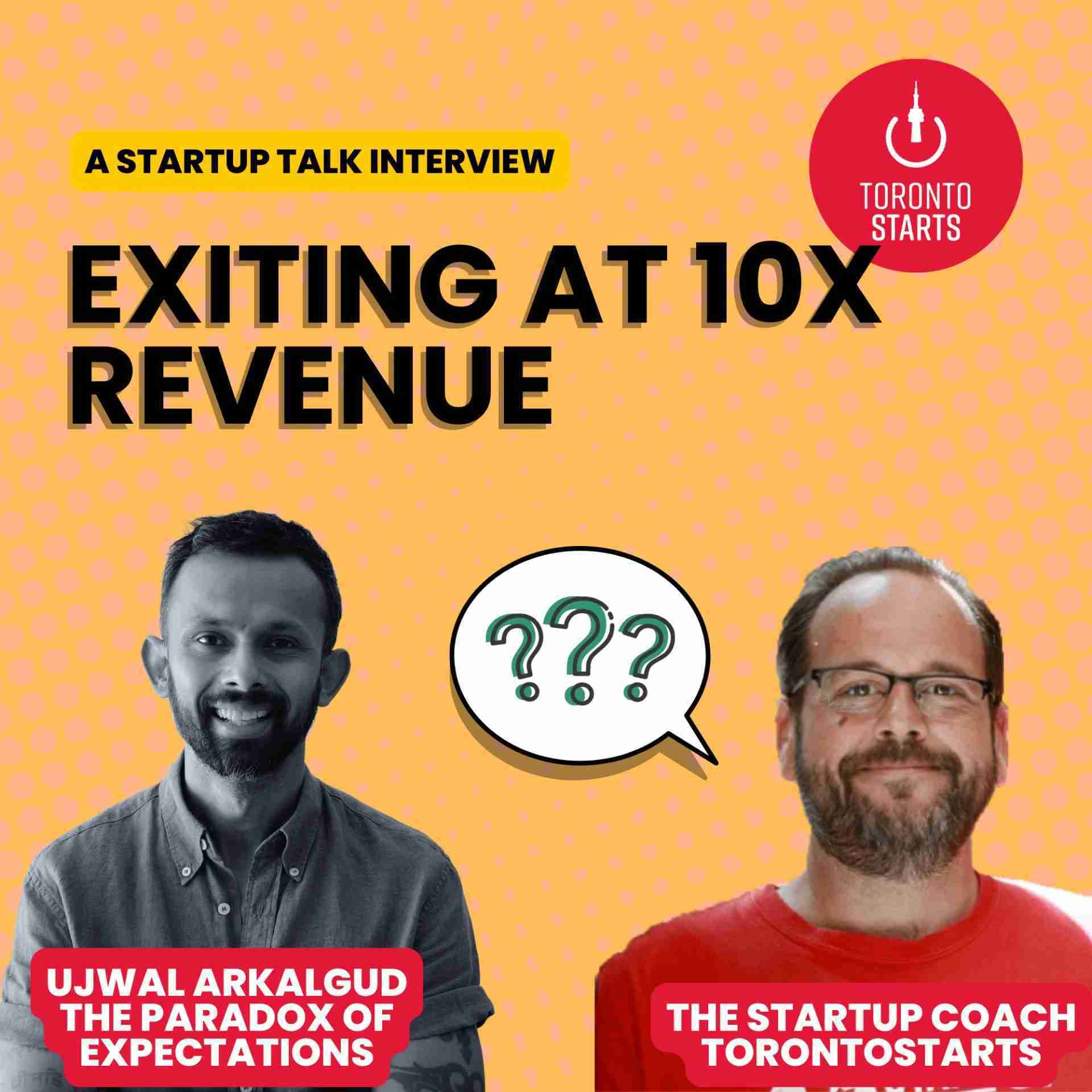
10x Revenue Exit
Discover actionable insights for achieving a 10x Revenue Exit through strategic scaling, profitability, and smart bootstrapping. https://torontostarts.com/2025/04/10/10x-revenue-exit/ Apple -> https://podcasts.apple.com/us/podcast/startup-talk/id1763804003 Spotify -> https://open.spotify.com/show/1siJMILILidHAiAsrX2VBU YouTube: https://youtube.com/playlist?list=PLj4v-RoA7A-jxV5FHs5e61oIsuvUJYmT_&si=LYegRe5GYLKNQ7xL Flowgrammer Apple -> https://podcasts.apple.com/us/podcast/flowgrammer-podcast/id1804155588 Spotify -> https://open.spotify.com/show/0wv3feR00iaVpE8zn7niNf Flowgrammer.ca -> https://flowgrammer.ca/ AI News and Resources -> https://flowgrammer.ca/resources/ Silicon Scoop Silicon Scoop Podcast - https://torontostarts.com/silicon-scoop/ Apple: https://podcasts.apple.com/us/podcast/silicon-scoop/id1758711826 Spotify: https://open.spotify.com/show/5bAzF0MwV6TtLhJAhvHayI YouTube: https://www.youtube.com/playlist?list=PLj4v-RoA7A-gT62vrEYqh1zCv-0Hj-o5J Startup Investor Drinks Toronto - https://startupdrinksto.com/ Toronto’s Startup Community - https://torontostarts.com/
A TorontoStarts podcast
Estimated reading time: 3 minutes
10x Revenue Exit: Achieving Strategic Profitability and Scalable Growth
In this episode of the Startup Talk Podcast, we dive into the journey toward a 10x Revenue Exit—sharing candid insights on bootstrapping, strategic scaling, and maintaining profitability while preparing for a major company exit.
Key Moments on the 10x Revenue Exit Journey
Our guest, Ujwal Arkalgud, recounts the pivotal moments that redefined their business approach. After an unexpected offer in 2019, the team was forced to reevaluate its growth model, learning firsthand that scaling profitably is as crucial as revenue generation. This turning point set the stage for achieving a 10x Revenue Exit by balancing customer acquisition with lean operational strategies.
Lessons Learned from a 10x Revenue Exit
Throughout the conversation, valuable lessons emerge about the importance of demonstrating sustainable growth without overreliance on venture capital. Ujwal explains how focusing on revenue generation and cost management can ultimately attract the right acquirers, paving the way to a successful 10x Revenue Exit. His insights challenge the traditional VC model and emphasize that profitability and smart scaling are key for long-term success.
Strategies for a 10x Revenue Exit
The discussion also highlights actionable strategies for startups:
- Bootstrap Smartly: Invest in technology and process improvements with available revenue.
- Prove Scalability: Run experiments that show the ability to grow without unsustainable cost increases.
- Prioritize Profitability: Ensure that every growth step reinforces the bottom line, reinforcing your journey to a 10x Revenue Exit.
Additional Links
• Silicon Scoop Podcast – Stay Informed, Stay Ahead!
• Futuretech Podcast – Explore more episodes and stay updated with the latest in technology and innovation.
• Startup Talk Podcast – https://torontostarts.com/startup-talk-toronto-startup-podcast/
• Who Are These Startups Podcast
• Startup Investor Drinks – Join the community and connect with fellow startup enthusiasts and investors.
• TorontoStarts Startup and Entrepreneur Community – Become a part of Toronto’s thriving startup ecosystem.
• Workhaus – Discover flexible workspace solutions for your business needs.
• Work with The Startup Coach – Get expert guidance and mentorship for your startup journey.
• Reach out to Jon Irwin on LinkedIn – Connect with our co-host and technology expert.
Ontario Startup Ecosystem Links
• Ontario’s Startup Ecosystem
• Startup Funding in Ontario
• Angel Investors in Ontario
• Ontario Incubators and Accelerators
• Venture Capital in Ontario: Top Firms, Sectors, and Funding Strategies
• Government Grants for Ontario Startups
• Ontario’s Startup Success Stories
• Ontario Centre of Innovation (OCI)
• Bank Loans and Financing for Startups in Ontario
• Research and Development Tax Credits in Ontario
• Government Loans and Financing for Startups in Ontario
• Equity Crowdfunding for Ontario Startups
• Toronto Entrepreneurs Resources
• Toronto’s Food and Beverage Entrepreneurs: Trends, Challenges, and Success Stories
• SEO Strategies for Toronto Entrepreneurs: Enhance Your Online Visibility
• Social Impact for Toronto Entrepreneurs: Starting and Running a Socially Responsible Business
• Toronto Arts and Media Entrepreneurs: Inspiring Profiles and Insights for Creative Success
• Exploring Toronto Green Tech Entrepreneurs: Innovators and Leaders in Sustainability
• Building a Team for Toronto Entrepreneurs: Strategies for Success
• A Guide for Toronto Food and Beverage Entrepreneurs
• Toronto Fashion and Retail Entrepreneurs: Trends, Opportunities, and Success Stories
Episode transcript
Read the full transcript
Speaker 0: exiting your company at ten times revenue is a huge achievement. what was the turning point that set you on the path to that successful outcome?
Speaker 1: we randomly, out of the blue, got an offer in twenty nineteen. we exited in twenty twenty two. in twenty nineteen, we got an offer. it didn't go through. we kinda got to the eleventh hour, and they pulled out. it was a big learning experience because until then, we hadn't really thought about exit. we were so busy trying to build a business. and by the way, you know, we were bootstrapped. we could not get a a venture capital firm to invest in us because anytime i'd use the word anthropology, people would turn their brains off. they'd go, too academic. nobody's gonna invest in this. how are you gonna scale this thing? and nobody would invest in us, so we had no choice but to bootstrap this thing. so in our first year, we exceeded a million in revenue, and we were already profitable because we had to be so that we could invest the money in building our technology and all that jazz. because we started with five grand in the bank. that's all we had. and so, by the time we got to twenty nineteen and, you know, we're four and a half years in, we were starting to scale, but, you know, it's the difference between what the world expects from you versus your own internal desires, and there's always this inherent tension between that. so what does the world expect from you? what does an acquirer expect from you? they expect you to show them a healthy business. fine. we could do that. but they also expect you to show them that you have somehow run some experiments where you have been able to scale your business, without needing to constantly add headcount in sort of a traditional saas sense. right? scale it without losing profitability. and, we hadn't done that. we hadn't performed those internal experiments yet. we knew it theoretically that we could do it. obviously, we had a track record, but we hadn't done that fully. and so that became this constant point of tension. that was the big learning experience. so after twenty nineteen, we reshaped how we looked at the business, and one of the first things we did was demonstrate how we could continue to scale the business without needing to spend a lot. and and i know this is counter to the entire vc model. and, by the way, nothing against the vc model, and i'll just add a little sidebar here, which is that, you know, the vc model works for less than one percent of companies, less than one percent. and majority of us and i'm giving us a healthy dose of reality check. right? the majority of us can have very successful businesses and never be part of the one percent, and that's okay. right? you can make millions and have a really successful business and have multiple exits, but you're not part of the one percent, and that's absolutely fine. we don't need to be. so if you're not part of the one percent, what do you do? you have to think about profitability. you have to think about scale without throwing millions of dollars at it. and so you have to figure out how to scale by first bringing the money in, which is the opposite of the vc model. right? so how do you scale by first bringing the money in? you sell. you bring the money in. you have a guarantee of the money coming in over the next twelve months, and then you build the tools and technologies like mad to serve that market. and so that's what we did. so between twenty nineteen and twenty twenty two, we demonstrated that we could scale the business whilst, also scaling revenue, maintaining profitability. we actually became more profitable, lo and behold, and that transformed everything. and so that ultimately gave us our ten x exit.
Speaker 0: yeah. i like to say, you know, instead of build it and they will come because it's just not true, sell it and they will come.
Speaker 1: that's right.
Speaker 0: if you're selling and you have customers, the investors will really start paying attention. and, you know, a lot of entrepreneurs are under the impression that a lot more startups get vc money and become successful than actually do.
More from Startup Talk
All episodes
startup-talk · April 8, 2025
Product Market Fit with Lauft
Product Market Fit with Lauft Welcome to Episode 217 of the Startup Talk Podcast, where we explore Product Market Fit in a conversation with Graham Wong, Founder and CEO of Lauft. Listen in as the Startup Coach uncovers how Lauft transformed a personal need into a thriving flexible workspace solution and discovered exactly what their […]
View episode
startup-talk · April 6, 2025
Know Yourself – Unlocking Entrepreneurial Potential
Discover how to Know Yourself as an entrepreneur to unlock your potential and overcome challenges in today's startup world. https://torontostarts.com/2025/04/06/know-yourself-unlocking-entrepreneurial-potential/ Apple -> https://podcasts.apple.com/us/podcast/startup-talk/id1763804003 Spotify -> https://open.spotify.com/show/1siJMILILidHAiAsrX2VBU YouTube: https://youtube.com/playlist?list=PLj4v-RoA7A-jxV5FHs5e61oIsuvUJYmT_&si=LYegRe5GYLKNQ7xL Flowgrammer Apple -> https://podcasts.apple.com/us/podcast/flowgrammer-podcast/id1804155588 Spotify -> https://open.spotify.com/show/0wv3feR00iaVpE8zn7niNf Flowgrammer.ca -> https://flowgrammer.ca/ AI News and Resources -> https://flowgrammer.ca/resources/ Silicon Scoop Silicon Scoop Podcast - https://torontostarts.com/silicon-scoop/ Apple: https://podcasts.apple.com/us/podcast/silicon-scoop/id1758711826 Spotify: https://open.spotify.com/show/5bAzF0MwV6TtLhJAhvHayI YouTube: https://www.youtube.com/playlist?list=PLj4v-RoA7A-gT62vrEYqh1zCv-0Hj-o5J Startup Investor Drinks Toronto - https://startupdrinksto.com/ Toronto’s Startup Community - https://torontostarts.com/
View episode
startup-talk · April 5, 2025
Bootstrapping Startups: Growing Without Outside Funding
Discover actionable strategies for bootstrapping startups to grow organically without external funding on Startup Talk https://torontostarts.com/2025/04/05/bootstrapping-startups-growing-without-outside-funding/ Apple -> https://podcasts.apple.com/us/podcast/startup-talk/id1763804003 Spotify -> https://open.spotify.com/show/1siJMILILidHAiAsrX2VBU YouTube: https://youtube.com/playlist?list=PLj4v-RoA7A-jxV5FHs5e61oIsuvUJYmT_&si=LYegRe5GYLKNQ7xL Flowgrammer Apple -> https://podcasts.apple.com/us/podcast/flowgrammer-podcast/id1804155588 Spotify -> https://open.spotify.com/show/0wv3feR00iaVpE8zn7niNf Flowgrammer.ca -> https://flowgrammer.ca/ AI News and Resources -> https://flowgrammer.ca/resources/ Silicon Scoop Podcast - https://torontostarts.com/silicon-scoop/ Apple: https://podcasts.apple.com/us/podcast/silicon-scoop/id1758711826 Spotify: https://open.spotify.com/show/5bAzF0MwV6TtLhJAhvHayI YouTube: https://www.youtube.com/playlist?list=PLj4v-RoA7A-gT62vrEYqh1zCv-0Hj-o5J Startup Investor Drinks Toronto - https://startupdrinksto.com/ Toronto’s Startup Community - https://torontostarts.com/
View episode