
Self-Healing Asphalt with Plant Spores and AI
Discover how self-healing asphalt, powered by plant spores and AI, revolutionizes pothole repair technology and sustainable roads https://torontostarts.com/2025/04/11/self-healing-asphalt-revolution/ Silicon Scoop Podcast - https://torontostarts.com/silicon-scoop/ Apple: https://podcasts.apple.com/us/podcast/silicon-scoop/id1758711826 Spotify: https://open.spotify.com/show/5bAzF0MwV6TtLhJAhvHayI YouTube: https://www.youtube.com/playlist?list=PLj4v-RoA7A-gT62vrEYqh1zCv-0Hj-o5J Startup Investor Drinks Toronto - https://startupdrinksto.com/ Toronto’s Startup Community - https://torontostarts.com/ Startup Talk Startup Talk Podcast -> https://torontostarts.com/startup-talk-toronto-startup-podcast/ Apple -> https://podcasts.apple.com/us/podcast/startup-talk/id1763804003 Spotify -> https://open.spotify.com/show/1siJMILILidHAiAsrX2VBU YouTube: https://youtube.com/playlist?list=PLj4v-RoA7A-jxV5FHs5e61oIsuvUJYmT_&si=LYegRe5GYLKNQ7xL Flowgrammer Apple -> https://podcasts.apple.com/us/podcast/flowgrammer-podcast/id1804155588 Spotify -> https://open.spotify.com/show/0wv3feR00iaVpE8zn7niNf Flowgrammer.ca -> https://flowgrammer.ca/ AI News and Resources -> https://flowgrammer.ca/resources/
With Craig Major and Jon Irwin
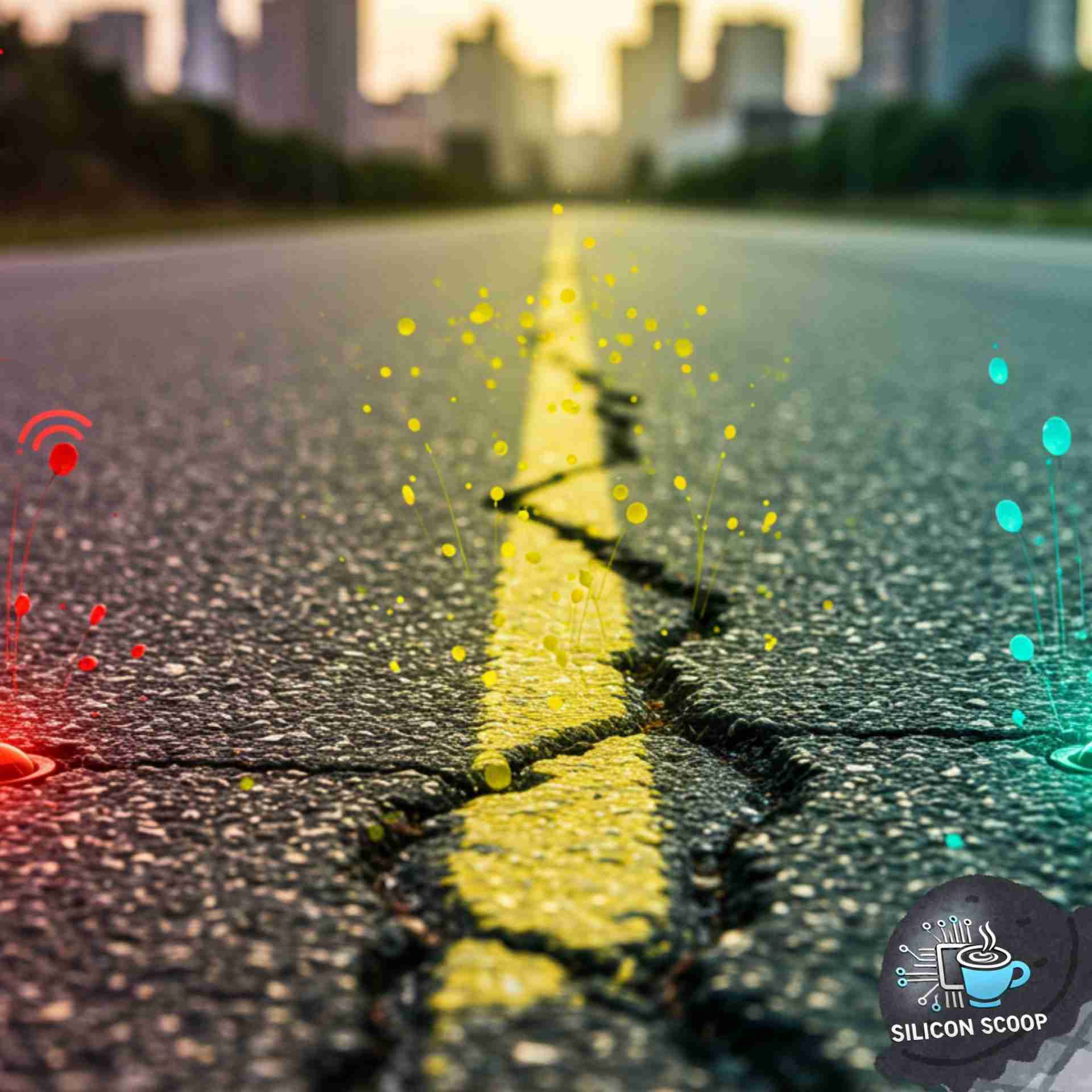
Self-Healing Asphalt: How Plant Spores and AI Are Revolutionizing Road Maintenance
Estimated reading time: 8 minutes
Key Takeaways
- Self-healing asphalt combines plant spores and AI for innovative road repair.
- This technology can reduce maintenance costs significantly while extending road lifespan.
- Environmentally friendly, it diminishes reliance on fossil fuels by using biomass materials.
- AI optimizes the blend for performance under varying conditions, leading to better durability.
Table of contents
- Introduction: The Future of Road Repair Is Here
- The Science Behind Self-Healing Asphalt
- The Self-Healing Mechanism
- Revolutionize Road Maintenance
- Advantages Over Traditional Methods
- Impact on Sustainability Goals
- Challenges and Ongoing Research
- Future Vision: AI-Integrated Infrastructure
- Expert Insights on Self-Healing Asphalt
- Frequently Asked Questions About Self-Healing Asphalt
- Conclusion: The Road Forward
Every year, the United Kingdom spends a staggering £143.5 million on pothole repairs alone. This massive expenditure highlights a global infrastructure challenge that demands innovative solutions. Self-healing asphalt represents a groundbreaking approach to this problem, offering a way to extend road lifespan and dramatically reduce maintenance costs.
Scientists have developed a revolutionary system that combines plant spores – microscopic containers filled with recycled oils – with AI-driven optimization to create roads that can repair themselves. This innovative blend of biomimicry and cutting-edge technology promises to transform how we build and maintain our vital transportation networks.
The Science Behind Self-Healing Asphalt
Understanding Bitumen Degradation
Traditional asphalt deteriorates primarily due to bitumen oxidation. As oxygen interacts with the bitumen binder, it hardens the material, making it increasingly brittle and prone to cracking under stress from traffic and weather conditions. These microscopic cracks eventually expand into the potholes that plague our roadways.
Artificial intelligence models now help engineers predict and mitigate these degradation patterns through advanced atomistic simulations. By understanding the molecular behavior of bitumen under various conditions, researchers can develop more effective healing mechanisms.
Plant Spores: Nature’s Repair Containers
The heart of plant spore asphalt technology utilizes hollow Lycopodium clavatum spores loaded with sunflower oil or similar rejuvenating agents. These microscopic spores are distributed throughout the asphalt mixture during construction.
When small cracks form in the road surface, they rupture the embedded spores, releasing the encapsulated oils. These oils then flow into the damaged areas, rejuvenating the oxidized bitumen and effectively healing micro-cracks within an hour. This process mimics biological healing systems found in nature.
Biomass Blueprint: Reducing Petroleum Dependence
This innovative material represents a significant advancement by replacing traditional petroleum-based components with biomass waste, enhancing sustainability in multiple ways:
- Decreases reliance on finite fossil fuel resources
- Repurposes agricultural and forestry waste materials
- Creates a circular economy model for road construction
- Reduces the carbon footprint of infrastructure development
AI Contribution: Optimizing Performance
Machine learning algorithms have accelerated asphalt mixture optimization through partnerships with cloud computing platforms like Google Cloud. These AI systems:
- Analyze thousands of potential material combinations
- Identify optimal chemical properties for enduring self-repair
- Predict performance under various climate and traffic conditions
- Continuously improve formulations based on real-world performance data
The Self-Healing Mechanism
The Four-Stage Healing Process
The self-healing system triggers a remarkable four-stage sequence when damage occurs:
- Crack Formation: Normal stress creates microscopic cracks in the asphalt surface
- Spore Rupture: The cracks break the embedded plant spores
- Oil Dispersion: Rejuvenating oils flow into the damaged area
- Bitumen Rebinding: The softened bitumen reattaches, closing the crack
Laboratory tests confirm complete resolution of micro-cracks within just 60 minutes, a dramatic improvement over traditional repair timelines that can take days or weeks.
Sustainability in Action
Beyond the obvious repair benefits, this technology promotes circular economy principles by:
- Repurposing waste biomass from agricultural and forestry industries
- Reducing long-term material demand through extended pavement life
- Minimizing construction-related traffic disruptions
- Decreasing overall lifetime carbon emissions of roadways
Revolutionize Road Maintenance
Discover how self-healing asphalt’s innovative blend of plant spores and AI can transform your infrastructure management. Learn more about implementing sustainable, cost-efficient solutions for your roads.
Explore Sustainable Road Solutions
Advantages Over Traditional Methods
Cost Efficiency That Compounds
Self-healing asphalt delivers substantial cost savings through multiple mechanisms:
- Minimized maintenance interventions over the pavement lifetime
- Extended useful life of road surfaces (potentially 20-30% longer)
- Reduced labor costs for repair crews
- Lower equipment and material expenses for patching and resurfacing
- Decreased traffic management costs during maintenance
While initial installation costs may be slightly higher than conventional asphalt, the long-term economic benefits far outweigh this premium, creating significant lifecycle savings for infrastructure managers.
Environmental Benefits Beyond Carbon Reduction
The environmental advantages extend well beyond simple carbon reduction:
- Lower carbon footprints from reduced asphalt production
- Decreased traffic-related emissions from fewer repair-related congestions
- Minimized waste generation throughout the pavement lifecycle
- Reduced noise pollution from smoother, well-maintained surfaces
- Better stormwater management due to fewer surface irregularities
These combined benefits help transportation authorities meet increasingly stringent environmental regulations while improving public satisfaction with road quality.
Infrastructure Resilience in Changing Climates
As climate patterns become more unpredictable, self-healing asphalt offers improved infrastructure resilience through:
- Enhanced material durability against freeze-thaw cycles
- Better performance during extreme temperature fluctuations
- Reduced vulnerability to water infiltration damage
- Less susceptibility to UV degradation
- Autonomous repair during favorable weather conditions
This adaptability ensures transportation networks remain functional despite increasingly challenging environmental conditions.
Economic Growth Potential
Beyond direct infrastructure benefits, self-healing asphalt stimulates economic growth in related sectors:
- Job creation in biomass waste processing
- Research and development opportunities in materials science
- Technology transfer possibilities across construction industries
- Export potential for nations developing expertise in this area
- Reduced economic losses from traffic delays and vehicle damage
This multiplier effect amplifies the technology’s value proposition beyond simple maintenance savings.
Impact on Sustainability Goals
Alignment with Net-Zero Targets
Self-healing asphalt technology aligns perfectly with the UK’s 2050 net-zero emissions targets by:
- Slashing carbon-intensive asphalt manufacturing requirements
- Reducing emissions from repair and maintenance operations
- Decreasing vehicle emissions through improved road surfaces
- Creating carbon sequestration opportunities through biomass integration
- Supporting renewable material supply chains
Global Scalability and Accessibility
The technology shows particular promise in regions without easy access to petroleum resources:
- Enables quality infrastructure development using local biomass sources
- Reduces dependence on imported petroleum products
- Creates opportunities for developing nations to implement advanced road systems
- Adapts to various climate conditions through customizable formulations
- Supports indigenous material sourcing and manufacturing
This accessibility promotes more equitable infrastructure development worldwide.
The Economic Case for Transition
Transitioning to self-healing asphalt stimulates innovation across multiple sectors:
- Waste-to-resource conversion industries
- AI-driven civil engineering applications
- Material testing and quality assurance systems
- Infrastructure monitoring technologies
- Specialized construction equipment and techniques
These growing sectors represent significant economic opportunities as transportation networks evolve toward more sustainable models.
Challenges and Ongoing Research
Real-World Testing Requirements
Despite promising laboratory results, self-healing asphalt requires comprehensive real-world validation:
- Performance under diverse climatic conditions
- Response to varying traffic loads and patterns
- Long-term durability assessment
- Compatibility with existing road construction techniques
- Behavior during extreme weather events
Pilot projects are currently underway in several countries to gather this critical data before widespread implementation.
Refining Healing Efficiency
Current research focuses on scaling healing efficiency for larger damage:
- Enhancing repair capabilities for macroscopic cracks
- Improving healing speed in colder temperatures
- Extending rejuvenator effectiveness over multiple healing cycles
- Optimizing spore distribution throughout the asphalt matrix
- Developing supplementary healing mechanisms for severe damage
These advancements will determine how effectively the technology can address more substantial road deterioration beyond microscopic cracking.
Future Vision: AI-Integrated Infrastructure
The ultimate potential of this technology lies in AI-integrated autonomous infrastructure systems that:
- Continuously monitor road health through embedded sensors
- Predict maintenance needs before visible damage occurs
- Adaptively manage healing processes based on traffic patterns and weather
- Communicate with transportation management systems
- Self-optimize performance based on usage data
This vision represents the convergence of materials science, artificial intelligence, and infrastructure management into a unified smart transportation ecosystem.
Expert Insights on Self-Healing Asphalt
Biomimicry as Innovation Driver
Dr. Francisco Martin-Martinez of King’s College London emphasizes the natural healing inspiration behind the technology: “We’re essentially mimicking what biological systems have perfected over millions of years—the ability to detect damage and repair it automatically. By translating these principles to infrastructure, we’re creating roads that behave more like living systems than static constructions.”
Interdisciplinary Collaboration
Dr. Jose Norambuena-Contreras from Swansea University highlights the critical role of cross-discipline research: “Creating truly net-zero roads requires bringing together chemists, materials scientists, civil engineers, AI specialists, and environmental experts. No single discipline has all the answers, but together we’re developing solutions that were unimaginable a decade ago.”
International Research Ecosystems
The UK-Chile partnership on self-healing asphalt exemplifies how transnational research tackles global infrastructure challenges more effectively than isolated efforts. By sharing expertise, resources, and testing environments, international teams develop more robust solutions applicable across diverse geographies.
Frequently Asked Questions About Self-Healing Asphalt
1. What exactly is self-healing asphalt?
Self-healing asphalt is a revolutionary road material that contains plant spores filled with rejuvenating oils. When cracks form in the asphalt, these spores rupture and release their contents, which then repair the damage autonomously without human intervention.
2. How do plant spores contribute to asphalt repair?
Plant spores act as microscopic capsules that hold rejuvenating oils. Their natural structure makes them perfect containers—strong enough to survive the asphalt mixing process but fragile enough to break when cracks form, releasing their healing contents precisely where needed.
3. What role does artificial intelligence play in self-healing asphalt?
AI optimizes asphalt mixtures by analyzing thousands of potential formulations, predicting performance under various conditions, and continuously improving designs based on real-world data. Machine learning algorithms identify the ideal chemical properties for effective self-repair mechanisms.
4. Is self-healing asphalt more expensive than traditional asphalt?
While initial installation costs may be 10-15% higher, self-healing asphalt significantly reduces lifetime maintenance expenses, resulting in overall savings of 30-40% throughout the pavement lifecycle. The technology becomes increasingly cost-effective as it matures.
5. How quickly can self-healing asphalt repair damage?
Laboratory tests show that micro-cracks can heal completely within 60 minutes under optimal conditions. The healing speed depends on temperature, crack size, and specific asphalt formulation, but is dramatically faster than traditional repair methods.
6. Does self-healing asphalt work in all climates?
Current formulations perform best in moderate climates, but researchers are developing specialized versions for extreme cold and hot environments. The technology’s effectiveness varies with temperature, working faster in warmer conditions and slower in colder ones.
7. How does self-healing asphalt benefit the environment?
This technology reduces carbon emissions by extending road lifespan, decreasing maintenance frequency, utilizing biomass waste instead of petroleum, and minimizing traffic congestion from roadwork. It creates a circular economy model for infrastructure development.
8. Can existing roads be retrofitted with self-healing technology?
While complete conversion requires resurfacing, researchers are developing rejuvenator treatments that can be applied to existing pavements to impart limited self-healing properties. Full benefits come with new construction or complete resurfacing.
9. How long does the self-healing capability last?
Current formulations maintain effective healing properties for 7-10 years, after which the rejuvenating capacity gradually diminishes. Researchers are working to extend this timeframe to match typical pavement design lives of 15-20 years.
10. Are there any disadvantages to self-healing asphalt?
The technology has limitations regarding repair of large structural damage, potentially higher initial costs, and needs further long-term performance data. It works best as part of a comprehensive maintenance strategy rather than a complete replacement for all maintenance.
Conclusion: The Road Forward
Self-healing asphalt represents a revolutionary convergence of biology, chemistry, and artificial intelligence that promises to transform our approach to road construction and maintenance. By combining plant spore technology with AI-driven optimization, this innovation addresses multiple challenges simultaneously:
- It dramatically reduces maintenance costs and extends infrastructure lifespan
- It decreases the environmental impact of road construction and repair
- It improves road safety and vehicle longevity through better surface conditions
- It creates new economic opportunities in sustainable materials and smart infrastructure
As global infrastructure demands continue to grow alongside environmental concerns, self-healing asphalt offers a practical path forward that balances performance with sustainability. By mimicking nature’s own repair mechanisms and enhancing them with cutting-edge technology, we’re creating roads that do more than simply connect places—they actively maintain themselves.
The transition to self-healing asphalt won’t happen overnight, but the technology has progressed from theoretical concept to practical application at remarkable speed. For transportation authorities, construction companies, and communities concerned with infrastructure resilience, this innovation represents one of the most promising developments in decades.
To stay at the forefront of sustainable infrastructure development, decision-makers should closely monitor advancements in this field and consider pilot implementations to gain firsthand experience with this transformative technology. The future of road construction isn’t just about building better—it’s about building smarter roads that can heal themselves.
Additional Links
• Silicon Scoop Podcast – Stay Informed, Stay Ahead!
• Futuretech Podcast – Explore more episodes and stay updated with the latest in technology and innovation.
• Startup Talk Podcast – https://torontostarts.com/startup-talk-toronto-startup-podcast/
• Who Are These Startups Podcast
• Startup Investor Drinks – Join the community and connect with fellow startup enthusiasts and investors.
• TorontoStarts Startup and Entrepreneur Community – Become a part of Toronto’s thriving startup ecosystem.
• Workhaus – Discover flexible workspace solutions for your business needs.
• Work with The Startup Coach – Get expert guidance and mentorship for your startup journey.
• Reach out to Jon Irwin on LinkedIn – Connect with our co-host and technology expert.
Ontario Startup Ecosystem Links
• Ontario’s Startup Ecosystem
• Startup Funding in Ontario
• Angel Investors in Ontario
• Ontario Incubators and Accelerators
• Venture Capital in Ontario: Top Firms, Sectors, and Funding Strategies
• Government Grants for Ontario Startups
• Ontario’s Startup Success Stories
• Ontario Centre of Innovation (OCI)
• Bank Loans and Financing for Startups in Ontario
• Research and Development Tax Credits in Ontario
• Government Loans and Financing for Startups in Ontario
• Equity Crowdfunding for Ontario Startups
• Toronto Entrepreneurs Resources
• Toronto’s Food and Beverage Entrepreneurs: Trends, Challenges, and Success Stories
• SEO Strategies for Toronto Entrepreneurs: Enhance Your Online Visibility
• Social Impact for Toronto Entrepreneurs: Starting and Running a Socially Responsible Business
• Toronto Arts and Media Entrepreneurs: Inspiring Profiles and Insights for Creative Success
• Exploring Toronto Green Tech Entrepreneurs: Innovators and Leaders in Sustainability
• Building a Team for Toronto Entrepreneurs: Strategies for Success
• A Guide for Toronto Food and Beverage Entrepreneurs
• Toronto Fashion and Retail Entrepreneurs: Trends, Opportunities, and Success Stories
Episode transcript
Read the full transcript
Craig: so imagine a world where the cracks in the asphalt in front of your house seal themselves up automatically within sixty minutes of forming. well, that might be a reality with the self healing asphalt with plant spores and ai. tell us what's going on here, john.
Jon: yeah. this is cool. so researchers have developed a form of self healing asphalt that incorporates, like you said, plant spores to prevent potholes from forming. so the material leverages natural properties of plant roots to repair cracks in the asphalt before they become significant. so how it works is the spores, typically from plants like alfalfa or clover, are mixed into the asphalt mixture. and then when water enters the cracks in the asphalt, the spores germinate, the roots grow, filling the gaps and strengthening the material, which okay. i was always taught that having roots within your infrastructure makes things weaker. so this is interesting, like, when you see those, you know, those vines growing on the sides of houses, those are all into like, they're getting into the cracks and stuff. so i'm curious to know how this helps as opposed to hinders. but, yeah, really interesting. what are your thoughts?
Craig: well, i don't know if i would consider this roots. maybe i didn't read that here. but
Jon: spores. yeah.
Craig: yeah. and they're spores. so, you know, it's a four step process. so what they do is they mix these spores that are filled with this oil into the concrete into the asphalt when they deploy it. right? and so the self healing system is triggered by this four step sequence where the crack formation or normal stress creates a microscopic cracks in the asphalt surface. that that cracking causes spores to rupture, breaking the embedded plant spores, and the oil now leaks out and flows into the damaged area. this softens the bitumen, softens it, and the bitumen reattaches closing the crack. and in laboratory tests, they confirm that the resolution of micro cracks within just sixty minutes, a dramatic improvement over traditional repair timelines that can take days or weeks.
Jon: yeah. this is cool because there are other self healing materials, but they rely on chemical or mechanical mechanisms. so this method harnesses the natural growth of and this is where i got it from. it harnesses the natural growth of plant roots to restore the integrity of the asphalt. so i don't know where i got that. i that's where i got it from. but, no. i
Craig: at no time did i think roots were growing through the asphalt. that's all. i think maybe they get the spores from the roots and put the spores in.
Jon: yeah.
Craig: i'd
Jon: love to see, like, what it looks like. so we'll have to find that and maybe do a follow-up on that. but yeah. no. this is cool. i love it. think, i think that there's we need some sort of advancement, especially up here in canada with the amount of cracks and things forming in our asphalt because of the freezing, the thawing, the freezing, the thawing, everything like that. so this is really interesting.
Craig: yeah. and it looks like there's a lot of benefits. like, there is an initial increase in cost when deploying the asphalt, but it minimized maintenance interventions over a pavement long period of time, extends the use of life of road surfaces potentially by up to thirty percent longer, reducing labor costs of repair crews, lower equipment and material expenses for patching and resurfacing, decreasing traffic management costs during maintenance and, you know, environmental, lower carbon footprint for reducing asphalt production, decrease traffic related emissions from fruit fuel repair related congestions, minimize the waste generation throughout the pavement cycle, reduce noise pollution from smoother, well maintained roads, better stormwater management due to fewer surface irregularities. so there's a lot of potential benefits on this. i am just not a like like with anything, they don't normally test this stuff in our weather. like, we just went through this bitter cold, and, you know, in the summer, we're gonna hit thirty five degrees, i'm sure. and so stuff has to handle both of those, and i'm not sure how something like this would work. but, i just haven't seen the temperature extremes that it handles. but it says it repairs itself a better in ideal condition. so it might crack over the winter, and as things warm up, it starts to repair itself. so you wouldn't necessarily see that in sixty minutes. you just might see it over a longer period of time.
Jon: maybe. yeah. we'll have to see. yeah. i'm curious to see how this scales, if this is deployable in climates like ours or if there's specific climates that can only work in. so
Craig: yeah. and this, apparently, slashes carbon related to, asphalt deployment, so it's great. like, when you go up here, the uk has spent, and just because they didn't have the the money for canada, a hundred and forty three point five million on pothole repairs alone.
Jon: wow.
Craig: so you start to think about the benefits of something like this and, you know, how potholes are pretty big. like, these aren't gonna like, how does that happen? is that a crack that happens over time, or is that a chunk of damage? right?
Jon: yeah.
Craig: so if it's a crack that happens over time, there's some self healing involved there. but they always overstate how great this thing is gonna be, but i'm excited that we're talking about, better, longer lasting roads, better for the environment. you know, this whole, stuff is grown, so it's a recyclable technology. and i'm excited to use all of that. i'm just not thinking this is gonna change everything.
Jon: no. might be good for for driveways and for parking lots, but we'll have to see.
Craig: yeah. i could definitely see this because, one, for people who want their driveway done, you don't necessarily have to get it sealed as often. or if you get it sealed, you get it sealed especially with this stuff that fixes the stuff. so you get it sealed, you know, every few years and whatnot. and it's environmentally friendly and whatnot, so you'll you'll be really happy about all those things. so, yeah, i could definitely see that happening at the driveway level. so we'd love to know what you think. are you gonna get something like this put in your driveway and let the spores take care of those, medicine cracks? are you gonna leave that to the city and see if they do it? or is this just another, pie in the sky dream that's never really gonna hit the roads here in canada? let us know what you think.
More from Silicon Scoop
All episodes
silicon-scoop · October 20, 2026
UltraRAM’s Quantum Leap: How Quinas Is Turning Universal Memory Into Commercial Silicon
UltraRAM and Quinas Technology push universal memory toward commercial silicon, scaling quantum-powered storage for neuromorphic computing and AI.
View episode

silicon-scoop · October 19, 2026
OpenAI’s Jalapeño Chip Stakes a Claim Against Nvidia Blackwell in Real-World AI Inference
OpenAI Jalapeno chip challenges Nvidia GB300 Blackwell with InferenceX AI benchmark results, reshaping AI inference accelerator efficiency and latency.
View episode

silicon-scoop · October 16, 2026
Meta’s $18 Billion Teen Safety Settlement: Soft Guardrails, Hard Leverage Over TikTok and YouTube
Deep dive on Meta teen safety settlement, social media addiction lawsuit, new Facebook Instagram time limits and pressure on TikTok YouTube age verification.
View episode