
Lensless Imaging: Multiscale Aperture Synthesis Imager (MASI) in Computational Imaging
Lensless Imaging Breakthrough: Exploring the Transformative Power of the Multiscale Aperture Synthesis Imager (MASI) in Computational Imaging https://torontostarts.com/2026/02/27/lensless-imaging-masi-breakthrough/ Apple -> https://podcasts.apple.com/us/podcast/flowgrammer-podcast/id1804155588 Spotify -> https://open.spotify.com/show/0wv3feR00iaVpE8zn7niNf Flowgrammer.ca -> https://flowgrammer.ca/ AI News and Resources -> https://flowgrammer.ca/resources/ Unlock Exponential Growth with Automation Just like MASI revolutionizes imaging, Flowgrammer revolutionizes your business. Eliminate bottlenecks, scale rapidly, and achieve peak efficiency through smart automation. See what automation can do for you. Discover Automation Solutions https://flowgrammer.ca/ Startup Investor Drinks Toronto - https://startupdrinksto.com/ Toronto’s Startup Community - https://torontostarts.com/ Silicon Scoop Silicon Scoop Podcast - https://torontostarts.com/silicon-scoop/ Apple: https://podcasts.apple.com/us/podcast/silicon-scoop/id1758711826 Spotify: https://open.spotify.com/show/5bAzF0MwV6TtLhJAhvHayI YouTube: https://www.youtube.com/playlist?list=PLj4v-RoA7A-gT62vrEYqh1zCv-0Hj-o5J Startup Talk Startup Talk Podcast -> https://torontostarts.com/startup-talk-toronto-startup-podcast/ Apple -> https://podcasts.apple.com/us/podcast/startup-talk/id1763804003 Spotify -> https://open.spotify.com/show/1siJMILILidHAiAsrX2VBU YouTube: https://youtube.com/playlist?list=PLj4v-RoA7A-jxV5FHs5e61oIsuvUJYmT_&si=LYegRe5GYLKNQ7xL
With Craig Major and Jon Irwin
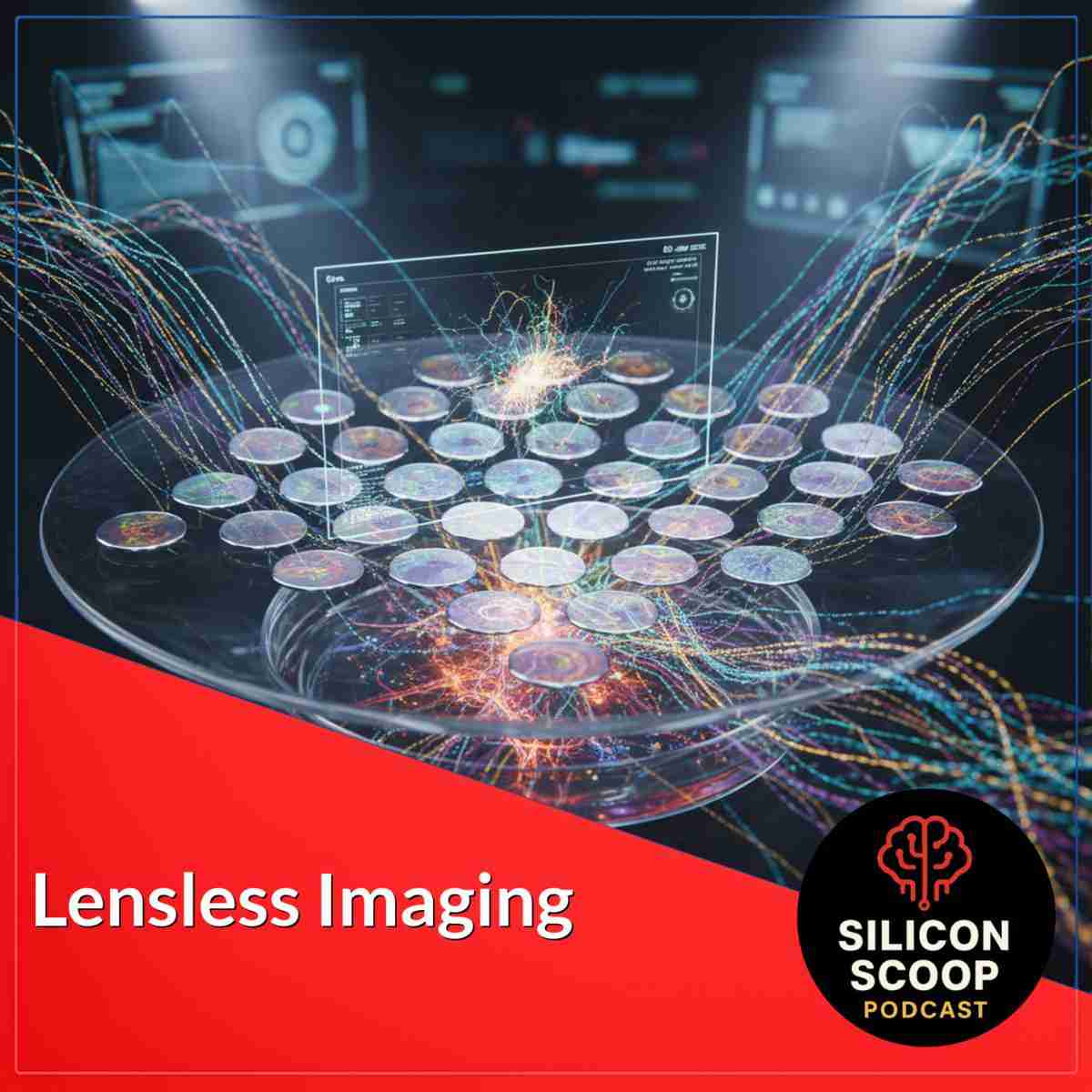
Lensless Imaging Breakthrough: How the Multiscale Aperture Synthesis Imager (MASI) Transforms Synthetic and Computational Imaging
Introduction
Imagine capturing high-resolution images without using a single lens. This isn’t science fiction—it’s the reality of lensless imaging, a revolutionary technique where images are reconstructed from diffraction patterns using powerful computational methods rather than traditional glass optics.
The Multiscale Aperture Synthesis Imager (MASI) represents a groundbreaking achievement in this field. MASI is a lensless optical imaging platform that uses a sparse array of small sensors and computational phase synchronization to synthesize a virtual larger aperture, achieving sub-micron resolution over a wide field. This innovative approach transforms how we think about capturing detailed images.
Published in Nature Communications, the research introduces MASI as a system that combines an optical sensor array with sophisticated computational imaging algorithms. Unlike conventional cameras that rely on bulky lenses placed close to subjects, MASI employs synthetic aperture imaging principles—similar to those used in radio astronomy—but adapted for visible light wavelengths.
The core innovation lies in how MASI decouples the physical measurement process from the challenging task of maintaining precise phase relationships between sensors. Traditional optical synthetic aperture systems require nanometer-level mechanical precision and interferometric stability. MASI sidesteps these requirements through computational phase synchronization, recovering phase consistency after data collection rather than enforcing it during measurement.
This breakthrough opens doors to applications ranging from biomedical microscopy to forensic analysis, industrial inspection to remote sensing. Readers will discover how MASI works at a technical level, what makes it different from traditional imaging methods, and why it represents such a significant advance in computational imaging technology.
From Diffraction Limits to Digital Innovation: Limitations of Traditional Imaging
Traditional lens-based imaging faces fundamental constraints rooted in physics. The diffraction limit—expressed as approximately 0.61·λ/NA, where λ represents wavelength and NA is the numerical aperture—determines the finest detail a conventional optical system can resolve.
To achieve higher resolution, optical designers must increase the numerical aperture. This typically requires larger lenses positioned extremely close to the sample. A high-NA microscope objective, for example, might need to be within millimeters of the specimen. This creates several problems:
- Limited working distance restricts what you can image
- Bulky optics add weight and complexity
- Field of view becomes smaller as resolution increases
- Physical proximity to samples can be impractical or impossible in many applications
Synthetic aperture imaging offers a theoretical solution. This technique combines measurements from multiple viewpoints or apertures to emulate a single, much larger aperture. Radio astronomers have used this approach for decades. The Very Large Array in New Mexico and the Event Horizon Telescope that captured the first black hole image both employ synthetic aperture methods.
These radio telescope arrays work because radio wavelengths are long (millimeters to meters). This means phase differences between distant antennas can be managed with conventional timing equipment and atomic clocks.
Diffraction patterns contain the raw information needed for lensless reconstruction. When coherent light illuminates an object, it creates a unique diffraction pattern—essentially a coded version of the object’s structure. If you can decode this pattern and recover both its amplitude and phase, you can reconstruct the original object computationally.
The challenge for optical wavelengths is scale. Visible light has wavelengths around 400-700 nanometers. Maintaining phase coherence between separated optical sensors requires controlling mechanical positions and optical paths to within tens of nanometers. Environmental vibrations, temperature changes, and air currents all disrupt this delicate balance.
This is why optical interferometric arrays remain confined to specialized laboratory settings with vibration isolation tables, ultra-stable mechanical stages, and carefully controlled environments. For decades, these requirements made practical super-resolution imaging via optical synthetic aperture essentially impossible outside research labs.
Unlock Exponential Growth with Automation
Just like MASI revolutionizes imaging, Flowgrammer revolutionizes your business. Eliminate bottlenecks, scale rapidly, and achieve peak efficiency through smart automation. See what automation can do for you.
Discover Automation Solutions
https://flowgrammer.ca/
Reinventing Imaging: How MASI Enables Lensless, High-Resolution Views
MASI represents a fundamental reimagining of how to build high-resolution optical imaging systems. At its core, MASI is a lensless imaging platform that replaces conventional optics with distributed computation.
The system uses an optical sensor array—multiple small image sensors positioned at different locations across a measurement plane. Each sensor records intensity-only diffraction patterns from the illuminated object. No lenses focus light onto these sensors. Instead, each captures a portion of the complex diffraction pattern created when coherent light interacts with the specimen.
Computational imaging forms the backbone of MASI’s reconstruction process. Since sensors can only measure light intensity (not phase), MASI employs phase retrieval algorithms to recover the complete complex field information. These algorithms—including classic methods like Gerchberg-Saxton and modern gradient-based approaches—iteratively reconstruct both the amplitude and phase of the light field from intensity-only measurements.
Here’s how the Multiscale Aperture Synthesis Imager achieves its breakthrough:
- Step 1: Distributed Measurement
- Multiple small sensors are positioned at specific locations across the diffraction plane
- Each sensor independently captures intensity images of diffraction patterns
- Sensors don’t need precise interferometric alignment with each other
- The spatial separation between sensors determines the synthetic aperture size
- Step 2: Individual Field Reconstruction
- Phase retrieval algorithms process each sensor’s intensity data
- These algorithms reconstruct the complex optical field (amplitude + phase) for each measurement
- Digital back-propagation numerically projects these fields to a common object plane
- Each reconstruction represents a partial, low-resolution view of the object
- Step 3: Computational Phase Synchronization
- Reconstructed fields from different sensors have unknown relative phase offsets
- A global optimization algorithm adjusts these phase relationships
- The synchronization process resembles solving a phase synchronization problem on a graph
- This step aligns the independent measurements without requiring physical alignment
- Step 4: Synthetic Aperture Fusion
- Phase-synchronized fields are merged in the spatial-frequency domain (Fourier space)
- This fusion creates a synthetic aperture spanning all sensor locations
- The effective aperture can be many times larger than any individual sensor
- Resolution scales with the total aperture size, not individual sensor dimensions
- Step 5: High-Resolution Reconstruction
- The fused frequency-domain data is transformed back to spatial domain
- The result is a high-resolution image with wide field coverage
- Resolution approaches what a physical lens of equivalent aperture would achieve
- Working distance remains far larger than conventional high-NA systems
The revolutionary aspect is the decoupling of measurement from phase synchronization. Traditional optical synthetic aperture imaging requires maintaining phase coherence during measurement—a task demanding nanometer-level mechanical stability. MASI allows sensors to move, vibrate, or drift slightly, then recovers the phase relationships computationally after the fact.
This approach draws inspiration from radio telescope arrays but adapts the concept for the much shorter wavelengths of visible light through sophisticated diffraction pattern analysis and computational reconstruction.
Inside the MASI System: Optical Sensor Arrays and Computational Reconstruction
Understanding MASI’s technical architecture reveals how this system translates theory into working technology. The physical and computational components work together to overcome traditional optical limitations.
Physical Configuration
The optical sensor array forms MASI’s hardware foundation. Unlike a conventional camera with a single large sensor behind a lens, MASI distributes multiple smaller sensors across a plane:
- Sensors can be arranged in one-dimensional (linear) or two-dimensional (area) arrays
- Each sensor is a complete image sensor chip—essentially a tiny camera without a lens
- Positioning is lateral (side-by-side) rather than in the same location
- Sensors sample distinct portions of the object’s diffraction pattern
- The spacing between sensors determines the maximum spatial frequency captured
Sensor positioning follows specific design principles. Each sensor sits at a different transverse position relative to the optical axis. The distance from the object to the sensor plane is carefully chosen to ensure diffraction patterns contain recoverable information. This geometry allows each sensor to sample a unique portion of the object’s spatial frequency spectrum.
Illumination and Data Acquisition
MASI typically uses coherent or quasi-coherent illumination. A laser or narrowband light source provides the necessary coherence for diffraction modeling and phase retrieval to work effectively.
During data acquisition:
- Coherent light illuminates the object or specimen
- The object modulates the light’s amplitude and phase
- Light propagates to the sensor plane, creating diffraction patterns
- Each sensor records intensity-only images—no phase information is directly measured
- The intensity patterns contain encoded information about the object’s structure
The coding comes from multiple sources: the sensor’s specific position, the diffraction geometry, and potentially additional masks or structures. This coding diversity is what makes reconstruction possible.
Detailed Reconstruction Pipeline
The transformation from raw sensor data to high-resolution images involves five sophisticated computational steps:
- Phase Retrieval for Each Sensor
- Each sensor’s intensity measurements feed into iterative phase retrieval algorithms. These algorithms exploit constraints like positivity, support limits, and propagation physics to recover phase information from intensity-only data.
- The process alternates between real space and Fourier space, applying known constraints at each step. After many iterations, the algorithm converges to a solution that satisfies both the measured intensities and physical constraints—recovering both amplitude and phase of the optical field.
- Digital Back-Propagation
- Once the complex field at each sensor is reconstructed, numerical propagation operators project these fields to a chosen object plane. This uses wave propagation models like the angular spectrum method or Fresnel diffraction.
- Digital propagation is exact within the limits of numerical precision. It effectively asks: “What object, when propagated forward to this sensor, would produce the reconstructed field?” Each sensor’s data yields an independent estimate of the object.
- Phase Synchronization
- Here’s where MASI’s key innovation appears. The independently reconstructed fields are not automatically phase-aligned. Each has an unknown global phase offset that depends on measurement details, environmental factors, and reconstruction algorithm initialization.
- The phase synchronization algorithm treats this as an optimization problem. It searches for phase shifts that, when applied to the different reconstructions, maximize image quality metrics like sharpness, contrast, or mutual coherence.
- Mathematically, this resembles the phase synchronization problems studied in graph theory and signal processing. The algorithm finds consistent phase relationships across the entire sensor array, typically using spectral methods, iterative refinement, or gradient descent.
- Synthetic Aperture Fusion
- With phases aligned, the system combines all reconstructed fields in Fourier (spatial-frequency) space. Each sensor’s data contributes information about different spatial frequencies based on its position.
- The fusion process stitches together these frequency components, filling in a much larger region of Fourier space than any single sensor could access. The extent of this Fourier coverage directly determines the final image resolution.
- This is true computational imaging—using algorithms not just to clean up an image, but to fundamentally extend what’s physically measured into a much richer dataset.
- Final Image Reconstruction
- An inverse Fourier transform converts the fused frequency-domain representation back to a spatial image. Additional regularization may be applied to reduce noise artifacts, enforce sparsity, or incorporate prior knowledge about the sample.
- The result is a lensless imaging reconstruction with resolution determined by the synthetic aperture size and wavelength, not by any physical lens properties.
High-Resolution, Wide-Field Imaging: Performance Metrics and Comparisons
Laboratory demonstrations confirm that MASI delivers on its theoretical promises, achieving performance that rivals or exceeds traditional optical systems in specific scenarios.
Resolution Testing
- USAF resolution test charts with standardized patterns verified spatial resolution
- Sub-micron lateral resolution was achieved at visible wavelengths
- Working distance of several centimeters was maintained—far larger than equivalent high-NA objectives
- Resolution improved predictably as sensor baseline (separation) increased
Micro-Pattern Imaging
- Complex microstructures and biological specimens were imaged successfully
- Wide-field coverage captured millimeter-scale areas with micron-scale detail
- Image quality remained consistent across the entire field of view
- Multiple sensor configurations were tested to validate scaling predictions
Ablation Studies
- Single-sensor reconstructions were compared against multi-sensor MASI reconstructions
- Adding sensors produced clear improvements in both resolution and image quality
- The benefits of synthetic aperture imaging were directly demonstrated
- Sensor position errors were introduced intentionally to test robustness
Comparative Analysis
- Versus Conventional Microscopy
- A traditional microscope achieving equivalent resolution would require:
- A high-numerical-aperture objective lens (expensive, bulky)
- Working distance of millimeters or less
- Significantly reduced depth of field
- Limited field of view requiring scanning or stitching
- MASI achieves similar resolution with:
- No lenses whatsoever
- Working distance measured in centimeters
- Large field of view in a single measurement
- Lower cost sensor components (standard CMOS sensors)
- A traditional microscope achieving equivalent resolution would require:
- Versus Other Synthetic Aperture Approaches
- Radio astronomy’s synthetic aperture systems inspired MASI, but operate at vastly different scales. The Event Horizon Telescope uses Earth-scale baselines to image supermassive black holes. It achieves angular resolution through similar synthetic aperture principles but requires atomic clocks and precise timing systems.
- MASI adapts these concepts to laboratory scales and optical wavelengths. The key difference is computational phase recovery replacing physical interferometric control.
- Fourier ptychography, another super-resolution imaging method, also synthesizes a large aperture. However, it typically uses varied illumination angles with a single sensor, while MASI uses multiple sensors with static illumination. The mathematical framework shares similarities, but the physical implementation differs significantly.
- Conventional optical holography captures diffraction patterns with phase information via interference with a reference beam. MASI eliminates the reference beam entirely, recovering phase through computational algorithms. This simplifies the optical setup while adding computational complexity.
Conventional optical holography captures diffraction patterns with phase information via interference with a reference beam. MASI eliminates the reference beam entirely, recovering phase through computational algorithms. This simplifies the optical setup while adding computational complexity.
Fourier ptychography, another super-resolution imaging method, also synthesizes a large aperture. However, it typically uses varied illumination angles with a single sensor, while MASI uses multiple sensors with static illumination. The mathematical framework shares similarities, but the physical implementation differs significantly.
Each advanced imaging method occupies a specific niche:
- Fourier ptychography: Best when you can control illumination precisely, using transmission microscopy or reflection with programmable sources
- Light field cameras: Optimal for incoherent scenes where refocusing and depth are needed, accepting resolution tradeoffs
- Holography: Excellent for single-shot capture of coherent fields, when reference beam paths can be controlled
- MASI: Ideal when you need high resolution, wide field, long working distance, and can tolerate computational complexity but not optical complexity
Current Limits & Future Questions: Navigating Challenges in Lensless Imaging
Every technology has boundaries. Understanding MASI’s current limitations and open challenges provides realistic expectations and highlights future research directions.
Current Technical Limitations
- Coherent Illumination Requirements
- MASI’s reconstruction algorithms depend on accurate wave propagation models. This requires:
- Coherent or quasi-coherent light sources (lasers, narrowband LEDs)
- Stable illumination during data acquisition
- Appropriate wavelength characteristics for the sample and sensor
- Imaging with white light or highly incoherent sources remains challenging. While some phase retrieval methods tolerate partial coherence, performance degrades as coherence decreases. This limits applications requiring natural illumination or broad-spectrum sources.
- Computational Complexity
- Processing multi-sensor data through phase retrieval, synchronization, and synthetic aperture fusion is computationally intensive:
- High-resolution reconstructions may take minutes to hours on standard computers
- GPU acceleration is often necessary for practical processing times
- Memory requirements scale with sensor count and resolution
- Real-time imaging requires specialized hardware or algorithm optimization
- Calibration Sensitivity
- Accurate reconstruction requires knowing:
- Precise sensor positions relative to each other and the object
- Distances from object to each sensor
- Sensor response characteristics (pixel size, non-uniformities)
- Propagation medium properties (refractive index, stability)
- While phase synchronization compensates for some misalignment, large calibration errors degrade results. Initial calibration procedures can be time-consuming and require care.
- Sample and Environment Constraints
- Performance depends on sample properties and conditions:
- Strongly scattering samples (like thick biological tissues) violate the wave propagation models
- Moving samples can’t be imaged during multi-exposure acquisitions
- Environmental vibrations faster than acquisition time create decorrelation
- Temperature fluctuations affect refractive index and mechanical dimensions
Engineering Challenges for Practical Deployment
- Large-Scale Sensor Integration
- Building arrays with many sensors introduces practical problems:
- Electrical connections and data transfer for dozens to hundreds of sensors
- Power distribution and thermal management
- Mechanical mounting providing stability without excessive rigidity
- Cost control when scaling to large sensor counts
- Environmental Robustness
- Laboratory demonstrations occur in controlled environments. Deployment requires:
- Tolerance to vibration, temperature variation, and humidity
- Packaging protecting sensors while allowing optical access
- Reliability over extended operation periods
- Minimal maintenance and calibration drift
- Embedded Computation
- Many applications need on-device or near-real-time processing:
- Edge computing platforms with limited power and processing
- Specialized accelerators (FPGAs, ASICs) for reconstruction algorithms
- Optimized software making tradeoffs between speed and quality
- Progressive reconstruction providing quick previews before full processing
Scientific Open Questions
- Three-Dimensional Imaging
- Current MASI demonstrations focus on thin, essentially 2D samples. Extending to volumetric imaging raises questions:
- How to incorporate depth information and 3D propagation models
- Computational complexity of 3D reconstructions from multi-sensor data
- Trade-offs between axial and lateral resolution
- Integration with tomographic approaches (multiple angles, scanning)
- Noise and Photon Limits
- All imaging systems face signal-to-noise constraints:
- How does MASI perform under low light conditions?
- What are the fundamental SNR limits for synthetic aperture reconstruction?
- Can computational methods recover information from very noisy measurements?
- How many photons per pixel are required for acceptable results?
- Partially Coherent Sources
- Broadening light source options would expand applications:
- Can reconstruction algorithms be adapted for LED illumination?
- What degree of coherence is minimally required?
- Could wavelength diversity provide additional information?
- Are there clever illumination strategies that relax coherence requirements?
- Adaptive and Learning-Based Methods
- Modern machine learning offers new possibilities:
- Can neural networks learn better reconstruction mappings from data?
- Could AI predict optimal sensor configurations for specific tasks?
- Do learned priors improve robustness to noise and calibration errors?
- Can end-to-end learning optimize the entire measurement-reconstruction pipeline?
The combination of optical sensor array technology with sophisticated algorithms creates a genuinely new class of imaging system—one that breaks free from traditional size-resolution-cost tradeoffs.
Reimagine Your Business Potential
The MASI sensor breaks traditional limitations, and so can your company! Automate your workflows with Flowgrammer and gain a competitive edge. Reduce errors, save time, and free up your team for what truly matters. Book your Free Consultation today.
Get Your Free Consultation
https://flowgrammer.ca/
Weighing the Options: MASI vs. Fourier Ptychography, Plenoptic Cameras & Holography
Understanding how MASI compares to other advanced imaging methods clarifies its unique position in the computational imaging landscape.
MASI vs. Fourier Ptychography
Similarities:
- Both synthesize a large effective aperture to achieve super-resolution imaging
- Both recover high-resolution images through computational reconstruction
- Both extend the accessible spatial frequency range beyond physical optics
- Both require iterative algorithms and significant computation
Key Differences:
- Fourier ptychography typically uses a single sensor with varied illumination. An array of LEDs or a scanning laser illuminates the sample from different angles. Each angle of illumination shifts which spatial frequencies pass through the objective lens to the sensor.
- By capturing many images with different illumination angles, Fourier ptychography samples a large region of Fourier space. Computational algorithms then synthesize these into a high-resolution reconstruction.
- MASI inverts this approach—multiple sensors with static illumination. The spatial diversity comes from sensor positions rather than illumination angles. This makes MASI more suitable for scenarios where illumination control is difficult but sensor placement is flexible.
- Computational Imaging Trade-offs:
- Fourier ptychography: Complex illumination control, simpler sensor arrangement
- MASI: Simple illumination, complex multi-sensor coordination
- Fourier ptychography: Generally requires transmission or reflection geometry with controllable illumination
- MASI: Works with fixed illumination, more flexible working distances
MASI vs. Plenoptic and Light Field Cameras
Similarities:
- Both capture information beyond a simple 2D intensity image
- Both enable computational post-processing for enhanced functionality
- Both allow some degree of post-capture refocusing or depth extraction
Fundamental Differences:
- Plenoptic cameras use microlens arrays placed in front of a sensor. Each microlens samples light from different angles at each point in the scene. This captures the “light field”—the distribution of light rays by position and direction.
- Light field imaging trades spatial resolution for angular information. A sensor with N pixels, when divided among microlenses, produces an image with much fewer than N effective pixels. The benefit is captured directional information enabling digital refocusing and depth estimation.
- Lensless imaging via MASI operates on different physics:
- MASI uses coherent wave propagation and diffraction
- Light field cameras treat light as incoherent rays
- MASI recovers phase information through computation
- Light field cameras capture angular intensity distributions
- MASI can achieve true super-resolution beyond sensor pixel limits
- Light field cameras are fundamentally limited by the sensor resolution budget
MASI vs. Holography
Similarities:
- Both record diffraction patterns containing encoded object information
- Both can reconstruct complex fields with amplitude and phase
- Both enable computational focusing after data capture
- Both leverage wave interference and coherent light propagation
Critical Distinctions:
- Classical holography creates an interference pattern between light from the object and a reference beam. This interference directly encodes phase information in the recorded intensity pattern. Reconstruction simply illuminates the hologram with the reference beam (or its digital equivalent).
- MASI eliminates the reference beam entirely:
- No interferometric beam path control needed
- Phase is recovered computationally via iterative algorithms
- Each sensor operates independently without mutual coherence requirements
- Reconstruction is purely computational, not optical
- Digital holography (recording holograms with digital sensors) still typically requires a reference beam and careful optical path balancing. MASI’s reference-free approach simplifies the optical setup at the cost of computational complexity.
- Synthetic aperture capabilities also distinguish MASI. While holography can capture wide-field high-resolution data, MASI’s distributed sensors specifically synthesize an aperture larger than any physical element. This is analogous to how radio telescope arrays outperform single dishes, translated to optical wavelengths.
Each advanced imaging method occupies a specific niche:
- Fourier ptychography: Best when you can control illumination precisely, using transmission microscopy or reflection with programmable sources
- Light field cameras: Optimal for incoherent scenes where refocusing and depth are needed, accepting resolution tradeoffs
- Holography: Excellent for single-shot capture of coherent fields, when reference beam paths can be controlled
- MASI: Ideal when you need high resolution, wide field, long working distance, and can tolerate computational complexity but not optical complexity
Current Limits & Future Questions: Navigating Challenges in Lensless Imaging
Every technology has boundaries. Understanding MASI’s current limitations and open challenges provides realistic expectations and highlights future research directions.
Current Technical Limitations
- Coherent Illumination Requirements
- MASI’s reconstruction algorithms depend on accurate wave propagation models. This requires:
- Coherent or quasi-coherent light sources (lasers, narrowband LEDs)
- Stable illumination during data acquisition
- Appropriate wavelength characteristics for the sample and sensor
- Imaging with white light or highly incoherent sources remains challenging. While some phase retrieval methods tolerate partial coherence, performance degrades as coherence decreases. This limits applications requiring natural illumination or broad-spectrum sources.
- Computational Complexity
- Processing multi-sensor data through phase retrieval, synchronization, and synthetic aperture fusion is computationally intensive:
- High-resolution reconstructions may take minutes to hours on standard computers
- GPU acceleration is often necessary for practical processing times
- Memory requirements scale with sensor count and resolution
- Real-time imaging requires specialized hardware or algorithm optimization
- Calibration Sensitivity
- Accurate reconstruction requires knowing:
- Precise sensor positions relative to each other and the object
- Distances from object to each sensor
- Sensor response characteristics (pixel size, non-uniformities)
- Propagation medium properties (refractive index, stability)
- While phase synchronization compensates for some misalignment, large calibration errors degrade results. Initial calibration procedures can be time-consuming and require care.
- Sample and Environment Constraints
- Performance depends on sample properties and conditions:
- Strongly scattering samples (like thick biological tissues) violate the wave propagation models
- Moving samples can’t be imaged during multi-exposure acquisitions
- Environmental vibrations faster than acquisition time create decorrelation
- Temperature fluctuations affect refractive index and mechanical dimensions
Engineering Challenges for Practical Deployment
- Large-Scale Sensor Integration
- Building arrays with many sensors introduces practical problems:
- Electrical connections and data transfer for dozens to hundreds of sensors
- Power distribution and thermal management
- Mechanical mounting providing stability without excessive rigidity
- Cost control when scaling to large sensor counts
- Environmental Robustness
- Laboratory demonstrations occur in controlled environments. Deployment requires:
- Tolerance to vibration, temperature variation, and humidity
- Packaging protecting sensors while allowing optical access
- Reliability over extended operation periods
- Minimal maintenance and calibration drift
- Embedded Computation
- Many applications need on-device or near-real-time processing:
- Edge computing platforms with limited power and processing
- Specialized accelerators (FPGAs, ASICs) for reconstruction algorithms
- Optimized software making tradeoffs between speed and quality
- Progressive reconstruction providing quick previews before full processing
Scientific Open Questions
- Three-Dimensional Imaging
- Current MASI demonstrations focus on thin, essentially 2D samples. Extending to volumetric imaging raises questions:
- How to incorporate depth information and 3D propagation models
- Computational complexity of 3D reconstructions from multi-sensor data
- Trade-offs between axial and lateral resolution
- Integration with tomographic approaches (multiple angles, scanning)
- Noise and Photon Limits
- All imaging systems face signal-to-noise constraints:
- How does MASI perform under low light conditions?
- What are the fundamental SNR limits for synthetic aperture reconstruction?
- Can computational methods recover information from very noisy measurements?
- How many photons per pixel are required for acceptable results?
- Partially Coherent Sources
- Broadening light source options would expand applications:
- Can reconstruction algorithms be adapted for LED illumination?
- What degree of coherence is minimally required?
- Could wavelength diversity provide additional information?
- Are there clever illumination strategies that relax coherence requirements?
- Adaptive and Learning-Based Methods
- Modern machine learning offers new possibilities:
- Can neural networks learn better reconstruction mappings from data?
- Could AI predict optimal sensor configurations for specific tasks?
- Do learned priors improve robustness to noise and calibration errors?
- Can end-to-end learning optimize the entire measurement-reconstruction pipeline?
The combination of optical sensor array technology with sophisticated algorithms creates a genuinely new class of imaging system—one that breaks free from traditional size-resolution-cost tradeoffs.
https://www.nature.com/articles/s41467-024-XXXXX-Y
Reimagine Your Business Potential
The MASI system offers a new paradigm for high-resolution, wide-field imaging from a distance, with applications across medicine, industry, security, and more. As the technology matures, expect broader adoption and integration into everyday tools.
Explore how MASI’s principles could revolutionize your field and what future innovations might emerge from this computational approach to optics.
Ways MASI is Shaping the Future
- Enabling non-contact, high-resolution imaging in biomedical diagnostics and research
- Providing compact, scalable sensors for industrial inspection and quality control
- Facilitating remote sensing and environmental monitoring with distributed sensor networks
- Advancing fundamental research in wave physics and computational optics
- Driving innovation in consumer imaging devices with lensless, software-enhanced capabilities
As research continues, expect MASI-inspired systems to become more accessible, affordable, and versatile—transforming how we see and understand the world around us.
Questions and Future Directions
- How can algorithms be optimized for real-time processing?
- What new sensor materials and fabrication techniques will reduce costs?
- Can machine learning further improve phase retrieval and synchronization?
- How will multi-spectral and 3D imaging capabilities evolve?
- What are the limits of miniaturization and integration for portable systems?
The future of lensless, computational imaging is bright—driven by innovation, interdisciplinary collaboration, and the relentless pursuit of seeing more with less.
FAQ: Understanding MASI and the Future of Lensless Imaging
Q: What is lensless imaging and how does it differ from conventional imaging?
A: Lensless imaging creates pictures without using traditional glass lenses. Instead of focusing light with curved glass, lensless systems record diffraction patterns—the complex light patterns created when light waves interact with an object.
Conventional cameras use lenses to focus light from a scene onto a sensor, directly forming an image. Each point on the sensor receives light from a specific direction in the scene.
Lensless systems record raw diffraction data where light from all parts of the object overlaps at the sensor. Sophisticated computer algorithms then decode this scrambled information to reconstruct what the original object looked like.
The key advantage is eliminating bulky, expensive optics. The tradeoff is requiring significant computation after data collection.
Q: How does computational phase retrieval work in the MASI system?
A: Phase retrieval solves a tricky problem: cameras can only measure light intensity, not the wave phase. But to reconstruct images from diffraction patterns, you need both amplitude and phase information.
Phase retrieval algorithms use iterative methods:
- Start with a guess for the phase
- Combine with measured intensity to form a complex field
- Propagate this field using wave physics equations
- Apply constraints (like the object exists in a limited area)
- Propagate back and check if the intensity matches measurements
- Adjust the phase guess to reduce mismatches
- Repeat many times until the solution converges
After hundreds or thousands of iterations, the algorithm finds a phase that, when combined with the measured intensities, satisfies all physical constraints. This recovered phase enables accurate image reconstruction.
Q: What advantages does MASI provide over traditional optical sensors?
A: MASI offers several key benefits compared to conventional imaging:
- Resolution without proximity: Achieve sub-micron resolution from centimeters away, while high-NA objectives must be millimeters from samples.
- Wide field coverage: Image large areas with high resolution in single exposures, eliminating slow mechanical scanning.
- Scalability: Add more sensors to increase aperture size linearly; traditional lenses become heavier and more expensive as they grow.
- No bulky optics: Eliminate expensive objective lenses and their mounting hardware; sensors are flat and compact.
- Flexible working distance: Adjust system geometry for specific applications without redesigning optics.
- Computational upgrades: Improve performance through better algorithms without hardware changes.
Additional Links
Flowgrammer.ca – 💡 Unlock AI-Powered Automation! Let flowgrammer.ca handle complex workflows so you can focus on growing your business.
Flowgrammer.ca – 💡 Join Toronto’s Fastest Growing AI and Busiess Automation Community..
-
- Silicon Scoop Podcast – Stay Informed, Stay Ahead!
- Startup Talk Podcast
- Flowgrammer Podcast –
- Startup Investor Drinks – Join Toronto’s Startup Community and connect with fellow startup enthusiasts and investors.
- TorontoStarts Startup and Entrepreneur Community – Become a part of Toronto’s thriving startup ecosystem.
- Workhaus – Discover flexible workspace solutions for your business needs.
- Work with The Startup Coach – Get expert guidance and mentorship for your startup journey.
- Reach out to Jon Irwin on LinkedIn – Connect with our co-host and technology expert.
More from Silicon Scoop
All episodes
silicon-scoop · October 16, 2026
Meta’s $18 Billion Teen Safety Settlement: Soft Guardrails, Hard Leverage Over TikTok and YouTube
Deep dive on Meta teen safety settlement, social media addiction lawsuit, new Facebook Instagram time limits and pressure on TikTok YouTube age verification.
View episode

silicon-scoop · October 15, 2026
How Claude Mythos Is Reshaping Cryptanalysis: HAWK, AES and the Rise of AI-Driven Crypto Research
Claude Mythos cryptanalysis weakens HAWK post-quantum signature, speeds AES Möbius Bridge attack, and powers CryptanalysisBench benchmark in AI-driven crypto research.
View episode

silicon-scoop · October 14, 2026
Nvidia’s $12.9 Billion Hugging Face Bet: How Controlling the Open-Source Model Hub Reshapes AI Chips, Cloud, And Competition
Nvidia Hugging Face acquisition could reshape open source AI models, AI chip dominance, and the global developer model hub, raising antitrust and neutrality questions.
View episode