
Harnessing the Future: Solar Battery Green Hydrogen – A New Era in Renewable Energy Storage
Harnessing the Future: Solar Battery Green Hydrogen – A New Era in Renewable Energy Storage Estimated reading time: 10 minutes Key Takeaways Breakthroughs in renewable energy have paved the way for an innovative shift in how we store and use sunlight. The solar battery green hydrogen system is at the heart of this revolution. This […]
With Craig Major and Jon Irwin
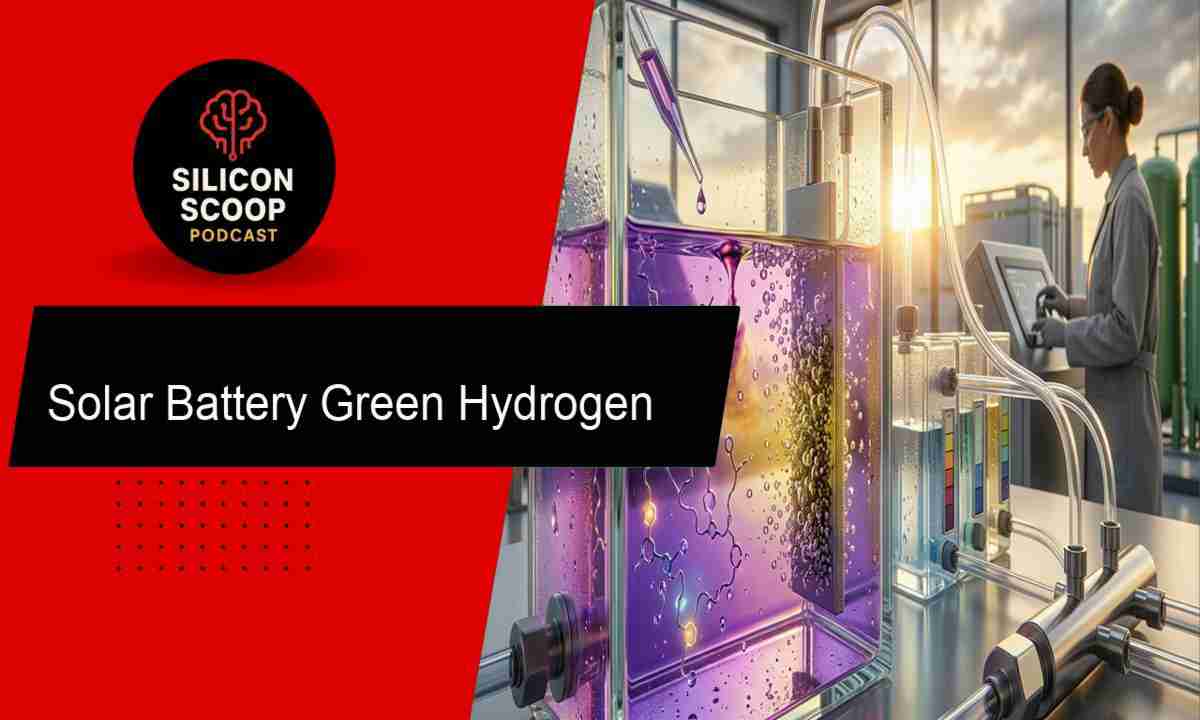
Harnessing the Future: Solar Battery Green Hydrogen – A New Era in Renewable Energy Storage
Estimated reading time: 10 minutes
Key Takeaways
- Breakthroughs in renewable energy have paved the way for an innovative shift in how we store and use sunlight.
- The solar battery green hydrogen system is at the heart of this revolution.
- This technology converts intermittent solar energy into a storable, rechargeable fuel known as green hydrogen.
- Built on a water‑soluble, copolymer-based photo‑redox system, it harvests sunlight and later releases hydrogen through a pH-triggered process.
- Key research studies have shown that this technology can store sunlight for days and then release it as hydrogen on demand.
Table of contents
- Harnessing the Future: Solar Battery Green Hydrogen – A New Era in Renewable Energy Storage
- Introduction
- Section 1: Overview of the Breakthrough Technology – Copolymer Solar Battery
- Call to Action
- Section 2: Technical Deep-Dive into the System’s Operation – Photocatalytic Hydrogen Production
- Section 3: Performance Metrics, Advantages, and Scalability – Scalable Solar Storage Solutions
- Call to Action
- Section 4: Scientific Significance and Future Research Directions – Green Hydrogen Storage Technology
- Section 5: Practical Applications and Broader Implications – Sustainable Chemical Energy Economy
- FAQ Section – 10 Common Questions and Answers
- Conclusion
Introduction
Breakthroughs in renewable energy have paved the way for an innovative shift in how we store and use sunlight. The solar battery green hydrogen system is at the heart of this revolution. This technology converts intermittent solar energy into a storable, rechargeable fuel known as green hydrogen. Built on a water‑soluble, copolymer-based photo‑redox system, it harvests sunlight and later releases hydrogen through a pH-triggered process.
In simple terms, a solar battery green hydrogen system uses a copolymer solar battery to capture energy from the sun, store it in chemical bonds, and subsequently discharge it as sustainable hydrogen fuel. This process combines light harvesting with green hydrogen storage technology, making it a unique and promising method for renewable energy storage.
Key research studies have shown that this technology can store sunlight for days and then release it as hydrogen on demand. Notable sources include a detailed article in Nature Communications (Nature Communications), a press release from Friedrich Schiller University Jena (Friedrich Schiller University Jena), and additional findings from Ulm University (Ulm University).
Section 1: Overview of the Breakthrough Technology – Copolymer Solar Battery
The field of renewable energy storage is rapidly evolving. Traditional solar panels generate power that must be used or stored immediately. Intermittent sunlight creates challenges that demand innovative solutions. Enter the copolymer solar battery: a rechargeable solar fuel system which stores sunlight in chemical bonds, releasing it later as green hydrogen.
Key Points of the Breakthrough:
- • The system uses a water‑soluble copolymer integrated with redox‑active units and photosensitizers to absorb sunlight.
- • It stores energy as electrons on redox-active sites within the polymer.
- • When triggered by a pH change, the stored chemical energy is converted into clean hydrogen gas—a process embraced by green hydrogen storage technology.
Important research findings from the German team highlight that this system can store sunlight for days and then release hydrogen on demand. Prof. Sven Rau stated, “This integration of polymer chemistry and photocatalysis is very promising.” Similarly, Prof. Ulrich S. Schubert noted its potential for scalable solar storage solutions.
- • This technology serves as a modular bridge between solar energy collection and hydrogen generation.
- • It provides a seamless transition from energy capture to hydrogen release, ensuring clean energy when needed.
For further details on the breakthrough technology, refer to the Nature Communications article: Nature Communications article, and the press releases from Friedrich Schiller University Jena: Friedrich Schiller University Jena, and Ulm University: Ulm University.
Call to Action
Turn Busywork Into Growth
If your team is stuck in spreadsheets, copy‑pasting, and chasing updates, you’re paying a “manual work tax” every day. Flowgrammer builds custom business automations that save hours, reduce errors, and help you scale—without hiring more staff.
👉 Book a Free Automation Audit → Book a Free Automation Audit
Section 2: Technical Deep-Dive into the System’s Operation – Photocatalytic Hydrogen Production
This solar battery green hydrogen system is a photocharged macromolecular electrolyte—a copolymer-based solar redox battery. Its operation is twofold: storing solar energy and later releasing it as hydrogen through a pH-controlled process.
Key Components and Mechanism:
• Copolymer
– Defined as a water‑soluble macromolecule with redox-active sites and attached photosensitizer units.
– Acts as a versatile “cell” that both absorbs light and stores the energy, making it a rechargeable solar fuel.
– Helps in efficient energy capture via integrated photosensitive units.
• Redox Units
– These units store electrons by undergoing reversible redox reactions, allowing repeated charging and discharging.
– Their performance is critical for photocatalytic hydrogen production, ensuring the energy remains stored until needed.
• Hydrogen Evolution Catalyst & pH Switch
– The catalyst accelerates hydrogen creation by combining electrons with protons when the pH is lowered.
– The innovative pH-switch mechanism means that the system charges at neutral pH and discharges in an acidic environment, triggering hydrogen release.
Operational Phases of the System:
1. Sunlight Charging Phase
– Under sunlight, the copolymer absorbs visible light.
– Electrons generated in the process are stored on the redox-active sites, changing the solution to a violet (charged) state.
– [Source: Nature Communications article (Nature Communications article)]
2. Storage Phase
– After charging, the system holds the energy with minimal self-discharge for days.
– The stability of the photocharged state ensures high efficiency and reliability over long periods.
– Efficiency metrics are impressive with up to 80% charging efficiency.
– [Source: Press release from Friedrich Schiller University Jena (Press release from Friedrich Schiller University Jena)]
3. Discharge Phase
– The pH-controlled mechanism is activated by adding acid to the system.
– The acid provides a burst of protons which, with the help of the hydrogen evolution catalyst, triggers rapid electron release.
– Hydrogen is evolved as a gas while the copolymer reverts to its yellow (discharged) state.
– The reversible process is repeatable and demonstrates a 72% discharge efficiency.
– [Source: Ulm University press release (Ulm University press release)]
In summary, the technical operation can be broken down into a robust series of steps ensuring that each phase—from absorption to storage and discharge—is efficient and sustainable. The integration of components such as the copolymer, redox-active sites, pH-switch, and catalyst makes this technology a prime example of modern advancements in photocatalytic hydrogen production and pH-controlled energy storage.
Section 3: Performance Metrics, Advantages, and Scalability – Scalable Solar Storage Solutions
This section dives into the numbers and unique benefits of the solar battery green hydrogen technology.
Performance and Efficiency Metrics:
• Charging Efficiency
– Approximately 80% of the incident sunlight is captured and stored as chemical energy.
– This high conversion rate makes the system highly promising.
• Discharge Efficiency
– Around 72% of the stored energy is recovered when hydrogen is produced.
– This ratio reflects the system’s ability to release a significant portion of the stored energy.
• Overall Round-Trip Efficiency
– The combination of charging and discharging gives an efficiency of approximately 58%.
• Storage Duration
– The reduced copolymer state remains stable for several days with minimal energy loss.
– This quality is critical for solar battery green hydrogen systems, which require reliable long-term storage.
• Built-In Colorimetric Indicator
– The system visibly shows its state: violet indicates a charged state and yellow a discharged state.
– This simple indicator offers an intuitive way to monitor system status.
Advantages of the Technology:
• Integration of Functions
– The technology seamlessly combines light harvesting, energy storage, and hydrogen production.
– No separate systems are required for each function, reducing complexity and cost.
• Scalability
– The process is fully solution-based.
– It can be scaled up from small laboratory experiments to large‑tank or flow‑system designs, paving the way for grid‑scale energy storage.
• Environmental Benefits
– Storing solar energy as green hydrogen minimizes reliance on fossil fuels, leading to a sustainable chemical energy economy.
• Ease of Monitoring
– The built-in color change (violet for the charged state, yellow for the discharged state) allows for simple and effective monitoring of the energy storage process.
• Economic Implications
– The system can potentially reduce costs linked to energy storage and transportation by converting solar energy directly into a storable form.
Advantages in a Nutshell:
• Integrated design reduces equipment and infrastructure costs.
• Highly efficient energy capture and release make it a revolutionary rechargeable solar fuel system.
• Scalable and suitable for industrial energy storage needs.
For further performance details and technical validations, see the Nature Communications article (Nature Communications article) and the related university press releases from Friedrich Schiller University Jena (Friedrich Schiller University Jena) and Ulm University (Ulm University).
Call to Action
Make Your Business Run On Autopilot
Imagine leads routed instantly, follow‑ups sent automatically, invoices generated, and reports delivered—while you focus on sales and strategy. Flowgrammer designs no‑code + AI automations that simplify operations and increase revenue with less effort.
🚀 See What We Can Automate For You → See What We Can Automate For You
Section 4: Scientific Significance and Future Research Directions – Green Hydrogen Storage Technology
The scientific significance of the solar battery green hydrogen system lies in its innovative integration of chemistry and energy storage. This technology fuses macromolecular polymer chemistry with photocatalysis, paving the way for advancements that go beyond traditional hydrogen production methods like electrolysis.
Scientific Impact:
• Hybrid Integration
– This technology unites two traditionally separate fields: polymer chemistry and photocatalysis.
– It simplifies the overall system architecture by serving as both the energy storage medium and the light-harvesting component.
• Innovative pH-Triggered Operation
– The built-in pH switch allows the stored energy to remain safe until it is needed.
– Such control over energy release enhances the functionality of green hydrogen storage technology.
• Expert Endorsements
– Prof. Sven Rau from Ulm University highlights the significance of merging different chemical concepts.
– Prof. Ulrich S. Schubert from Friedrich Schiller University Jena emphasizes that scalable solar storage technologies can transform our sustainable chemical energy economy.
Future Research Directions:
• Enhancing Redox Capacity
– Researchers plan to optimize the copolymer for higher redox capacity to store more electrons per molecule.
• Broadening Solar Spectrum Absorption
– Modifying the polymer to capture a wider range of sunlight wavelengths will increase efficiency.
• Catalyst Sustainability and Durability
– Further study is necessary to identify cost-effective, durable catalysts that maintain performance over many cycles.
• Reactor Design and Integration
– Engineering new reactor designs is critical to safely harvest, store, and release hydrogen at larger scales.
• Comparative Analysis
– Researchers are comparing this system to traditional hydrogen production techniques. The solar battery green hydrogen technology offers flexible operating conditions and could reduce infrastructure requirements.
For more insights on the fundamental research and scientific claims, refer back to the Nature Communications article (Nature Communications article) and the detailed press releases from both Friedrich Schiller University Jena (Friedrich Schiller University Jena) and Ulm University (Ulm University).
Section 5: Practical Applications and Broader Implications – Sustainable Chemical Energy Economy
Scaling the solar battery green hydrogen system has vast potential for real-world applications and significant environmental impacts.
Potential Applications:
• Grid‑Scale Energy Storage
– The technology can be used to store solar energy on a large scale, providing a reliable, storable energy source for electrical grids.
• Industrial Hydrogen Supply
– Industries such as steelmaking, ammonia synthesis, and refineries can benefit from a steady supply of green hydrogen.
• Remote and Backup Power Systems
– In areas with abundant solar energy, the technology can provide vital backup power during outages or supply shortfalls.
• Hydrogen Fuel-Cell Vehicles
– Future integration may extend the use of stored green hydrogen to fuel-cell vehicles and other low-emission transport solutions.
Environmental and Climate Impact:
• Renewable Solution to Fossil Fuels
– By reducing dependence on fossil fuels, this technology plays a vital role in mitigating climate change and boosting a sustainable chemical energy economy.
• Low-Carbon Energy Pathway
– Solar battery green hydrogen systems offer an environmentally friendly method to store renewable energy and reduce greenhouse gas emissions.
• Modular and Scalable
– The solution’s fully chemical, solution-based design enables easy scaling from small installations to industrial applications.
Key Implications for Future Energy Systems:
• Flexible and Decentralized
– The system supports decentralized energy production, bridging the gap between centralized solar farms and distributed energy applications.
• Economic Efficiency
– By combining energy storage and hydrogen production, overall energy system costs may be significantly reduced.
• Advancement in Energy Storage Technology
– The breakthrough represents a major step in the evolution of rechargeable solar fuel systems and pH-controlled energy storage, enabling further innovations in sustainable energy.
Further reading on the broader implications and potential applications of this breakthrough is available in the Nature Communications article (Nature Communications article), the Friedrich Schiller University Jena press release (Friedrich Schiller University Jena press release), and the Ulm University press release (Ulm University press release).
FAQ Section – 10 Common Questions and Answers
1. How does the solar battery store energy as green hydrogen?
Answer: The system functions by absorbing sunlight using a copolymer solar battery. The sunlight is converted into stored electrons on redox-active sites. When the pH is lowered, the stored electrons convert into hydrogen gas through a hydrogen evolution catalyst. (Keywords: solar battery green hydrogen, pH-controlled energy storage)
2. What is a copolymer solar battery?
Answer: A copolymer solar battery is a water‑soluble macromolecule that features redox-active sites and photosensitizer units. It absorbs sunlight, stores energy chemically, and later releases it as green hydrogen, functioning as a rechargeable solar fuel. (Keywords: copolymer solar battery, rechargeable solar fuel)
3. How does pH-controlled energy storage work in this system?
Answer: Under neutral or mildly basic conditions, the system stores electrons efficiently. When acid is added, lowering the pH, the change triggers the release of electrons to form hydrogen gas. This switch in pH indicates the transition from storage to discharge mode. (Keywords: pH-controlled energy storage, photocatalytic hydrogen production)
4. What are the benefits of using a copolymer-based system over traditional solar cells or electrolyzers?
Answer: The copolymer system integrates light absorption, storage, and hydrogen production in one liquid medium. This integration simplifies design, increases scalability, and provides a visual color switch to indicate charge status, unlike traditional separate systems. (Keywords: copolymer solar battery, solar battery green hydrogen)
5. How efficient is the energy storage process?
Answer: The process shows approximately 80% charging efficiency and 72% discharge efficiency, resulting in an overall round-trip efficiency of about 58%. These numbers demonstrate robust performance for a renewable energy storage method. (Keywords: scalable solar storage solutions, rechargeable solar fuel)
6. Can the process be scaled up for industrial applications?
Answer: Yes. The system’s fully solution-based chemistry allows for scale-up to large-tank or flow-system designs, which is ideal for grid‑scale applications, industrial hydrogen supply, and decentralized energy storage. (Keywords: scalable solar storage solutions, sustainable chemical energy economy)
7. What role does the color change play in the operation of the battery?
Answer: The color change—from violet when charged to yellow when discharged—acts as a built-in, visual indicator. This feature allows for easy monitoring of the battery’s state and simplifies operational control. (Keywords: copolymer solar battery, pH-controlled energy storage)
8. How does this technology contribute to a sustainable chemical energy economy?
Answer: By storing renewable solar energy and converting it into on‑demand green hydrogen, this technology reduces fossil fuel reliance, cuts emissions, and provides a cleaner, decentralized energy source that supports sustainable economic growth. (Keywords: solar battery green hydrogen, sustainable chemical energy economy)
9. What are the current challenges before full commercial scalability can be achieved?
Answer: Challenges include optimizing the energy density, ensuring long-term cycle stability of the copolymer, improving catalyst durability, and integrating reactor design for safe hydrogen capture and storage. (Keywords: rechargeable solar fuel, green hydrogen storage technology)
10. Why is research on this solar battery system significant for the future of renewable energy?
Answer: This research introduces a new paradigm by integrating solar energy storage with hydrogen generation in one system. It offers a flexible, efficient, and scalable solution, bridging the gaps between intermittent solar power and reliable fuel supply systems. (Keywords: solar battery green hydrogen, photocatalytic hydrogen production)
Conclusion
In conclusion, the solar battery green hydrogen system represents a groundbreaking advance in renewable energy storage. By combining a water‑soluble, copolymer-based solar redox system with pH-triggered hydrogen release, this technology creates a highly efficient, scalable, and sustainable approach to energy management. Its integration of light harvesting, chemical storage, and hydrogen production is a critical step toward a sustainable chemical energy economy—one that reduces our reliance on fossil fuels and supports decarbonized industrial processes.
The versatility of the copolymer system, marked by its dual functionality and simple visual indicators, presents a future where renewable energy is stored safely and utilized on demand. As research continues to optimize components and address current challenges, the potential for this technology will undoubtedly expand, ushering in a new era of energy autonomy and environmental stewardship.
We invite feedback, insights, and further discussion on how solar battery green hydrogen can revolutionize our energy systems. Explore the research and share your thoughts with the broader community to help shape the future of renewable energy storage.
Additional Links
Flowgrammer.ca – 💡 Unlock AI-Powered Automation! Let flowgrammer.ca handle complex workflows so you can focus on growing your business.
Flowgrammers.ca – 💡 Join Toronto’s Fastest Growing AI and Busiess Automation Community..
-
-
- Silicon Scoop Podcast – Stay Informed, Stay Ahead!
- Startup Talk Podcast
- Flowgrammer Podcast –
- Startup Investor Drinks – Join Toronto’s Startup Community and connect with fellow startup enthusiasts and investors.
- TorontoStarts Startup and Entrepreneur Community – Become a part of Toronto’s thriving startup ecosystem.
- Workhaus – Discover flexible workspace solutions for your business needs.
- Work with The Startup Coach – Get expert guidance and mentorship for your startup journey.
- Reach out to Jon Irwin on LinkedIn – Connect with our co-host and technology expert.
-
More from Silicon Scoop
All episodes
silicon-scoop · October 16, 2026
Meta’s $18 Billion Teen Safety Settlement: Soft Guardrails, Hard Leverage Over TikTok and YouTube
Deep dive on Meta teen safety settlement, social media addiction lawsuit, new Facebook Instagram time limits and pressure on TikTok YouTube age verification.
View episode

silicon-scoop · October 15, 2026
How Claude Mythos Is Reshaping Cryptanalysis: HAWK, AES and the Rise of AI-Driven Crypto Research
Claude Mythos cryptanalysis weakens HAWK post-quantum signature, speeds AES Möbius Bridge attack, and powers CryptanalysisBench benchmark in AI-driven crypto research.
View episode

silicon-scoop · October 14, 2026
Nvidia’s $12.9 Billion Hugging Face Bet: How Controlling the Open-Source Model Hub Reshapes AI Chips, Cloud, And Competition
Nvidia Hugging Face acquisition could reshape open source AI models, AI chip dominance, and the global developer model hub, raising antitrust and neutrality questions.
View episode