
M6 MacBook Pro Leaks Raise the Bar for Pro Laptops
M6 MacBook Pro leaks raise the bar for pro laptops https://torontostarts.com/silicon-scoop/ Flowgrammer.ca -> https://flowgrammer.ca/ AI News and Resources -> https://flowgrammers.ca OpenClaw Toronto -> https://openclawto.com/ Turn busywork into background work Stop losing hours to copy-paste, follow-ups, and manual reporting. Flowgrammer builds automations that run your ops on autopilot so you can scale without more headcount. Book an automation audit https://flowgrammer.ca Startup Investor Drinks Toronto - https://startupdrinksto.com/ Toronto’s Startup Community - https://torontostarts.com/ Silicon Scoop Silicon Scoop Podcast - https://torontostarts.com/silicon-scoop/ Apple: https://podcasts.apple.com/us/podcast/silicon-scoop/id1758711826 Spotify: https://open.spotify.com/show/5bAzF0MwV6TtLhJAhvHayI YouTube: https://www.youtube.com/playlist?list=PLj4v-RoA7A-gT62vrEYqh1zCv-0Hj-o5J Startup Talk Startup Talk Podcast -> https://torontostarts.com/startup-talk-toronto-startup-podcast/ Apple -> https://podcasts.apple.com/us/podcast/startup-talk/id1763804003 Spotify -> https://open.spotify.com/show/1siJMILILidHAiAsrX2VBU YouTube: https://youtube.com/playlist?list=PLj4v-RoA7A-jxV5FHs5e61oIsuvUJYmT_&si=LYegRe5GYLKNQ7xL
With Craig Major and Jon Irwin
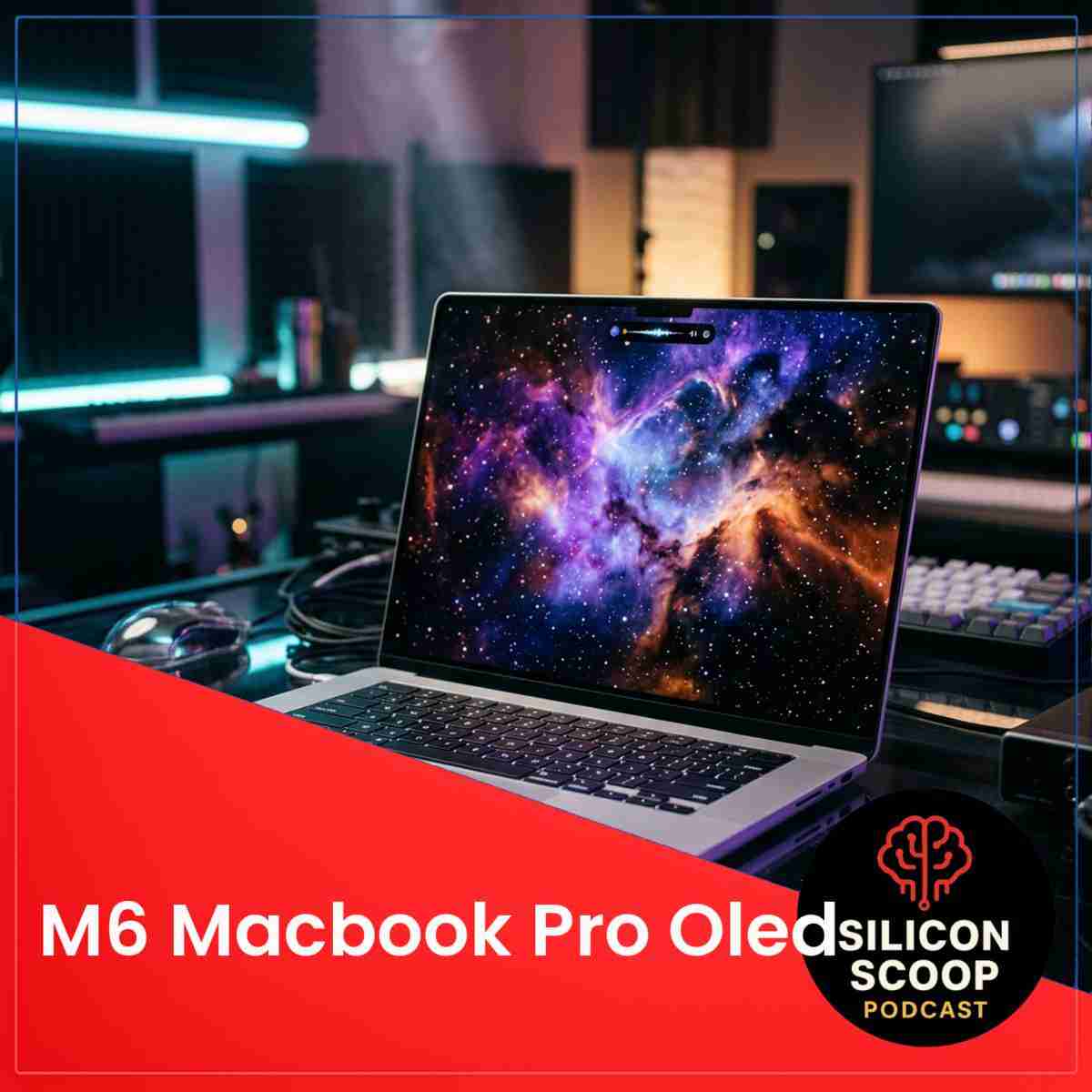
M6 MacBook Pro OLED: Apple’s Biggest Redesign in 5 Years Revealed
Estimated reading time: 8 minutes
Key Takeaways
- The M6 MacBook Pro OLED is shaping up to be the most exciting Apple laptop in years.
- Apple is expected to ditch mini-LED in favor of tandem OLED display technology.
- Rumors point to a Dynamic Island, a touchscreen, and a slimmer redesign.
- The 2nm M6 chip (TSMC N2) is expected to bring major performance and efficiency gains.
- Optional 5G cellular connectivity is rumored, alongside pro ports like Thunderbolt 5, HDMI, SD, and MagSafe.
Table of contents
- M6 MacBook Pro OLED: Apple’s Biggest Redesign in 5 Years Revealed
- Key Takeaways
- Apple Is About to Change Everything With the M6 MacBook Pro OLED
- OLED Display: The MacBook Pro Finally Gets the Screen It Deserves
- Dynamic Island MacBook and Touchscreen: Two Features That Change Everything
- 2nm M6 Chip: The Most Powerful MacBook Pro Ever Built
- Thermal Management and Connectivity: Built for Professionals
- ✋ Before We Get to the Release Date and Pricing…
- Slimmer Design and Release Timeline: When Can You Buy It?
- Should You Wait for the M6 MacBook Pro OLED?
- Frequently Asked Questions: M6 MacBook Pro OLED
Apple Is About to Change Everything With the M6 MacBook Pro OLED
The M6 MacBook Pro OLED is shaping up to be the most exciting Apple laptop in years.
Leaks, analyst reports, and insider sources are all pointing to the same conclusion: Apple is preparing a ground-up redesign of its MacBook Pro lineup. We are talking about a new display type, a brand new chip, a touchscreen, and even a Dynamic Island — all packed into a slimmer body.
If the rumors hold up, this will be the biggest change to the MacBook Pro since its M1 redesign in 2021.
Here is everything we know so far.
Apple M6 Pro/Max MacBook Pro OLED display everything we know so far 2026 update
OLED Display: The MacBook Pro Finally Gets the Screen It Deserves
Tandem OLED Technology Is Coming to the MacBook Pro
Apple is expected to ditch its current mini-LED panels in favor of tandem OLED display technology — the same dual-stack OLED used in the iPad Pro M4.
What does tandem OLED mean? It stacks two OLED layers on top of each other. The result is:
- Higher peak brightness than a single-stack OLED
- Deeper blacks and true infinite contrast ratios
- Superior color accuracy across the full spectrum
- Longer panel lifespan due to reduced strain on each layer
This is not just a visual upgrade. For professionals in video editing, graphic design, color grading, and photography, this display could become the single best reason to upgrade.
Mini-LED has served the MacBook Pro well, but OLED is simply in a different league when it comes to contrast performance and color depth. The jump from mini-LED to OLED is similar to the jump from a standard HD TV to a true 4K HDR panel.
Energy Efficiency Gets a Boost Too
One of the biggest knocks on OLED in the past was power consumption at high brightness. Tandem OLED solves this. Because both layers share the load, each works less hard — meaning the display draws less power overall.
This could help the MacBook Pro maintain its already impressive battery life even with a brighter, more vibrant screen.
Apple M6 Pro/Max MacBook Pro OLED display everything we know so far 2026 update
Dynamic Island MacBook and Touchscreen: Two Features That Change Everything
The Dynamic Island Is Coming to the MacBook Pro
Apple is rumored to replace the current MacBook Pro notch with a hole-punch camera cutout — and wrap it in a Dynamic Island, just like the iPhone.
The Dynamic Island on MacBook Pro would:
- House a new 4K front-facing camera
- Display live activity notifications in a sleek, animated pill shape
- Integrate natively with macOS 27
This is not just a cosmetic change. The Dynamic Island brings a smarter, more interactive notification system to the desktop. Think live timers, music playback controls, and system alerts — all living in that small area above your screen without cluttering your workspace.
The codenames for the two new models have leaked as well: K114 for the 14-inch and K116 for the 16-inch. Both are expected to feature thinner and lighter chassis designs.
Touchscreen MacBook: Real or Hype?
The touchscreen MacBook has been a rumor for years. It looks like 2027 is when Apple finally does it.
But here is the key detail: Apple analyst Mark Gurman of Bloomberg describes the new MacBook Pro as “touch-friendly, not touch-first.” This is not Apple trying to turn your MacBook into an iPad. It is a measured, purposeful addition.
What to expect from the touchscreen MacBook Pro:
- macOS 27 will include touch-optimized interface elements
- Scrolling, tapping, and basic gestures will work natively
- A redesigned hinge will reduce screen wobble during touch use
- It will complement the trackpad, not replace it
Ming-Chi Kuo, one of the most reliable Apple analysts, calls this a “major upgrade” and predicts superior OLED image quality will be a standout feature for creative professionals.
AppleTrack adds that the 2nm chip will deliver game-changing performance without sacrificing battery life — a balance Apple has struggled to promise in the past with new display tech.
touchscreen MacBook Pro touch-friendly
2nm M6 Chip: The Most Powerful MacBook Pro Ever Built
M6 Pro and M6 Max Are Built on TSMC’s 2nm Process
The 2nm M6 chip is the engine behind all of these upgrades. Built on TSMC’s N2 process node, the M6 Pro and M6 Max chipsets represent a massive leap in silicon engineering.
Here is what the data says:
- 15% CPU performance gains over M5
- 30% improvement in power efficiency
- Retains approximately 24-hour battery life despite increased capability
- Next-generation GPU cores for graphics-intensive workloads
The 2nm architecture squeezes more transistors into a smaller space. More transistors means more processing power. Better efficiency means less heat and longer battery life. It is a win on every front.
What This Means for Real-World Use
Whether you are rendering 4K video, training machine learning models, running virtual machines, or compiling code, the M6 Pro and M6 Max will handle it faster and cooler than anything Apple has shipped before.
The M6 Max is expected to be particularly dominant for high-end creative professionals — think music producers, 3D animators, and data scientists who push their machines to the limit every single day.
first look at all-new design 7 biggest changes
Thermal Management and Connectivity: Built for Professionals
Advanced Cooling for a Slimmer Machine
Making a laptop slimmer while also making it more powerful is one of the hardest engineering challenges in the industry. Apple is expected to solve this with a redesigned thermal management system.
Rumored cooling upgrades include:
- Vapor chamber cooling — spreads heat more evenly across a larger surface area
- Improved fan design for quieter, more effective airflow
- Better heat dissipation materials throughout the chassis
This means the M6 MacBook Pro can sustain peak performance for longer without throttling — a common complaint with thin laptops from other manufacturers.
Ports Stay. Wireless Gets Bigger.
Professionals rely on physical connections. Apple knows this. The M6 MacBook Pro is expected to keep:
- Thunderbolt 5 ports for ultra-fast data transfer and display output
- HDMI port for direct monitor connection
- SD card slot for photographers and videographers
- MagSafe charging
And here is something new: optional 5G cellular connectivity is rumored to be in the works. If true, this would make the MacBook Pro the first Mac with built-in wireless broadband — a genuine game changer for professionals who work on the go.
first look at all-new design 7 biggest changes
✋ Before We Get to the Release Date and Pricing…
If you are a professional, freelancer, or small business owner reading this — you already know that upgrading your tools is only half the battle.
The other half is making sure your operations can keep up with your output.
Turn Busywork Into Background Work
Stop losing hours to copy-paste, follow-ups, and manual reporting.
Flowgrammer builds automations that run your ops on autopilot — so you can scale without more headcount.
Whether you are managing clients, handling invoices, or chasing leads, Flowgrammer designs custom workflows that do the heavy lifting for you.
👉 Book an automation audit and find out where you are losing time — and how to get it back.
Slimmer Design and Release Timeline: When Can You Buy It?
A Thinner MacBook Pro Without Sacrificing Power
Apple is walking a fine line with the new design. The M6 MacBook Pro is expected to be noticeably slimmer than the current model — but it will not go as thin as the rumored ultra-thin MacBook Neo.
The goal is to sit comfortably between the two: lighter and more portable than today’s MacBook Pro, while still packing the thermal headroom needed for M6 Pro and M6 Max performance.
The codenames K114 and K116 suggest both 14-inch and 16-inch versions are in development, both targeting a thinner and lighter chassis than their predecessors.
Release Date and Pricing
Here is what the current timeline looks like:
- Standard M6 MacBook Pro models: Possible late 2026 launch
- Redesigned OLED M6 Pro and M6 Max models: Expected early 2027
On pricing, the OLED display and 2nm chip upgrades will come at a cost:
- 14-inch M6 MacBook Pro: Expected to start around $2,200 (up from ~$2,000)
- 16-inch M6 MacBook Pro: Expected to start around $2,700
- Price increase estimated at $200 or more over current models
That is a meaningful jump. But for professionals who depend on their machine daily, the combination of OLED visuals, 2nm performance, touchscreen capability, and 5G connectivity makes a compelling case.
Apple M6 Pro/Max MacBook Pro OLED display everything we know so far 2026 update
Should You Wait for the M6 MacBook Pro OLED?
If you are currently on an Intel MacBook, a pre-M2 model, or any machine older than three years — yes, wait.
The M6 MacBook Pro OLED is not a minor refresh. It is a complete rethink of what a professional laptop should be. Every major component is being upgraded at the same time:
- Display: mini-LED → tandem OLED
- Chip: M5 → 2nm M6 Pro/Max
- Input: trackpad-only → touchscreen MacBook
- Notch: static notch → Dynamic Island MacBook
- Connectivity: Wi-Fi only → possible 5G cellular
If you are on an M2 or M3 MacBook Pro and your machine is working well, the decision is harder. But even then, the OLED display alone may be worth the upgrade for creative professionals.
The M6 MacBook Pro is shaping up to be a once-in-a-generation leap — not just the best MacBook ever made, but potentially one of the best professional laptops ever built.
first look at all-new design 7 biggest changes
Frequently Asked Questions: M6 MacBook Pro OLED
1. What is the M6 MacBook Pro OLED?
The M6 MacBook Pro OLED is the next-generation MacBook Pro expected to launch in 2027. It will feature a tandem OLED display, Apple’s 2nm M6 Pro or M6 Max chip, a touchscreen, and a Dynamic Island replacing the notch.
2. When will the M6 MacBook Pro be released?
Standard M6 models may arrive in late 2026. The full redesigned OLED versions with M6 Pro and M6 Max chips are expected in early 2027.
3. What is tandem OLED technology?
Tandem OLED stacks two OLED layers together. This results in higher brightness, deeper blacks, better color accuracy, and a longer display lifespan compared to single-stack OLED or mini-LED panels.
4. Will the MacBook Pro really have a touchscreen?
Yes, leaks and analysts strongly suggest a touchscreen is coming. Mark Gurman of Bloomberg describes it as “touch-friendly, not touch-first.” macOS 27 will include touch-optimized interface elements to support it.
5. What is the Dynamic Island on MacBook Pro?
The Dynamic Island is a smart notification area around the front camera cutout, first seen on iPhone. On the MacBook Pro, it would replace the current notch and display live activity alerts and system information in an animated pill shape.
6. How much faster is the 2nm M6 chip compared to M5?
The M6 chip built on TSMC’s 2nm process is expected to deliver approximately 15% better CPU performance and 30% better power efficiency compared to the M5.
7. Will the M6 MacBook Pro have 5G?
Optional 5G cellular connectivity is rumored but not confirmed. If included, it would make the MacBook Pro the first Mac with built-in mobile broadband.
8. How much will the M6 MacBook Pro cost?
Estimates suggest the 14-inch model will start around $2,200 and the 16-inch around $2,700. That is approximately $200 more than current models due to the OLED display and new chip.
9. Will the M6 MacBook Pro be thinner than the current model?
Yes. The redesign is expected to produce a slimmer and lighter chassis, codenamed K114 and K116. It will be thinner than the current MacBook Pro but not as thin as the rumored ultra-slim MacBook Neo.
10. Is it worth waiting for the M6 MacBook Pro OLED?
If you are on an older Intel or pre-M2 MacBook, yes — waiting is highly recommended. The M6 MacBook Pro represents a complete upgrade across display, chip, input, and connectivity all at once, making it one of the most significant Apple laptop launches in years.
Sources: MacRumors, Tom’s Guide, Zeera Wireless, Bloomberg (Mark Gurman), Ming-Chi Kuo, AppleTrack, Matt Talks Tech
Additional Links
Flowgrammer.ca – 💡 Unlock AI-Powered Automation! Let flowgrammer.ca handle complex workflows so you can focus on growing your business.
Flowgrammers.ca – 💡 Join Toronto’s Fastest Growing AI and Business Automation Community.
- SRED Funding Solutions – Maximize your R&D tax credits and secure funding for your innovation.
- Silicon Scoop Podcast – Stay Informed, Stay Ahead!
- Startup Talk Podcast
- Flowgrammer Youtube
- Startup Investor Drinks – Join Toronto’s Startup Community and connect with fellow startup enthusiasts and investors.
- TorontoStarts Startup and Entrepreneur Community – Become a part of Toronto’s thriving startup ecosystem.
- Workhaus – Discover flexible workspace solutions for your business needs.
- Work with The Startup Coach – Get expert guidance and mentorship for your startup journey.
- Reach out to Jon Irwin on LinkedIn – Connect with our co-host and technology expert.
Episode transcript
Read the full transcript
Craig: apple is finally caving on touch screens and shrinking transistors to the molecular limit with the new m six macbook pro. this isn't just a refresh. it's a ground up hardware reckoning that resets the standard for the next five years. the max, everything, redesign arrival. so this have leaked, and apple is coming with a two nanometer m six chip with a dual stack tandem oled and a touchscreen a touch responsive screen. it's the first complete structural overhaul of the pro lineup since the original m one transition in 2021. this effectively kills the ipad versus macdebate by merging touch, five d cellular, and extreme efficiency into a singular professional workstation. what do you think about this, john?
Jon: i'm excited. this is the first time i've been excited for a new i'm not a fan of anything apple except the macbook pros. and i know that. i think everything else is just useless, from a tech perspective, but, and old. but this is exciting. so i have a m one max, and i've been waiting for something like this. i think i'm looking i might look to upgrade sooner than later, but i might wait for the m seven. but this is cool. so not only are they moving from oh, so they're moving from mini led to oled display, so that's gonna help with battery. also, the two nanometer, architecture is gonna help with battery. so, like, there's good this could be a twenty four hour laptop, potentially. i'm throwing that out there. i'm hoping it is. maybe not. but i think this is, this is a this is a game changer for for laptops, especially with the touchscreen. i'm excited for that. i'm i'm less excited for the touchscreen now that i don't have a touchscreen lenovo that i'm using as well. because when i had the touchscreen lenovo, i would ghost touch my, my macbook pro, and it wouldn't do anything. so, but i like that there's a touch. i'm just a little concerned because the macos, is not really designed for touch. and i'm trying to imagine it because, like, you have the disappearing bar at the bottom. you've got a bunch of different things. so, i'll be it'll be interesting to see if they actually do implement touch and how they, how they make changes to macos for that. what do you think about this, craig? what do you think about this upgrade?
Craig: well, i don't have the same concerns about you with touch. they're, they're just gonna port over all their i ipad stuff, and they've been doing touch for a long time. yeah. so swipe up to get the bar, swipe from the left to get the bar. you know, it's all fairly straightforward, i think, at this stage, whether we'll like it or not. i'd like to think of the tandem oled display like a dual engine plane instead of one screen working overtime and burning out to stay bright. if two layers sharing the load, you get twice as much punch with half the exhaustion, meaning the screen lasts years longer and sips battery while it's looking better than your living room tv. so you're right. it might be the first twenty four hour, laptop.
Jon: yeah. so the thing is, just, something to note that the leaker was saying is that it's the high end models that they're gonna get the full redesign and the base models are gonna get incremental updates only. so, like, m six pro and m six max, which i'm excited to see because, i really loved the innovation that apple did when they brought out the first macbook air that it slid into a manila envelope. and so i obviously, we can't get to that. maybe we can, but, we cover a lot of future tech and a lot of cooling and a lot of stuff. i don't think we have the technology to get to that thin on a m six mac, macbook pro.
Craig: alright. that's yeah. that's a dream.
Jon: but, yeah. i, i love now the other thing is, and this is more of support versus architecture, but, gaming. so the m one max is great for gaming. it's just it's not supported. so, hopefully, that as apple keeps coming out with these chips that are more and more capable for ai and, and, like, all this, all this other stuff that hopefully gaming will become, more of a regular thing on these laptops.
Craig: yeah. we're expecting a $200 price hike. so they'll be starting at 2,200, for the 14 inch model and 2,700 for the 16 inch model. it should run macos 27, specifically being redesigned for a touch friendly navigation. it has built in five g connectivity, means you can finally use your laptop at the coffee shop and stay on secure, high yeah. without using, their wi fi and stuff. the two nanometer tsmc n two process, the first move, from the gate all around architecture, that should be interesting. and thunderbolt five, eighty gigabits bidirectional up to a 120 gigabits with a bandwidth boost. it's 30% more power efficient, power reduction at the same clock speed as the m five. and a four k front facing camera integrated into the dynamic island, which, i guess is, where they have the camera interface now, i guess, that where they have the notch at the top, they're gonna call that the dynamic island.
Jon: yeah. it's gonna be more of a hole and not a big, like,
Craig: a lot of well, it's gonna be pill shaped, and you're gonna be able to get alerts and stuff in that. okay.
Jon: i guess that makes sense with the touch. right?
Craig: so the dynamic island brings smarter, more interactive notification system desktop. think live timers, music playback controls, system or alerts, all living in a small area above your screen without cluttering your workspace. so we'll have to see if that's gonna be successful. they tried the dynamic, touch bar, which, you know, they pulled pretty quickly because that was not successful. so we'll have to see how this dynamic island yeah. works.
Jon: i just hope they don't mess with the keyboard. or if they do, it's it doesn't break.
Craig: yeah. i hope so too. the m six utilized nanosheet transistors where the gate wraps around the channel on all four sides. this provides a superior electrostatic control and eliminates the current leakage issues found in older thin fet designs. this is the most significant architecture pivot since the move from intel x 86 to arm. we are, transitioning from thin transistors to nanosheets. so, we're moving from the finfet era, which has dominated silicon for the last fifteen years, to a new gaafet structure. it's what finally allows apple to hit the two nanometer physical limit without the chip melting itself. so we'll have to see you know, steve jobs has famously declared the vertical touch screens ergonomically terrible. i'm coining the term gorilla arm, right, to describe the fatigue of reaching for screens. and so seventeen late years later, apple's finally caving in on this and reversing their stand. i don't know. when you have a touch screen, do you use it more than a touchpad or a mouse, or do you, you know, just use it intermittently?
Jon: i was using it more the, like, on the little just to, like, to tap on something, to x something out. like, something that was easily reachable as opposed to having to move my mouse depending on where my mouse was, especially if i was typing. so yeah. and it makes sense that they're moving to a touch screen because of the macos updates that you can now use your ipad as a second screen. so that's a touch screen. right? so why not make the laptop a touch screen? so it makes sense.
Craig: and we'll have to see what kinda next generation gpu design is in this because, you know, everyone's talking about ai and how powerful these new chips can be. so i'm curious to see, how it's gonna be, for three d rendering and for ai tasks from a gpu perspective.
Jon: yeah.
Craig: so the m six macbook pro is the kitchen sink mac. every rumored feature of the last decade is finally arriving in one chassis. is a touch screen on a macbook must have for your workflow, or are you just paying $200 for extra fingerprints on your displays? let us know in the chat what you think. will you be, upgrading one of these soon or it's not your cup of tea?
More from Silicon Scoop
All episodes
silicon-scoop · October 16, 2026
Meta’s $18 Billion Teen Safety Settlement: Soft Guardrails, Hard Leverage Over TikTok and YouTube
Deep dive on Meta teen safety settlement, social media addiction lawsuit, new Facebook Instagram time limits and pressure on TikTok YouTube age verification.
View episode

silicon-scoop · October 15, 2026
How Claude Mythos Is Reshaping Cryptanalysis: HAWK, AES and the Rise of AI-Driven Crypto Research
Claude Mythos cryptanalysis weakens HAWK post-quantum signature, speeds AES Möbius Bridge attack, and powers CryptanalysisBench benchmark in AI-driven crypto research.
View episode

silicon-scoop · October 14, 2026
Nvidia’s $12.9 Billion Hugging Face Bet: How Controlling the Open-Source Model Hub Reshapes AI Chips, Cloud, And Competition
Nvidia Hugging Face acquisition could reshape open source AI models, AI chip dominance, and the global developer model hub, raising antitrust and neutrality questions.
View episode