
Moon Dust Oxygen Could Cut Artemis Costs Fast
Moon Dust Oxygen Could Cut Artemis Costs Fast https://torontostarts.com/silicon-scoop/ Flowgrammer.ca -> https://flowgrammer.ca/ AI News and Resources -> https://flowgrammers.ca OpenClaw Toronto -> https://openclawto.com/ Automate the Busywork You Keep Postponing If your team is copying data, chasing approvals, and updating spreadsheets, you’re paying for repeatable work. We build automations that save hours every week and scale without hiring. Book a free automation consult https://flowgrammer.ca Startup Investor Drinks Toronto - https://startupdrinksto.com/ Toronto’s Startup Community - https://torontostarts.com/ Silicon Scoop Silicon Scoop Podcast - https://torontostarts.com/silicon-scoop/ Apple: https://podcasts.apple.com/us/podcast/silicon-scoop/id1758711826 Spotify: https://open.spotify.com/show/5bAzF0MwV6TtLhJAhvHayI YouTube: https://www.youtube.com/playlist?list=PLj4v-RoA7A-gT62vrEYqh1zCv-0Hj-o5J Startup Talk Startup Talk Podcast -> https://torontostarts.com/startup-talk-toronto-startup-podcast/ Apple -> https://podcasts.apple.com/us/podcast/startup-talk/id1763804003 Spotify -> https://open.spotify.com/show/1siJMILILidHAiAsrX2VBU YouTube: https://youtube.com/playlist?list=PLj4v-RoA7A-jxV5FHs5e61oIsuvUJYmT_&si=LYegRe5GYLKNQ7xL
With Craig Major and Jon Irwin
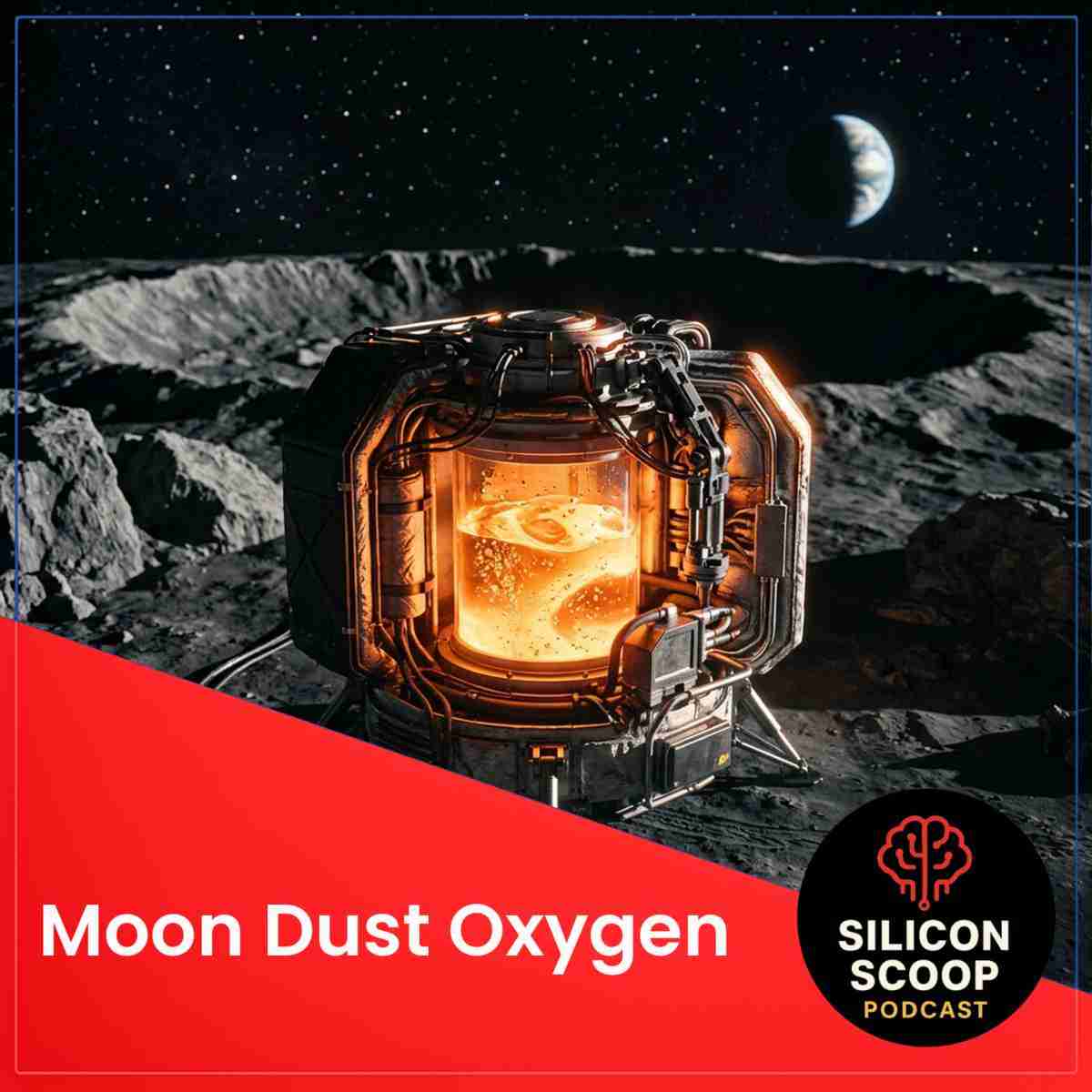
Moon Dust Oxygen: Blue Origin’s Air Pioneer Reactor Just Changed Everything About Living on the Moon
Estimated reading time: 10 minutes
Key Takeaways
- Moon dust oxygen — the idea of pulling breathable air straight from lunar soil — just moved from theory to reality.
- Blue Origin has successfully extracted medical-grade and propellant-grade oxygen from moon dust simulant using its compact Air Pioneer reactor.
- This is not a lab curiosity. It is a working prototype that passed a Critical Design Review in 2025 and is on track for a full autonomous Earth-based demonstration in 2026.
- The process behind the Air Pioneer reactor is called lunar regolith electrolysis — specifically, molten regolith electrolysis (MRE).
- Besides oxygen, the byproducts include iron, aluminum, silicon, and calcium — all potentially useful for construction and manufacturing on the lunar surface.
- NASA awarded $35 million in Tipping Point funding to support Blue Alchemist.
- ISRU oxygen production could reduce lunar landing costs by up to 60% and fuel cell masses could be reduced by up to 70% if oxidizer is sourced on the Moon.
- Silicon produced as a byproduct is refined to 99.999% purity — suitable for making radiation-resistant solar cells on the Moon, without toxic chemicals.
Table of contents
- Moon Dust Oxygen: Blue Origin’s Air Pioneer Reactor Just Changed Everything About Living on the Moon
- Key Takeaways
- Introduction: Breathing on the Moon Is No Longer Science Fiction
- What Is Lunar Regolith and Why Does It Contain Oxygen?
- How Blue Origin’s Lunar Regolith Electrolysis Process Works
- Blue Alchemist: The NASA-Funded Program Behind the Breakthrough
- ⚙️ Automate the Busywork You Keep Postponing
- What This Means for Permanent Lunar Bases and Mars Missions
- The Silicon Byproduct: Solar Power Built From Moon Dust
- Blue Origin’s Space Resources Center of Excellence: Building the Future in LA
- What Happens Next: Timeline to the Moon
- FAQ: 10 Questions About Moon Dust Oxygen and Blue Origin’s Air Pioneer
- Conclusion: The Moon Just Got a Lot More Livable
Introduction: Breathing on the Moon Is No Longer Science Fiction
Moon dust oxygen — the idea of pulling breathable air straight from lunar soil — just moved from theory to reality.
Blue Origin has successfully extracted medical-grade and propellant-grade oxygen from moon dust simulant using its compact Air Pioneer reactor. This is not a lab curiosity. It is a working prototype that passed a Critical Design Review in 2025 and is on track for a full autonomous Earth-based demonstration in 2026.
For anyone following the Artemis program, space exploration, or the future of human settlements beyond Earth, this is the breakthrough that changes the math entirely.
This post breaks down exactly what happened, how the technology works, what it means for lunar bases and Mars missions, and why this moment matters far beyond space.
What Is Lunar Regolith and Why Does It Contain Oxygen?
Moon Soil Is More Than Dust — It Is a Treasure Chest of Oxygen
The Moon’s surface is covered in a fine, powdery material called lunar regolith. This gray, abrasive soil is made up of minerals like silicon dioxide, iron oxide, aluminum oxide, and calcium oxide — all of which are rich in chemically bound oxygen.
The key word is bound. The oxygen in lunar regolith is not floating freely. It is locked inside minerals as part of their molecular structure. To get it out, you need energy and the right process.
Here is why this matters:
- Oxygen makes up about 45% of the mass of lunar regolith by weight
- It is the single most abundant element on the Moon’s surface
- The Moon has essentially no atmosphere to draw breathable oxygen from
- Every kilogram of oxygen shipped from Earth costs a staggering amount in rocket fuel and mission overhead
Unlocking oxygen from lunar soil is like finding a fuel depot that was already there, waiting. The Moon’s regolith is not waste material. It is infrastructure.
Blue Alchemist hits major milestone toward permanent, sustainable lunar infrastructure
How Blue Origin’s Lunar Regolith Electrolysis Process Works
Air Pioneer Uses Molten Rock and Electricity to Free Oxygen from Moon Dust
The process behind the Air Pioneer reactor is called lunar regolith electrolysis — specifically, molten regolith electrolysis (MRE).
Here is how it works, step by step:
- Moon dust simulant is fed into the reactor — a material that closely mimics the chemical and physical properties of real lunar regolith
- The regolith is heated until it melts — forming a molten mineral bath at extremely high temperatures
- Electrical current is passed through the molten material — this is the electrolysis step, which splits the oxygen atoms from the metal oxides in the melt
- Oxygen gas rises from the melt — it is captured and routed through a gas purification system
- The Air Pioneer’s purification system outputs medical- and propellant-grade oxygen — both clean enough to breathe and clean enough to use as rocket fuel
What comes out of the reactor besides oxygen? Metals. The byproducts include iron, aluminum, silicon, and calcium — all potentially useful for construction and manufacturing on the lunar surface.
The Air Pioneer Reactor: Key Technical Details
- Developed at Blue Origin’s Space Resources Center of Excellence (SRCE) in Los Angeles
- The SRCE spans 60,000 square feet across 3 acres
- The team includes 65 domain experts in materials science, electrochemistry, systems engineering, and aerospace
- The reactor operates at 1 megawatt of power — enough to supply electricity to 400 to 1,000 homes
- Silicon produced as a byproduct is refined to 99.999% purity — suitable for making radiation-resistant solar cells on the Moon, without toxic chemicals
- Oxygen purity has been verified using NASA’s Kennedy Space Center flight metrology hardware
The fact that oxygen purity is verified with actual NASA flight hardware is significant. This is not a rough demo. This is production-quality output being measured with space-qualified instruments.
Blue Alchemist hits major milestone toward permanent, sustainable lunar infrastructure
From moon dust to moon colonies
Blue Alchemist: The NASA-Funded Program Behind the Breakthrough
NASA’s $35 Million Bet on In-Situ Resource Utilization Is Paying Off
The Air Pioneer reactor was not built in a vacuum. It is the flagship hardware of Blue Alchemist — Blue Origin’s in-situ resource utilization (ISRU) program funded by NASA through its Tipping Point Partnership via the Game Changing Development program.
Key program milestones:
- NASA awarded $35 million in Tipping Point funding to support Blue Alchemist
- The program completed its Critical Design Review (CDR) in 2025 — a formal engineering gate that confirms the design is mature and ready for the next phase
- Blue Alchemist is now advancing toward a full autonomous Earth-based demonstration in 2026
- The demonstration is designed to prove the system can run without human intervention — a critical requirement for deployment on the Moon
The Tipping Point program exists specifically to fund technologies that are close to commercial readiness but need a final push. NASA is not betting on basic research here. It is investing in a technology it believes will be operational within years, not decades.
Why ISRU Changes Everything for the Artemis Program
In-situ resource utilization means using materials found at the destination rather than hauling everything from Earth. For lunar missions, this concept has been discussed for decades. Blue Alchemist is the first serious step toward making it real at operational scale.
The numbers are stark:
- Launching 1 kilogram of payload to the Moon costs tens of thousands of dollars
- The current cost model for Artemis missions is driven heavily by the need to carry consumables — air, water, fuel
- ISRU oxygen production could reduce lunar landing costs by up to 60%
- Fuel cell masses could be reduced by up to 70% if oxidizer is sourced on the Moon
As Blue Origin VP Pat Remias put it: “Each kilogram of oxygen produced on the lunar surface means one less from Earth — a giant leap toward permanent settlements.”
Blue Alchemist hits major milestone toward permanent, sustainable lunar infrastructure
⚙️ Automate the Busywork You Keep Postponing
If your team is copying data, chasing approvals, and updating spreadsheets, you’re paying for repeatable work. We build automations that save hours every week and scale without hiring.
Book a free automation consult →
What This Means for Permanent Lunar Bases and Mars Missions
Moon Dust Oxygen Is the Foundation of Self-Sustaining Space Settlements
The reason this breakthrough generates excitement far beyond aerospace circles is what it enables downstream.
For lunar bases:
- Astronauts can breathe oxygen produced on-site rather than relying on resupply missions
- Rocket propellant can be manufactured locally — liquid oxygen is the oxidizer in most rocket engines
- Construction materials like iron, aluminum, and silicon become available without Earth launches
- Solar panels for power can be built on the Moon using the ultra-pure silicon the reactor produces as a byproduct
- Each of these capabilities stacks on the others, creating a self-reinforcing infrastructure loop
For Mars missions:
- The Moon becomes a fuel depot and staging point for deep space missions
- Technologies proven on the Moon can be adapted for Martian regolith, which also contains bound oxygen
- Reducing Earth dependency at each step makes missions exponentially more feasible
For commercial ventures:
- Private companies can lease or operate ISRU infrastructure on the Moon
- Lunar oxygen becomes a tradeable commodity in a future cis-lunar economy
- Tourism, mining, and manufacturing operations all require breathable air and propellant
Analysts tracking the space economy highlight that ISRU-enabled lunar bases would dramatically lower the barrier to sustained human presence in space. Blue Origin’s reactor is not just a scientific achievement — it is the seed of a commercial ecosystem.
From moon dust to moon colonies
The Silicon Byproduct: Solar Power Built From Moon Dust
Ultra-Pure Silicon From Lunar Regolith Could Power the Moon Itself
One of the most underreported aspects of the Air Pioneer process is what happens to the non-oxygen outputs.
When electrolysis splits oxygen from the molten regolith, metals and metalloids are left behind. Among them is silicon — and the Blue Alchemist process refines it to a purity of 99.999%.
That level of purity is not scrap material. It is semiconductor-grade silicon, suitable for manufacturing radiation-resistant solar cells directly on the Moon.
Why does that matter?
- The Moon receives abundant solar energy — roughly 1.3 kilowatts per square meter at the surface
- Bringing solar panels from Earth is expensive and fragile
- Manufacturing them on-site using Moon-derived silicon closes another loop in the ISRU chain
- The process uses no toxic chemicals — a critical constraint for any facility operating in a closed habitat
This means the same reactor that produces oxygen for breathing and propellant for rockets could also supply the raw material for the solar panels that power the base. From a systems engineering perspective, this is extraordinarily efficient.
Blue Alchemist hits major milestone toward permanent, sustainable lunar infrastructure
Blue Origin’s Space Resources Center of Excellence: Building the Future in LA
A 3-Acre Facility With 65 Experts Is Where Moon Colonies Are Being Designed
The Air Pioneer reactor did not come from a startup garage. It was developed inside a dedicated, purpose-built research complex.
The Space Resources Center of Excellence (SRCE) is located in Los Angeles and operates at a scale that matches the ambition of the project:
- 60,000 square feet of laboratory, engineering, and testing space
- 3 acres of total facility footprint
- 65 subject matter experts spanning electrochemistry, mechanical engineering, materials science, space systems, and more
- Equipped with hardware that can simulate the thermal, electrical, and material conditions of lunar regolith processing
This is not a skunkworks project. It is a full industrial R&D operation focused entirely on turning space resources into usable materials. The SRCE represents one of the most concentrated investments in space resource extraction technology anywhere in the world.
Blue Alchemist hits major milestone toward permanent, sustainable lunar infrastructure
What Happens Next: Timeline to the Moon
From Critical Design Review to Lunar Deployment — The Roadmap Is Clear
| Milestone | Status |
|---|---|
| NASA Tipping Point Award ($35M) | Complete |
| Air Pioneer Reactor Development | Complete |
| Critical Design Review (CDR) | Complete — 2025 |
| Full Autonomous Earth Demo | Planned — 2026 |
| Lunar Deployment (Artemis era) | Target — late 2020s |
The 2026 autonomous demonstration is the next major gate. If the system can run without human operation on Earth, it proves the core requirement for lunar deployment — because astronauts cannot babysit a reactor on the Moon around the clock.
After that, integration with the Artemis program’s surface infrastructure plans becomes the path to actual Moon deployment.
The timeline is aggressive but grounded. The engineering is not speculative — it has been demonstrated and verified with NASA hardware. What remains is scaling, hardening for the space environment, and integration.
Blue Alchemist hits major milestone toward permanent, sustainable lunar infrastructure
FAQ: 10 Questions About Moon Dust Oxygen and Blue Origin’s Air Pioneer
Q1: What is moon dust oxygen?
Moon dust oxygen refers to oxygen that is chemically locked inside lunar regolith — the fine soil covering the Moon’s surface. Minerals in the soil contain large amounts of oxygen bonded to metals like iron, silicon, and aluminum. Technologies like Blue Origin’s Air Pioneer reactor can extract that oxygen through a process called molten regolith electrolysis.
Q2: How does the Air Pioneer reactor work?
The reactor heats lunar regolith simulant until it melts, then passes electricity through the molten material. This electrolysis process breaks the chemical bonds holding oxygen to metal atoms. The freed oxygen gas rises, is captured, and is purified into medical-grade and propellant-grade oxygen.
Q3: What is lunar regolith electrolysis?
Lunar regolith electrolysis is the process of using an electric current to split oxygen from molten moon soil. It is the core technology behind the Blue Alchemist program and the Air Pioneer reactor. The same principle is used in industrial metal smelting on Earth but adapted for the extreme conditions and unique chemistry of lunar soil.
Q4: Who is funding Blue Alchemist?
NASA funded the Blue Alchemist program with $35 million through its Tipping Point Partnership, managed under the Game Changing Development program. The goal of this funding category is to support technologies that are close to commercial and operational readiness.
Q5: Has the oxygen been tested and verified?
Yes. The purity of oxygen produced by the Air Pioneer reactor has been verified using NASA’s Kennedy Space Center flight metrology hardware — the same measurement tools used for actual space missions. This confirms the output meets both medical and propellant grade specifications.
Q6: What byproducts does the process create?
Besides oxygen, the process releases metals including iron, aluminum, and calcium, and silicon refined to 99.999% purity. That ultra-pure silicon can be used to manufacture radiation-resistant solar panels on the Moon — without any toxic chemicals in the production process.
Q7: How much does this reduce the cost of Moon missions?
Analysts estimate that producing oxygen on the lunar surface through ISRU (in-situ resource utilization) could reduce lunar landing costs by up to 60% and cut fuel cell masses by up to 70%. Oxygen is one of the heaviest consumables a Moon mission must currently carry from Earth.
Q8: When will this technology be ready for actual use on the Moon?
The Blue Alchemist program completed its Critical Design Review in 2025 and is targeting a full autonomous Earth-based demonstration in 2026. Lunar deployment is tied to the Artemis program timeline, with targets in the late 2020s. The autonomous operation requirement is critical — the system must run without constant human supervision.
Q9: Does this technology work for Mars too?
The principles of molten regolith electrolysis are not exclusive to the Moon. Martian regolith also contains bound oxygen in similar mineral structures. Technologies proven on the Moon can be adapted for Mars, making this breakthrough relevant to the long-term goal of human settlements on Mars as well.
Q10: Where is the Air Pioneer reactor being developed?
The reactor is being developed at Blue Origin’s Space Resources Center of Excellence (SRCE) in Los Angeles — a 60,000-square-foot, 3-acre facility staffed by 65 domain experts. It is one of the most dedicated and well-resourced space resource extraction research facilities in the world.
Conclusion: The Moon Just Got a Lot More Livable
The extraction of breathable oxygen from moon dust is no longer a future goal. It is a demonstrated, NASA-verified capability sitting inside a 60,000-square-foot facility in Los Angeles, on track for autonomous operation by 2026.
Blue Origin’s Air Pioneer reactor and the Blue Alchemist program have crossed the line from concept to hardware. The numbers back it up — 60% reduction in mission costs, 70% reduction in fuel cell mass, 99.999% pure silicon as a free byproduct, and oxygen verified at flight-quality standards.
This is what the foundation of a permanent human presence on the Moon looks like. Not a flag, not a footprint — a reactor that turns lunar soil into air, fuel, and solar panels.
The Artemis generation is not just going back to the Moon. With lunar regolith electrolysis in the toolkit, they may actually stay.
Blue Alchemist hits major milestone toward permanent, sustainable lunar infrastructure
Additional Links
Flowgrammer.ca – 💡 Unlock AI-Powered Automation! Let flowgrammer.ca handle complex workflows so you can focus on growing your business.
Flowgrammers.ca – 💡 Join Toronto’s Fastest Growing AI and Business Automation Community.
- SRED Funding Solutions – Maximize your R&D tax credits and secure funding for your innovation.
- Silicon Scoop Podcast – Stay Informed, Stay Ahead!
- Startup Talk Podcast
- Flowgrammer Youtube
- Startup Investor Drinks – Join Toronto’s Startup Community and connect with fellow startup enthusiasts and investors.
- TorontoStarts Startup and Entrepreneur Community – Become a part of Toronto’s thriving startup ecosystem.
- Workhaus – Discover flexible workspace solutions for your business needs.
- Work with The Startup Coach – Get expert guidance and mentorship for your startup journey.
- Reach out to Jon Irwin on LinkedIn – Connect with our co-host and technology expert.
Episode transcript
Read the full transcript
Craig: the moon is no longer just a destination. it's a gas station and a hardware store. blue origin's air pioneer reactor just proved we can literally cook moon dust into breathable air and rocket fuel, flashing the cost of space travel by 60%. so moon dust becomes our lunar life support system. blue origin has successfully demonstrated that the air pioneer reactor, which extracts metal grade oxygen from simulated lunar soil, this is isn't a lab experiment. it's a production ready prototype that passed nasa's critical design review. this effectively ends our total dependence on earth for survivability in space, making permanent lunar bases economically viable for the first time. what do you think about this, john?
Jon: yeah. i think this is cool. it did i miss something that there's tons of oxygen on the moon? because this is really the first time i've been hearing about this, and, apparently, everyone knows this. so, so the cool thing about lunar soil or regolith, it's composed largely of metal oxides. so silicon dioxide, aluminum oxide, iron oxide. and so these compounds, they contain 40 to 45% of oxygen by weight. so that makes oxygen the most abundant element on the moon, but it's chemically bound and unusable in its natural state. so the challenge has always been how to extract oxygen efficiently without bringing massive industrial infrastructure from earth. and so there's this cool process. it's the most promising method as molten regolith electrolysis. so what happens is moon dust is heated to extremely high temperature. let's we're talking 800 to a thousand degrees celsius. i don't know what it is in fahrenheit or higher. and it's melted into a liquid state, then an electric current is passed through it, and then oxygen is released as a gas. now, you get some byproducts of that. you get metals as a byproduct, iron, aluminum, etcetera. but this process essentially splits the chemical bonds and holds oxygen inside lunar minerals. and so the key advantage, it requires only regular and energy, so no additional chemicals. and it produces oxygen and useful construction metals, which is pretty cool. so you get breathable oxygen, and you get metals that you can use to build the infrastructure. now there are some hurdles that are going to remain in this. so, like, let's reality check this for a second. extreme temperatures are required. so there's a high energy demand in a harsh lunar environment. you're handling corrosive molten materials and trying to efficiently capture and storing oxygen gas within all of this. so even a large scale tests, systems themselves, the test they must operate in vacuum conditions and materials degrade quickly under thermal stress. so, there's still a lot to think about, but what i like this. this is kinda cool. this makes it promising for us to establish, bases and makes it much more easy for us to establish bases, don't you think, on the moon?
Craig: oh, absolutely. and to, comment on your first thing about oxygen on the moon, we knew there was oxygen on the moon when we found ice. so the yeah. but we didn't really know about this that we could pull it out. so i just wanted to and the ice wasn't as abundant enough for this and all that kind of stuff. so this changes this. think of this update like a magical oven that takes a bag of dry, dusty flour and turns it both into oxygen you can breathe and the electricity that runs your house. you aren't even bringing the bread from home anymore. you're just harvesting the dirt in the backyard to build the whole bakery. so full autonomous earth based demo happening in 2026 with, lunar deployments targeted, for late twenty twenties. not sure what we're targeting 2028, 2029. fully integrated with nasa's artemis program and future commercial colonies. it operates at one megawatt up enough to power a thousand earth homes. outputs 99.999 pure silicon and medical, grade oxygen. the oxygen makes up 45% of the lunar regolith by weight, so this process unlocks it all. so this is really, really cool, and it explains why things like elon musk are moving towards launching rockets from the moon versus earth and building a base there to refuel and do stuff as oxygen and whatnot becomes more available in these types of tools because it becomes easier to do that from the moon, and takes less resources from us and be able to mine the resources there. so the byproduct is so pure that it is semiconductor grade, allowing for the three d printing of solar panels directly on the moon without using a single toxic chemical. the project was developed at blue origin space resource center of excellence in la. it's a massive 60,000 square foot facility dedicated entirely to living off the land in space. the oxygen purity purity was verified using the exact same flight, metrology hardware nasa uses at the kennedy space center, meaning this stimulated air is already clean for astronaut clean enough for and cleared for astronauts' lungs. the power requirement is pretty big. running a one megawatt reactor on the moon requires a nuclear fission surface, system or a football field solar sized, array, neither of which are fully developed yet. so we'll have to figure out if we can power this thing. any final thoughts on this, john?
Jon: no. is, this is super interesting. i'm curious to see how we solve the energy problem. but yeah.
Craig: we're moving from camping on the moon to living on the moon, thanks to a reactor that turns gray dirt into gold. if you were offered a one way ticket to a lunar base powered by moon dust, would you take it, or is earth's atmosphere still the only air you trust? let us know in the chat.
More from Silicon Scoop
All episodes
silicon-scoop · October 16, 2026
Meta’s $18 Billion Teen Safety Settlement: Soft Guardrails, Hard Leverage Over TikTok and YouTube
Deep dive on Meta teen safety settlement, social media addiction lawsuit, new Facebook Instagram time limits and pressure on TikTok YouTube age verification.
View episode

silicon-scoop · October 15, 2026
How Claude Mythos Is Reshaping Cryptanalysis: HAWK, AES and the Rise of AI-Driven Crypto Research
Claude Mythos cryptanalysis weakens HAWK post-quantum signature, speeds AES Möbius Bridge attack, and powers CryptanalysisBench benchmark in AI-driven crypto research.
View episode

silicon-scoop · October 14, 2026
Nvidia’s $12.9 Billion Hugging Face Bet: How Controlling the Open-Source Model Hub Reshapes AI Chips, Cloud, And Competition
Nvidia Hugging Face acquisition could reshape open source AI models, AI chip dominance, and the global developer model hub, raising antitrust and neutrality questions.
View episode