
Optical Servers Just Cut AI Power Bills by 90%
Optical Servers Just Cut AI Power Bills by 90% https://torontostarts.com/2026/07/02/optical-computing-lumai-iris/ Flowgrammer.ca -> https://flowgrammer.ca/ AI News and Resources -> https://flowgrammers.ca OpenClaw Toronto -> https://openclawto.com/ Stop Babysitting Busywork Automate the repeatable tasks that eat your day—intake, follow-ups, invoices, reporting—so your team can focus on revenue. Book an automation consult https://flowgrammer.ca Startup Investor Drinks Toronto - https://startupdrinksto.com/ Toronto’s Startup Community - https://torontostarts.com/ Silicon Scoop Silicon Scoop Podcast - https://torontostarts.com/silicon-scoop/ Apple: https://podcasts.apple.com/us/podcast/silicon-scoop/id1758711826 Spotify: https://open.spotify.com/show/5bAzF0MwV6TtLhJAhvHayI YouTube: https://www.youtube.com/playlist?list=PLj4v-RoA7A-gT62vrEYqh1zCv-0Hj-o5J Startup Talk Startup Talk Podcast -> https://torontostarts.com/startup-talk-toronto-startup-podcast/ Apple -> https://podcasts.apple.com/us/podcast/startup-talk/id1763804003 Spotify -> https://open.spotify.com/show/1siJMILILidHAiAsrX2VBU YouTube: https://youtube.com/playlist?list=PLj4v-RoA7A-jxV5FHs5e61oIsuvUJYmT_&si=LYegRe5GYLKNQ7xL
With Craig Major and Jon Irwin
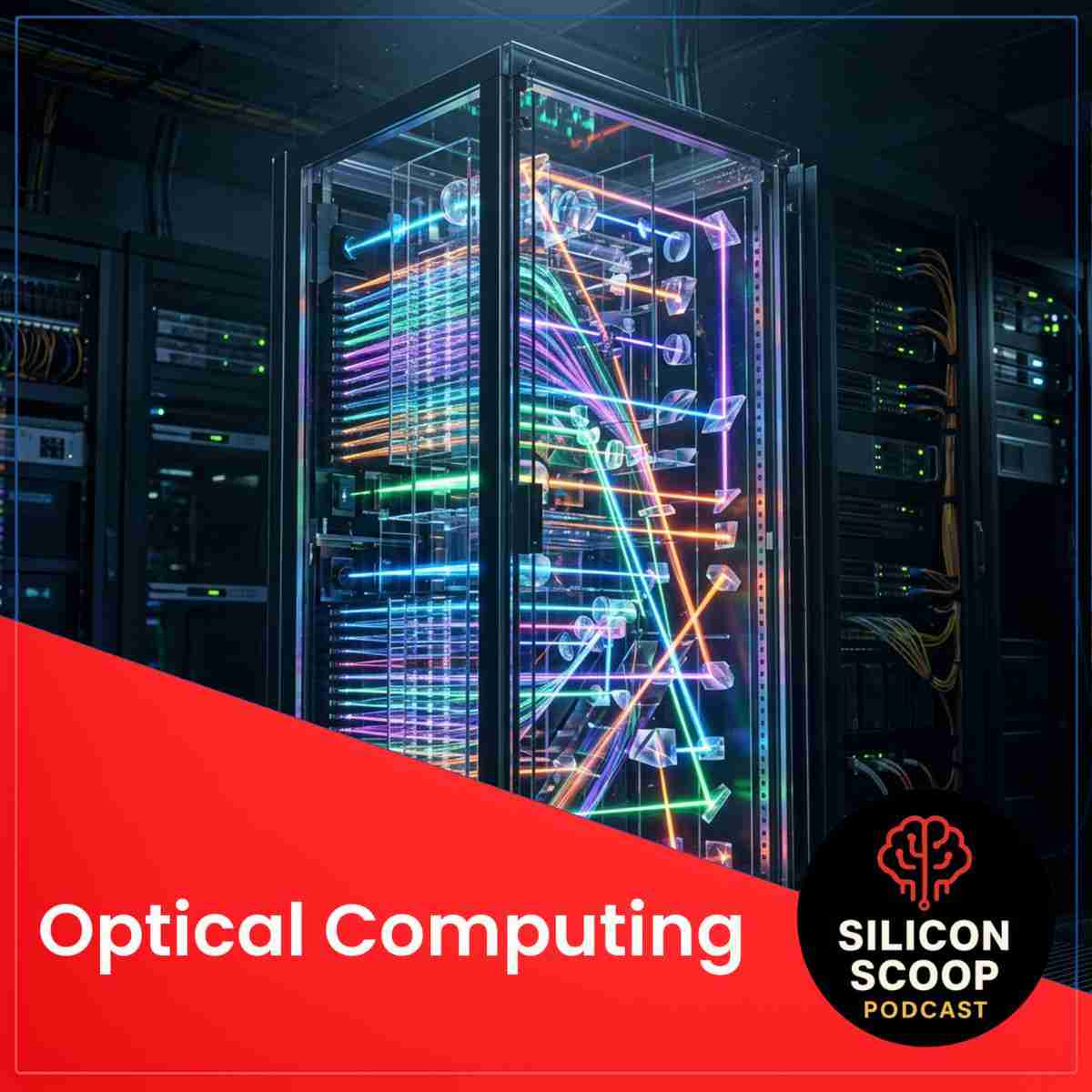
Lumai Iris Nova: The Optical Computing Breakthrough Changing AI Inference Forever
Estimated reading time: 8 minutes
Key Takeaways
- Optical computing is already running billion-parameter AI models in live data centers.
- Lumai’s Iris Nova is the world’s first optical computing server capable of running LLMs like Llama 8B and 70B in real time.
- The system uses light instead of electricity to crunch numbers, cutting energy consumption by up to 90% compared to traditional GPU-based systems.
- Iris Nova achieves 100 TOPS per Watt and up to 1 ExaOPS within a 10kW power budget.
- The server integrates into existing data center infrastructure and workflows without requiring a full stack rebuild.
Table of contents
- Lumai Iris Nova: The Optical Computing Breakthrough Changing AI Inference Forever
- Introduction: A New Era for Optical Computing
- Section 1: The Problem With Silicon-Based AI Computing
- Section 2: What Is the Lumai Iris Nova Optical AI Server?
- ⚡ Stop Babysitting Busywork
- Section 3: Optical Computing vs Traditional AI Infrastructure
- Section 4: Industry Impact and the Post-Silicon AI Era
- Frequently Asked Questions About Optical Computing and Lumai Iris Nova
- Final Thoughts
Introduction: A New Era for Optical Computing
Optical computing is no longer a lab experiment. It is here, it is real, and it is already running billion-parameter AI models in live data centers.
Oxford-based startup Lumai has launched the Iris Nova — the world’s first optical computing server capable of running large language models (LLMs) like Llama 8B and 70B in real time. The system uses light instead of electricity to crunch numbers, cutting energy consumption by up to 90% compared to traditional GPU-based systems.
This is not a minor upgrade. This is a fundamental shift in how artificial intelligence gets its work done.
In this post, we break down exactly what the Iris Nova is, how it works, why it matters, and what it means for the future of AI infrastructure.
Section 1: The Problem With Silicon-Based AI Computing
Silicon Is Running Out of Road
For decades, silicon chips powered everything — from smartphones to supercomputers. But silicon is now hitting a wall.
Each new generation of processors delivers more computing power, but it comes at an exponential increase in energy consumption. That trade-off is becoming unsustainable, especially as AI models grow larger and more demanding.
Here is what that looks like in practice:
- Bigger AI models require more matrix multiplications per second
- More matrix multiplications demand more processors running in parallel
- More processors mean more power draw, more heat, and more cooling costs
- More cooling costs translate directly into ballooning data center operating expenses
The result? AI inference — the process of running a trained model to generate outputs — is one of the fastest-growing energy consumers in the world. Traditional digital computing architectures were simply not designed for this scale.
Why GPU-Based Systems Are Struggling
Graphics Processing Units (GPUs) became the backbone of AI training and inference because of their ability to handle parallel computations. But they are power-hungry and increasingly expensive to operate at scale.
Hyperscalers and enterprise AI teams are now facing a hard question: How do we keep scaling AI without the power bills killing us?
That is the gap Lumai is stepping into — and it is doing so with a fundamentally different approach to computing hardware.
> “The demands on existing AI processors necessitate an urgent search for alternative scaling pathways.” — Suraj Bramhavar, Program Director at ARIA
The UK government’s Advanced Research and Invention Agency (ARIA) is actively backing Lumai’s work because the urgency is real. Silicon scaling is stalling. The industry needs a new path forward.
Lumai productizes lens-based optical computer
Section 2: What Is the Lumai Iris Nova Optical AI Server?
Light-Speed Computing for AI Inference
The Lumai Iris Nova is the world’s first commercial optical AI server designed specifically for real-time LLM inference. Instead of using electrons moving through silicon circuits, it uses photons — particles of light — to perform the massive mathematical operations that power modern AI.
This shift from electrons to photons is not just clever engineering. It is a rethinking of the entire computing stack.
How the Iris Nova Works
At the core of the Iris Nova is a hybrid processor made up of two key components:
- Optical Tensor Engine — handles the heavy mathematical computation using light
- Digital Processing Layer — manages system control, non-linear operations, and overall orchestration
The optical engine uses 1,024 laser sources duplicated through lenses and an electronic display to encode weight matrices. Light beams pass through 3D spatial arrays and transparent lenses, performing matrix multiplication at enormous scale.
Key technical specs of the Iris Nova:
- Matrix size: Up to 2,048 × 2,048 operations
- Precision: INT4/INT8-equivalent using lens-based encoding
- Throughput: 100 TOPS per Watt (TeraOperations Per Second per Watt)
- Total capacity: 1 ExaOPS within a 10kW power budget
- Energy savings: Up to 90% less power than GPU-based equivalents
- Performance gain: Up to 50x improvement in performance-per-watt
This is not integrated photonics in the traditional sense. Lumai’s approach uses free-space optics — light traveling through physical lenses and spatial arrays — which allows for massive parallelism that chip-based photonics cannot yet achieve.
Running Real AI Models Right Now
Lumai has already demonstrated Iris Nova running inference on:
- Llama 8B (8 billion parameters)
- Llama 70B (70 billion parameters)
Both models ran in real time using the hybrid digital-optical processor. Approximately 90% of the Llama workload runs optically, with the CPU only stepping in to handle non-linear operations that light cannot yet perform efficiently. A hardware-aware orchestration layer manages the split between optical and digital computation seamlessly.
The server slots directly into existing data center infrastructure and workflows, meaning companies do not need to rebuild their entire stack to adopt it.
Who Can Access Iris Nova Today?
Lumai is currently making Iris Nova available for evaluation to:
- Hyperscalers (large cloud platforms)
- Neo-clouds (next-generation cloud providers)
- Enterprises running their own AI inference pipelines
- Research institutes exploring next-generation computing
⚡ Stop Babysitting Busywork
Your team shouldn’t be drowning in intake forms, follow-up emails, invoices, and weekly reports. Every hour spent on repeatable manual tasks is an hour not spent on revenue-generating work.
Automate the repeatable tasks that eat your day — intake, follow-ups, invoices, reporting — so your team can focus on what actually moves the needle.
👉 Book an automation consult with Flowgrammer
Section 3: Optical Computing vs Traditional AI Infrastructure
The Core Advantage of Photon-Based AI Processing
The term optical computing refers to using light to perform calculations instead of electrical signals in silicon. The key advantages over traditional digital systems are:
- Speed: Light travels faster than electrons in wire
- Parallelism: Optical systems can process many operations simultaneously in 3D space
- Energy efficiency: Photons require far less energy than electrons to carry and process information
- Heat reduction: Less energy means less heat, which means lower cooling costs
Traditional silicon processors are fundamentally two-dimensional. They are etched onto flat chips, and adding more power means adding more chips, more lanes, more interconnects — and more energy.
Lumai’s optical engine operates in three dimensions, using spatial parallelism to process massive matrix operations simultaneously. This is how it achieves 1 ExaOPS — one quintillion operations per second — within a 10kW power budget that would barely run a handful of high-end GPUs.
Energy Efficiency: The Numbers That Matter
Let’s put the 90% energy reduction into perspective:
| System | Power Draw | Operations | Efficiency |
|—|—|—|—|
| GPU-based cluster (equivalent) | ~100kW | 1 ExaOPS | ~10 TOPS/W |
| Lumai Iris Nova | ~10kW | 1 ExaOPS | 100 TOPS/W |
That is a 10x improvement in operations per watt — a gap that compounds dramatically at data center scale. For a facility running thousands of inference servers, this translates into millions of dollars in annual energy savings and a dramatically smaller carbon footprint.
Beyond Iris Nova: The Aura and Tetra Roadmap
Lumai is not stopping with Iris Nova. The company has announced two additional optical servers in its pipeline:
- Iris Aura — combines multiple optical units for greater capacity
- Iris Tetra — targets larger-scale AI inference workloads
Both are being positioned as more powerful alternatives to GPU-based systems for inference at cluster scale. Lumai is targeting test cluster deployments by end of 2026, giving hyperscalers and enterprise AI teams a near-term path to evaluating next-generation optical AI infrastructure.
Lumai productizes lens-based optical computer
Section 4: Industry Impact and the Post-Silicon AI Era
The Shift From Training to Inference
The AI industry is in the middle of a major transition. For years, the dominant focus was on training — building and refining large models. That phase required enormous compute clusters running for weeks or months.
Now, the industry is entering what Lumai CEO Xianxin Guo calls the “inference era” — where the primary challenge is running trained models at scale, cheaply, and fast.
> “As the industry transitions into the inference era, we are simultaneously crossing the threshold into the post-silicon era.” — Xianxin Guo, CEO and Co-Founder of Lumai
Inference is where optical computing has its clearest advantage. The repeated matrix multiplications that define LLM inference are exactly the kind of operation that photon-based processors handle with extraordinary efficiency.
Competitive Landscape: Who Else Is in the Race?
Lumai is not alone in pursuing photonic AI processing, but it is currently the furthest along commercially:
- Lightmatter — another optical computing startup, eyeing 2027 for broader commercial deployments
- Traditional GPU vendors — still dominant but increasingly aware of the energy and scalability ceiling
Analysts widely agree that optical AI processors represent one of the most promising alternative scaling pathways as models grow toward trillions of parameters. Lumai is setting the commercial viability benchmark that competitors will be measured against.
ARIA’s backing adds significant credibility. The UK government agency was created specifically to fund high-risk, high-reward technology research — and it has placed a meaningful bet on Lumai’s optical computing approach.
What This Means for Data Centers
For data center operators, the implications are significant:
- Lower power bills without sacrificing inference throughput
- Reduced cooling requirements due to lower heat output
- Compatibility with existing workflows — Iris Nova integrates without a full infrastructure rebuild
- Path to scalability as AI model sizes continue to grow
The sustainable AI inference angle is increasingly important as governments and corporations face pressure to reduce data center carbon emissions. Optical computing offers a path to scaling AI without a proportional increase in energy consumption.
Lumai productizes lens-based optical computer
Frequently Asked Questions About Optical Computing and Lumai Iris Nova
Q1: What is optical computing?
Optical computing uses light (photons) instead of electricity (electrons) to perform calculations. By routing beams of light through lenses and spatial arrays, optical systems can run massive parallel computations — especially matrix multiplications — far more efficiently than silicon chips.
Q2: What makes the Lumai Iris Nova different from a regular AI server?
The Iris Nova uses a hybrid optical-digital processor instead of traditional GPU or CPU chips for its core computations. Its optical tensor engine handles up to 2,048 × 2,048 matrix operations using light, achieving 100 TOPS per Watt — roughly 10 times more efficient than equivalent GPU-based systems.
Q3: Can the Iris Nova run real AI models right now?
Yes. Lumai has already demonstrated the Iris Nova running Llama 8B and Llama 70B models in real time. These are the same open-source large language models used by businesses and researchers worldwide.
Q4: How much energy does the Iris Nova save?
The Iris Nova uses up to 90% less power than conventional GPU-based servers delivering equivalent AI inference performance. It achieves 1 ExaOPS — one quintillion operations per second — within a 10kW power budget.
Q5: Is the Iris Nova available to buy or test?
The Iris Nova is currently available for evaluation to hyperscalers, neo-cloud providers, enterprises, and research institutes. Interested organizations can contact Lumai directly through their website at Lumai Iris Nova product page.
Q6: What AI models can run on the Iris Nova?
Currently demonstrated on Meta’s Llama 8B and 70B models. The system is designed to handle billion-parameter LLMs and is expected to scale further with the upcoming Aura and Tetra servers targeting even larger model workloads.
Q7: What are the Iris Aura and Iris Tetra?
These are Lumai’s next two optical AI servers in development. The Aura and Tetra combine multiple optical units for greater inference capacity. Both are targeting availability for test cluster deployment by end of 2026, with higher throughput than the Iris Nova.
Q8: How does the optical engine actually work?
The optical tensor engine uses 1,024 laser sources that are duplicated through lenses. An electronic display encodes the AI model’s weight matrices. The light beams pass through the spatial array, perform the matrix multiplication optically, and the results are read out digitally. It operates in 3D space rather than flat silicon, enabling massive parallelism.
Q9: Does optical computing replace GPUs entirely?
Not yet — and probably not entirely. The Iris Nova uses a hybrid approach where the optical engine handles about 90% of the computational workload (primarily matrix multiplications), while a CPU manages non-linear operations and system control. As the technology matures, more of the workload may shift to photonic processing.
Q10: Why is the UK government supporting Lumai?
The UK’s Advanced Research and Invention Agency (ARIA) is backing Lumai because silicon-based computing is approaching its efficiency limits, and AI’s growing energy demands require alternative approaches. ARIA views optical computing as one of the most promising pathways beyond traditional digital computing, and Lumai is the furthest along in demonstrating commercial viability.
Final Thoughts
The launch of the Lumai Iris Nova is one of the most significant hardware developments in the AI industry in years. Not because it is slightly better than what came before — but because it represents a genuinely different approach to computation.
Optical computing is moving from theory to production. Light is replacing electricity as the medium for AI inference. And the energy math is simply too compelling for the industry to ignore.
With 90% energy savings, 100 TOPS per Watt efficiency, and real-world LLM inference running today, Iris Nova sets a new commercial benchmark for what AI infrastructure can look like in the post-silicon era.
As models grow larger and inference demands increase, the companies that adopt photon-based processing early will have a meaningful edge — in cost, in capacity, and in sustainability.
The inference era is here. And it runs on light.
Sources:
– Lumai Iris Nova product page
– Lumai launches the world’s first optical computing system for real-time billion-parameter LLM inferenc
– Lumai productizes lens-based optical computer
Additional Links
Flowgrammer.ca – 💡 Unlock AI-Powered Automation! Let flowgrammer.ca handle complex workflows so you can focus on growing your business.
Flowgrammers.ca – 💡 Join Toronto’s Fastest Growing AI and Business Automation Community.
- SRED Funding Solutions – Maximize your R&D tax credits and secure funding for your innovation.
- Silicon Scoop Podcast – Stay Informed, Stay Ahead!
- Startup Talk Podcast
- Flowgrammer Youtube
- Startup Investor Drinks – Join Toronto’s Startup Community and connect with fellow startup enthusiasts and investors.
- TorontoStarts Startup and Entrepreneur Community – Become a part of Toronto’s thriving startup ecosystem.
- Workhaus – Discover flexible workspace solutions for your business needs.
- Work with The Startup Coach – Get expert guidance and mentorship for your startup journey.
- Reach out to Jon Irwin on LinkedIn – Connect with our co-host and technology expert.
Episode transcript
Read the full transcript
Craig: silicon valley has been terrified that ai's energy hunger would break the power grid. but a start up just traded electrons for photons to save the day while traditional chips are hitting a brick wall. lumet is using light to cut power bills by a staggering 90%. ai inference models now move at light speed. lumet has launched its iris nova, the world's first commercial optical server that uses light instead of electricity to run large language models. it handles heavy duty math through lenses and lasers, making it 10 times more efficient than the best gpus on the market. this solves the energy prices of ai, and it allows companies to run massive models like lama 70 d without needing a dedicated power plant next door. what do you think about this, john?
Jon: i think this is cool. i'm a little skeptical. but let's dive into kind of the nuances. so the system's called irisnova, and it uses a hybrid arp architecture, which is an optical tensor engine, which performs the heavy mathematical computations. and traditional digital electronics, they handle control and system logic. so, this is critical because ai workloads, especially llms, are dominated by matrix multiplications, which are computationally intensive, but they're highly paralyzable, parallelizable. so optical systems excel here because light can process many operations simultaneously in physical space. so traditional chips, they rely on electrons moving through transistors, which is limited by heat and resistance and increasingly inefficient at scale. and so this optical computing replaces electrons with photons. so we all know light travels faster with less energy loss. it can encode information in amplitude, phase, and wavelength simultaneously, and it enables spatial parallelism. so what this does is this allows the system to bypass the physical limits of silicon chips, which are approaching diminishing returns under moore's law, which we all know. so the cool breakthrough about this though, okay, is that the system demonstrated real time inference on billion parameter ai models comparable to gpu based systems and up to 90 reduction in power consumption. so why is this significant? well, modern ai models, like you said, they require enormous compute resources, issues? i don't know. what do you think? you're on mute.
Craig: you know, well, i was gonna mute because i was about to sneeze, but i think i got it under control. so i think of this update like the evolution of transportation. traditional silicon chips are like a crowded city bus. they're heavy. they get hot, but they're stuck on two d roads or the circuits. lume iris nova is like a fleet of private jets flying in three d formation because light can cross paths without crashing and moves through space rather than wires. you get more passengers to the destination using a fraction of the fuel. we'll have to see because this is now available for evaluations and people are evaluating it, evaluating it, and cluster deployments are expected late this year. the idea is this is hyper scale pricing focusing on reducing opex by 90%. it says it's plug and play with existing data centers, and it runs a p and 70 b models, which is great, but does it run other people's models? when they say it runs llama 70 b model, that means it'll run numitron, the nvidia models as an example because numitron is based on llama and whatnot. faster, cheaper ai responses for the apps, you use daily as companies can afford to run smarter 24 by seven models without going bankrupt on electricity. so you mentioned the throughputs of a 100, tops per watt compared to approximately, 10 tops per watt for a high end gpu cluster. and, ex exa ops with a modest 10 kilowatt envelope. so hybrid systems using, 24 lasers, sources, and 24 by 24 matrix operation. this utilized free space optic, optics unlike integrated photonics, which keeps light inside the chip. this uses three d spatial arrays and physical lenses to perform four year transformers and matrix multiplication at the speed of light. so it sounds great, but to me, it sounds big.
Jon: it sounds what?
Craig: big. like, we're moving to a two nanometer chip with cpus and gpus production, a three nanometer, four nanometer. yeah. this looks like it's gonna be big. so when you're trying to build a data center, how much bigger space wise does it have to be? because this doesn't sound small.
Jon: no. it doesn't.
Craig: yeah. it wouldn't be that size. so i'm curious as to see where we are. photons are bosons, meaning that they can occupy the same space at the same spot time unlike electrons, which are fermions. this is why optical computing can achieve three d parallelism that silicon physically cannot match. so maybe we're heading into a new, area of optical computing, and this might be leading the way. i'd like to see that happen because it might break a lot of the physical barriers of that limitations that we're having now. lumai is a spin out from the university of oxford and is a key beneficiary of the uk's advanced research and invention agency area, which specifically targets moonshot tech that vcs often find too risky. while we think of this as future tech, the basic principles using lenses to process information, optical fourier transforms were actually theorized and tested back in the sixties. we've lacked the precise laser arrays and digital checkers to make it commercially viable until now. so the system is hybrid, meaning light can't do everything yet. about 10% of the workload, nonlinear operation still relies on traditional, digital cpus, which could create a bottleneck if the handoff isn't perfectly optimized. if you're an enterprise developer, you should start taking a look at these and see if there's a sweet spot for optical hardware here that you should be looking at. what do you think, john?
Jon: yeah. i'm i'm interested to see where this goes. like, the direct competitor to this is nvidia. right? so, it's a direct threat to nvidia's gpu dominance. so this is, the optical systems, they don't just compete on speed. they compete on cost per inference, like you said, in energy efficiency. so that's where the real disruption is. so this is gonna be interesting to see where they go.
Craig: yeah. the disruption here is the 90% opex cost reduction rather than a capex. so they do a hardware expenditure that they can write off over a period of time, but it reduces the monthly run rate over time because it's 90% less power. and power is the big situation here. so we'll have to see if we're trading power for space and if we're heading into a new era. the inference era is no longer limited by the power out. it's limited only by how fast we can pulse the laser. would you trust an ai more if you knew its frame was made of light and lenses instead of wires and heat, or if it was designed specifically to run specific ai models that maybe you don't wanna run, let us know in the chat. we'd love to hear from you.
More from Silicon Scoop
All episodes
silicon-scoop · October 16, 2026
Meta’s $18 Billion Teen Safety Settlement: Soft Guardrails, Hard Leverage Over TikTok and YouTube
Deep dive on Meta teen safety settlement, social media addiction lawsuit, new Facebook Instagram time limits and pressure on TikTok YouTube age verification.
View episode
silicon-scoop · October 15, 2026
How Claude Mythos Is Reshaping Cryptanalysis: HAWK, AES and the Rise of AI-Driven Crypto Research
Claude Mythos cryptanalysis weakens HAWK post-quantum signature, speeds AES Möbius Bridge attack, and powers CryptanalysisBench benchmark in AI-driven crypto research.
View episode

silicon-scoop · October 14, 2026
Nvidia’s $12.9 Billion Hugging Face Bet: How Controlling the Open-Source Model Hub Reshapes AI Chips, Cloud, And Competition
Nvidia Hugging Face acquisition could reshape open source AI models, AI chip dominance, and the global developer model hub, raising antitrust and neutrality questions.
View episode