
Native Color Lidar Just Made Camera Stacks Feel Dated
Native Color Lidar Just Made Camera Stacks Feel Dated https://torontostarts.com/silicon-scoop/ Flowgrammer.ca -> https://flowgrammer.ca/ AI News and Resources -> https://flowgrammers.ca OpenClaw Toronto -> https://openclawto.com/ Stop Doing Work Your Software Should Do If your team is copy-pasting, chasing approvals, or updating spreadsheets by hand, you’re leaking time and margin. Flowgrammer builds automations that run your ops in the background—clean handoffs, fewer mistakes, faster cycles. Book an automation call https://flowgrammer.ca Startup Investor Drinks Toronto - https://startupdrinksto.com/ Toronto’s Startup Community - https://torontostarts.com/ Silicon Scoop Silicon Scoop Podcast - https://torontostarts.com/silicon-scoop/ Apple: https://podcasts.apple.com/us/podcast/silicon-scoop/id1758711826 Spotify: https://open.spotify.com/show/5bAzF0MwV6TtLhJAhvHayI YouTube: https://www.youtube.com/playlist?list=PLj4v-RoA7A-gT62vrEYqh1zCv-0Hj-o5J Startup Talk Startup Talk Podcast -> https://torontostarts.com/startup-talk-toronto-startup-podcast/ Apple -> https://podcasts.apple.com/us/podcast/startup-talk/id1763804003 Spotify -> https://open.spotify.com/show/1siJMILILidHAiAsrX2VBU YouTube: https://youtube.com/playlist?list=PLj4v-RoA7A-jxV5FHs5e61oIsuvUJYmT_&si=LYegRe5GYLKNQ7xL
With Craig Major and Jon Irwin
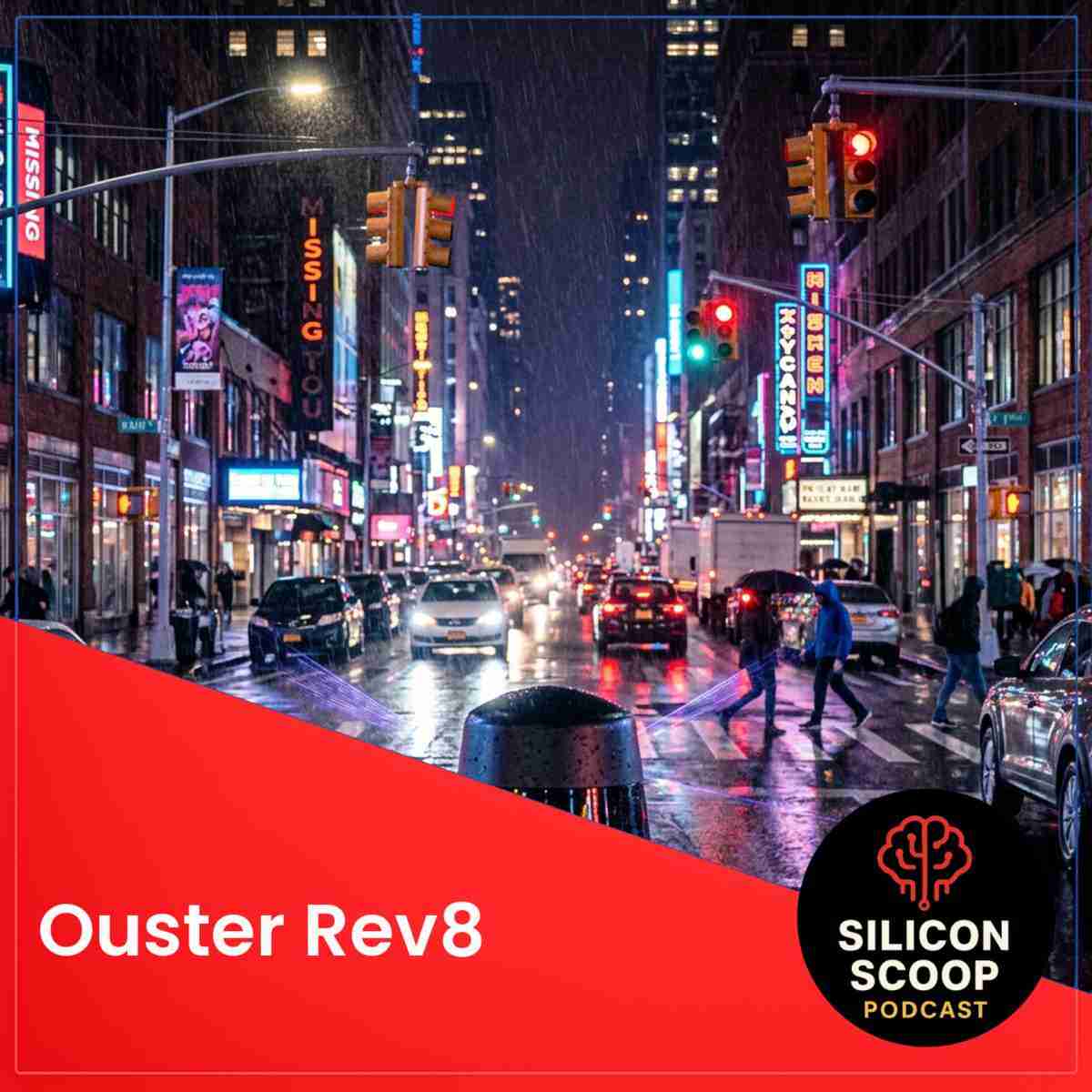
Ouster Rev8: The Native Color LiDAR Sensor That Gives Machines Human-Like Vision
Estimated reading time: 10 minutes
By the Flowgrammer Content Team | May 19, 2026
Key Takeaways
- For decades, machines have been navigating the world without color.
- The Ouster Rev8 changes that completely — and it may be the biggest leap forward in machine vision in years.
- Native color LiDAR captures depth and color at the exact same moment, in the exact same data point.
- The Rev8 is built around a brand-new chip called the L4.
- The OS1 Max flagship sensor can detect objects at up to 200 meters at 10% reflectivity and up to 500 meters under ideal lighting conditions.
Table of contents
- Ouster Rev8: The Native Color LiDAR Sensor That Gives Machines Human-Like Vision
- What Is Native Color LiDAR and Why Does It Matter?
- How the Ouster Rev8 Digital LiDAR Sensor Actually Works
- The OS1 Max: Flagship Specs That Set a New Benchmark
- Who Is Already Using the Ouster Rev8?
- Stop Doing Work Your Software Should Do
- Ouster’s Physical AI Strategy: Beyond Selling Sensors
- The Competitive Landscape: Where Rev8 Fits
- What This Means for Physical AI and the Future of Autonomous Systems
- Frequently Asked Questions: Ouster Rev8 Native Color LiDAR
For decades, machines have been navigating the world without color. They could measure distance and build maps, but they couldn’t see the world the way humans do. The Ouster Rev8 changes that completely — and it may be the biggest leap forward in machine vision in years.
This is not just a better LiDAR sensor. It is a fundamentally different approach to how machines perceive the physical world.
What Is Native Color LiDAR and Why Does It Matter?
Most autonomous systems today use two separate tools to understand their environment:
- LiDAR for precise 3D geometry and depth
- Cameras for color and visual detail
Then a software algorithm tries to stitch both together. That process is messy. It introduces calibration errors, timing mismatches, and latency. When a robot or self-driving car is moving fast through a busy street, those small errors can become big problems.
Native color LiDAR solves this at the hardware level. Instead of capturing depth and color separately and merging them later, the Ouster Rev8 captures both at the exact same moment, in the exact same data point. Every single point in its 3D map already has color baked in — no extra software, no extra cameras, no extra calibration needed.
This is what Ouster means when they say “native color.” The color is not added later. It is captured as part of the original scan.
Think of the difference like this: traditional sensor fusion is like taking a black-and-white photo and colorizing it afterward. Native color LiDAR is like taking a full-color photo in the first place.
This matters enormously for physical AI perception — the ability of machines to understand and react to real-world environments. When depth and color are fused at the source, AI models train faster, perceive more accurately, and make better decisions in real time.
introducing-rev8-os-family
ousters-new-color-lidar-is-coming-to-replace-cameras
How the Ouster Rev8 Digital LiDAR Sensor Actually Works
The Ouster Rev8 is built around a brand-new chip called the L4. This is the brain of the sensor, and it does something no LiDAR chip has done before — it handles color processing entirely in hardware, at the moment of detection.
Here is what makes the L4 chip remarkable:
- 42.94 GMACs of on-chip processing — enough computing power to handle dense perception workloads that previously required a separate GPU
- 20 trillion photons detected per second — capturing an enormous amount of light data in real time
- 40 kHz measurement rate with picosecond-level timing precision — incredibly fast and incredibly accurate
- 10.4 million points per second output — a dense, rich 3D point cloud
- 22.4 Gbit/s off-chip data bandwidth — fast enough to push all that data where it needs to go without bottlenecks
Ouster partnered with Fujifilm to embed their color science directly into the L4 chip. Fujifilm’s expertise in imaging technology — the same knowledge behind their cameras and film — is now running inside a LiDAR sensor. The result is 48-bit color depth and 116 dB of dynamic range.
What does 116 dB of dynamic range mean in plain language? It means the sensor can simultaneously see fine detail in the darkest shadows and the brightest highlights without blowing out or going blind. It works in conditions ranging from 1 lux (near total darkness, like a moonlit road) all the way up to 2,000,000 lux (harsh direct sunlight on a reflective surface).
The Rev8 comes in two main variants:
- 128-channel L4 — the standard configuration
- 256-channel L4 Max (OS1 Max) — the flagship, with maximum resolution and range
This digital LiDAR sensor architecture represents a shift away from older analog designs. Digital-first means more programmability, better data fidelity, and easier software integration — key advantages when building scalable autonomous systems.
introducing-rev8-os-family
ousters-new-color-lidar-is-coming-to-replace-cameras
how-ouster-rev8-native-colour-lidar-simplifies-sensor-fusion-in-robotics
The OS1 Max: Flagship Specs That Set a New Benchmark
The OS1 Max is the most powerful sensor in the Rev8 family. Its specifications push well past what any previous commercial LiDAR has delivered.
Detection Range:
- Up to 200 meters at 10% reflectivity — meaning it can detect surfaces that absorb 90% of the light hitting them
- Up to 500 meters under optimal conditions — roughly the length of five football fields
Field of View:
- 45 degrees vertical
- 360 degrees horizontal — a full panoramic sweep of the environment
Resolution and Color:
- 256 channels — double the resolution of Ouster’s previous generation, the Rev7
- 48-bit color depth with 116 dB dynamic range
Lighting Performance:
- Operates from 1 lux to 2,000,000 lux — moonlight to blazing midday sun
To put the range improvement in perspective: Ouster claims the Rev8 doubles both the range and resolution of the Rev7. That is not an incremental upgrade. That is a generational leap.
With this level of performance, a single OS1 Max sensor can:
- Read a traffic sign from hundreds of meters away, including its color
- Detect brake lights on the car ahead before a human driver would notice
- Build topographic maps with real-world color overlaid on precise geometry
- Navigate complex indoor environments like warehouses or factories with full spatial and color awareness
Ouster CEO Angus Pacala described the launch this way:
“Rev8 is the most advanced family of LiDAR sensors ever released and sets a new standard in sensing. With the L4 Ouster Silicon, we are delivering on the promise of our digital architecture to deliver exponential improvements in performance, doubling our core specs and simultaneously introducing the world’s first native color LiDAR to give machines 3D human-like sight for the next era of Physical AI.”
introducing-rev8-os-family
ouster-releases-rev8-os-family-worlds-first-native-color-lidar
Who Is Already Using the Ouster Rev8?
Ouster has not launched into a quiet market. Around two dozen companies across multiple industries have already signed on as early adopters. The list includes major names:
- Volvo Autonomous Solutions
- Skydio (drone autonomy)
- PlusAI (autonomous trucking)
- Seegrid (warehouse robotics)
These are not small experiments. These are production-minded organizations testing technology they plan to deploy at scale. The spread across automotive, robotics, drone, and infrastructure markets tells you how broadly Ouster is positioning this technology.
In the robotics and autonomous mobile robot (AMR) space specifically, the Rev8’s in-silicon color fusion simplifies a major headache: calibration. In cluttered indoor environments — warehouses, factories, fulfillment centers — traditional sensor fusion with separate cameras and LiDAR units requires constant recalibration as conditions change. The Rev8 eliminates most of that burden because color and depth are already aligned the moment they are captured.
This makes the Rev8 particularly attractive for physical AI perception in industrial automation, where operational efficiency depends on sensors that just work, consistently, without constant tuning.
ousters-new-color-lidar-is-coming-to-replace-cameras
how-ouster-rev8-native-colour-lidar-simplifies-sensor-fusion-in-robotics
Stop Doing Work Your Software Should Do
If your team is copy-pasting, chasing approvals, or updating spreadsheets by hand, you’re leaking time and margin. Flowgrammer builds automations that run your ops in the background — clean handoffs, fewer mistakes, faster cycles.
Ouster’s Physical AI Strategy: Beyond Selling Sensors
The Rev8 launch is not just about a better product. It reflects a deeper strategic shift in how Ouster sees its role in the market.
In February 2026, Ouster acquired StereoLabs — a leading computer vision company — for $38 million in cash plus 1.8 million shares. StereoLabs is known for their ZED cameras and long-range 3D vision systems.
That acquisition signals something important: Ouster is not trying to be just a sensor manufacturer. They are building a full perception platform for physical AI.
Here is why that matters:
When color and geometry are fused at the sensor level, training AI perception models becomes significantly easier. You do not need to separately label camera images and LiDAR point clouds and then teach the model to correlate them. Everything comes pre-aligned in a single, coherent data stream.
CEO Angus Pacala has been direct about this ambition. In interviews, he has framed Rev8’s native color capability as a deliberate attempt to make cameras unnecessary in many autonomy and robotics stacks. His argument is that a single digital LiDAR sensor can deliver safer, more temporally aligned perception than camera-plus-LiDAR fusion setups.
This is a bold bet. Most autonomous vehicle developers still use multi-sensor philosophies — cameras, radar, and LiDAR working together. Ouster is arguing that Rev8 can consolidate much of that stack into one device.
If they are right, the cost and complexity savings for manufacturers and robotics companies would be enormous.
Ouster, post its merger with Velodyne, is now considered one of the best-positioned Western LiDAR vendors for 2026. Market analysts note the company benefits from:
- Diversified revenue streams across automotive, robotics, and infrastructure
- Cost synergies from the Velodyne merger
- A digital-first chip roadmap that scales more efficiently than analog alternatives
- The potential to attach higher-margin software and perception services on top of hardware sales
Pacala summarized the commercial vision clearly:
“Rev8 is the foundational technology that will allow customers to move from prototype to commercial production at scale, providing the reliability and affordability required to enable real-world autonomy across industries.”
ousters-new-color-lidar-is-coming-to-replace-cameras
how-ouster-rev8-native-colour-lidar-simplifies-sensor-fusion-in-robotics
lidar-measures-world-truth
The Competitive Landscape: Where Rev8 Fits
Ouster is not alone in this race. The LiDAR and autonomous perception market is intensely competitive. Key players include:
- Luminar — known for its long-range automotive LiDAR and end-to-end software stack
- Innoviz — strong in the automotive OEM space, particularly with BMW
- Hesai — a Chinese LiDAR maker with significant volume and pricing advantages
- RoboSense — another Chinese competitor with aggressive market penetration
- Valeo — a traditional automotive supplier moving deeper into LiDAR
The sector research projects strong growth for the automotive LiDAR market through 2033–2034. More machines — cars, trucks, drones, robots, infrastructure sensors — will need sophisticated spatial awareness. The market for companies that can supply it is expanding fast.
Where does the Ouster Rev8 stand in this competitive picture?
Strengths:
- First commercially available native color LiDAR — a genuine first-mover advantage
- Digital silicon architecture that can improve with firmware updates
- Broad industry support from major early adopters
- StereoLabs acquisition adds computer vision software depth
- Strong positioning as a Western vendor in markets that are scrutinizing Chinese supply chains
Challenges:
- Cost and pricing for production programs has not been publicly disclosed
- Camera-plus-LiDAR stacks are deeply embedded in existing development programs
- Reliability in volume production at scale still needs to be proven
- Competition from Chinese players on price will be fierce
Expert consensus from industry analysts and robotics integrators is measured but positive. Rev8 is viewed as a meaningful technical step that could genuinely narrow the gap between machine and human vision — especially in complex or rapidly changing lighting conditions. But most analysts do not expect cameras to disappear overnight. Rev8 will need to prove its reliability and cost structure in volume deployments before it displaces established multi-sensor architectures.
automotive-lidar-sensors-market
automotive-lidar-market
how-ouster-rev8-native-colour-lidar-simplifies-sensor-fusion-in-robotics
What This Means for Physical AI and the Future of Autonomous Systems
The phrase physical AI perception refers to the ability of machines to understand and respond to the real, physical world — not just in a lab, but in unpredictable, messy, real-world conditions.
For years, the bottleneck in physical AI has not been intelligence. It has been sensing. Machines could think, but they could not see clearly enough to act safely.
The Ouster Rev8 addresses that bottleneck directly. By collapsing depth, color, and timing into a single hardware-level output, it:
- Reduces latency — fewer processing steps between sensing and decision
- Eliminates spatial mismatches — color and geometry are always perfectly aligned
- Simplifies AI training pipelines — one coherent data stream instead of multiple synchronized feeds
- Lowers system complexity — fewer sensors, fewer cables, fewer calibration routines
- Improves reliability — fewer components means fewer failure points
These advantages compound across every application:
- Self-driving vehicles that can read brake light color changes and traffic sign text in real time
- Warehouse robots and AMRs that can navigate cluttered environments with color-coded shelving and inventory
- Inspection drones that can capture topographic maps with genuine color fidelity
- Smart infrastructure sensors that can monitor and classify objects by color and shape simultaneously
The sensor market is moving toward integration. Separate cameras and LiDAR units stitched together by software will increasingly give way to unified sensing hardware that does more, more simply. The Rev8 is one of the clearest signals yet of where that trend leads.
Rev8 sensors are available to order now, with shipments expected to begin in the current quarter. Pricing for business customers has not yet been publicly announced.
introducing-rev8-os-family
ouster-releases-rev8-os-family-worlds-first-native-color-lidar
ousters-new-color-lidar-is-coming-to-replace-cameras
Frequently Asked Questions: Ouster Rev8 Native Color LiDAR
1. What is the Ouster Rev8?
The Ouster Rev8 is a family of digital LiDAR sensors that captures 3D depth and color in a single, unified data stream. It is the first commercially available LiDAR with native color — meaning color is captured at the hardware level, not added later by software.
2. What does “native color LiDAR” mean?
Native color LiDAR means that every point in the sensor’s 3D map already contains color information at the exact moment it is captured. Traditional systems use a separate camera and then merge the images with LiDAR data using software. Native color skips that merging step entirely.
3. What chip powers the Rev8?
The Rev8 is powered by Ouster’s new L4 chip. It delivers 42.94 GMACs of on-chip processing, detects up to 20 trillion photons per second, and runs at a 40 kHz measurement rate. Fujifilm’s color science is embedded directly into this chip.
4. How far can the OS1 Max detect objects?
The OS1 Max flagship sensor can detect objects at up to 200 meters at 10% reflectivity and up to 500 meters under ideal lighting conditions.
5. What lighting conditions can the Rev8 handle?
The Rev8 operates across an extreme range — from 1 lux (near total darkness) to 2,000,000 lux (direct intense sunlight). Its 116 dB dynamic range lets it handle both extremes simultaneously.
6. Who are the early adopters of the Ouster Rev8?
Early adopters include Google, Volvo Autonomous Solutions, Skydio, PlusAI, and Seegrid, along with roughly two dozen other companies across automotive, robotics, and smart infrastructure sectors.
7. How does Rev8 compare to the previous Rev7?
Ouster claims the Rev8 doubles both the range and the resolution of the Rev7 generation. The flagship OS1 Max adds 256-channel resolution, 48-bit color, and significantly extended detection range.
8. Will Rev8 replace cameras in autonomous vehicles?
Ouster’s CEO has positioned Rev8 as capable of replacing cameras in many applications. However, most analysts expect cameras to remain in safety-critical designs until Rev8’s reliability and cost are proven at scale in production programs.
9. Why did Ouster acquire StereoLabs?
Ouster acquired StereoLabs in February 2026 for $38 million plus shares as part of a strategic move to evolve from a sensor company into a full perception platform provider. StereoLabs adds computer vision software expertise that complements the Rev8’s hardware capabilities.
10. When will Rev8 sensors be available, and how much do they cost?
Rev8 sensors are available to order now, with shipments expected to begin in Q2 2026. Ouster has not publicly announced pricing for business customers.
Want to stay ahead of the technology trends reshaping autonomous systems, robotics, and AI? Explore more at Flowgrammer.
Additional Links
Flowgrammer.ca – 💡 Unlock AI-Powered Automation! Let flowgrammer.ca handle complex workflows so you can focus on growing your business.
Flowgrammers.ca – 💡 Join Toronto’s Fastest Growing AI and Business Automation Community.
- SRED Funding Solutions – Maximize your R&D tax credits and secure funding for your innovation.
- Silicon Scoop Podcast – Stay Informed, Stay Ahead!
- Startup Talk Podcast
- Flowgrammer Youtube
- Startup Investor Drinks – Join Toronto’s Startup Community and connect with fellow startup enthusiasts and investors.
- TorontoStarts Startup and Entrepreneur Community – Become a part of Toronto’s thriving startup ecosystem.
- Workhaus – Discover flexible workspace solutions for your business needs.
- Work with The Startup Coach – Get expert guidance and mentorship for your startup journey.
- Reach out to Jon Irwin on LinkedIn – Connect with our co-host and technology expert.
More from Silicon Scoop
All episodes
silicon-scoop · October 16, 2026
Meta’s $18 Billion Teen Safety Settlement: Soft Guardrails, Hard Leverage Over TikTok and YouTube
Deep dive on Meta teen safety settlement, social media addiction lawsuit, new Facebook Instagram time limits and pressure on TikTok YouTube age verification.
View episode

silicon-scoop · October 15, 2026
How Claude Mythos Is Reshaping Cryptanalysis: HAWK, AES and the Rise of AI-Driven Crypto Research
Claude Mythos cryptanalysis weakens HAWK post-quantum signature, speeds AES Möbius Bridge attack, and powers CryptanalysisBench benchmark in AI-driven crypto research.
View episode

silicon-scoop · October 14, 2026
Nvidia’s $12.9 Billion Hugging Face Bet: How Controlling the Open-Source Model Hub Reshapes AI Chips, Cloud, And Competition
Nvidia Hugging Face acquisition could reshape open source AI models, AI chip dominance, and the global developer model hub, raising antitrust and neutrality questions.
View episode