
Canada’s National AI Literacy Initiative: Inside the $2.3B Strategy to Train a Million Students
Canada’s National AI Literacy Initiative under the AI strategy aims to train 1M students, educators and workers with free AI literacy courses via Amii and partners.
With Craig Major and Jon Irwin
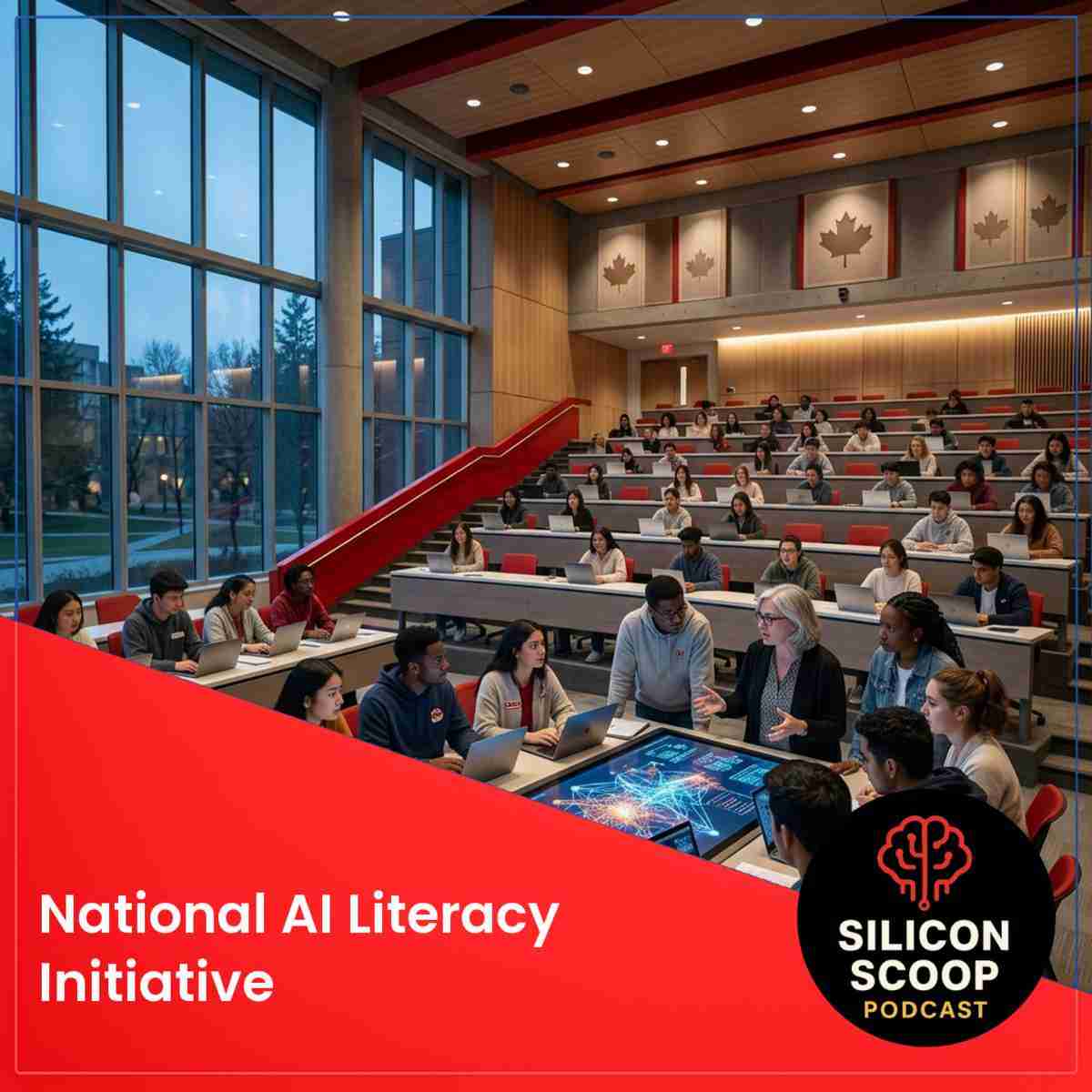
Canada's National AI Literacy Initiative Just Trained a Million Students
Estimated reading time: 10 minutes
Key Takeaways
- On September 10, 2026, AI Minister Evan Solomon announced the National AI Literacy Initiative — a federally funded program built to give every Canadian a working understanding of artificial intelligence.
- It is one of six core pillars of Canada's sweeping AI for All national strategy, backed by approximately $2.3 billion in new and expanded AI funding.
- The literacy initiative alone carries a $13-million partnership with Amii, the Edmonton-based institute that built the model the entire country is now borrowing from.
- The Canada AI training rollout is structured in three clear streams: one for post-secondary students, one for K-12 educators, and one for the general public.
- The first courses go live on September 21, 2026, with access arriving in stages depending on consortium and rollout timelines.
Table of contents
- Canada's National AI Literacy Initiative Just Trained a Million Students
- Key Takeaways
- Canada's AI Strategy Built the Foundation for This Initiative
- How Canada AI Training Will Actually Be Delivered
- Amii AI Literacy Courses Set the National Standard
- Why Changing Public Perception Is Part of the Plan
- What the 2031 Goals Actually Require
- What This Means Right Now If You Are a Student, Educator, or Worker
- 10 Frequently Asked Questions About Canada's National AI Literacy Initiative
Canada is making a bold bet on its people.
On September 10, 2026, AI Minister Evan Solomon stood at Edmonton's Alberta Machine Intelligence Institute (Amii) and announced the National AI Literacy Initiative — a federally funded program built to give every Canadian a working understanding of artificial intelligence. Free courses. Nationwide reach. A target of one million post-secondary students and over 50,000 K-12 educators.
This is not a pilot project. It is one of six core pillars of Canada's sweeping AI for All national strategy, backed by approximately $2.3 billion in new and expanded AI funding. The literacy initiative alone carries a $13-million partnership with Amii, the Edmonton-based institute that built the model the entire country is now borrowing from.
Currently, fewer than one in four Canadians has any formal AI training. Ottawa wants to close that gap — fast. And the clock is already ticking, with the first courses going live on September 21, 2026.
Here is what the initiative actually looks like, who it is built for, and why it matters far beyond a single press release.
---
Canada's AI Strategy Built the Foundation for This Initiative
To understand why the National AI Literacy Initiative exists, you need to understand what sits behind it.
On June 4, 2026, Prime Minister Mark Carney launched AI for All: Canada's National Artificial Intelligence Strategy. The strategy organizes roughly $2.3 billion in federal AI spending around six distinct pillars:
- Empowering Canadians with AI training
- Protecting Canadians and safeguarding democracy
- Powering shared prosperity
- Building sovereign AI infrastructure
- Scaling Canadian AI champions
- Building trusted global alliances
The National AI Literacy Initiative is the direct output of that first pillar. It is the skills-training engine underneath everything else the strategy promises. Without a population that understands AI — how it works, what it risks, and how to use it responsibly — the rest of the strategy has a weak foundation.
The numbers behind the strategy are significant. Beyond the $13-million Amii partnership for the literacy initiative, the federal government injected an additional $30 million into the CanCode program to expand digital and AI skills training for youth. The full AI for All strategy sets targets that extend to 2031, including universal access to free AI literacy training for all Canadians.
This is not a small commitment. It is a multi-year, multi-institution plan anchored in the belief that AI education is the precondition for everything else.
Minister Solomon said it plainly at the Edmonton launch: "Education is the best hedge against change."
Sources:
- Prime Minister Carney launches AI for All: Canada's new national artificial
- Government of Canada launches national AI literacy initiative
---
How Canada AI Training Will Actually Be Delivered
The Canada AI training rollout is structured in three clear streams: one for post-secondary students, one for K-12 educators, and one for the general public. Each stream has its own timeline, delivery model, and goals.
Stream 1: Post-Secondary Students
This is the largest stream by target numbers. The goal is to reach one million entry-level post-secondary students with a free, three-hour AI literacy course.
But there is an important structural detail here that news headlines tend to skip over. Post-secondary institutions cannot simply plug their students into this course on their own. According to ISED's official launch backgrounder, universities and colleges must join a National Student AI Literacy Initiative consortium to offer the course. Consortium enrollment formally opens on September 21, 2026 — the same day the student course goes live.
This means the actual rollout across campuses will be staggered. Early adopters who join the consortium quickly will be able to offer the course first. Institutions that take longer to sign on will follow later. Students at schools that are slow to join the consortium will have to wait.
The three-hour course itself is modelled directly on Amii's existing AI for Everyone program. It covers:
- Core AI concepts and terminology
- How AI systems are built and how they make decisions
- How to identify AI-generated content
- How to assess AI for bias, misinformation, and privacy risks
- How to use AI tools more confidently and responsibly
Stream 2: K-12 Educators
The educator stream is branded as "AI for All: Essentials for Educators" and is built across six chapters. Only the first chapter launches on September 21. The remaining five chapters roll out through fall 2026.
This means educators do not get a complete course on day one. They receive staggered access — a design choice that may frustrate teachers hoping to integrate AI training into their classrooms immediately at the start of the school year.
The long-term goal is ambitious: train more than 3,000 educators with full AI learning kits they can use directly in classrooms. These kits are designed to let teachers bring AI literacy into their existing curriculum rather than treating it as a separate subject.
Stream 3: The Canadian Public
The public stream — "Essentials for Canadians" — will not launch on September 21. It is planned for later in 2026. Delivery will happen through community partners, libraries, and public organizations across the country.
Workers and job seekers will also be able to access short-duration AI training through the Government of Canada's Job Bank portal. That programming focuses specifically on how people can adapt as AI changes jobs, tools, and workplace expectations. It is built for people who are not in school and not in a classroom — people who need practical, fast answers about what AI means for their working lives.
Sources:
- Government of Canada launches national AI literacy initiative
- Canada's free AI course starts September 21 — access arrives in stages
---
Stop Doing Things Manually When AI Can Do Them For You
If Canada is investing billions to help people understand AI, imagine what it means for your business to actually use AI right now. Every hour your team spends on repetitive tasks — data entry, scheduling, follow-ups, reporting — is an hour that automation can give back to you. The businesses scaling fastest today are the ones removing manual work from the equation entirely.
👉 See How Flowgrammer Builds Automation That Works While You Sleep
---
Amii AI Literacy Courses Set the National Standard
The Amii AI literacy courses are not new. They are the reason the federal government chose Amii to lead this initiative in the first place.
Amii — the Alberta Machine Intelligence Institute — has been running AI literacy programming for years, long before Ottawa came looking for a national model. The institute's AI for Everyone platform is the direct ancestor of the student course launching September 21. It was built on the principle that AI education does not need to create AI engineers. It needs to create informed people.
Amii CEO Cam Linke made this clear at the launch event: "It's not about turning everyone into an AI expert; it's about giving everyone the foundation they need."
That framing matters. The initiative is not a workforce development program in the traditional sense. It is not trying to produce coders or data scientists at scale. It is trying to produce citizens and workers who can interact with AI systems critically — who can spot when an AI is wrong, understand when their data is being used, and make thoughtful decisions about when to trust an algorithm.
Amii's track record made it the natural choice to lead this nationally. The institute had already demonstrated, at a smaller scale, that practical AI education could be delivered to people without technical backgrounds. The federal government essentially took that proven model and asked Amii to apply it to an entire country.
The $13-million federal partnership is the budget for that expansion. It covers the development and delivery of the core literacy programming across all three streams, the consortium infrastructure for post-secondary delivery, and the national rollout through community channels later in the year.
It is also worth noting what is not yet confirmed. During the summer AI strategy rollout, Minister Solomon mentioned that Canada's other two major AI research institutes — Montreal's Mila and Toronto's Vector Institute — would play roles in literacy programming. As of the September 10 launch, it remains unclear whether either institute is formally involved in the September 21 rollout. The initiative as currently structured is an Amii-led program.
Sources:
- AI literacy for everyone platform
- Amii receives $9 million from feds to equip energy workers with AI skills
- Government of Canada launches national AI literacy initiative
---
Why Changing Public Perception Is Part of the Plan
There is a political layer to this initiative that is worth naming directly.
Roughly half of Canadians currently view AI as a potential threat to humanity. That is not a fringe position — it reflects a broad public unease about how fast AI is being integrated into daily life, workplaces, and infrastructure. In Alberta, Premier Danielle Smith and provincial technology minister Nate Glubish faced significant public backlash at town halls held to address concerns about AI data centres. The backlash was loud enough to generate national coverage.
The National AI Literacy Initiative arrives directly into this environment. And that timing is deliberate.
AI Strategy task force member Taylor Owen argued earlier this year that literacy training can help signal to Canadians that the government takes understanding and awareness seriously — that AI is not just being deployed at them, but that they are being given tools to engage with it on their own terms.
Policy analysts and national tech commentators have broadly supported this framing. Coverage following the AI for All launch described Ottawa's citizen-centric approach — using free courses, libraries, and community organizations as delivery channels — as a deliberate differentiator. The argument is that you cannot scale advanced AI deployment across the economy if the public does not trust it. Literacy is how you build that trust.
But critics have also pointed out what the literacy initiative does not address. The AI for All strategy is currently light on specifics around algorithmic bias, surveillance pricing, chatbot safety standards, and other concrete safeguard mechanisms. Literacy training teaches people to recognize AI risks. It does not, by itself, prevent those risks from existing. Commentators monitoring the strategy closely have noted that the success of the literacy push will depend heavily on whether robust safeguards are developed and published alongside it — safeguards that, as of now, are only lightly sketched in current strategy drafts.
This does not make the literacy initiative less important. It makes the surrounding policy work more urgent.
Sources:
- Federal artificial intelligence strategy
- Carney Canada AI strategy
- Canada's free AI course starts September 21 — access arrives in stages
---
What the 2031 Goals Actually Require
The September 21 launch is the beginning of a long road. The full scope of what Canada has committed to by 2031 is larger than what a single launch event can communicate.
By 2031, the federal government has committed to:
- Universal access to free AI literacy training for all Canadians
- One million entry-level post-secondary students reached
- 3,000+ educators trained with AI learning kits for classroom use
- Youth AI skills expanded through a $30-million CanCode program boost
- Community-based delivery through libraries and local organizations nationwide
Reaching these targets will require sustained institutional commitment over five years, not just a strong launch month. It will require post-secondary institutions to actually join the consortium and actively encourage student enrollment. It will require teachers to complete all six chapters of the educator course and integrate AI learning kits into real classrooms. It will require community organizations and libraries to prioritize AI literacy programming for adults who may be deeply skeptical of the technology.
It will also require ongoing content updates. AI moves fast. A three-hour course built in 2026 will need to be refreshed regularly to stay relevant. The initiative will need to evolve with the technology it is teaching people about — which means Amii and federal partners will need long-term funding and editorial processes to keep the content accurate and current.
The $13-million Amii partnership and the $30-million CanCode injection are meaningful starting points. But the 2031 targets, particularly universal access and one million students, will require continued investment well beyond the current commitment.
Sources:
- Prime Minister Carney launches AI for All: Canada's new national artificial
- Government of Canada launches national AI literacy initiative
---
What This Means Right Now If You Are a Student, Educator, or Worker
Here is the practical breakdown of what you can actually do today.
If you are a post-secondary student:
Check whether your institution has joined or is joining the National Student AI Literacy Initiative consortium. If they have, the free three-hour AI literacy course will be available through your school. If they have not, you can still access Amii's existing AI for Everyone platform directly at Amii's existing AI for Everyone platform while you wait.
If you are a K-12 educator:
The first chapter of AI for All: Essentials for Educators is live as of September 21. You do not need to wait for all six chapters before starting. Chapter one covers the core foundational concepts you need to understand AI in your classroom context. The remaining chapters roll out through fall 2026.
If you are a worker or job seeker:
Watch the Government of Canada's Job Bank portal at canada.ca. Short-duration AI training specifically designed for workers adapting to AI in their industries is being added to the portal. This is the stream most directly relevant to career resilience and practical job market preparation.
If you are a member of the general public:
The Essentials for Canadians stream launches through community partners later in 2026. Your local library is likely to be a primary delivery point. In the meantime, Amii's existing public programming remains accessible online.
---
10 Frequently Asked Questions About Canada's National AI Literacy Initiative
1. What is the National AI Literacy Initiative?
It is a federal government program launched in September 2026 to give Canadians access to free AI literacy training. It is built on programming developed by the Alberta Machine Intelligence Institute (Amii) and is one of the six core pillars of Canada's AI for All national AI strategy. It targets post-secondary students, K-12 educators, workers, and the general public through separate delivery streams.
2. When does the initiative officially launch and who can access it on day one?
The first courses go live on September 21, 2026. On that date, post-secondary students at institutions that have joined the National Student AI Literacy Initiative consortium can access the free three-hour course. The first chapter of the educator stream also opens on September 21. The public stream launches later in 2026 through community partners.
3. How much is the federal government spending on this initiative?
The Amii partnership for the National AI Literacy Initiative is valued at $13 million. This sits within Canada's broader AI for All strategy, which allocates approximately $2.3 billion across six AI pillars. An additional $30 million has been injected into the CanCode program to expand digital and AI skills for youth.
4. What does the student AI literacy course actually teach?
The free, three-hour course covers core AI concepts, how AI systems work, how to identify AI-generated content, how to recognize bias and misinformation in AI outputs, and how to make informed decisions about AI use. It is designed for people with no technical background and does not require prior knowledge of coding or computer science.
5. Do post-secondary schools need to do anything to offer the student course?
Yes. Universities and colleges must formally join the National Student AI Literacy Initiative consortium before they can offer the course to their students. Consortium recruitment opens on September 21, 2026. Schools that do not join the consortium will not be able to deliver the course through their own channels.
6. How is the educator stream structured?
The educator stream is called AI for All: Essentials for Educators and is organized into six chapters. Chapter one launches on September 21. The remaining five chapters are released over fall 2026. The long-term goal is to provide more than 3,000 educators with full AI learning kits for classroom use by 2031.
7. How will workers and job seekers access AI training?
Workers and job seekers can access short-duration AI training through the Government of Canada's Job Bank portal. This programming is specifically focused on understanding how AI is changing jobs, tools, and workplaces, and on practical strategies for adapting to those changes.
8. Why was Amii chosen to lead the national initiative?
Amii had already built and delivered successful AI literacy programming at scale before the federal initiative was announced. Its AI for Everyone platform served as the direct model for the national student course. The federal government described Amii's existing programming as foundational to building the national program. Amii's CEO Cam Linke also emphasized a practical, non-technical approach to AI education that aligned with the government's goals.
9. Is this initiative trying to make everyone an AI developer?
No. The initiative is explicitly not a technical training program for coders or data scientists. Its stated goal is to give all Canadians a working foundation in AI — enough to understand what it is, use it responsibly, and make informed decisions about it. As Amii CEO Cam Linke put it: "It's not about turning everyone into an AI expert; it's about giving everyone the foundation they need."
10. What are the risks or gaps critics have identified in the initiative?
Critics and commentators have raised two main concerns. First, the staggered delivery model means that not all Canadians — and not even all students or educators — will have access to the full program on September 21. Access will depend on whether their institution or community partner has joined the program. Second, the broader AI for All strategy is currently light on specific safeguards around algorithmic bias, surveillance pricing, and chatbot safety. Literacy training helps people recognize AI risks, but it does not prevent those risks from existing. Analysts have stressed that the initiative needs to be paired with strong regulatory safeguards to be fully effective.
Sources:
- Government of Canada launches national AI literacy initiative
- Prime Minister Carney launches AI for All: Canada's new national artificial
- Federal artificial intelligence strategy
- Carney Canada AI strategy
- Canada's free AI course starts September 21 — access arrives in stages
- AI literacy for everyone platform
Additional Links
Flowgrammer.ca – 💡 Unlock AI-Powered Automation! Let flowgrammer.ca handle complex workflows so you can focus on growing your business.
Flowgrammers.ca – 💡 Join Toronto's Fastest Growing AI and Business Automation Community.
- SRED Funding Solutions – Maximize your R&D tax credits and secure funding for your innovation.
- Silicon Scoop Podcast – Stay Informed, Stay Ahead!
- Startup Talk Podcast
- Flowgrammer Youtube
- Startup Investor Drinks – Join Toronto’s Startup Community and connect with fellow startup enthusiasts and investors.
- TorontoStarts Startup and Entrepreneur Community – Become a part of Toronto’s thriving startup ecosystem.
- Workhaus – Discover flexible workspace solutions for your business needs.
- Work with The Startup Coach – Get expert guidance and mentorship for your startup journey.
- Reach out to Jon Irwin on LinkedIn – Connect with our co-host and technology expert.
Episode transcript
Read the full transcript
Craig: canvas says it wants to teach a million students how ai actually works, but nobody has trained that million students yet. the first course is beginning to roll out september 21, so just next week, and access will depend heavily on schools and community partners joining the program. so the federal government and edmonton's omni have announced a free ai literacy training for post secondary students, k to 12 educators, and later, the general public. the rollout comes as ai enters schools and workplaces faster than many canadians feel prepared for. this matters because the courses could give people a practical foundation in how ai works, where it fails, and when not to trust it. but we still do not know how many institutions will participate, how many learners, will complete the training. and let's face it, we don't really know whether they're gonna come out with the skills they need to succeed. and secondly, are they gonna be targeting some of these, layoffs that we have as we see that we had a lot of extra job losses in august, not an increase as the tech sector really declines. are we gonna give, the people the skills to get back to work? anyway, what do you think about this, john?
Jon: i think this is timely. shout out to doug, the editor in chief of betakit here for for another amazing article. love beta kit. shout out to them for their amazing articles that cover stuff like this. i wouldn't have known, because i don't really follow the news. i follow beta kit for... they become a lot of good stuff. but i like this. i think this is timely. i think, the way they're rolling it out is is... to me, it's weird because we're talking three mainstream. they're talking essentials for students, essentials for educators, and essentials for canadians. i don't get why we can't just roll this all out at once, especially with technology nowadays and ai, especially. so, it just... it's weird, that they're doing it this way, but, again, it's the government. they do weird things. so they're saying the initiative could reach as many as 1,000,000 post secondary students and more than 50,000 k to 12 educators. so i think that's really cool. so the one thing, though, is ai literacy. it's much broader than knowing how to write a good chat gpt prompt. and i know that. right, craig?
Craig: absolutely.
Jon: yeah. and so the just... the way that canada is describing this initiative, is around a progression. so understand ai, use ai, and then potentially build with ai. and i think that's great. i think that's that's that's a good, trajectory to do that. and so the foundational level is about understanding what ai actually is even though no one really knows because no one... anyways, we can get... that's a whole other conversation for another day. but, that means knowing, at least conceptually, that a generative ai system is predicting outputs from patterns learned from enormous datasets rather than consulting some perfect database of truth. so users need to understand concepts such as training data, model inference, hallucination, bias, and limitations. so then the next layer is the critical evaluation. and so canadians are supposed to learn to assess ai generated information instead of accepting it automatically. i think this is so critical, and this is so key. and you and i have talked about this so many times because people are using ai for things that they don't know what the output should be, and that scares me. that scares me so much, and then they're taking it as truth, and that's not okay. and so this is critical because this is gonna involve asking, where did this information come from? can i verify it? could the model be hallucinating? does the answer contain bias? am i disclosing private information? is ai even appropriate for this task? and so those capabilities may ultimately be more important than technical knowledge, and i think they are. what do you think about that? and then i'll get into the third layer. that second layer.
Craig: i mean, i'm... are we really training the right people?
Jon: what do
Craig: you mean?... talking... well, i... if we're doing a three hour course on, you know, what to believe and what not to believe on how to challenge ai and, you know, write a... it sounds a little bit more like a little, media literacy more than how to use ai. and, you know, is that maybe a better campaign for, say, television or youtube versus a course to teach people how to use ai?
Jon: well, i don't think it's that simple. i think it's more teaching them to critically think about the responses. so it's more giving them a general kind of... it's not just challenging ai or... it's more about giving them the skills to do more of a technical understanding of the output and evaluate that output as opposed to just taking it as is kind of thing. okay. but then... but let's let's get into the rest of it, though, because it builds on that. so the third one
Craig: the first pillar. first, fair. fair.
Jon: yeah. yeah. yeah. so... no. the first one is understanding what ai actually is. the second one is this challenging it or not taking its output as the end all be all. the third is the practical use, which includes understanding how ai can help with writing, research, analysis, coding, workplace automation, and decision support while also recognizing when human judgment should remain in control, which is, i think, another critical part. and we're... and they're just kind of instilling it more. then the fourth layer, which, is available to people who wanna go farther, is building with ai. and so i i think i think they've been... they've thought this through pretty well. i love that second layer so much because i think that is really, really critical. and the only thing i don't like is that they've broken it down into different stages, but i think it's later in 2026. so it's not like it's gonna be, like, two, three years away. think, i think it's okay. what are your thoughts on the framework and kind of, how they're deploying it? and this thing overall.
Craig: i like the overall idea of a national ai literacy, but i'll be honest. when i saw the article, i thought more. and then i read the article, and then i did some research. and i'm like, oh, this is pretty much, a let data centers be in your backyard kind of campaign. ai is good. how to challenge ai. i feel like there's only a certain amount of value, and i take a step back because... and i know you're... you get a little defensive over there. but i look at this, $13,000,000 to build a three hour course, and we're hoping to get it to a million students. like, what are we in? the nineteen seventies?
Jon: i agree.
Craig: we can't put that course online. we can't, record a dozen people teaching it in different languages and have it available for everybody in canada to watch, download, and get, i don't know, ai literacy certified, whatever. it's... i i like the idea, but, you know, when i start to see 2,300,000,000 ai federal federal spending around this, i start to wonder, are we just gonna be throwing this away on a boondoggle rather than actually empowering people to work with ai and become more efficient and better so so they won't lose their jobs. you know? we talk about this a lot of times, and the mantra is you're not gonna lose your job to ai. you're gonna lose your job to someone who knows how to use ai, and you need to know how to use ai. and this is the whole point of this. and there's a lot of very anti ai sentiment out there, and you can love it or hate it, but it's kinda here to stay. and, you know, jobs are gonna require this knowledge. so how do we empower our nation to become a leader in ai? and i... so far, it's not what i've seen.
Jon: no. i agree. and, are we gonna be... are we gonna run into another, covid app issue where we're paying a ridiculous amount of money for, for something that is not gonna bring much value? so we'll have to see what the course is like, but i agree with you. 13,000,000 is way too much nowadays for something that, like, you or i could do up within an hour, using, like, astra or, what's that? banana... nano banana or whatever. yeah.
Craig: we could build the website easily enough, and have it ready for all canadians in a cup... in a hour. and, you know, if we wanted to kick around, make it really look good, maybe a day. and all we need is yeah. it's content and, you know, 13,000,000. that's why i sit back and say, you know, we... it... and they're going to 13,000,000 from, beyond the ai partnership, the government injected out of 30,000,000 in the cancode program, which might be better because that's expanded digital ai skills training youth for a full set of ai strategies to 2031. so yeah. i just... i'm not impressed with the first leg and how they're approaching it. we'll see if it gets better. i like the idea. we need to become a leader in ai, and we need to start not thinking about the past, but thinking about where canada is headed. yeah.
Jon: and just, just to kind of put it dollars to cents so that it's not... like, 13,000,000... when you take it to, like, when you take it to account each individual person's cost or, like, what that would cost for each person, that's roughly $12 per student or teacher. right? which isn't that much in the grand scheme of things. but for you and i, because we know what it can cost to put together a course and... a good course, and, and deploy that and do everything within... like, let's let's let's say realistic a week. right? a week which would make it really, really good. that's that's unheard of. like, at 13,000,000, it's just absolutely ridiculous, cost. but there are other countries doing it. know, i know finland is doing something. i know the european union, they have article four where, it's the eu ai act where providers and organizations deploying ai systems have an obligation to take measures supporting ai literacy. so i think this is, a a good start for canada because, like, people might say, well, what about computer literacy? what about internet literacy? like like, we did miss the vote on a lot of that, but i think, i think we're way beyond that, and we need to focus on what we can focus on and address now, which is ai literacy.
Craig: absolutely. so check whether your school, employer, or local library becomes a participating partner, but don't make the mistake that september 21 milestone to universal public access. the real impact is not that canada has trained a million people. it's that canada has started the building, the machinery that might. ai literacy should teach people to use these systems without surrendering their judgment. what is the single lesson every canadian should learn before trusting an ai answer? let us know what your comments are in the, what your answers are in the question below. we'd love to hear from you.
More from Silicon Scoop
All episodes
silicon-scoop · October 28, 2026
OpenAI Cuts Cursor Off After SpaceX’s $60B Deal: How Model Access Became a Strategic Weapon
OpenAI Cursor fallout: SpaceX acquisition triggers change-of-control clause, AI model access cutoff, and a new era of strategic control over developer tools.
View episode

silicon-scoop · October 27, 2026
Quantum Encryption Breakthrough: Unconditional Unclonable Encryption Explained
Unclonable encryption advances quantum cryptography with the no-cloning theorem and information-theoretic security in a one-time scheme.
View episode

silicon-scoop · October 26, 2026
Dark Matter Breakthrough? Inside LUX‑ZEPLIN’s Mysterious 248 keV Event and What Comes Next
LUX-ZEPLIN dark matter experiment reports a 248 keV nuclear recoil, a potential WIMP detection in a South Dakota xenon detector. Explore models and market impact.
View episode