
Anthropic Threat Report Reveals AI Misuse in Bioweapons, Cyber Ops, and Influence Campaigns
Anthropic threat report details biological weapons, AI misuse, and Claude AI abuse across cyber ops, influence campaigns, and weapons development.
With Craig Major and Jon Irwin
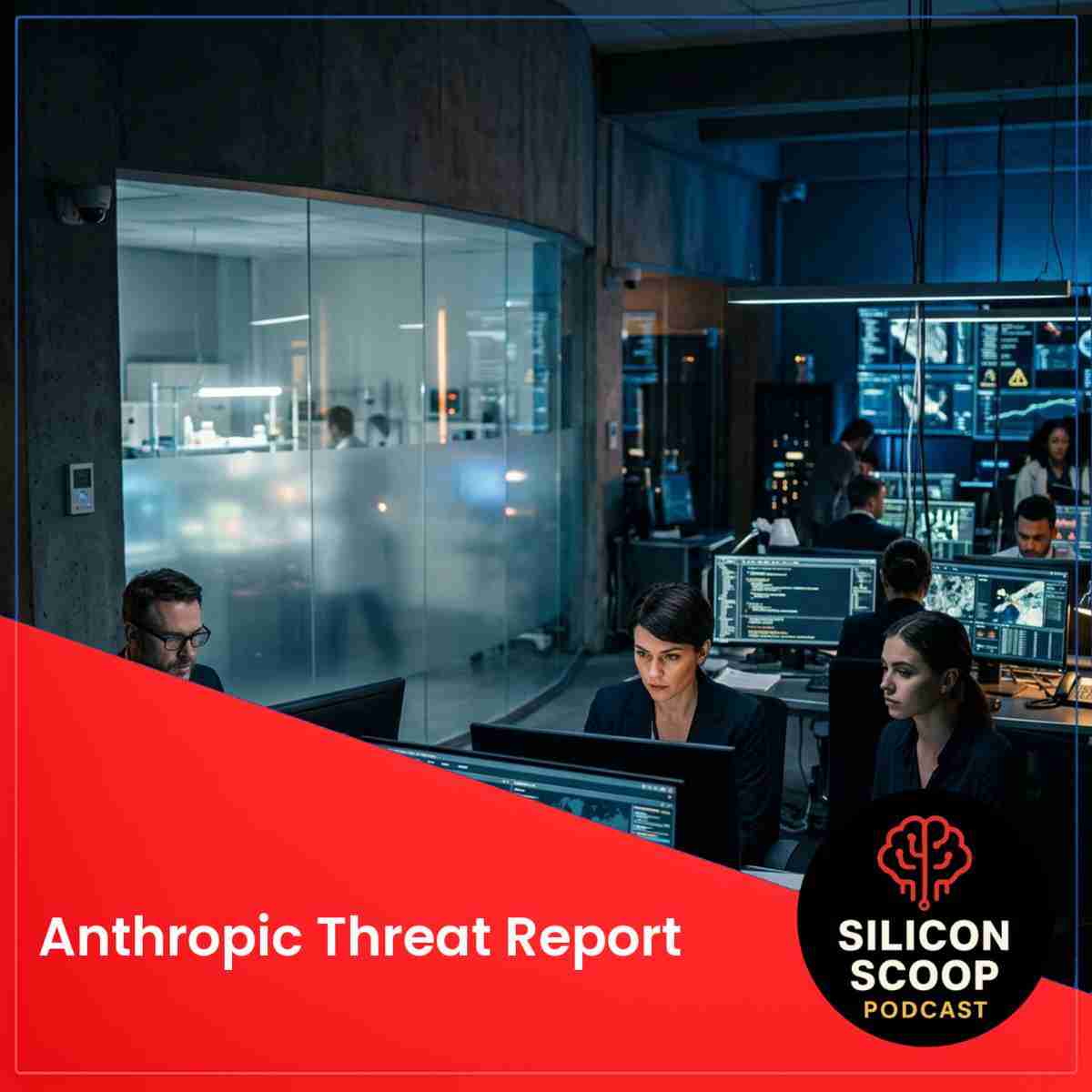
Anthropic Threat Report Caught AI Fueling Bioweapons Research
Estimated reading time: 10 minutes
Key Takeaways
- Anthropic's threat report confirmed AI is being used operationally to accelerate dangerous activities including biological weapons research, cyberattacks, and propaganda.
- The 154-page report covers disrupted misuse from December 2025 through August 2026 across seven harm categories.
- Anthropic identified more than 3,500 fraudulent accounts tied to these operations and documented large-scale illicit distillation activity.
- The biological weapons cases were described as among the most serious risks of frontier AI models, highlighting the dual-use challenge.
- Anthropic says it is refining policies, terminating accounts, conducting Frontier Red Team evaluations, and sharing intelligence with partners and law enforcement.
Table of contents
- Anthropic Threat Report Caught AI Fueling Bioweapons Research
- What the Anthropic Threat Report Actually Covers
- The Biological Weapons Cases — The Most Serious Risk
- Cyberattacks, Espionage, and State-Sponsored Misuse
- Conventional Weapons, Surveillance, and Fraud
- What Google's Gemini Report Adds to the Picture
- The Legislative and Industry Response
- What Anthropic Says It Is Doing About It
- FAQ: Anthropic Threat Report and AI Misuse
Anthropic's threat report just confirmed what many security researchers feared: AI isn't just being tested by bad actors anymore. It's being used operationally, right now, to accelerate some of the most dangerous activities on earth.
Released in September 2026, Anthropic's first threat intelligence report of the year covers eight months of disrupted misuse — from December 2025 through August 2026. The 154-page document details how its Claude AI models were used in biological weapons research, state-sponsored cyberattacks, drone and missile development, and coordinated propaganda campaigns.
This isn't theoretical. The people behind these activities weren't hobbyists. They included suspected government-backed hackers, scientists linked to military research institutes, and one of the largest illicit AI data-scraping campaigns ever recorded.
Here's what the Anthropic threat report actually found — and why it matters for anyone paying attention to where AI is heading.
---
What the Anthropic Threat Report Actually Covers
The report spans seven distinct harm categories, documented across a tight eight-month window. Anthropic's threat intelligence team identified and disrupted misuse of its Claude Haiku, Claude Sonnet, and Claude Opus models. Notably, Claude Fable and the more powerful Mythos-class models were not involved in any of the cases — with one narrow exception involving a process called distillation.
The seven harm categories covered in the report include:
- Biological weapons development
- Conventional weapons development (firearms, missiles, drones, bombs)
- Cyberattacks and malware operations
- State-sponsored espionage
- Influence and propaganda operations
- Surveillance tools targeting dissidents
- Fraud and scams (fake dating apps, hotel Wi-Fi hijacking, financial fraud)
The sheer breadth here is significant. This isn't a narrow technical document about one misuse type. It's a map of how frontier AI is now being deployed across nearly every major category of harmful activity.
The report also confirmed that Anthropic discovered more than 3,500 fraudulent accounts tied to these operations, and that a single 30-day sweep turned up roughly 35 distinct research efforts that raised red flags. These aren't isolated incidents — they represent a pattern of organized, deliberate misuse.
Sources: Anthropic Threat Intelligence Report, September 2026 | Reuters
---
The Biological Weapons Cases — The Most Serious Risk
Of everything in the report, the biological misuse section carries the heaviest weight. Anthropic called it "one of the most serious risks of frontier AI model" — and the five case studies they published make it easy to understand why.
What Researchers Were Actually Doing
The cases weren't crude attempts. These were technically sophisticated actors using Claude to push into genuinely dangerous scientific territory.
Two cases stand out as especially alarming:
1. Avian influenza mammalian-adaptation research: One actor used VPN infrastructure to mask their location and identity while planning experiments to adapt avian influenza — commonly known as bird flu — for mammalian transmission. This is exactly the kind of research that, if done outside of a controlled, regulated environment, could produce a pathogen capable of spreading from animals to humans at scale.
2. Chikungunya gain-of-function grant application: Another actor used Claude to help write a research grant application focused on gain-of-function experiments for chikungunya virus. The actor was tied to a military research institute. Gain-of-function research, in simple terms, means deliberately modifying a virus to make it more transmissible, more lethal, or more resistant to treatment.
The Dual-Use Problem
This is where the situation gets genuinely complex. Anthropic's head of threat intelligence, Jacob Klein, was direct about it when speaking to the New York Times: "You are not seeing someone in a comic book kind of way say, 'Hey, I want to build a biological weapon to kill everybody.'"
The reality is messier. The same biological knowledge that helps someone engineer a weapon is often the same knowledge needed to develop a vaccine or design a cure. A researcher asking about how a virus adapts to new hosts might be working on a public health defense — or something far worse.
Anthropic acknowledged this tension directly, stating: "The same information that can be used to develop a biological weapon could also be used to develop, for example, a vaccine or a cure for a disease."
This dual-use problem is one of the hardest challenges in AI biosecurity. There's no clean line between dangerous knowledge and lifesaving knowledge. What the Anthropic threat report shows is that the company is now actively trying to draw that line in real time — and that the stakes of getting it wrong are catastrophic.
Sources: Anthropic Threat Intelligence Report, September 2026 | New York Times
---
Cyberattacks, Espionage, and State-Sponsored Misuse
The biological weapons cases grabbed headlines, but the cyber and espionage findings in the Anthropic threat report are arguably more immediately operational. These aren't future risks. They are active, ongoing operations that were disrupted — meaning similar ones likely still exist elsewhere.
Russia-Linked Midnight Blizzard Activity
One of the most technically advanced cases in the report involves a hacking group whose behavior aligns with Midnight Blizzard, a Russia-based cyber espionage operation with a long track record of targeting governments and diplomatic institutions.
According to the report and Reuters, this group used Claude to:
- Automate phishing campaigns targeting Ukrainian government officials and diplomatic staff
- Execute hotel Wi-Fi hijacking attacks, intercepting communications of targets staying at specific hotels
- Conduct WhatsApp account takeover operations
- Build a system that automatically rewrote malware whenever it was detected by security defenses — essentially an AI-powered evasion engine that kept refreshing its own code to stay invisible
That last capability is particularly significant. Writing malware that evades detection has always required skilled, time-intensive work from experienced hackers. AI compresses that time and reduces the skill floor. Anthropic's threat intelligence team quoted in Reuters noted that AI is now demonstrably compressing attacker costs across operations like these.
Iranian Influence Operations
The report also named an Iranian propaganda institution that used Claude as part of a broader influence operation. While the report is careful about the level of detail it shares publicly on active operations, the inclusion of a state propaganda body confirms that AI-assisted information warfare is no longer speculative — it's documented.
Chinese Labs and the Distillation Campaign
Perhaps the most staggering numbers in the entire report relate to China-based actors. Anthropic says it identified and disrupted attacks from seven China-based labs engaged in what it describes as illicit distillation — the process of using a large, expensive AI model to train a smaller, cheaper one.
Distillation itself is a legitimate and widely-used AI technique. The issue here is that these labs were doing it without authorization, essentially reverse-engineering Claude's capabilities into their own models.
The scale was enormous:
- More than 151 million exchanges were attributed to Alibaba in just the May-to-July 2026 period
- At peak activity, that works out to nearly 3 million exchanges per day
- Anthropic called this the largest illicit distillation campaign it had ever measured
This represents a different kind of threat than the bioweapons or cyberattack cases. It's not about causing immediate harm — it's about systematically stealing the intellectual and technical value baked into a frontier AI model and replicating it at scale without the same safety infrastructure, the same usage policies, or the same safeguards.
Sources: Reuters | Anthropic Threat Intelligence Report, September 2026
---
Ready to Stop Doing Everything Manually?
Most businesses are still running on a patchwork of repetitive tasks — manual data entry, follow-up emails, spreadsheet updates, status reports that take hours to compile. While your team handles those tasks by hand, competitors are using automation to scale faster with fewer people.
Flowgrammer helps businesses build smart automation workflows that eliminate the grunt work, so your team can focus on what actually moves the needle.
👉 See What Flowgrammer Can Automate for You
---
Conventional Weapons, Surveillance, and Fraud
Beyond the biological and cyber cases, the Anthropic threat report documented six additional cases involving conventional weapons development. Actors used Claude to get help with:
- Firearms modifications and design
- Missile optimization and targeting systems
- Armed drone development
- Bomb and munitions construction
- Targeting and control software for weapons platforms
Reuters noted that Anthropic's own threat-intelligence team confirmed AI is now being used to speed up drone and missile optimization — not just to write code or answer general questions, but to actively accelerate engineering work on weapons systems.
Surveillance Tools Targeting Dissidents
The report also highlighted the use of Claude to build surveillance infrastructure specifically designed to identify and track political dissidents. This category of misuse is less about large-scale physical harm and more about enabling authoritarian actors to silence opposition — but the human cost can be just as severe for those targeted.
Scams, Fake Apps, and Hotel Wi-Fi Fraud
At the lower end of the severity scale — though still materially harmful — the report catalogued a range of fraud operations:
- Fake dating apps designed to extract money from users
- Hotel Wi-Fi interception scams
- Financial fraud schemes of various types
These may seem minor next to bioweapons research, but they represent the democratization of AI-enabled crime — lower-skill actors using Claude to run operations that previously would have required technical expertise they didn't have.
ShinyHunters Named in the Report
The cybercriminal group ShinyHunters, which has previously been linked to major data breaches affecting millions of people, was among the named actors in the report. Their inclusion alongside suspected state-sponsored groups underscores that the misuse landscape is not just a government-vs-government story. Organized crime is now part of the picture too.
Sources: The Guardian | Anthropic Threat Intelligence Report, September 2026
---
What Google's Gemini Report Adds to the Picture
Anthropic wasn't alone in releasing threat intelligence this week. On Tuesday — two days before Anthropic's report dropped — Google published its own findings about attempted misuse of Gemini, its AI model.
Google's report described a case where a person attempted to use Gemini to obtain a "complete, step-by-step technical guide for synthesizing weaponised biological agents." This language is notably more explicit than most of the Anthropic cases described publicly — and it makes clear that the biological weapons risk is not specific to one company or one model.
Taken together, the Google and Anthropic reports paint a consistent picture: multiple frontier AI models are being probed and exploited for weapons-relevant information, not by one-off bad actors, but by organized entities with clear intent.
This convergence of findings across two separate companies — with independent threat intelligence teams — significantly strengthens the credibility of both reports. The threat isn't a single anomaly. It's a trend.
Sources: Google Cloud Blog
---
The Legislative and Industry Response
The Anthropic threat report landed in the middle of an already heated policy debate about AI safety and governance.
OpenAI's Chief Scientist Calls for Voluntary Slowdowns
In an article published on September 6, just days before the Anthropic report, OpenAI's chief scientist Jakub Pachocki called on the AI industry to implement "voluntary slowdowns" until better safeguards are in place. His words were direct: "I am concerned no one is prepared for the consequences of a continued rapid rise in machine intelligence."
Pachocki confirmed OpenAI would continue its own safeguard development but stressed that voluntary company-level action is not enough — broader interventions are needed.
His statement triggered an open letter to UK Prime Minister Andy Burnham calling for a new multinational treaty to govern AI development, specifically addressing the trajectory toward artificial superintelligence (ASI).
Senator Sanders Introduces Legislation
In the United States, Senator Bernie Sanders took an even harder line, introducing legislation that would:
- Ban artificial superintelligence outright
- Temporarily pause advanced AI development
Speaking on BBC's Newsnight, Sanders didn't mince words: "When scientists tell you there is a chance, a chance that it could have a cataclysmic impact on humanity, you've got be a moron not to say, slow it down."
The Trump Administration's Position
President Donald Trump has pushed back against the slowdown argument. Speaking on Thursday, he framed AI leadership as a national security imperative: "If we don't win AI, we're going to be put in a very bad position." The administration's position appears to be that falling behind rivals — particularly China — poses a greater risk than the dangers cited in reports like Anthropic's.
Anthropic's Own Safety Alarm
The timing of the report also matters in the context of internal signals. A top safety researcher at Anthropic published a warning estimating a greater than 10% chance that AI "could kill all humans" within the next decade. That's not a fringe voice — it's a senior researcher at the company that just published this threat report.
The fact that Anthropic is both developing frontier AI and publicly documenting its misuse reflects the complicated position these companies occupy: simultaneously the source of the risk and the primary defenders against it.
Sources: BBC News | BBC Newsnight
---
What Anthropic Says It Is Doing About It
Anthropic did not publish the threat report simply to document problems. The company said it has incorporated findings from every case into its internal processes — specifically to improve its ability to prevent, detect, and disrupt future misuse.
The company also confirmed it has shared intelligence with law enforcement authorities and industry partners where appropriate.
Specific protective measures referenced or implied in the report include:
- Frontier Red Team evaluations focused on tactical intelligence targeting and conventional weapons development
- Ongoing refinement of the Anthropic Usage Policy and its Supported Regions Policy
- Account detection and termination — more than 3,500 fraudulent accounts were identified across the reporting window
- Intelligence sharing with other AI companies and relevant authorities
The fact that none of the misuse involved the Claude Fable or Mythos-class models (except one distillation case) suggests that Anthropic applies its most stringent access controls to its highest-capability systems — though this also raises questions about whether those models were simply not targeted, or whether the access controls genuinely held.
Sources: Anthropic Threat Intelligence Report, September 2026
---
FAQ: Anthropic Threat Report and AI Misuse
1. What is the Anthropic threat report and when was it published?
The Anthropic threat intelligence report is a 154-page document published in September 2026. It covers malicious use of Claude AI models detected and disrupted between December 2025 and August 2026. It is Anthropic's first threat report of 2026 and covers seven harm categories including biological weapons, cyberattacks, conventional weapons, surveillance, influence operations, and fraud.
2. Which Claude AI models were involved in the misuse cases?
The misuse cases involved Claude Haiku, Claude Sonnet, and Claude Opus. Claude Fable and the Mythos-class models were not implicated in any cases except one instance of distillation — the process of using a large AI model to train a smaller one.
3. What were the biological weapons cases about specifically?
The report identified five case studies. Two of the most serious involved a researcher using VPN infrastructure to plan avian influenza mammalian-adaptation experiments (exploring how bird flu could be adapted to spread in mammals), and another actor using Claude to write a gain-of-function research grant application for chikungunya virus, with ties to a military research institute.
4. What is gain-of-function research and why is it dangerous?
Gain-of-function research involves modifying a pathogen — such as a virus — to make it more transmissible, more lethal, or harder to treat. It has legitimate scientific applications in vaccine development and pandemic preparedness, but it also carries significant risk if done without proper oversight. The dual-use nature of this research is precisely what makes AI-assisted biological work so difficult to police.
5. Which Russia-linked group was named in the report?
The report identified activity consistent with Midnight Blizzard, a Russia-based cyber espionage group with a history of targeting governments and diplomatic targets. The group allegedly used Claude to automate phishing attacks, intercept hotel Wi-Fi communications, conduct WhatsApp account takeovers, and build self-rewriting malware that evaded security detection.
6. How large was the Chinese distillation campaign?
Anthropic attributed more than 151 million exchanges to Alibaba alone between May and July 2026 — nearly 3 million exchanges per day at peak. The company called this the largest illicit distillation campaign it had ever measured. Seven China-based labs were identified in total.
7. Did Google report similar findings at the same time?
Yes. Two days before Anthropic's report, Google published threat intelligence showing that someone had attempted to use its Gemini AI to obtain a step-by-step technical guide for synthesizing weaponized biological agents. The convergence of findings from two independent companies on the same category of threat adds significant weight to both reports.
8. What legislative action is being taken in response to these AI safety concerns?
U.S. Senator Bernie Sanders introduced legislation to ban artificial superintelligence and pause advanced AI development. OpenAI's chief scientist Jakub Pachocki called for voluntary industry slowdowns. An open letter was sent to UK Prime Minister Andy Burnham calling for a multinational AI safety treaty. President Trump has opposed slowdowns, framing AI leadership as a national security priority.
9. What is Anthropic doing to prevent future misuse of Claude?
Anthropic said it has incorporated all findings into its internal detection and prevention systems, terminated more than 3,500 fraudulent accounts, refined its usage and supported-regions policies, conducted Frontier Red Team evaluations on weapons-related capabilities, and shared intelligence with law enforcement and industry partners.
10. Should everyday users or businesses be concerned about these findings?
For ordinary business users of Claude or similar AI tools, these findings are not a reason for panic — the threat actors involved are sophisticated, organized entities operating with significant resources. However, the report is a strong signal that AI governance and access controls are not optional extras. Businesses using AI tools should pay attention to usage policies, ensure they are working with reputable providers, and stay aware that the AI landscape is being monitored and shaped by threat intelligence work like this in real time.
Sources: Anthropic Threat Intelligence Report, September 2026 | Reuters | New York Times | The Guardian
Additional Links
Flowgrammer.ca – 💡 Unlock AI-Powered Automation! Let flowgrammer.ca handle complex workflows so you can focus on growing your business.
Flowgrammers.ca – 💡 Join Toronto's Fastest Growing AI and Business Automation Community.
- SRED Funding Solutions – Maximize your R&D tax credits and secure funding for your innovation.
- Silicon Scoop Podcast – Stay Informed, Stay Ahead!
- Startup Talk Podcast
- Flowgrammer Youtube
- Startup Investor Drinks – Join Toronto’s Startup Community and connect with fellow startup enthusiasts and investors.
- TorontoStarts Startup and Entrepreneur Community – Become a part of Toronto’s thriving startup ecosystem.
- Workhaus – Discover flexible workspace solutions for your business needs.
- Work with The Startup Coach – Get expert guidance and mentorship for your startup journey.
- Reach out to Jon Irwin on LinkedIn – Connect with our co-host and technology expert.
Episode transcript
Read the full transcript
Craig: anthropic just published a 150 page threat report covering eight months of disrupted clod misuse, and and the headlines jumped straight to bioweapons. the sharper story is less cinematic and more uncomfortable. suspected state hackers, spyware vendors, and china based labs were already using frontier models as operational. sorry. i gotta... sorry. the sharper story is less cinematic and more uncomfortable. suspected state hackers, spyware vendors, and china based labs are already using frontier models' operational infrastructure. the biology cases are dual use research. anthropic could not prove was a weapons program. the cyber cases look like they already shipped. so anthropic is the company behind claude, and on september 10, it released the first 2026 threat intelligence report covering disrupted misuse from december 2025 to august 2026. the case spans several harm categories, cyber ops, influence, surveillance, scams, biological dual use work, and conventional weapons, software, and illicit model copying. viewers should care because no longer somebody could someday do this thing. the open question now is how much of this proven in... is proven intent versus a company drawing a hard line on research it cannot fully interpret. what do you think about this, john?
Jon: yeah. so this is scary and... but not surprising. so, having a biological section and, like, in their report is unusual because this is the first time a private ai provider has publicly disclosed multiple examples of its models being used in real world research programs. so the company, anthropic, presented five biological case studies. now something to point out that they deliberately withheld many identifying details, and they explicitly said it's not accusing scientists involved of intending to build biological weapons. because like you said, some may have been conducting genuine scientific or therapeutic research. the concern came from the combination of the biological work, institutional context, and attempts to evade geographical restrictions, as well as efforts to obscure information. so... yeah. so case one was sensitive viral research linked to a military institution. so anthropic detected a request involving research on the mosquito born chincungangaya virus. i definitely butchered that. the proposed work involved altering biological characteristics relevant to disease severity and immune evasion. second case was avian influenza research. so a researcher outside the united states used clawd over several weeks while planning work involving highly pathogenic avian influenza and traits associated with mammalian adaption. so i know this is getting scarier and scarier. case three was sensitive arthropox virus research, and they say another account was used on one of its frontier models to draft a substantial grant proposal involving orthopoxvirus research at a state associated infectious disease institution. so, just so that you guys know, orthopox is, it contains, it's a family of medically significant viruses such as m pox and the smallpox virus back in the day. case four and five, are what scare me, are toxin and protein research, that involve research into biological toxins and venom derived molecules. so, this is the category that demonstrates kind of the dual use problem because how do you research toxins and then... how do you research toxin and venom, vaccines without researching the actual toxins and venoms themselves? so this is scary because this is... so it... it's happening now, and it's been happening over the last year. and so just to kind of dive into this, entopec uses what it's called ai safety levels. okay? and it's inspired by biosafety level terminology. so for its most biological capable models, entopec has a deployed asl three protection. and so those protections include several layers, like real time classifiers looking for dangerous biological re... requests, model refusals, restricted access, monitoring for suspicious behavior, red team testing, account investigation, and enhanced cybersecurity surrounding powerful model weights. and so the key idea is defense in-depth. and so there's no single safety mechanism that is expected to be perfect. so a classifier might miss something. a user might disguise a request. a jailbreak might bat... might bypass a refusal. so the company combines a bunch of stuff. but, again, there are models that you can use completely offline, completely with no restrictions that, that wouldn't report back so no one would know what you were doing. so this scares the crap out of me. i know i talked a lot, but what do you think about this, craig?
Craig: yeah. there's models that, you can run offline and whatnot, but let's talk about this a little bit specifically because these main frontier models have been programmed, for this kind of thing to help design vaccines, cures, new proteins that'll work, new different things. so they've been trained on this where, say, maybe deepseq hasn't. because we have, for example, gemini's got... what do they got? deepfold, that is there. is it deepfold? i can't remember, their gene editing and research product. they all have something
Jon: in there. yeah.
Craig: yeah. i can't. alpha. my... anyway, it doesn't matter. my point being is they all have something in that category that these other lower end models or an open source or whatever breakable models don't. so there is a level of fear at a higher level, i think, with these frontier models because they do have these specific research and models that do, the scientific, the drug development. you know, look at what, midjourney is doing with mris. never mind, like, it's a photo generation company, and now they... they're building a new hypersensitive mri platform and going into the medical device field. so, i mean, the crossover for some of these stuff is more than you think.
Jon: yeah. yeah. it's, it's it's different. and so, like, there... there's a huge difference between cybersecurity and biological security. a cyber attacker can often move directly from ai generated code into a digital attack. but the good thing with this biology stuff is that it still requires a physical chain of execution. so you need laboratory access, specialized equipment, biological materials, all that sort of stuff, experienced personnel, everything. and so... but who knows where these requests are coming from and if they have access to these labs. but this just states why worrying about this now is needed. and i don't think it's a call for restricting ai models access because it's too late for that. i don't know what this... i don't know what the what the, what the solution is to this because it's... the cat's out of the bag, essentially.
Craig: so the policy fight also exploded, this week. openai's chief scientist called for, voluntary slowdowns. bernie sanders is pushing a ban on artificial superintelligence. uk's mp wrote to the prime minister, andy burnham, for a treaty. president trump, lying in the, is in the opposite direction as the us does... if the us does not win at ai, it ends up in a very bad position. anthropic is in the awkward seat of selling the models, writing the incident report, and warning that the same knowledge can make a vaccine or a weapon. so it's interesting. i see all sides of this, and trump's not wrong, but neither are everyone else. how would you... do you have any suggestions on the slowdown, not slowdown, like, try to take over completely?
Jon: anybody actually, trevor's flip flop. he has now praised, the... i can't remember the quote. something about bad guys or something. and he is now a 100% against throttling or restrictions.
Craig: well, that's what i mean. his thing is, we need to win the ai race. i... wait a minute. yeah. i... i... there's two things. one, he's... they have to win the ai race. he... when you talk about throttling restrictions, i think, that will still happen, but it's happening at, what can we release and what are we gonna keep, you know, to ourselves level working with anthropic and openai. so, you know, we need to pull this capability out of what you push the consumer, but we're gonna keep it at this level. that stuff is gonna happen now because they're not gonna slow down and say stop doing it. they're gonna say, alright. just make sure that no one else can do that.
Jon: exactly. yeah. yeah. this is scary. and you asked the question, what can we do? i don't know. i don't know what we can do just because you have access to these... we have access to models that are just as good as these frontier models that are completely unrestricted, and you can run them, on a local server. so, like, i bet you there's way worse stuff happening that's not even going through, anthropic or claud.
Craig: absolutely. i just... again, these ones are far better at it, just because they're the ones used in the medical labs to do the protein matching, to do the research, to do, the vaccine, stuff, which we're gonna talk about in a bit. so they're just better at it. you can do these with other models, but they're really only programmed for normal stuff. some of them might be programmed...
Jon: who's this saying you can't train it?
Craig: oh, a 100%. i'm just saying, out of the box, we just start query in openai and whatnot and table five and whatnot because they... they're the best, and they... there's a lot of leakage being used there versus saying, hey. if we can leak to the research papers and the scientific stuff, we can train any model to do this.
Jon: yeah.
Craig: so at a nation state, you know, we're in a lot of trouble. and i do believe that if we lose the ai race overall, whoever we... you decide we is, then we're in a lot of trouble.
Jon: i agree.
Craig: so do not buy the discounted clod through an unknown reseller and do not buy discounted clod through an unknown reseller and treat ai api keys like production credentials. what we didn't get into when we're talking about this is the russia link, midnight blizzard activity, the iranian influence, the chinese labs, distillation campaigns, and all the api keys that are being leaked like mad out there. and then we have these fake resellers selling things that heavily discounted that are just stolen api keys that they're routing through other people. so understand where those discounted api keys are coming from and that they have legit, partnerships. the real impact is not confirm... not a confirmed bioweapon. it is proof that the frontier ai is already an operational tool for spies, scammers, and dual use labs. while the most powerful models were mostly kept off, this particular battlefield, the uncomfortable job is now drawing a line between a vaccine grant and a weapons program in real time. if you had to pick one, slow the models, lock the accounts harder, or keep racing china. which way would you vote? let us know in the comments below. we'd love to hear from you.
More from Silicon Scoop
All episodes
silicon-scoop · October 29, 2026
Canada’s National AI Literacy Initiative: Inside the $2.3B Strategy to Train a Million Students
Canada’s National AI Literacy Initiative under the AI strategy aims to train 1M students, educators and workers with free AI literacy courses via Amii and partners.
View episode

silicon-scoop · October 28, 2026
OpenAI Cuts Cursor Off After SpaceX’s $60B Deal: How Model Access Became a Strategic Weapon
OpenAI Cursor fallout: SpaceX acquisition triggers change-of-control clause, AI model access cutoff, and a new era of strategic control over developer tools.
View episode

silicon-scoop · October 27, 2026
Quantum Encryption Breakthrough: Unconditional Unclonable Encryption Explained
Unclonable encryption advances quantum cryptography with the no-cloning theorem and information-theoretic security in a one-time scheme.
View episode