
Skills Investors Look For in Startup Founders
Skills Investors Look for in Startup Founders In this episode of Startup Talk Podcast, we dive deep into the minds of investors to explore what critical skills they look for in startup founders. Whether you’re an aspiring entrepreneur or a seasoned founder preparing to scale your business, this discussion offers invaluable insights into the skill […]
A TorontoStarts podcast
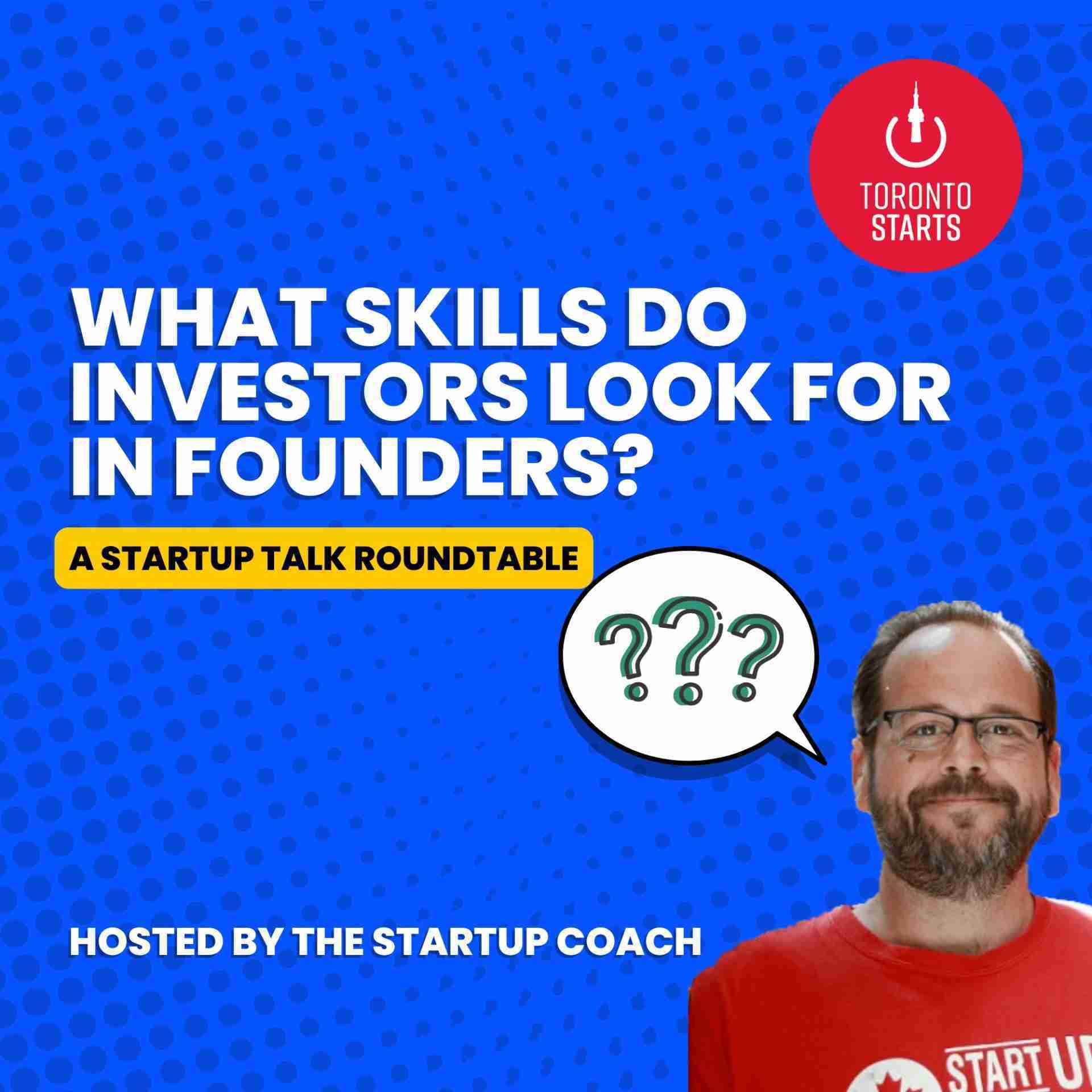
Skills Investors Look for in Startup Founders
In this episode of Startup Talk Podcast, we dive deep into the minds of investors to explore what critical skills they look for in startup founders. Whether you’re an aspiring entrepreneur or a seasoned founder preparing to scale your business, this discussion offers invaluable insights into the skill sets that catch the attention of top investors. This episode features leading voices in the Canadian startup ecosystem: Jon Irwin, Jeff Hoedeman, Alex Morsink, and Graeme Barlow. Each of these experts shares what they look for when evaluating founders and their startups, from team dynamics to the essential entrepreneurial mindset.
Skills Investors Look For in Startup Founders Speaker List:
- Jon Irwin
Preferred Contact: LinkedIn
Canadian companies can book a free assessment for government funding. - Jeff Hoedeman
Preferred Contact: LinkedIn - Alex Morsink
Preferred Contact: LinkedIn
More resources are available at the Equivesto Learning Center. - Graeme Barlow
Social Platforms: @Graemebarlow on all social platforms, including LinkedIn, Instagram, and X (formerly Twitter).
Website: GraemeBarlow.com
Skills Investors Look For in Startup Founders Key Points Discussed:
1. Team Chemistry and Problem-Solving Skills
Graeme Barlow opens the conversation by emphasizing the importance of team chemistry and resourcefulness. Investors aren’t just looking for a talented individual; they’re searching for a cohesive team that can weather storms together. Graeme mentions the significance of how teams handle disagreements and tough times, especially when facing financial challenges. The ability to collaborate under pressure and remain resourceful in solving problems is crucial.
As an investor, Graeme values a co-founder group over solopreneurs, noting that the collective resourcefulness of the team often dictates success. Whether it’s quickly developing a prototype using tools like Figma or Canva, or identifying potential investors, it’s the team’s ability to adapt and take initiative that impresses investors.
2. Industry Expertise Matters
Graeme highlights that having industry expertise is vital, particularly in complex fields like healthcare or finance. Startups that venture into unfamiliar industries without any relevant background may struggle to understand the intricacies of the problems they’re attempting to solve. Investors prefer to see at least one member of the team with deep domain knowledge, which offers the credibility and insight necessary to navigate industry challenges.
3. Sales Skills: A Non-Negotiable
Jeff Hoedeman weighs in, identifying sales skills as a frequently missing piece in many founding teams. He stresses that being able to sell isn’t just about moving a product—founders also need to sell their vision and company to investors. The ability to confidently communicate and pitch the startup to early-stage investors can make or break a deal. For Jeff, strong sales ability demonstrates that a founder will likely overcome the early hurdles of acquiring customers and attracting investment.
4. Personal Attributes: Resilience and Adaptability
The conversation also touches on personal traits investors like to see in founders, such as resilience and the ability to be coachable. Both Graeme and Jeff mention that how a founder reacts under pressure is telling. In fact, they often test founders by challenging their ideas or placing them in difficult scenarios to see how they adapt and come together as a team.
Key Takeaways for Founders:
- Team Cohesion: Investors want to see a balanced team where co-founders complement each other’s skills. Ensure that your team can work well together, particularly when faced with adversity.
- Resourcefulness: Demonstrating creativity and initiative, especially when resources are limited, will make your startup stand out.
- Industry Knowledge: Be prepared to showcase your understanding of the market you’re entering. Investors are wary of founders without hands-on experience or domain knowledge.
- Sales Skills: Your ability to pitch your startup effectively, both to investors and potential customers, is a critical skill that could be the difference between success and failure.
Additional Resources:
For listeners who want to explore more, Jon Irwin invites Canadian companies to book a free assessment for government funding, a valuable resource for startups seeking financial support. Additionally, Alex Morsink shares that founders can dive deeper into these topics at the Equivesto Learning Center, where more educational content is available for founders aiming to raise capital.
Mentioned in This Episode:
- Jon Irwin: Connect on LinkedIn
- Jeff Hoedeman: Connect on LinkedIn
- Alex Morsink: Equivesto Learning Center
- Graeme Barlow: GraemeBarlow.com
Relevant Links and Events:
- Startup Investor Drinks: Join the next event to connect with other founders and investors.
- TorontoStarts Startup and Entrepreneur Community: Engage with the largest startup community in Canada.
- Workhaus: A co-working space supporting the startup ecosystem.
- Work with The Startup Coach: Book a session to receive tailored guidance for your startup.
Listen to Our Other Podcasts:
- Silicon Scoop Podcast – Stay Informed, Stay Ahead!
- Futuretech Podcast – Explore more episodes and stay updated with the latest in technology and innovation.
- Startup Talk Podcast – https://torontostarts.com/startup-talk-toronto-startup-podcast/
- Who Are These Startups Podcast
- Startup Investor Drinks – Join the community and connect with fellow startup enthusiasts and investors.
- TorontoStarts Startup and Entrepreneur Community – Become a part of Toronto’s thriving startup ecosystem.
- Workhaus – Discover flexible workspace solutions for your business needs.
- Work with The Startup Coach – Get expert guidance and mentorship for your startup journey.
Follow Us:
- Twitter: @TorontoStarts
- LinkedIn: Startup Coach
- Instagram: @TorontoStarts
- YouTube: TorontoStarts
Ontario Startup Ecosystem Links
Episode transcript
Read the full transcript
What mix of skills do you like to see among co-founders? Graham, we'll start with you. Good question. I mean, I think there's the the old I don't know what was it added to the hacker, the hustler and something. I think for me, for me, it's team chemistry. And how well do I think you complement each other and how well do you disagree with each other? It's easy to meet a founding team that's all friends when everything is wonderful. When your back's up against the wall, everything is awful and you're running out of money in forty eight hours. How well are you actually going to come together? So trying to get a sense for what that dynamic looks like, the resourcefulness of the group on the whole. I mean, typically I I look for co-founder groups. I don't love solopreneurs just because everything I've ever done has been as a co-founder team. And I couldn't imagine surviving the building a company process solo. So credit to those that do. But honestly, resourcefulness, like when when problems show up, how well do you guys come together and solve it? And oftentimes that's things like, oh, we need a prototype. So somebody figures out how to build a prototype in Figma or Canva or sketch it together with no code. Oh, we need where do I go find angels? Someone jumps on the Internet and finds a list of five hundred angels like it's the it's the resourceful stuff that. is hard to kind of, I don't know, make tangible. And then someone on the team needs to have a deep, deep understanding of the problem you're solving. It doesn't have to be the whole team, but I'm like, if you're going to go solve healthcare, somebody on your team needs to have some kind of background or experience in the industry that you're attacking. Too often I meet people that have never worked in a space at all. And they're like, we're going to go revolutionize how hospitals work. I'm like, Have you sold into hospitals before? Like, do you have any concept of what that takes? And I mean, sometimes ignorance is bliss and it's a superpower to open doors. Oftentimes it's just a like nightmare of not understanding that there's maybe systems in there that you don't know about, or there's processes that you're not aware of. industry expertise, resourcefulness, and going to try. I mean, this is just a personal thing, but like I'm going to try and kind of fuck with the founders a little bit and see how they react if we put different people in the light at different times or push them a little bit or challenge them a bit. And how well do they come together? Because ultimately, that's what's going to test you. Jeff, what do you look for in the combo of founders? Yeah, it's an interesting, I was going to jump in and say that it's going to be different for different investors because often we're looking for things that mattered to us that may not matter to the next investor. And so as a founder, You can't really say, oh, what should I put together to make this investor love us? It's going to be different. I think the skill set that's mostly missing in a lot of founder groups that I've been pitched by is sales, sales skills, sales ability. And sales goes way beyond, can I sell my product? Sales is, can I sell my company? Because that's what they're doing when they're pitching an investor. They're selling a company. And if I see that skill or talent or whatever, sometimes you're just born with it. That's a good sign to me because I think that they're going to be able to get over some of those hurdles that happen early on, which is getting your first customers, getting your first investors.
More from Startup Talk
All episodes
startup-talk · April 10, 2025
10x Revenue Exit
Discover actionable insights for achieving a 10x Revenue Exit through strategic scaling, profitability, and smart bootstrapping. https://torontostarts.com/2025/04/10/10x-revenue-exit/ Apple -> https://podcasts.apple.com/us/podcast/startup-talk/id1763804003 Spotify -> https://open.spotify.com/show/1siJMILILidHAiAsrX2VBU YouTube: https://youtube.com/playlist?list=PLj4v-RoA7A-jxV5FHs5e61oIsuvUJYmT_&si=LYegRe5GYLKNQ7xL Flowgrammer Apple -> https://podcasts.apple.com/us/podcast/flowgrammer-podcast/id1804155588 Spotify -> https://open.spotify.com/show/0wv3feR00iaVpE8zn7niNf Flowgrammer.ca -> https://flowgrammer.ca/ AI News and Resources -> https://flowgrammer.ca/resources/ Silicon Scoop Silicon Scoop Podcast - https://torontostarts.com/silicon-scoop/ Apple: https://podcasts.apple.com/us/podcast/silicon-scoop/id1758711826 Spotify: https://open.spotify.com/show/5bAzF0MwV6TtLhJAhvHayI YouTube: https://www.youtube.com/playlist?list=PLj4v-RoA7A-gT62vrEYqh1zCv-0Hj-o5J Startup Investor Drinks Toronto - https://startupdrinksto.com/ Toronto’s Startup Community - https://torontostarts.com/
View episode
startup-talk · April 8, 2025
Product Market Fit with Lauft
Product Market Fit with Lauft Welcome to Episode 217 of the Startup Talk Podcast, where we explore Product Market Fit in a conversation with Graham Wong, Founder and CEO of Lauft. Listen in as the Startup Coach uncovers how Lauft transformed a personal need into a thriving flexible workspace solution and discovered exactly what their […]
View episode
startup-talk · April 6, 2025
Know Yourself – Unlocking Entrepreneurial Potential
Discover how to Know Yourself as an entrepreneur to unlock your potential and overcome challenges in today's startup world. https://torontostarts.com/2025/04/06/know-yourself-unlocking-entrepreneurial-potential/ Apple -> https://podcasts.apple.com/us/podcast/startup-talk/id1763804003 Spotify -> https://open.spotify.com/show/1siJMILILidHAiAsrX2VBU YouTube: https://youtube.com/playlist?list=PLj4v-RoA7A-jxV5FHs5e61oIsuvUJYmT_&si=LYegRe5GYLKNQ7xL Flowgrammer Apple -> https://podcasts.apple.com/us/podcast/flowgrammer-podcast/id1804155588 Spotify -> https://open.spotify.com/show/0wv3feR00iaVpE8zn7niNf Flowgrammer.ca -> https://flowgrammer.ca/ AI News and Resources -> https://flowgrammer.ca/resources/ Silicon Scoop Silicon Scoop Podcast - https://torontostarts.com/silicon-scoop/ Apple: https://podcasts.apple.com/us/podcast/silicon-scoop/id1758711826 Spotify: https://open.spotify.com/show/5bAzF0MwV6TtLhJAhvHayI YouTube: https://www.youtube.com/playlist?list=PLj4v-RoA7A-gT62vrEYqh1zCv-0Hj-o5J Startup Investor Drinks Toronto - https://startupdrinksto.com/ Toronto’s Startup Community - https://torontostarts.com/
View episode