
Best Inbound Revenue Strategies 2025
Podcast Title: Best Inbound Revenue Strategies 2025: Insights from Graeme Pitches Episode Description:In episode 182 of the Startup Talk Podcast, The Startup Coach sits down with Graeme Pitches to explore the Best Inbound Revenue Strategies 2025. This insightful conversation dives deep into proven tactics and innovative approaches that help businesses scale revenue through inbound marketing. […]
A TorontoStarts podcast
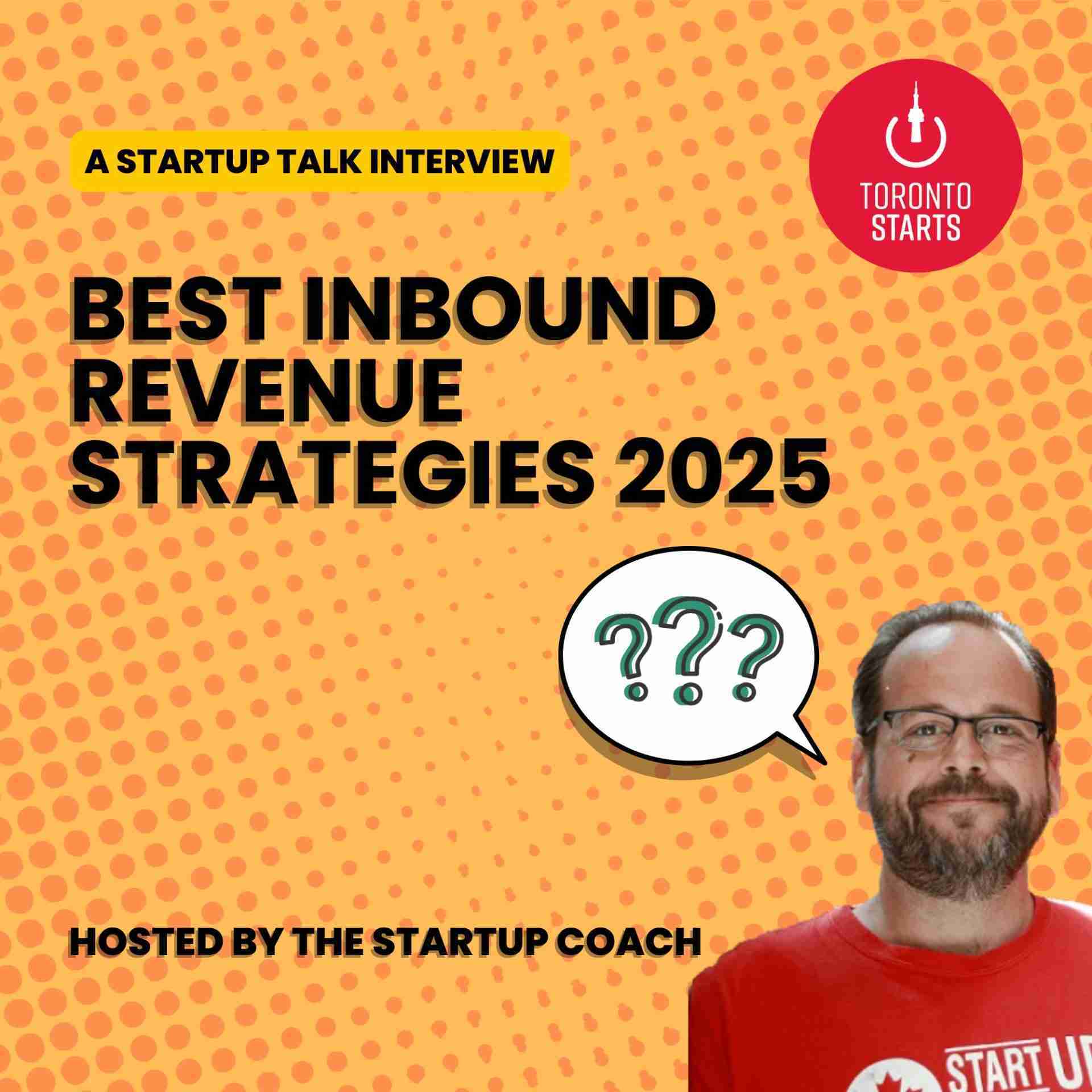
Podcast Title: Best Inbound Revenue Strategies 2025: Insights from Graeme Pitches
Episode Description:
In episode 182 of the Startup Talk Podcast, The Startup Coach sits down with Graeme Pitches to explore the Best Inbound Revenue Strategies 2025. This insightful conversation dives deep into proven tactics and innovative approaches that help businesses scale revenue through inbound marketing. From leveraging LinkedIn for company-wide engagement to optimizing referrals and perfecting your Ideal Customer Profile (ICP), this episode is packed with actionable tips. Learn why focusing on human-centric storytelling and offering white-glove services can skyrocket your customer satisfaction and revenue.
Key Takeaways:
Understanding the Best Inbound Revenue Strategies 2025
- The power of LinkedIn for personal and corporate branding.
- How employee advocacy, like Gong’s repost strategy, can amplify reach.
Referrals: The Underrated Goldmine
- Why asking for referrals should be a core strategy.
- Creative incentives to encourage referrals and testimonials.
Ideal Customer Profile (ICP): The Key to Targeted Growth
- Hone in on your ICP to improve referrals and articulate value clearly.
- When to start broad and narrow down your ICP as signals emerge.
Human-Centric Storytelling
- Celebrate customer success stories with a focus on the individual, not just the company.
- Use case studies, podcasts, and short videos to attract and resonate with similar audiences.
Pricing and Service Excellence
- Why underpricing your product can hurt your brand.
- Transition from low-cost offerings to premium white-glove services to build trust and de-risk decisions for customers.
Join the Conversation:
What inbound revenue strategies have worked for your business? Share your thoughts and connect with us at Startup Talk Podcast
Don’t forget to subscribe and tune in weekly for more actionable insights for startups and entrepreneurs.
Additional Resources and Links:
- Silicon Scoop Podcast – Stay Informed, Stay Ahead!
- Futuretech Podcast – Explore more episodes and stay updated with the latest in technology and innovation.
- Startup Talk Podcast – https://torontostarts.com/startup-talk-toronto-startup-podcast/
- Who Are These Startups Podcast
- Startup Investor Drinks – Join the community and connect with fellow startup enthusiasts and investors.
- TorontoStarts Startup and Entrepreneur Community – Become a part of Toronto’s thriving startup ecosystem.
- Workhaus – Discover flexible workspace solutions for your business needs.
- Work with The Startup Coach – Get expert guidance and mentorship for your startup journey.
Ontario Startup Ecosystem Links
- Ontario’s Startup Ecosystem
- Startup Funding in Ontario
- Angel Investors in Ontario
- Ontario Incubators and Accelerators
- Venture Capital in Ontario: Top Firms, Sectors, and Funding Strategies
- Government Grants for Ontario Startups
- Ontario’s Startup Success Stories
- Ontario Centre of Innovation (OCI)
- Bank Loans and Financing for Startups in Ontario
- Research and Development Tax Credits in Ontario
- Government Loans and Financing for Startups in Ontario
- Equity Crowdfunding for Ontario Startups
- Toronto Entrepreneurs Resources
- Toronto’s Food and Beverage Entrepreneurs: Trends, Challenges, and Success Stories
- SEO Strategies for Toronto Entrepreneurs: Enhance Your Online Visibility
- Social Impact for Toronto Entrepreneurs: Starting and Running a Socially Responsible Business
- Toronto Arts and Media Entrepreneurs: Inspiring Profiles and Insights for Creative Success
- Exploring Toronto Green Tech Entrepreneurs: Innovators and Leaders in Sustainability
- Building a Team for Toronto Entrepreneurs: Strategies for Success
- A Guide for Toronto Food and Beverage Entrepreneurs
- Toronto Fashion and Retail Entrepreneurs: Trends, Opportunities, and Success Stories
Episode transcript
Read the full transcript
Speaker 0: what are some of the best inbound strategies that you would recommend?
Speaker 1: yeah. i think, obviously, companies, a lot of people are living on linkedin these days. right? and, you know, so it is what it is, whether you're for or against that. you know, there's kind of the building the company in public. i definitely think that's something that any company should be active on linkedin. definitely think, you know, the founder needs to kinda be that persona, you know, kinda building that that company in public as well as well as the employees. i think it was gong that a case study, and they were saying how whenever gong releases something on linkedin, every single employee reposts that, and you see it. right? when they release a new feature, you know, you're getting bombarded, and and that's completely free. right? so, again, from what i understand, how kind of the algorithms work, obviously, the more engagement is gonna get promoted as well too. i think an underrated tactic is referrals, and i know that's hard. i know that's very, very sometimes it's we're hesitant to ask for a referral. but, you know, i think that if you can, say, you're on the cx side or say you have a bunch of very happy customers saying, listen. is there anyone else you can recommend who would benefit from this? right? so you can, you know, dangle a discount in there or maybe you get, you know, the first month free or something. but i truly believe if you have an amazing product and you're actually achieving impact with your customers, that referral motion can work, especially early on. i'm a big fan of, you know, being where your customers are. and these days, a lot of times, it is conferences. right? being in there and, again, being able to run into people in the, you know, the coffee shop lineup. right? you wouldn't normally come across. right? so, again, sort of spreading out, getting back to that more traditional in person, definitely are a couple strategy i think can, that can work.
Speaker 0: in person, there's still no match for it. i run a lot of in person events, networking events, and whatnot. and the value of meeting someone face to face and talking them is completely different than the online and everything else. so definitely in it get out there and do that. it's it's probably the biggest, way you're gonna make sales. now you mentioned referrals. and i work with a few of the b and i groups in toronto, and they're all based on referrals, which is great. so if you fit into that mode, you know, joining a group like that where every week they're getting and giving referrals to each other, that is obviously worth its weight in gold. are there other groups or other things people should do in that vein?
Speaker 1: terms of referrals? yeah. i think it's just it's just staying really close to your customers. i know definitely from my experience, when you have customers who really get value out of their product, they're willing to introduce you. right? if they're not willing to introduce you, well, maybe that's a, know, bit of a red flag. maybe they're not getting the value out of the product. right? so think, like i even think with, like, a few customers, you can get a lot of referrals and especially the ones that are getting the value. and the ones that aren't, maybe they're not gonna be the best fit for your company.
Speaker 0: yeah. and if you're just starting out, you know, sometimes you want those referrals. you want that testimonial. sometimes you'll have to do something out of the ordinary. do it for free. do it for trade. do it. i'm doing something right now with a couple of cofounders, and we're doing a cofounder prenup. and i said, you know what? i'm gonna reach out to this lawyer i know and say, hey. will you look at this and kinda make sure we're on the right track and all that stuff? and in return, we're gonna do x, y, and z for you for free, and, hopefully, that'll work out well because we'll get a customer slash testimonial referral plus some free legal work, and it's win all around. so it's just being creative sometimes, especially when you're starting out.
Speaker 1: yeah. i think too, like, maybe taking a bit of a step back, really, really honing in on your icp or your ideal customer profile. right? i think that's where a lot of start ups are. and i understand why. you know, you're obviously trying to get funding. right? you're trying to get customers. right? so, hey. our icp is here. i may be able to just kinda, you know, move over here because we might be able to get some services work in the interim or some consult to work in the interim. so, again, i think if you are providing good value to a very specific ideal customer profile, right, you can speak very intelligent to the industry and the problems that they're having. i think that definitely helps your referral, referral motion. because, again, we've all done that broken telephone. right? someone's trying to refer you, and they can't actually articulate the value you provide. right? so, again, if you really hone in on that ideal customer profile, make it very easy for that person referring to you referring you to clearly articulate the value of that they're getting out of your product or service, and that's definitely definitely gonna help your motion.
Speaker 0: yeah. and i agree. definitely stay in your lane. in my scenario, we would be staying in our lane for what we're doing. i wouldn't be, you know, going to, hey, a grocery store, and let me do this for you, but i'm looking for lawyer clients or what have you. it doesn't make sense. so, yeah, you gotta stay in your lane and understand the target market. and it gives you a chance to test the target mark because maybe, you know, it's not what you think. and i've seen recently, especially, there are schools of thought that says you shouldn't be laser focused on your ideal client, icp super early because you really don't know. so you need to be a little bit more generic. and then as you progress, you kinda narrow it down because you get those signals that we were talking about earlier.
Speaker 1: yeah. i think another thing to add as well to an idea just that just came up. i think salesforce, does this very well is they celebrate those customer use cases or those customer case studies, but with the focus on the actual customer, the actual person. right? they don't make it about the company the person is working for. they make it about that person. so, again, if i was a start up and i had a great use case from my icp, i would put something up on social around that person and what they were able to achieve. that could be a linkedin post. that could be a podcast you're doing with them. that could be, you know, a short youtube snippet. right? again, kind of all these things that are relatively inexpensive, but, again, focusing on that person because then potential customers that research the company say, hey. that person reminds me of me. right? that person is a production manager at a cement manufacturer. that person is a head of sales a, you know, a fifty person, you know, sales org. right? so, again, i think really honing in on that icp, make it about that person as opposed to their company can definitely help you relate a bit more to prospective customers.
Speaker 0: yeah. and that's a very good point. you know, a lot of things i focus on when, talking to start ups because most of them don't know what they're selling, and i focus on that transition principle. you're selling, you know, point a to point b most of the time. so that's a great example. focus on the person. this is what it was like before, and this is, you know, what it's like now. look at me saving hours of time or life is great now.
Speaker 1: then you're gonna have a champion for life. right? that person is a lot more in public. they're on the podcast. right? so, you know, i think it's, yeah, very, very important. i think very few people would turn down, the opportunity to be publicly, publicly acknowledged, with the companies, especially if they're ambitious and up and coming.
Speaker 0: and don't forget to ask. right? you don't get testimonials. you don't get these things unless you ask people. you know? and you always gotta follow-up. it's funny. i had this one thing for my growth hacking course, that i don't teach anymore what i used to. the one testimonial was the one student earned seventy eight thousand dollars in two weeks with one tip from my class, and it was great. and what it was was this real estate agent who did what, i told him to do. he took one tip, and he sold the house within two weeks with that tip, and it made him seventy eight thousand dollars. and he's like, okay. you know? this goes to, starting up. it's like, if your startups don't charge enough. so it which becomes the problem. if you're only charging fifty bucks or twenty bucks a month for your product and you're, you know, doing all this searching on linkedin and all these sales enablement strategy, you're losing so much money along the way. so you really need to start thinking about stop charging fifty bucks a month and start charging five hundred bucks a month and give the white glove service. like, we're not just giving you this tool. we're gonna implement it for you. we're gonna give you the reports. we're gonna do all this so that when you're done, it's set up, and we can afford to have the support structure to do that. your customer is gonna be so much more happier than the person who's frustrated at fifty bucks a month, can't get what he wants out of the system. what are your thoughts on that approach?
Speaker 1: yeah. the, it's the i think there's i forget who did this study. it was the guys from the jolt effect, around, not fomo, but fomo. so what prevents a lot of customers from buying is that fomo, that fear of messing up. so to your point where especially early on, you were, you know, you're kind of an unproven startup. right? but if you can, again, give that white glove service, derisk the deal for, you know, the decision maker. right? again, that could be extra support. that could be going on-site. that could be, hey. you know, you can call me anytime. you're an early customer. right? i think definitely definitely helps them, helps them make that buying decision.
More from Startup Talk
All episodes
startup-talk · April 10, 2025
10x Revenue Exit
Discover actionable insights for achieving a 10x Revenue Exit through strategic scaling, profitability, and smart bootstrapping. https://torontostarts.com/2025/04/10/10x-revenue-exit/ Apple -> https://podcasts.apple.com/us/podcast/startup-talk/id1763804003 Spotify -> https://open.spotify.com/show/1siJMILILidHAiAsrX2VBU YouTube: https://youtube.com/playlist?list=PLj4v-RoA7A-jxV5FHs5e61oIsuvUJYmT_&si=LYegRe5GYLKNQ7xL Flowgrammer Apple -> https://podcasts.apple.com/us/podcast/flowgrammer-podcast/id1804155588 Spotify -> https://open.spotify.com/show/0wv3feR00iaVpE8zn7niNf Flowgrammer.ca -> https://flowgrammer.ca/ AI News and Resources -> https://flowgrammer.ca/resources/ Silicon Scoop Silicon Scoop Podcast - https://torontostarts.com/silicon-scoop/ Apple: https://podcasts.apple.com/us/podcast/silicon-scoop/id1758711826 Spotify: https://open.spotify.com/show/5bAzF0MwV6TtLhJAhvHayI YouTube: https://www.youtube.com/playlist?list=PLj4v-RoA7A-gT62vrEYqh1zCv-0Hj-o5J Startup Investor Drinks Toronto - https://startupdrinksto.com/ Toronto’s Startup Community - https://torontostarts.com/
View episode
startup-talk · April 8, 2025
Product Market Fit with Lauft
Product Market Fit with Lauft Welcome to Episode 217 of the Startup Talk Podcast, where we explore Product Market Fit in a conversation with Graham Wong, Founder and CEO of Lauft. Listen in as the Startup Coach uncovers how Lauft transformed a personal need into a thriving flexible workspace solution and discovered exactly what their […]
View episode
startup-talk · April 6, 2025
Know Yourself – Unlocking Entrepreneurial Potential
Discover how to Know Yourself as an entrepreneur to unlock your potential and overcome challenges in today's startup world. https://torontostarts.com/2025/04/06/know-yourself-unlocking-entrepreneurial-potential/ Apple -> https://podcasts.apple.com/us/podcast/startup-talk/id1763804003 Spotify -> https://open.spotify.com/show/1siJMILILidHAiAsrX2VBU YouTube: https://youtube.com/playlist?list=PLj4v-RoA7A-jxV5FHs5e61oIsuvUJYmT_&si=LYegRe5GYLKNQ7xL Flowgrammer Apple -> https://podcasts.apple.com/us/podcast/flowgrammer-podcast/id1804155588 Spotify -> https://open.spotify.com/show/0wv3feR00iaVpE8zn7niNf Flowgrammer.ca -> https://flowgrammer.ca/ AI News and Resources -> https://flowgrammer.ca/resources/ Silicon Scoop Silicon Scoop Podcast - https://torontostarts.com/silicon-scoop/ Apple: https://podcasts.apple.com/us/podcast/silicon-scoop/id1758711826 Spotify: https://open.spotify.com/show/5bAzF0MwV6TtLhJAhvHayI YouTube: https://www.youtube.com/playlist?list=PLj4v-RoA7A-gT62vrEYqh1zCv-0Hj-o5J Startup Investor Drinks Toronto - https://startupdrinksto.com/ Toronto’s Startup Community - https://torontostarts.com/
View episode