
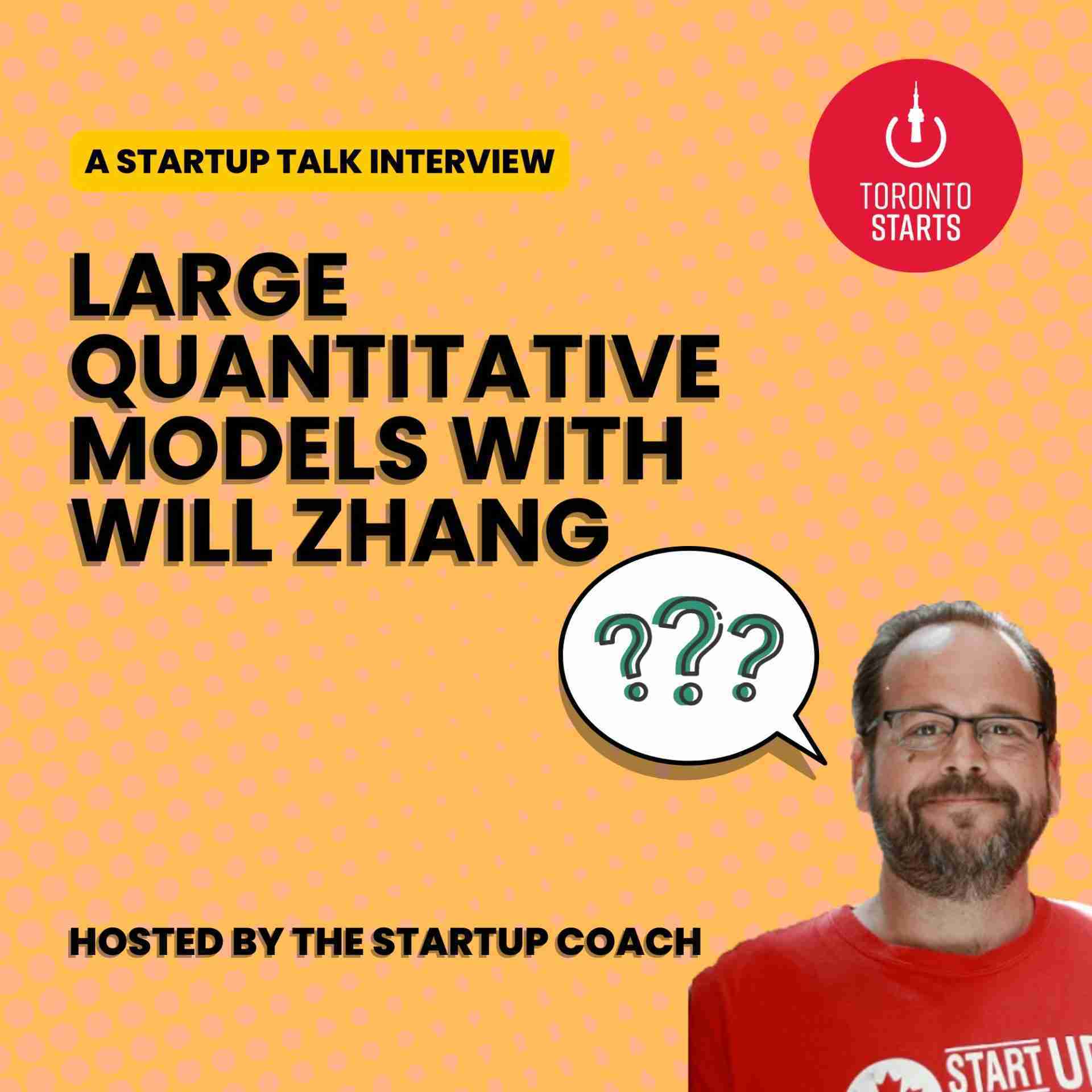
Large Quantitative Models with Will Zhang of Openhouse.ai
Large Quantitative Models with Will Zhang of Openhouse.ai In this insightful episode of the Startup Talk Podcast, The Startup Coach dives deep into the fascinating world of Large Quantitative Models with Will Zhang, the Co-founder of Openhouse.ai. Learn how these powerful tools are revolutionizing industries by enabling data-driven decision-making and predictive analytics. If you’re curious […]
A TorontoStarts podcast
Estimated reading time: 3 minutes
Large Quantitative Models with Will Zhang of Openhouse.ai
In this insightful episode of the Startup Talk Podcast, The Startup Coach dives deep into the fascinating world of Large Quantitative Models with Will Zhang, the Co-founder of Openhouse.ai. Learn how these powerful tools are revolutionizing industries by enabling data-driven decision-making and predictive analytics. If you’re curious about how large-scale data models are shaping the future of business, this episode is a must-listen.
Key Topics Discussed
- What are Large Quantitative Models, and why are they important?
- Practical applications of these models in the tech and real estate sectors.
- How Openhouse.ai leverages Large Quantitative Models to deliver cutting-edge solutions.
- Will Zhang’s journey in the tech industry and his vision for the future.
Meet the Guest: Will Zhang
Will Zhang, Co-founder of Openhouse.ai, brings a wealth of knowledge and experience in using advanced AI and data models to transform businesses. Connect with Will on LinkedIn.
About Openhouse.ai
Openhouse.ai is a leader in leveraging Large Quantitative Models to provide innovative solutions in real estate and beyond. Learn more about their work through their platforms:
What You’ll Learn in This Episode
- The foundational concepts behind Large Quantitative Models.
- Real-world examples of how businesses are implementing these models for success.
- Insights into the future of AI and data modeling from an industry expert.
Why Listen to This Episode?
Whether you’re an entrepreneur, a tech enthusiast, or a professional looking to stay ahead in the AI-driven world, understanding Large Quantitative Models is essential. This episode offers practical insights, actionable advice, and a deep dive into the strategies driving innovation today.
🎧 Listen to the full episode now to explore the power of Large Quantitative Models and gain inspiration for leveraging data in your own ventures!
Additional Links
• Silicon Scoop Podcast – Stay Informed, Stay Ahead!
• Futuretech Podcast – Explore more episodes and stay updated with the latest in technology and innovation.
• Startup Talk Podcast – https://torontostarts.com/startup-talk-toronto-startup-podcast/
• Who Are These Startups Podcast
• Startup Investor Drinks – Join the community and connect with fellow startup enthusiasts and investors.
• TorontoStarts Startup and Entrepreneur Community – Become a part of Toronto’s thriving startup ecosystem.
• Workhaus – Discover flexible workspace solutions for your business needs.
• Work with The Startup Coach – Get expert guidance and mentorship for your startup journey.
• Reach out to Jon Irwin on LinkedIn – Connect with our co-host and technology expert.
Ontario Startup Ecosystem Links
• Ontario’s Startup Ecosystem
• Startup Funding in Ontario
• Angel Investors in Ontario
• Ontario Incubators and Accelerators
• Venture Capital in Ontario: Top Firms, Sectors, and Funding Strategies
• Government Grants for Ontario Startups
• Ontario’s Startup Success Stories
• Ontario Centre of Innovation (OCI)
• Bank Loans and Financing for Startups in Ontario
• Research and Development Tax Credits in Ontario
• Government Loans and Financing for Startups in Ontario
• Equity Crowdfunding for Ontario Startups
• Toronto Entrepreneurs Resources
• Toronto’s Food and Beverage Entrepreneurs: Trends, Challenges, and Success Stories
• SEO Strategies for Toronto Entrepreneurs: Enhance Your Online Visibility
• Social Impact for Toronto Entrepreneurs: Starting and Running a Socially Responsible Business
• Toronto Arts and Media Entrepreneurs: Inspiring Profiles and Insights for Creative Success
• Exploring Toronto Green Tech Entrepreneurs: Innovators and Leaders in Sustainability
• Building a Team for Toronto Entrepreneurs: Strategies for Success
• A Guide for Toronto Food and Beverage Entrepreneurs
• Toronto Fashion and Retail Entrepreneurs: Trends, Opportunities, and Success Stories
Episode transcript
Read the full transcript
Speaker 0: one thing was interesting is, we are very deep in the, cutting and research, is that, current large language model, there's a lot of hallucination problem. and, that's actually what we are working very hard to solve that ourselves. that's why we call it large quantitative model. and if interest there, i can elaborate more about how do we actually see about embedding the physical phenomenon of the laws of physics into the language model. that's what we're working on right now for the home building industry.
Speaker 1: yeah. so i would love let's drill down on that in a bit. so you're calling your it's not a large language model. you're calling it again a what?
Speaker 0: a large quantitative model. quantitative model. and
Speaker 1: to reduce, the hallucinations, you're putting physics into this model?
Speaker 0: yeah. so it's the cutting edge challenge is actually how do we make it has reasoning capability. how do you bound the constraint into the system to say it has to follow this rule? i'll use a simple example. in the newtonian physics, right, so this, second law of motion, we know that f equals m a, which, like, the new new newtonian, discovery actually set the foundation of modern physical world leading to all this great discovery. and the second law of motion says, force equals mass multiple by acceleration, meaning something moving, you have to apply as the force to get it going, or you have to apply as force to make it stop. sounds trivial and obvious today. but for the last ten thousand years of history, mankind, this is only found only four hundred years ago. so they're not that far away if you look at the time horizon. the second thing is actually not trivial is that for newton to understand this acceleration, he had to invent calculus to do that. so if you think about llm, large language model, it's almost like the new invention of calculus. so that's actually tremendously powerful so that we can discover those new phenomenon. but one challenge in large language model is that it does not understand the causal relationship. meaning, you can easily just mathematically change your formula to say, well, you know what? if i can, increase the force or reshoot acceleration purely by just looking at math, i can change the mass because because mass equals f divided by a. right? so, oh, if i get more mass without changing acceleration sorry. if i give more forces without changing acceleration, then the thing will get heavier. that's what human is nonsense, but from mathematical standpoint, a large language model do not understand it. it's actually as far as the causal relationship to the acceleration. so that's actually what we're working very hard to actually think about deploying large language model to a industry that actually moving dirt, building houses in a physical environment that you are governed by the laws of physics. and that's why we realized that if we basically need to teach your algorithm that math is something that you do not change. it's the force that cause acceleration to change. and that's actually those are phenomena we basically need to feed into the language model before and after, and actually have this physical, loss of basic bounding the, the large language language model to make it applicable for this industry. and, that's actually got it very exciting about how do we also be part of advancing the technology development as well.
Speaker 1: it sounds very interesting. you know, when you're training large language models, oftentimes, you're you're fielding, feeding it a scenario and then a solution, a correct solution, a wrong solution, whatever, on these tables to train it. how do you train it, to understand that this formula equals the amount of physical dirt you have to move. like, it's a thing that's a leap for lack of a
Speaker 0: yeah. so that's actually of course, like, we do not have unlike openai or entropic, we don't have billions of dollars to spend to build our foundation model. we basically take advantage of existing large language model, also taking some open source model. and what is open source model by absorbing the data from internet in their latent feature, essentially, they build a understanding or abstraction of the world. so that allow it actually to create new solution in inference time. so, of course, when we feed data into it, we feed data by providing some like, for example, like, we say, hey. math is something you cannot change. we feed those into the model. but then when they're coming out, we then deploy tons of classical machine learning approach, layer on top of that to basically do optimization theory. so there's a field that is actually not typically you can put it as part of ai. some people might not. there's a field that's actually called operational research. it's how do you minimize or maximize the objective function. like, basically, for example, minimize the cost or maximize the, profit of the business or maximize the utility of a resource with constraint. and those constraint are the physical law the laws of physics. and, also, when there are uncertainty, how do we play out to know if this situation, what would happen? if the other situation, what would happen? when we're making decision under uncertainty, we use a lot of monte carlo simulation technique which involve a lot of volume compute, but very different compute compared to, and so we do a lot of things before and by basically wrapping large language model. but on top of that, which is not just wrapping it, we put layers of or more classical machine learning model that actually injecting the physical, physical phenomena into the technology to help them to make better decision.
Speaker 1: and here's another question. just again, i'm looking on the outside coming in my mind. when you say math doesn't change, you know, i don't know if that's actually true. and when i say that, i'll i'll explain that in a second.
Speaker 0: if you're looking
Speaker 1: at a scenario, say, i gotta move this volume of dirt. k? yeah. if it's clay, the mass might be different. if it's wet dirt, the mass might be different. if it's dry dirt, it might be different. if it's so how do you explain that to, say, a computer ai model? because the math actually doesn't change, but the environment changes enough that the formula math actually changes because of it.
Speaker 0: oh, abs i was more referring to that analogy, more like, well, for example, you can say, hey. like, you can make a demand protection, but the demand doesn't go negative. for example, like, in but the mathematic would say, oh, allow you to put negative view. paste now, put boundary into math model, but that actually all of a sudden. it's more like math now. it's not a continuous function. so that caused a lot of math just immediate breakdown. so your question is how do we feed that in is basically that's where it's actually in the post processing of the language model after you actually extract it out. so in input, we basically say, these are the phenomena that you have to be grounded in the input. in the training dataset, we actually also do a ton of feature engineering to basically bias the data intentionally to certain distribution. that's actually in the early days, the rgfl technique for large language model, how do they train? it's almost like, i'm gonna use another analogy to explain it. the internet might have a lot of cat information, a lot of cute cat. but if you want to ask a lot of language model, what's the most common picture you will see in the world? they might spit out as cat. so so how do you actually correct that? it's actually you re you you rebias those information back to the phenomena you know is governed by the laws of physics. so that's in the input phase. but on the output, then when the outcome is actually go reach beyond those laws of physics, we basically then kick in other machine learning technique to say, well, that's the outcome that we're gonna reject. there's a lot of governance. there's a lot of guidance. there's a lot of checks and balance around those to basically eliminate the obvious problem. and then the second layer is now we deploy simulation to understand the sensitivity exposure of such decision. how much risk are we actually talking about? so, it's getting a bit more deeply into the mathematic, but it's before and after, you basically put those rules and balance and policy around it so they make the right decision for people.
Speaker 1: i'm always fascinated about, you know, how this is done and how different companies are mhmm. are training ai and this large quantitative model versus, say, small language models and large language models and how everyone's having a different approach and now large action models that are out there. it's really nice to see, you know, how all these agents and things are coming into play.
More from Startup Talk
All episodes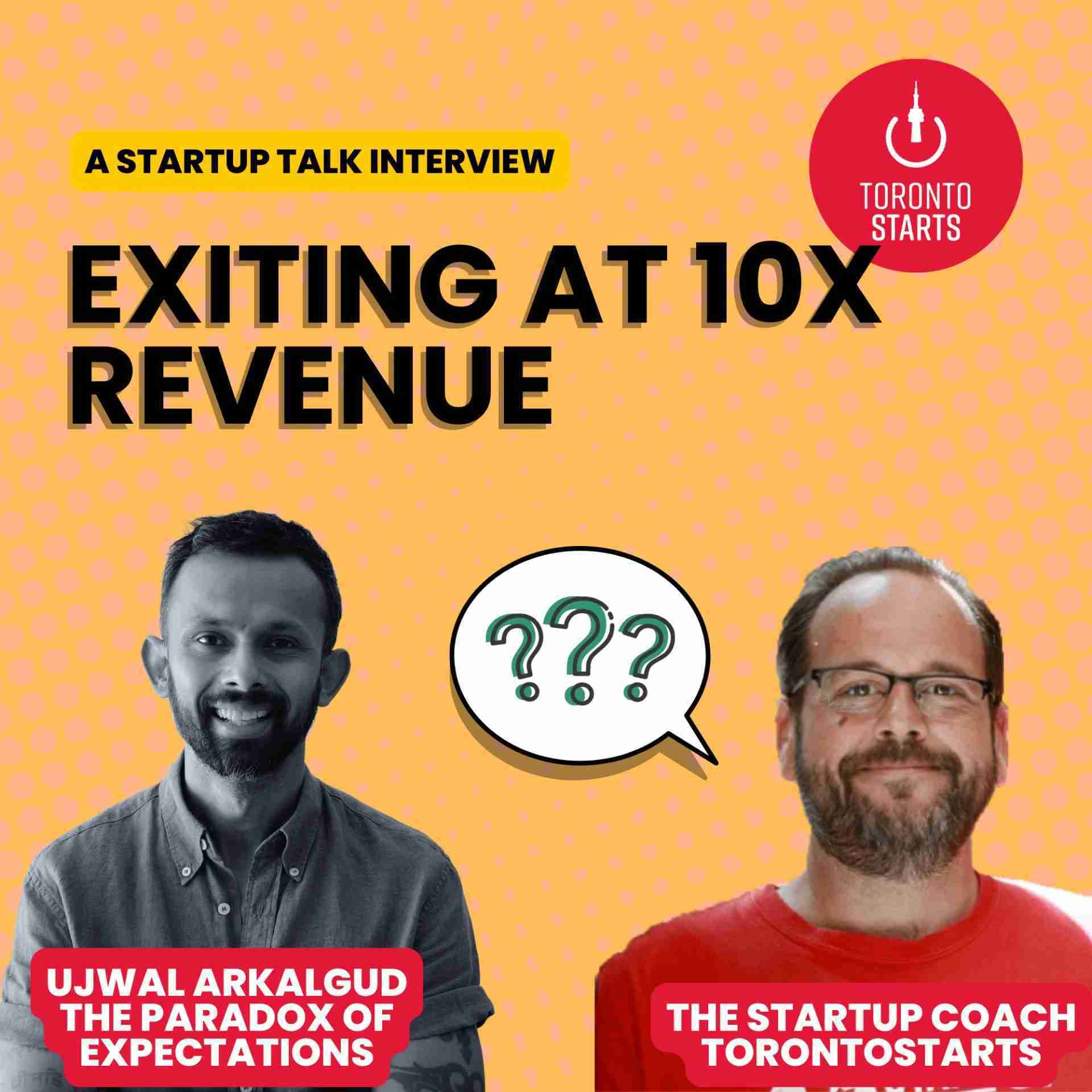
startup-talk · April 10, 2025
10x Revenue Exit
Discover actionable insights for achieving a 10x Revenue Exit through strategic scaling, profitability, and smart bootstrapping. https://torontostarts.com/2025/04/10/10x-revenue-exit/ Apple -> https://podcasts.apple.com/us/podcast/startup-talk/id1763804003 Spotify -> https://open.spotify.com/show/1siJMILILidHAiAsrX2VBU YouTube: https://youtube.com/playlist?list=PLj4v-RoA7A-jxV5FHs5e61oIsuvUJYmT_&si=LYegRe5GYLKNQ7xL Flowgrammer Apple -> https://podcasts.apple.com/us/podcast/flowgrammer-podcast/id1804155588 Spotify -> https://open.spotify.com/show/0wv3feR00iaVpE8zn7niNf Flowgrammer.ca -> https://flowgrammer.ca/ AI News and Resources -> https://flowgrammer.ca/resources/ Silicon Scoop Silicon Scoop Podcast - https://torontostarts.com/silicon-scoop/ Apple: https://podcasts.apple.com/us/podcast/silicon-scoop/id1758711826 Spotify: https://open.spotify.com/show/5bAzF0MwV6TtLhJAhvHayI YouTube: https://www.youtube.com/playlist?list=PLj4v-RoA7A-gT62vrEYqh1zCv-0Hj-o5J Startup Investor Drinks Toronto - https://startupdrinksto.com/ Toronto’s Startup Community - https://torontostarts.com/
View episode

startup-talk · April 8, 2025
Product Market Fit with Lauft
Product Market Fit with Lauft Welcome to Episode 217 of the Startup Talk Podcast, where we explore Product Market Fit in a conversation with Graham Wong, Founder and CEO of Lauft. Listen in as the Startup Coach uncovers how Lauft transformed a personal need into a thriving flexible workspace solution and discovered exactly what their […]
View episode
startup-talk · April 6, 2025
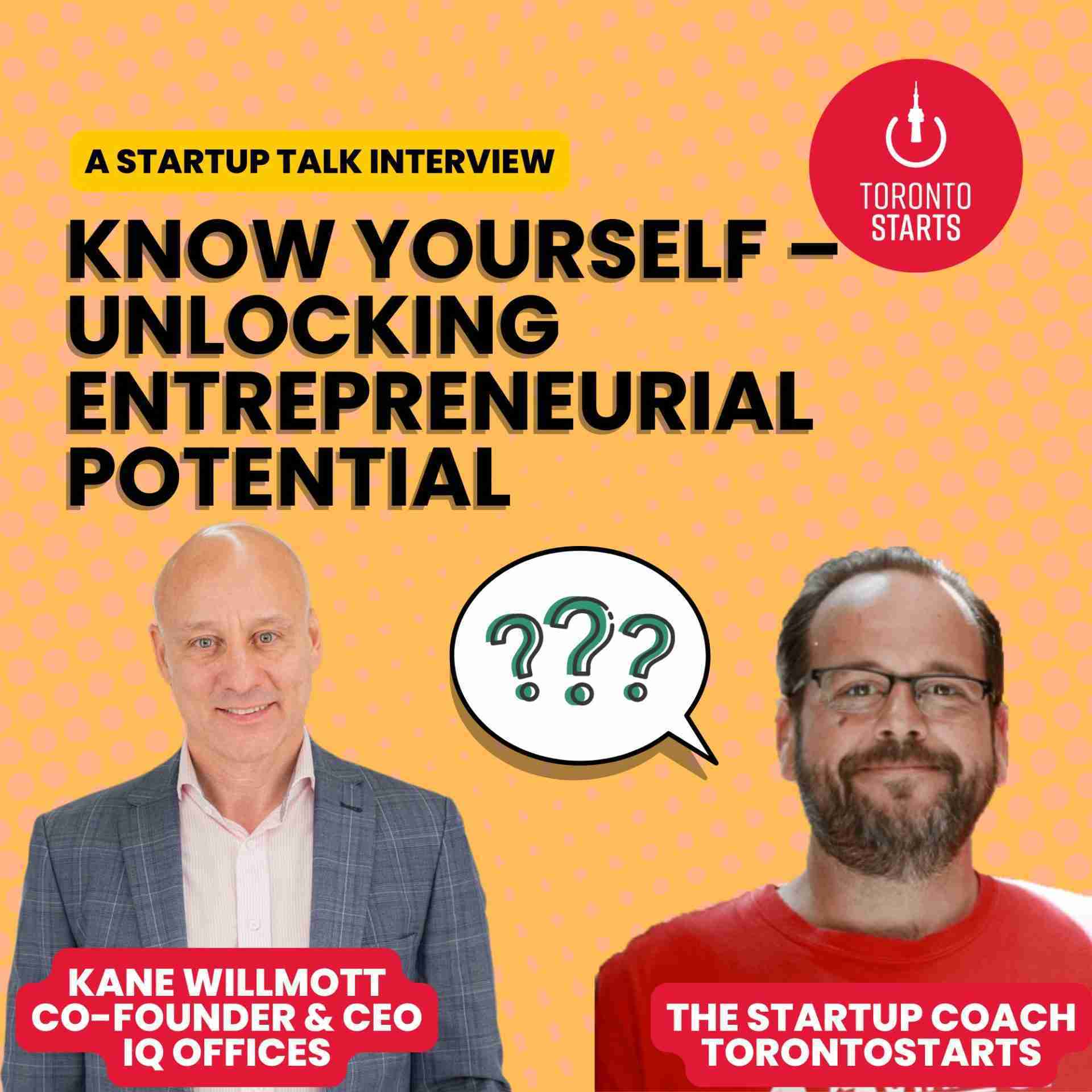
Know Yourself – Unlocking Entrepreneurial Potential
Discover how to Know Yourself as an entrepreneur to unlock your potential and overcome challenges in today's startup world. https://torontostarts.com/2025/04/06/know-yourself-unlocking-entrepreneurial-potential/ Apple -> https://podcasts.apple.com/us/podcast/startup-talk/id1763804003 Spotify -> https://open.spotify.com/show/1siJMILILidHAiAsrX2VBU YouTube: https://youtube.com/playlist?list=PLj4v-RoA7A-jxV5FHs5e61oIsuvUJYmT_&si=LYegRe5GYLKNQ7xL Flowgrammer Apple -> https://podcasts.apple.com/us/podcast/flowgrammer-podcast/id1804155588 Spotify -> https://open.spotify.com/show/0wv3feR00iaVpE8zn7niNf Flowgrammer.ca -> https://flowgrammer.ca/ AI News and Resources -> https://flowgrammer.ca/resources/ Silicon Scoop Silicon Scoop Podcast - https://torontostarts.com/silicon-scoop/ Apple: https://podcasts.apple.com/us/podcast/silicon-scoop/id1758711826 Spotify: https://open.spotify.com/show/5bAzF0MwV6TtLhJAhvHayI YouTube: https://www.youtube.com/playlist?list=PLj4v-RoA7A-gT62vrEYqh1zCv-0Hj-o5J Startup Investor Drinks Toronto - https://startupdrinksto.com/ Toronto’s Startup Community - https://torontostarts.com/
View episode