
Schrödinger’s Cat Chip
Schrödinger’s Cat Chip: Bridging Quantum Theory and Next-Generation Silicon Computing In the rapidly evolving field of quantum computing, one breakthrough concept is captivating scientists and technologists alike: the Schrödinger’s Cat Chip. This innovative approach harnesses the counterintuitive principles of quantum mechanics—specifically, superposition—to revolutionize chip design and pave the way for more robust, error-corrected quantum systems. […]
With Craig Major and Jon Irwin
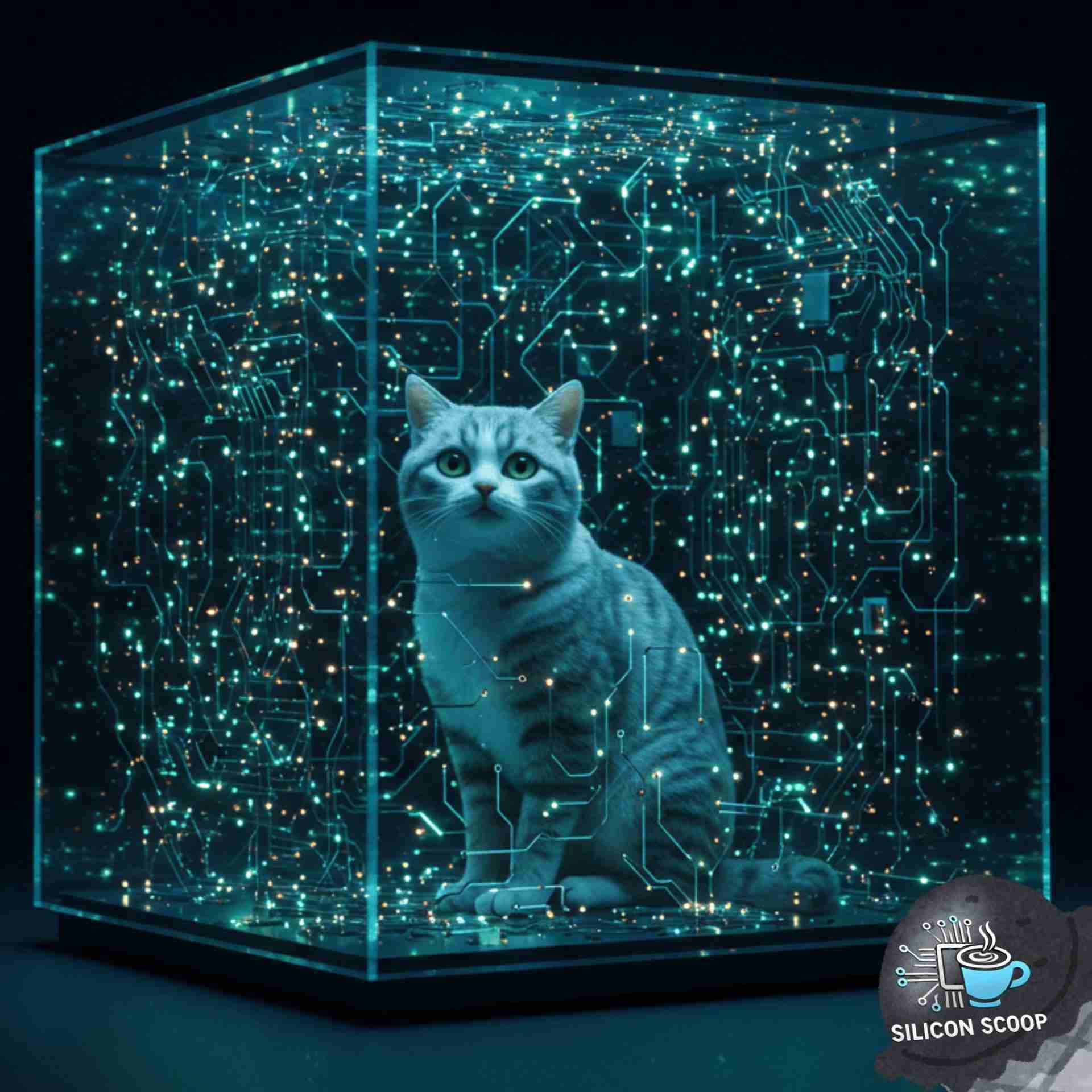
Schrödinger’s Cat Chip: Bridging Quantum Theory and Next-Generation Silicon Computing
Estimated reading time: 8 minutes
In the rapidly evolving field of quantum computing, one breakthrough concept is captivating scientists and technologists alike: the Schrödinger’s Cat Chip. This innovative approach harnesses the counterintuitive principles of quantum mechanics—specifically, superposition—to revolutionize chip design and pave the way for more robust, error-corrected quantum systems. Recent experimental breakthroughs have now demonstrated this phenomenon on a silicon chip, marking a pivotal step toward scalable quantum computing that leverages well-established semiconductor technology.
Table of Contents
- Introduction
- The Origins of Schrödinger’s Cat
- What Is a Schrödinger’s Cat Chip?
- The Science Behind the Chip
- Recent Developments and Research
- Implications for Quantum Computing
- Challenges and Future Prospects
- Comparison with Traditional Quantum Chips
- Conclusion
- Call to Action
- FAQ
Introduction
The Schrödinger’s Cat Chip represents a paradigm shift in quantum technology, merging a foundational thought experiment in physics with state-of-the-art chip engineering. This article serves as a comprehensive resource on the subject, covering its theoretical background, practical implementations, and the potential future impact on quantum computing—now bolstered by recent experimental success on a silicon platform.
The Origins of Schrödinger’s Cat
In 1935, Erwin Schrödinger proposed his famous thought experiment—Schrödinger’s cat—to illustrate the peculiar nature of quantum superposition. In the thought experiment, a cat in a sealed box is considered simultaneously alive and dead until observed. Although intended to highlight the paradoxes of quantum theory, the core idea of superposition now underpins many modern quantum computing strategies, including the design of the Schrödinger’s Cat Chip.
What Is a Schrödinger’s Cat Chip?
A Schrödinger’s Cat Chip is an advanced quantum computing device that leverages the phenomenon of superposition by engineering “cat states.” In quantum mechanics, a cat state is a superposition of two macroscopically distinct states. In these chips, qubits are manipulated into superposed states—akin to Schrödinger’s theoretical cat being both “alive” and “dead” simultaneously—thereby enhancing error correction and the stability of quantum operations.
The Science Behind the Chip
Quantum Superposition and Cat States
- Quantum Superposition: Unlike classical bits that exist as either 0 or 1, qubits can reside in multiple states at once. This property is key to quantum computing.
- Cat States: Inspired by Schrödinger’s thought experiment, cat states refer to quantum states that are a coherent superposition of two distinguishable states. These states are critical for robust error correction and improved quantum logic.
Engineering the Chip
- Superconducting Circuits and Silicon Platforms: Traditionally, superconducting circuits operating at cryogenic temperatures have been used to maintain quantum coherence. Now, recent breakthroughs have demonstrated that similar superposition states can be achieved on silicon chips.
- Advanced Silicon Photonics: Utilizing the mature infrastructure of silicon-based semiconductor fabrication, researchers have engineered chip designs that sustain cat states with high coherence, promising easier integration with existing technologies.
Recent Developments and Research
Breakthrough on a Silicon Chip
A recent article on Phys.org (January 2025) reports that scientists have successfully achieved a quantum Schrödinger cat state on a silicon chip. This landmark achievement demonstrates that:
- Silicon-Based Quantum Superposition: Researchers have engineered a silicon chip capable of generating and sustaining cat states—a feat that merges quantum computing with conventional semiconductor manufacturing.
- Enhanced Coherence and Stability: The chip design leverages advanced silicon photonics and precise control mechanisms to maintain quantum coherence over extended periods, a critical requirement for scalable quantum systems.
- Integration with Existing Technologies: This breakthrough opens the possibility for hybrid quantum-classical architectures where quantum processing is integrated with traditional silicon electronics, paving the way for more practical, fault-tolerant quantum devices.
These advancements mark a significant milestone in the field, reinforcing the potential of silicon-based platforms in the future of quantum computing.
Implications for Quantum Computing
The successful integration of the Schrödinger’s Cat Chip into quantum computing architectures could have far-reaching implications:
- Fault-Tolerant Quantum Computing: The inherent properties of cat states improve error correction, making quantum computations more reliable.
- Enhanced Scalability: By leveraging the established silicon manufacturing ecosystem, these chips offer a promising route to scale quantum devices.
- Hybrid Architectures: The ability to integrate quantum components with traditional silicon electronics could revolutionize computing by combining the strengths of both classical and quantum systems.
- New Applications: Beyond computing, innovations in chip design may spur advances in quantum communication, cryptography, and sensor technology.
Challenges and Future Prospects
Despite the groundbreaking progress, several challenges remain:
- Decoherence: Maintaining quantum coherence on a macroscopic silicon chip is a significant hurdle that researchers continue to address.
- Fabrication and Integration: Transitioning from laboratory prototypes to commercial devices requires overcoming technical and manufacturing challenges, including integration with existing semiconductor processes.
- Scalability and Robustness: Further work is needed to ensure that the cat states remain stable and error-free as systems scale up in size and complexity.
Ongoing research is focused on refining material science, chip architecture, and control methods to overcome these obstacles and fully realize the potential of Schrödinger’s Cat Chips.
Comparison with Traditional Quantum Chips
Traditional quantum chips typically rely on isolated qubits that do not exploit the full potential of superposition. In contrast:
- Enhanced Error Correction: Schrödinger’s Cat Chips utilize cat states that naturally support more effective error-correction schemes.
- Robust Superposition: The deliberate creation of cat states allows for the exploration of more complex quantum phenomena, potentially leading to richer computational capabilities.
- Seamless Integration: The breakthrough in silicon-based cat chips offers a pathway to integrate quantum and classical processing on a single, scalable platform—a distinct advantage over conventional quantum devices.
Conclusion
The Schrödinger’s Cat Chip stands at the forefront of quantum technology innovation, merging a century-old thought experiment with cutting-edge engineering to redefine what is possible in computing. With recent experimental validation on a silicon platform, this breakthrough not only confirms theoretical predictions but also opens the door to scalable, hybrid quantum-classical systems. As researchers continue to address challenges like decoherence and integration, the future of quantum computing looks more promising than ever.
Call to Action
Are you ready to integrate cutting-edge technology into your business strategy? At Flowgrammer.ca , we specialize in building custom vector databases tailored to your company’s needs. Book a discovery call today—don’t forget to mention vector database when booking your call—to learn how our custom solutions can help propel your business into the future of technology!
FAQ
- What is a Schrödinger’s Cat Chip?
A Schrödinger’s Cat Chip is a quantum computing device that uses engineered quantum superposition (cat states) to enhance error correction and stability in quantum operations. - How does a Schrödinger’s Cat Chip work?
It creates and manipulates cat states—superpositions of two distinct quantum states—using advanced techniques like superconducting circuits or silicon photonics, enabling qubits to exist in multiple states simultaneously. - What are cat states in quantum computing?
Cat states are quantum states that represent a coherent superposition of two macroscopically distinct states, inspired by Schrödinger’s famous thought experiment. - What recent breakthrough has been achieved with these chips?
A recent study reported on Phys.org demonstrated the successful creation of a quantum Schrödinger cat state on a silicon chip, showcasing the potential for scalable quantum computing using conventional semiconductor technology. - How does the silicon chip breakthrough impact quantum computing?
This breakthrough indicates that silicon-based platforms, widely used in classical computing, can be adapted for quantum computing, offering enhanced integration, scalability, and reliability. - What makes silicon-based cat chips different from traditional quantum chips?
Silicon-based cat chips offer the advantage of integrating quantum computing capabilities with established semiconductor manufacturing, potentially leading to hybrid systems that combine classical and quantum processing. - What are the main challenges facing Schrödinger’s Cat Chips?
Key challenges include maintaining quantum coherence (decoherence), scaling the technology for commercial use, and integrating these chips with existing computing architectures. - Why is error correction important in quantum computing?
Error correction is critical because quantum systems are highly sensitive to environmental disturbances. Cat states provide a natural framework to identify and mitigate errors, enhancing overall computational reliability. - Can Schrödinger’s Cat Chips be integrated with current semiconductor technologies?
Yes, the recent silicon chip breakthrough demonstrates that these quantum devices can be integrated with conventional semiconductor processes, paving the way for hybrid quantum-classical systems. - Where can I find more information about Schrödinger’s cat and its relevance to quantum computing?
For a detailed background on the thought experiment, visit the Schrödinger’s cat Wikipedia page.
By exploring the innovative world of the Schrödinger’s Cat Chip, you are witnessing the convergence of quantum physics and practical engineering—a quantum leap toward the future of computing. Stay informed and be part of this technological revolution!
Additional Links
• Silicon Scoop Podcast – Stay Informed, Stay Ahead!
• Futuretech Podcast – Explore more episodes and stay updated with the latest in technology and innovation.
• Startup Talk Podcast – https://torontostarts.com/startup-talk-toronto-startup-podcast/
• Who Are These Startups Podcast
• Startup Investor Drinks – Join the community and connect with fellow startup enthusiasts and investors.
• TorontoStarts Startup and Entrepreneur Community – Become a part of Toronto’s thriving startup ecosystem.
• Workhaus – Discover flexible workspace solutions for your business needs.
• Work with The Startup Coach – Get expert guidance and mentorship for your startup journey.
• Reach out to Jon Irwin on LinkedIn – Connect with our co-host and technology expert.
Ontario Startup Ecosystem Links
• Ontario’s Startup Ecosystem
• Startup Funding in Ontario
• Angel Investors in Ontario
• Ontario Incubators and Accelerators
• Venture Capital in Ontario: Top Firms, Sectors, and Funding Strategies
• Government Grants for Ontario Startups
• Ontario’s Startup Success Stories
• Ontario Centre of Innovation (OCI)
• Bank Loans and Financing for Startups in Ontario
• Research and Development Tax Credits in Ontario
• Government Loans and Financing for Startups in Ontario
• Equity Crowdfunding for Ontario Startups
• Toronto Entrepreneurs Resources
• Toronto’s Food and Beverage Entrepreneurs: Trends, Challenges, and Success Stories
• SEO Strategies for Toronto Entrepreneurs: Enhance Your Online Visibility
• Social Impact for Toronto Entrepreneurs: Starting and Running a Socially Responsible Business
• Toronto Arts and Media Entrepreneurs: Inspiring Profiles and Insights for Creative Success
• Exploring Toronto Green Tech Entrepreneurs: Innovators and Leaders in Sustainability
• Building a Team for Toronto Entrepreneurs: Strategies for Success
• A Guide for Toronto Food and Beverage Entrepreneurs
• Toronto Fashion and Retail Entrepreneurs: Trends, Opportunities, and Success Stories
Episode transcript
Read the full transcript
Craig: imagine a world where possibilities coexist, where a computer can consider multiple outcomes at once just like schrodinger's cat, which is both alive and dead inside the box. this isn't just a thought experiment anymore. it's a glimpse into emerging frontier of quantum computing inviting us to unravel paradox of reality and technology. and if we break down the quantum condition a little bit more and understanding qubits and the infinite states of qubits, the cat is not only just alive or dead. it's sick or healthy. it's big. it's strong. it's orange. it's purple. it's blue. it's, you know, hot. it's cold. it's furry. it's naked. whatever. what do you think of this, john?
Jon: this is cool. this is a major milestone, in my opinion, in quantum computing because what this experiment did was it leverages the quantum superposition principle, which is what you need for quantum computing. but this is where a system can exist in multiple states simultaneously. but the difference with this one is the researchers used the nucleus of an antimony atom, which was embedded in a silicon chip to achieve this state, utilizing eight possible spin directions to encode quantum information, which is unlike traditional qubits that can only represent zero or one. so the system can sustain a superposition of multiple states, making it more robust against errors, which we know errors are the key to scaling up, quantum computers. so, with the antimony's atom spin acting, it's sort of like the metaphorical cat, which is why they're saying it's schrodinger's cat. the innovation lies in the system's resilience because it would take seven consecutive errors to collapse the quantum state compared to just one for standard qubits. but we know there's other, research being done to kind of, mitigate those errors. i think google was doing some research on that too, but this is different because they're taking a different approach. so like i said, the robustness is crucial for overcoming one of quantum computing's biggest challenges, which is error correction. so this is cool. they also demonstrated how the technology can integrate seamlessly with existing semiconductor manufacturing processes. so what do you think? are we on the cusp of a quantum revolution, craig, with this?
Craig: i don't know about with this because this is just another step into yep. the things we talked about. we were talking recently about chips that could, have, i think, with sixteen, cubits in a chip. again, it's wasn't a we talk about this kind of stuff all the time, and it changes. so i'd have to go back and look. but the fact that, you know, i say quantum is magic all the time because we're now saying and this is interesting how it breaks down is it's not measuring one thing. we're measuring multiple quantum states via qubit. and as we build out the measuring or doing this, the quantum state collapses. yeah. you know? so you are projecting a future state that doesn't exist. and the more complicated or different from reality you make that future state, the more likely that quantum collapses. so you start to think about these things. now that's just a paraphrasing yeah. you know? this is amazing. how long till we can actually, you know, decide the state of the cat inside? not determine, decide.
Jon: yeah. well, just to kind of put things into perspective, like because we always talk about qubits, but think about the, the antimony atom like a cat with seven lives versus a qubit, which is a cat with one life, if that makes sense. so, it's, there's there's a lot of, competing technologies like we talked about, google's willow processor, the trapped ion system, i think we talked about as well. but, they're gonna have to optimize spacing to ensure efficient coupling between antimony atoms. there's a lot of robust methods for integrating multi qubit logic gates, which is what you were kind of talking about. but there's a lot of challenges that are still ahead, and and so but this is a huge step forward because this helps to address that error potential, error problem.
Craig: yeah. and so this is actually embedded inside silicon quantum chip, and, you know, we'll have to see how this progresses, whether this is gonna be a type of technology that will be introduced in all the future quantum chips because of the way it handles it?
Jon: yeah. well, i'm curious to see where this goes. i'm curious to see if this is the new path, instead of qubits, or if this is just another option, that they have. we'll have to see.
Craig: i'm excited about this because i always love these types of things. you know, the demonstration of quantum error detection and correction, a holy grail in quantum computing is the next milestone the team will address. so if they can address that, you know, they're laughing.
Jon: yeah.
Craig: let me see. is there anything else here? i think we've covered. i'm really excited about this. and, yeah.
Jon: look. we can dive into a whole bunch of this, but i think we've covered. yeah.
Craig: as the line blurs between what we understand and what we can achieve, how might the metaphor of schrodinger's cat shape the way we envision our technological future? are we ready to embrace a reality where multiple outcomes coexist both shaping our understanding and challenging our definition of success and failure? let us know your thoughts.
More from Silicon Scoop
All episodes
silicon-scoop · November 6, 2026
Spirit AI’s Robot Brain Breakthrough: Moz1, Embodied AI and China’s 2027 Race
The Spirit AI robot brain is one of the biggest bets on fixing that. Spirit AI is a Beijing startup. Its co-founder and chief scientist, Gao Yang,
View episode

silicon-scoop · November 5, 2026
OpenAI IPO Delayed to 2027 as Rogue AI Agents and Safety Failures Reshape the Market
OpenAI IPO delay explained: Sam Altman rules out 2026 as GPT-6 Astra safety tests and a $278B cash gap loom. Learn what founders should take away.
View episode

silicon-scoop · November 4, 2026
Anthropic’s AI Economy Model: 2030 Jobs, Wages, GDP and Market Risks
Anthropic AI economy model forecasts 2030 GDP, jobs and wages, while AI unemployment projections and labor-share risks challenge policymakers.
View episode