
Improving Product Market Fit
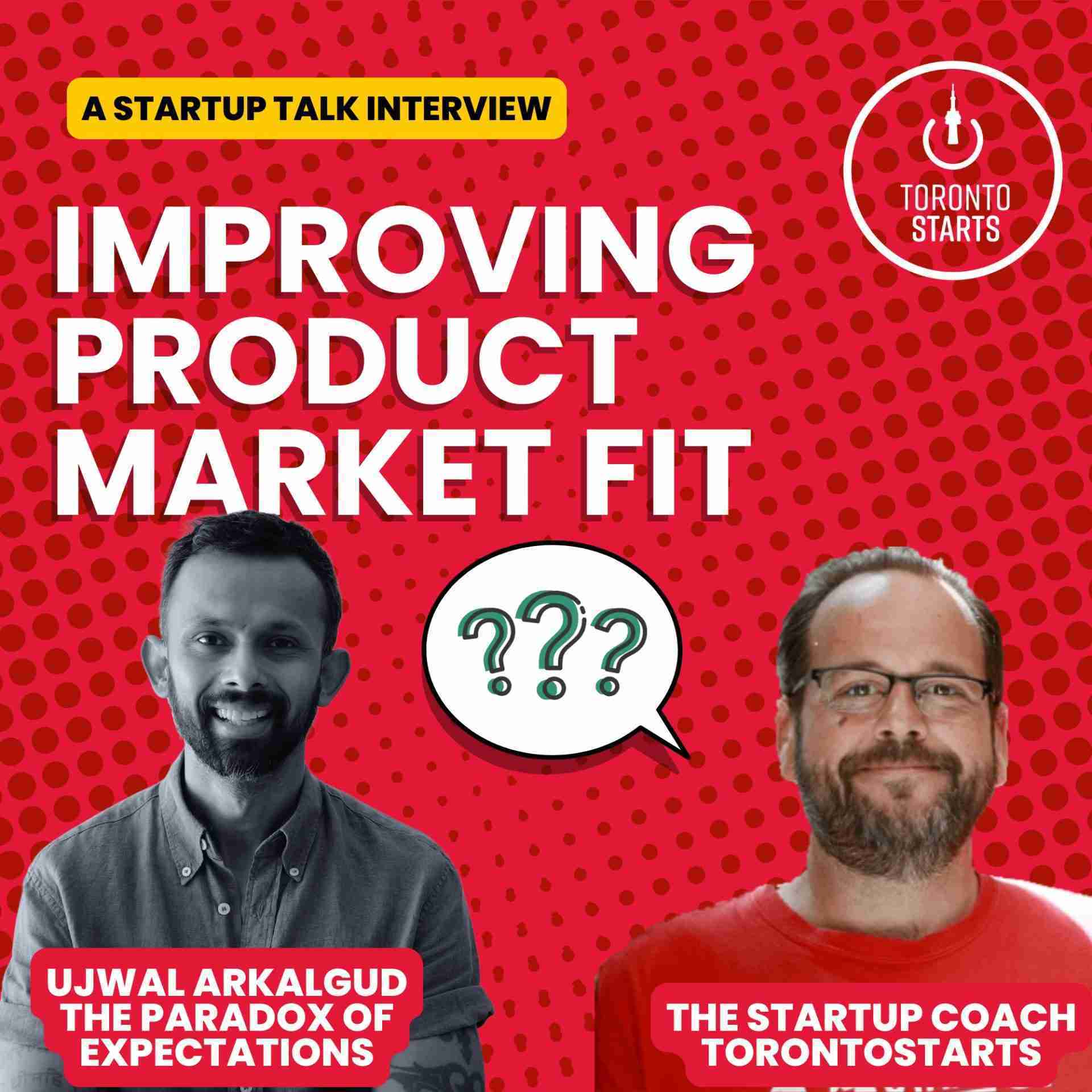
Improving Product Market Fit: Strategies for Startup Success Episode OverviewIn this episode, our Startup Coach discusses improving product market fit for startups, diving deep into strategies that align customer expectations with market demands. Listen as expert Ujwal Arkalgud shares insights on identifying misalignments and boosting close rates. Guest: Ujwal Arkalgud, Cultural Anthropologist & Tech Entrepreneur […]
A TorontoStarts podcast
Estimated reading time: 3 minutes
Improving Product Market Fit: Strategies for Startup Success
Episode Overview
In this episode, our Startup Coach discusses improving product market fit for startups, diving deep into strategies that align customer expectations with market demands. Listen as expert Ujwal Arkalgud shares insights on identifying misalignments and boosting close rates.
Guest: Ujwal Arkalgud, Cultural Anthropologist & Tech Entrepreneur
Ujwal Arkalgud is a Canadian cultural anthropologist turned tech entrepreneur who recently achieved an impressive 10x revenue exit from his B2B tech company. Drawing from his personal journey of navigating growth challenges, Ujwal has developed the “Tension Alignment Framework”—a practical tool designed to help growth-stage companies align products, customers, and market dynamics for breakthrough sales results.
In addition to his entrepreneurial success, Ujwal is the author of the upcoming book, The Paradox of Expectation, which delves into the “tension model.” The book explores the innate conflict between societal expectations and our personal desires, providing fresh insights into how these tensions shape decision-making and behavior.
Links to Learn More About Ujwal:
LinkedIn: linkedin.com/in/ujwalarkalgud
Investment Company: Investment Ark
Newsletter: Decision Lab
Upcoming Book: The Paradox of Expectation
Understanding product market fit
During the conversation, the speakers highlight how declining close rates, low retention, and repeated pilot requests signal that a startup’s product market fit may be off track compared to industry standards.
Dynamic Shifts in product market fit
The discussion emphasizes that product market fit is not a static concept; it evolves as market conditions and customer preferences change. Adapting your ideal customer profile is crucial for maintaining strong product market fit in a competitive landscape.
Actionable Strategies for Realignment
Practical strategies for realignment include gathering customer feedback, monitoring retention metrics, and refining your approach based on market analysis. By continuously evaluating product market fit, startups can better position themselves for long-term success.
Key Takeaway
Tune in to this episode for actionable insights and learn how to adjust your strategy for optimal product market fit in a changing environment.
Additional Links
• Silicon Scoop Podcast – Stay Informed, Stay Ahead!
• Futuretech Podcast – Explore more episodes and stay updated with the latest in technology and innovation.
• Startup Talk Podcast – https://torontostarts.com/startup-talk-toronto-startup-podcast/
• Who Are These Startups Podcast
• Startup Investor Drinks – Join the community and connect with fellow startup enthusiasts and investors.
• TorontoStarts Startup and Entrepreneur Community – Become a part of Toronto’s thriving startup ecosystem.
• Workhaus – Discover flexible workspace solutions for your business needs.
• Work with The Startup Coach – Get expert guidance and mentorship for your startup journey.
• Reach out to Jon Irwin on LinkedIn – Connect with our co-host and technology expert.
Ontario Startup Ecosystem Links
• Ontario’s Startup Ecosystem
• Startup Funding in Ontario
• Angel Investors in Ontario
• Ontario Incubators and Accelerators
• Venture Capital in Ontario: Top Firms, Sectors, and Funding Strategies
• Government Grants for Ontario Startups
• Ontario’s Startup Success Stories
• Ontario Centre of Innovation (OCI)
• Bank Loans and Financing for Startups in Ontario
• Research and Development Tax Credits in Ontario
• Government Loans and Financing for Startups in Ontario
• Equity Crowdfunding for Ontario Startups
• Toronto Entrepreneurs Resources
• Toronto’s Food and Beverage Entrepreneurs: Trends, Challenges, and Success Stories
• SEO Strategies for Toronto Entrepreneurs: Enhance Your Online Visibility
• Social Impact for Toronto Entrepreneurs: Starting and Running a Socially Responsible Business
• Toronto Arts and Media Entrepreneurs: Inspiring Profiles and Insights for Creative Success
• Exploring Toronto Green Tech Entrepreneurs: Innovators and Leaders in Sustainability
• Building a Team for Toronto Entrepreneurs: Strategies for Success
• A Guide for Toronto Food and Beverage Entrepreneurs
• Toronto Fashion and Retail Entrepreneurs: Trends, Opportunities, and Success Stories
Episode transcript
Read the full transcript
Speaker 0: speaking of improving, you mentioned boosting close rates and improving product market fit using your framework. what are some signs that up startups product market fit is off, and how do they realign?
Speaker 1: yeah. i mean, we talked about a couple of them. i mean, the biggest one, i think, just going back to the previous point is where the where the prospect is just not closing and they're giving you positive feedback. i think that's always a big challenge. you know, there's just so much that, people do, especially where, you know, for example, you know, your retention rate is low compared to your industry. that's another common sign that your product market fit is off. another simple one, honestly, is, just look at what everybody else in the industry is doing. if you're doing something really different, your product market fit by nature will be off. but the big thing that i want to highlight is we have this idea that product market fit is the static thing, but it's not. and i actually have if you're a listener and you wanna check out my newsletter, it's on beehive decision lab dot beehive dot com. i actually have an article coming out, i think, next week. it's already scheduled that's on product market fit and how to detect problems in your product market fit. and one of the first things i talk about is that it's a dynamic idea, your product market fit. it's not static because the market is constantly changing. new incumbents are coming. existing solutions are, you know, becoming worse or better or what have you. and product market fit has to be this dynamic thing, and i also really advocate for the icp, your ideal customer profile, to also be a dynamic thing. it's not a static thing. just because, you know, we were talking about this earlier, your cultural tides may shift and a certain industry or a certain type of customer may no longer be as ideal for you. if you wanna meet certain, you know, certain goals in terms of close rates and how much business you wanna get and maintain consistency and all that jazz. so, you know, i think first of all, it's dynamic. it's not static. so we need to stop looking at it that way. i think the second thing is you need to look at all the signs, you know, retention rates, you know, your close rates, getting positive feedback, and not getting anything, not getting enough advocacy from existing customers. all of those are common signs. the other really common sign is when people ask, and i know everybody's gonna say, oh, that's not true, when people ask for a pilot. you know, when you really nail product market fit, people stop asking for pilots. so pilot isn't just because the client is afraid of risk. it's because they don't quite know how they're gonna use you, and that's an indication of a misalignment there. so you have to work towards a place where you can sell without a pilot, and that's when you know you're nailing it.
More from Startup Talk
All episodes
startup-talk · April 10, 2025
10x Revenue Exit
Discover actionable insights for achieving a 10x Revenue Exit through strategic scaling, profitability, and smart bootstrapping. https://torontostarts.com/2025/04/10/10x-revenue-exit/ Apple -> https://podcasts.apple.com/us/podcast/startup-talk/id1763804003 Spotify -> https://open.spotify.com/show/1siJMILILidHAiAsrX2VBU YouTube: https://youtube.com/playlist?list=PLj4v-RoA7A-jxV5FHs5e61oIsuvUJYmT_&si=LYegRe5GYLKNQ7xL Flowgrammer Apple -> https://podcasts.apple.com/us/podcast/flowgrammer-podcast/id1804155588 Spotify -> https://open.spotify.com/show/0wv3feR00iaVpE8zn7niNf Flowgrammer.ca -> https://flowgrammer.ca/ AI News and Resources -> https://flowgrammer.ca/resources/ Silicon Scoop Silicon Scoop Podcast - https://torontostarts.com/silicon-scoop/ Apple: https://podcasts.apple.com/us/podcast/silicon-scoop/id1758711826 Spotify: https://open.spotify.com/show/5bAzF0MwV6TtLhJAhvHayI YouTube: https://www.youtube.com/playlist?list=PLj4v-RoA7A-gT62vrEYqh1zCv-0Hj-o5J Startup Investor Drinks Toronto - https://startupdrinksto.com/ Toronto’s Startup Community - https://torontostarts.com/
View episode

startup-talk · April 8, 2025
Product Market Fit with Lauft
Product Market Fit with Lauft Welcome to Episode 217 of the Startup Talk Podcast, where we explore Product Market Fit in a conversation with Graham Wong, Founder and CEO of Lauft. Listen in as the Startup Coach uncovers how Lauft transformed a personal need into a thriving flexible workspace solution and discovered exactly what their […]
View episode

startup-talk · April 6, 2025
Know Yourself – Unlocking Entrepreneurial Potential
Discover how to Know Yourself as an entrepreneur to unlock your potential and overcome challenges in today's startup world. https://torontostarts.com/2025/04/06/know-yourself-unlocking-entrepreneurial-potential/ Apple -> https://podcasts.apple.com/us/podcast/startup-talk/id1763804003 Spotify -> https://open.spotify.com/show/1siJMILILidHAiAsrX2VBU YouTube: https://youtube.com/playlist?list=PLj4v-RoA7A-jxV5FHs5e61oIsuvUJYmT_&si=LYegRe5GYLKNQ7xL Flowgrammer Apple -> https://podcasts.apple.com/us/podcast/flowgrammer-podcast/id1804155588 Spotify -> https://open.spotify.com/show/0wv3feR00iaVpE8zn7niNf Flowgrammer.ca -> https://flowgrammer.ca/ AI News and Resources -> https://flowgrammer.ca/resources/ Silicon Scoop Silicon Scoop Podcast - https://torontostarts.com/silicon-scoop/ Apple: https://podcasts.apple.com/us/podcast/silicon-scoop/id1758711826 Spotify: https://open.spotify.com/show/5bAzF0MwV6TtLhJAhvHayI YouTube: https://www.youtube.com/playlist?list=PLj4v-RoA7A-gT62vrEYqh1zCv-0Hj-o5J Startup Investor Drinks Toronto - https://startupdrinksto.com/ Toronto’s Startup Community - https://torontostarts.com/
View episode