
Earning the Commute – Redefining Office Spaces for the Hybrid Workforce
Earning the Commute – Redefining Office Spaces for the Hybrid Workforce Welcome to our latest episode on Earning the Commute, where we explore how coworking spaces and dynamic office environments are transforming traditional workplaces. In this discussion, Startup Coach and iQ Offices’ CEO Kane Willmott delve into the multifaceted approach of Earning the Commute by […]
A TorontoStarts podcast
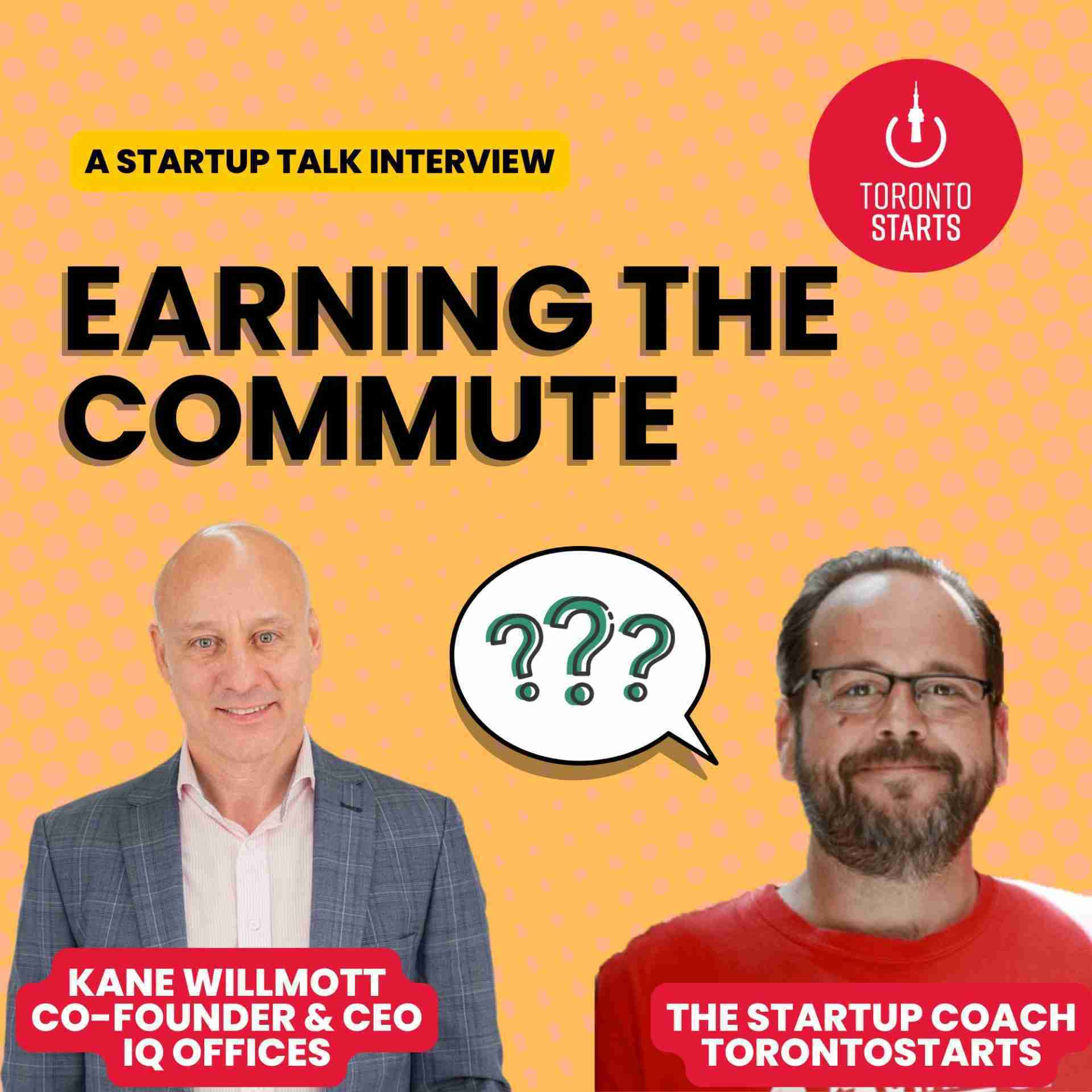
Earning the Commute – Redefining Office Spaces for the Hybrid Workforce
Welcome to our latest episode on Earning the Commute, where we explore how coworking spaces and dynamic office environments are transforming traditional workplaces. In this discussion, Startup Coach and iQ Offices’ CEO Kane Willmott delve into the multifaceted approach of Earning the Commute by curating engaging and flexible workspaces that adapt to modern business needs.
The Concept of Earning the Commute
In this episode, our guests discuss the challenges of balancing real estate costs with employee engagement in a world that increasingly values flexibility. The discussion on Earning the Commute emphasizes the importance of accessible locations and vibrant communal areas, turning conventional office spaces into dynamic hubs of productivity.
Strategies for Earning the Commute in Modern Offices
Guests share insights on adapting workspace design to fluctuating attendance and evolving business needs. By focusing on factors such as proximity, amenities, and community, companies can better implement the principles of Earning the Commute to attract talent and boost morale. This fresh perspective challenges outdated models and encourages a reimagining of the office environment.
In addition, the conversation highlights how a service-driven approach can streamline long-term contracts and optimize space usage. This strategy, centered on Earning the Commute, not only enhances the work experience but also reduces operational costs. Both speakers agree that cultivating a lively, community-focused space is key to success.
Finally, this episode on Earning the Commute illustrates that transforming an office into a destination is about more than aesthetics; it is about creating an environment where every commute is earned through positive, engaging experiences. Tune in to gain practical strategies and insights on how to revamp your workspace, align with modern work trends, and ultimately, master Earning the Commute.
Contact
Kane Willmott, Co-Founder & CEO of iQ Offices
Kane Willmott is the Co-Founder and CEO of iQ Offices, Canada’s largest independent Canadian-owned coworking operator. With a background in real estate brokerage, Kane has leveraged his expertise to build and scale iQ Offices into a leader in the coworking space.
A trusted voice on the future of work, workplace dynamics, and building purpose-driven teams, Kane offers valuable insights at a time when return-to-office requirements are reshaping the workforce. His perspective is highly relevant to both entrepreneurs and the broader Canadian workforce.
Links to Learn More About Kane & iQ Offices:
- Website: iqoffices.com
- Instagram: @iqoffices
- LinkedIn: iQ Offices
- Facebook: iQ Offices Canada
Additional Resources:
- Survey Findings: What Motivates Canadians to Return to the Office
Additional Links
• Silicon Scoop Podcast – Stay Informed, Stay Ahead!
• Futuretech Podcast – Explore more episodes and stay updated with the latest in technology and innovation.
• Startup Talk Podcast – https://torontostarts.com/startup-talk-toronto-startup-podcast/
• Who Are These Startups Podcast
• Startup Investor Drinks – Join the community and connect with fellow startup enthusiasts and investors.
• TorontoStarts Startup and Entrepreneur Community – Become a part of Toronto’s thriving startup ecosystem.
• Workhaus – Discover flexible workspace solutions for your business needs.
• Work with The Startup Coach – Get expert guidance and mentorship for your startup journey.
• Reach out to Jon Irwin on LinkedIn – Connect with our co-host and technology expert.
Ontario Startup Ecosystem Links
• Ontario’s Startup Ecosystem
• Startup Funding in Ontario
• Angel Investors in Ontario
• Ontario Incubators and Accelerators
• Venture Capital in Ontario: Top Firms, Sectors, and Funding Strategies
• Government Grants for Ontario Startups
• Ontario’s Startup Success Stories
• Ontario Centre of Innovation (OCI)
• Bank Loans and Financing for Startups in Ontario
• Research and Development Tax Credits in Ontario
• Government Loans and Financing for Startups in Ontario
• Equity Crowdfunding for Ontario Startups
• Toronto Entrepreneurs Resources
• Toronto’s Food and Beverage Entrepreneurs: Trends, Challenges, and Success Stories
• SEO Strategies for Toronto Entrepreneurs: Enhance Your Online Visibility
• Social Impact for Toronto Entrepreneurs: Starting and Running a Socially Responsible Business
• Toronto Arts and Media Entrepreneurs: Inspiring Profiles and Insights for Creative Success
• Exploring Toronto Green Tech Entrepreneurs: Innovators and Leaders in Sustainability
• Building a Team for Toronto Entrepreneurs: Strategies for Success
• A Guide for Toronto Food and Beverage Entrepreneurs
• Toronto Fashion and Retail Entrepreneurs: Trends, Opportunities, and Success Stories
Episode transcript
Read the full transcript
Speaker 0: so everything's going along in your business great, same with mine, and then all of a sudden covid comes along and people can't get together anymore. running an event business, all of a sudden, you can't do those things. and, you know, coworking, all of a sudden, there's new rules about space and people and all those things. now we live in a new generation where so many people are working from home, and they're very reluctant to come back into the office. and enterprises are trying to figure out, well, we have all this space. what's the right size to have? you know? do we have everybody back in the office all the time? do we rotate between people? do i need thirty percent of my real estate when i'm distributed? do i need, coworking space for people to come in? how like, there's a lot more questions than it used to be, and it's a real number on the expense sheet as you mentioned. and some of these things are long term contracts. so these companies have to, like you said, earn the commute, to get either new employees or whatever to come into the office on whatever frequency they need. how is iq offices earning the commute?
Speaker 1: yeah. it really goes back to the people again. you know, i've got i've kind of, really, reiterating that over and over again. but, but it really is about the service offering. it's about being in a location that's very accessible that allows people to multiple forms of communication or, transportation, sorry, to, to get to the location. great amenities when they're there, having access to great amenities. so, like, so we locate in downtown, like, financial, districts and and downtown business districts. that is our primary focus. that is our focus in terms of our locations in vancouver, toronto, ottawa, and montreal. so we look at that. like, how do people get to the space? very important. so in terms of earning the commute, doing everything you can to to make that that space or that building accessible through multiple forms of transportation is very important. and then beyond that, it's really what the experience is when you're on-site. one of the great things about a coworking space is that to your point about getting people back to the office and some people work some days and some people don't work other days and, you know, like, like like, looking at the distributed teams, and and flexible workspace and hybrid and all these sort of things is very complicated. it's very complicated. and because you have all those factors, not only is it complicated, but it's also ever changing because you'll have the turnover in the company and those sort of things. so what one person, like, you know and different lifestyles, different like, things happen. someone has a baby, and now they have a different situation than they had last year, and now they want something different. like, so for a company to try and figure out how much space they actually need is extremely difficult in this environment, and i believe it will be into the future. but what also is very difficult is taking a ten thousand square foot space and trying to activate it for thirty people. because you walk into that space, and it's like walking into a restaurant. it can be the most beautiful restaurant that you go into. and if you got three tables actually that have people sitting at it, you're like, this place has no vibe. you know? and it's not about the music, and it's not about the build out, and it's not about the location, and it's, you know, and it's not about the menu. it's all about who's in the space. right? so when you look at a at an office space, it's it's the same thing. so if you have ten thousand square feet, it's like and i've actually seen this happen from occupiers where they say, oh, you know, this is in this environment, this crazy sublease is so cheap. i'm gonna take fifty percent more space. i'm like, you do realize by taking fifty percent more space, you are creating this cavernous environment that is gonna be absolutely horrible for your staff, and it's not gonna earn the commute. and they're gonna go to the space, and it's gonna be depressing, and they're not gonna wanna go there every day. so with the co working space, what companies can do is they can, you know, obviously, turn over all the activation to us, but beyond that, they don't have to take more space than they need. they can define the requirement from now for the next year, for the next six months, and then they can adjust. so if lifestyles change, things change, staffing changes, the, you know, the company decides you want everybody in the office five days a week or you want them two days a week or, you know, or you want them one day a week, whatever the case may be. things change over time. we're in an ever changing environment. and when you have office space, workspace that caters to that so that when people come into the space, they don't have this cavernous environment. they have this, like, this beautiful space. they have this space that fits their needs for the amount of people that are gonna be in that space. and then when they walk outside of that space, there's energy. there's energy because there's people in the amenity spaces. right? so that's kind of a long answer, craig, to, like, how you earn the commute. like, it's it's not a silver bullet. it's not one thing. it's, like, it's it's a number of the things, but it's curating an experience is what it really comes down to
Speaker 0: and making the space accessible and easy to get to.
Speaker 1: oh, i think, you might be
Speaker 0: on mute, craig. i was on mute. thank you. definitely, as a person who runs events, i often will change the room i'm in based on the number of people that are coming. like, i normally have, say, a hundred and fifty person room. but this event, i've only got seventy five people, so i'm gonna switch to a much smaller room because it's gonna feel like a much more lively, intimate event because people are closer together versus a cavernous one where people are really spread out thinking, wow, nobody's here. it really changes the mindset. and in coworking, you need the right balance of open space, drop in space, office space. it's it's interesting, to get that right because, you know, everyone has different needs.
Speaker 1: yeah. absolutely. so let's let's let's go a little further with your event analogy. right? so you start planning an event. at the beginning of planning that event, you don't know how many people you're gonna have at the event. right? and then as you start to get closer to the event date, you get a little bit of a better idea of how many you have an idea of what cars going in, but but but you don't know. right? and then, ultimately, when you get closer to the event, you have to look at curating that space in a way that makes it feel lively. right? and so you do that in events. it's done in restaurants. restaurants usually are set up so they can block off sections so they can, like, they can squeeze it. right? and have you ever seen an office like that? have you have you ever seen off like like a ten thousand square foot office space where they're able to, like, shrink, make it bigger, do these sort of things. right? like, it's like and no. because, like, if you look at the traditional floor plan, it's open space, offices, meeting rooms, reception. that's every single office. right?
Speaker 0: yeah.
Speaker 1: so it's interesting because i think for office for so long, it was just like, it was office space by default. it's like, i have a company. i have a hundred people. i need a hundred square feet. i'm gonna get ten thousand square feet, and there you go. boom. right? like, like, we're done. we're just gonna go and get that. that's what you do. and i'm gonna tell every single one of my employees that they need to be there, you know, from eight till six, whatever it is. right? monday to friday. that's just what it was. and now the office is not seen as being a necessary expense. it's seen as being an investment to drive engagement. right? so with that change in mindset, you have to give consideration to the venue. right? and i think in a lot of ways, it's extremely difficult to do with the product and the inventory. there's just a lot of antiquated inventory out there, and it's just and it's it's very difficult to create that that cordoned off and lively experience in a workspace for one company. it's just very, very difficult to do. so i think, like, in the fullness of time, you will see more and more office buildings being activated in the way where they have these amenities that get people together that, you know, create that human connection, that create the vibe within the space. and then people will have their offices, but the office will just be a workspace component of what they do. you know? because when you start to connect the two together, that's where it becomes interesting. so if i walk into the lobby of an office building and it looks like one of your events where, you you know, it's like, everybody's there and it's bumping and things are happening. you're like, this is amazing. i love being here. and then you go to your workspace and your workspace and you get to see all, like, the people that you work with, your friends. right? and it's the right size for you. but then you can go out of your office space and go back to that bump in space that you wanted to go to. right? like, you have this experience. so i think, you know, you're gonna see more and more of that. we're seeing it in other markets. we're seeing it in some us markets where landlords are doing it. it's it's very much a different business model than what landlords traditionally do. so it's very difficult. and it's very difficult for them to do because it's a different business model, number one. but number two, they're not set up for success either because all the way down the chain, all everybody wants is a bond. they want an office building to look like a bond. they want you to sign a ten year lease so they can go and get a ten year mortgage. right? and that's so they can go and get the investment, based on a valuation that's based on the commitment and the quality of the credit from that tenant for the next ten years. that's how the whole thing's set up. and when you all of a sudden go in and say, no. no. no. we're gonna do shorter terms or like, i don't like, very few office users would say to you, oh, i would way rather i don't want the seven page. i would rather do a seventy page. can you give me a seventy page that is totally skewed towards your interest so that i could hire a lawyer and pay them ten thousand dollars to try and figure out what this means? like, no one ever is is ever gonna say that. in addition to that, people don't wanna build up their own space. they don't wanna sort solve the tech, solve the technology issues. they don't wanna be thinking about, like, what's the new technology things? access control. they're not only thinking about, like, what's the newest printer, or what kind of, of circuit do i want in this space? these are all things that take away people's focus from their core business. and in addition to that, when you're doing that in a long term office space, it takes you away from your core business. and just like we talked about, those the structure of those spaces are just they don't set up these companies for success to earn the commute. and i think that's the that's what we saw back in two thousand eleven when we explored this in two thousand and twelve when we opened our first location, but it's more true today than it's ever been. because there's just so much complexity in terms of providing people space, getting people into the space. you have to sell it. like, as a business owner, if you wanna have people in the office, you can dictate it. of course, you can. you can say you can mandate it and say you gotta be in the office five days a week. but if you think of it more like a restaurant owner and say, how do i get everybody in this space? how do i get everybody here? what do i need to do to really get them here other than just telling them they have to be here? and you think about, like, what kind of environment do i have to create that's gonna earn the commute? it's gonna be a very different conversation, and i think you'll get very different results out of the people that, that you're bringing to the space.
More from Startup Talk
All episodes
startup-talk · April 10, 2025
10x Revenue Exit
Discover actionable insights for achieving a 10x Revenue Exit through strategic scaling, profitability, and smart bootstrapping. https://torontostarts.com/2025/04/10/10x-revenue-exit/ Apple -> https://podcasts.apple.com/us/podcast/startup-talk/id1763804003 Spotify -> https://open.spotify.com/show/1siJMILILidHAiAsrX2VBU YouTube: https://youtube.com/playlist?list=PLj4v-RoA7A-jxV5FHs5e61oIsuvUJYmT_&si=LYegRe5GYLKNQ7xL Flowgrammer Apple -> https://podcasts.apple.com/us/podcast/flowgrammer-podcast/id1804155588 Spotify -> https://open.spotify.com/show/0wv3feR00iaVpE8zn7niNf Flowgrammer.ca -> https://flowgrammer.ca/ AI News and Resources -> https://flowgrammer.ca/resources/ Silicon Scoop Silicon Scoop Podcast - https://torontostarts.com/silicon-scoop/ Apple: https://podcasts.apple.com/us/podcast/silicon-scoop/id1758711826 Spotify: https://open.spotify.com/show/5bAzF0MwV6TtLhJAhvHayI YouTube: https://www.youtube.com/playlist?list=PLj4v-RoA7A-gT62vrEYqh1zCv-0Hj-o5J Startup Investor Drinks Toronto - https://startupdrinksto.com/ Toronto’s Startup Community - https://torontostarts.com/
View episode
startup-talk · April 8, 2025
Product Market Fit with Lauft
Product Market Fit with Lauft Welcome to Episode 217 of the Startup Talk Podcast, where we explore Product Market Fit in a conversation with Graham Wong, Founder and CEO of Lauft. Listen in as the Startup Coach uncovers how Lauft transformed a personal need into a thriving flexible workspace solution and discovered exactly what their […]
View episode
startup-talk · April 6, 2025
Know Yourself – Unlocking Entrepreneurial Potential
Discover how to Know Yourself as an entrepreneur to unlock your potential and overcome challenges in today's startup world. https://torontostarts.com/2025/04/06/know-yourself-unlocking-entrepreneurial-potential/ Apple -> https://podcasts.apple.com/us/podcast/startup-talk/id1763804003 Spotify -> https://open.spotify.com/show/1siJMILILidHAiAsrX2VBU YouTube: https://youtube.com/playlist?list=PLj4v-RoA7A-jxV5FHs5e61oIsuvUJYmT_&si=LYegRe5GYLKNQ7xL Flowgrammer Apple -> https://podcasts.apple.com/us/podcast/flowgrammer-podcast/id1804155588 Spotify -> https://open.spotify.com/show/0wv3feR00iaVpE8zn7niNf Flowgrammer.ca -> https://flowgrammer.ca/ AI News and Resources -> https://flowgrammer.ca/resources/ Silicon Scoop Silicon Scoop Podcast - https://torontostarts.com/silicon-scoop/ Apple: https://podcasts.apple.com/us/podcast/silicon-scoop/id1758711826 Spotify: https://open.spotify.com/show/5bAzF0MwV6TtLhJAhvHayI YouTube: https://www.youtube.com/playlist?list=PLj4v-RoA7A-gT62vrEYqh1zCv-0Hj-o5J Startup Investor Drinks Toronto - https://startupdrinksto.com/ Toronto’s Startup Community - https://torontostarts.com/
View episode