
Tension Alignment Framework
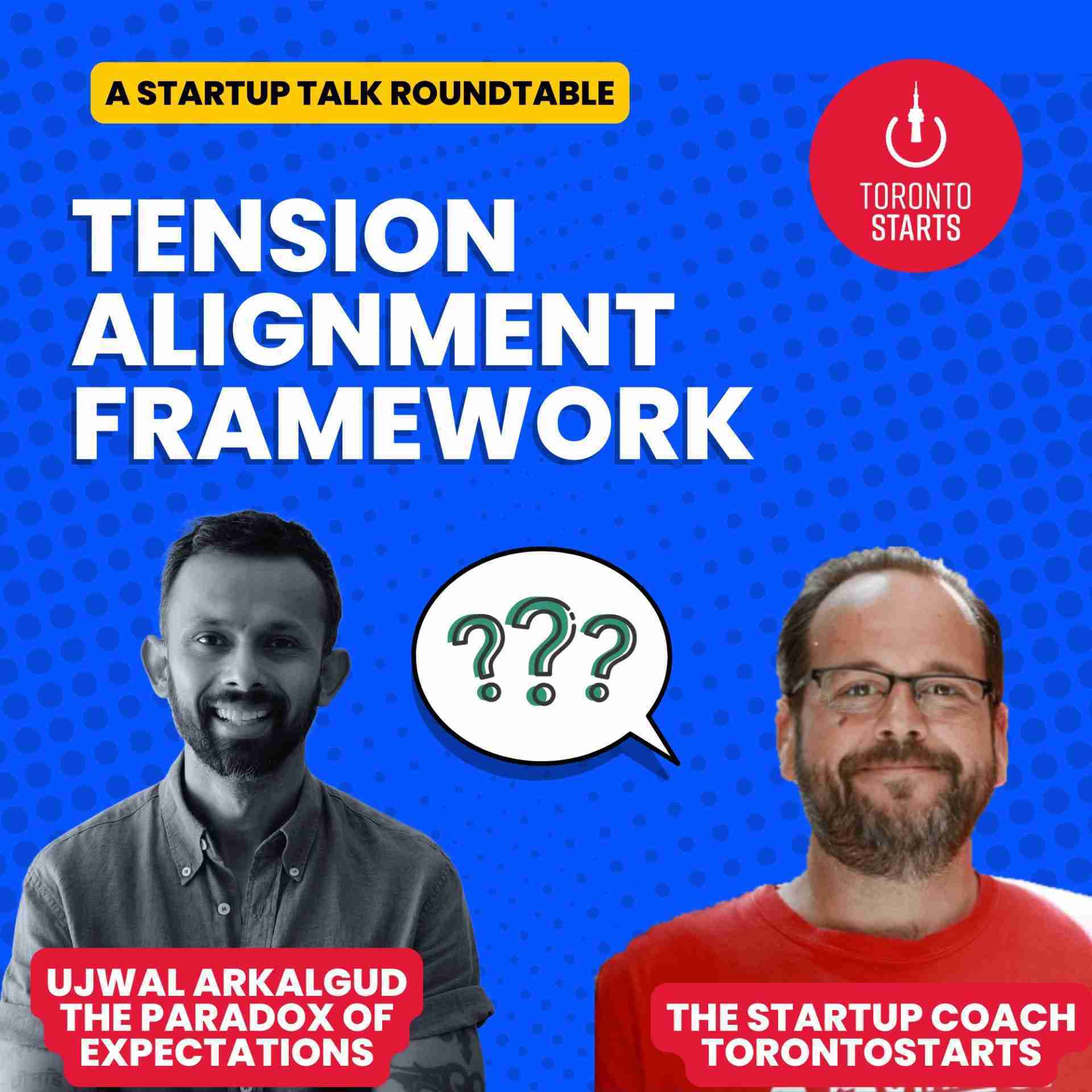
Tension Alignment Framework: Unlocking Growth Barriers for Entrepreneurs In this episode of the Startup Talk Podcast, we dive into the Tension Alignment Framework to explore how entrepreneurs can identify and resolve growth barriers in their businesses. Through real-world examples and strategic insights, listeners discover how aligning market expectations with innovative solutions can transform challenges into […]
A TorontoStarts podcast
Estimated reading time: 5 minutes
Tension Alignment Framework: Unlocking Growth Barriers for Entrepreneurs
In this episode of the Startup Talk Podcast, we dive into the Tension Alignment Framework to explore how entrepreneurs can identify and resolve growth barriers in their businesses. Through real-world examples and strategic insights, listeners discover how aligning market expectations with innovative solutions can transform challenges into opportunities.
Guest: Ujwal Arkalgud, Cultural Anthropologist & Tech Entrepreneur
Ujwal Arkalgud is a Canadian cultural anthropologist turned tech entrepreneur who recently achieved an impressive 10x revenue exit from his B2B tech company. Drawing from his personal journey of navigating growth challenges, Ujwal has developed the “Tension Alignment Framework”—a practical tool designed to help growth-stage companies align products, customers, and market dynamics for breakthrough sales results.
In addition to his entrepreneurial success, Ujwal is the author of the upcoming book, The Paradox of Expectation, which delves into the “tension model.” The book explores the innate conflict between societal expectations and our personal desires, providing fresh insights into how these tensions shape decision-making and behavior.
Links to Learn More About Ujwal:
- Investment Company: Investment Ark
- Newsletter: Decision Lab
- Upcoming Book: The Paradox of Expectation
- LinkedIn: linkedin.com/in/ujwalarkalgud
Understanding the Tension Alignment Framework
This episode breaks down the Tension Alignment Framework by examining the core tension between market expectations and entrepreneurial desires. Listeners will learn how to repackage their solutions to match customer needs without compromising on innovation.
Key Insights on the Tension Alignment Framework
Entrepreneurs are encouraged to view challenges through the lens of the Tension Alignment Framework. By understanding that the gap between what the industry expects and what founders aim to achieve creates a unique opportunity, startups can reposition their offerings effectively. Tension Alignment Framework is not just a theoretical model; it offers actionable strategies to transform tensions into market advantages.
Practical Applications of the Tension Alignment Framework
Entrepreneurs can integrate the Tension Alignment Framework into their strategic planning by mapping customer expectations and aligning product narratives. This approach not only drives inbound client engagement but also builds long-term trust in competitive markets.
Conclusion
In summary, this model serves as a powerful tool for startups to overcome market resistance and drive sustainable growth. Its layered approach to resolving tensions makes it indispensable for modern entrepreneurs.
Tension Alignment Framework: Unlocking Growth Barriers for Entrepreneurs
In this episode of the Startup Talk Podcast, we dive into the Tension Alignment Framework to explore how entrepreneurs can identify and resolve growth barriers in their businesses. Through real-world examples and strategic insights, listeners discover how aligning market expectations with innovative solutions can transform challenges into opportunities.
Understanding the Tension Alignment Framework
This episode breaks down the Tension Alignment Framework by examining the core tension between market expectations and entrepreneurial desires. Listeners will learn how to repackage their solutions to match customer needs without compromising on innovation.
Key Insights on the Tension Alignment Framework
Entrepreneurs are encouraged to view challenges through the lens of the Tension Alignment Framework. By understanding that the gap between what the industry expects and what founders aim to achieve creates a unique opportunity, startups can reposition their offerings effectively. Tension Alignment Framework is not just a theoretical model; it offers actionable strategies to transform tensions into market advantages.
Practical Applications of the Tension Alignment Framework
Entrepreneurs can integrate the Tension Alignment Framework into their strategic planning by mapping customer expectations and aligning product narratives. This approach not only drives inbound client engagement but also builds long-term trust in competitive markets.
Conclusion
In summary, this model serves as a powerful tool for startups to overcome market resistance and drive sustainable growth. Its layered approach to resolving tensions makes it indispensable for modern entrepreneurs.
Additional Links
• Silicon Scoop Podcast – Stay Informed, Stay Ahead!
• Futuretech Podcast – Explore more episodes and stay updated with the latest in technology and innovation.
• Startup Talk Podcast – https://torontostarts.com/startup-talk-toronto-startup-podcast/
• Who Are These Startups Podcast
• Startup Investor Drinks – Join the community and connect with fellow startup enthusiasts and investors.
• TorontoStarts Startup and Entrepreneur Community – Become a part of Toronto’s thriving startup ecosystem.
• Workhaus – Discover flexible workspace solutions for your business needs.
• Work with The Startup Coach – Get expert guidance and mentorship for your startup journey.
• Reach out to Jon Irwin on LinkedIn – Connect with our co-host and technology expert.
Ontario Startup Ecosystem Links
• Ontario’s Startup Ecosystem
• Startup Funding in Ontario
• Angel Investors in Ontario
• Ontario Incubators and Accelerators
• Venture Capital in Ontario: Top Firms, Sectors, and Funding Strategies
• Government Grants for Ontario Startups
• Ontario’s Startup Success Stories
• Ontario Centre of Innovation (OCI)
• Bank Loans and Financing for Startups in Ontario
• Research and Development Tax Credits in Ontario
• Government Loans and Financing for Startups in Ontario
• Equity Crowdfunding for Ontario Startups
• Toronto Entrepreneurs Resources
• Toronto’s Food and Beverage Entrepreneurs: Trends, Challenges, and Success Stories
• SEO Strategies for Toronto Entrepreneurs: Enhance Your Online Visibility
• Social Impact for Toronto Entrepreneurs: Starting and Running a Socially Responsible Business
• Toronto Arts and Media Entrepreneurs: Inspiring Profiles and Insights for Creative Success
• Exploring Toronto Green Tech Entrepreneurs: Innovators and Leaders in Sustainability
• Building a Team for Toronto Entrepreneurs: Strategies for Success
• A Guide for Toronto Food and Beverage Entrepreneurs
• Toronto Fashion and Retail Entrepreneurs: Trends, Opportunities, and Success Stories
Episode transcript
Read the full transcript
Speaker 0: can you walk us through the tension alignment framework and how entrepreneurs can apply it to identify and resolve growth barriers in their business?
Speaker 1: yeah. i mean, the biggest, tension we all experience and, obviously, there's all kinds of tensions at play in every marketplace. right? but the biggest tension i look at is the tension between what we want to do and what the industry expects from us. so, you know, i'll give you a great example. i recently, was talking to an entrepreneur, who is selling, ransomware and threat protection software. it's a saas solution to small and medium businesses. great example because who wants to buy ransomware. right? we all believe that's not gonna happen to us. we all believe that, especially for small and medium businesses. and so, what happens in this situation is you resort to fear mongering, and then that pushes the prospect away even more. yeah. like, selling life insurance to somebody. right? or you try to tell them about all the features benefits, and you give them some kind of roi calculation, and that doesn't work either. right? and so, what do you do in a situation like that? one of the first things, you do is you take a step back and you go, okay. what is the inherent tension here? the tension is the world expects, that they wouldn't need this solution. that's what the world expects. the world doesn't want, anti ransomware solution. their expectation is i don't need any of this stuff. right? and your desire is i want every company to have this stuff because i wanna protect them. okay. so now that you've realized this, now you gotta figure out, okay, if the world doesn't want to or doesn't need any of this stuff, how do you make them need it? so what do they need? right? and so turns out what they need, for example, is to be able to track the efficiency of their network, for example, or they might need other peripheral services like, you know, ways to track the security of their network when people are on their mobile devices and things like that. and so you might realize that, actually, the solution you need to sell has to be packaged in part of a larger solution that's doing something else for the customer. so until you look at the tension between expectations and desires in terms of your industry, i'm not talking about, you know, our internal the stuff we do on the therapy couch. i'm talking about what the industry expects from our product versus what we want our product to do. until you do that, you don't give yourself that important dose of reality check. the moment you get the reality check, you realize, okay. we cannot win by pushing water uphill. what we have to figure out is how to fit our product into the expectation of the customer, at least initially. and then later, we can change that expectation. but initially, we have to. there's no other way to win.
Speaker 0: and it sounds like, you know, these are the exact techniques that santi was asking about. how do you go from looking for clients to clients looking for you?
Speaker 1: yeah. fantastic question. and, you know, we did this, when we were building motivebase, this is what we did. everything was inbound. everything was inbound. and the way we did it, was and i'm, you know, i'm not gonna talk about content strategy here. there's lots of gurus that talk about content strategy. for me, the point is the moment you do this expectation mapping exercise, you have tons to write about. so, for example, in our industry, we knew that, clients' expectations were charts and graphs. people love seeing a chart and a graph that says, i don't know, like, twenty two percent of millennials care about this. but as anthropologists, we wanted them to ask, what do these people believe? and that's pushing water uphill. we can't get them to do that in twenty fifteen. by twenty two, they were doing that. but in twenty fifteen, they weren't doing that. so how do we solve that problem? we solve that problem by figuring out, okay. step one, how do we fit our solution into the charts and graphs? so the first thing we did was we actually sought inspiration because my little one at that point had, you know, these, these kids' books where you can pull tabs or you open it's like where's waldo. open stuff and you get new layers of information. so we use that as inspiration. and so behind the graphs and charts were, layers of belief and value based information that came from our ip. and so we packaged it up in that way, which meant we had tons to talk about. so our entire content strategy revolved around peeling the layers. so that's what we call it, peeling the layers. so all we did was talk about the layers behind the statistics you see, and it got so much attention. us, ctos would reach out to us, and we'd acquire new customers. i remember this one time we acquired, conagra foods as a customer. in a matter of two weeks, she signed a three hundred and fifty thousand dollar deal, and that had never happened in the history of our business at that point. and it happened just because we didn't know this, but she had been reading our content for a year about peeling the layers behind the common statistics you see. so my point is, how do you go from looking for clients to clients looking for you? you have to figure out what is your version of peeling the layers. right? so do the expectation mapping exercise and then figure out what is your unique story that allows you to basically talk about this stuff to no end and gives you a unique voice. it's really important.
More from Startup Talk
All episodes
startup-talk · April 10, 2025
10x Revenue Exit
Discover actionable insights for achieving a 10x Revenue Exit through strategic scaling, profitability, and smart bootstrapping. https://torontostarts.com/2025/04/10/10x-revenue-exit/ Apple -> https://podcasts.apple.com/us/podcast/startup-talk/id1763804003 Spotify -> https://open.spotify.com/show/1siJMILILidHAiAsrX2VBU YouTube: https://youtube.com/playlist?list=PLj4v-RoA7A-jxV5FHs5e61oIsuvUJYmT_&si=LYegRe5GYLKNQ7xL Flowgrammer Apple -> https://podcasts.apple.com/us/podcast/flowgrammer-podcast/id1804155588 Spotify -> https://open.spotify.com/show/0wv3feR00iaVpE8zn7niNf Flowgrammer.ca -> https://flowgrammer.ca/ AI News and Resources -> https://flowgrammer.ca/resources/ Silicon Scoop Silicon Scoop Podcast - https://torontostarts.com/silicon-scoop/ Apple: https://podcasts.apple.com/us/podcast/silicon-scoop/id1758711826 Spotify: https://open.spotify.com/show/5bAzF0MwV6TtLhJAhvHayI YouTube: https://www.youtube.com/playlist?list=PLj4v-RoA7A-gT62vrEYqh1zCv-0Hj-o5J Startup Investor Drinks Toronto - https://startupdrinksto.com/ Toronto’s Startup Community - https://torontostarts.com/
View episode

startup-talk · April 8, 2025
Product Market Fit with Lauft
Product Market Fit with Lauft Welcome to Episode 217 of the Startup Talk Podcast, where we explore Product Market Fit in a conversation with Graham Wong, Founder and CEO of Lauft. Listen in as the Startup Coach uncovers how Lauft transformed a personal need into a thriving flexible workspace solution and discovered exactly what their […]
View episode

startup-talk · April 6, 2025
Know Yourself – Unlocking Entrepreneurial Potential
Discover how to Know Yourself as an entrepreneur to unlock your potential and overcome challenges in today's startup world. https://torontostarts.com/2025/04/06/know-yourself-unlocking-entrepreneurial-potential/ Apple -> https://podcasts.apple.com/us/podcast/startup-talk/id1763804003 Spotify -> https://open.spotify.com/show/1siJMILILidHAiAsrX2VBU YouTube: https://youtube.com/playlist?list=PLj4v-RoA7A-jxV5FHs5e61oIsuvUJYmT_&si=LYegRe5GYLKNQ7xL Flowgrammer Apple -> https://podcasts.apple.com/us/podcast/flowgrammer-podcast/id1804155588 Spotify -> https://open.spotify.com/show/0wv3feR00iaVpE8zn7niNf Flowgrammer.ca -> https://flowgrammer.ca/ AI News and Resources -> https://flowgrammer.ca/resources/ Silicon Scoop Silicon Scoop Podcast - https://torontostarts.com/silicon-scoop/ Apple: https://podcasts.apple.com/us/podcast/silicon-scoop/id1758711826 Spotify: https://open.spotify.com/show/5bAzF0MwV6TtLhJAhvHayI YouTube: https://www.youtube.com/playlist?list=PLj4v-RoA7A-gT62vrEYqh1zCv-0Hj-o5J Startup Investor Drinks Toronto - https://startupdrinksto.com/ Toronto’s Startup Community - https://torontostarts.com/
View episode