
Minimum Sellable Product vs Minimum Viable Product
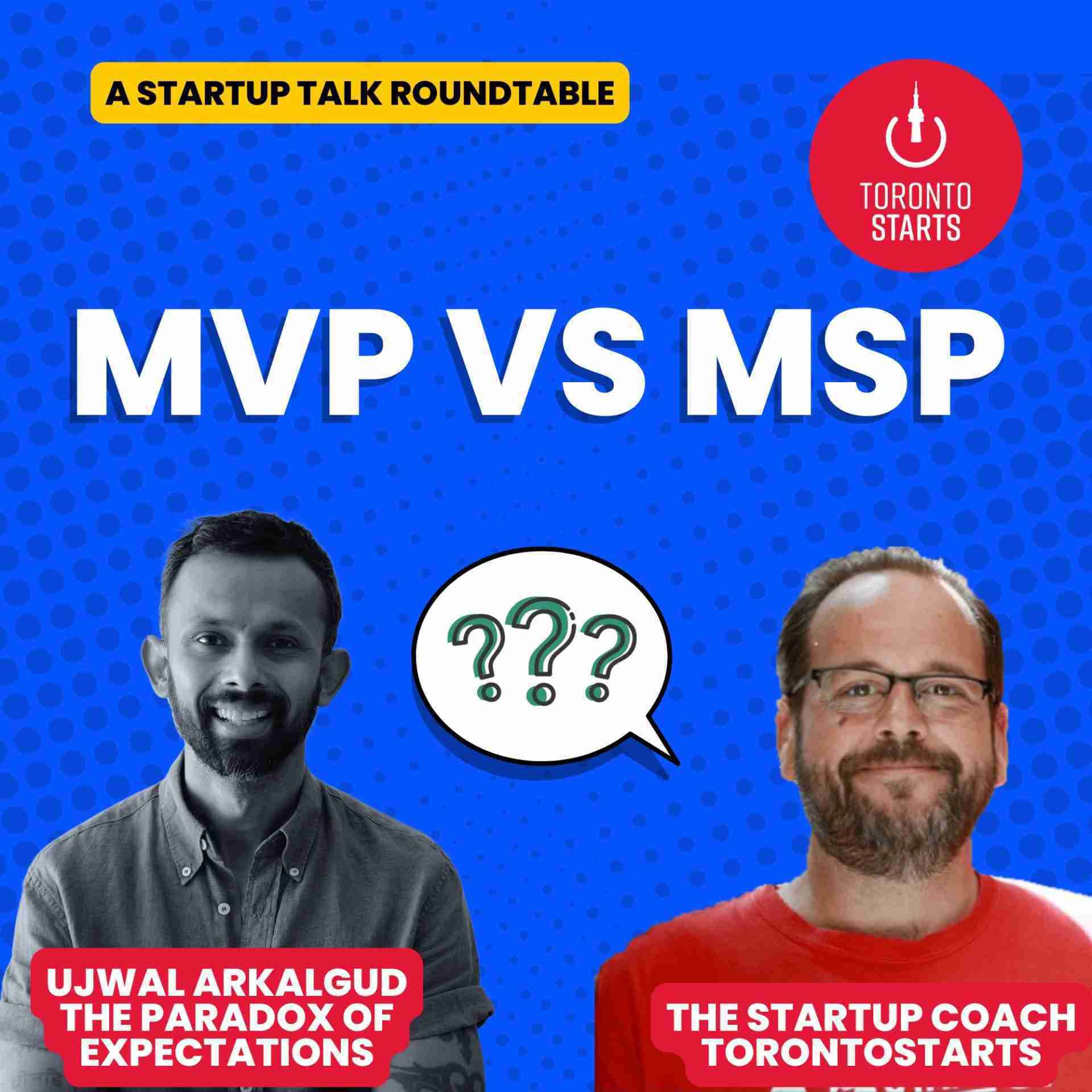
Minimum Sellable Product: Why It Beats the MVP Approach Minimum Sellable Product is the focus of this episode, where we dive deep into why the Minimum Sellable Product approach outperforms the traditional MVP. In this discussion, our Startup Coach and tech entrepreneur Ujwal Arkalgud explore how shifting from an MVP mindset to a Minimum Sellable […]
A TorontoStarts podcast
Estimated reading time: 4 minutes
Minimum Sellable Product: Why It Beats the MVP Approach
Minimum Sellable Product is the focus of this episode, where we dive deep into why the Minimum Sellable Product approach outperforms the traditional MVP. In this discussion, our Startup Coach and tech entrepreneur Ujwal Arkalgud explore how shifting from an MVP mindset to a Minimum Sellable Product can drive early revenue and build stronger customer relationships.
Guest: Ujwal Arkalgud, Cultural Anthropologist & Tech Entrepreneur
Ujwal Arkalgud is a Canadian cultural anthropologist turned tech entrepreneur who recently achieved an impressive 10x revenue exit from his B2B tech company. Drawing from his personal journey of navigating growth challenges, Ujwal has developed the “Tension Alignment Framework”—a practical tool designed to help growth-stage companies align products, customers, and market dynamics for breakthrough sales results.
In addition to his entrepreneurial success, Ujwal is the author of the upcoming book, The Paradox of Expectation, which delves into the “tension model.” The book explores the innate conflict between societal expectations and our personal desires, providing fresh insights into how these tensions shape decision-making and behavior.
Links to Learn More About Ujwal:
- Investment Company: Investment Ark
- Newsletter: Decision Lab
- Upcoming Book: The Paradox of Expectation
- LinkedIn: linkedin.com/in/ujwalarkalgud
Overview Of Minimum Sellable Product
In this segment, we break down the concept of the Minimum Sellable Product. Unlike the MVP—which often focuses on building a visually appealing user experience solely for pitches—the Minimum Sellable Product prioritizes core functionalities that directly generate revenue. The speakers explain that by investing in a Minimum Sellable Product, startups can deliver tangible value to their customers from day one.
Revenue-Driven Strategies With Minimum Sellable Product
This episode outlines key strategies for developing a Minimum Sellable Product. The conversation highlights how back-end innovations and human intervention can be more beneficial than spending excessive time perfecting the front-end experience. By building a Minimum Sellable Product, founders can acquire paying customers and prove market demand early, which is essential for scaling the business without sacrificing equity for superficial improvements.
Founder’s Perspective On Minimum Sellable Product
Our discussion includes real-world examples where startups succeeded by choosing a Minimum Sellable Product over an MVP. Founders share their experiences about landing blue-chip clients and generating revenue with a product that works rather than one that merely impresses investors. They stress that the Minimum Sellable Product approach aligns more with long-term growth, ensuring the product is both sellable and sustainable.
Conclusion: Embrace The Minimum Sellable Product Mindset
In wrapping up, the episode encourages entrepreneurs to consider whether they want to build a product that attracts investor interest or one that delivers actual sales. The Minimum Sellable Product strategy not only minimizes risks but also maximizes the potential for customer satisfaction and revenue generation.
Additional Links
• Silicon Scoop Podcast – Stay Informed, Stay Ahead!
• Futuretech Podcast – Explore more episodes and stay updated with the latest in technology and innovation.
• Startup Talk Podcast – https://torontostarts.com/startup-talk-toronto-startup-podcast/
• Who Are These Startups Podcast
• Startup Investor Drinks – Join the community and connect with fellow startup enthusiasts and investors.
• TorontoStarts Startup and Entrepreneur Community – Become a part of Toronto’s thriving startup ecosystem.
• Workhaus – Discover flexible workspace solutions for your business needs.
• Work with The Startup Coach – Get expert guidance and mentorship for your startup journey.
• Reach out to Jon Irwin on LinkedIn – Connect with our co-host and technology expert.
Ontario Startup Ecosystem Links
• Ontario’s Startup Ecosystem
• Startup Funding in Ontario
• Angel Investors in Ontario
• Ontario Incubators and Accelerators
• Venture Capital in Ontario: Top Firms, Sectors, and Funding Strategies
• Government Grants for Ontario Startups
• Ontario’s Startup Success Stories
• Ontario Centre of Innovation (OCI)
• Bank Loans and Financing for Startups in Ontario
• Research and Development Tax Credits in Ontario
• Government Loans and Financing for Startups in Ontario
• Equity Crowdfunding for Ontario Startups
• Toronto Entrepreneurs Resources
• Toronto’s Food and Beverage Entrepreneurs: Trends, Challenges, and Success Stories
• SEO Strategies for Toronto Entrepreneurs: Enhance Your Online Visibility
• Social Impact for Toronto Entrepreneurs: Starting and Running a Socially Responsible Business
• Toronto Arts and Media Entrepreneurs: Inspiring Profiles and Insights for Creative Success
• Exploring Toronto Green Tech Entrepreneurs: Innovators and Leaders in Sustainability
• Building a Team for Toronto Entrepreneurs: Strategies for Success
• A Guide for Toronto Food and Beverage Entrepreneurs
• Toronto Fashion and Retail Entrepreneurs: Trends, Opportunities, and Success Stories
Episode transcript
Read the full transcript
Speaker 0: can you take a deep dive into your dislike of mvp versus what i call the msp?
Speaker 1: yeah. and i love the term, you know, minimal sellable product because the thing is the problem with the mvp is you prioritize different tools to build in an mvp than in an msp. k. so what's the difference? if it's an msp, if it's a minimal sellable product, you will prioritize building things that you can sell. so, for example, in our situation, we built some things on the back end that the client could not see, but it allowed us to deliver a certain output in the first year. so, yes, there was more human intervention, but it allowed us to take the product and sell it and acquire customers. and we acquired blue chip clients in year one because we prioritize building some stuff on the back end that allowed us to do certain type of trend analysis. if i was building an mvp, i would have focused on building more of a user experience that the client could access, which meant so much time would go to doing the front end, to doing user experience. that stuff is what sucks up time. building and optimizing user experience, making sure the flow works and stuff doesn't break, my god, is that time consuming. and one little mistake and the client's pissed and it's not working. so that's why i take a bit of a dislike to mvp because it forces you to prioritize things that don't get the money in. instead, it prioritizes things that gets you vc money because the vc sees the product and they go, oh, okay. it's looking a certain way, and i can see how you can sell this thing. and so it's the in my mind, at least, it's the wrong prioritization. you should be building stuff that can get revenue and not building stuff that is making you give up your company.
Speaker 0: yeah. that's a really great way of putting it. i think of an mvp could be like a diagram on a napkin because you're talking about showing your concept to somebody, whether that's a potential cofounder or an investor, but that's not usually sellable. like, i can't say, will you give me five hundred dollars for this napkin for a month? so it's the sellable part is, okay. i've got this functioning thing that people are ready to pay for. and those are two different things, and i agree that the target for an mvp is for cofounders. it's for the pitch deck. it's for, investors. it's for a different community than your customer.
Speaker 1: i just met, and i can't, go into details about them because of a very, very strong nda. but i just met a very, very interesting company, and they've just spent a year and a half building an mvp. and my first question was, have you tried selling this thing? they said, yeah. okay. how much revenue did you bring in? two hundred bucks, five hundred bucks. but your pitch deck says you are going to build a billion dollar company. that's what your pitch deck says. and then you haven't been able to sell even a thousand dollars. something's off. yet the vc will give them money. but i won't. right? because it's the mindset is different. so i think this is where i try to tell founders, you gotta think here. do you want to take the shortcut, or or do you wanna do things the hard way but the right way? and, you know, by again, i'll just reiterate. i'm not saying nobody should go get vc money. of course, you should for the right reasons and at the right times. and for me, the greatest benefit of entrepreneurship is the sense of ownership, the joy you get when you solve big problems. as an entrepreneur, that was so satisfying, solving problems, building a company, hiring people. you know? when we had the exit, a lot of our employees who were shareholders all had significant impacts on their lives. like, these are the things that i think matters at the end of the day. so i think just to get philosophical for a second, i think these are the questions you have to ask yourself before you figure out what your route you wanna take, you know, mvp or msp.
More from Startup Talk
All episodes
startup-talk · April 10, 2025
10x Revenue Exit
Discover actionable insights for achieving a 10x Revenue Exit through strategic scaling, profitability, and smart bootstrapping. https://torontostarts.com/2025/04/10/10x-revenue-exit/ Apple -> https://podcasts.apple.com/us/podcast/startup-talk/id1763804003 Spotify -> https://open.spotify.com/show/1siJMILILidHAiAsrX2VBU YouTube: https://youtube.com/playlist?list=PLj4v-RoA7A-jxV5FHs5e61oIsuvUJYmT_&si=LYegRe5GYLKNQ7xL Flowgrammer Apple -> https://podcasts.apple.com/us/podcast/flowgrammer-podcast/id1804155588 Spotify -> https://open.spotify.com/show/0wv3feR00iaVpE8zn7niNf Flowgrammer.ca -> https://flowgrammer.ca/ AI News and Resources -> https://flowgrammer.ca/resources/ Silicon Scoop Silicon Scoop Podcast - https://torontostarts.com/silicon-scoop/ Apple: https://podcasts.apple.com/us/podcast/silicon-scoop/id1758711826 Spotify: https://open.spotify.com/show/5bAzF0MwV6TtLhJAhvHayI YouTube: https://www.youtube.com/playlist?list=PLj4v-RoA7A-gT62vrEYqh1zCv-0Hj-o5J Startup Investor Drinks Toronto - https://startupdrinksto.com/ Toronto’s Startup Community - https://torontostarts.com/
View episode
startup-talk · April 8, 2025
Product Market Fit with Lauft
Product Market Fit with Lauft Welcome to Episode 217 of the Startup Talk Podcast, where we explore Product Market Fit in a conversation with Graham Wong, Founder and CEO of Lauft. Listen in as the Startup Coach uncovers how Lauft transformed a personal need into a thriving flexible workspace solution and discovered exactly what their […]
View episode
startup-talk · April 6, 2025
Know Yourself – Unlocking Entrepreneurial Potential
Discover how to Know Yourself as an entrepreneur to unlock your potential and overcome challenges in today's startup world. https://torontostarts.com/2025/04/06/know-yourself-unlocking-entrepreneurial-potential/ Apple -> https://podcasts.apple.com/us/podcast/startup-talk/id1763804003 Spotify -> https://open.spotify.com/show/1siJMILILidHAiAsrX2VBU YouTube: https://youtube.com/playlist?list=PLj4v-RoA7A-jxV5FHs5e61oIsuvUJYmT_&si=LYegRe5GYLKNQ7xL Flowgrammer Apple -> https://podcasts.apple.com/us/podcast/flowgrammer-podcast/id1804155588 Spotify -> https://open.spotify.com/show/0wv3feR00iaVpE8zn7niNf Flowgrammer.ca -> https://flowgrammer.ca/ AI News and Resources -> https://flowgrammer.ca/resources/ Silicon Scoop Silicon Scoop Podcast - https://torontostarts.com/silicon-scoop/ Apple: https://podcasts.apple.com/us/podcast/silicon-scoop/id1758711826 Spotify: https://open.spotify.com/show/5bAzF0MwV6TtLhJAhvHayI YouTube: https://www.youtube.com/playlist?list=PLj4v-RoA7A-gT62vrEYqh1zCv-0Hj-o5J Startup Investor Drinks Toronto - https://startupdrinksto.com/ Toronto’s Startup Community - https://torontostarts.com/
View episode