
Mastering Startup Growth: Identifying Misalignments
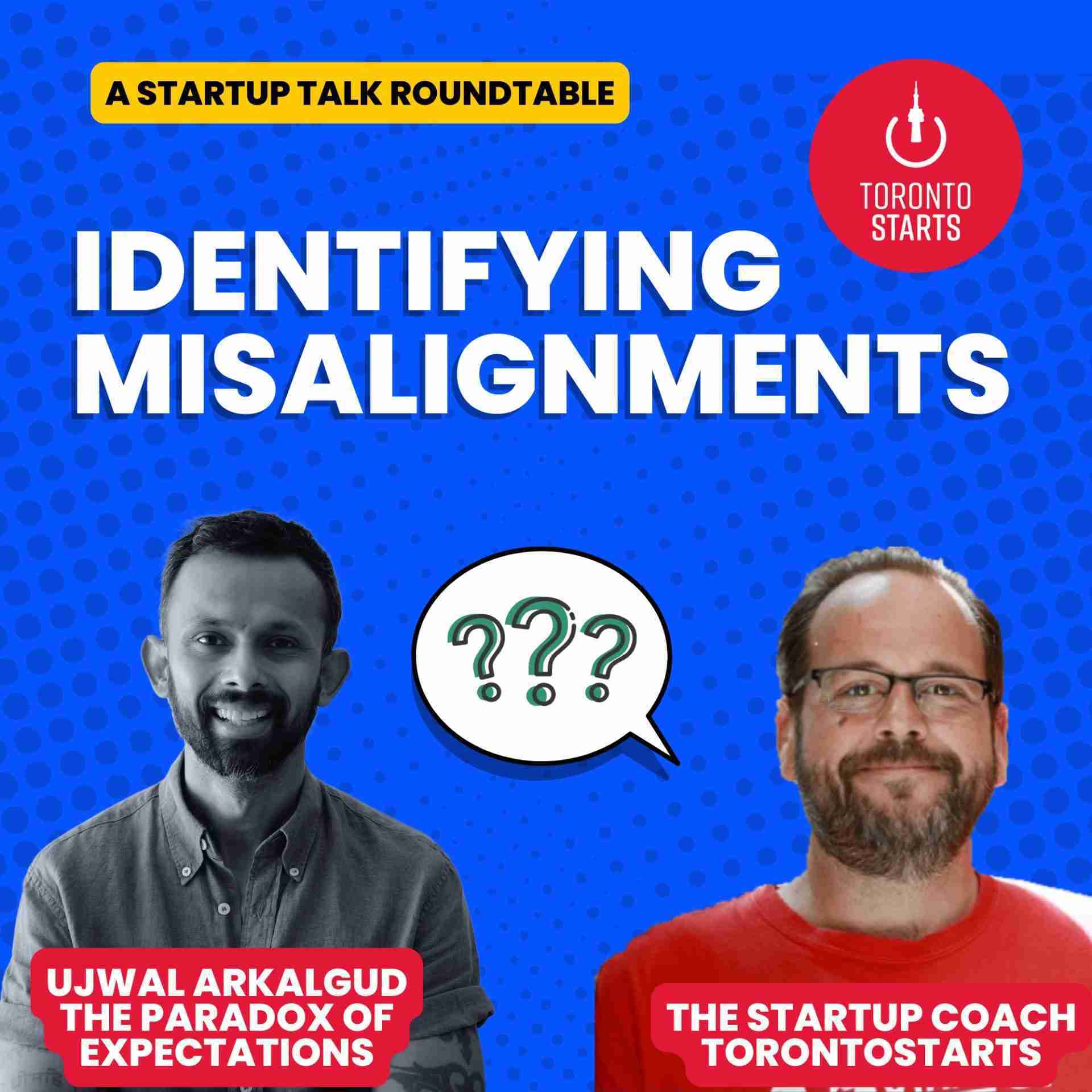
Mastering Startup Growth: Identifying Misalignments Welcome to this episode of the Startup Talk Podcast, where we explore the art of Identifying Misalignments that can hinder early growth and create obstacles in the sales process. In this episode, our Startup Coach and Ujwal Arkalgud dive into strategies for founders to realign their approach by truly mastering […]
A TorontoStarts podcast
Estimated reading time: 4 minutes
Mastering Startup Growth: Identifying Misalignments
Welcome to this episode of the Startup Talk Podcast, where we explore the art of Identifying Misalignments that can hinder early growth and create obstacles in the sales process. In this episode, our Startup Coach and Ujwal Arkalgud dive into strategies for founders to realign their approach by truly mastering the process of Identifying Misalignments.
Guest: Ujwal Arkalgud, Cultural Anthropologist & Tech Entrepreneur
Ujwal Arkalgud is a Canadian cultural anthropologist turned tech entrepreneur who recently achieved an impressive 10x revenue exit from his B2B tech company. Drawing from his personal journey of navigating growth challenges, Ujwal has developed the “Tension Alignment Framework”—a practical tool designed to help growth-stage companies align products, customers, and market dynamics for breakthrough sales results.
In addition to his entrepreneurial success, Ujwal is the author of the upcoming book, The Paradox of Expectation, which delves into the “tension model.” The book explores the innate conflict between societal expectations and our personal desires, providing fresh insights into how these tensions shape decision-making and behavior.
Links to Learn More About Ujwal:
- Investment Company: Investment Ark
- Newsletter: Decision Lab
- Upcoming Book: The Paradox of Expectation
- LinkedIn: linkedin.com/in/ujwalarkalgud
Understanding Identifying Misalignments
In this segment, we examine how founders can tell the difference between a long sales cycle and genuine misalignment. By closely observing client signals—such as enthusiastic nods that fail to convert into timely decisions—startups learn the importance of Identifying Misalignments early. This careful analysis not only improves their market approach but also paves the way for more efficient decision-making processes centered on Identifying Misalignments.
Tactical Approaches to Identifying Misalignments
The conversation then shifts to practical tactics for Identifying Misalignments, such as tracking executive transitions and mapping cultural tides. These techniques help pinpoint the precise moment when customer expectations diverge from the offered solution. By leveraging pilot projects and breaking down larger challenges into micro decisions, startups can continuously refine their process of Identifying Misalignments. Over time, these iterative steps build credibility and enable more agile market positioning.
Ultimately, mastering Identifying Misalignments empowers startups to harness customer advocacy and convert early interest into decisive action. As our speakers have shown, being keen on Identifying Misalignments transforms long sales cycles into short, actionable steps for success.
Additional Links
• Silicon Scoop Podcast – Stay Informed, Stay Ahead!
• Futuretech Podcast – Explore more episodes and stay updated with the latest in technology and innovation.
• Startup Talk Podcast – https://torontostarts.com/startup-talk-toronto-startup-podcast/
• Who Are These Startups Podcast
• Startup Investor Drinks – Join the community and connect with fellow startup enthusiasts and investors.
• TorontoStarts Startup and Entrepreneur Community – Become a part of Toronto’s thriving startup ecosystem.
• Workhaus – Discover flexible workspace solutions for your business needs.
• Work with The Startup Coach – Get expert guidance and mentorship for your startup journey.
• Reach out to Jon Irwin on LinkedIn – Connect with our co-host and technology expert.
Ontario Startup Ecosystem Links
• Ontario’s Startup Ecosystem
• Startup Funding in Ontario
• Angel Investors in Ontario
• Ontario Incubators and Accelerators
• Venture Capital in Ontario: Top Firms, Sectors, and Funding Strategies
• Government Grants for Ontario Startups
• Ontario’s Startup Success Stories
• Ontario Centre of Innovation (OCI)
• Bank Loans and Financing for Startups in Ontario
• Research and Development Tax Credits in Ontario
• Government Loans and Financing for Startups in Ontario
• Equity Crowdfunding for Ontario Startups
• Toronto Entrepreneurs Resources
• Toronto’s Food and Beverage Entrepreneurs: Trends, Challenges, and Success Stories
• SEO Strategies for Toronto Entrepreneurs: Enhance Your Online Visibility
• Social Impact for Toronto Entrepreneurs: Starting and Running a Socially Responsible Business
• Toronto Arts and Media Entrepreneurs: Inspiring Profiles and Insights for Creative Success
• Exploring Toronto Green Tech Entrepreneurs: Innovators and Leaders in Sustainability
• Building a Team for Toronto Entrepreneurs: Strategies for Success
• A Guide for Toronto Food and Beverage Entrepreneurs
• Toronto Fashion and Retail Entrepreneurs: Trends, Opportunities, and Success Stories
Episode transcript
Read the full transcript
Speaker 0: you mentioned being trapped by misaligned products, customers, market dynamics early on. how do you identify these misalignments, and what steps did you take to address them?
Speaker 1: i mean, the biggest one, you know, everybody talks about product market fit. right? the biggest misalignment and this is a painful one. you know, you're on a sales call, and especially in b two b tech, everybody will know what this feels like. you're on a sales call and the prospects nodding along. they're loving everything you're saying, but they don't buy. and then the sales cycle just keeps dragging on, you know, month, two months, six months. and, you know, the worst part is you start to believe that maybe in our industry, sales cycles are in fact long. you know, initially, our sales cycles were six months. once we dialed it in, it was anywhere from thirty to forty days. so what was the big difference? the unlock started to happen when we asked that expectation question. i'll give you a great example of this. you know, we realized that, the researchers that would buy our technology, their biggest problem was they wanted a seat at the big kids' table. you know, all these researchers traditionally in large corporations, they were seen as sort of and i'm simplifying. they were seen as the nerds of the group. right? they're not brought into the big decision making conversations. they're told, i'm gonna give you five minutes in front of the cmo. come make a presentation. and they have no power, and they all wanted a seat at the big kids' table because, you know, consumer trends were evolving like crazy. and we've seen this the last decade, and it continues this way. you know, the human identity is changing and evolving. it's becoming more and more complex. and, we knew that when we started asking the expectation question, if our technology could allow these clients of ours to show their bosses something that made them kinda go, i haven't thought about it this way, or lean in and go, oh, that's interesting. i don't think i can explain that to the cmo. so can you join me in this really important meeting so you can lead it? that started to happen when we asked the expectation question. and this is kind of the inspiration for the paradox of expectation book that i'm writing as well because i realized that, you know, we're all told so much about how to do usability and how to build technology and, you know, how to look at ebitda and how to manage your growth numbers and blah blah blah. but, actually, ultimately, we're all human beings. we're operating in a marketplace where we are all making decisions as much as we don't like to admit it always. we're making decisions based on our beliefs and our value systems and emotions. and i think the whole mantra of being an anthropologist running a business, and i realized this only as time went on, is that that became sort of a key superpower for me because i started to realize that the better i did at tapping into the emotional side of the equation, the better our business did.
Speaker 0: so we had a thing coming here from adrian. thanks for watching, adrian. in the mining industry, and heavy industries, saas offers can take two to three year sales cycle, which is a great point. you know? how do you know that you're misaligned or that you're just in a long sales cycle? like, sometimes it's one and sometimes it's the other. how do you know which it is?
Speaker 1: yeah. so there's sort of three things that i look for. you know, the first thing as i mentioned is, you know, clients nodding along saying, yes. yes. yes. everything's great. and then they stop responding to you or they take a long time. they give you timelines, but the timelines are never met. so that's one area. right? and we often put it back on the client. oh, the client's terrible at decision making. they don't have, you know, the authority to make these decisions. but the reality is if that pattern happens where somebody's saying yes, but then they go dark on you, that's one, key component. another one is the existing clients that you do have, are they advocating on your behalf without you having to ask? and i will tell you this, and i've seen this not just with my own business, also with the businesses that i coach, is the moment alignment starts to happen, that automatic, sort of i wanna champion your business, it just starts automatically. you never have to ask a customer. they just start doing it. so that's another sign. if that's not happening organically with your existing customers, that's another sign usually that things aren't really going well. the third one is, you know, we all talk about and this mining question is a good one because we all talk about budget cycles. right? and everybody knows that, and and it doesn't take a lot to understand budget cycles among your customer base. but what i also like to understand is the cultural cycle. so i'll give you an example. we used to sell into the retail industry. we also sold into the cpg industry. we also sold into the health care industry and so on. this year, there may be a cultural tide really affecting the beauty industry because clean beauty is becoming a thing and everybody cares about it. next year, beauty is gonna be killing it, and the customer is not gonna care about changing any solutions. but there may be another cultural tide happening in the health care industry where everybody's freaking out about something else, and now everybody's changing their solutions. right? so cultural tides are really important to understand because cultural tides are what will circumvent budget cycles. so if there's a cultural cycle, so some pressure, external pressure, it will shorten the decision making timeline. so that's really important to understand. often, we don't pay attention to that. and then the third thing that i talk about often is what i call micro decisions. so, you know, if you look at the cycle for big decisions, like a platform change, that might happen every one, two, three, four years depending on your industry. but what happens is and if you think about it as the sociology of risk, how does the human brain manage risk? we manage risk by one, getting a new solution when something is forcing us to do so. new boss, we better prove we're good, or something is changing in culture, trends are changing, we better change something. right? so there's pressure. or the other way we manage risk is we say, okay. i'm not gonna make any big decisions. i'll just make a bunch of smaller ones over time. so that's the other side. so i call them micro decisions, and we have to think about what are all those micro decisions and how can we play a role there. and by the way, i'm not saying run pilots because it's the death of any startup. what i mean is how do you build micro products that can serve those micro decisions? we have to do that so that what happens is you eventually start selling components and components and components before you can sell the full saas offering, and then you can start to grow that saas offering. but sometimes you need those components, and the power of those components is that it prevents you from having to do the the sort of dreaded pilot, which, you know, is a waste of your time and everybody else's.
Speaker 0: all good at points. adrian also mentioned it's urgency that's not clear, though the need is, and some only move the needle during quarterly meeting or budgeting sessions, etcetera. so
Speaker 1: yeah.
Speaker 0: do you have thoughts on, you know, how to increase the urgency when the need is clear?
Speaker 1: yeah. i mean, i go back to the previous, point i made about expectations. if you go through sort of the three why questions on expectations, so the immediate person i'm selling to, what do they expect from a piece of technology, not just from us, from any piece of technology. let's say, what do their bosses expect from them? if you go through those three whys, you will find the urgency very, very quickly. so for example, you know, in our case, one of the things that really drove urgency was we knew that anytime there was a change of guard, so anytime there was a new executive, it always drove urgency. so we literally had trackers built so that we would know which companies, in our potential customer pool had any executive change happening. and we knew that in the first three months, the executive change was the time to strike because, that's when, you know, the chief technology officer is doing calls with all the vps, and the vps better have smart things to say in those meetings. so, you know, you just have to map the three whys. and, unfortunately, you know, i say this to a lot of founders all the time, especially with scale, there's just no shortcuts. and, honestly, through my experience, what i've learned is the smarter you get at the illogical side of the market, the better your results are going to be. because, otherwise, you can't compete. everybody else knows the logical stuff. everybody knows how to map a market and how to identify so called icp and all that jazz.
Speaker 0: i like what you're saying where you're getting all the people on your side. and so when they're talking to the new cio, ceo, whatever, that he's hearing the or she is hearing the same thing or they are hearing the same thing from, different people, which validates what you're doing or supports what you're doing. it's always a good strategy. i have had that in several companies that i worked with or worked in where i would always plant the seed with my peers at a certain level. by the time i got to the ceo, they were asking me about my proposal, not me having to propose it. and it became a completely different thing because we had all these people on board. and that's the way to go. i mean, it's a question of are you moving the needle, and are the conversations happening inside the organization that you need them to?
Speaker 1: absolutely. you know, the other thing i talk about a lot, and i'm, you know, doing a lot of research on this where i'm studying hundreds of different entrepreneurs, not just companies, who are doing interesting things. i'll give you an example. there's a woman named dominique brown. she, makes black art inspired and black culture inspired decor and has an incredible collaboration with target and, i think, now macy's and a bunch of other retailers. the interesting thing is she didn't start when she realized that, hey. there was no black art or representative art and decor available in america. she didn't rage a war against the mainstream. because the challenge is we all have this, belief that, oh, the industry is doing it all wrong. and i thought this through too when we started our research technology. and i said, i would love to just wage a war because all your research methods are wrong. they're not good, and i'm gonna fix it. right? nobody wants that. nobody wants that kind of a challenge. it doesn't work. it's actually detrimental to your business. what you need is to figure out how to create a safe space wherein you can go and create small solutions and get small wins and slowly expand on them. so in dominique brown's case, she won by first doing a puzzle. she had the number one puzzle on this website, and the puzzle was black art inspired, but it was a puzzle. you know? it's like, if you think about it in the grand scheme of things, it's sort of a low point of tension, taking on a puzzle that becomes a huge success since a buyer at target notices that and the rest is history. but she didn't fight that by going to every single retailer and saying, hey. you don't have this, and let me try to do it, and nobody would have listened. the same happened with us too. you know? we didn't try to change everything. we started to do some research and we realized, okay. what is the one small area where we could give ourselves a little bit of a safe space where there's not a lot of incumbent solutions because we were competing against billion dollar incumbents. and we found that space was the trend analysis space. so we created a small niche for ourselves, and we didn't try to solve all the problems for the first, i think, four years. that's all we focused on, and we slowly built credibility. and that credibility then allowed us to go much broader, eventually getting, you know, million dollar enterprise wide contracts.
More from Startup Talk
All episodes
startup-talk · April 10, 2025
10x Revenue Exit
Discover actionable insights for achieving a 10x Revenue Exit through strategic scaling, profitability, and smart bootstrapping. https://torontostarts.com/2025/04/10/10x-revenue-exit/ Apple -> https://podcasts.apple.com/us/podcast/startup-talk/id1763804003 Spotify -> https://open.spotify.com/show/1siJMILILidHAiAsrX2VBU YouTube: https://youtube.com/playlist?list=PLj4v-RoA7A-jxV5FHs5e61oIsuvUJYmT_&si=LYegRe5GYLKNQ7xL Flowgrammer Apple -> https://podcasts.apple.com/us/podcast/flowgrammer-podcast/id1804155588 Spotify -> https://open.spotify.com/show/0wv3feR00iaVpE8zn7niNf Flowgrammer.ca -> https://flowgrammer.ca/ AI News and Resources -> https://flowgrammer.ca/resources/ Silicon Scoop Silicon Scoop Podcast - https://torontostarts.com/silicon-scoop/ Apple: https://podcasts.apple.com/us/podcast/silicon-scoop/id1758711826 Spotify: https://open.spotify.com/show/5bAzF0MwV6TtLhJAhvHayI YouTube: https://www.youtube.com/playlist?list=PLj4v-RoA7A-gT62vrEYqh1zCv-0Hj-o5J Startup Investor Drinks Toronto - https://startupdrinksto.com/ Toronto’s Startup Community - https://torontostarts.com/
View episode
startup-talk · April 8, 2025
Product Market Fit with Lauft
Product Market Fit with Lauft Welcome to Episode 217 of the Startup Talk Podcast, where we explore Product Market Fit in a conversation with Graham Wong, Founder and CEO of Lauft. Listen in as the Startup Coach uncovers how Lauft transformed a personal need into a thriving flexible workspace solution and discovered exactly what their […]
View episode
startup-talk · April 6, 2025
Know Yourself – Unlocking Entrepreneurial Potential
Discover how to Know Yourself as an entrepreneur to unlock your potential and overcome challenges in today's startup world. https://torontostarts.com/2025/04/06/know-yourself-unlocking-entrepreneurial-potential/ Apple -> https://podcasts.apple.com/us/podcast/startup-talk/id1763804003 Spotify -> https://open.spotify.com/show/1siJMILILidHAiAsrX2VBU YouTube: https://youtube.com/playlist?list=PLj4v-RoA7A-jxV5FHs5e61oIsuvUJYmT_&si=LYegRe5GYLKNQ7xL Flowgrammer Apple -> https://podcasts.apple.com/us/podcast/flowgrammer-podcast/id1804155588 Spotify -> https://open.spotify.com/show/0wv3feR00iaVpE8zn7niNf Flowgrammer.ca -> https://flowgrammer.ca/ AI News and Resources -> https://flowgrammer.ca/resources/ Silicon Scoop Silicon Scoop Podcast - https://torontostarts.com/silicon-scoop/ Apple: https://podcasts.apple.com/us/podcast/silicon-scoop/id1758711826 Spotify: https://open.spotify.com/show/5bAzF0MwV6TtLhJAhvHayI YouTube: https://www.youtube.com/playlist?list=PLj4v-RoA7A-gT62vrEYqh1zCv-0Hj-o5J Startup Investor Drinks Toronto - https://startupdrinksto.com/ Toronto’s Startup Community - https://torontostarts.com/
View episode