
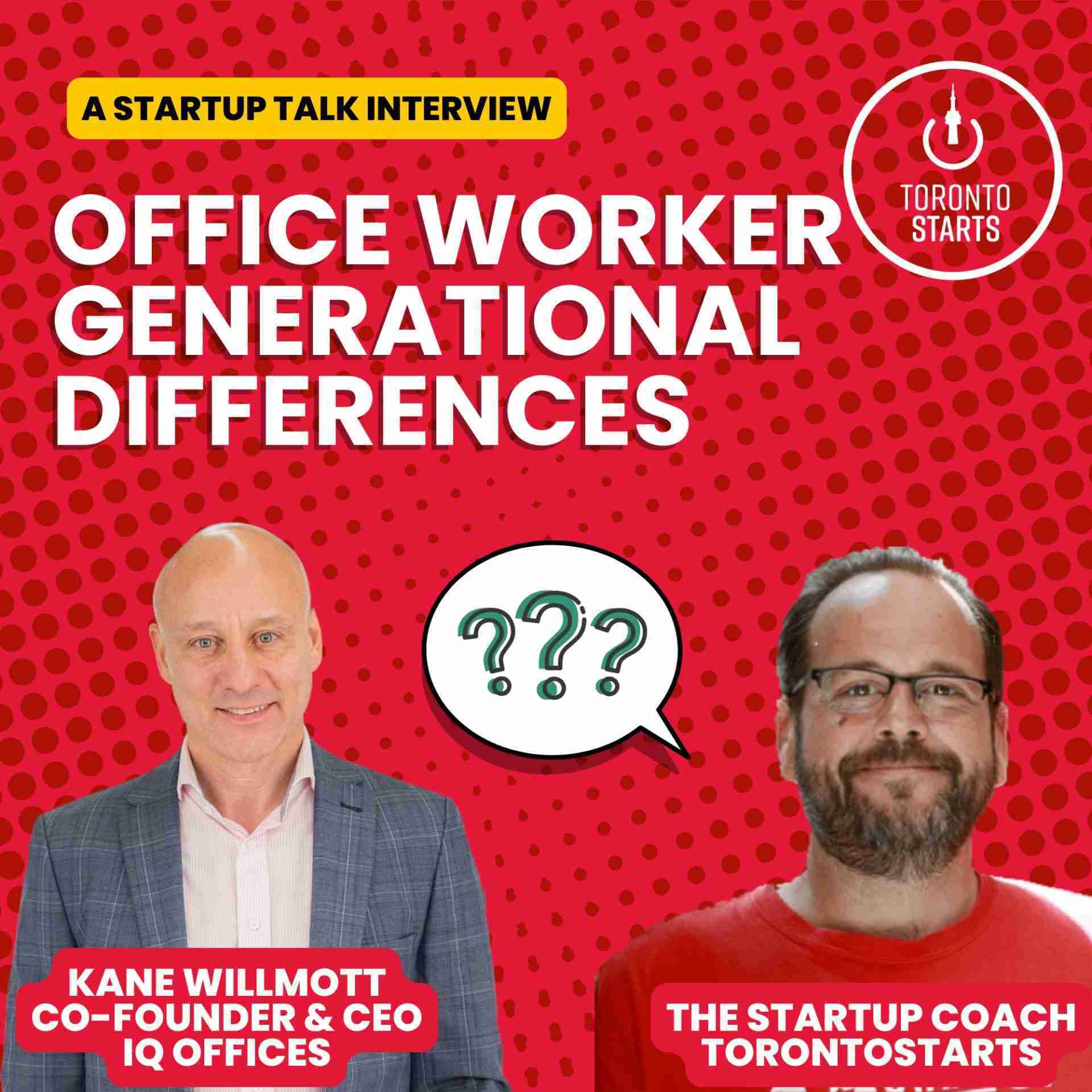
Office Worker Generational Differences
Office Worker Generational Differences: Insights and Trends from Startup Talk Podcast IntroductionIn this episode of the Startup Talk Podcast, we dive into Office Worker Generational Differences and explore how various generations view and engage with office environments. The conversation examines survey data revealing that Gen Z, Millennials, and Gen Xers each have distinct attitudes toward […]
A TorontoStarts podcast
Estimated reading time: 4 minutes
Office Worker Generational Differences: Insights and Trends from Startup Talk Podcast
Introduction
In this episode of the Startup Talk Podcast, we dive into Office Worker Generational Differences and explore how various generations view and engage with office environments. The conversation examines survey data revealing that Gen Z, Millennials, and Gen Xers each have distinct attitudes toward returning to the office, highlighting the importance of in-person mentorship, collaboration, and the social dynamics of a well-designed workspace.
Guest: Kane Willmott, Co-Founder & CEO of iQ Offices
Kane Willmott is the Co-Founder and CEO of iQ Offices, Canada’s largest independent Canadian-owned coworking operator. With a background in real estate brokerage, Kane has leveraged his expertise to build and scale iQ Offices into a leader in the coworking space.
A trusted voice on the future of work, workplace dynamics, and building purpose-driven teams, Kane offers valuable insights at a time when return-to-office requirements are reshaping the workforce. His perspective is highly relevant to both entrepreneurs and the broader Canadian workforce.
Links to Learn More About Kane & iQ Offices:
- Website: iqoffices.com
- Instagram: @iqoffices
- LinkedIn: iQ Offices
- Facebook: iQ Offices Canada
Additional Resources:
- Survey Findings: What Motivates Canadians to Return to the Office
Key Takeaways on Office Worker Generational Differences
- Survey Insights: The discussion begins with a surprising statistic—76% overall willingness to return to the office, with 92% of Gen Z, 83% of Millennials, and 69% of Gen Xers embracing the office environment.
- Mentorship & Collaboration: The episode emphasizes that Office Worker Generational Differences are not merely about numbers; they reflect deeper values such as mentorship, spontaneous interactions, and the benefits of face-to-face collaboration.
- Lifestyle Considerations: Lifestyle factors, such as family obligations, play a significant role in these differences, as the panelists note that while younger generations crave dynamic office experiences, older generations balance professional and personal commitments differently.
Discussion on Office Worker Generational Differences
Our hosts discuss how the physical workspace offers intangible benefits that technology alone cannot replace. They argue that leveraging the advantages of in-person interaction can significantly boost productivity and innovation. By understanding Office Worker Generational Differences, companies can tailor their workspaces and policies to meet diverse needs while fostering a cohesive culture.
Final Thoughts
This episode provides valuable insights into how companies can bridge Office Worker Generational Differences through smart workspace design and flexible work arrangements. The discussion also underscores the need for balancing technology with personal interaction to cultivate a vibrant work culture.
Additional Links
• Silicon Scoop Podcast – Stay Informed, Stay Ahead!
• Futuretech Podcast – Explore more episodes and stay updated with the latest in technology and innovation.
• Startup Talk Podcast – https://torontostarts.com/startup-talk-toronto-startup-podcast/
• Who Are These Startups Podcast
• Startup Investor Drinks – Join the community and connect with fellow startup enthusiasts and investors.
• TorontoStarts Startup and Entrepreneur Community – Become a part of Toronto’s thriving startup ecosystem.
• Workhaus – Discover flexible workspace solutions for your business needs.
• Work with The Startup Coach – Get expert guidance and mentorship for your startup journey.
• Reach out to Jon Irwin on LinkedIn – Connect with our co-host and technology expert.
Ontario Startup Ecosystem Links
• Ontario’s Startup Ecosystem
• Startup Funding in Ontario
• Angel Investors in Ontario
• Ontario Incubators and Accelerators
• Venture Capital in Ontario: Top Firms, Sectors, and Funding Strategies
• Government Grants for Ontario Startups
• Ontario’s Startup Success Stories
• Ontario Centre of Innovation (OCI)
• Bank Loans and Financing for Startups in Ontario
• Research and Development Tax Credits in Ontario
• Government Loans and Financing for Startups in Ontario
• Equity Crowdfunding for Ontario Startups
• Toronto Entrepreneurs Resources
• Toronto’s Food and Beverage Entrepreneurs: Trends, Challenges, and Success Stories
• SEO Strategies for Toronto Entrepreneurs: Enhance Your Online Visibility
• Social Impact for Toronto Entrepreneurs: Starting and Running a Socially Responsible Business
• Toronto Arts and Media Entrepreneurs: Inspiring Profiles and Insights for Creative Success
• Exploring Toronto Green Tech Entrepreneurs: Innovators and Leaders in Sustainability
• Building a Team for Toronto Entrepreneurs: Strategies for Success
• A Guide for Toronto Food and Beverage Entrepreneurs
• Toronto Fashion and Retail Entrepreneurs: Trends, Opportunities, and Success Stories
Episode transcript
Read the full transcript
Speaker 0: what generational differences or attitudes did you get from the survey?
Speaker 1: so that was interesting too. so let's go back to the the ones the stat that i thought was so interesting that seventy six percent of people would go back to the office. so we drilled down further on that and said, okay. that's interesting. but now let's drill it down by generation. so it's we found out that, gen zers, ninety two percent said they would go to the office, for, like, for all the things, all things you and i just talked about, which is the snacks, the beverages, the central location, the amenities. eighty, for millennials, it was eighty three percent, and for gen xers, it was sixty nine percent. so it's still a high percentage, and i i suspect it has to do with lifestyle. so gen xers just you know, they have kids and, like, millennials are having kids, obviously, you know, now as well. and, but the one thing i see in that to me is a little bit troubling is that the gen xers, like me, had the benefit of working in an office every single day with a highly skilled mentor that taught me everything that i know. and the fact that people in my age bracket are less engaged to the office, i it i i believe that does a disservice. i mean, we're talking about sixty nine percent. so this is not like a small percentage, but i'm saying there's a variance. i'm saying there's the the the gen zers, the people that are coming into the workforce, ninety two percent of them say, like, give me the right office, give me the right circumstance. i'd love to come to the office. right? and a smaller percent the, of the gen z'ers. so, you know, my hope is that is that, you know, over time, the in person interaction, the benefit that you get of being close to, close to other people in your space, how much you learn from being around other people. i mean, you know, we're we're pack animals. right? like, there's a reason that we don't all live in cabins up in northern canada where you can buy a place for a hundred thousand dollars. we all live in the city where you buy a place for a crazy amount of money because we all wanna be together. that's the reality. right? so if we can create these environments, and then we can attract everybody and have them come into the office, i i just think it's a better situation for all involved, subject, of course, to lifestyle. i mean, you have people have obligations. they gotta take care of those obligations, and and we all understand that. that and, absolutely, companies should be making, you know, like, a situation where they're taking care of those of people's needs that they have outside of the office, of course. but i do think in person is very important. i'm super biased. you know, i'm super biased because i'm i'm, first of all, in the workspace business, and i also grew up in a very office centric environment, you know, so throughout my career. but what's interesting is you would expect it would go the other way. like, maybe the gen zers would say, well, i can talk i can text people. i'm comfortable with technology. i've never i've never been in an office. like, you know, i haven't been in an office for thirty years. right? like, i'm good. i work from home. that's cool. but it's actually not. it's not the case. it's that those those people wanna come to the office because they're seeing the benefits of being in the office. and a big part of that is being around the people that they can mentorship them.
Speaker 0: yeah. and i think in the last several years, mentorship and coaching has taken a hit for a number of reasons. let's hope that it does get back. and you're right about you're missing stuff if you're not in the office because, you know, you don't know what goes on when they mute the phone. you're not talking to your boss when you go get a coffee in between, you know, calls in the meetings. you're not there's a lot of conversations that don't happen. and when that project or that job or that raise comes up, the vision or image in your boss's head isn't the phone or whatever. it's the person they've been talking to this whole time. so you miss there's something missing from not being in the room, and it's funny. you gotta take advantage of your space. and i guess i've always done this. when i was a project manager at davidson henderson, i would sit in the kitchen area. they had all these standing tables and whatever. i'd sit at one of them in the morning, while people are going to get the coffee. and my boss came to me one day, and he says, i always see you here in the morning. like, why are you here? and i said, just sit with me for ten minutes. and in ten to fifteen minutes, i got all my project updates from all the people on my project teams who went and got their morning coffee.
Speaker 1: i didn't have
Speaker 0: to call them. i didn't have to do them and say, hey. how was this? and all of a sudden, the light bulb went on. he's like, oh, okay. off he went. mhmm. and it's just taking advantage of that situation where, you know, people congregate. you can get their updates. you're not having to call them. you're not interrupting their work. you're not and everybody's in a very comfortable environment. so i think there's definitely advantages to being at the office that we don't experience, when we're remote even though we have some great tools to culturally keep that connection.
Speaker 1: yeah. thank god we had the technology through covid. because i like, back when i started in ninety eight, like, you know, i had a desk with a massive computer on it and a phone and a cell phone that was costing me four dollars a minute. right? so imagine if we had went through covid in that environment. right? that, like, it it would have been horrible. right? so the technology is a great way for us to stay updated, i think. you know? it's a it is a good way to connect. we have offices in ottawa, montreal, vancouver, and i'm in i'm i'm based out of toronto, so i travel to those markets, but but i'm able to see them every friday. right? we can hop on the zoom call, and i can see them. so it's great, and i love that technology. but what i will say and what i've experienced is when we as a group are in the office together, we move faster because i don't have to schedule a zoom call with you when you have an opening on your calendar in three days from now to talk about the thing that's on my mind. i just wanna i just wanna walk to your desk, and i wanna ask you a question. and you could probably answer it like that, and either we have something to explore, maybe we don't have anything to explore. right? but we can move so quickly when we're in the office together. and i don't necessarily think that that means that everybody's gotta be in the office five days a week. i think what is somewhat unfair is that when i started in ninety eight, when i left, i, you know, i still did work, but not to the same extent now. i mean, i like, i always have my phone with me all the time. right? so there's a different expectation. right? and i wouldn't say expectation. i would say there's a difference in mindset of because you have this phone on, like, on you and you get that email at ten o'clock at night, you're like, i wanna respond to this. i just wanna do this and get it done. right? so having people go into the office and be present in the office and then go home to their families and not be present, that doesn't work either. right? so i think there i think there can be a great balance. i really do. i think there could be a great balance where everybody's schedules and needs can be accommodated, but there's still an opportunity to be in the office together and have really very, like, like, meaningful, meaningful time together, and it can be compressed. it could be quality versus quantity, right, in terms of the time that people spend together. and that's something that we're able to offer because you don't have to have an office manager that's there when no one else is. right? because, you know, that space will keep running even if you're not in that day. that's okay. right? you still have your workspace. it's still gonna be amazing when you walk into it. if you decide to go in on monday or if you don't decide to go in on monday, it's still running. right? and, and so that's, like, that's a a big benefit. and i think that's, you know, it's something on the other side of covid it's, like, it's something that we're doing to serve our members that wasn't really there, like, before covid because there just wasn't that same amount of complexity. so i think in a lot of ways, the technology and covid created that we that a freedom and a mindset that we didn't have before, which i think is a benefit for everyone. but i think also too, if we can solve the supply gap, which is what that survey says, i think we can create also these environments where we can get the most in person interactions.
More from Startup Talk
All episodes
startup-talk · April 10, 2025
10x Revenue Exit
Discover actionable insights for achieving a 10x Revenue Exit through strategic scaling, profitability, and smart bootstrapping. https://torontostarts.com/2025/04/10/10x-revenue-exit/ Apple -> https://podcasts.apple.com/us/podcast/startup-talk/id1763804003 Spotify -> https://open.spotify.com/show/1siJMILILidHAiAsrX2VBU YouTube: https://youtube.com/playlist?list=PLj4v-RoA7A-jxV5FHs5e61oIsuvUJYmT_&si=LYegRe5GYLKNQ7xL Flowgrammer Apple -> https://podcasts.apple.com/us/podcast/flowgrammer-podcast/id1804155588 Spotify -> https://open.spotify.com/show/0wv3feR00iaVpE8zn7niNf Flowgrammer.ca -> https://flowgrammer.ca/ AI News and Resources -> https://flowgrammer.ca/resources/ Silicon Scoop Silicon Scoop Podcast - https://torontostarts.com/silicon-scoop/ Apple: https://podcasts.apple.com/us/podcast/silicon-scoop/id1758711826 Spotify: https://open.spotify.com/show/5bAzF0MwV6TtLhJAhvHayI YouTube: https://www.youtube.com/playlist?list=PLj4v-RoA7A-gT62vrEYqh1zCv-0Hj-o5J Startup Investor Drinks Toronto - https://startupdrinksto.com/ Toronto’s Startup Community - https://torontostarts.com/
View episode

startup-talk · April 8, 2025
Product Market Fit with Lauft
Product Market Fit with Lauft Welcome to Episode 217 of the Startup Talk Podcast, where we explore Product Market Fit in a conversation with Graham Wong, Founder and CEO of Lauft. Listen in as the Startup Coach uncovers how Lauft transformed a personal need into a thriving flexible workspace solution and discovered exactly what their […]
View episode

startup-talk · April 6, 2025
Know Yourself – Unlocking Entrepreneurial Potential
Discover how to Know Yourself as an entrepreneur to unlock your potential and overcome challenges in today's startup world. https://torontostarts.com/2025/04/06/know-yourself-unlocking-entrepreneurial-potential/ Apple -> https://podcasts.apple.com/us/podcast/startup-talk/id1763804003 Spotify -> https://open.spotify.com/show/1siJMILILidHAiAsrX2VBU YouTube: https://youtube.com/playlist?list=PLj4v-RoA7A-jxV5FHs5e61oIsuvUJYmT_&si=LYegRe5GYLKNQ7xL Flowgrammer Apple -> https://podcasts.apple.com/us/podcast/flowgrammer-podcast/id1804155588 Spotify -> https://open.spotify.com/show/0wv3feR00iaVpE8zn7niNf Flowgrammer.ca -> https://flowgrammer.ca/ AI News and Resources -> https://flowgrammer.ca/resources/ Silicon Scoop Silicon Scoop Podcast - https://torontostarts.com/silicon-scoop/ Apple: https://podcasts.apple.com/us/podcast/silicon-scoop/id1758711826 Spotify: https://open.spotify.com/show/5bAzF0MwV6TtLhJAhvHayI YouTube: https://www.youtube.com/playlist?list=PLj4v-RoA7A-gT62vrEYqh1zCv-0Hj-o5J Startup Investor Drinks Toronto - https://startupdrinksto.com/ Toronto’s Startup Community - https://torontostarts.com/
View episode