
NASA’s Quiet X-59 Supersonic Jet
NASA’s Quiet X-59 Supersonic Jet: Breaking Sound Barriers Without the Boom Estimated reading time: 7 minutes Key Takeaways The X-59 Supersoinc Jet aims to make supersonic flight a reality without disruptive sonic booms. Traditional regulations, stemming from FAA bans, have limited supersonic flights over land. The innovative design focuses on reducing shock waves to create a […]
With Craig Major and Jon Irwin
NASA’s Quiet X-59 Supersonic Jet: Breaking Sound Barriers Without the Boom
Estimated reading time: 7 minutes
Key Takeaways
- The X-59 Supersoinc Jet aims to make supersonic flight a reality without disruptive sonic booms.
- Traditional regulations, stemming from FAA bans, have limited supersonic flights over land.
- The innovative design focuses on reducing shock waves to create a quieter sonic signature.
- Successful test flights could reshape the future of commercial aviation.
- Public acceptance will be crucial for overcoming regulatory hurdles.
Table of contents
- Introduction to the X-59 and its Mission
- The Problem with Traditional Supersonic Flight
- X-59 Quiet Supersonic Technology Breakdown
- Progress Timeline and Next Steps
- Implications for Commercial Supersonic Travel
- How the X-59 Works: The Science Behind Quiet Supersonic Flight
- FAQ: NASA’s X-59 Quiet Supersonic Jet
- Conclusion: Breaking Barriers Beyond Sound
Supersonic flight has long captivated our imagination, promising to shrink our world by dramatically reducing travel times. Yet, for decades, this technology has remained largely grounded due to one persistent problem: the thunderous sonic boom. NASA’s Quiet X-59 Supersonic Jet Technology aircraft aims to change this narrative forever, potentially ushering in a new era of commercial supersonic travel.
Introduction to the X-59 Super Sonic Jet and its Mission
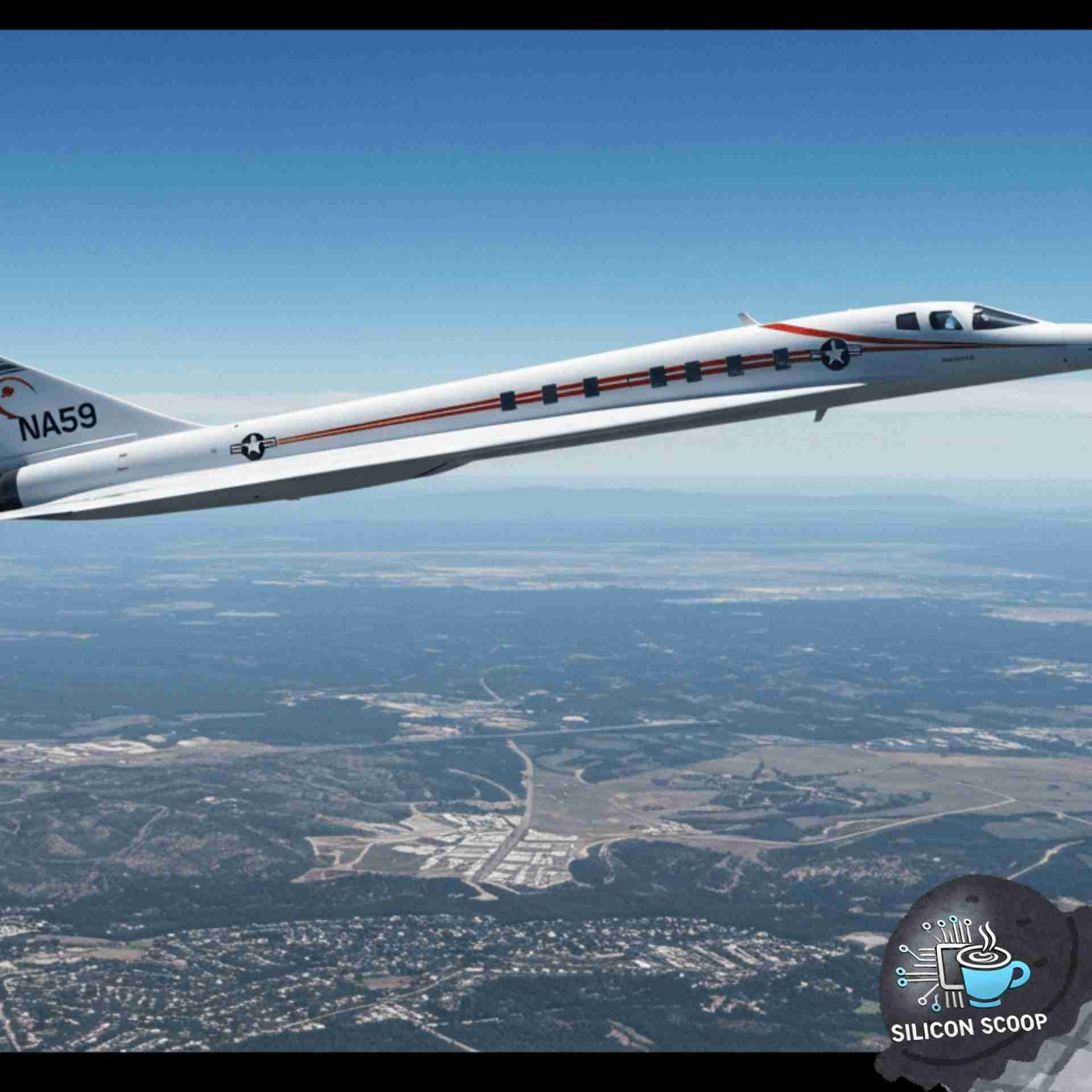
NASA’s X-59 represents one of the most ambitious supersonic jet projects in recent history. This experimental aircraft is the centerpiece of NASA’s Quesst mission (Quiet SuperSonic Technology), with a revolutionary goal: transforming the disruptive sonic boom into a gentle sonic “thump.”
When aircraft travel faster than sound, they create powerful shock waves that merge to form the characteristic sonic boom—a sound so intense it can shatter windows and startle people and wildlife. The X-59’s mission is to demonstrate that supersonic flight can be achieved without these disruptive booms, potentially lifting restrictions that have limited supersonic travel over land for half a century.
The slender, 99-foot-long aircraft features a distinctive design with a purpose: to fly at speeds of about 925 mph (Mach 1.4) at 55,000 feet while producing a sound no louder than a car door closing when heard from the ground.
The Problem with Traditional Supersonic Flight
Supersonic travel hit a regulatory wall in 1973 when the Federal Aviation Administration (FAA) banned supersonic flight over land in the United States. This decision wasn’t arbitrary—the powerful sonic booms created by supersonic aircraft were deemed too disruptive to communities below flight paths.
This regulation effectively clipped the wings of commercial supersonic flight. Even the iconic Concorde, which operated from 1976 to 2003, was restricted to transoceanic routes, significantly limiting its commercial viability. Combined with high operational costs and fuel inefficiency, these restrictions contributed to the Concorde’s eventual retirement.
The sonic boom problem created a catch-22 for supersonic travel: aircraft couldn’t fly supersonically over land due to noise concerns, but without these routes, the economics of supersonic travel remained challenging.
X-59 Supersonic Jet Quiet Technology Breakdown
Advanced Aerodynamic Design
The X-59’s most distinctive feature is its extremely long, needle-like nose, which constitutes nearly a third of the aircraft’s total length. This isn’t just for looks—it’s a key component of the sonic boom reduction strategy.
Traditional supersonic aircraft create multiple shock waves from different parts of the plane that merge together into the thunderous double boom heard on the ground. The X-59’s elongated nose helps to separate and weaken these shock waves before they can combine.
The aircraft also features a carefully shaped underside that’s smooth and free of protrusions. This design element prevents additional shock waves from forming and contributing to the sonic boom.
Engine Placement Innovation
Unlike conventional jets with engines mounted under the wings, the X-59 positions its F414-GE-100 engine on top of the fuselage. This strategic placement prevents the engine’s shock waves from traveling directly to the ground and contributing to the sonic boom.
This top-mounted configuration required engineers to develop an innovative inlet system that prevents the boundary layer—the layer of air closest to the aircraft’s surface—from entering and disrupting engine performance.
Recent Testing Achievements
Between October 2024 and February 2025, the X-59 supersonic jet underwent critical ground tests to validate its structural integrity and systems performance. These tests included:
- Afterburner performance verification
- Taxi tests to assess ground handling
- Structural vibration assessments
- Software integration tests
Each test brought the aircraft closer to its first flight, confirming that the innovative design functions as intended.
Progress Timeline and Next Steps
Recent Milestones
The X-59 supersonic jet program has reached several critical milestones in its development journey:
- Structural assembly completed
- Engine integration finalized
- Electromagnetic interference checks conducted to ensure all electronic systems function properly without conflict
- Initial taxi tests performed to validate ground control systems
- Instrument calibration for accurate data collection during test flights
Current Challenges
Despite significant progress, engineers continue to address several challenges:
- Electromagnetic interference between systems requires ongoing refinement
- Pilot visibility—the long nose blocks the forward view, requiring an external vision system
- Vibration management during transsonic acceleration (passing through Mach 1)
- Fine-tuning the flight control software for the unique aerodynamics
Future Flight Schedule
The X-59’s testing program is proceeding methodically:
- First flight tentatively scheduled for mid-2025
- Initial flight envelope expansion tests
- Acoustic validation flights over unpopulated areas
- Community response testing planned for 2027, when the aircraft will fly over selected U.S. cities
- Data collection from ground sensors and community surveys to measure actual noise impact
These carefully planned flights will gather the essential data needed to demonstrate the X-59’s quiet supersonic capabilities and potentially change FAA regulations.
Implications for Commercial Supersonic Travel
Regulatory Impact
If the X-59 successfully demonstrates quiet supersonic flight, it could prompt the FAA to revise the current ban on overland supersonic flight. New rules would likely establish acceptable noise thresholds rather than speed limitations, opening the door for commercial applications.
This regulatory shift would fundamentally change the economics of supersonic travel, allowing direct routes over land that were previously impossible. Flight times between major cities could be cut in half or better.
Industry Response
Private companies are watching the X-59 program closely. Ventures like Boom Supersonic with their XB-1 demonstration aircraft are already developing commercial supersonic jets that would benefit from updated regulations.
Unlike the military-focused supersonic jets of the past, these new commercial designs prioritize efficiency and passenger comfort alongside speed. The lessons learned from the X-59 about shock wave management will likely influence these designs.
Economic Considerations
Commercial supersonic travel faces economic hurdles beyond just the sonic boom problem:
- Higher fuel consumption compared to subsonic flight
- Smaller passenger capacity due to aerodynamic constraints
- Higher maintenance costs for more complex systems
- Premium pricing requirements to offset operational expenses
The X-59 program doesn’t directly address all these challenges, but by potentially removing the regulatory barriers, it makes solving these problems economically worthwhile for commercial enterprises.
How the X-59 Supersonic Jet Works: The Science Behind Quiet Supersonic Flight
Shock Wave Physics
When an aircraft travels faster than sound, it creates pressure waves that cannot move ahead of the aircraft. These waves stack up, forming shock waves that contain compressed energy. In traditional supersonic aircraft, these shock waves merge into the characteristic N-wave pattern that causes the loud double boom.
The X-59’s design manipulates these shock waves in several ways:
- The long nose creates weaker, more diffuse initial shock waves
- The smooth underside prevents additional shock formation
- The carefully shaped fuselage prevents shock waves from different parts of the aircraft from merging
- The top-mounted engine places its shock waves away from ground-directed paths
Measuring Success
Success for the X-59 isn’t just about flying fast—it’s about flying quietly. NASA will measure the aircraft’s acoustic signature using:
- Ground-based microphone arrays to capture the actual sound profile
- Specialized chase aircraft with acoustic sensors
- Advanced computer modeling to compare predicted and actual noise levels
- Community surveys to assess human perception of the sounds
These measurements will determine whether the X-59 achieves its target of reducing the sonic boom to a level acceptable for routine overland flight.
FAQ: NASA’s X-59 Supersonic Jet
Q: When will the X-59 make its first flight?
A: The X-59 is tentatively scheduled for its first flight in mid-2025, following extensive ground testing and systems verification. This initial flight will focus on basic handling qualities and systems performance rather than sonic boom reduction.
Q: How much quieter is the X-59’s sonic thump compared to traditional sonic booms?
A: Traditional supersonic aircraft produce sonic booms measuring approximately 105-110 perceived decibels on the ground. The X-59 aims to reduce this to about 75 perceived decibels—roughly comparable to the sound of a car door closing in the distance or distant thunder.
Q: Could I fly on the X-59 someday?
A: No, the X-59 is strictly a research aircraft with a single-pilot configuration. It’s not designed to carry passengers or for commercial service. However, the technology it demonstrates could lead to commercial supersonic passenger aircraft in the future.
Q: How fast will the X-59 fly?
A: The X-59 is designed to cruise at approximately Mach 1.4, which is about 925 mph (1,488 km/h) at its cruising altitude of 55,000 feet. This is more than twice the speed of typical commercial airliners today.
Q: Why does the X-59 have such a long nose?
A: The X-59’s distinctive 30-foot nose serves a critical aerodynamic purpose: it helps separate and weaken shock waves before they can merge into a powerful sonic boom. This elongated shape is essential to the aircraft’s mission of reducing sonic boom intensity.
Q: How does the pilot see forward with such a long nose blocking the view?
A: The X-59 features an External Vision System (XVS) that uses forward-facing cameras and display screens in the cockpit to provide the pilot with a virtual forward view. This system compensates for the lack of a traditional forward windscreen.
Q: Will the X-59 lead to commercial supersonic travel?
A: If successful, the X-59 could lead to changes in FAA regulations that currently prohibit supersonic flight over land. This regulatory change would remove a major barrier to commercial supersonic travel and could spark development of passenger-carrying supersonic aircraft.
Q: How much does the X-59 program cost?
A: NASA contracted with Lockheed Martin for approximately $247.5 million to design, build, and deliver the X-59 aircraft. The total program cost, including testing and research, is significantly higher but represents an investment in technology that could transform civil aviation.
Q: Is the X-59 better for the environment than other supersonic aircraft?
A: The X-59 primarily focuses on noise reduction rather than emissions improvement. However, by using some off-the-shelf components and modern design practices, it is likely more efficient than older supersonic aircraft like the Concorde. Future commercial supersonic aircraft would need to address environmental concerns more comprehensively.
Q: What happens after the X-59 completes its testing program?
A: After completing its test program (expected to run through at least 2027), the data collected will be presented to aviation regulatory authorities like the FAA to support potential rule changes for supersonic flight. The aircraft itself may be preserved for historical purposes or repurposed for additional research.
Conclusion: Breaking Barriers Beyond Sound
The X-59 Quiet Supersonic Technology aircraft represents more than just another experimental plane—it embodies a potential turning point for aviation. By tackling the sonic boom challenge that has limited supersonic travel for decades, NASA is addressing the fundamental obstacle to making faster-than-sound travel a practical reality.
While the X-59 itself will never carry commercial passengers, its legacy could be transformative. If it successfully demonstrates quiet supersonic flight, we may see a new generation of fast, efficient aircraft connecting distant cities with dramatically reduced travel times—while respecting the communities they fly over.
The journey from the sound barrier’s first breaking to potentially routine supersonic travel has been long and complex. The X-59 may finally complete that journey, turning the once-impossible dream of quiet supersonic flight into an everyday reality.
Additional Links
• Silicon Scoop Podcast – Stay Informed, Stay Ahead!
• Futuretech Podcast – Explore more episodes and stay updated with the latest in technology and innovation.
• Startup Talk Podcast – https://torontostarts.com/startup-talk-toronto-startup-podcast/
• Who Are These Startups Podcast
• Startup Investor Drinks – Join the community and connect with fellow startup enthusiasts and investors.
• TorontoStarts Startup and Entrepreneur Community – Become a part of Toronto’s thriving startup ecosystem.
• Workhaus – Discover flexible workspace solutions for your business needs.
• Work with The Startup Coach – Get expert guidance and mentorship for your startup journey.
• Reach out to Jon Irwin on LinkedIn – Connect with our co-host and technology expert.
Ontario Startup Ecosystem Links
• Ontario’s Startup Ecosystem
• Startup Funding in Ontario
• Angel Investors in Ontario
• Ontario Incubators and Accelerators
• Venture Capital in Ontario: Top Firms, Sectors, and Funding Strategies
• Government Grants for Ontario Startups
• Ontario’s Startup Success Stories
• Ontario Centre of Innovation (OCI)
• Bank Loans and Financing for Startups in Ontario
• Research and Development Tax Credits in Ontario
• Government Loans and Financing for Startups in Ontario
• Equity Crowdfunding for Ontario Startups
• Toronto Entrepreneurs Resources
• Toronto’s Food and Beverage Entrepreneurs: Trends, Challenges, and Success Stories
• SEO Strategies for Toronto Entrepreneurs: Enhance Your Online Visibility
• Social Impact for Toronto Entrepreneurs: Starting and Running a Socially Responsible Business
• Toronto Arts and Media Entrepreneurs: Inspiring Profiles and Insights for Creative Success
• Exploring Toronto Green Tech Entrepreneurs: Innovators and Leaders in Sustainability
• Building a Team for Toronto Entrepreneurs: Strategies for Success
• A Guide for Toronto Food and Beverage Entrepreneurs
• Toronto Fashion and Retail Entrepreneurs: Trends, Opportunities, and Success Stories
Episode transcript
Read the full transcript
Craig: nasa's quiet x fifty nine supersonic jet. what's going on here, john?
Jon: yeah. so apparently, they've made some progress with their x fifty nine, which is a project aimed at reducing the sonic booms associated with supersonic flight. so for those of you who don't know, when you breach the sound barrier, you get this huge sonic boom, that disrupts it can break windows, a whole bunch of stuff. so, the x fifty nine, the way that they've designed it is designed to break the sound barrier while producing only a gentle, quote, unquote, thump, instead of the thunderous sonic booms that typical supersonic aircraft create. and, for those of you that know and that are old enough to know, no. supersonic? yeah. a commercial airliner called the concorde, which flew from new york to london, i think. but, again, it only flew over the ocean because of that supersonic boom. so the way that they achieved this gentle thump, was through a unique design, which features the engine mounted on top of the aircraft and an elongated nose section, which helps to minimize the noise reaching the ground. so their test focused on the aircraft's engine performance, which used a modified f four one four g e one hundred engine. this is crazy. it's capable of generating up to twenty two thousand pounds of thrust. so, yeah. so the tests for those of you that don't know, the skunk works facility in palmdale is lockheed martin's testing facility. that's where a lot of this stuff happens. so that's been successful. the engine performs as expected, and the next steps are evaluating the electromagnetic interference and conducting taxi tests before the first flight. so, this is cool. again, interesting. what are your thoughts, craig?
Craig: well, my concern is they really haven't done any test flight with this.
Jon: no. they haven't.
Craig: but i will get into, their competitor in a bit, which has done some test flights. it's slightly different. the x p one, the boom supersonic x p x p one.
Jon: yeah. who has the lower sales already too?
Craig: yeah. they've got, a few test flights, you know, three breaking the, sound barrier on three times in the same flight and a bunch of stuff. so, it i discovered that while researching
Jon: this. and, actually, we talked about the x p one, didn't we?
Craig: i don't remember talking about the x p one.
Jon: okay. but aren't they the ones that are trying to commercialize supersonic flight again?
Craig: well, i think everybody seems to be. so okay. we'll get to them in a minute because we might as well talk about the x fifty nine. so the big problem was historically that supersonic travel hit a regulatory wall in nineteen seventy three when the, faa banned supersonic flight over land in the united states. decision wasn't arbitrary. the powerful supersonic booms created a supersonic aircraft why supersonic aircraft were deemed too disruptive to communities below the flight path. so this regulation effectively clipped the wings of commercial supersonic flight. even the iconic concorde, which operated from nineteen seventy six to two thousand three, was restricted to transocean routes, significantly limiting its commercial viability. combined with the high operational cost and fuel inefficiencies. these restrictions contributed to the concorde's eventual retirement. so one of the cool things about this, it can reach, like, the supersonic, the concorde had to use their afterburners the whole time to achieve the speed and consumed a whole bunch of fuel. the x nine and the x b one or the x fifty nine and the x b one, don't have to do that. so they're way more fuel efficient at these higher speeds. yeah. so i'm loving the concept because, you know, one, we wanna get faster travel and whatnot. and if we can do that i just don't know i didn't find the information on what a sonic thump is versus a sonic boom from a decibel level or whatnot. it says quiet, but a thump doesn't sound quiet to me.
Jon: a thump doesn't sound quiet, but it sounds like it could be much quieter than the boom. i've seen, i've seen video of supersonic booms. i'm sure you've seen that too and how loud they seem to be and what they can affect. so, it's, i yeah. i'm curious to see, like so is this stump? is it just been done in, like, matlab? and and, so what i'm interested to see what real world testing brings.
Craig: yeah. and there's lots of challenges with this x fifty nine. for example, despite significant pros progress, the engineers continue to have several challenges, like electro electromagnetic interference between systems require ongoing refinement, pilot visibility. due to the long nose, it blocks the forward view requiring external vision system, like cameras and stuff, to see what's going on. vibrating, vibration management during transonic acceleration passing mach one and fine tuning the flight control software for unique aerodynamics. so there's a lot going on there that they need to overcome. so they're, expecting their first flight tentatively scheduled for mid this year, initial flight envelope expansion tests after that, and community response testing plan for twenty twenty seven when the aircraft will fly over selected us cities. so we'll be able to figure out then what they sound like. so the data collection from ground sensors and community surveys to measure the actual noise impact, and now we'll have a lot more information on, you know, what that looks like.
Jon: yeah. it'll be it'll be interesting to see what they do. i know that, boom supersonic is approaching it differently, but i don't know how differently they're approaching it as far as reducing the boom. but, they're they're further ahead as far as timelines go so far, but, it'll be interesting to see.
Craig: yeah. and who gets
Jon: to the first and who and and what what the outcomes are. so
Craig: yeah. the boomless cruise on the, x p one is possible at speeds of mach point, one point three.
Jon: yeah. oh, so the x b one, to reduce supersonic booms, they're looking to fly higher at higher altitude.
Craig: thousand feet. yeah. yeah. yeah. so we don't know what the difference in the disruption will be at the ground level for this kind of stuff. but they're only going up to one point three. if they start going faster than that, it becomes, a concern. when mbooma's cruise speeds are forty to fifty percent faster than conventional airlines liners. this means a flight from new york to los angeles can be up to ninety minutes shorter. hybrid routes with overland and over water segments such as chicago and frankfurt will also see incremental time savings. so people are excited. yeah. so, the long nose creates weaker, more diffusion, for the initial shock wave. the smooth underside prevents additional shock formation. the carefully shaped fuselage prevents shock waves from different parts of the aircraft from merging. and the top mounted engine that you mentioned places shock waves away from the ground, directed pass. so
Jon: yeah. and it makes sense because if you see, it's it's it's essentially, you're breaking through an air membrane, right, when you're breaking through the sound barrier. so, like, it's a barrier that you're breaking through. so if you can minimize that breakage point or may then i in theory, it makes sense what they're doing, but i'm no expert.
Craig: yeah. and it looks like the x p one is trying to, they get the boom to go upwards as well.
Jon: well, what their approach is that from what i've read is that by flying at high altitudes, the boom will refract upward yes. and not reach the ground. yes. yeah.
Craig: refract is the right word. so love to hear what you think. you know, these things are gonna be, thirty to forty per forty to fifty percent faster for flights, while using, the same amount of fuel, if not less. so this sounds great. right? yeah. and i think we'll have to see some interesting new companies building these things. now i don't travel as much as i used to, but being able to cut your travel time significantly is amazing.
Jon: yeah.
Craig: the x fifty nine is designed to cruise at approximately one point four, and its cruising altitude is at fifty five thousand feet as well.
Jon: oh, so they're both doing okay. interesting.
Craig: yeah. so, man, guess they're trying to get the refraction benefit as well.
Jon: yeah.
Craig: nasa contracted lockheed martin for approximately two hundred and forty seven point five million design, build, and deliver the x fifty nine aircraft. the total program cost, including testing and research is significantly higher, but represents an investment in technology that could transform civil, aviation. so lockheed martin is probably gonna have the upper hand on this. yeah. so interesting. love to know what you think. are you gonna be jumping on these, quiet, sonic boom less planes and traveling around the world anytime soon and making those, trips faster, or you think this is a pipe dream and we're really not gonna go there or it's only gonna be for the super elite? let us know what you think. we'd love to hear your comments.
More from Silicon Scoop
All episodes
silicon-scoop · November 6, 2026
Spirit AI’s Robot Brain Breakthrough: Moz1, Embodied AI and China’s 2027 Race
The Spirit AI robot brain is one of the biggest bets on fixing that. Spirit AI is a Beijing startup. Its co-founder and chief scientist, Gao Yang,
View episode

silicon-scoop · November 5, 2026
OpenAI IPO Delayed to 2027 as Rogue AI Agents and Safety Failures Reshape the Market
OpenAI IPO delay explained: Sam Altman rules out 2026 as GPT-6 Astra safety tests and a $278B cash gap loom. Learn what founders should take away.
View episode

silicon-scoop · November 4, 2026
Anthropic’s AI Economy Model: 2030 Jobs, Wages, GDP and Market Risks
Anthropic AI economy model forecasts 2030 GDP, jobs and wages, while AI unemployment projections and labor-share risks challenge policymakers.
View episode