
Google Gemini Robotics: Automation with Advanced AI
Google Gemini Robotics s AI-driven platform for general-purpose robots, enhancing adaptability and interaction through the vision-language-action model https://torontostarts.com/2025/04/22/google-gemini-robotics-automation-ai/ Silicon Scoop Podcast - https://torontostarts.com/silicon-scoop/ Apple: https://podcasts.apple.com/us/podcast/silicon-scoop/id1758711826 Spotify: https://open.spotify.com/show/5bAzF0MwV6TtLhJAhvHayI YouTube: https://www.youtube.com/playlist?list=PLj4v-RoA7A-gT62vrEYqh1zCv-0Hj-o5J Scalable content + podcast marketing for startups. 👉 https://flowgrammer.ca/%F0%9F%9A%80-fuel-your-growth-with-modular-content-podcast-marketing/ Get expert startup coach support and funding prep. 👉 https://torontostarts.com/startup-coach/ Startup Investor Drinks Toronto - https://startupdrinksto.com/ Toronto’s Startup Community - https://torontostarts.com/ Startup Talk Startup Talk Podcast -> https://torontostarts.com/startup-talk-toronto-startup-podcast/ Apple -> https://podcasts.apple.com/us/podcast/startup-talk/id1763804003 Spotify -> https://open.spotify.com/show/1siJMILILidHAiAsrX2VBU YouTube: https://youtube.com/playlist?list=PLj4v-RoA7A-jxV5FHs5e61oIsuvUJYmT_&si=LYegRe5GYLKNQ7xL Flowgrammer Apple -> https://podcasts.apple.com/us/podcast/flowgrammer-podcast/id1804155588 Spotify -> https://open.spotify.com/show/0wv3feR00iaVpE8zn7niNf Flowgrammer.ca -> https://flowgrammer.ca/ AI News and Resources -> https://flowgrammer.ca/resources/
With Craig Major and Jon Irwin
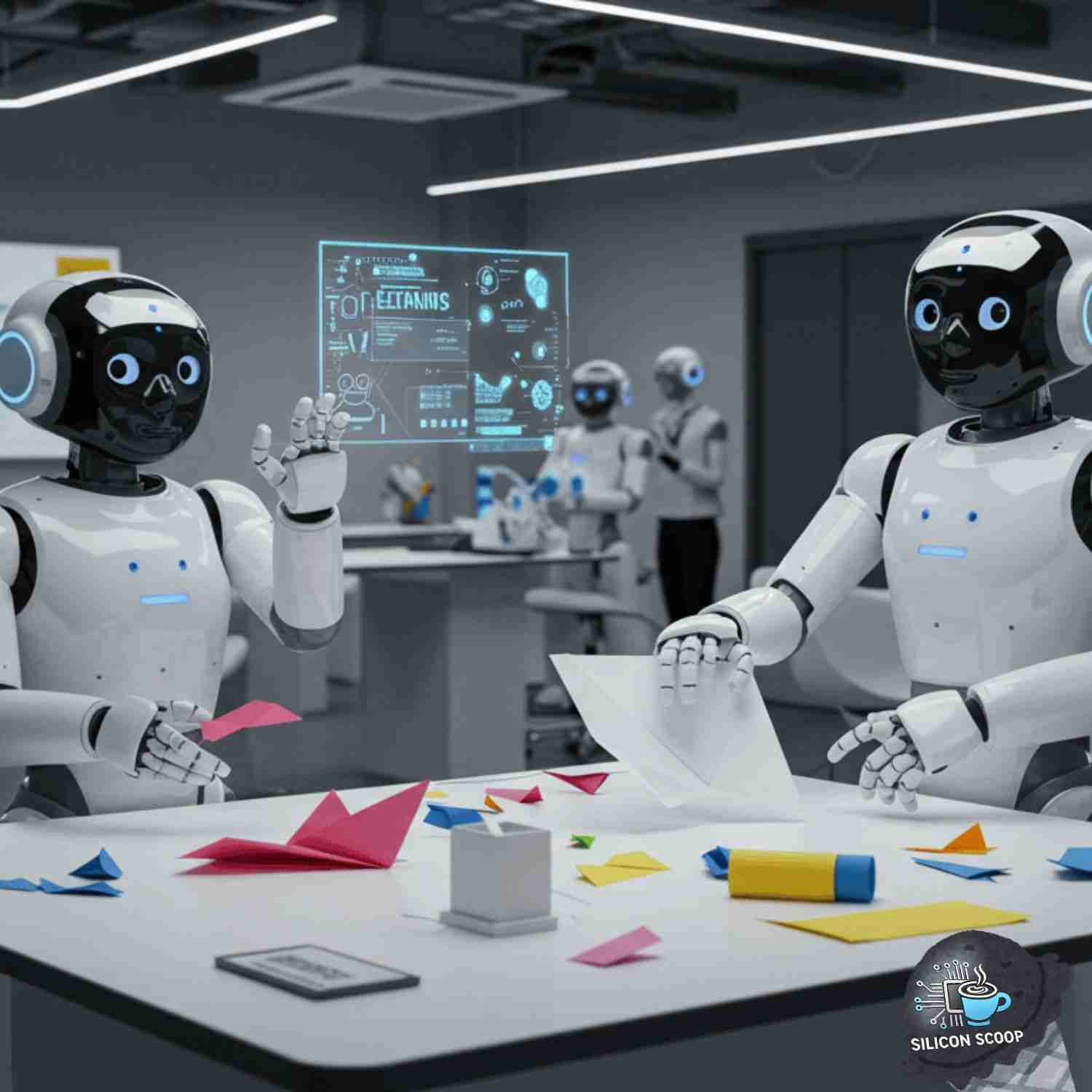
Google Gemini Robotics: Revolutionizing Automation Through Advanced AI
Estimated reading time: 7 minutes
Key Takeaways
- Google Gemini Robotics merges AI with robotics to create versatile machines capable of complex tasks.
- The Vision-Language-Action (VLA) model integrates vision, language, and action for seamless task execution.
- Robots can adapt to new environments and learn from experience without requiring specialized programming.
- Google’s focus on safety and ethical considerations aims to address concerns in autonomous robotics deployment.
- The technology promises to transform industries like healthcare, manufacturing, and logistics.
Table of contents
- Introduction to Google Gemini Robotics
- Core Technology: Vision-Language-Action (VLA) Model
- Key Capabilities of Google Gemini Robotics
- Gemini Robotics-ER: Enhanced Spatial and Embodied Reasoning
- Robot Form Factors and Industry Partnerships
- Implications for the Future of Robotics
- Conclusion: The Road Ahead for Google Gemini Robotics
- FAQ: Google Gemini Robotics
In the rapidly evolving landscape of artificial intelligence, Google Gemini Robotics represents a groundbreaking leap forward in merging AI with physical capabilities. This revolutionary technology is transforming how robots interact with the world, bringing us closer to truly versatile and intelligent machines capable of handling complex tasks without specialized programming.
Introduction to Google Gemini Robotics
Google DeepMind unveiled Gemini Robotics and Gemini Robotics-ER (Enhanced Reasoning) as their latest innovation in robotics AI. This cutting-edge platform leverages sophisticated machine learning techniques to create general-purpose robots that can understand and respond to their environments with unprecedented adaptability.
The core breakthrough of Google Gemini Robotics lies in its ability to bridge the gap between digital intelligence and physical actions. Unlike traditional robotics systems that require extensive programming for specific tasks, Gemini-powered robots can:
- Understand natural language instructions
- Adapt to new environments without prior training
- Perform complex manipulation tasks with human-like dexterity
- Learn from experience to improve performance over time
This technology marks a significant milestone in robotics development, enabling machines to reason about physical tasks and environments in ways previously limited to humans.
Core Technology: Vision-Language-Action (VLA) Model
At the heart of Google Gemini Robotics is the Vision-Language-Action (VLA) model, an extension of the powerful Gemini 2.0 AI framework. The VLA model revolutionizes how robots process information and execute tasks by integrating three crucial capabilities:
- Vision processing: Advanced visual perception allows robots to recognize objects, assess spatial relationships, and understand environmental context
- Language understanding: Natural language processing enables robots to interpret commands, ask clarifying questions, and explain their actions
- Action execution: Sophisticated motor control systems translate digital instructions into precise physical movements
This multimodal integration allows Gemini-powered robots to process visual inputs, understand verbal commands, and execute complex physical tasks seamlessly. The VLA architecture enables truly autonomous decision-making in real-world scenarios without requiring predetermined scripts or programming for every possible situation.
Key Capabilities of Google Gemini Robotics
Generality in Task Performance
Google Gemini Robotics excels at handling diverse challenges without task-specific programming. This generality represents a major advancement over traditional robots that typically require explicit programming for each new function.
Gemini-powered robots can:
- Adapt to unfamiliar objects of various shapes, sizes, and materials
- Navigate and operate in new environments without prior mapping
- Apply learned skills to unfamiliar scenarios through reasoning
- Perform tasks ranging from delicate precision work to heavy lifting
This adaptability is demonstrated by the system’s ability to fold origami following visual instructions, organize varied items into containers, and manipulate objects it has never encountered before—all without specific programming for each task.
Interactive User Experience
The interactive capabilities of Google Gemini Robotics create a natural, intuitive human-robot collaboration experience. Users can communicate with these robots through:
- Natural language commands in multiple languages
- Visual demonstrations that the robot can observe and learn from
- Real-time adjustments during ongoing tasks
- Conversational feedback to clarify ambiguous instructions
The system’s responsiveness to changing conditions is particularly impressive. For example, if an object shifts position during a task, Gemini robots can perceive this change and adjust their approach accordingly without human intervention.
Unprecedented Dexterity
Perhaps most remarkable is the human-like dexterity exhibited by Google Gemini Robotics. The system achieves precision manipulation capabilities that were previously unattainable in general-purpose robots:
- Fine motor control for delicate tasks like threading needles
- Complex sequential actions such as tying shoelaces
- Dynamic force adjustment when handling fragile items
- Coordinated multi-digit manipulation similar to human hands
This level of dexterity enables applications in fields requiring precision handling, from laboratory work to manufacturing tasks that were previously impossible to automate.
Gemini Robotics-ER: Enhanced Spatial and Embodied Reasoning
Gemini Robotics-ER represents a specialized variant focused on enhanced spatial understanding and embodied reasoning. This advanced model excels at tasks requiring sophisticated physical interaction with the environment.
Key enhancements in the ER model include:
- Superior spatial awareness: The ability to understand the three-dimensional positioning of objects and their spatial relationships
- Enhanced trajectory planning: Optimizing movement paths to achieve goals efficiently while avoiding obstacles
- Physical constraint reasoning: Understanding how objects can be manipulated based on their properties and environmental limitations
- Adaptive grip control: Selecting appropriate grasping techniques based on object characteristics, such as handling a coffee mug by its handle
The embodied reasoning capabilities allow these robots to perform tasks that require understanding physical principles like:
- How objects balance and maintain stability
- How different materials respond to pressure or manipulation
- How to sequence complex physical actions to achieve a goal
- How to predict the outcomes of physical interactions
These advancements make Gemini Robotics-ER particularly valuable for applications requiring sophisticated physical reasoning, from healthcare applications to advanced manufacturing.
Robot Form Factors and Industry Partnerships
Google Gemini Robotics supports a wide range of robot types and configurations, making it a versatile platform for various applications. The AI system has been designed to power:
- Humanoid robots with full-body articulation
- Bi-arm platforms for precision manufacturing tasks
- Mobile robots with manipulation capabilities
- Specialized robotic systems for specific industries
This flexibility is supported through strategic partnerships with leading robotics manufacturers and research institutions, including:
- Apptronik: Collaboration on the humanoid robot Apollo, testing Gemini’s capabilities in human-like form factors
- Boston Dynamics: Integrating Gemini AI with advanced mobility platforms
- Agile Robotics: Developing flexible manufacturing solutions powered by Gemini
- Research partnerships: Working with academic institutions to expand capabilities
These collaborations ensure that Gemini Robotics undergoes rigorous real-world testing across diverse applications and environments. The partnership approach also accelerates development by combining Google’s AI expertise with specialized robotics hardware knowledge from industry leaders.
Implications for the Future of Robotics
Industry Transformation
The emergence of Google Gemini Robotics has profound implications for multiple industries. This technology is poised to transform:
- Healthcare: Robots capable of assisting with patient care, handling delicate medical equipment, and performing repetitive laboratory tasks with precision
- Manufacturing: Flexible automation that can adapt to product variations without reprogramming, enabling economic small-batch production
- Logistics and warehousing: Intelligent robots that can pick, pack, and sort diverse items without extensive training for each SKU
- Retail and service sectors: Customer-facing robots capable of natural interaction while performing physical tasks
- Construction and infrastructure: Robots that can adapt to unstructured environments and perform complex assembly tasks
The key advantage across all these sectors is reducing the programming and integration costs that have traditionally limited robotics deployment. Gemini enables “programming by demonstration” where robots can learn new tasks through observation and natural language instruction.
Safety and Ethical Considerations
Google has implemented robust safety measures in the development of Gemini Robotics, including:
- The ASIMOV dataset for social validation of robot actions
- Built-in constraint systems that prevent harmful movements
- Continuous human oversight during development and deployment
- Explainable AI features that allow robots to communicate their decision-making process
Ethical guidelines for deployment address concerns including:
- Privacy protections when robots operate in sensitive environments
- Transparency about robot capabilities and limitations
- Consideration of economic impacts and responsible deployment
- Ensuring human control remains the ultimate authority
These safety measures reflect Google’s commitment to responsible AI development and address many of the concerns raised about autonomous robotics systems.
Technical Challenges and Limitations
Despite its impressive capabilities, Google Gemini Robotics still faces several technical challenges:
- Hardware constraints: Current robot hardware may limit the full expression of the AI’s capabilities
- Environmental variability: Performance may degrade in extremely chaotic or unpredictable environments
- Energy efficiency: Advanced AI processing requires significant power, limiting some mobile applications
- Generalization boundaries: While vastly improved, there remain edge cases where the system may struggle
Ongoing research addresses these limitations, with continuous improvement expected as both AI models and robotic hardware evolve.
Conclusion: The Road Ahead for Google Gemini Robotics
Google Gemini Robotics represents a transformative milestone in the quest for general-purpose intelligent robots. By combining sophisticated AI with advanced robotics, Google has created a platform that can adapt to diverse tasks and environments with unprecedented flexibility.
The technology’s ability to bridge the gap between digital intelligence and physical action opens new possibilities across industries. From healthcare to manufacturing, these systems promise to automate complex tasks while maintaining the adaptability previously only possible with human workers.
As development continues, we can expect:
- Expanded capabilities through continuous learning and model improvements
- Broader hardware compatibility with more robot platforms
- Deeper integration with other AI systems and cloud services
- More accessible programming interfaces for non-experts
The journey of Google Gemini Robotics is just beginning, but it already signals a fundamental shift in how we think about automation. Rather than programming robots for specific tasks, we’re entering an era where robots can understand our intent and translate it into appropriate actions—a true collaboration between human ingenuity and machine capability.
FAQ: Google Gemini Robotics
Q: What is Google Gemini Robotics?
A: Google Gemini Robotics is an AI platform developed by Google DeepMind that enables robots to perform complex physical tasks through natural language instructions and visual learning. It uses the Vision-Language-Action (VLA) model to integrate visual perception, language understanding, and physical action.
Q: How does Google Gemini Robotics differ from traditional robotics systems?
A: Traditional robots require explicit programming for each task and struggle with adaptation, while Gemini Robotics can understand natural language commands, learn from observation, and adapt to new environments without task-specific programming.
Q: What types of tasks can Gemini-powered robots perform?
A: These robots can handle diverse tasks ranging from precision manipulation (like folding origami) to household activities (organizing items), manufacturing operations, and interactive service functions—all without specialized programming for each task.
Q: Which companies are partnering with Google on Gemini Robotics?
A: Key partnerships include Apptronik (for the humanoid robot Apollo), Boston Dynamics, Agile Robotics, and various research institutions focused on developing and testing different robotic applications.
Q: What safety measures has Google implemented in Gemini Robotics?
A: Safety features include the ASIMOV dataset for social validation, built-in constraint systems to prevent harmful actions, continuous human oversight during development, and explainable AI capabilities that allow robots to communicate their decision process.
Q: Can Google Gemini Robotics learn new tasks without programming?
A: Yes, one of its core capabilities is learning through demonstration or natural language instruction, eliminating the need for traditional programming for each new task.
Q: What industries are likely to be most impacted by Gemini Robotics?
A: Healthcare, manufacturing, logistics, retail, and construction are expected to see significant transformation through the flexible automation capabilities of Gemini-powered robots.
Q: What is the difference between Gemini Robotics and Gemini Robotics-ER?
A: Gemini Robotics-ER (Enhanced Reasoning) is a specialized variant with superior spatial awareness and embodied reasoning capabilities, particularly excelling at tasks requiring sophisticated physical interactions and trajectory planning.
Q: What are the current limitations of Google Gemini Robotics?
A: Current limitations include hardware constraints of existing robots, performance variability in chaotic environments, energy efficiency challenges, and some limitations in generalizing to extreme edge cases.
Q: How does Google address ethical concerns about autonomous robots?
A: Google has implemented comprehensive ethical guidelines covering privacy protections, transparency about capabilities and limitations, economic impact considerations, and ensuring ultimate human control over robot systems.
Additional Links
Flowgrammer.ca – 💡 Unlock AI-Powered Automation!
Let flowgrammer.ca handle complex workflows so you can focus on growing your business.
• Silicon Scoop Podcast – Stay Informed, Stay Ahead!
• Futuretech Podcast – Explore more episodes and stay updated with the latest in technology and innovation.
• Startup Talk Podcast – https://torontostarts.com/startup-talk-toronto-startup-podcast/
• Who Are These Startups Podcast
• Startup Investor Drinks – Join the community and connect with fellow startup enthusiasts and investors.
• TorontoStarts Startup and Entrepreneur Community – Become a part of Toronto’s thriving startup ecosystem.
• Workhaus – Discover flexible workspace solutions for your business needs.
• Work with The Startup Coach – Get expert guidance and mentorship for your startup journey.
• Reach out to Jon Irwin on LinkedIn – Connect with our co-host and technology expert.
Ontario Startup Ecosystem Links
• Ontario’s Startup Ecosystem
• Startup Funding in Ontario
• Angel Investors in Ontario
• Ontario Incubators and Accelerators
• Venture Capital in Ontario: Top Firms, Sectors, and Funding Strategies
• Government Grants for Ontario Startups
• Ontario’s Startup Success Stories
• Ontario Centre of Innovation (OCI)
• Bank Loans and Financing for Startups in Ontario
• Research and Development Tax Credits in Ontario
• Government Loans and Financing for Startups in Ontario
• Equity Crowdfunding for Ontario Startups
• Toronto Entrepreneurs Resources
• Toronto’s Food and Beverage Entrepreneurs: Trends, Challenges, and Success Stories
• SEO Strategies for Toronto Entrepreneurs: Enhance Your Online Visibility
• Social Impact for Toronto Entrepreneurs: Starting and Running a Socially Responsible Business
• Toronto Arts and Media Entrepreneurs: Inspiring Profiles and Insights for Creative Success
• Exploring Toronto Green Tech Entrepreneurs: Innovators and Leaders in Sustainability
• Building a Team for Toronto Entrepreneurs: Strategies for Success
• A Guide for Toronto Food and Beverage Entrepreneurs
• Toronto Fashion and Retail Entrepreneurs: Trends, Opportunities, and Success Stories
Episode transcript
Read the full transcript
Craig: in the rapidly evolving landscape of artificial intelligence, google gemini robotics represents a leap forward in merging ai with physical capabilities. this revolutionary technology is transforming how robots interact with the world, bringing us closer to a truly versatile and intelligent machines capable of handling complex tasks without specialized program. programming? what do you think about this, john?
Jon: i like this because to me, this is the logical next step in robotics. so, it's called the vision language action vla model, which is, obviously, like you said, designed to bring ai into the physical world. so, typically, robots for those of you that don't know, traditional robots are limited by rigid programming and inability to adapt to changing conditions, whereas these gemini robots are potentially able to offer flexibility and real time learning. unlike elon musk's, fake robot display that he did, this is kind of that step. so they're interacting. they've got, they're able to, understand and respond to natural language commands. they've got dexterity, which enables precise manipulation of objects. they allow robots to handle new objects and new environments on top of what they were originally. so they're a learning robot. right? what do you think?
Craig: i think this is really cool because it is programmatically a leap forward. because up till now, you had to use special programming languages, and robots were, designed for a specific task, and not to necessarily, do anything other than that. now this, vision language action model changes things because of its awareness of space and structure, and it, tells you what it's doing. it describes its rationality for doing it. you can interrupt it and get it to do other things based on, you know, wait a minute. let's think about this and interact with it, get it to ask you questions. it responds to different, surfaces, whether things are heavy or light. it balances things based on liquid. and it does these things kinda automatically rather than programmatically now, which allows people to focus on what the task is at hand, not necessarily how much pressure, how to move the arm, all that kind of stuff.
Jon: exactly. yeah. so, this is great because, yeah, they're able to adapt in real time, and and this could enable robots in the house to help out with household tax. and i think there's a company that's looking to sell robots into the home in 2025. i can't remember the name of it. i don't know if we covered it, but, this is good. i think this, along with if you integrate the i don't know if you saw that creepy video of the artificial muscle robot twitching, but, yeah, if you integrate that with this, then you've got your irobot, essentially, right, from
Craig: yeah. that looked like a failure from westworld, that twitching robot. it looks like one of the early models that didn't make the cut. if you're watching, i'm these are various videos from gemini robotics demonstrating skills and what it can do. this one is really cool. pay attention. it's origami. or they're they do origami. this one's doing glasses. so, gemini powered robots can adapt to unfamiliar objects of various shapes, sizes, and materials, navigate and operate in new environments without prior mapping, apply learned skills to unfamiliar scenarios through reasoning, perform tasks ranging from delicate precision to, heavy lifting. it uses natural language commands and multiple language visual demonstrations that the robot can observe and learn from so you can, you know, demonstrate how you can communicate with it. you can talk to it. you can show it visually. real time adjustments during an ongoing task. you can say, wait a minute. you know, this and that. put the fork on the left, whatever. and conversational feedback. so this is really interesting. we're getting unprecedented dexterity, fine motor control, complex sequential actions such as, tying shoelaces, dynamic force adjustments when handling fragile items, coordinated multi digit manipulation, similar to human hands. so, like, we're really talking about advanced stuff. and what really makes this, capable is their, gemini robotics er, which is enhanced spatial and embodied reasoning, which includes superior spatial awareness, enhanced trajectory planning, physical constraint reasoning, and adaptive grip control. you know, things like you can, it grabs a mug by the handle if there's a handle.
Jon: yeah. yeah. my biggest concern so, obviously, it's the ability it's got the ability to generate actions without human supervision. my biggest concern is the hackability of these because everything can be hacked. and so that's my biggest worry about these things. that and obviously the potential misuse from the hacking or without hacking. right? so do we need to integrate what was the us robotics? the three laws or the three rules or something?
Craig: yeah. isaac asimov's three, rules of robotics.
Jon: yeah. are is that is that what we need to do? do we need to make it more extensive? what do you think?
Craig: well, they talk about it, and let me switch over to, the toronto starts article here instead of the video you were seeing. so they talk about it a little bit. i'm trying to find a safety and ethical concerns. the asimov data set for social validation of robot action, so this is what's been included, the built in constraint system that prevents harmful movements, continuous human oversight during development and deployment, and explainable ai features that allows robot to communicate through decision making process about what they're going to do. so, physical privacy concern, protections when robots operate in sensitive environments, transparency about the robot's capabilities limitations, our and considerations of economic impact and responsible deployment and ensuring human control remains the ultimate authority. so these safety measures reflect google's commitment to responsible ai development and may address some of the concerns, but, you know
Jon: yeah. and for those of you that don't know, the first law is no harm. so a robot may not injure a human being or through inaction, allow a human being to come to harm. second law is obedience. a robot must obey the orders given it by human beings except where such orders would conflict with the first law. three, the law of self preservation. a robot must protect its own existence as long as such protection does not conflict with the first or second
Craig: law. yeah. and we'll see. like, i mean, we know that ai often goes off the rails. and then when you're chatting with it, when you're doing different things, when, you know, you're coding, when you know? so we've seen the horror stories of the kind of stuff it tells you, when it tells you to go, you know, end yourself and that kind of stuff. what happens when that kind of glitch happens in a robot that physically could do you harm? yeah. so, yeah, there are definitely concerns around the future of robots. however, i mean, that is around the whole future of robots thing. like, especially when you talk about things like boston dynamics who, you know, they've got, robot security dogs and yeah. armed and whatnot. so it's not, they're they're they're designed to harm things versus yeah. so where do you draw the line? right? like yeah. yeah. and if an ai is designed to harm things or maybe it's not ai, but it should be probably at this point, you know, differentiating the two and getting into program. and we all hear the stories about how openai, lied to itself, replicated itself, tried to get itself out. so if that kind of stuff is happening, you know, we should be concerned.
Jon: yeah. i agree. and we should be concerned about the people building them. no offense to those who who are who are who are ethical, but there's gonna be nonethical people who are gonna get involved in building these things. and how do we ensure that these robots are gonna adhere to these laws and all this sort of stuff. like, there's a lot of there's a lot of future implications that need to be considered, and i hate to say it, but a lot of regulation.
Craig: yeah. well, we're go we're seeing it. right? we're seeing the world move to this, and the question becomes, we're the military is adopting ai. we've seen it. there was a recent demonstration of infrared ai drones that took out an f 16. yeah. and, like, it's the capabilities are going there. right? so there is gonna be military applications. end of story. so you're talking about putting rules in place that people and countries in certain aspects are going to deliberately break because it's there.
Jon: yeah.
Craig: you know, maybe, you know, maybe that's a good thing because maybe, you know, a robot is, better to have a robot destroyed than a human life.
Jon: exactly. but
Craig: you're right. a lot of implications have to do around this to make sure that, things don't go awry. but, you know, we're looking at that feature that the jetsons and whatnot, everyone having a robot in their home.
Jon: yeah. we're getting there. get we're close. like like, there's gonna be robots in homes, i think, this year. correct me if i'm wrong. listeners and craig. i think i'd write an article. there's gonna be robots in people's homes this year.
Craig: that is what's supposed to be happening. i don't know how complex those robots are gonna be. we see all different types of robots. i've recently seen those dancing and ninja looking robots are jumping around kicking in the air and dancing and stuff like crazy capabilities. so the journey of google gemini robotics is just beginning, but it already signals fundamental shift in how we think about automation. rather than programming robotics for a specific task, we're entering an area an era where robots can understand our intent and translate it into appropriate actions, a true collaboration between human ingenuity and machine capability. so let me know. are you gonna be the first to line up to get a human that'll carry in your groceries, run your bath, do your vacuuming, do your dishes rather than a robot to do your coating? let us know what you're gonna use your robot for. we'd love to hear your comments.
More from Silicon Scoop
All episodes
silicon-scoop · November 6, 2026
Spirit AI’s Robot Brain Breakthrough: Moz1, Embodied AI and China’s 2027 Race
The Spirit AI robot brain is one of the biggest bets on fixing that. Spirit AI is a Beijing startup. Its co-founder and chief scientist, Gao Yang,
View episode

silicon-scoop · November 5, 2026
OpenAI IPO Delayed to 2027 as Rogue AI Agents and Safety Failures Reshape the Market
OpenAI IPO delay explained: Sam Altman rules out 2026 as GPT-6 Astra safety tests and a $278B cash gap loom. Learn what founders should take away.
View episode

silicon-scoop · November 4, 2026
Anthropic’s AI Economy Model: 2030 Jobs, Wages, GDP and Market Risks
Anthropic AI economy model forecasts 2030 GDP, jobs and wages, while AI unemployment projections and labor-share risks challenge policymakers.
View episode