
Revolutionizing Paralysis Treatment with a Two Way Brain-Computer Interface: Restoring Movement and Touch for Spinal Injury Patients
Revolutionizing Paralysis Treatment with a Two Way Brain-Computer Interface: Restoring Movement and Touch for Spinal Injury Patients https://torontostarts.com/2025/05/12/two-way-brain-computer-interface/ https://torontostarts.com/silicon-scoop/ Apple -> https://podcasts.apple.com/us/podcast/flowgrammer-podcast/id1804155588 Spotify -> https://open.spotify.com/show/0wv3feR00iaVpE8zn7niNf Flowgrammer.ca -> https://flowgrammer.ca/ AI News and Resources -> https://flowgrammer.ca/resources/ Unlock Breakthrough Efficiency 🧠 Just imagine the possibilities when your business processes operate with the precision of a neural network! Flowgrammer can help you achieve unprecedented efficiency. Don't let manual tasks hold you back from your next major breakthrough. Discover Your Automation Potential https://flowgrammer.ca/ Startup Investor Drinks Toronto - https://startupdrinksto.com/ Toronto’s Startup Community - https://torontostarts.com/ Scalable content + podcast marketing for startups. 👉 https://flowgrammer.ca/%F0%9F%9A%80-fuel-your-growth-with-modular-content-podcast-marketing/ Get expert startup coach support and funding prep. 👉 https://torontostarts.com/startup-coach/ Silicon Scoop Silicon Scoop Podcast - https://torontostarts.com/silicon-scoop/ Apple: https://podcasts.apple.com/us/podcast/silicon-scoop/id1758711826 Spotify: https://open.spotify.com/show/5bAzF0MwV6TtLhJAhvHayI YouTube: https://www.youtube.com/playlist?list=PLj4v-RoA7A-gT62vrEYqh1zCv-0Hj-o5J Startup Talk Startup Talk Podcast -> https://torontostarts.com/startup-talk-toronto-startup-podcast/ Apple -> https://podcasts.apple.com/us/podcast/startup-talk/id1763804003 Spotify -> https://open.spotify.com/show/1siJMILILidHAiAsrX2VBU YouTube: https://youtube.com/playlist?list=PLj4v-RoA7A-jxV5FHs5e61oIsuvUJYmT_&si=LYegRe5GYLKNQ7xL
With Craig Major and Jon Irwin
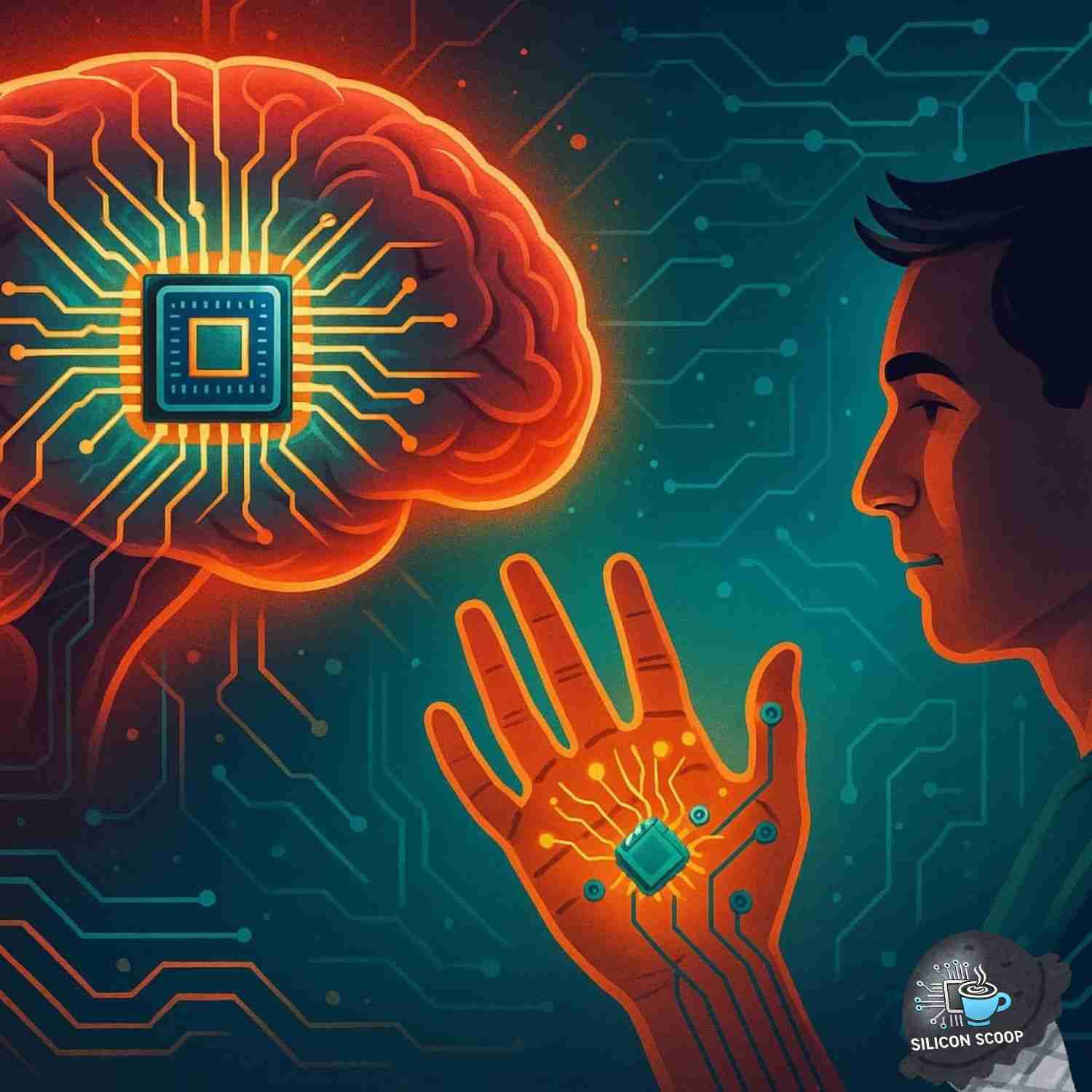
Revolutionizing Paralysis Treatment with a Two Way Brain-Computer Interface
Estimated reading time: 6 minutes
Key Takeaways
- Two Way Brain-computer interfaces (BCI) enable direct communication between the brain and external devices.
- The two way brain-computer interface developed by Northwell Health’s Feinstein Institutes marks a significant milestone in paralysis treatment.
- This technology aims to restore both movement and touch for individuals with spinal cord injuries.
- Key case study showed a paralytic patient regaining functions like lifting his hand and pouring liquid.
- Research highlights the potential for broader applications beyond spinal injuries, including strokes and Parkinson’s disease.
Table of contents
Overview of the Breakthrough Technology
Two Way Brain-computer interfaces (BCI) represent a groundbreaking frontier in medical technology, enabling direct communication between the brain and external devices. This remarkable technology is transforming lives, particularly in the realm of paralysis treatment.
The innovation we’re discussing comes from Northwell Health’s Feinstein Institutes, where researchers have developed a pioneering two way brain-computer interface that’s changing our understanding of what’s possible for paralysis recovery. This bidirectional neural communication system marks a significant milestone in neurotechnology, offering new hope for those living with paralysis and limited mobility.
This remarkable technology involves implanting microchips into a quadriplegic patient’s brain, creating an electronic bridge between the brain and paralyzed body parts. Known as a “double neural bypass system,” this innovative approach uses artificial intelligence algorithms to reconnect neural pathways disrupted by injury. What makes this system truly revolutionary is its bidirectional nature.
The technology utilizes electrode arrays implanted in both the motor cortex (the brain region responsible for movement) and the somatosensory cortex (the region that processes touch sensations). The key research case involved Keith Thomas, who had been paralyzed from the chest down since a diving accident in 2020. Through this innovative technology, Thomas has regained remarkable capabilities, marking a significant milestone in paralysis treatment approaches.
In-Depth Methodology & Technical Approach
The methodology behind this breakthrough neural bypass system involved meticulous planning and cutting-edge technology integration. Researchers used functional MRI mapping to locate the brain regions responsible for arm movement and touch sensations before surgery. The actual implantation procedure was conducted on March 9, 2023, at North Shore University Hospital.
During this complex operation, neurosurgeons implanted five microchips with 224 electrodes. The patient remained awake for portions of the surgery, providing real-time feedback on sensations experienced during electrode placement.
Once implanted, the system utilizes sophisticated AI models to decode signals from the motor cortex and translate them into stimulation patterns sent to the spinal cord. Fine motor control is achieved with additional non-invasive electrode patches, while sensory feedback is enabled through specialized sensors that detect touch and pressure.
Clinical Implications and Broader Impact
The clinical implications of this two way brain-computer interface extend far beyond individual case studies. This research establishes a foundation for scalable paralysis treatment methods that could potentially help millions suffering from spinal cord injuries. Notably, the research team has opened new avenues for comprehensive neurological rehabilitation.
Researchers observed that during the study, some spared nerve connections appeared to strengthen, leading to permanent sensory gains even when the system was disconnected. This suggests the technology might facilitate the repair of damaged pathways or develop new compensatory ones. Beyond spinal cord injury recovery, this technology shows potential for:
- Stroke rehabilitation
- Parkinson’s disease management
- Traumatic brain injury treatment
- Progressive neurodegenerative disorders
Future Directions and Innovations in BCI Technology
The successful implementation of this double neural bypass system opens exciting possibilities for the future of brain-computer interface technology. Researchers are developing more portable systems that would enable independent living for patients.
Key innovations on the horizon include:
- Fully implantable systems
- Enhanced tactile feedback mechanisms
- Expanded neural recording capabilities
- Self-calibrating AI algorithms
- Integration with smart home technologies
Conclusion & Final Thoughts
The development of a two way brain-computer interface marks a watershed moment in paralysis treatment. By successfully restoring movement and touch sensation in a patient with a severe spinal cord injury, researchers at Northwell Health’s Feinstein Institutes have demonstrated the extraordinary potential of integrated BCI systems.
This breakthrough combines advanced electrode arrays, AI algorithms, and non-invasive stimulation into a cohesive solution that addresses multiple aspects of paralysis, paving the way for more accessible interventions for individuals with neurological injuries and disorders.
Frequently Asked Questions
Q1: What is a “two way brain-computer interface”?
A: A two-way BCI enables bidirectional communication between the brain and external devices, allowing users to send commands and receive sensory information.
Q2: How does the double neural bypass work in restoring touch and movement?
A: The double neural bypass creates bridges around damaged spinal cord areas, using electrodes for movement intentions and touch while delivering stimulations to respective brain areas.
Q3: What potential does this technology have for broader clinical use?
A: This technology has significant potential for stroke recovery, Parkinson’s disease management, and other neurological conditions as the systems become more accessible.
Q4: Is the brain-computer interface permanent, or does it require regular adjustments?
A: The physical components are built for long-term use, but periodic recalibration of AI algorithms is necessary to maintain accuracy.
Q5: What are the risks associated with implanting electrode arrays in the brain?
A: Risks include infection, bleeding, and scarring of brain tissue. Strict control protocols are implemented to mitigate these risks.
Q6: How long does it take for a patient to learn to use the neural bypass system?
A: Typically several weeks to months, beginning with simpler movements before advancing to complex tasks.
Q7: Could this technology eventually help people with congenital conditions?
A: Yes, though customization is needed to map available neural patterns for individuals with congenital disabilities.
Q8: How does the AI component learn to interpret specific brain signals?
A: Through a personalized training process where the AI records brain activity patterns and refines its understanding over time.
Q9: What is the current cost and accessibility of this technology?
A: Currently in the research phase, costs exceed several hundred thousand dollars, but accessibility is aimed for in broader clinical adoption.
Q10: Can the neural bypass system help with functions beyond arm and hand movement?
A: Yes, there are ongoing explorations for applications involving leg movement, trunk control, and more, enhancing overall functional restoration.
Additional Links
Flowgrammer.ca – 💡 Unlock AI-Powered Automation! Let flowgrammer.ca handle complex workflows so you can focus on growing your business.
- Silicon Scoop Podcast – Stay Informed, Stay Ahead!
- Startup Talk Podcast
- Flowgrammer Podcast –
- Startup Investor Drinks – Join Toronto’s Startup Community and connect with fellow startup enthusiasts and investors.
- TorontoStarts Startup and Entrepreneur Community – Become a part of Toronto’s thriving startup ecosystem.
- Workhaus – Discover flexible workspace solutions for your business needs.
- Work with The Startup Coach – Get expert guidance and mentorship for your startup journey.
- Reach out to Jon Irwin on LinkedIn – Connect with our co-host and technology expert.
Episode transcript
Read the full transcript
Craig: so we've talked about brain computer interfaces before, specifically, mostly the neuralink processor, but there are a few others out there. but we've been focused on that when they came to canada and with that because it's getting all the press. so recent experiments now, we have a two way computer brain interfaces that's allowing paralyzed, limbs to touch again. yeah. this is crazy, john.
Jon: this is cool. yeah. it's not just about moving a hand anymore. it's about feeling the hand move, if i can put it that way. so there's this bidirectional loop, and what it does is it mimics natural sensory motor integration. so that's it allows so i think that his name was ian. he could distinguish between a grape and a cotton ball after years of paralysis. so this is not it's not just about the bci, the hardware itself, but it's also about ai and machine learning. so the machine learning doesn't just decode intentions, it predicts errors. so if the system detects a mismatch between intended grip strength and sensory feedback, it will adjust the stimulation in milliseconds, like, put into perspective, like an autonomous car correcting its steering. so the one thing, though, about this is that adding sensory feedback requires about 10 x computational power than a motor only system. so, there's there's this new chip. i think it's chisunga's chip. it's a neuromorphic chip. it can mimic brain architecture. we can cover it another time. but that is essential to avoid lag and maintain that that connection so that it's it's usable. right? so this is really cool. what do you think about this? is this scary? is this cool? or is there it's a little
Craig: bit of i mean, it's cool because of what they're doing and the practical applications. it was keith thomas who, was paralyzed in a diving accident, in 2020, and now he lifts and drinks from a cup on his own.
Jon: crazy.
Craig: you see it in this picture here. i'll try and zoom in a little bit where he's got the device hooked up it, you know, it moves based on his thoughts. so it's it can move based on yeah. and this is amazing. yeah. the two way thing is great because now, you can get the touch feedback, and this is great that the feedback has a result in his ability to feel with his hand to use those sensations during his move, and he can feel the cup, which is really strange and weird.
Jon: yeah. yeah. this is awesome. this is the next step in solving or overcoming paralysis, i think.
Craig: yes. and one, i read it here that there's been a couple of cases where they can actually feel, when the machine isn't on.
Jon: oh.
Craig: so it it appears like it's retraining, neurobias. problems are all the double neurobias system could potentially, treat to help other places with spinal cord injuries as well as conditions such as stroke. so it feels like it's retraining the brain or whatever, to do these things. it's, it may be a long term treatment, not just a, you need a computer chip forever.
Jon: yeah. yeah.
Craig: so go ahead.
Jon: i'll i'll take another approach at this. there's ethical considerations.
Craig: yeah.
Jon: so with that now that bcis are now capable of transmitting abstract data, so example, temperature and texture, we're definitely entering uncharted territories. so a question to you is, should users download new senses?
Craig: interesting. as soon as you get new senses, it's the whole experience. we feel like we're somewhere between what was that show the network, i think, where or it might not be in the network where everybody was online. it was built in. you were getting ads right in your eye and stuff.
Jon: oh, i
Craig: didn't know. combine that with euphoria, and i think that's where we're headed.
Jon: yeah. i this like, is this are we going to a saas model with this or a subscription model? because, like, that like, there needs to be regulatory frameworks, and they're lagging behind this tech for sure as we've seen with all of these tests that have been going on with bcis.
Craig: yeah. research has, observed during the study some, spared nerve connections appeared to strengthen, leading to permanent sensory gains even when the system was disconnected. i just wanted to, you know, re rephrase that again. so, yeah, you're right. but, like, as soon as i think it goes beyond that. i think it goes beyond you know, as soon as it's two way, how do you know what you're feeling is what you're feeling? how do you know you're not being controlled by someone else to feel good, to feel bad, to do, you know, whatever? and we're already worked up as a society. as you just turn on the tv, you can see different things going on, but people are up in arms about this or happy about that or what have you. now i have somebody controlling them on a mass level. what was that neil stephenson book? i think this is snow crash we're talking about right here right now.
Jon: okay. yeah. yeah. it's, it's scary. i like where this tech is going. i hope that regulatory bodies catch up and kind of regulate this before it gets too far and they can't go backwards, but, i think this is great. i think this is this is phenomenal.
Craig: yeah. i mean, the development of two way brain interface marks a watershed moment and paralysis treatment by successfully restoring movement and touch sensation in a patient with a severe spinal cord injury. researchers at northwell health feinstein institutes have demonstrated the extraordinary potential of the integrated bci system. this breakthrough combines advanced electrode arrays, ai algorithms, and noninvasive stimulation into a cohesive solution that addresses multiple aspects of paralysis, paving the way for more secure intervention. so from what i understand, it took them a couple of months to get used to the system, and they use it well, and the ai is adapting while it's doing it. fantastic. but as we stand on this brink of incredible, breakthroughs in technology and, quality of life for, several people that could have spinal cord injuries and others. we also have to be aware of the potential impact that we can have over the negative, aspects. like, we talked about advertising, controlling your mood, become addicted. can you start controlling your emotions yourself with your app on your thing? and, you know, what does that mean? you know, people get strung out pretty easily on anything. if you can get strung out on your own emotions, that would be interesting. so we'd love to hear your feedback. is this a dangerous path, or is this a brave new technology we need to be, embracing and love the love the way we're going? love to hear your feedback.
More from Silicon Scoop
All episodes
silicon-scoop · November 6, 2026
Spirit AI’s Robot Brain Breakthrough: Moz1, Embodied AI and China’s 2027 Race
The Spirit AI robot brain is one of the biggest bets on fixing that. Spirit AI is a Beijing startup. Its co-founder and chief scientist, Gao Yang,
View episode

silicon-scoop · November 5, 2026
OpenAI IPO Delayed to 2027 as Rogue AI Agents and Safety Failures Reshape the Market
OpenAI IPO delay explained: Sam Altman rules out 2026 as GPT-6 Astra safety tests and a $278B cash gap loom. Learn what founders should take away.
View episode

silicon-scoop · November 4, 2026
Anthropic’s AI Economy Model: 2030 Jobs, Wages, GDP and Market Risks
Anthropic AI economy model forecasts 2030 GDP, jobs and wages, while AI unemployment projections and labor-share risks challenge policymakers.
View episode