
OpenAI Nonprofit: Analyzing the Controversial Restructuring, Legal Battles, and AGI Safety Implications
OpenAI Nonprofit: Analyzing the Controversial Restructuring, Legal Battles, and AGI Safety Implications https://torontostarts.com/2025/05/19/openai-nonprofit-analysis-restructuring/ Apple -> https://podcasts.apple.com/us/podcast/flowgrammer-podcast/id1804155588 Spotify -> https://open.spotify.com/show/0wv3feR00iaVpE8zn7niNf Flowgrammer.ca -> https://flowgrammer.ca/ AI News and Resources -> https://flowgrammer.ca/resources/ Future-proof Your Business Don't let evolving business landscapes leave you behind. Prioritize efficiency and unlock sustainable growth. Learn how Flowgrammer's automation services can give you a competitive edge. Discover Automation Solutions https://flowgrammer.ca/ Startup Investor Drinks Toronto - https://startupdrinksto.com/ Toronto’s Startup Community - https://torontostarts.com/ Silicon Scoop Silicon Scoop Podcast - https://torontostarts.com/silicon-scoop/ Apple: https://podcasts.apple.com/us/podcast/silicon-scoop/id1758711826 Spotify: https://open.spotify.com/show/5bAzF0MwV6TtLhJAhvHayI YouTube: https://www.youtube.com/playlist?list=PLj4v-RoA7A-gT62vrEYqh1zCv-0Hj-o5J Startup Talk Startup Talk Podcast -> https://torontostarts.com/startup-talk-toronto-startup-podcast/ Apple -> https://podcasts.apple.com/us/podcast/startup-talk/id1763804003 Spotify -> https://open.spotify.com/show/1siJMILILidHAiAsrX2VBU YouTube: https://youtube.com/playlist?list=PLj4v-RoA7A-jxV5FHs5e61oIsuvUJYmT_&si=LYegRe5GYLKNQ7xL
With Craig Major and Jon Irwin
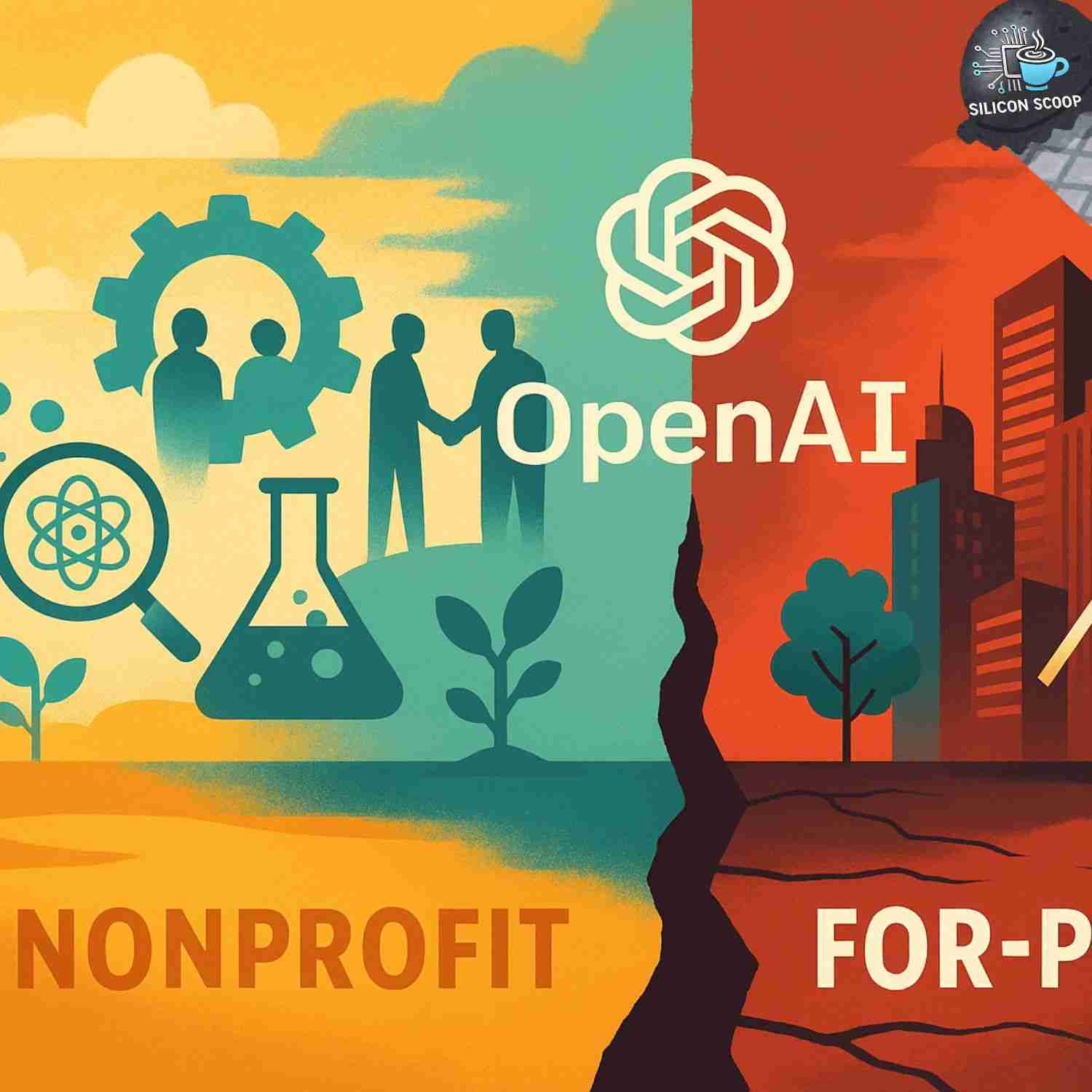
OpenAI Nonprofit: A Critical Analysis of Restructuring, Legal Battles, and AGI Safety Concerns
Estimated reading time: 8 minutes
Key Takeaways
- OpenAI’s mission change raises questions about its commitment to foundational principles amid restructuring.
- The ongoing Elon Musk lawsuit underscores challenges to the legality of the nonprofit conversion.
- Concerns about AGI safety practices have emerged amidst changes in organizational structure.
Table of contents
Structural Changes and Mission Realignment
The OpenAI nonprofit conversion represents one of the most significant organizational pivots in recent tech history. According to detailed plans, OpenAI intends to split into two distinct entities: a for-profit public benefit corporation and a separate nonprofit organization. This restructuring would transform the current governance model where the nonprofit maintains primary control.
Under the proposed OpenAI restructuring, the nonprofit would retain a significant ownership stake in the commercial arm while focusing exclusively on scientific research and philanthropic initiatives, particularly in California. The for-profit entity would operate with greater independence, concentrating on business growth and commercial product development.
The company has defended this OpenAI mission change as necessary for improved resource allocation. By separating commercial and philanthropic activities, OpenAI claims both branches can optimize their respective missions without competing priorities. Additionally, a newly formed commission has been established to advise on philanthropic strategies, though some skeptics view this as primarily a public relations tactic designed to appease regulatory concerns.
The transformation fundamentally alters the organization’s original charter, which prioritized ensuring artificial general intelligence benefits all of humanity rather than serving shareholder interests.
Future-proof Your Business
Don’t let evolving business landscapes leave you behind. Prioritize efficiency and unlock sustainable growth. Learn how Flowgrammer’s automation services can give you a competitive edge.
Legal and Regulatory Challenges
The OpenAI nonprofit conversion faces formidable legal obstacles that could potentially derail the entire restructuring process. At the center of these challenges is the high-profile Elon Musk OpenAI lawsuit that has captured headlines across the tech industry.
Musk’s legal action directly confronts the organization’s planned transition. His lawsuit contends that the restructuring fundamentally violates the conditions attached to his substantial $44 million donation, which was explicitly contingent on OpenAI maintaining its nonprofit status. Musk argues that the conversion betrays the company’s charitable purpose and undermines its founding mission to develop artificial general intelligence that benefits humanity rather than serving commercial interests.
The legal scrutiny extends beyond Musk’s individual lawsuit. California’s Attorney General has launched an investigation into multiple aspects of the proposed conversion. The OpenAI California AG investigation examines whether the process has maintained adequate transparency, whether the nonprofit’s assets are being appropriately valued, and whether the nonprofit entity will maintain genuine independence from commercial pressures after the restructuring.
Additionally, since OpenAI incorporates in Delaware, that state’s Attorney General may also intervene in evaluating the legality of the conversion process. These multiple regulatory fronts create a complex legal landscape that OpenAI must successfully navigate to complete its transformation.
The legal challenges have revealed deep OpenAI board conflicts regarding the appropriate path forward. Former employees and nonprofit organizations have publicly aligned with Musk’s position, with some even filing supportive amicus briefs that bolster his legal arguments against the company.
This multi-faceted legal battle carries significant implications for OpenAI’s operational timelines and potential investor relationships. The various investigations and lawsuits could extend well beyond the deadlines established in OpenAI’s financing agreements, potentially triggering clawback provisions with investors if the conversion isn’t completed by late 2025 or 2026.
Under Sam Altman’s OpenAI leadership, the company has maintained that the restructuring represents a necessary evolution rather than an abandonment of core principles. However, legal experts question whether corporate leadership has the authority to fundamentally alter a nonprofit’s mission without appropriate judicial and regulatory oversight.
Criticisms and Opposition
The OpenAI controversy extends far beyond legal challenges, with substantial criticism emerging from both former insiders and external experts. Several former employees and organizational leaders have publicly condemned the restructuring, characterizing it as a profound betrayal of OpenAI’s founding principles and original mission.
These critics argue that the nonprofit structure wasn’t merely an incidental feature but rather a fundamental component of OpenAI’s identity and purpose. They contend that maintaining nonprofit control was deliberately designed to ensure that advanced AI development would prioritize humanity’s collective benefit over individual profit-seeking. Many former employees have expressed that the nonprofit governance model was a key factor in attracting talent to the organization in the first place.
Legal experts from UCLA have taken a particularly strong position against the conversion, labeling it as a potential violation of charitable trust law. These experts assert that such a fundamental alteration to a nonprofit’s mission requires explicit judicial approval—a standard they believe OpenAI has not met. Their analysis suggests that charitable assets originally dedicated to public benefit cannot simply be redirected toward private gain without appropriate legal processes and protections.
Further extending the opposition, a coalition of California nonprofit organizations has voiced serious concerns about fair asset valuation and the potential for commercial interests to compromise research integrity. This group emphasizes that assets developed using the nonprofit’s resources should be accurately valued to ensure public investments are properly compensated in any conversion.
A recurring criticism centers on the perception that OpenAI is strategically maintaining a nominal nonprofit element primarily for purposes of public relations and regulatory appeasement. Critics suggest that rather than representing a genuine commitment to charitable purposes, the continued nonprofit involvement serves mainly as window dressing to deflect criticism while the organization pursues increasingly commercial objectives.
The OpenAI board conflict became publicly visible during a tumultuous period in late 2023, when governance disagreements resulted in significant leadership changes. These internal disputes revealed deep philosophical divisions regarding the appropriate balance between commercial growth and adherence to the organization’s original safety-focused mission.
Safety Governance Concerns
Among the most troubling developments in OpenAI’s transformation are the emerging AGI safety concerns that have coincided with the restructuring process. Industry observers and AI safety advocates have raised alarms about potential compromises to the organization’s commitment to developing artificial general intelligence (AGI) safely and responsibly.
Recent months have seen the departure of several prominent safety leaders from OpenAI’s ranks. These exits have raised questions about whether appropriate expertise and authority remain to guide the organization’s approach to increasingly powerful AI systems. The timing of these departures amid the broader restructuring has intensified concerns that commercial priorities may be overshadowing safety considerations.
Simultaneously, reports have emerged indicating a relaxation of testing standards for certain models, including o3 and GPT-4.1. These changes suggest an acceleration of development timelines that some experts fear could outpace adequate safety verification. Critics argue that expedited development cycles prioritize competitive market positioning over thorough risk assessment and mitigation.
In response to these criticisms, OpenAI has announced the formation of consolidated safety teams under new leadership. These teams purportedly aim to address identified gaps in safety protocols and maintain rigorous standards. However, skepticism persists about whether these organizational adjustments represent genuine commitments to safety or merely attempt to placate external concerns.
The fundamental question surrounding safety governance is whether OpenAI’s evolving corporate structure can maintain the necessary focus on AGI safety amid increasing commercial pressures. As the organization becomes more accountable to investors seeking returns, critics fear that safety considerations may become subordinate to market competition and growth imperatives.
The implications extend beyond OpenAI itself. As a leading AI research organization, OpenAI’s approach to safety sets precedents for the broader industry. Any compromise in safety standards could influence norms across the field, potentially increasing risks associated with increasingly powerful AI systems developed by multiple organizations.
Financial Pressures and Deadlines
The OpenAI restructuring operates under significant financial constraints and deadline pressures that substantially influence the organization’s strategic decisions. According to financial terms tied to recent funding rounds, OpenAI faces potential investor clawback risks if the conversion process isn’t completed by specific deadlines in late 2025 or 2026.
These financial timelines create a challenging dynamic wherein regulatory approvals and legal resolutions must align with investor-imposed deadlines. The California Attorney General’s investigation, along with other regulatory scrutiny, operates on its own timeline that may extend well beyond the deadlines established in OpenAI’s financing agreements.
This tension between regulatory and financial timelines places OpenAI in a precarious position. Rushing the conversion to satisfy investors might compromise regulatory compliance, while extended regulatory processes could jeopardize financing arrangements. This balancing act demonstrates how financial considerations significantly influence governance decisions.
The restructuring also involves complex valuation questions regarding the appropriate compensation for transferring control of commercially valuable assets. Independent valuation is essential to ensure that resources developed under the nonprofit structure are appropriately valued when transferred to for-profit control. Critics argue that undervaluation would effectively constitute a transfer of public assets to private interests.
These financial pressures reflect broader questions about OpenAI’s ability to maintain its stated mission while meeting commercial obligations. As financial stakeholders gain influence through the restructuring process, observers question whether decision-making will increasingly prioritize investor returns over the organization’s original purpose of ensuring AGI benefits humanity broadly.
The financial timeline creates an environment where expedient completion of the restructuring may take precedence over thorough consideration of governance implications. This acceleration could potentially compromise the development of robust safety mechanisms and oversight structures necessary for responsible AGI development.
Conclusion
The OpenAI nonprofit conversion represents a pivotal moment not just for the organization itself, but for the governance of advanced AI development more broadly. As we’ve explored, this transition encompasses sweeping structural changes, faces significant legal challenges, has attracted substantial criticism, raises serious safety concerns, and operates under intense financial pressures.
The central question remains whether OpenAI’s shift away from its foundational nonprofit principles fundamentally undermines its original mission. While the organization argues that the restructuring enables better resource allocation and enhanced capabilities, critics maintain that the conversion jeopardizes the core commitment to developing AGI that benefits humanity rather than serving narrow commercial interests.
The legal battles, particularly the Elon Musk OpenAI lawsuit, highlight fundamental disagreements about the proper interpretation of OpenAI’s founding mission and the constraints placed on organizational evolution. These legal challenges, combined with regulatory scrutiny from multiple jurisdictions, create significant uncertainty about the viability and timeline of the proposed conversion.
The OpenAI mission change reflects broader tensions within the AI industry between commercial incentives and responsible development. The resolution of these tensions at OpenAI will likely influence approaches to AI governance across the sector, establishing precedents for how organizations balance innovation, safety, and commercial viability.
As this situation continues to evolve, maintaining transparency and accountability will be essential to ensuring that the development of increasingly powerful AI systems proceeds with appropriate safeguards and oversight. The ultimate outcome of OpenAI’s restructuring will reveal much about the industry’s capacity to reconcile commercial success with responsible innovation in advanced artificial intelligence.
Navigate Change with Automation
In a world of constant shifts, agility is key. Implement smart automation strategies to adapt quickly, minimize risk, and optimize resource allocation. Connect with Flowgrammer to get started.
FAQ Section
1. What does “OpenAI nonprofit conversion” mean exactly?
The OpenAI nonprofit conversion refers to the process where OpenAI is transforming from an organization primarily controlled by a nonprofit entity to a structure incorporating a for-profit public benefit corporation. While a nonprofit element will remain to focus on scientific research and philanthropic initiatives, the commercial operations will gain greater independence under the new model.
2. How does the restructuring impact OpenAI’s original mission?
Critics argue the restructuring fundamentally compromises OpenAI’s original mission to develop artificial general intelligence that benefits humanity rather than serving shareholders. Defenders counter that the new structure allows better resource allocation, enabling both commercial success and continued philanthropic work through separate entities with focused missions.
3. What is the basis of Elon Musk’s lawsuit against OpenAI?
Elon Musk’s OpenAI lawsuit contends that the restructuring violates the conditions tied to his $44 million donation, which was contingent on OpenAI maintaining its nonprofit status. Musk argues the conversion betrays the organization’s charitable purpose and original mission to develop AGI for humanity’s benefit rather than private gain.
4. What role is the California Attorney General playing in this situation?
California’s Attorney General is investigating multiple aspects of OpenAI’s proposed conversion, including whether the process has maintained adequate transparency, whether nonprofit assets are being appropriately valued, and whether the nonprofit entity will maintain genuine independence from commercial pressures after restructuring.
5. What are the main AGI safety concerns related to OpenAI’s restructuring?
Key AGI safety concerns include recent departures of safety leadership, reports of relaxed testing standards for models like o3 and GPT-4.1, and questions about whether safety considerations may become subordinate to commercial pressures as the organization becomes more accountable to investors seeking returns.
6. How might financial pressures affect OpenAI’s decision-making?
OpenAI faces investor clawback risks if the conversion isn’t completed by deadlines in late 2025 or 2026. These financial timelines create pressure to complete regulatory approvals quickly, potentially compromising thorough consideration of governance implications and safety mechanisms in favor of meeting investor-imposed deadlines.
7. What criticisms have former OpenAI employees raised about the restructuring?
Former employees have characterized the restructuring as a betrayal of OpenAI’s founding principles, arguing that the nonprofit structure was fundamental to ensuring AI development prioritized humanity’s collective benefit. Many claim the nonprofit governance model was a key factor in attracting talent to the organization initially.
8. How does OpenAI’s restructuring set precedents for the AI industry?
As a leading AI research organization, OpenAI’s approach to balancing commercial interests with safety and public benefit will likely influence industry norms. The resolution of its restructuring will establish precedents for how organizations navigate tensions between innovation, safety, and commercial viability as AI capabilities advance.
9. What are the potential implications if regulatory approvals extend beyond OpenAI’s financial deadlines?
If regulatory reviews extend beyond investor-imposed deadlines, OpenAI could face financing complications including potential clawback provisions. This timing conflict might force difficult decisions between regulatory compliance and meeting financial obligations, potentially affecting the organization’s stability and strategic direction.
10. How is OpenAI addressing safety concerns amid the restructuring?
OpenAI has announced consolidated safety teams under new leadership to address identified gaps in safety protocols. However, critics question whether these organizational adjustments represent genuine commitments or attempts to placate external concerns while development timelines accelerate to meet market competition.
Additional Links
Flowgrammer.ca – 💡 Unlock AI-Powered Automation! Let flowgrammer.ca handle complex workflows so you can focus on growing your business.
- Silicon Scoop Podcast – Stay Informed, Stay Ahead!
- Startup Talk Podcast
- Flowgrammer Podcast –
- Startup Investor Drinks – Join Toronto’s Startup Community and connect with fellow startup enthusiasts and investors.
- TorontoStarts Startup and Entrepreneur Community – Become a part of Toronto’s thriving startup ecosystem.
- Workhaus – Discover flexible workspace solutions for your business needs.
- Work with The Startup Coach – Get expert guidance and mentorship for your startup journey.
- Reach out to Jon Irwin on LinkedIn – Connect with our co-host and technology expert.
Episode transcript
Read the full transcript
Craig: let's jump in. the openai nonprofit conversion represents one of the most significant organizational pivots in recent tech history. according to detailed plans, openai intends to split into two distinct entities, a for profit public benefit corporation and a separate nonprofit organization. this restriction would transform the current governance model where the nonprofit maintains primary control. so we talked about this originally and over time a little bit about their weird half for profit and half not for profit structure, plus some of the legalities going on. what do you think about this, john?
Jon: yeah. well, like so i didn't know one of the biggest driving forces behind this is the fact that there's an ultimatum from softbank, that openai must complete this transition by december 2025 to secure their $40,000,000,000 full funding. and if they delay that, they could have the investment by 20,000,000,000, which would reduce their valuation. did you know that before reading this article?
Craig: i knew that they had a deadline. i just didn't know it was 40,000,000,000. and i know softbank and other investors had, put a deadline, but they didn't know there was a $40,000,000,000 price tag to work to that.
Jon: yeah. so that's crazy. so, yeah, so the proposed, i think it's a delaware non or delaware public benefit corp. so it grants the nonprofit board special voting rights, which will block hostile takeovers, like, for example, elon musk's ninety seven billion dollar bid. but the one thing that you may not know is that it strips its operational control. so i can see why musk is upset because this creates kind of ambiguity about how the mission will be enforced without direct oversight. right? so, and layer on top of that, you've got these whistleblower allegations where employees report, nda stifling criticism and a culture prioritizing product launches over safety audits, and the dissolution of the super alignment team, which exemplifies kind of this shift. right? so, there's a lot of trauma at openai, around not just directly related to this, but just in general. right?
Craig: well, it seems to be a drama focused company. it was about a year ago, think, when they fired, lou over. it fired sam oltman on a friday, and he was back on the monday yeah. on saturday being hired by microsoft and them, having a new division all ready to go for them and stuff. and then, like, the world moves fast, and it's a strange place. and, like, a lot of investors went into this at the beginning under a certain set of understandings, and those understandings have changed. and though we've had some discussions around this, and we haven't always agreed about, you know, elon musk has sued them over this and other people are. it's because yeah. it's not clear as to, you know, we invested you because of this. now that doesn't look right, and you're like, i believe they need to separate, you know, completely. you know? here's your one entity and here's the and make it very clear as to what those distinctions are. yeah. because we sit back and we talked about, sam altman's world, his new, everything app that's gonna end up going up against elon musk and everything else and say, okay. well, this is started kind of as a not for profit then went for a full profit then it's for half, and now you are using your inside knowledge of these tools and access to it to build this other product and going competing with other investors not for profit. i mean, there's some conflicts here. that's all i was saying is that yeah. you know, because of the if you were just for profit, crap. because you got all this stuff in there, it's like, these need to be clearly divided. and, you know, what does safety mean? i always argue that when it comes to, ai because people have different thoughts on this, but it's true. like, if you're for profit, you have different, goals, than if you're not for profit. and if safety and making sure what you release out there has all the guardrails or whatever from an open source point of view from a not for profit. great. but that was one of the big concerns. like, we talked about when, sam was, fired. they said, well, he's moving too fast, and we're not yeah. keeping to our safety. and all the people who were involved in that are gone now from openai. so, but, you know, controversy, controversy, all surrounding, you know, are we moving too fast, and are there safety, and who is controlling that safety. like, who is the decider and what's safe and what isn't, and all these things are kinda coming to light with the investors. yeah. so i'm really interested to see how this goes. you know, critics believe that the nonprofit aspect is now a public relations tool, not a genuine safeguard. california attorney general is investigating the transparency and legality of the restructuring progress. you know, sam ai, sam hey. sam from altman from openai said, you know, just give us we'll be done we'll, you know, we'll have a great not for profit and restructuring done by december 30. and, obviously, they've got the legal goals in mind to make sure that they meet these deadlines the investors have. so, you know, legal experts suggest openai might be violating charitable trust law with this transformation. financial deadlines imposed by investors may rush the process, risking oversight or safety, protocol compromise, and critics argue that the foundational ai principles are being sacrificed for profitability and growth, and that employees view the nonprofit model as the court open eyes original ethical commitments. now, i mean, original ethical commitments, wasn't google's original ethical commitment do no evil? yeah. i think i don't yeah. i'm not sure they've they've, kept up to that. so, i mean, i think as companies grow, though those things crack a little, but, you know, we are going a little bit off the rails. it'll be interesting to see where this goes. i don't think it's gonna slow openai down a lot, but rushing it might be a problem. but at the same time, letting this go on for too long is definitely a problem. what are your thoughts on, you know, how quickly do we need to get this done?
Jon: well, i'm always of the proponent get things done right, but, obviously, there are timelines and money tied to this. so, i still say do things right, but, again, i'm not sam altman. i have no vested interest in this. and the reason why i say that is because there's so many, like, there's so many problems. like, for example, the former safety researcher, i think his name was todor or something. he claimed that the leadership used the nonprofit mission as kinda like a smokescreen to attract talent, while pursuing commercial goals. so they're they're doing things commercially as a nonprofit right now anyway. so, like, i think what they're just trying to do is they're they're trying to get this for profit arm so that what they're currently doing can be continued to be done.
Craig: yeah. i wanna interrupt you just for a second. i i sort of agree with you up to the point of view. just because you're not making a profit doesn't mean you're not acting like a for profit company. just be clear and there. okay? yeah. i mean, not for profit. like, they are acting like a for profit company. they're talking about, hey. what about a $10,000 a month plan? what about this? what about because their pricing is not right and none of these ai companies are actually being profitable, doesn't mean they're not acting like a for profit company. yeah. sorry. go ahead.
Jon: yeah. no. and the other thing to think about too is that, right now, he takes zero salary. not saying he doesn't make money, but, he's got a lot to gain going, from from going to a for profit public, company. right? because he he holds he'll he'll have shares, so there'll be some equity there. right? also, originally, investors' returns were limited to a hundred x their investment, which is crazy, but the transition will remove this cap, which aligns openai with more traditional tech start ups. so, there's a lot of benefit to sam and to openai for this move. and the thing is is these regulatory constraints and things like that, like, and governance and control and all that sort of stuff, like, i don't see why that would like, anything is going to change drastically going by by going to this public company. obviously, they're they're gonna be more focused on, shareholder returns. but right now, they're focused on on on being the best. so what's the difference?
Craig: i i'm i there is a big difference.
Jon: okay.
Craig: i take a step back, and, there is a big difference because as you see, these companies are leapfrogging each other in the market. they're, like, one releases, something, and all of a sudden everyone else has to rush by a week or two or a month to release stuff. we've seen openai do the same thing. if they were strictly a not for profit, they wouldn't do those things. you know, you would release it when you felt it was ready. your release cycle wouldn't be tied to some sort of, marketing window.
Jon: not for profit right now.
Craig: yeah. that's what i'm saying. they're not acting like one.
Jon: yeah. yeah. exactly. that's what yeah. sorry. you and i are in agreement.
Craig: yes. i think we are. it's just like so they have to make up their mind. and this is what you know, people invested. they've attracted talent. they have, tax potential implications around being not for profit. but, you know, in order for them to really scale and grow, they need to probably be for profit. so yeah. you know, they have to decide what is it. and i don't know what splitting the company in two would look like. yeah. does that mean the core nonprofit sticks to the core openai tools and shares that with everybody for free? because, you know, well, you know, we don't get that for free, do we? so then what does that mean? what does the other team do? take those tools and make them into more advanced tools that they sell and do stuff with and, you know, altman's building, they're they're building a fab, a chip manufacturing company. so what is it? and i think it needs to be clear, and i don't think it is. even in these articles, it's not clear what that split up would look like, and, you know, where the rules are gonna change for them. so i think, you know, they are in a little bit of a hot water. they have these deadlines. they really need to figure it out and get to a point that satisfies the investors and government and whatever. if they say, you know what? screw this. we're gonna go full for profit, and we're gonna roll all your investments into, you know, stock, whatever, of this by removing this and removing that. and all of a sudden, they can do right by the investors, turn it for profit, and just deal with the non nonprofit stuff, whatever that means, legally converting and
Jon: whatever that means. i think the what, the disconnect for me is i'm not fully understanding the, the restrictions being a nonprofit versus for profit. i didn't do a deep dive into that. so, because, to me, right now, what they're doing, there's no difference. right? so, yeah, i think that there there's gotta be some things that i'm just missing on. right?
Craig: well, yeah. and, you know, for a nonprofit a nonprofit's, goal is not growth. and yeah. they don't necessarily have to be, the leader in a specific field. yeah. you know, their goals are usually more, human related. we wanna be safe. we wanna be this. you know, if we decide to say we're going openai is a nonprofit from here on in, and what we're gonna do is we're gonna open source all our stuff to american companies, and we're gonna have support team and do, like, a, what was that linuxcom a red hat style model. yeah. where, the for profit provides services and whatnot and support and whatever, and the nonprofit builds the core of the product. you could definitely see some things going on there. it's just hard. how do you extract these things? so the companies that make some decisions, they are definitely a leader. i think they're gonna come out of this okay. you know, the openai is currently a $300,000,000,000 for profit company governed by a nonprofit board. yeah.
Jon: so it's
Craig: something that's gotta give. right? yeah. and well, interesting to see what happens. they've got the deadlines by the end of the year, but i think people are gonna wanna know more, before that. so we're gonna hear more news as this comes forward. but, we're curious to, hear what you think. do you think, openai is done for? you think this is a change for the future? do you think they're gonna end up being two separate entities or just a nonprofit or just a for profit? let us know. i would love to hear your comments.
More from Silicon Scoop
All episodes
silicon-scoop · November 6, 2026
Spirit AI’s Robot Brain Breakthrough: Moz1, Embodied AI and China’s 2027 Race
The Spirit AI robot brain is one of the biggest bets on fixing that. Spirit AI is a Beijing startup. Its co-founder and chief scientist, Gao Yang,
View episode

silicon-scoop · November 5, 2026
OpenAI IPO Delayed to 2027 as Rogue AI Agents and Safety Failures Reshape the Market
OpenAI IPO delay explained: Sam Altman rules out 2026 as GPT-6 Astra safety tests and a $278B cash gap loom. Learn what founders should take away.
View episode

silicon-scoop · November 4, 2026
Anthropic’s AI Economy Model: 2030 Jobs, Wages, GDP and Market Risks
Anthropic AI economy model forecasts 2030 GDP, jobs and wages, while AI unemployment projections and labor-share risks challenge policymakers.
View episode