
Whatsapp Meta Antitrust: An In-depth Look at the FTC vs Meta Trial and Social Media Monopoly Challenges
Whatsapp Meta Antitrust: An In-depth Look at the FTC vs Meta Trial and Social Media Monopoly Challenges https://torontostarts.com/2025/05/27/whatsapp-meta-antitrust-trial-analysis/ Apple -> https://podcasts.apple.com/us/podcast/flowgrammer-podcast/id1804155588 Spotify -> https://open.spotify.com/show/0wv3feR00iaVpE8zn7niNf Flowgrammer.ca -> https://flowgrammer.ca/ AI News and Resources -> https://flowgrammer.ca/resources/ Future-Proof Your Business ⚙️ Don't get left behind! Just like Meta's strategic decisions, automating your business gives you a competitive edge. Seize opportunities and build a resilient, efficient operation with Flowgrammer. Explore Automation Solutions https://flowgrammer.ca/ Startup Investor Drinks Toronto - https://startupdrinksto.com/ Toronto’s Startup Community - https://torontostarts.com/ Silicon Scoop Silicon Scoop Podcast - https://torontostarts.com/silicon-scoop/ Apple: https://podcasts.apple.com/us/podcast/silicon-scoop/id1758711826 Spotify: https://open.spotify.com/show/5bAzF0MwV6TtLhJAhvHayI YouTube: https://www.youtube.com/playlist?list=PLj4v-RoA7A-gT62vrEYqh1zCv-0Hj-o5J Startup Talk Startup Talk Podcast -> https://torontostarts.com/startup-talk-toronto-startup-podcast/ Apple -> https://podcasts.apple.com/us/podcast/startup-talk/id1763804003 Spotify -> https://open.spotify.com/show/1siJMILILidHAiAsrX2VBU YouTube: https://youtube.com/playlist?list=PLj4v-RoA7A-jxV5FHs5e61oIsuvUJYmT_&si=LYegRe5GYLKNQ7xL
With Craig Major and Jon Irwin
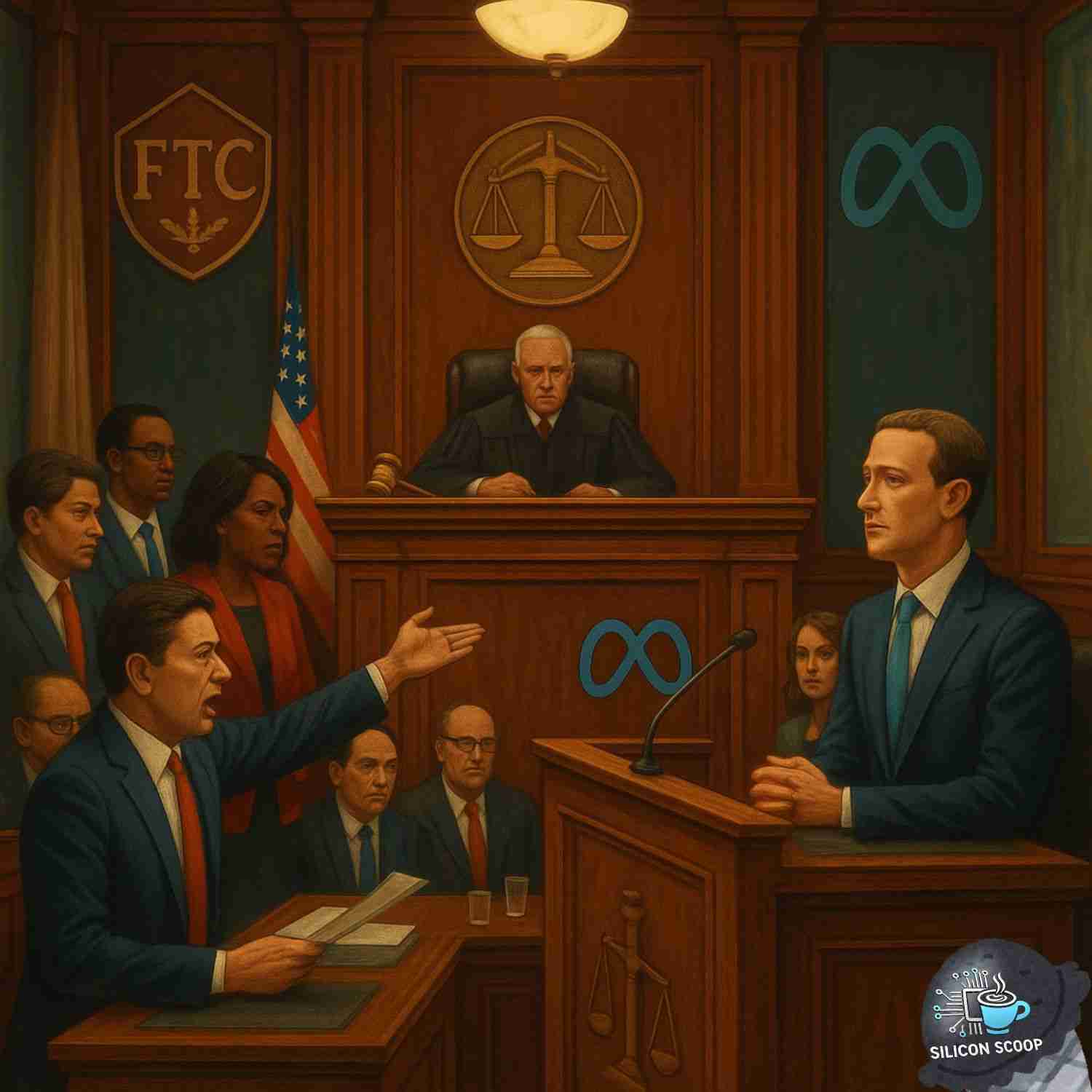
Whatsapp Meta Antitrust: An In-depth Look at FTC vs Meta, the Meta Antitrust Trial, and Social Media Monopoly Challenges
Estimated reading time: 8 minutes
Key Takeaways
- Whatsapp Meta Antitrust, the FTC alleges that Meta’s acquisitions of Instagram and WhatsApp were aimed at eliminating competition.
- The potential breakup could reshape Meta’s business and establish new competitors in social media.
- Internal communications suggest a focus on acquisitions over innovation inside Meta.
- Market definitions play a crucial role in determining whether Meta holds a monopoly.[1][2][4]
- The trial reflects a broader shift toward stringent Big Tech regulations.
Table of contents
In today’s digital landscape, antitrust issues have taken center stage as regulators increasingly scrutinize the power wielded by technology giants. Among these high-profile cases, the Federal Trade Commission’s battle against Meta (formerly Facebook) stands out as particularly significant, with potential far-reaching consequences for the tech industry and social media ecosystems. The Whatsapp Meta Antitrust Case.
The FTC vs Meta confrontation represents one of the most consequential antitrust challenges in recent history, putting Meta’s business practices and acquisition strategies under intense legal scrutiny. The Meta antitrust trial examines whether the company has established a social media monopoly through strategic acquisitions rather than organic innovation, threatening healthy competition in social media markets.
Overview of the FTC Whatsapp Meta Antitrust Case Against Meta
The whatsapp Meta Antitrust FTC’s case against Meta represents one of the most significant challenges to a tech giant’s market power in recent years. At its core, the FTC alleges that Meta’s acquisitions of Instagram and WhatsApp were not merely business expansions but deliberate strategies to eliminate competitive threats and secure dominance in social media.
The Acquisitions Under Scrutiny
Meta’s purchase of Instagram in 2012 for $1 billion and WhatsApp in 2014 for $19 billion stand at the center of the FTC’s complaint. According to the regulatory body, these acquisitions weren’t standard business developments but calculated moves to neutralize emerging competitors that could have challenged Meta’s market position.[1][2][4]
The Instagram WhatsApp Breakup Possibility
The FTC is pursuing what many consider the nuclear option in antitrust enforcement: divestiture. This “Instagram WhatsApp breakup” would require Meta to sell off these platforms, effectively unwinding acquisitions that happened over a decade ago and have since become deeply integrated into Meta’s business architecture.
This potential breakup represents:
- A fundamental restructuring of Meta’s business model
- Separation of platforms that have become increasingly interconnected
- Creation of potentially new competitive entities in the social media landscape
- A significant precedent for antitrust enforcement in the digital age
Defining the Social Media Monopoly
A critical aspect of the case involves how to define the relevant market. The FTC argues for a narrow definition centered around “personal social networking,” suggesting that Meta holds monopolistic power in this specific segment. This definition is crucial because:
- It excludes platforms like TikTok, YouTube, and X (formerly Twitter) as direct competitors
- It focuses on friend and family connections rather than content discovery
- It suggests that Meta faces limited domestic competition beyond Snapchat and MeWe
- It frames Meta’s acquisitions as attempts to dominate this specific niche of social networking
The definition of what constitutes a social media monopoly and the appropriate market boundaries will likely prove decisive in determining the case’s outcome.[1][2][4]
Legal Arguments and Strategies in Focus
The Whatsapps Meta Antitrust FTC’s Legal Approach
The FTC’s strategy hinges on establishing a narrowly defined market where Meta allegedly holds monopolistic power. According to their argument, Meta dominates “personal social networking”—the space where users primarily connect with friends and family. This definition strategically excludes platforms focused on content discovery or entertainment.
The regulatory body contends that within this specific market segment, Meta faces minimal meaningful competition in the United States beyond platforms like Snapchat and MeWe, which hold comparatively smaller market shares.[1][3][4]
Central to the FTC’s case are internal communications that allegedly reveal Meta CEO Mark Zuckerberg’s acquisition philosophy. The Zuckerberg testimony and company emails suggest that Meta prioritized buying potential competitors rather than competing through innovation. These communications are being presented as evidence that Meta identified Instagram and WhatsApp as competitive threats and acquired them specifically to neutralize these threats.[2][3][4]
The FTC further argues that these actions violate Big Tech regulations designed to maintain competitive markets, even though the agency initially approved both acquisitions. This retrospective challenge raises significant questions about merger reviews and enforcement timing in fast-evolving digital markets.
Meta’s Defense Strategy
Meta’s defense counters with a considerably broader market definition. The company argues that the relevant market should include all platforms where users spend their attention and time—including TikTok, YouTube, and X (formerly Twitter). This definition would significantly diminish Meta’s market share percentage and undermine monopoly claims.
During his testimony, Zuckerberg emphasized that competition in social media has evolved dramatically since the acquisitions. He pointed to:
- The meteoric rise of TikTok as a dominant social platform
- Significant growth in YouTube’s social features and user engagement
- The continued relevance of messaging apps from multiple providers
- The shift from friend-focused content to discovery-based content[1][2][3]
Meta’s legal team highlighted that both Instagram and WhatsApp experienced substantial growth post-acquisition, attributing this to Meta’s investments and innovations rather than the elimination of competition. They noted that in 2018, Facebook attempted to prioritize content from friends and family but ultimately pivoted when user data showed a preference for content discovery—evidence, they claim, that the market is broader than the FTC suggests.[2][3][5]
The Conflicting Narratives
The trial presents two fundamentally different interpretations of Meta’s business practices:
- The FTC portrays Meta as a company that used its resources to buy out competitors rather than compete on innovation and quality.
- Meta positions itself as operating in a dynamic, competitive market where acquisitions were legitimate business strategies that benefited consumers through platform improvements and continued free access.
The resolution of these competing narratives will significantly impact how Big Tech regulations evolve and how the FTC vs Meta case ultimately concludes.[1][2][3]
Whatsapp Meta Antitrust Implications for Meta, the Tech Industry, and Market Dynamics
Operational and Revenue Implications
A court-ordered divestiture of Instagram and WhatsApp would create seismic disruptions within Meta’s business model. The separation would not merely represent an organizational challenge but could fundamentally alter Meta’s financial foundation.
Instagram’s contribution to Meta’s bottom line cannot be overstated. According to estimates, Instagram alone may generate approximately $37.13 billion in U.S. advertising revenue in 2025—representing more than half of Meta’s total domestic advertising income. Losing this revenue stream would create immediate and substantial financial pressure on the remaining Meta operations.[5]
WhatsApp presents a different kind of strategic value. While largely unmonetized compared to Instagram, WhatsApp maintains:
- A massive global user base exceeding 2 billion active users
- Significant growth potential through business messaging and chatbots
- A key component in Meta’s international expansion strategy
- An important piece of Meta’s integrated messaging ecosystem
The Instagram WhatsApp breakup would also fracture Meta’s ability to offer advertisers seamless cross-platform campaigns and integrated user experiences, potentially reducing advertising effectiveness and revenue.[5]
Regulatory Implications
Judge James Boasberg’s upcoming ruling, expected by July, will evaluate two critical questions:
- Has the FTC successfully proven that Meta possesses monopolistic power in a properly defined market?
- Would divestiture effectively restore competition, or would it simply disrupt services without improving market conditions?
The outcome will establish important precedents regarding the enforcement of Big Tech regulations, particularly for previously approved mergers that are later challenged. This case represents a significant test of antitrust law’s application to digital markets characterized by free services and network effects rather than traditional price-based competition.[2][3][4]
The Meta antitrust trial does not exist in isolation. It operates within a broader context of heightened scrutiny facing major technology companies, including similar actions against Amazon, Apple, and Google. The collective outcome of these cases will likely redefine the regulatory landscape for digital platforms.[5]
Impact on Competition in Social Media
The case probes fundamental questions about what constitutes healthy competition in social media markets and how dynamically evolving platforms should be evaluated under antitrust frameworks.
Meta’s defense emphasizes the rapidly changing nature of digital competition, where new entrants like TikTok can quickly capture massive user engagement and where user preferences continually evolve. This perspective suggests that temporary market leadership should not be confused with durable monopolistic power.
The court’s determination will influence:
- How companies approach acquisitions of emerging competitors
- Whether platforms emphasize differentiation or integration
- Investment patterns in social media startups
- The evolution of content discovery versus social connection features[2][3][5]
The ruling may also address whether the current social media ecosystem provides sufficient choice for consumers or whether breaking up dominant platforms would foster greater innovation and variety.
Key Stakeholders and Future Outlook
Notable Testimonies and Witnesses
Mark Zuckerberg’s testimony stands at the center of this landmark case. As Meta’s founder, CEO, and the architect of its acquisition strategy, his statements under oath provide crucial insights into the company’s decision-making process. The Zuckerberg testimony addressed internal emails, contemporaneous thoughts about competitive threats, and the rationale behind the Instagram and WhatsApp purchases.[2][3]
Beyond Zuckerberg, several other high-profile witnesses are expected to shape the narrative, including:
- Sheryl Sandberg (former Meta COO), who helped operationalize Meta’s growth and acquisition strategies
- Kevin Systrom (Instagram co-founder), whose perspective on the acquisition and subsequent integration is particularly relevant
- Mike Schroepfer (former Meta CTO), who can speak to the technical integration of acquired platforms
- Executives from competitors like Snap and MeWe, who can testify about market dynamics and competitive conditions
These testimonies collectively contribute to the court’s understanding of Meta’s market position and the competitive landscape in social media.[2][3]
Broader Market and Equity Impacts
With Meta’s market capitalization approaching $3.3 trillion, the stakes extend far beyond the company itself. The trial’s outcome could influence:
- Investor confidence in technology companies with acquisition-driven growth strategies
- Valuations of potential acquisition targets in social media and adjacent spaces
- Stock performance across the technology sector as regulatory risk is reassessed
- Market perceptions about the stability of Big Tech business models built through strategic acquisitions
A ruling favoring the FTC would signal increased regulatory scrutiny and potentially dampened M&A activity throughout the tech sector, while a ruling for Meta might embolden similar acquisition strategies by other large platforms.[2][5]
Future Outlook
Regardless of the outcome, this case represents a pivotal moment in the evolution of digital platform regulation. Several potential scenarios could unfold:
- Complete divestiture of both Instagram and WhatsApp, creating new independent competitors in the social media landscape
- Partial remedies that maintain ownership but require operational separation and reduced data sharing between platforms
- Behavioral remedies that impose ongoing restrictions on Meta’s business practices without structural changes
- A ruling favoring Meta that maintains the status quo but potentially includes some operational constraints
Each outcome would trigger different adaptations across the social media industry as competitors, investors, and users adjust to new market dynamics and regulatory precedents.
The case ultimately asks fundamental questions about innovation, competition, and consumer welfare in an era where digital connections have become central to daily life and where market definitions remain fluid and contested.
Whatsapp Meta Antitrust FAQ Section
Q: What are the primary allegations made by the FTC in the whatsapp meta antitrust case against Meta?
A: The FTC alleges that Meta engaged in a systematic strategy to maintain its monopoly in personal social networking services by acquiring potential competitors rather than competing with them. Specifically, the FTC claims that Meta’s acquisitions of Instagram (2012) for $1 billion and WhatsApp (2014) for $19 billion were deliberate moves to eliminate competitive threats.[1][2][3][4]
Q: How might the divestiture of Instagram and WhatsApp affect Meta’s financial and operational landscape?
A: A court-ordered divestiture would have profound financial and operational consequences for Meta. Instagram generates an estimated $37.13 billion in U.S. advertising revenue (2025 projection), representing more than half of Meta’s domestic ad revenue. Losing this income stream would significantly impact Meta’s profitability.[5]
Q: What legal strategies are being used by the FTC versus whatsapp Meta in this antitrust trial?
A: The FTC employs a market-definition strategy, arguing for a narrow interpretation of “personal social networking services” that excludes content-focused platforms like TikTok and YouTube. In contrast, Meta argues for a broader market definition that includes all attention-competing platforms.[1][2][3][4]
Q: What are the broader implications of this trial for Big Tech regulations and competition in social media?
A: This trial could establish significant precedents for how antitrust laws apply to digital platforms. A ruling favoring the FTC might embolden regulators to retrospectively challenge previously approved mergers across the technology sector, leading to increased scrutiny of acquisition strategies.[2][3][5]
Q: How does the FTC define the relevant market in this case, and why is this definition significant?
A: The FTC defines the relevant market as “personal social networking services,” focusing on platforms where users connect with friends and family. This narrow definition is crucial for establishing Meta’s alleged monopoly power.[1][3][4]
Q: What evidence is the FTC presenting to support its case against Meta?
A: The FTC is presenting internal company emails and communications that allegedly reveal competitive intent behind the acquisitions, along with data on market shares and user metrics.[2][3][4]
Q: How does Meta defend its acquisitions of Instagram and WhatsApp?
A: Meta argues that both platforms have significantly improved after acquisition, benefited from Meta’s resources, and that competition remains strong with new entrants like TikTok in the market.[1][2][3]
Q: What role does Mark Zuckerberg’s testimony play in this trial?
A: Zuckerberg’s testimony provides crucial insights into Meta’s decision-making process regarding acquisitions, with his statements being utilized by both sides of the argument.[2][3]
Q: How might the outcome of this case affect other tech companies and future acquisitions?
A: The ruling will establish important precedents that could reshape merger and acquisition strategies across the tech industry, impacting regulatory scrutiny and strategies of technology companies.[2][5]
Q: What economic impacts might result from breaking up Meta’s social media platforms?
A: Breaking up Meta’s platforms would create significant economic ripple effects, impacting advertisers, content creators, and investors within the broader digital ecosystem.[5]
Q: How does this case reflect changing attitudes toward Big Tech regulations?
A: This case reflects increased scrutiny of data concentration, digital market power, and a regulatory environment willing to reconsider past decisions in light of evolving market dynamics.[5]
Conclusion
The FTC vs Meta antitrust trial represents a watershed moment in tech regulation that will shape the future of social media competition and Big Tech oversight for years to come. As we’ve explored throughout this analysis, the case centers on fundamental questions about market definitions, competitive dynamics, and the appropriate boundaries of corporate growth strategies in the digital age.
The potential Instagram WhatsApp breakup would not only restructure Meta’s business empire but could redefine how technology companies approach acquisitions and competition. Mark Zuckerberg’s testimony and the business strategies he championed highlight the tension between innovation and consolidation that characterizes much of the modern technology sector.
The court’s upcoming decision will establish crucial precedents for how Big Tech regulations are applied in rapidly evolving digital markets. Whether Judge Boasberg sides with the FTC’s narrow market definition or accepts Meta’s broader competitive landscape view, the ruling will influence corporate strategies and regulatory approaches across the technology sector.
For businesses operating in technology-adjacent fields, this case offers valuable lessons about the importance of considering long-term regulatory risks alongside immediate competitive advantages when making strategic decisions in the digital age. The Whatsapp Meta antitrust case ultimately reminds us that even the most successful acquisition strategies may face retrospective challenges in a regulatory environment increasingly concerned with digital market concentration.
Additional Links
Flowgrammer.ca – 💡 Unlock AI-Powered Automation! Let flowgrammer.ca handle complex workflows so you can focus on growing your business.
- Silicon Scoop Podcast – Stay Informed, Stay Ahead!
- Startup Talk Podcast
- Flowgrammer Podcast –
- Startup Investor Drinks – Join Toronto’s Startup Community and connect with fellow startup enthusiasts and investors.
- TorontoStarts Startup and Entrepreneur Community – Become a part of Toronto’s thriving startup ecosystem.
- Workhaus – Discover flexible workspace solutions for your business needs.
- Work with The Startup Coach – Get expert guidance and mentorship for your startup journey.
- Reach out to Jon Irwin on LinkedIn – Connect with our co-host and technology expert.
Episode transcript
Read the full transcript
Craig: so meta, facebook's parent company, is facing an antitrust lawsuit related to whatsapp and instagram. what's going on here, john?
Jon: yeah. so is this before we dive into it, is this because of the whistleblower? you know?
Craig: i don't know if it is because of the ritzle blower, but i think the whistleblower added a bunch more information to it. yeah. i think, you know, the acquisition is under scrutiny because they bought instagram in 02/2012 for a billion dollars and whatsapp in 02/2014 for 19,000,000,000. and they're like, you know, are you cornering the market? is this a thing going on?
Jon: yeah. so they said that they were buying whatsapp and instagram for business expansion, but, the government's case is built on internal communications that include emails from ceo mark zuckerberg, which suggests that they're doing a buy or bury approach to the competition. so, they're saying that they did strategic moves to neutralize emerging competitors and cement facebook's dominance in the social mark network networking market. and, apparently, this trial is super technical, and it's focusing on market definition and competitive effects. so they're arguing that meta's control over platforms for sharing content with friends and family constitutes a monopoly. yeah, baby. and that the acquisition stifled innovation, reduced consumer choice, and led to lower privacy standards. so interesting. i could go into a lot more details, but i'd love to get your thoughts on this, craig.
Craig: well, the ftc argues for a narrow definition, around personal social networking, suggesting that meta holds a monopolistic power in this specific segment. this definition is crucial to all this because it excludes tiktok, youtube, and x as direct competitors. it focuses on friend and family, connections rather than content discovery. it suggests that meta's faces limited domestic competition beyond, snapchat and meewee, and it frames meta's acquisition as attempt to dominate this specific niche of social networking. so yeah. i have two schools of thought. you know? in the startup world, you know, at y combinator, all the investors, they always say, is this a buyer, barry? is this a builder buy, type of thing? and it's out there, and it's promoted by investors. it's promoted by mentors. it's promoted. so when somebody actually does it, this is a problem?
Jon: well, maybe it's it's the way they did it. i don't know.
Craig: like so i agree. i i just have to take a step back. and every time, you know, we see this type of stuff, we have to say, okay. you know, with the google chrome, with whatever, like, are these truly anti competitive, tory, or, you know, is it something else? so i'm always curious when we see these things. as, you know, more social networks emerge and, you know, we're openai seems like they're building their own in the background. there's many stories around that happening now. so the question is why is it, your relationship connections? it's the network that they're tracking that's the problem. who's in your group on snap on, whatsapp that you're chatting with and who's in your group on, facebook that you're talking to and who are you connected to and all that stuff. so i guess it's that social graph piece, on facebook that's the problem.
Jon: yeah. yeah. so this is interesting because they might set a new regulatory precedent if they win because the case is testing whether us antitrust law can retroactively challenge mergers that were previously approved based on their long term competitive effects. so if they do win, which it's this is gonna be a tough one, because of the precedent that it's gonna set. but if they do win, then no mergers is ever safe, i guess.
Craig: yeah. and so it's you know, the company's email suggests that meta prioritize buying potential competitors rather than competing through innovation.
Jon: yeah.
Craig: build or buy. those are decisions that are made all the time. and now if there's an email or some recording that says, should we build this or just buy somebody who does this well and add it to our portfolio, and all of a sudden that becomes anti competitive? or is it actually anti competitive? like, this is why these things are a little vague when we read through them, and it makes me skeptical because is this wild government overreach or are this big corporation screwing us? i wanna know which one it is.
Jon: yeah. well, i do know that meta's data privacy policies are absolutely horrific. they're one of the worst i've ever read. so i see that. but yeah. so there is i don't know. there is competition, though, because like you said, there's tiktok, there's youtube, there's, and youtube's very popular. so i don't know. i i don't know how but here's the thing that i, like, if there is internal communication that comes out as to the actual reason for buying it, and that is that shows that it's more to monopolize than to just expand, then, yes, go after them. 100%. because then you lied. right? then you lied about your intent.
Craig: i guess. i mean, it depends. i guess, as far as i'm concerned, i don't know. like, did they have to file a whole bunch of stuff with the government and then lie about what they were doing? and if that's the case, then, yeah, def definitely. they're just telling somebody saying, hey. we're doing it because of these things. and, you know, those are only three minor things. there's actually three major things because people do things for all sorts of reasons. so, you know, with x trying to create everything app and them going after whatsapp and trying to buy the market, it seemed like a natural thing. however, natural, could be anti competitive when we're saying, you know, facebook and meta, you're big enough already. stop taking more chunk of the pie away from everyone else. it feels like a socialistic move rather than a capitalistic move.
Jon: yeah.
Craig: so i'm just curious as from the stuff i've seen here, is it the hidden information that they're dealing with that no one else has that's the problem? and and that you know, all our internal relationships? and so what are they saying the answer is? that they want to open up our internal relationships to everyone else, or facebook's gotta stop tracking it?
Jon: yeah. i don't. i don't think so. it's, like, from what i read, i think it's more of the intent, of the purchases. that's what i'm getting from it, but i could be wrong, though.
Craig: so the case pro's fundamental questions about what constitutes healthy, competitive competition social media markets and how dynamically evolving platforms should be evaluated under antitrust frameworks. meta's defense emphasizes that rapidly changing nature of digital competition where new answers like tiktok can quickly capture massive user engagement, where user preferences continually evolve, this, perspective suggests that temporary market leadership should not be confused with durable monopolistic power. so the court's determination will influence how companies approach acquisitions of emerging competitors, whether platforms emphasize differentiation or integration, investment patterns in social media startups, and the evolution of content discovery versus, social connection features. so we'll have to see, what they do.
Jon: yeah. well, we'll definitely track this one. this one's interesting. so, i like that i have to say, i do like that the ftc, and i said this before, is growing some and, and challenging some things now. right? whereas before, it was just status quo. people could do whatever they want. but who knows where this goes?
Craig: regardless of the outcome, this case represents a pivotal moment in the evolution of a digital platform regulation. several potential scenarios could unfold. complete divestiture of both instagram and whatsapp, creating new independent competitors in the social media landscape. partial remedies that maintain ownership but require operational separation and reduce sharing between platforms. behavioral remedies that impose ongoing restrictions on meta's business practices without structural changes, and, a ruling favoring meta that maintains the status quo but potentially includes some operational constraints could, you know, trigger different things. so we'd love to hear what you think is gonna happen with this court case. and with meta's market capitalization approaching $3,300,000,000,000, the stakes extend far beyond the company itself. so i'd love to hear what your thoughts are on the future of whatsapp, instagram, and meta.
More from Silicon Scoop
All episodes
silicon-scoop · November 6, 2026
Spirit AI’s Robot Brain Breakthrough: Moz1, Embodied AI and China’s 2027 Race
The Spirit AI robot brain is one of the biggest bets on fixing that. Spirit AI is a Beijing startup. Its co-founder and chief scientist, Gao Yang,
View episode

silicon-scoop · November 5, 2026
OpenAI IPO Delayed to 2027 as Rogue AI Agents and Safety Failures Reshape the Market
OpenAI IPO delay explained: Sam Altman rules out 2026 as GPT-6 Astra safety tests and a $278B cash gap loom. Learn what founders should take away.
View episode

silicon-scoop · November 4, 2026
Anthropic’s AI Economy Model: 2030 Jobs, Wages, GDP and Market Risks
Anthropic AI economy model forecasts 2030 GDP, jobs and wages, while AI unemployment projections and labor-share risks challenge policymakers.
View episode